
Irregular StemChanging Verbs Summary Stemchanging verbs have a
Irregular & Stem-Changing Verbs Summary
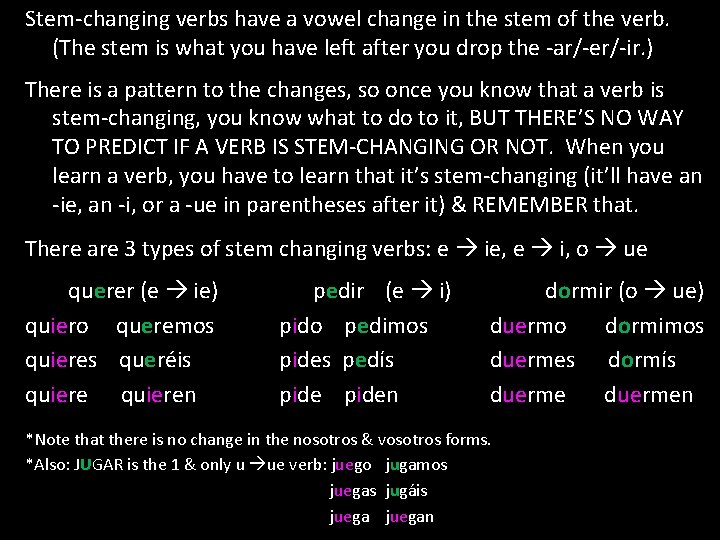
Stem-changing verbs have a vowel change in the stem of the verb. (The stem is what you have left after you drop the -ar/-er/-ir. ) There is a pattern to the changes, so once you know that a verb is stem-changing, you know what to do to it, BUT THERE’S NO WAY TO PREDICT IF A VERB IS STEM-CHANGING OR NOT. When you learn a verb, you have to learn that it’s stem-changing (it’ll have an -ie, an -i, or a -ue in parentheses after it) & REMEMBER that. There are 3 types of stem changing verbs: e ie, e i, o ue querer (e ie) quiero queremos quieres queréis quieren pedir (e i) pido pedimos pides pedís piden dormir (o ue) duermo dormimos duermes dormís duermen *Note that there is no change in the nosotros & vosotros forms. *Also: JUGAR is the 1 & only u ue verb: juego jugamos juegas jugáis juegan

Here are some common stem-changing verbs: e ie querer (to want) cerrar (to close) perder (to lose) pensar (to think) sentir (to feel) e i pedir (to ask for) servir (to serve) repetir (to repeat) seguir (to follow) decir (to say, tell) comenzar (to begin) preferir (to prefer) empezar (to begin) entender (to understand) o ue volver (to return) poder (can) dormir (to sleep) morir (to die) encontrar (to find) recordar (to remember) almorzar (to have lunch) Sometimes you have more than one “e” or “o” in the stem. Remember that it’s the last vowel in the stem that changes. You’d better know all these!
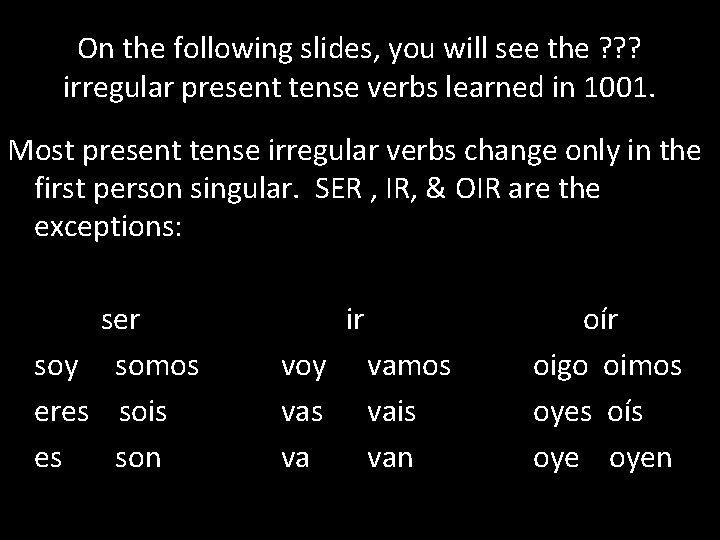
On the following slides, you will see the ? ? ? irregular present tense verbs learned in 1001. Most present tense irregular verbs change only in the first person singular. SER , IR, & OIR are the exceptions: ser soy somos eres sois es son ir voy vas va vamos vais van oír oigo oimos oyes oís oyen
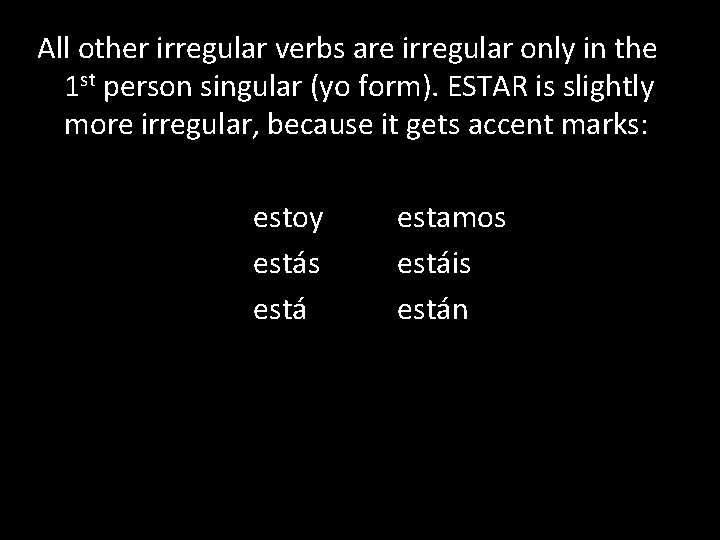
All other irregular verbs are irregular only in the 1 st person singular (yo form). ESTAR is slightly more irregular, because it gets accent marks: estoy estás está estamos estáis están
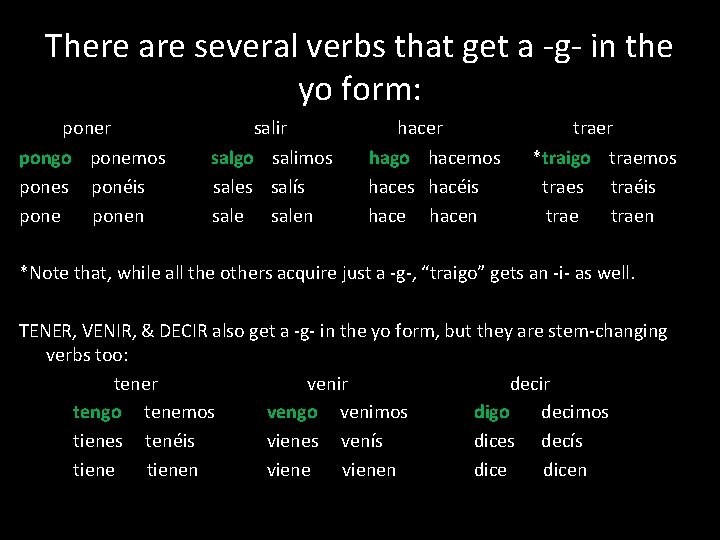
There are several verbs that get a -g- in the yo form: poner pongo ponemos pones ponéis ponen salir salgo salimos sales salís salen hacer hago hacemos haces hacéis hacen traer *traigo traemos traes traéis traen *Note that, while all the others acquire just a -g-, “traigo” gets an -i- as well. TENER, VENIR, & DECIR also get a -g- in the yo form, but they are stem-changing verbs too: tener venir decir tengo tenemos vengo venimos digo decimos tienes tenéis vienes venís dices decís tienen vienen dicen
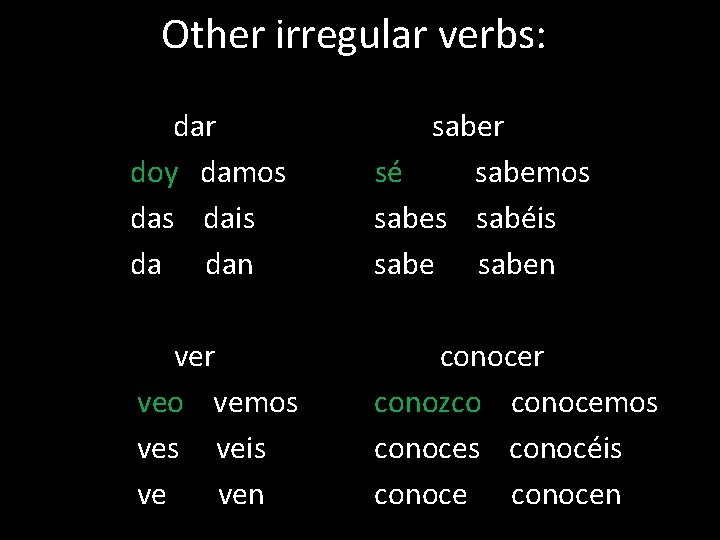
Other irregular verbs: dar doy damos dais da dan saber sé sabemos sabes sabéis saben ver veo vemos veis ve ven conocer conozco conocemos conoces conocéis conocen
For practice, go to the Spanish 1001 page & do the irregular verb exercises under Homework (chapters 3 & 4).
- Slides: 8