
Irradiation and Structural Analysis Capabilities at Brookhaven National
Irradiation and Structural Analysis Capabilities at Brookhaven National Laboratory: A synergistic model of beam irradiation and synchrotron light source characterization to bridge the micro-macro characterization gap of radiation effects and damage C. Cutler, D. Kim, D. Medvedev, M. Palmer*, N. Simos
Nuclear (and other) Material Studies at BNL At a glance: • Intense proton beam effects on target materials and beam windows • 24 Ge. V protons at AGS • Radiation damage effects on particle accelerator materials and systems • Targets, beam windows and collimators • Radiation damage effects on reactor materials • • • Graphites, Carbon-fiber and Si. C/Si. C composites, Be, W, Ta, Mo Super-alloys (super-Invar, Gum metal, Ti 6 Al 4 V) Dispersion strengthened Cu (fusion, LHC) Nano-precipitated steels Nano-structured coatings on reactor steels Molten-salt/material interfaces (Inconel, Steels) • Radiation effects on detectors and exotic systems • • Rare earth magnets (synchrotron undulators) CZT crystals Si. O 2 fibers Ferrofluids 2

Nuclear Materials and Synchrotron Radiation Relationship Advanced Reactor Concepts N. Simos, “Composite Materials under Extreme Radiation and Temperature Environments of the Next Generation Nuclear Reactors", Composite Materials, Intech Publishers, ISBN 978 -953 -307 -1098 -3, 2011 3
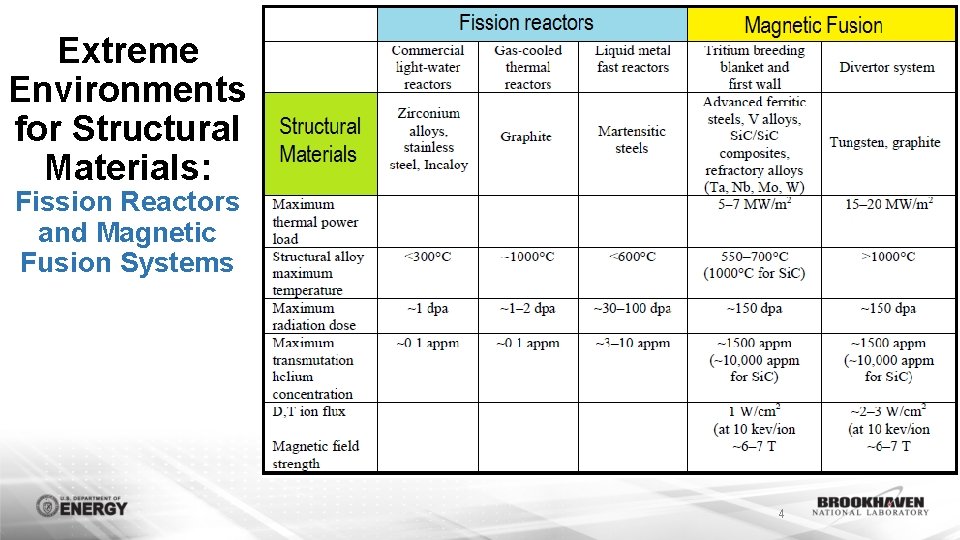
Extreme Environments for Structural Materials: Fission Reactors and Magnetic Fusion Systems 4
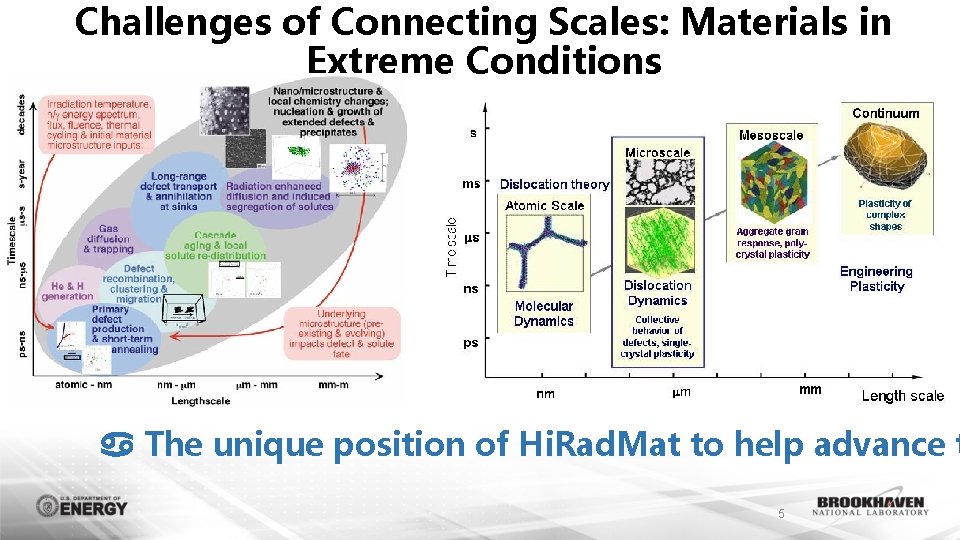
Challenges of Connecting Scales: Materials in Extreme Conditions a The unique position of Hi. Rad. Mat to help advance t 5

Synergies with the BNL Accelerator Complex Collider Complex NSLS II Synergy ID 28 (XPD) 6
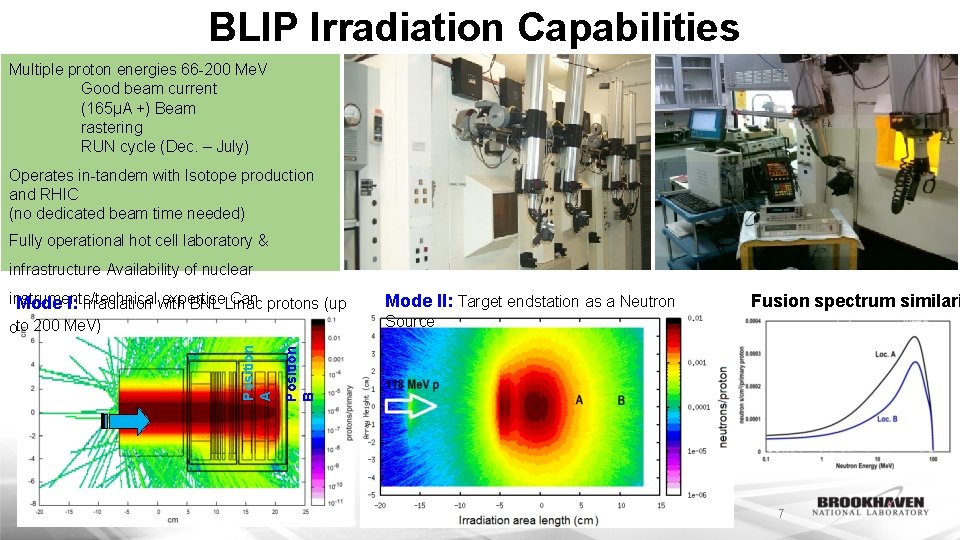
BLIP Irradiation Capabilities Multiple proton energies 66 -200 Me. V Good beam current (165µA +) Beam rastering RUN cycle (Dec. – July) Operates in-tandem with Isotope production and RHIC (no dedicated beam time needed) Fully operational hot cell laboratory & infrastructure Availability of nuclear Position B Position A instruments/technical expertise Can protons (up Mode I: Irradiation with BNL Linac to 200 Me. V) operate as neutron spallation source Mode II: Target endstation as a Neutron Fusion spectrum similari Source Beam 7
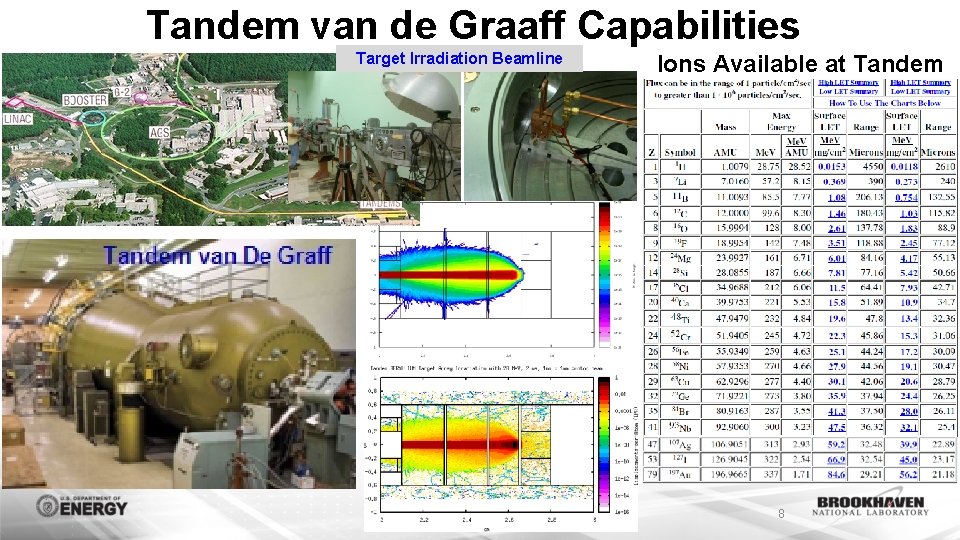
Tandem van de Graaff Capabilities Target Irradiation Beamline Ions Available at Tandem 8
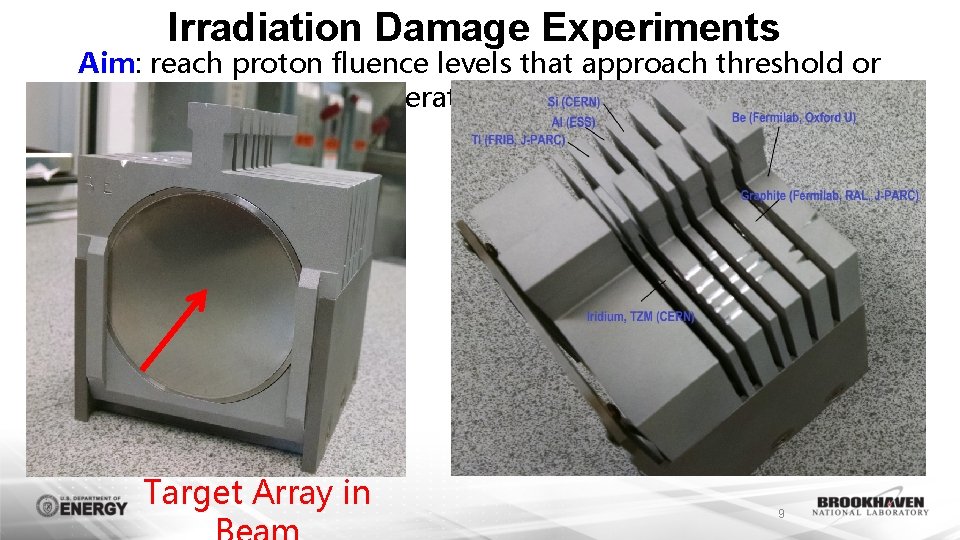
Irradiation Damage Experiments Aim: reach proton fluence levels that approach threshold or operational goal Target Array in 9
Nuclear Material Studies at BNL Radiation damage effects Linking macrostructure to radiation-induced lattice defects Focus on: • Gr, h-BN, Be • Super-alloys • Dispersion strengthened Cu (fusion, LHC) • Nano-precipitated steels 10
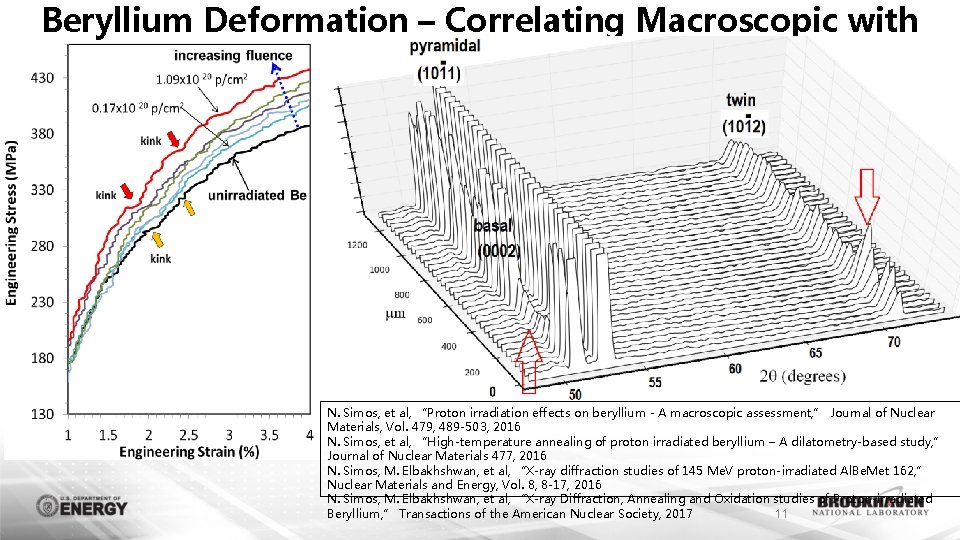
Beryllium Deformation – Correlating Macroscopic with Lattice Strain N. Simos, et al, “Proton irradiation effects on beryllium - A macroscopic assessment, ” Journal of Nuclear Materials, Vol. 479, 489 -503, 2016 N. Simos, et al, “High-temperature annealing of proton irradiated beryllium – A dilatometry-based study, ” Journal of Nuclear Materials 477, 2016 N. Simos, M. Elbakhshwan, et al, “X-ray diffraction studies of 145 Me. V proton-irradiated Al. Be. Met 162, ” Nuclear Materials and Energy, Vol. 8, 8 -17, 2016 N. Simos, M. Elbakhshwan, et al, “X-ray Diffraction, Annealing and Oxidation studies of Proton-irradiated Beryllium, ” Transactions of the American Nuclear Society, 2017 11

Graphite Irradiation Damage Studies Proton-neutron damage correlation with the help of NSLS-II Neutron Damage Proton Damage N. Simos, et al. , “Proton Irradiated Graphite Grades for a Long Baseline Neutrino Facility Experiment, ” Ph. Review Accelerators and Beams 20, 071002 2017 12
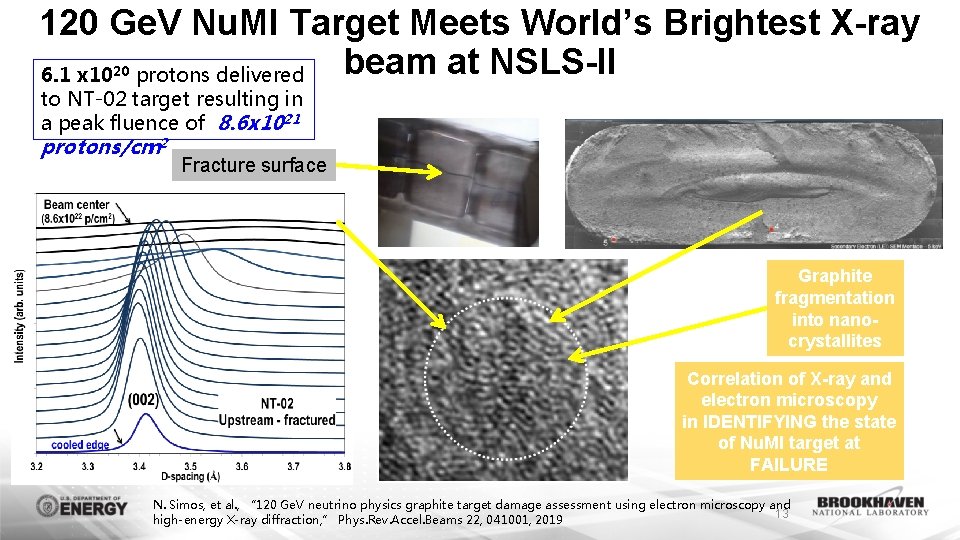
120 Ge. V Nu. MI Target Meets World’s Brightest X-ray beam at NSLS-II 6. 1 x 10 protons delivered 20 to NT-02 target resulting in a peak fluence of 8. 6 x 10²¹ protons/cm 2 Fracture surface Graphite fragmentation into nanocrystallites Correlation of X-ray and electron microscopy in IDENTIFYING the state of Nu. MI target at FAILURE N. Simos, et al. , “ 120 Ge. V neutrino physics graphite target damage assessment using electron microscopy and 13 high-energy X-ray diffraction, ” Phys. Rev. Accel. Beams 22, 041001, 2019
Using the BNL Accelerator Complex to Study Super-alloys & Novel Materials • The (α + β) Ti-6 Al-4 V alloy • Super-Invar • The β-titanium alloy Gum metal (Ti-21 Nb-0. 7 Ta-2. Zr-1. 2 O) Simos et al. , Multi-MW accelerator target material properties under proton irradiation at Brookhaven National Laboratory linear isotope producer, PHYSICAL REVIEW ACCELERATORS AND BEAMS 21, 053001 (2018) 14
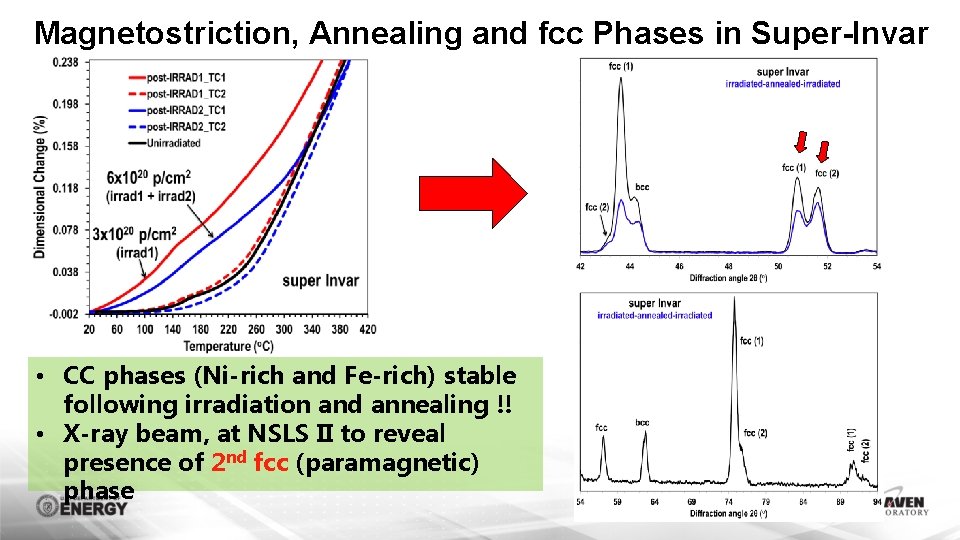
Magnetostriction, Annealing and fcc Phases in Super-Invar • CC phases (Ni-rich and Fe-rich) stable following irradiation and annealing !! • X-ray beam, at NSLS II to reveal presence of 2 nd fcc (paramagnetic) phase 15
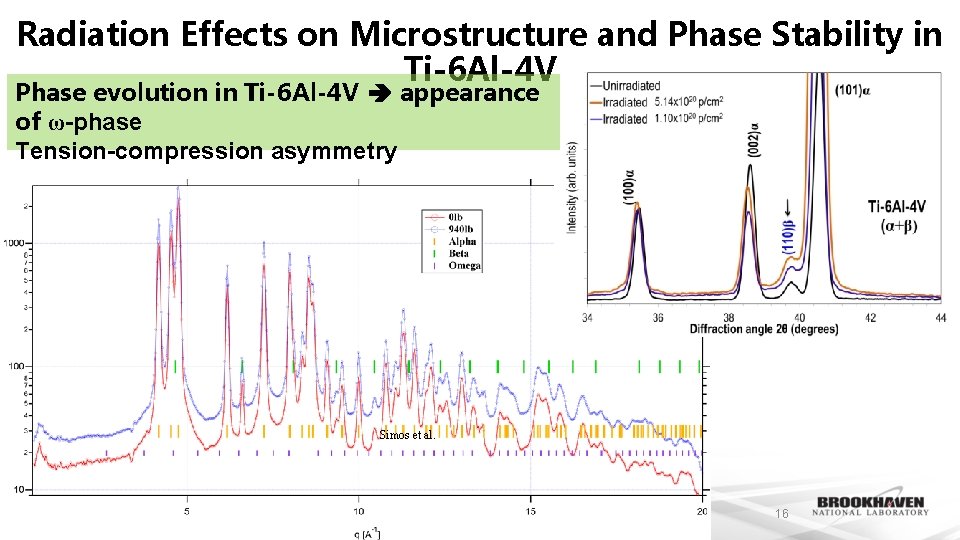
Radiation Effects on Microstructure and Phase Stability in Ti-6 Al-4 V Phase evolution in Ti-6 Al-4 V appearance of ω-phase Tension-compression asymmetry Simos et al. 16
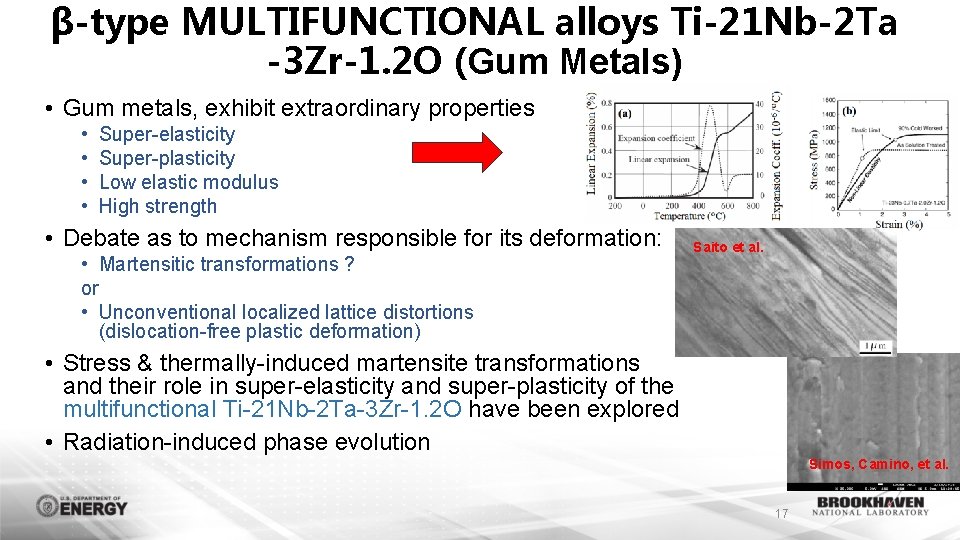
β-type MULTIFUNCTIONAL alloys Ti-21 Nb-2 Ta -3 Zr-1. 2 O (Gum Metals) • Gum metals, exhibit extraordinary properties • • Super-elasticity Super-plasticity Low elastic modulus High strength • Debate as to mechanism responsible for its deformation: • Martensitic transformations ? or • Unconventional localized lattice distortions (dislocation-free plastic deformation) Saito et al. • Stress & thermally-induced martensite transformations and their role in super-elasticity and super-plasticity of the multifunctional Ti-21 Nb-2 Ta-3 Zr-1. 2 O have been explored • Radiation-induced phase evolution Simos, Camino, et al. 17
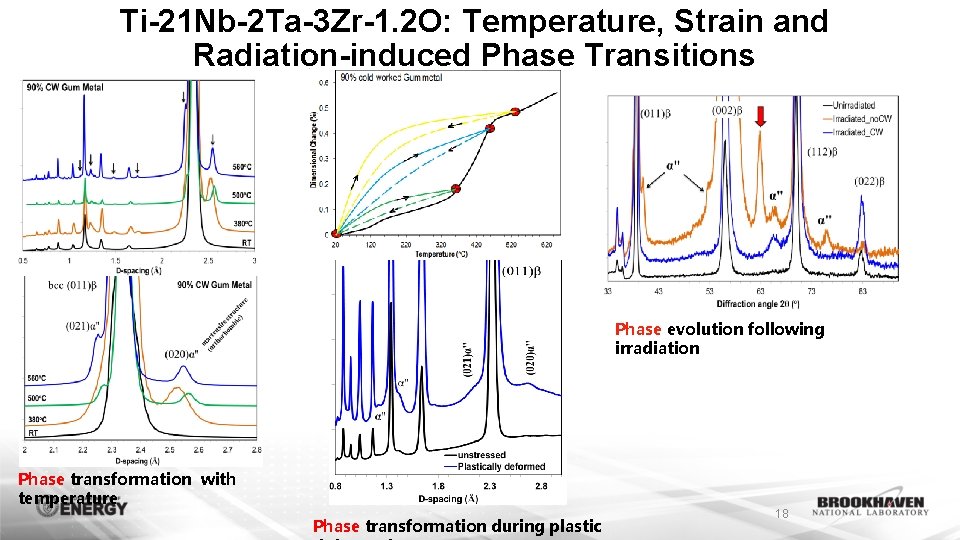
Ti-21 Nb-2 Ta-3 Zr-1. 2 O: Temperature, Strain and Radiation-induced Phase Transitions Phase evolution following irradiation Phase transformation with temperature Phase transformation during plastic 18
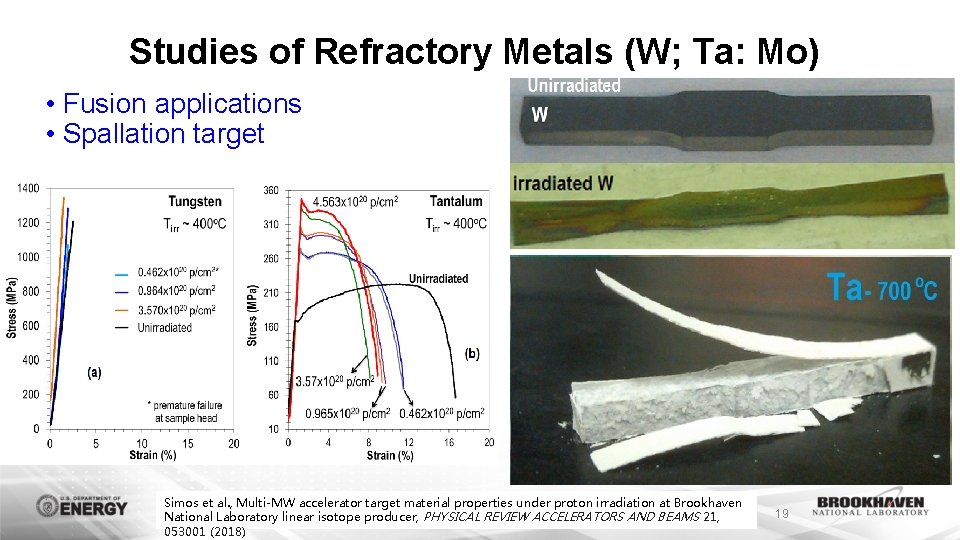
Studies of Refractory Metals (W; Ta: Mo) • Fusion applications • Spallation target Simos et al. , Multi-MW accelerator target material properties under proton irradiation at Brookhaven National Laboratory linear isotope producer, PHYSICAL REVIEW ACCELERATORS AND BEAMS 21, 053001 (2018) 19
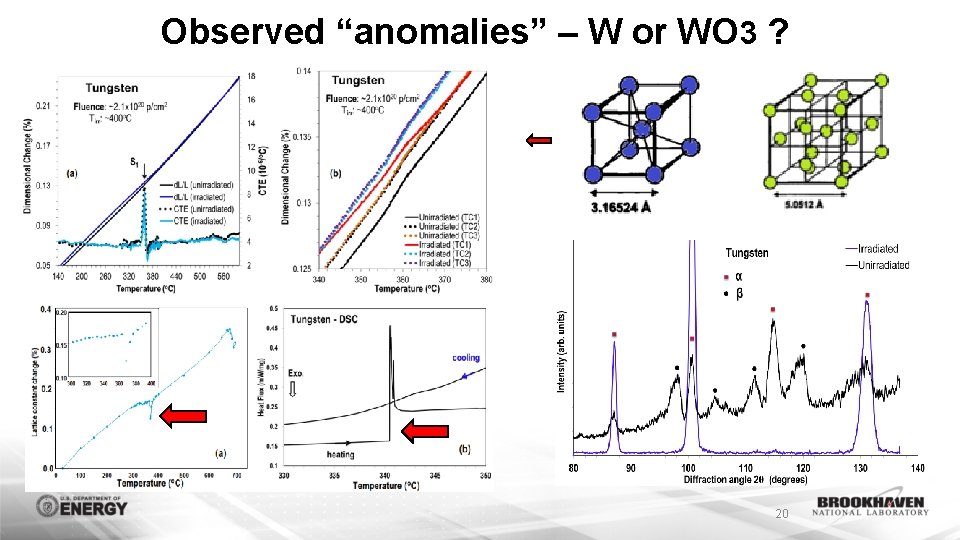
Observed “anomalies” – W or WO 3 ? 20
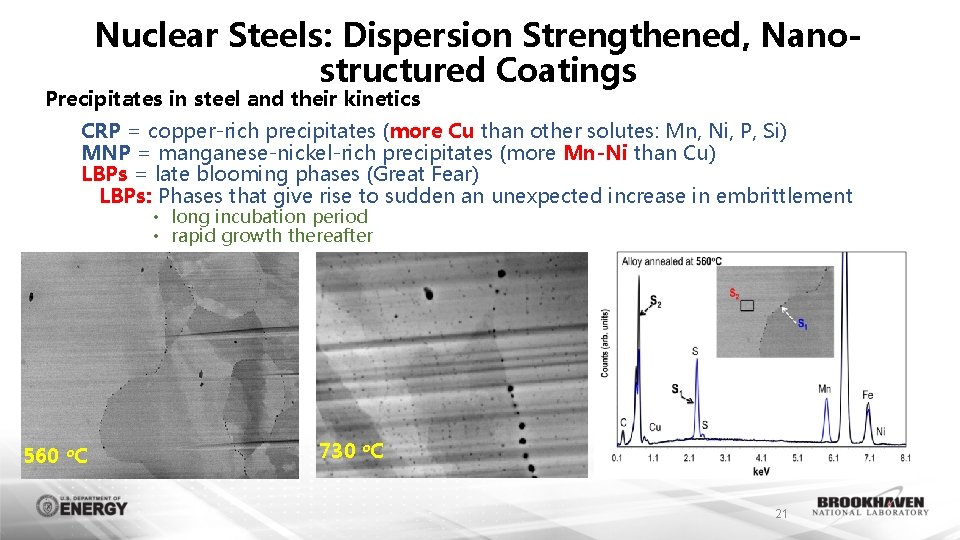
Nuclear Steels: Dispersion Strengthened, Nanostructured Coatings Precipitates in steel and their kinetics CRP = copper-rich precipitates (more Cu than other solutes: Mn, Ni, P, Si) MNP = manganese-nickel-rich precipitates (more Mn-Ni than Cu) LBPs = late blooming phases (Great Fear) LBPs: Phases that give rise to sudden an unexpected increase in embrittlement • long incubation period • rapid growth thereafter 560 o. C 730 o. C 21
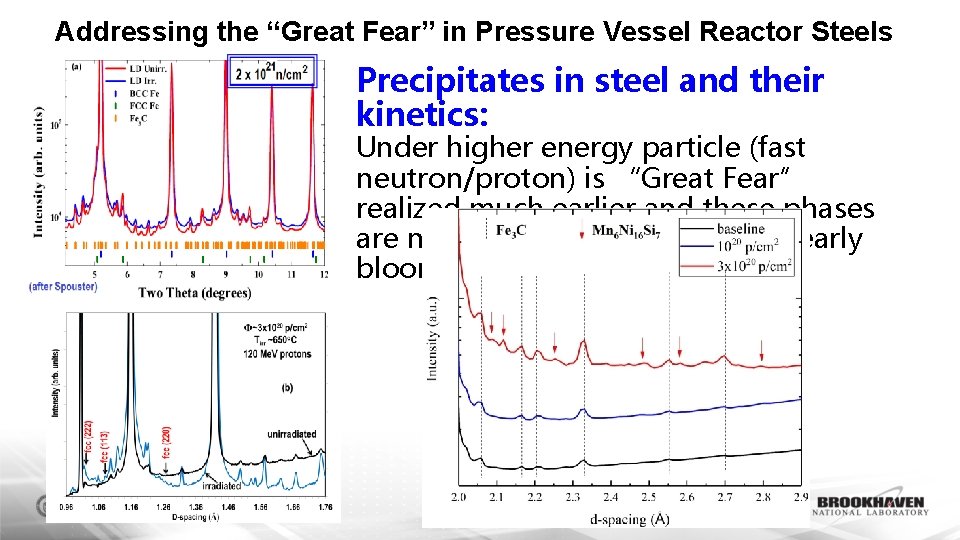
Addressing the “Great Fear” in Pressure Vessel Reactor Steels Precipitates in steel and their kinetics: Under higher energy particle (fast neutron/proton) is “Great Fear” realized much earlier and these phases are not late blooming but rather early blooming? 22
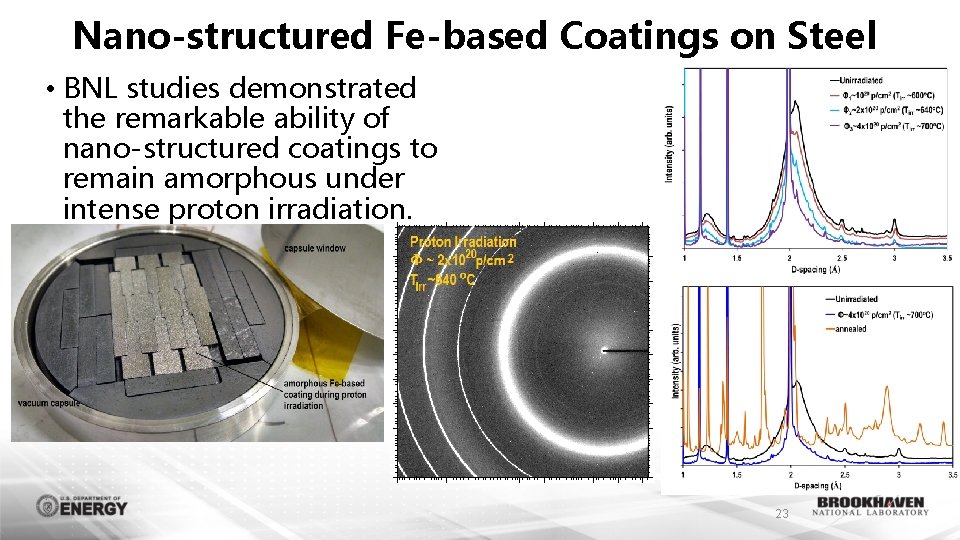
Nano-structured Fe-based Coatings on Steel • BNL studies demonstrated the remarkable ability of nano-structured coatings to remain amorphous under intense proton irradiation. 23
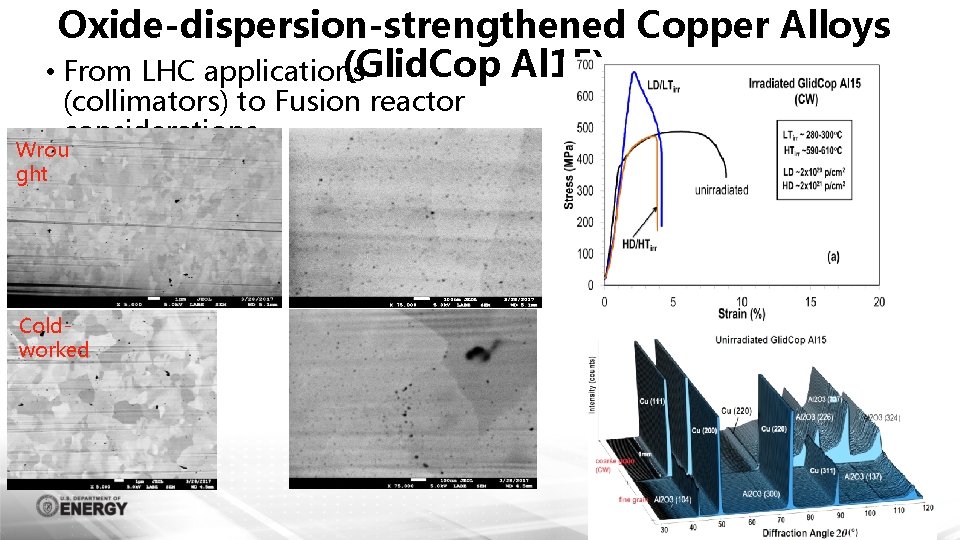
Oxide-dispersion-strengthened Copper Alloys (Glid. Cop Al 15) • From LHC applications (collimators) to Fusion reactor considerations Wrou ght Coldworked 24

Using BNL accelerator complex to study detector materials, etc. • Rare earth magnets • CZT crystals • Si. O 2 fibers • Ferrofluidics 25
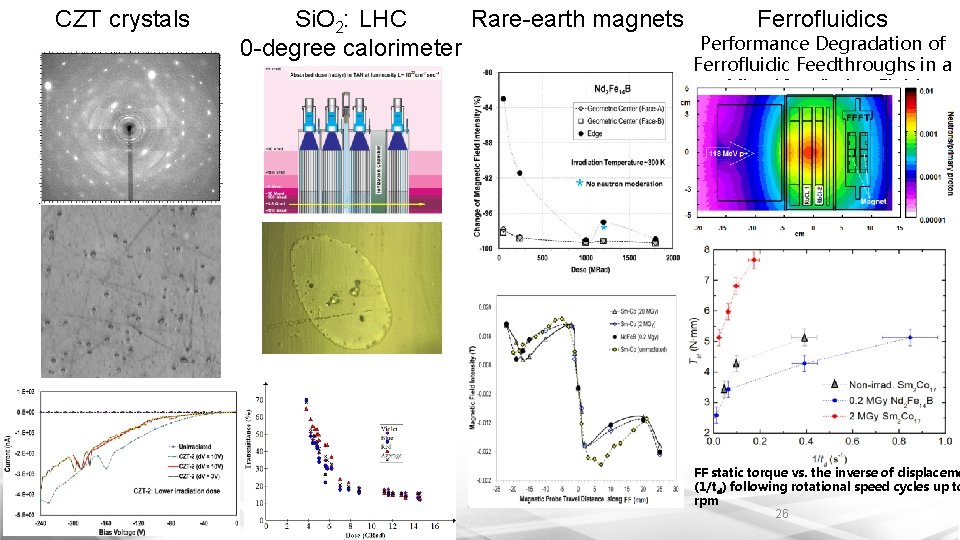
CZT crystals Si. O 2: LHC Rare-earth magnets 0 -degree calorimeter Ferrofluidics Performance Degradation of Ferrofluidic Feedthroughs in a Mixed Irradiation Field FF static torque vs. the inverse of displaceme (1/td) following rotational speed cycles up to rpm 26
Summary • The novel materials, alloys and composites required for next generation reactors and accelerator applications require evaluation under extreme conditions • The suite of tools available with the BNL accelerator complex enable such assessments • Predicting material lifetimes in likely future environments remains a formidable challenge • Detailed studies of the structural evolution of materials under a range of conditions can substantially improve our ability to anticipate material performance • The availability of fast neutron sources with high fluence for materials tests is very limited • Our knowledge of how materials evolve and damage under thermal neutrons cannot be extrapolated to their response to fast neutrons for fast reactors • Using protons or heavy ions as surrogates to emulate the damaging effects of fast neutrons is an ongoing debate and research • BNL’s combination of irradiation and x-ray characterization tools provides a powerful route to studying relationship between proton and fast neutron damage through detailed study 27 of the evolution of materials at the

The BNL Team looks forward to continued collaboration with the Hi. Rad. Mat effort to provide the next-generation materials our future facilities require Thank you for your attention! 28
- Slides: 28