
Iron Toroidal Magnets Front absorber and back calorimeter
Iron Toroidal Magnets Front absorber and back calorimeter Vladimir Kashikhin Forward Spectrometer Meeting, CERN-FNAL April 16, 2020
OUTLINE • • • 2 Magnet specification Magnetic field simulations and analysis Coils parameters Fringe field analysis Magnet conceptual design Summary V. Kashikhin | Toroidal Magnet 4/16/2020
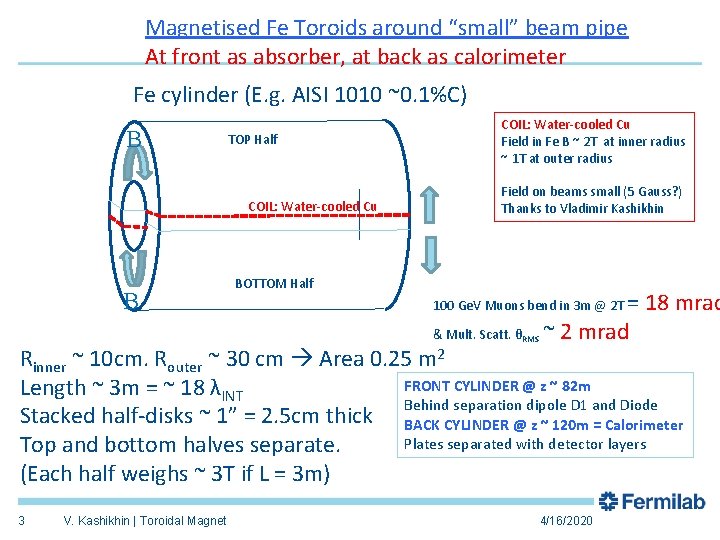
Magnetised Fe Toroids around “small” beam pipe At front as absorber, at back as calorimeter Fe cylinder (E. g. AISI 1010 ~0. 1%C) B TOP Half COIL: Water-cooled Cu B COIL: Water-cooled Cu Field in Fe B ~ 2 T at inner radius ~ 1 T at outer radius Field on beams small (5 Gauss? ) Thanks to Vladimir Kashikhin BOTTOM Half = 18 mrad ~ 2 mrad 100 Ge. V Muons bend in 3 m @ 2 T & Mult. Scatt. θRMS Rinner ~ 10 cm. Router ~ 30 cm Area 0. 25 m 2 FRONT CYLINDER @ z ~ 82 m Length ~ 3 m = ~ 18 λINT Behind separation dipole D 1 and Diode Stacked half-disks ~ 1” = 2. 5 cm thick BACK CYLINDER @ z ~ 120 m = Calorimeter Plates separated with detector layers Top and bottom halves separate. (Each half weighs ~ 3 T if L = 3 m) 3 V. Kashikhin | Toroidal Magnet 4/16/2020
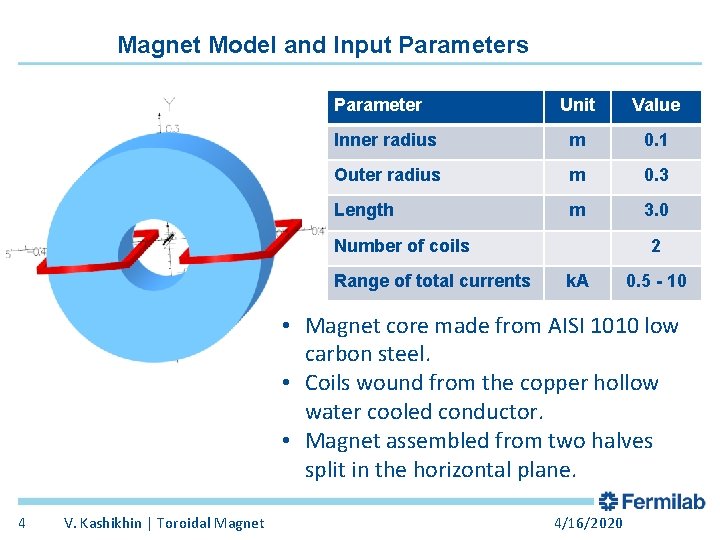
Magnet Model and Input Parameters Parameter Unit Value Inner radius m 0. 1 Outer radius m 0. 3 Length m 3. 0 Number of coils Range of total currents 2 k. A 0. 5 - 10 • Magnet core made from AISI 1010 low carbon steel. • Coils wound from the copper hollow water cooled conductor. • Magnet assembled from two halves split in the horizontal plane. 4 V. Kashikhin | Toroidal Magnet 4/16/2020
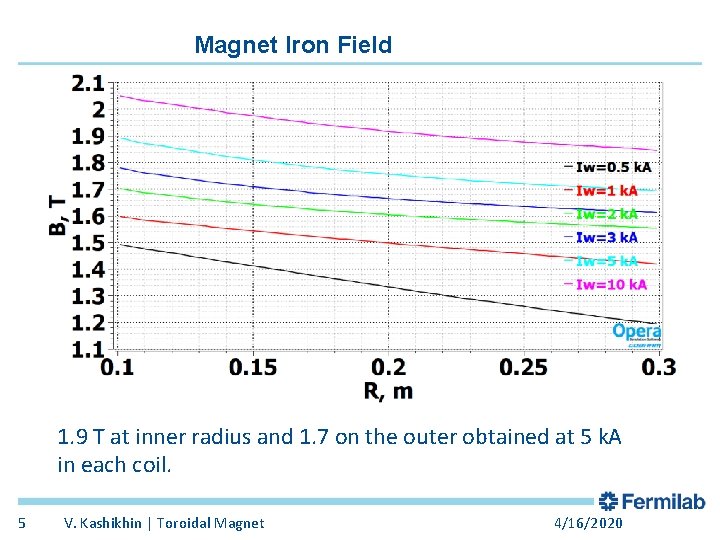
Magnet Iron Field 1. 9 T at inner radius and 1. 7 on the outer obtained at 5 k. A in each coil. 5 V. Kashikhin | Toroidal Magnet 4/16/2020
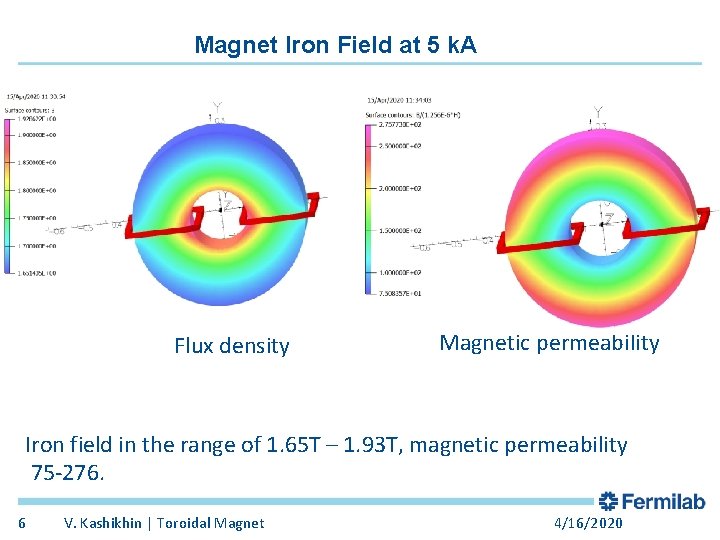
Magnet Iron Field at 5 k. A Flux density Magnetic permeability Iron field in the range of 1. 65 T – 1. 93 T, magnetic permeability 75 -276. 6 V. Kashikhin | Toroidal Magnet 4/16/2020
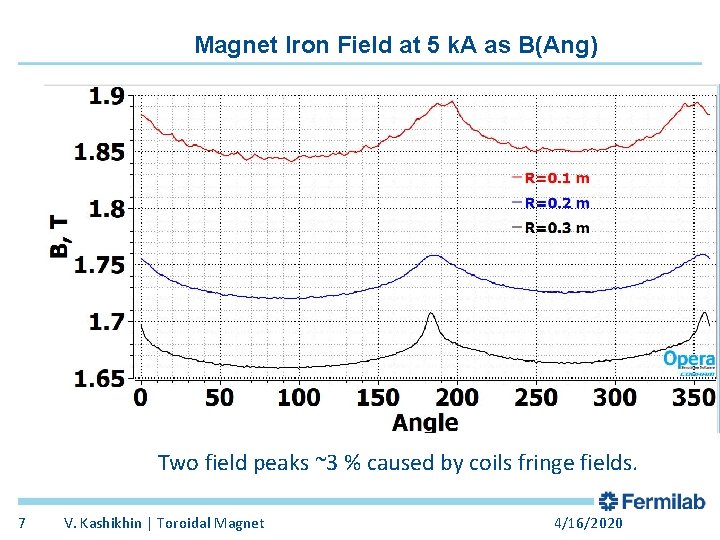
Magnet Iron Field at 5 k. A as B(Ang) Two field peaks ~3 % caused by coils fringe fields. 7 V. Kashikhin | Toroidal Magnet 4/16/2020
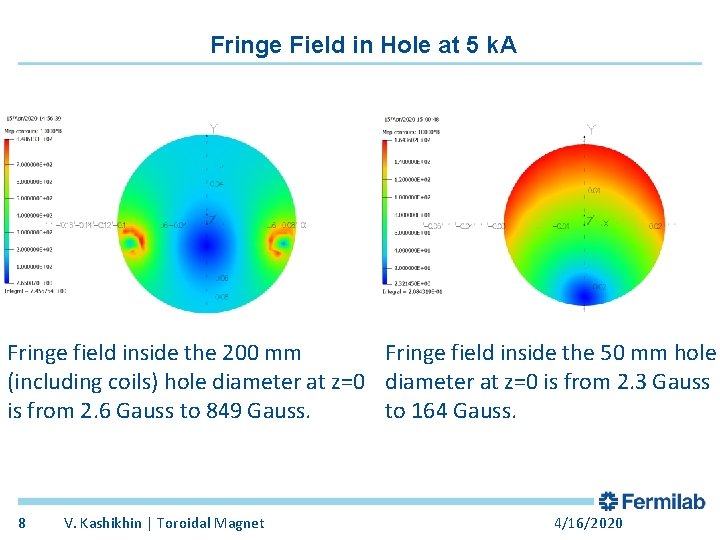
Fringe Field in Hole at 5 k. A Fringe field inside the 50 mm hole Fringe field inside the 200 mm (including coils) hole diameter at z=0 is from 2. 3 Gauss to 164 Gauss. is from 2. 6 Gauss to 849 Gauss. 8 V. Kashikhin | Toroidal Magnet 4/16/2020
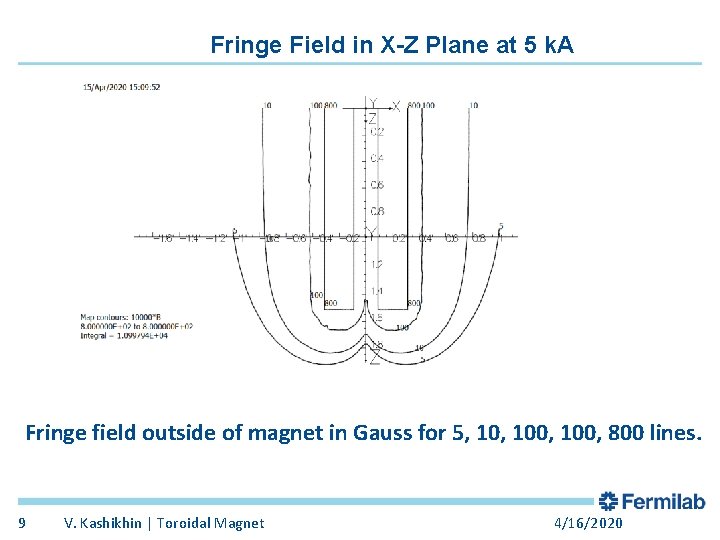
Fringe Field in X-Z Plane at 5 k. A Fringe field outside of magnet in Gauss for 5, 100, 800 lines. 9 V. Kashikhin | Toroidal Magnet 4/16/2020
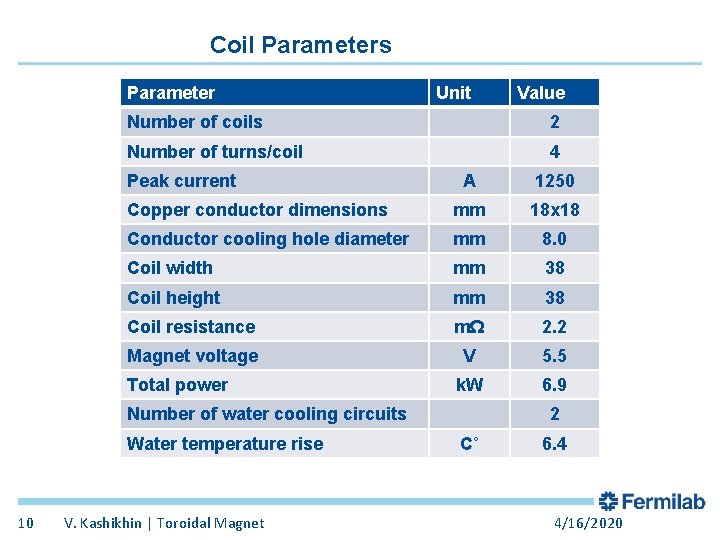
Coil Parameters Parameter Unit Number of coils 2 Number of turns/coil 4 Peak current A 1250 Copper conductor dimensions mm 18 x 18 Conductor cooling hole diameter mm 8. 0 Coil width mm 38 Coil height mm 38 Coil resistance mΩ 2. 2 Magnet voltage V 5. 5 k. W 6. 9 Total power Number of water cooling circuits Water temperature rise 10 Value V. Kashikhin | Toroidal Magnet 2 C˚ 6. 4 4/16/2020
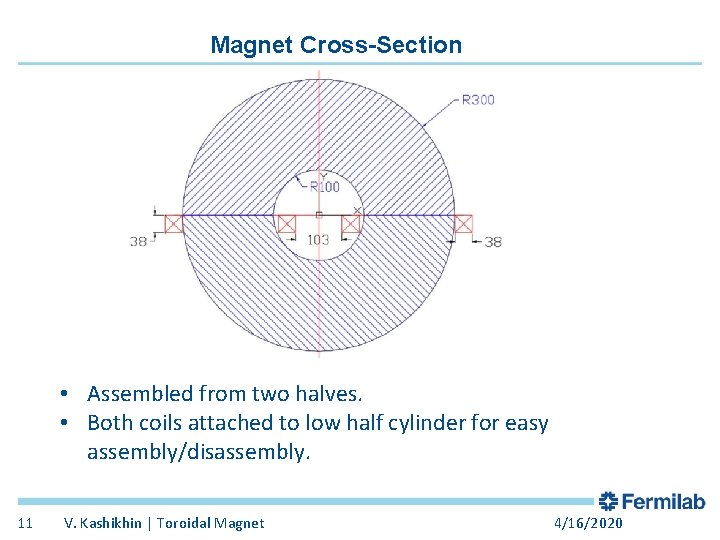
Magnet Cross-Section • Assembled from two halves. • Both coils attached to low half cylinder for easy assembly/disassembly. 11 V. Kashikhin | Toroidal Magnet 4/16/2020
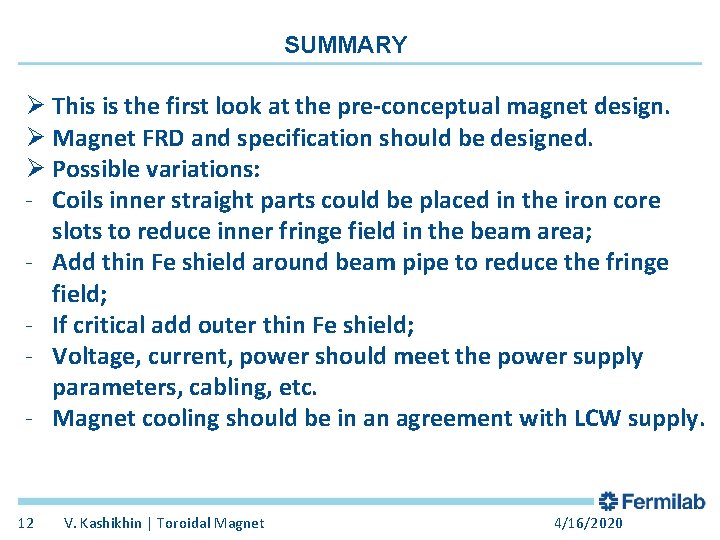
SUMMARY Ø This is the first look at the pre-conceptual magnet design. Ø Magnet FRD and specification should be designed. Ø Possible variations: - Coils inner straight parts could be placed in the iron core slots to reduce inner fringe field in the beam area; - Add thin Fe shield around beam pipe to reduce the fringe field; - If critical add outer thin Fe shield; - Voltage, current, power should meet the power supply parameters, cabling, etc. - Magnet cooling should be in an agreement with LCW supply. 12 V. Kashikhin | Toroidal Magnet 4/16/2020
- Slides: 12