
Iron and Biogeochemical Cycles Redfield Ratio C N
Iron and Biogeochemical Cycles
Redfield Ratio • C: N: P • 106: 16 : 1 (Redfield, 1958) • Could there be other essential micro-nutrients? -Trace metals such as Fe, Zn, Co are important!
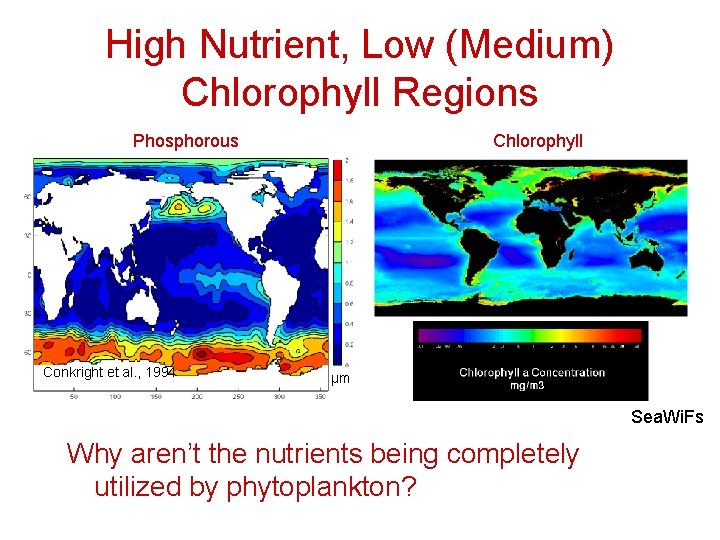
High Nutrient, Low (Medium) Chlorophyll Regions Phosphorous Conkright et al. , 1994 Chlorophyll µm Sea. Wi. Fs Why aren’t the nutrients being completely utilized by phytoplankton?
Hypotheses • Light • Grazing • Micronutrient limitation

In situ Fertilization experiments: Is iron limiting? e. g. Iron needed for enzymes that facilitate electron transport, O 2 transport and other important functions.

‘Dissolved’ Iron distribution Surface Why are there so few measurements? - Difficult to measure 1000 m
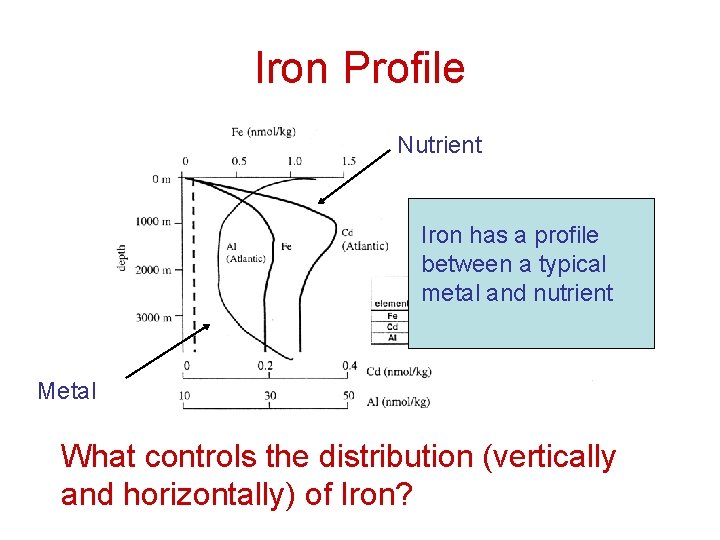
Iron Profile Nutrient Iron has a profile between a typical metal and nutrient Metal What controls the distribution (vertically and horizontally) of Iron?
Sources of Iron • Riverine • Continental Shelves • Dust
![Riverine • [Fe’] decreases further from coast. • This is due to scavenging of](http://slidetodoc.com/presentation_image/23721dafcaa82062325ceb44775caafe/image-9.jpg "Riverine • [Fe’] decreases further from coast. • This is due to scavenging of")
Riverine • [Fe’] decreases further from coast. • This is due to scavenging of Fe by particles. • We can conclude that rivers are not an important source for the open ocean Boyle et al. (1977)
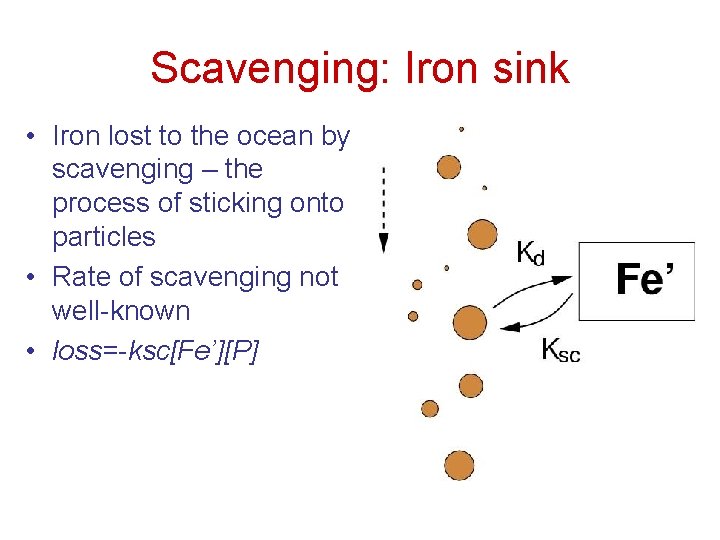
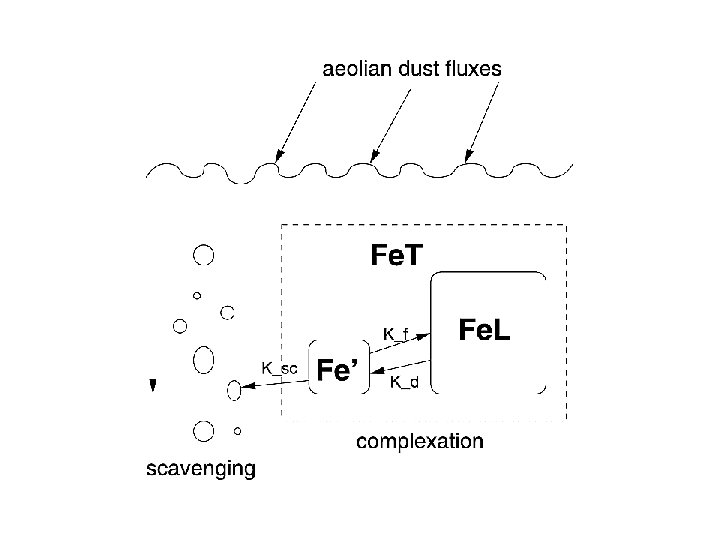
Scavenging: Iron sink • Iron lost to the ocean by scavenging – the process of sticking onto particles • Rate of scavenging not well-known • loss=-ksc[Fe’][P]
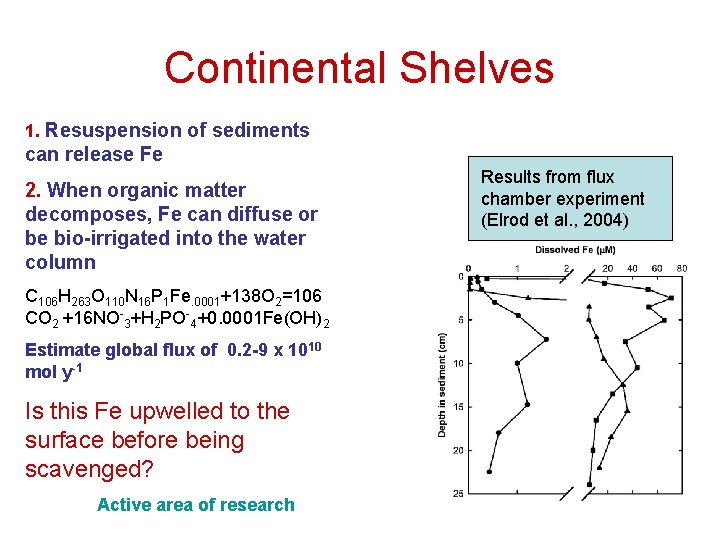
Continental Shelves 1. Resuspension of sediments can release Fe 2. When organic matter decomposes, Fe can diffuse or be bio-irrigated into the water column C 106 H 263 O 110 N 16 P 1 Fe. 0001+138 O 2=106 CO 2 +16 NO-3+H 2 PO-4+0. 0001 Fe(OH)2 Estimate global flux of 0. 2 -9 x 10¹⁰ mol y-1 Is this Fe upwelled to the surface before being scavenged? Active area of research Results from flux chamber experiment (Elrod et al. , 2004)
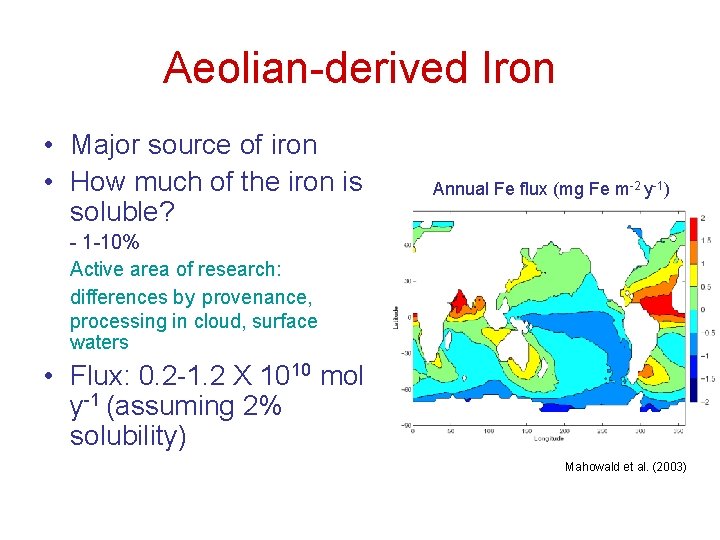
Aeolian-derived Iron • Major source of iron • How much of the iron is soluble? Annual Fe flux (mg Fe m-2 y-1) - 1 -10% Active area of research: differences by provenance, processing in cloud, surface waters • Flux: 0. 2 -1. 2 X 10¹⁰ mol y-1 (assuming 2% solubility) Mahowald et al. (2003)
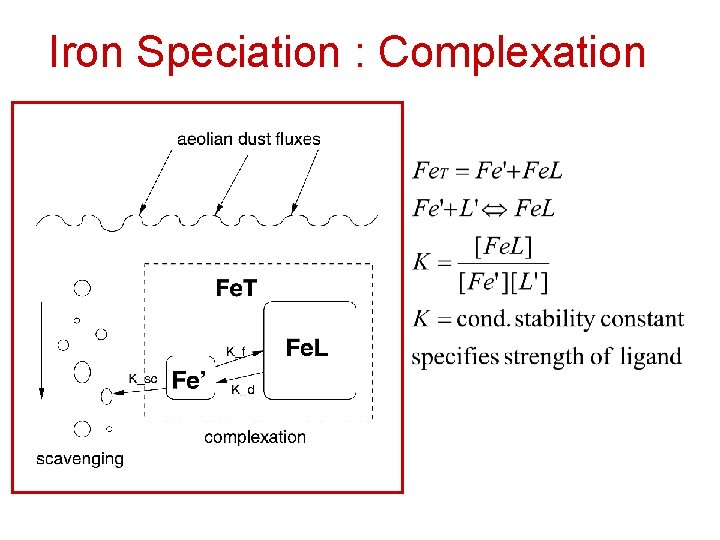
Iron Speciation : Complexation
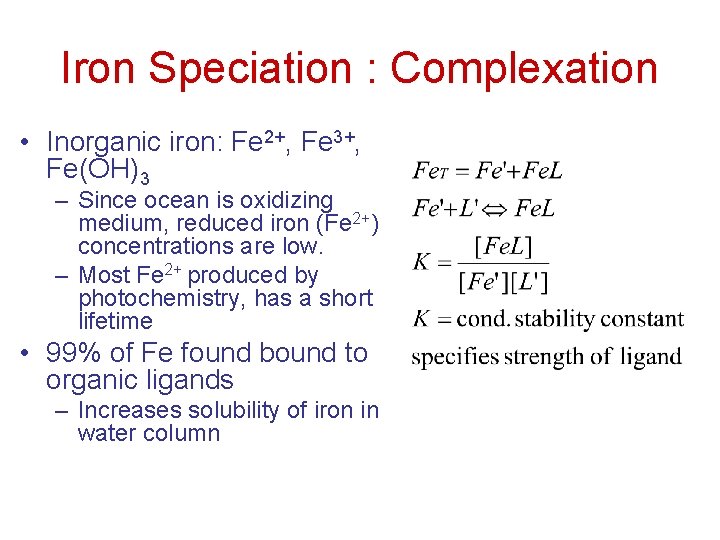
Iron Speciation : Complexation • Inorganic iron: Fe 2+, Fe 3+, Fe(OH)3 – Since ocean is oxidizing medium, reduced iron (Fe 2+) concentrations are low. – Most Fe 2+ produced by photochemistry, has a short lifetime • 99% of Fe found bound to organic ligands – Increases solubility of iron in water column
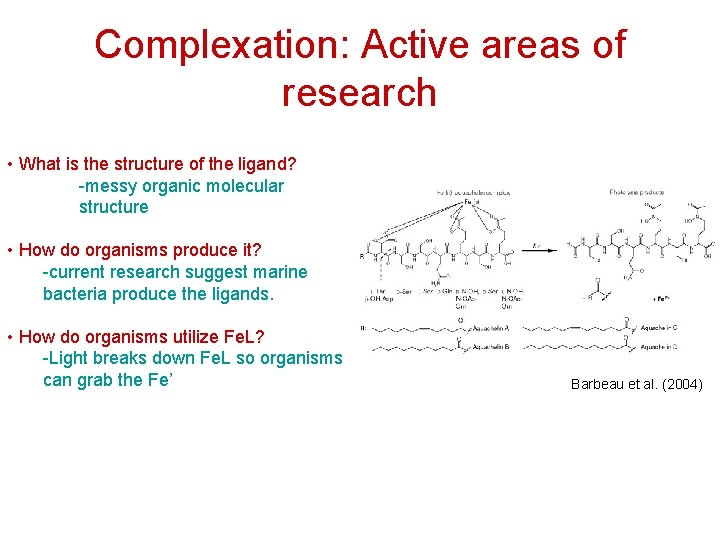
Complexation: Active areas of research • What is the structure of the ligand? -messy organic molecular structure • How do organisms produce it? -current research suggest marine bacteria produce the ligands. • How do organisms utilize Fe. L? -Light breaks down Fe. L so organisms can grab the Fe’ Barbeau et al. (2004)
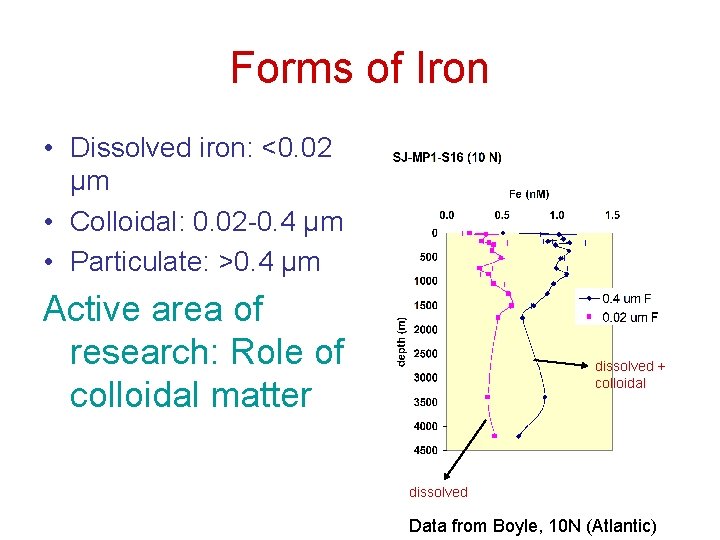
Forms of Iron • Dissolved iron: <0. 02 µm • Colloidal: 0. 02 -0. 4 µm • Particulate: >0. 4 µm Active area of research: Role of colloidal matter dissolved + colloidal dissolved Data from Boyle, 10 N (Atlantic)
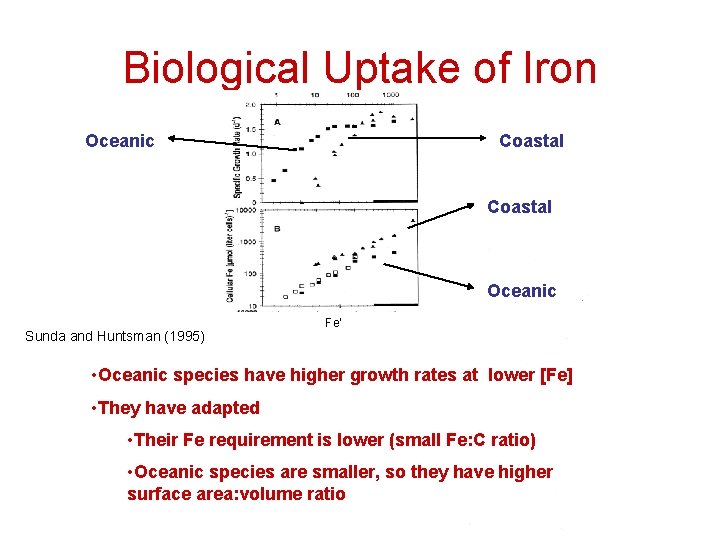
Biological Uptake of Iron Oceanic Coastal Oceanic Sunda and Huntsman (1995) Fe’ • Oceanic species have higher growth rates at lower [Fe] • They have adapted • Their Fe requirement is lower (small Fe: C ratio) • Oceanic species are smaller, so they have higher surface area: volume ratio
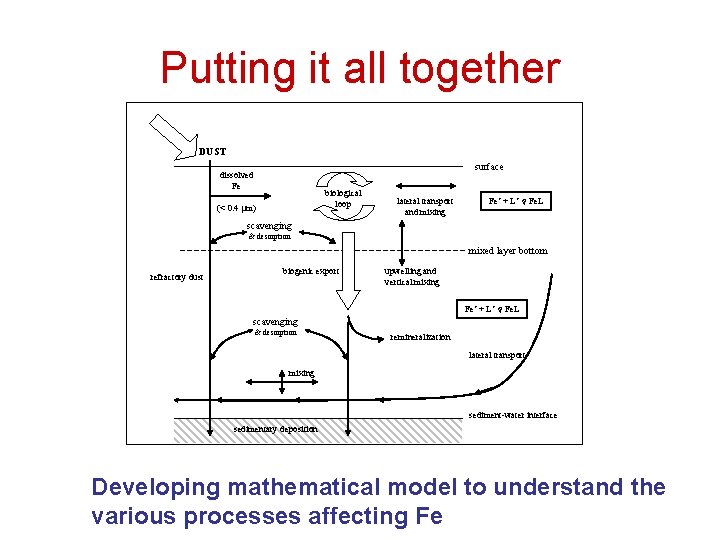
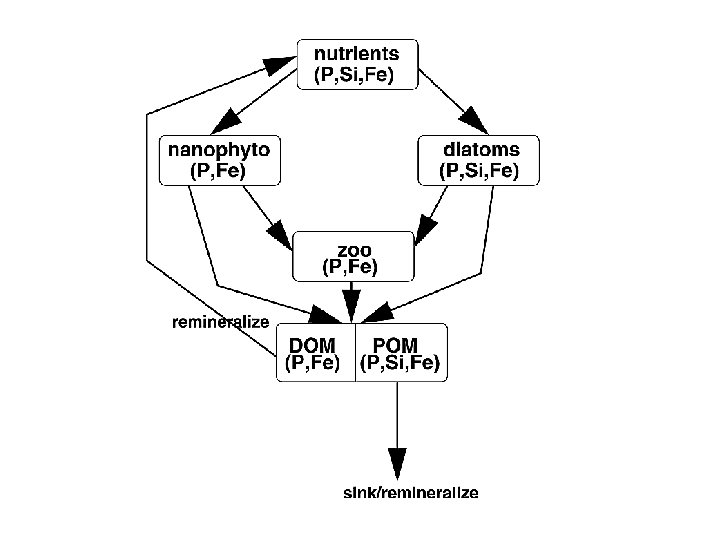
Putting it all together DUST surface dissolved Fe biological loop (< 0. 4 mm) lateral transport and mixing Fe’ + L’ Fe. L scavenging & desorption mixed layer bottom refractory dust biogenic export upwelling and vertical mixing Fe’ + L’ Fe. L scavenging & desorption remineralization lateral transport mixing sediment-water interface sedimentary deposition Developing mathematical model to understand the various processes affecting Fe
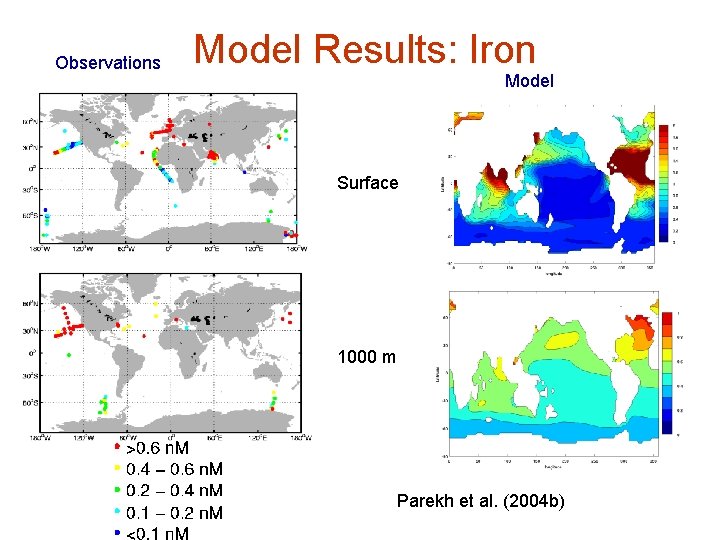
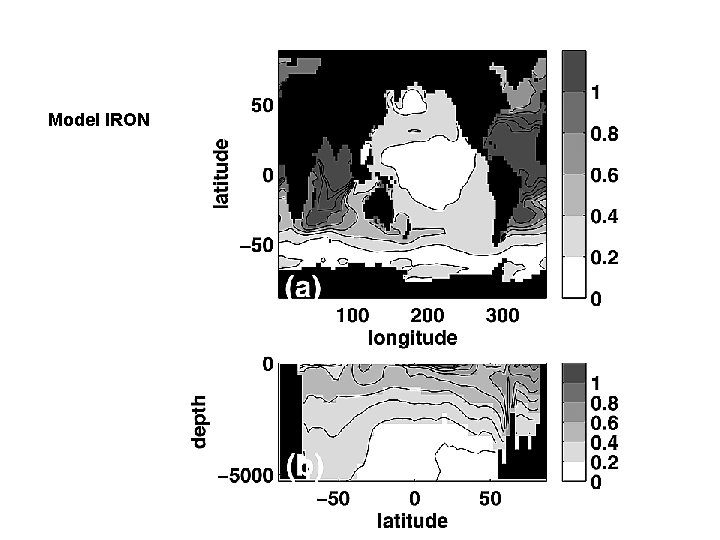
Observations Model Results: Iron Model Surface 1000 m Parekh et al. (2004 b)
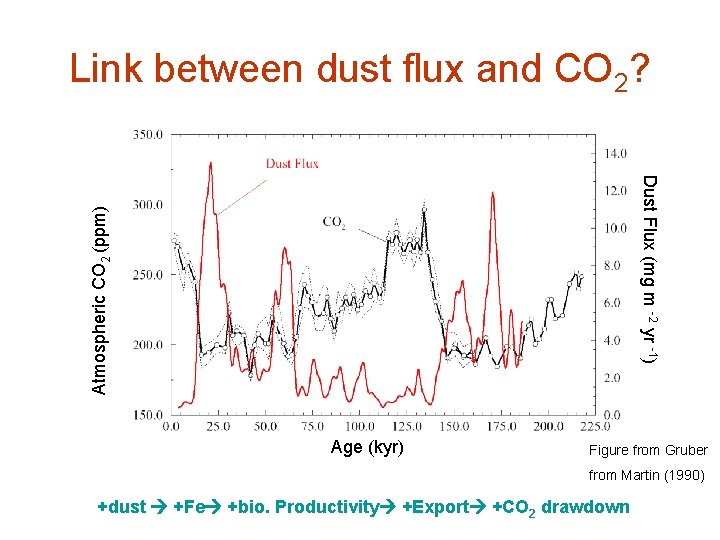
Link between dust flux and CO 2? Atmospheric CO 2 (ppm) Dust Flux (mg m -2 yr -1) Age (kyr) Figure from Gruber from Martin (1990) +dust +Fe +bio. Productivity +Export +CO 2 drawdown
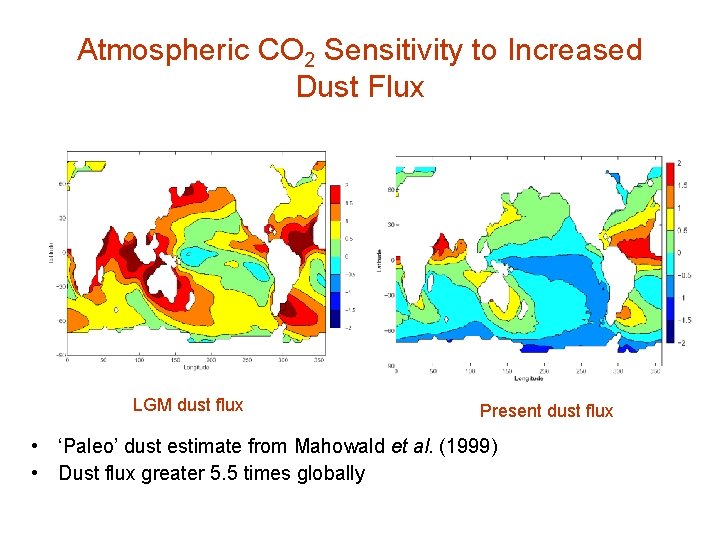
Atmospheric CO 2 Sensitivity to Increased Dust Flux LGM dust flux Present dust flux • ‘Paleo’ dust estimate from Mahowald et al. (1999) • Dust flux greater 5. 5 times globally
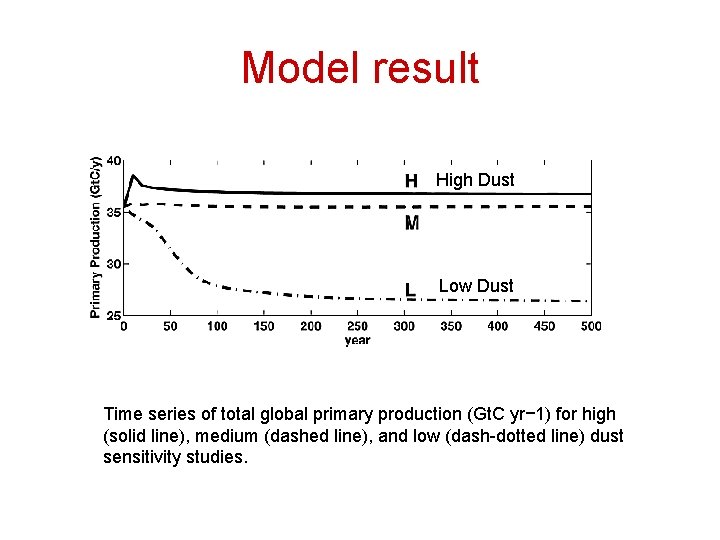
Model result High Dust Low Dust Time series of total global primary production (Gt. C yr− 1) for high (solid line), medium (dashed line), and low (dash-dotted line) dust sensitivity studies.
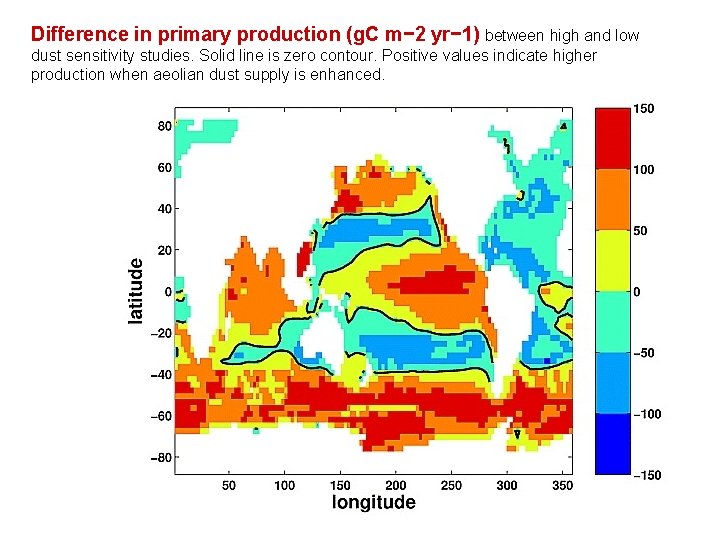
Difference in primary production (g. C m− 2 yr− 1) between high and low dust sensitivity studies. Solid line is zero contour. Positive values indicate higher production when aeolian dust supply is enhanced.
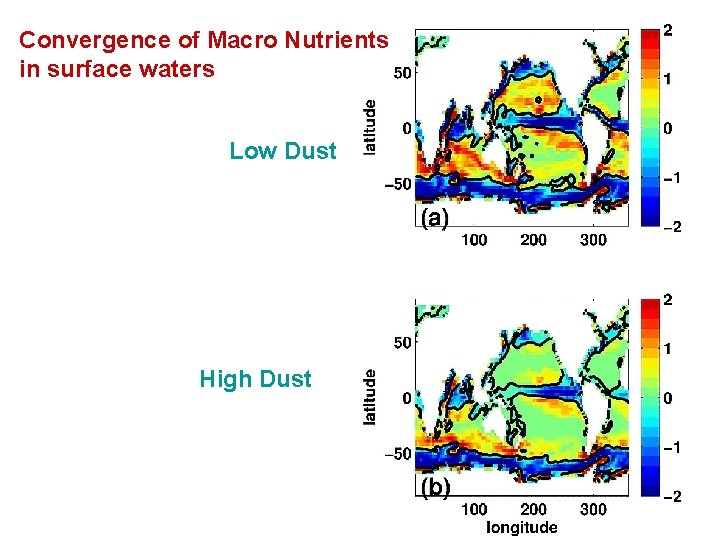
Convergence of Macro Nutrients in surface waters Low Dust High Dust
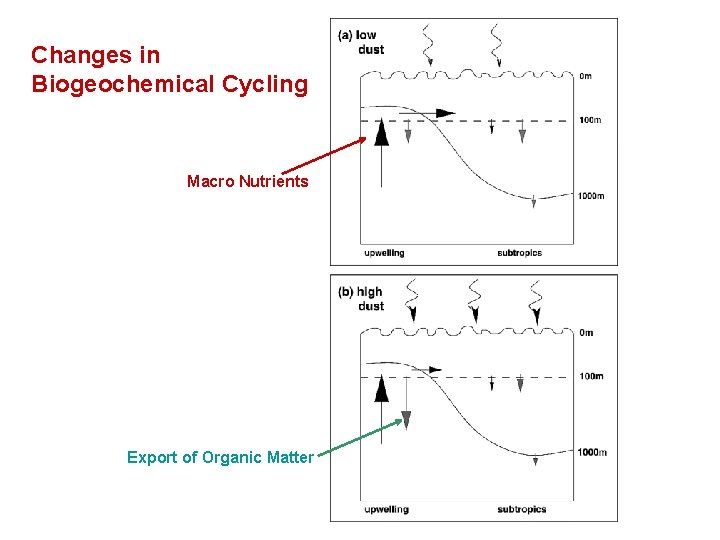
Changes in Biogeochemical Cycling Macro Nutrients Export of Organic Matter
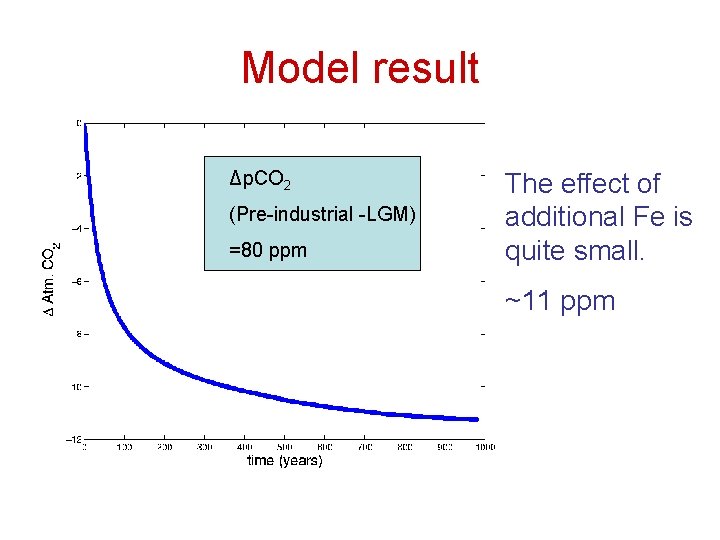
Model result Δp. CO 2 (Pre-industrial -LGM) =80 ppm The effect of additional Fe is quite small. ~11 ppm
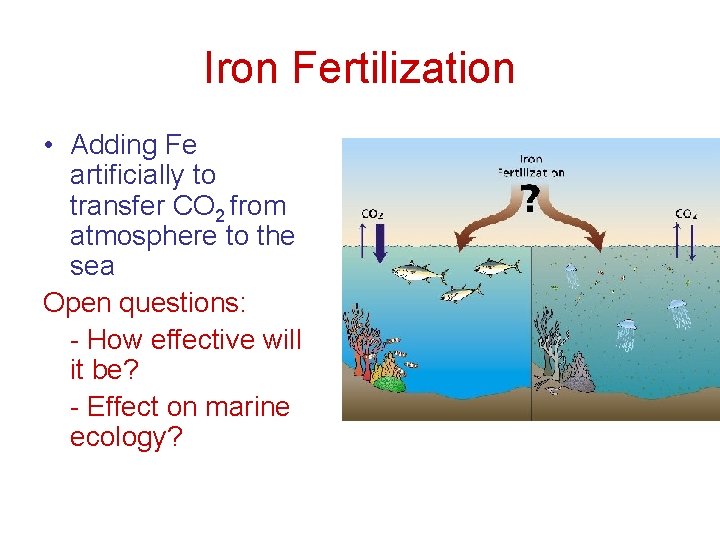
Iron Fertilization • Adding Fe artificially to transfer CO 2 from atmosphere to the sea Open questions: - How effective will it be? - Effect on marine ecology?

End
Model IRON
- Slides: 31