
Irish School System The levels of Irelands education
- Slides: 8
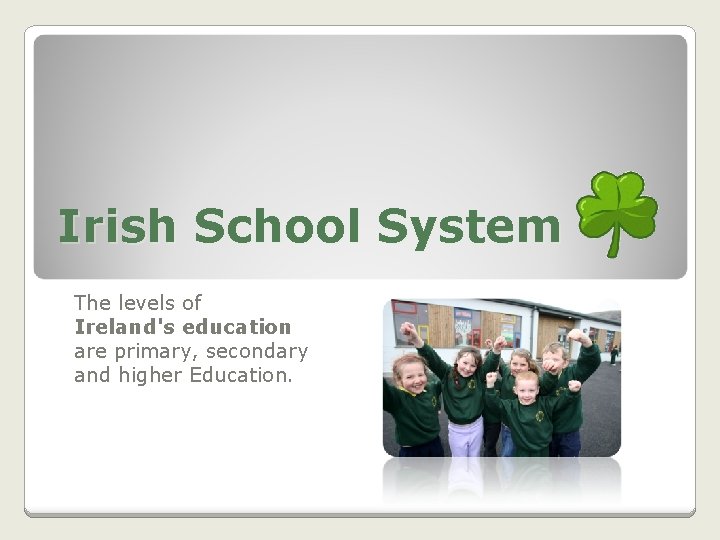
Irish School System The levels of Ireland's education are primary, secondary and higher Education.
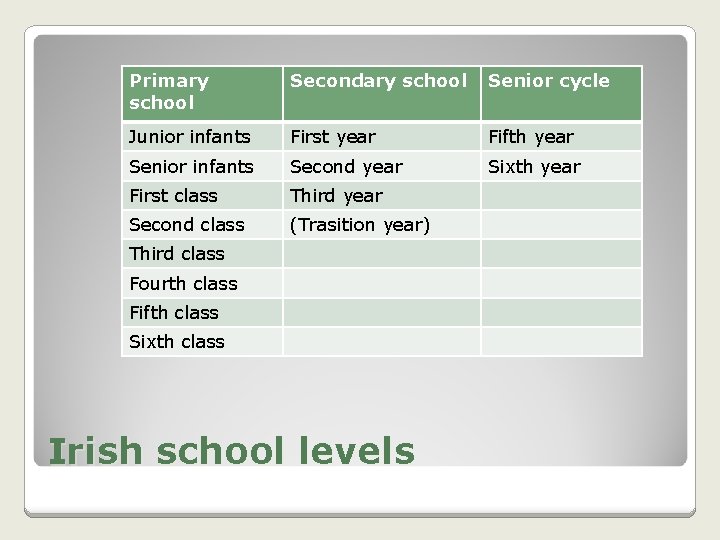
Primary school Secondary school Senior cycle Junior infants First year Fifth year Senior infants Second year Sixth year First class Third year Second class (Trasition year) Third class Fourth class Fifth class Sixth class Irish school levels
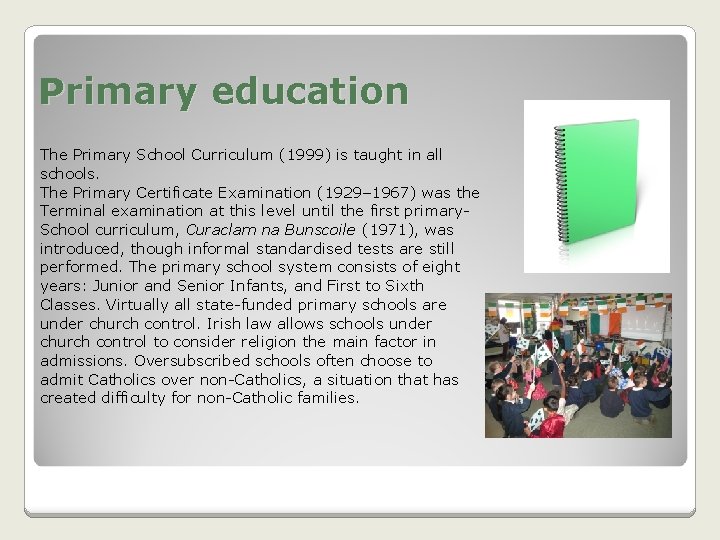
Primary education The Primary School Curriculum (1999) is taught in all schools. The Primary Certificate Examination (1929– 1967) was the Terminal examination at this level until the first primary. School curriculum, Curaclam na Bunscoile (1971), was introduced, though informal standardised tests are still performed. The primary school system consists of eight years: Junior and Senior Infants, and First to Sixth Classes. Virtually all state-funded primary schools are under church control. Irish law allows schools under church control to consider religion the main factor in admissions. Oversubscribed schools often choose to admit Catholics over non-Catholics, a situation that has created difficulty for non-Catholic families.
Most students enter secondary school aged 12– 13. Secondary education is generally completed at one of four types of school: � Voluntary secondary schools, or just "secondary schools", are owned and managed by religious communities or private organisations. . � Vocational schools are owned and managed by Education and Training Boards. These schools educate 28% of secondary pupils. � Comprehensive schools or community schools were established in the 1960 s, often by amalgamating voluntary secondary and vocational schools. Nearly 15% of secondary pupils attend such schools. � Gaelcholáiste's or Gaelcholáistí are the second-level schools for the Irish-language medium education sector in English-speaking communities. Approximately 3% of secondary students attend these schools. � Grind Schools are fee paying privately run schools outside the state sector, who tend to run only the Senior Cycle curriculum for 5 th and 6 th Year students as well as a one -year repeat Leaving Certificate programme. Secondary education
Types of programme � The Junior Cycle builds on the education received at primary level and culminates with the Junior Certificate Examination. Students usually begin this at the age of 12 or 13. The Junior Certificate Examination is taken after three years of study and not before fourteen years of age. It consists of exams in English, Irish, maths and science (unless the student has an exemption in one of these) as well as a number of chosen subjects. Transition Year is a one-year informal course taken by an increasing number of students usually ages 15 or 16. The content of this is left to the school to model on the local needs. It is compulsory in some schools but optional in others. Some schools do not offer it. Students may attend structured classes, but do not cover material relevant to the Senior Cycle or the Leaving Certificate exams, and therefore students who choose not to do this year are in no way academically disadvantaged when entering the Senior Cycle.
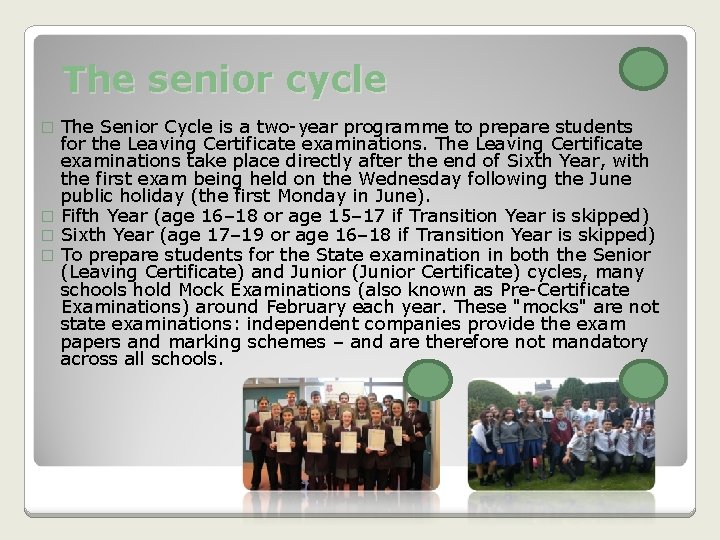
The senior cycle The Senior Cycle is a two-year programme to prepare students for the Leaving Certificate examinations. The Leaving Certificate examinations take place directly after the end of Sixth Year, with the first exam being held on the Wednesday following the June public holiday (the first Monday in June). � Fifth Year (age 16– 18 or age 15– 17 if Transition Year is skipped) � Sixth Year (age 17– 19 or age 16– 18 if Transition Year is skipped) � To prepare students for the State examination in both the Senior (Leaving Certificate) and Junior (Junior Certificate) cycles, many schools hold Mock Examinations (also known as Pre-Certificate Examinations) around February each year. These "mocks" are not state examinations: independent companies provide the exam papers and marking schemes – and are therefore not mandatory across all schools. �
Holidays vary depending on the school. Generally primary and secondary get similar holidays. The year is broken up into three terms: from the first week of September or last week in August to the week before Christmas. From the week after New Year's Day to the week before Easter Sunday and from the week after Easter Sunday to the end of May/Start of June. � There is a mid-term around the Halloween bank holiday, two weeks off for Christmas: generally the last week in December and the first week in January, another mid-term in February, two weeks off for Easter and summer holidays. Primary schools usually have July and August off, while secondary schools have June, July and August off. � Holidays…
Realized by -Buffone Carmine -Straface Samuele -Cassano Luigi -Giglio Giulia -Gallipoli Martina Sources: Wikipedia