
Irish culture Holidays Religion Symbols Language and minorities
Irish culture • Holidays • Religion • Symbols • Language and minorities • Arts and literature
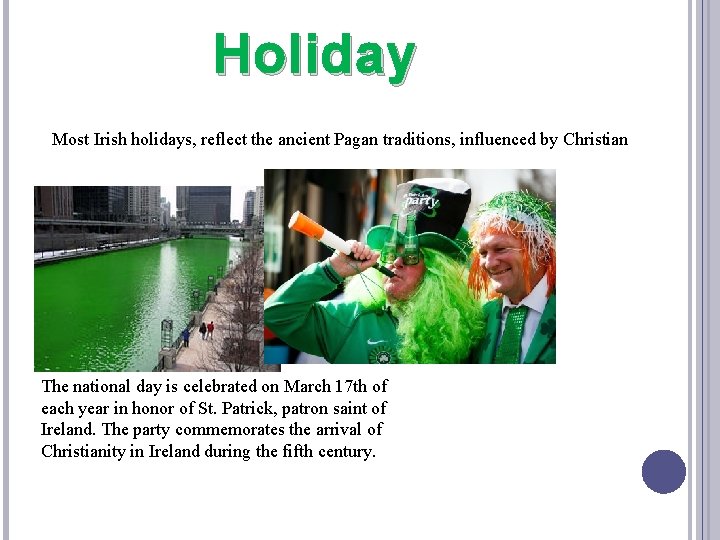
Holiday Most Irish holidays, reflect the ancient Pagan traditions, influenced by Christian The national day is celebrated on March 17 th of each year in honor of St. Patrick, patron saint of Ireland. The party commemorates the arrival of Christianity in Ireland during the fifth century.
Halloween or Hallowe'en also known as All halloween, All Hallows' Eve vor All Saints' Eve, is a celebration observed in several countries on 31 October, the eve of the Western Christian feast of All Hallows' Day. It begins the three-day observance of Allhallowtide, the time in the liturgical year dedicated to remembering the dead, including saints, martyrs, and all the faithful departed
samhain Samhain is a Gaelic festival marking the end of the harvest season and the beginning of winter or the "darker half" of the year. Traditionally, it is celebrated from 31 October to 1 November, as the Celtic day began and ended at sunset. This is about halfway between the autumn equinox and the winter solstice. It is one of the four Gaelic seasonal festivals, along with Imbolc, Bealtaine and Lughnasadh. Historically, it was widely observed throughout Ireland, Scotland the Isle of Man. Similar festivals are held at the same time of year in other Celtic lands; for example the Brythonic Calan Gaeaf , Kalan Gwav and Kalan Goañv in Brittany, both Celtic branches are roughly as old as each other
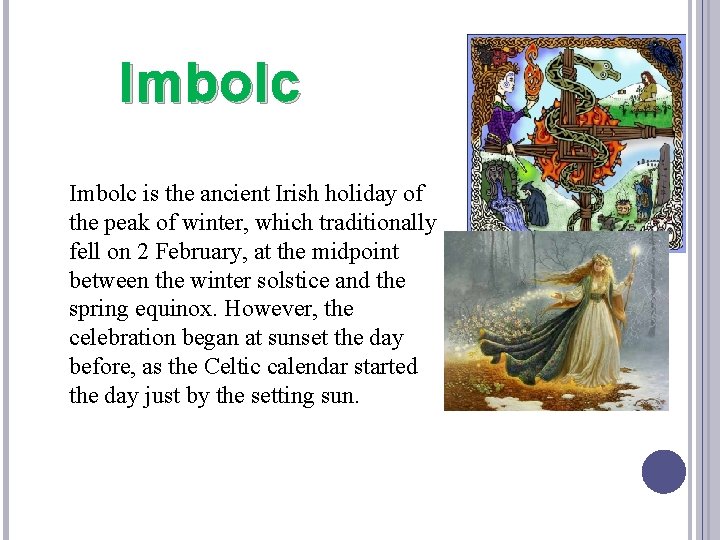
Imbolc is the ancient Irish holiday of the peak of winter, which traditionally fell on 2 February, at the midpoint between the winter solstice and the spring equinox. However, the celebration began at sunset the day before, as the Celtic calendar started the day just by the setting sun.
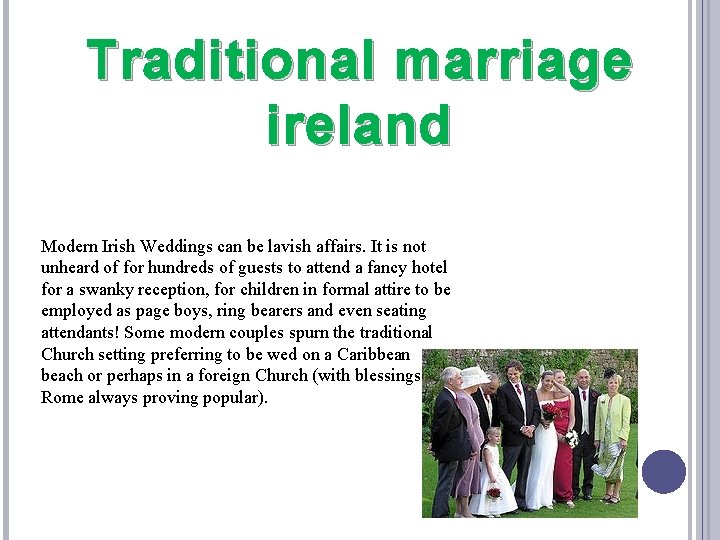
Traditional marriage ireland Modern Irish Weddings can be lavish affairs. It is not unheard of for hundreds of guests to attend a fancy hotel for a swanky reception, for children in formal attire to be employed as page boys, ring bearers and even seating attendants! Some modern couples spurn the traditional Church setting preferring to be wed on a Caribbean beach or perhaps in a foreign Church (with blessings in Rome always proving popular).

Religion Although predominantly Roman Catholic, Ireland today is a multi-cultural society where all religions are embraced and respected as playing vital roles in the societal make-up of the country. Other religious groups in Ireland include the Church of Ireland, Presbyterian, Methodist and Baptist Churches as well as Eastern Orthodox, Jehovah's Witnesses, Mormons and Salvation Army Communities. There also centres for Buddhists, Hindus, Baha'is and those of the Islamic and Jewish faiths. Most of Ireland’s higher institutions have suitable prayer rooms for students to practice their faith when they are studying in Ireland.
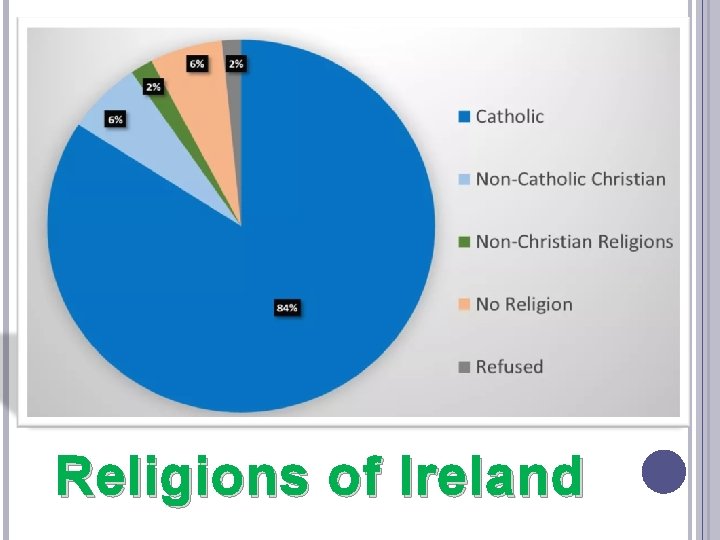
Religions of Ireland
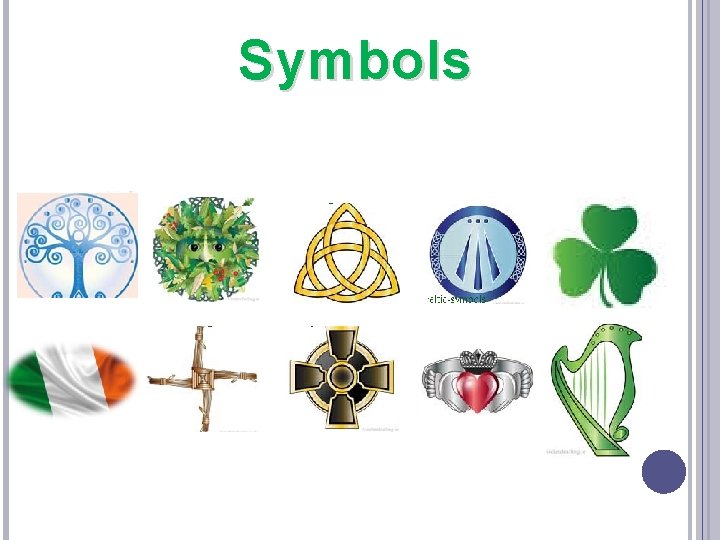
Symbols
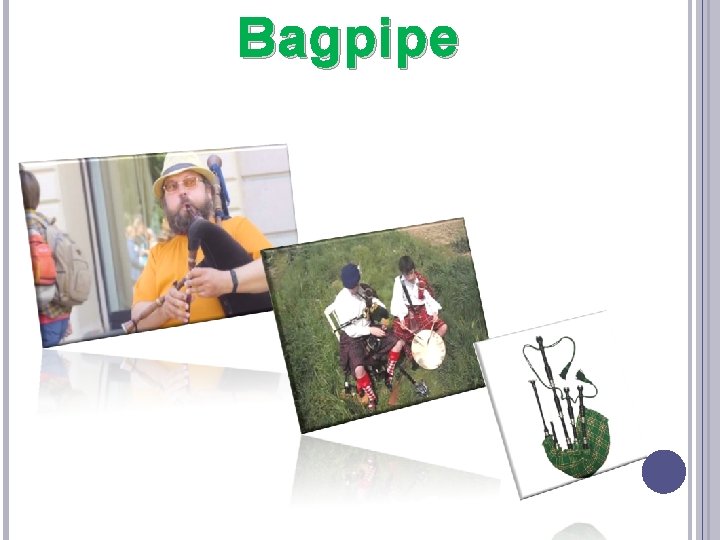
Bagpipe
Language and Minorities The constitution provides that Irish be the first official language and English the second. All official documents are published in both Irish and English. The modern Irish language, which is very similar to Scottish Gaelic, was widely spoken up to the time of the Irish Potato Famine of the 1840 s and the subsequent emigrations. Ethnic and racial minorities make up about 12 percent of the population of Ireland—a proportion that doubled in the first decade of the 21 st century. Immigration from the rest of Europe, Africa, and Asia has been significant since the last two decades of the 20 th century.
Art The first recorded evidence of Irish artwork dates back to 3200 B. CDuring the Bronze Age beginning 1900 BC, the Irish produced much ornamental gold work. Irish artists were also known for religious carvings, and medieval illuminated manuscripts. One of the most well known illuminations is the Book of Kells. This masterpiece of period art was created by a group of monks and dates to 800 B. C. Other well known antiquities are the Ardagh Chalice an ornate copper cup, and the Tara Brooch a spectacular piece of Celtic jewelry. Later in this period Scandinavian influences took hold due to the Viking Invasions, and with the Norman invasion of the twelfth century Celtic styles were largely overshadowed. Due to ongoing wars, occupation and poverty, the Irish arts mostly consisted of music and literature. Happily, the creative flame is difficult to extinguish, and in the late 17 th century, Irish artists began to reemerge. Due to the lack of available funds these painters, sculptures etc. typically looked outside of Ireland for, training and for clients who were wealthy enough to purchase art. Today, Ireland has grown into a national power with a vivid and energetic arts community. Its painters, sculptors, playwrights and photographers make a substantial contribution to the world of art.
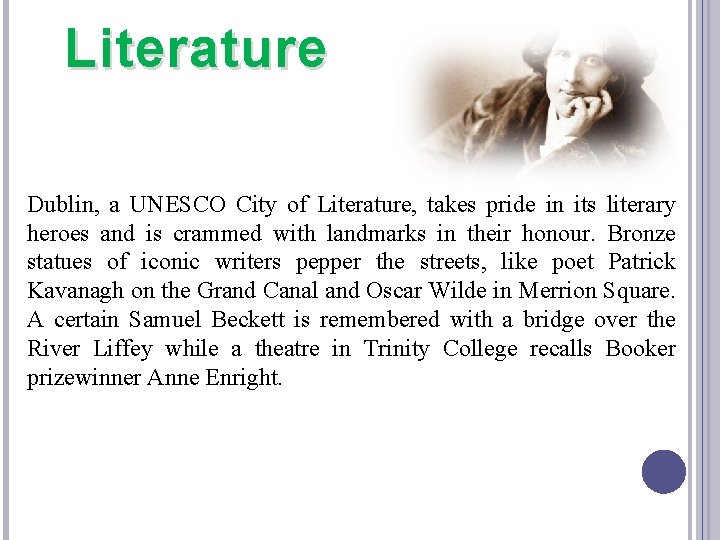
Literature Dublin, a UNESCO City of Literature, takes pride in its literary heroes and is crammed with landmarks in their honour. Bronze statues of iconic writers pepper the streets, like poet Patrick Kavanagh on the Grand Canal and Oscar Wilde in Merrion Square. A certain Samuel Beckett is remembered with a bridge over the River Liffey while a theatre in Trinity College recalls Booker prizewinner Anne Enright.
- Slides: 13