
IRIG106 CHAPTER 7 TELEMETRY DOWNLINK ETTC JUNE 2015


- Slides: 17
IRIG-106 CHAPTER 7 TELEMETRY DOWNLINK ETTC JUNE 2015 Balázs Bagó Zodiac Data Systems
IRIG 106 CHAPTER 7 PRESENTATION OVERVIEW Topics: • • Idea behind it Key elements Some examples Benefits Presentation length: 15 Minutes
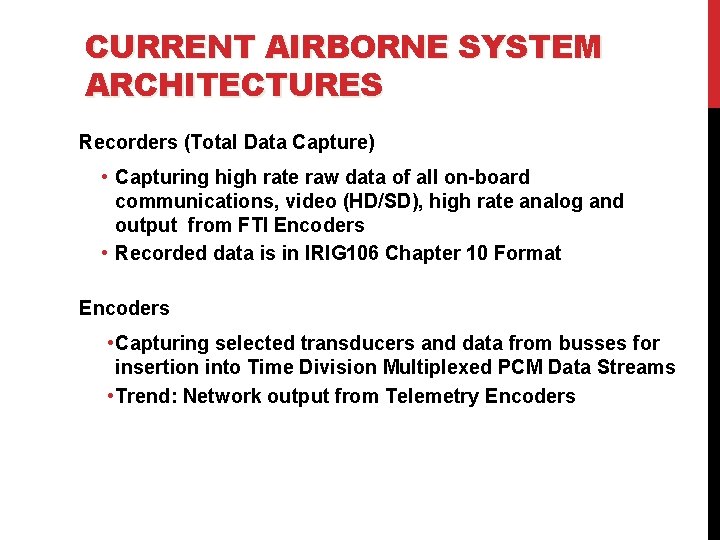
CURRENT AIRBORNE SYSTEM ARCHITECTURES Recorders (Total Data Capture) • Capturing high rate raw data of all on-board communications, video (HD/SD), high rate analog and output from FTI Encoders • Recorded data is in IRIG 106 Chapter 10 Format Encoders • Capturing selected transducers and data from busses for insertion into Time Division Multiplexed PCM Data Streams • Trend: Network output from Telemetry Encoders
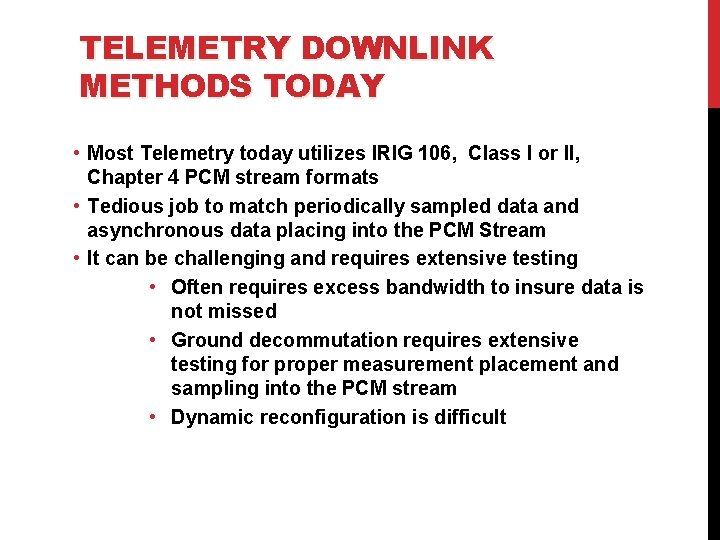
TELEMETRY DOWNLINK METHODS TODAY • Most Telemetry today utilizes IRIG 106, Class I or II, Chapter 4 PCM stream formats • Tedious job to match periodically sampled data and asynchronous data placing into the PCM Stream • It can be challenging and requires extensive testing • Often requires excess bandwidth to insure data is not missed • Ground decommutation requires extensive testing for proper measurement placement and sampling into the PCM stream • Dynamic reconfiguration is difficult
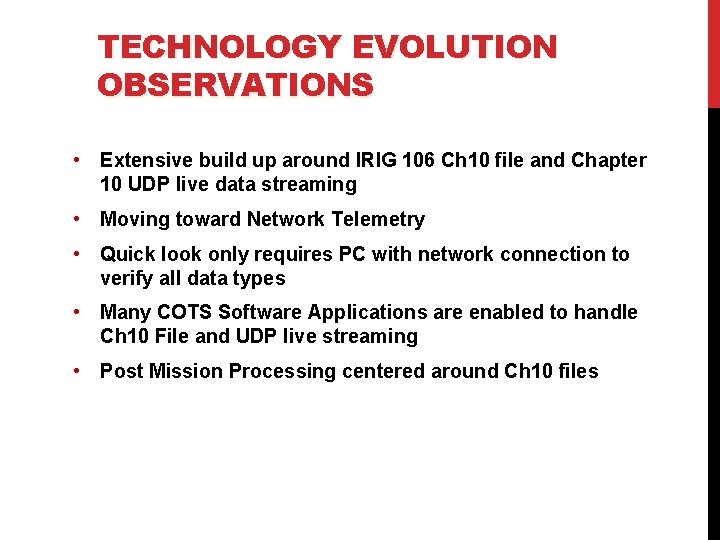
TECHNOLOGY EVOLUTION OBSERVATIONS • Extensive build up around IRIG 106 Ch 10 file and Chapter 10 UDP live data streaming • Moving toward Network Telemetry • Quick look only requires PC with network connection to verify all data types • Many COTS Software Applications are enabled to handle Ch 10 File and UDP live streaming • Post Mission Processing centered around Ch 10 files
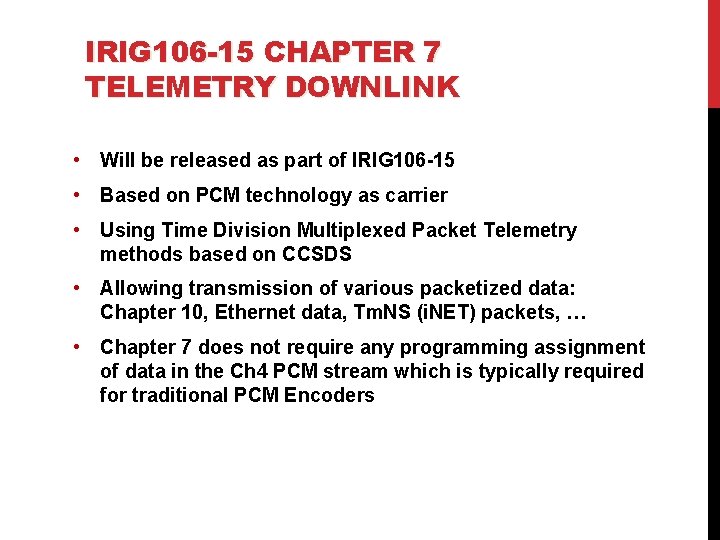
IRIG 106 -15 CHAPTER 7 TELEMETRY DOWNLINK • Will be released as part of IRIG 106 -15 • Based on PCM technology as carrier • Using Time Division Multiplexed Packet Telemetry methods based on CCSDS • Allowing transmission of various packetized data: Chapter 10, Ethernet data, Tm. NS (i. NET) packets, … • Chapter 7 does not require any programming assignment of data in the Ch 4 PCM stream which is typically required for traditional PCM Encoders
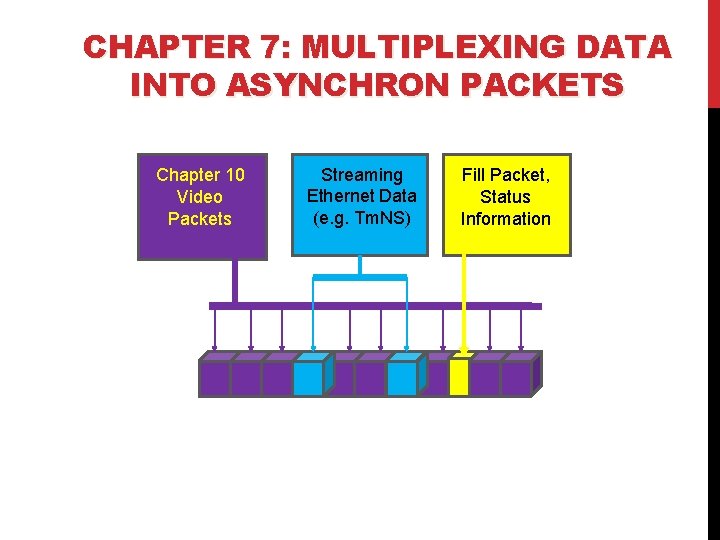
CHAPTER 7: MULTIPLEXING DATA INTO ASYNCHRON PACKETS Chapter 10 Video Packets Streaming Ethernet Data (e. g. Tm. NS) Fill Packet, Status Information
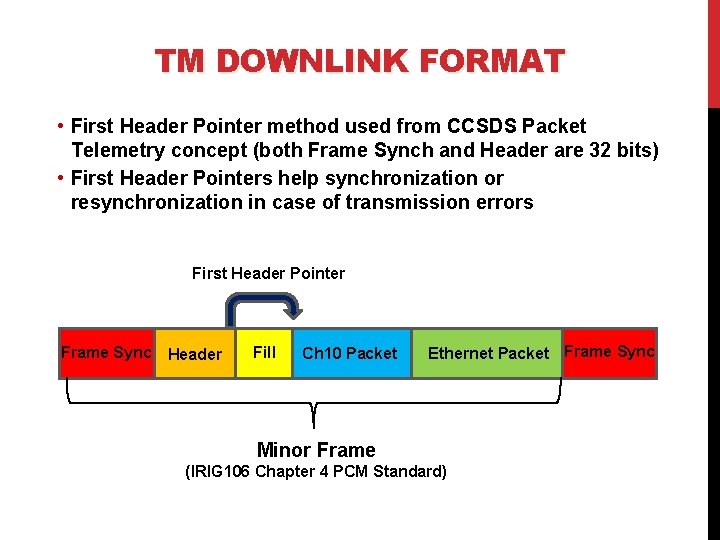
TM DOWNLINK FORMAT • First Header Pointer method used from CCSDS Packet Telemetry concept (both Frame Synch and Header are 32 bits) • First Header Pointers help synchronization or resynchronization in case of transmission errors First Header Pointer Frame Sync Header Fill Ch 10 Packet Ethernet Packet Frame Sync Minor Frame (IRIG 106 Chapter 4 PCM Standard)
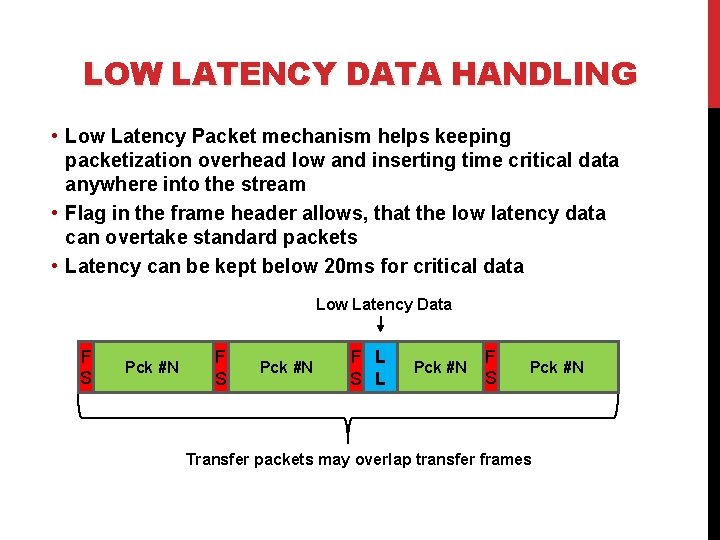
LOW LATENCY DATA HANDLING • Low Latency Packet mechanism helps keeping packetization overhead low and inserting time critical data anywhere into the stream • Flag in the frame header allows, that the low latency data can overtake standard packets • Latency can be kept below 20 ms for critical data Low Latency Data F S Pck #N F L S L Pck #N F S Pck #N Transfer packets may overlap transfer frames
PROTECTING STRUCTURE CRITICAL ELEMENTS • Transmission errors can lead to multiplied error rate, if they are modifying the data interpretations (e. g. altering structure length or data type information). • Extended Golay coding is used to protect structure critical information, as: • Frame Headers, Packet Header data type and packet length information, Length and Data Type information in Chapter 10 and Tm. NS headers • Extended Golay (24, 12, 8) code corrects 3 of 24 transmitted bits with 100 % overhead on structure critical elements • Simple realization possible with small look-up tables
ADDITIONAL ERROR CORRECTION AND RANDOMIZATION • Additional error correction or data randomization methods are NOT part of Chapter 7 • Reed-Solomon, LDPC or other error correction methods shall be included in telemetry transmitters and receivers • Randomized PCM code: IRIG 106 Chapter 4 is increasing the error rate by factor 3, so CCSDS additive randomization is to be considered.
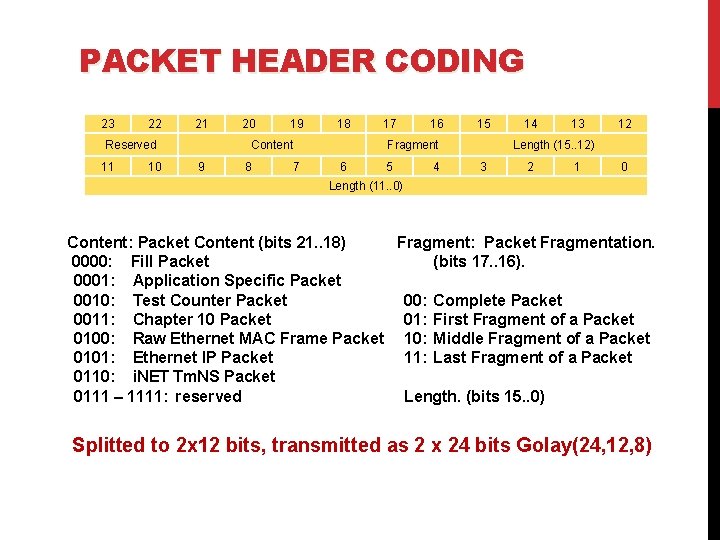
PACKET HEADER CODING 23 22 21 Reserved 11 10 20 19 18 Content 9 8 17 16 15 Fragment 7 6 5 4 14 13 12 Length (15. . 12) 3 2 1 0 Length (11. . 0) Content: Packet Content (bits 21. . 18) Fragment: Packet Fragmentation. 0000: Fill Packet (bits 17. . 16). 0001: Application Specific Packet 0010: Test Counter Packet 00: Complete Packet 0011: Chapter 10 Packet 01: First Fragment of a Packet 0100: Raw Ethernet MAC Frame Packet 10: Middle Fragment of a Packet 0101: Ethernet IP Packet 11: Last Fragment of a Packet 0110: i. NET Tm. NS Packet 0111 – 1111: reserved Length. (bits 15. . 0) Splitted to 2 x 12 bits, transmitted as 2 x 24 bits Golay(24, 12, 8)
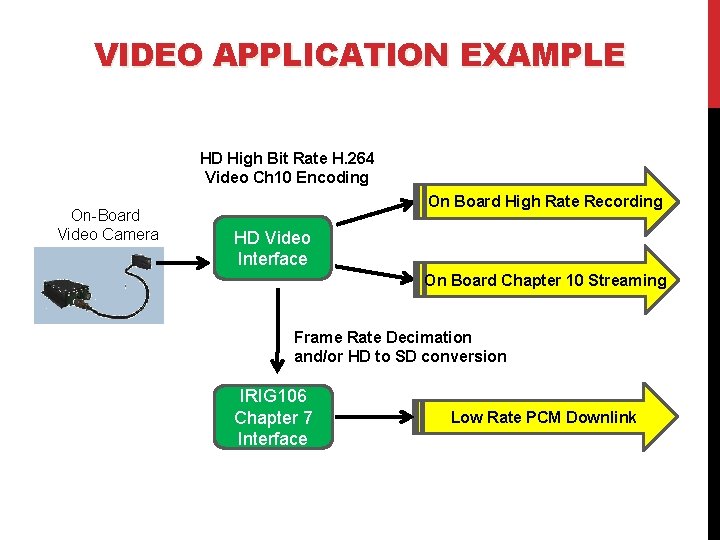
VIDEO APPLICATION EXAMPLE HD High Bit Rate H. 264 Video Ch 10 Encoding On-Board Video Camera On Board High Rate Recording HD Video Interface On Board Chapter 10 Streaming Frame Rate Decimation and/or HD to SD conversion IRIG 106 Chapter 7 Interface Low Rate PCM Downlink
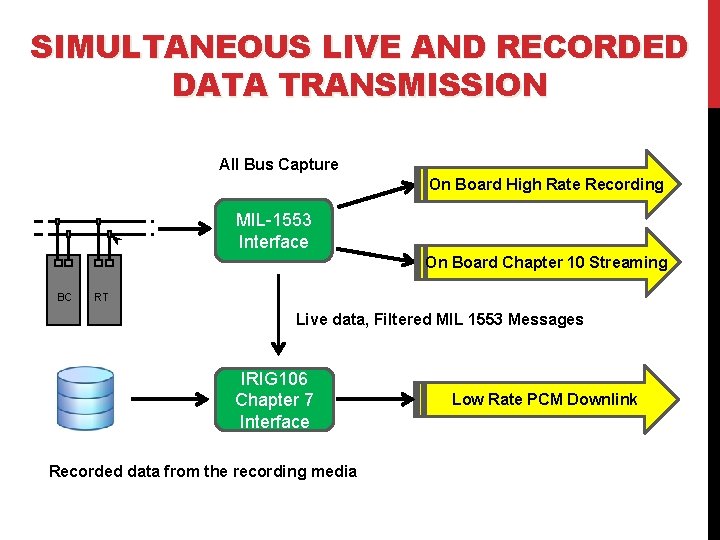
SIMULTANEOUS LIVE AND RECORDED DATA TRANSMISSION All Bus Capture On Board High Rate Recording MIL-1553 Interface On Board Chapter 10 Streaming BC RT Live data, Filtered MIL 1553 Messages IRIG 106 Chapter 7 Interface Recorded data from the recording media Low Rate PCM Downlink
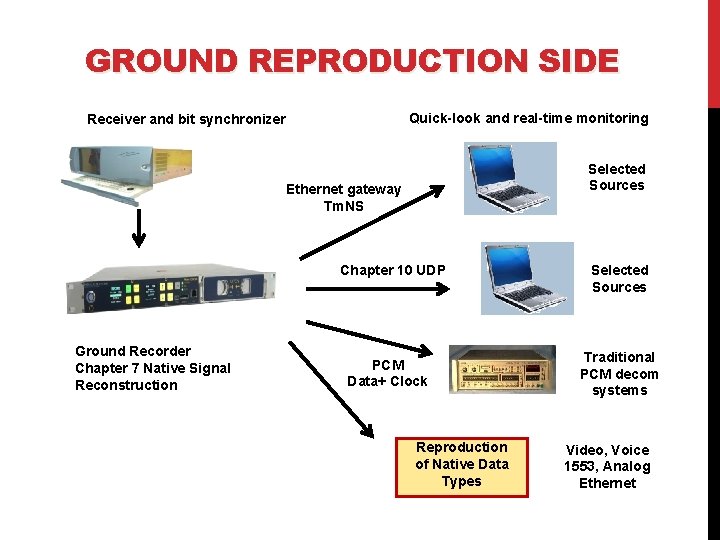
GROUND REPRODUCTION SIDE Quick-look and real-time monitoring Receiver and bit synchronizer Selected Sources Ethernet gateway Tm. NS Chapter 10 UDP Ground Recorder Chapter 7 Native Signal Reconstruction PCM Data+ Clock Reproduction of Native Data Types Selected Sources Traditional PCM decom systems Video, Voice 1553, Analog Ethernet
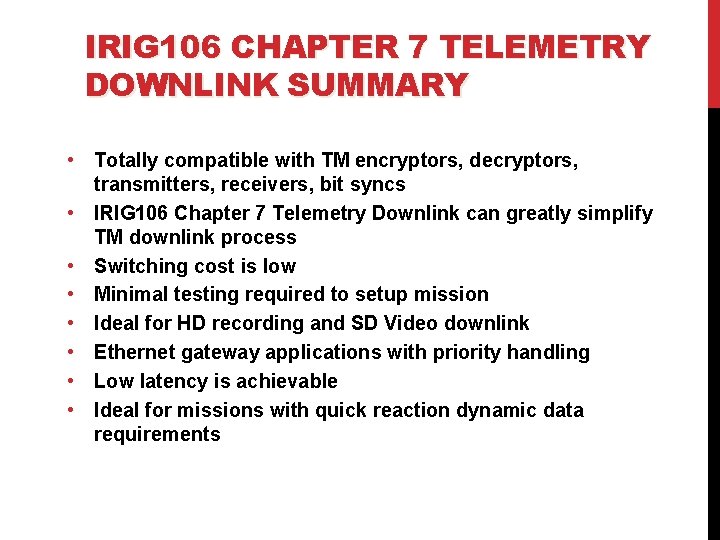
IRIG 106 CHAPTER 7 TELEMETRY DOWNLINK SUMMARY • Totally compatible with TM encryptors, decryptors, transmitters, receivers, bit syncs • IRIG 106 Chapter 7 Telemetry Downlink can greatly simplify TM downlink process • Switching cost is low • Minimal testing required to setup mission • Ideal for HD recording and SD Video downlink • Ethernet gateway applications with priority handling • Low latency is achievable • Ideal for missions with quick reaction dynamic data requirements
THANK YOU !