
IRIA Statistics Production Model of the National Statistical

- Slides: 31
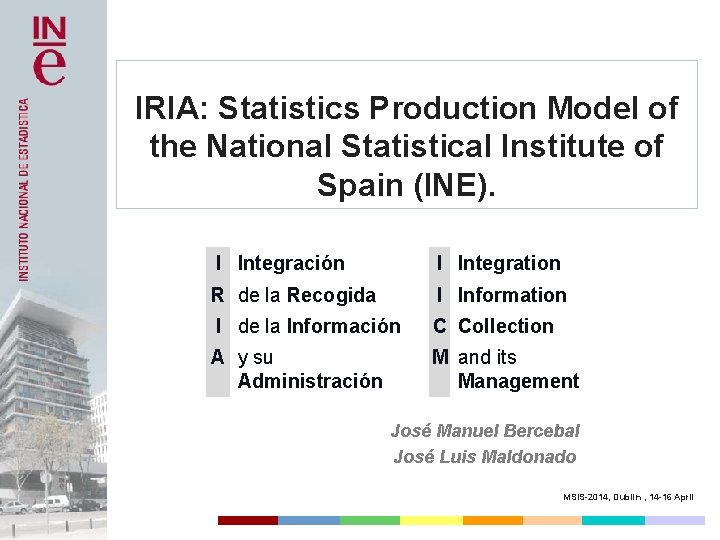
IRIA: Statistics Production Model of the National Statistical Institute of Spain (INE). I Integración I Integration R de la Recogida I Information I de la Información C Collection A y su Administración M and its Management José Manuel Bercebal José Luis Maldonado MSIS-2014, Dublin , 14 -16 April
AGENDA 1. IRIA: Main features and sub-systems 2. Create, run and manage a multichannel survey. 3. Advantages of IRIA. More information http: //www. unece. org/fileadmin/DAM/stats/documents/ece/ces/g e. 50/2014/Topic_4_Spain. pdf MSIS-2014, Dublin , 14 -16 April
INTRODUCTION: INE’s STRATEGY 1. 2. 3. 4. Building integrated system. Managing by standardized tools. Using corporate Data. Bases. Allow to reuse tasks, processes and information MSIS-2014, Dublin , 14 -16 April
WHAT’S IRIA? IRIA is a modular and configurable system that allows the end-user (without computer skills), to design, build, debug, run and manage all kind of surveys and reuse all modules or information with minimal participation of IT Department and generating a corporate database of raw data allowing natural integration from different types of information MSIS-2014, Dublin , 14 -16 April
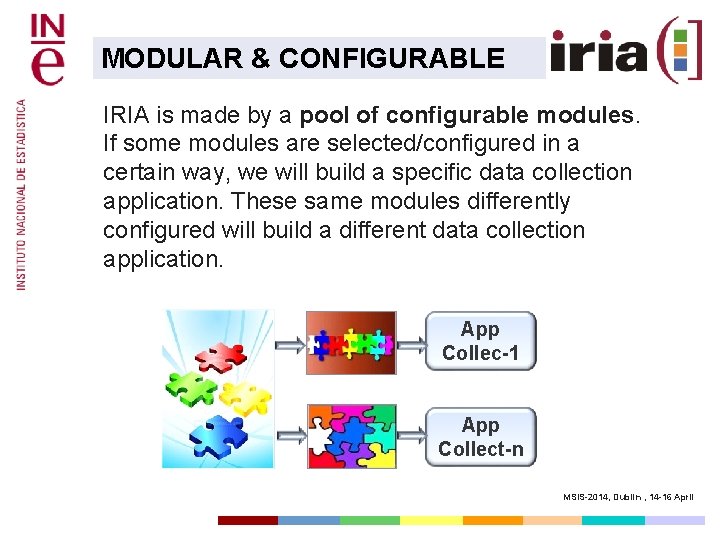
MODULAR & CONFIGURABLE IRIA is made by a pool of configurable modules. If some modules are selected/configured in a certain way, we will build a specific data collection application. These same modules differently configured will build a different data collection application. App Collec-1 App Collect-n MSIS-2014, Dublin , 14 -16 April
END-USER IRIA is a tool for the end-user, therefore IRIA has been developed using the following guidelines: • It must be a simple and user-friendly interface. • It must have on-line help. • It must allow us to do enough tests in order to be sure that the survey is free of errors. MSIS-2014, Dublin , 14 -16 April
ALL KIND OF SURVEYS • Social and economic. • Structural and short-term ALL COLLECTING CHANNELS • CAPI (Computer-assisted personal interviewing) • CAWI (Computer-assisted web interviewing) • CATI (Computer-assisted telephone interviewing) • PAPI (Paper and Pencil Interview) MSIS-2014, Dublin , 14 -16 April
REUSE Reuse is a key feature of the IRIA system. It covers the reuse of both • Components: Copying from a survey all kind of items including the whole questionnaire, getting libraries etc. • Information. IRIA is a unique system for all surveys so it may use data from earlier periods of the same survey or data from other surveys or, indeed, data residing in other information repositories. This can be accessed by database query, web services, or uploading additional information to the IRIA system. Reuse is essential for significant reductions of time to start gathering information. MSIS-2014, Dublin , 14 -16 April
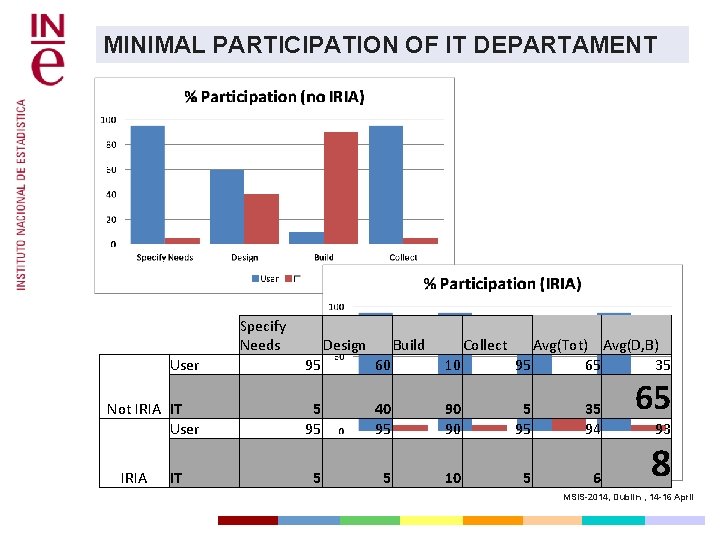
MINIMAL PARTICIPATION OF IT DEPARTAMENT Specify Needs User 95 60 10 Avg(Tot) Avg(D, B) 95 65 35 Not IRIA IT User 5 95 40 95 90 90 5 95 35 94 5 5 10 5 6 IRIA IT Design Build Collect 65 93 8 MSIS-2014, Dublin , 14 -16 April
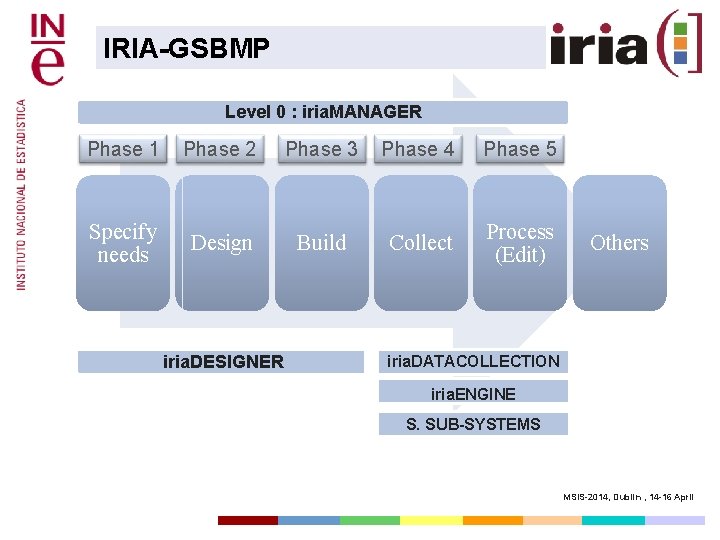
IRIA-GSBMP Level 0 : iria. MANAGER Phase 1 Phase 2 Phase 3 Phase 4 Phase 5 Specify needs Design Build Collect Process (Edit) iria. DESIGNER Others iria. DATACOLLECTION iria. ENGINE S. SUB-SYSTEMS MSIS-2014, Dublin , 14 -16 April
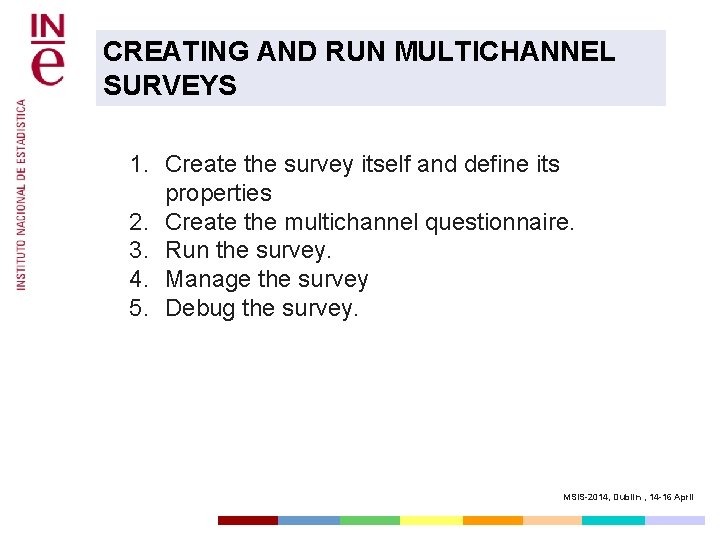
CREATING AND RUN MULTICHANNEL SURVEYS 1. Create the survey itself and define its properties 2. Create the multichannel questionnaire. 3. Run the survey. 4. Manage the survey 5. Debug the survey. MSIS-2014, Dublin , 14 -16 April
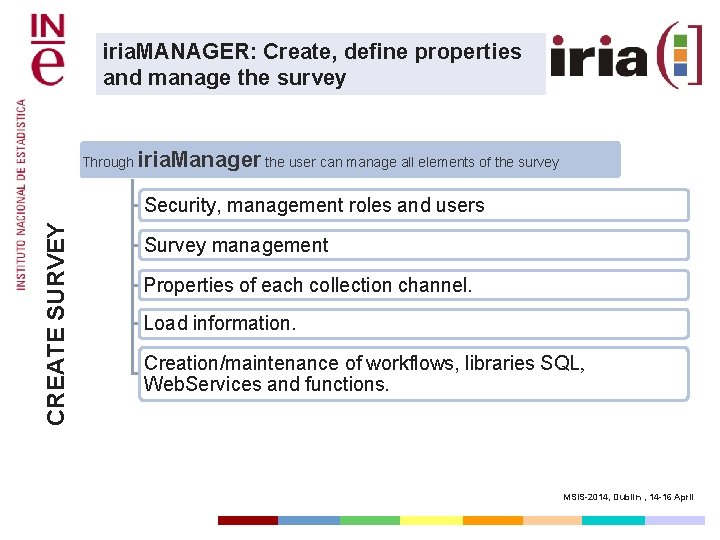
iria. MANAGER: Create, define properties and manage the survey Through iria. Manager the user can manage all elements of the survey CREATE SURVEY Security, management roles and users Survey management Properties of each collection channel. Load information. Creation/maintenance of workflows, libraries SQL, Web. Services and functions. MSIS-2014, Dublin , 14 -16 April
CREATE QUESTIONNAIRE iria. DESIGNER: Design, Build, Test iria. DESIGNER allows questionnaires to be designed, built and tested with a user-friendly interface. For practical purposes iria. DESIGNER distinguishes: 1. Structure of the questionnaire 2. Global items. Can be applied to whole or part of the questionnaire. MSIS-2014, Dublin , 14 -16 April
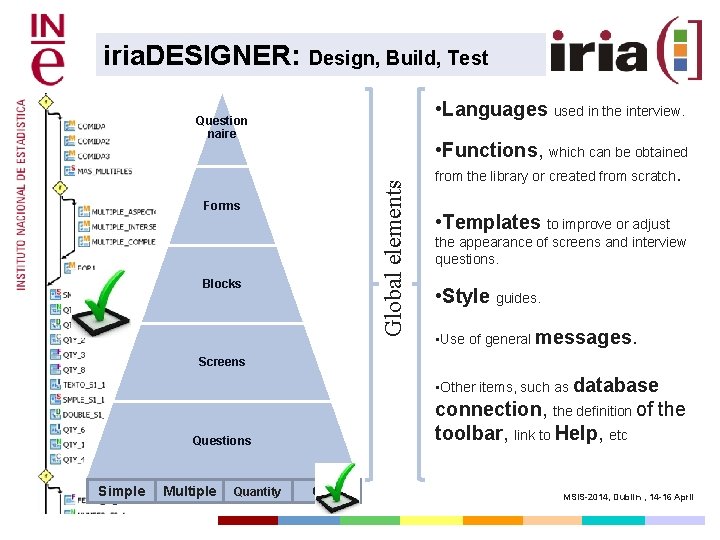
iria. DESIGNER: Design, Build, Test • Languages used in the interview. Global elements Question naire Forms Blocks • Functions, which can be obtained from the library or created from scratch. • Templates to improve or adjust the appearance of screens and interview questions. • Style guides. • Use of general messages. Screens • Other items, such as database connection, the definition of the toolbar, link to Help, etc Questions Simple Multiple Quantity Grid MSIS-2014, Dublin , 14 -16 April
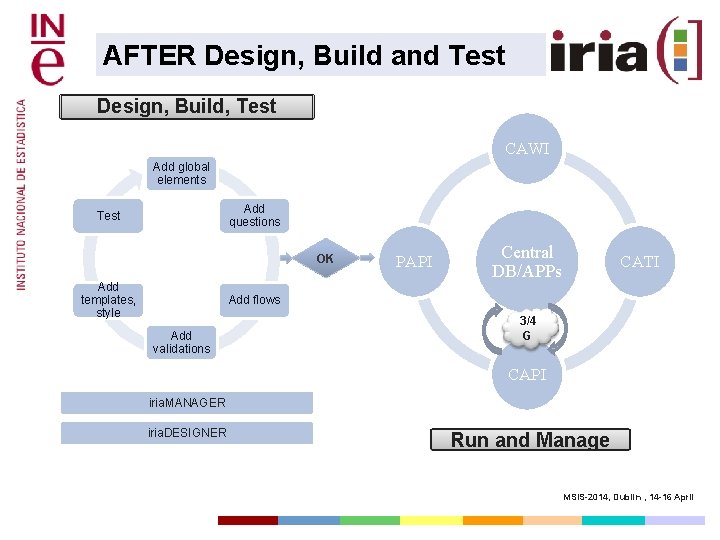
CREATE QUESTIONNAIRE iria. DESIGNER- How? 1. Reusing any existing component from IRIA (questions, screens, flows, styles, templates, libraries, etc). 2. Creating any not previously existing component. 3. The questions can be obtained from the corporate metadata system. Add global elements Add questions Test Add templates, styles Add flows Add validations MSIS-2014, Dublin , 14 -16 April
AFTER Design, Build and Test Design, Build, Test CAWI Add global elements Add questions Test OK Add templates, style PAPI Central DB/APPs CATI Add flows Add validations 3/4 G CAPI iria. MANAGER iria. DESIGNER Run and Manage MSIS-2014, Dublin , 14 -16 April
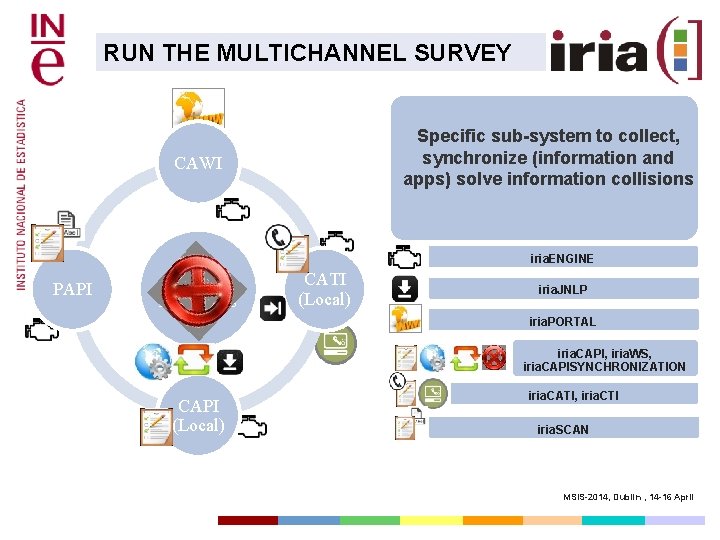
RUN THE MULTICHANNEL SURVEY Specific sub-system to collect, synchronize (information and apps) solve information collisions CAWI iria. ENGINE PAPI Central DB/APPs CATI (Local) iria. JNLP iria. PORTAL iria. CAPI, iria. WS, iria. CAPISYNCHRONIZATION CAPI (Local) iria. CATI, iria. CTI iria. SCAN MSIS-2014, Dublin , 14 -16 April
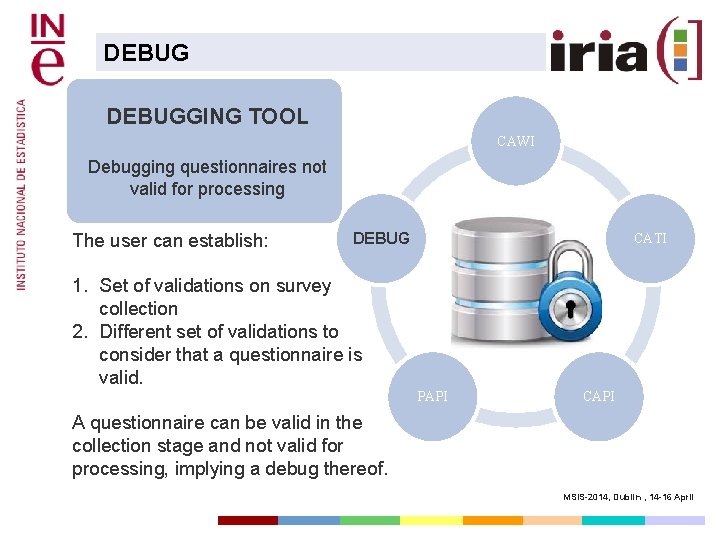
DEBUGGING TOOL CAWI Debugging questionnaires not valid for processing The user can establish: DEBUG CATI Central DB/APPs 1. Set of validations on survey collection 2. Different set of validations to consider that a questionnaire is valid. PAPI CAPI A questionnaire can be valid in the collection stage and not valid for processing, implying a debug thereof. MSIS-2014, Dublin , 14 -16 April
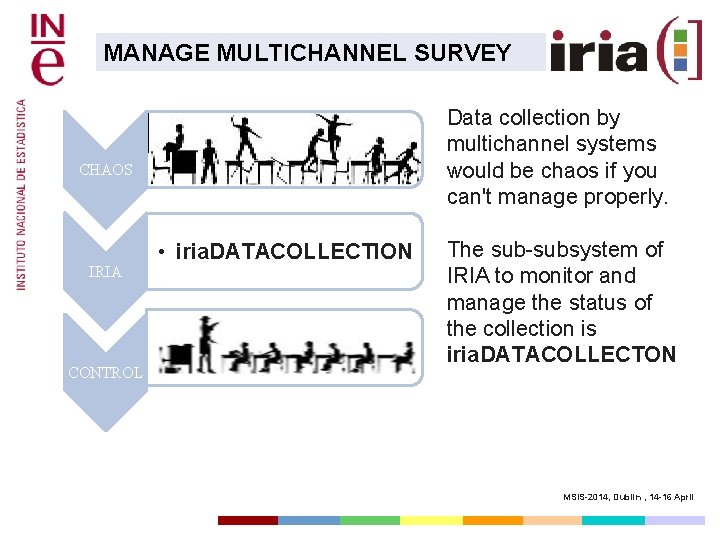
MANAGE MULTICHANNEL SURVEY Data collection by multichannel systems would be chaos if you can't manage properly. CHAOS IRIA CONTROL • iria. DATACOLLECTION The sub-subsystem of IRIA to monitor and manage the status of the collection is iria. DATACOLLECTON MSIS-2014, Dublin , 14 -16 April
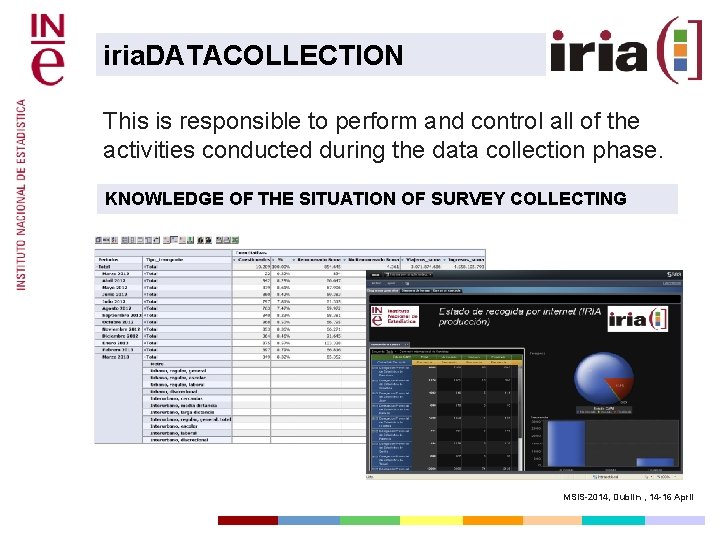
iria. DATACOLLECTION This is responsible to perform and control all of the activities conducted during the data collection phase. KNOWLEDGE OF THE SITUATION OF SURVEY COLLECTING MSIS-2014, Dublin , 14 -16 April
iria. DATACOLLECTION KNOWLEDGE OF THE STATUS FOR EACH QUESTIONNAIRE Accessing to the real situation of each questionnaire. DISTRIBUTION AND CONTROL TASKS Depending on the user’s permissions, may can have control over collection units, surveys and collecting channels for assigning or reassigning all kind tasks. MSIS-2014, Dublin , 14 -16 April
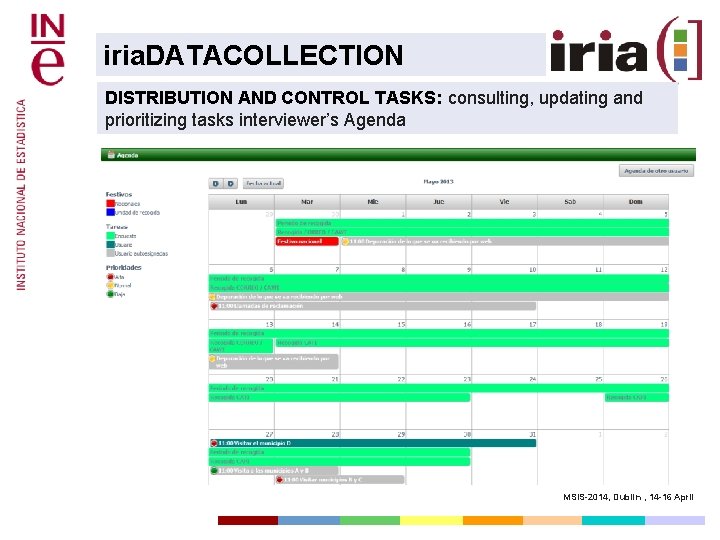
iria. DATACOLLECTION DISTRIBUTION AND CONTROL TASKS: consulting, updating and prioritizing tasks interviewer’s Agenda MSIS-2014, Dublin , 14 -16 April
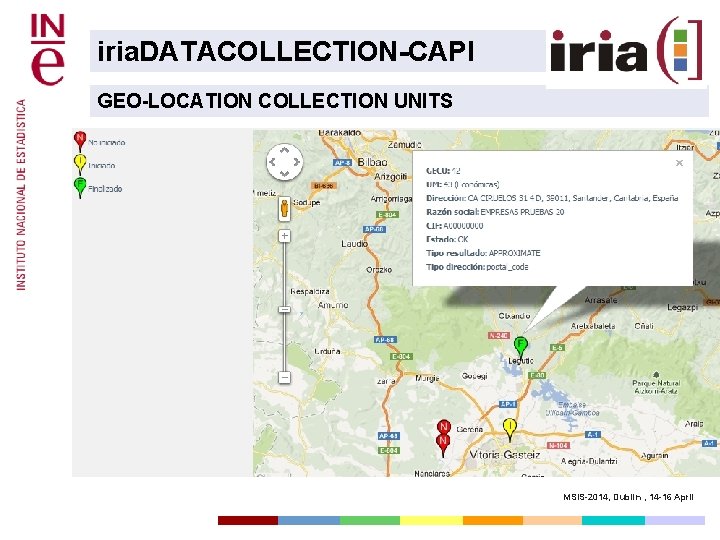
iria. DATACOLLECTION OTHER UTILITIES Communications with informants: For designing and editing mailing templates, label generation, letters and emails. Geo-location collection units MSIS-2014, Dublin , 14 -16 April
iria. DATACOLLECTION-CAPI GEO-LOCATION COLLECTION UNITS MSIS-2014, Dublin , 14 -16 April
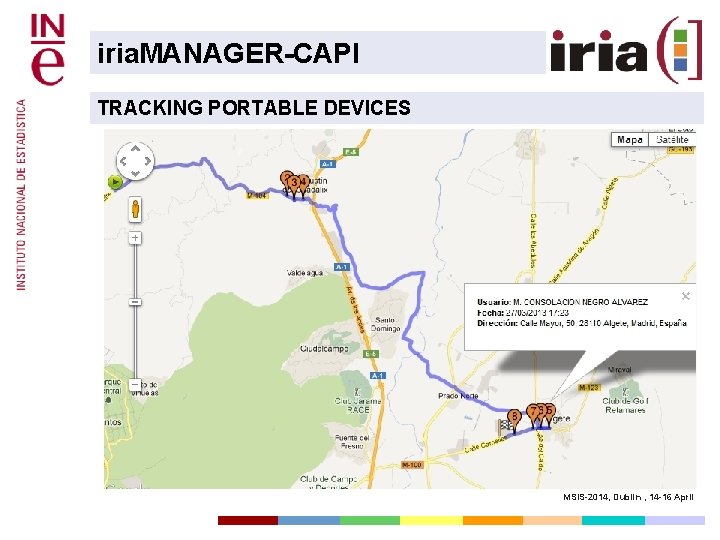
iria. MANAGER-CAPI TRACKING PORTABLE DEVICES MSIS-2014, Dublin , 14 -16 April
ADVANTAGES • Control in real time over all elements of the survey. • To have a single IT tool for the design, building and run of all surveys and all collection channels allows to NSI: • Distribute tasks among INE’s units according to the knowledge of the users. • Reusing the defining elements from other surveys. • Reuse of the formulation of questions and their associated lists from a library (metadata) MSIS-2014, Dublin , 14 -16 April
ADVANTAGES • To have a single storage system for all survey information allows, Reusing information of some other surveys and from other administrative sources. • Time reduction for questionnaire development: from 8 to 2 -3 months and less outsourcing dependence. MSIS-2014, Dublin , 14 -16 April
ADVANTAGES • With IRIA most of the surveys may be carried out sequentially CAWI PAPI / CATI CAPI implying a reduction in the costs of data collection. For the Survey on the Structure of Agricultural Operations (2013) its saving has been over 50% compared with the costs of previous survey (2007). • 2007: Total costs: 3. 794. 906 € (interviewers plus data recording) • 2013: Budget: 1. 782. 887 € (all channels). MSIS-2014, Dublin , 14 -16 April
ADVANTAGES • Costs reductions: 1 mill €/year saving in structural surveys. • Releasing IT resources: For 31 economic surveys and 4 household surveys which are currently in production, the IT Department took part only in 2 of them. IRIA is helping to ease the lack of personnel in the IT Department MSIS-2014, Dublin , 14 -16 April
Josemanuel. bercebal. gomez@ine. es Joseluis. maldonado. cecilia@ine. es MSIS-2014, Dublin , 14 -16 April
IRIA: Statistics Production Model of the National Statistical Institute of Spain (INE). I Integración I Integration R de la Recogida I Information I de la Información C Collection A y su Administración M and its Management José Manuel Bercebal José Luis Maldonado MSIS-2014, Dublin , 14 -16 April