
IREC 2015 Benchmarking a fuel cell stack compression

IREC 2015 Benchmarking a fuel cell stack compression process Mussawar Ahmad, WMG mussawar. ahmad@warwick. ac. uk Academic Supervisors Industrial Supervisors Prof Robert Harrison, Automation Systems Group, Warwick University Dr Axel Bindel, HSSMI Dr James Meredith, Sheffield University Dr Ben Todd, Managing Director, Horizon Fuel Cells UK
Overview Background Compression Importance Literature values Spring equivalent model Horizon fuel cell compression system performance Conclusion Proposed further work
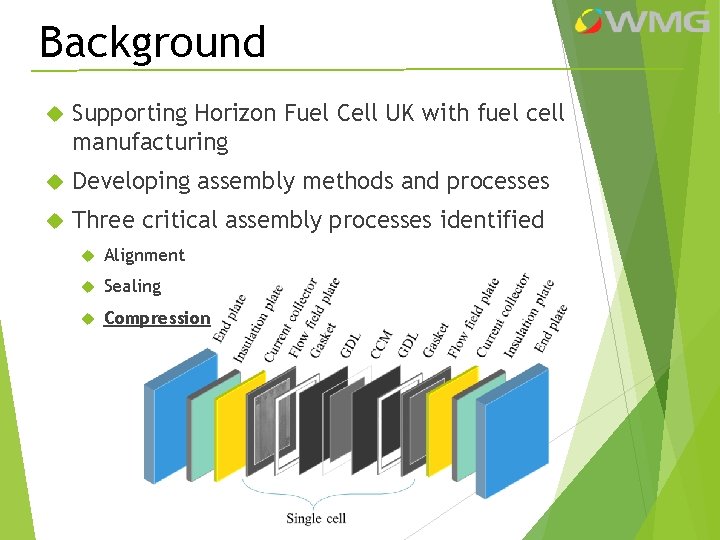
Background Supporting Horizon Fuel Cell UK with fuel cell manufacturing Developing assembly methods and processes Three critical assembly processes identified Alignment Sealing Compression
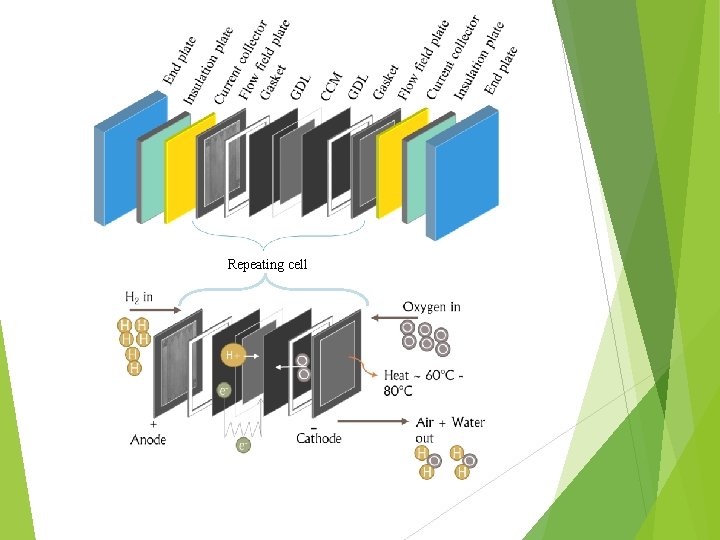
Repeating cell
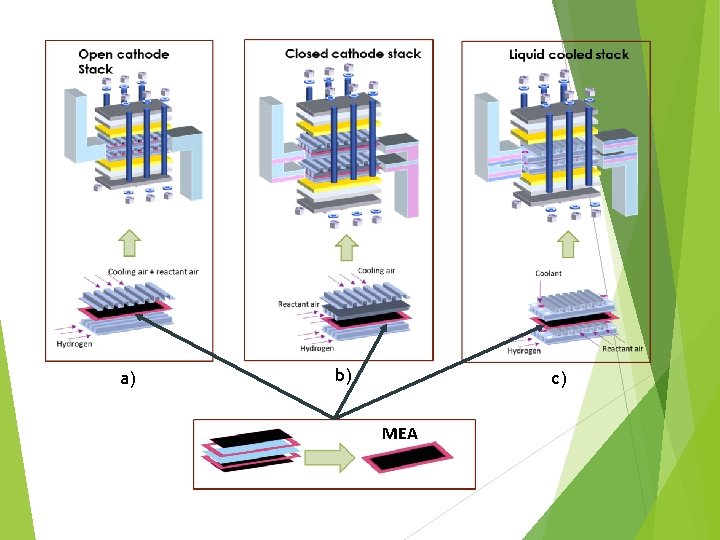
a) b) c) MEA
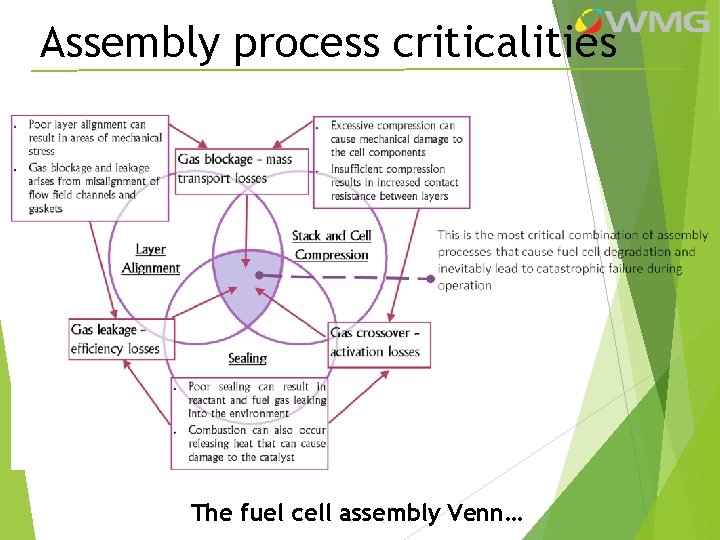
Assembly process criticalities The fuel cell assembly Venn…
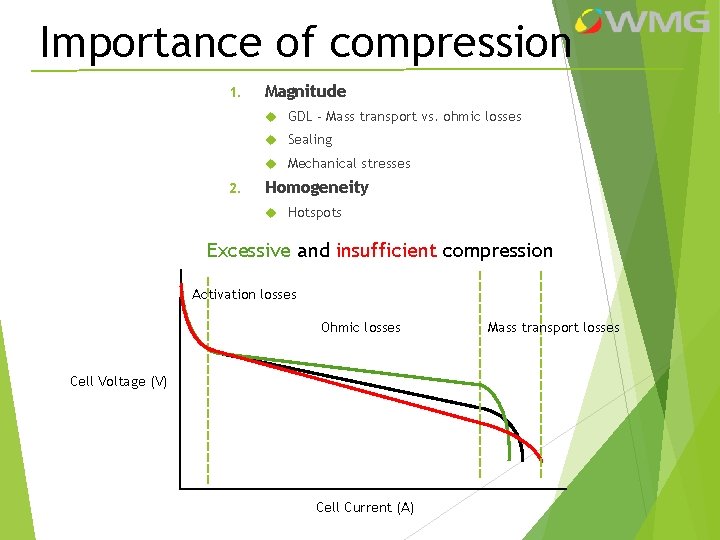
Importance of compression 1. Magnitude GDL - Mass transport vs. ohmic losses Sealing Mechanical stresses 2. Homogeneity Hotspots Excessive and insufficient compression Activation losses Ohmic losses Cell Voltage (V) Cell Current (A) Mass transport losses

Literature Comp. Ratios • • • Trendline – coefficient of determination – 0. 92 Useful tool to help fuel cell researchers identify a ballpark figures for GDL compression Porosity and PTFE loading also do need to be considered
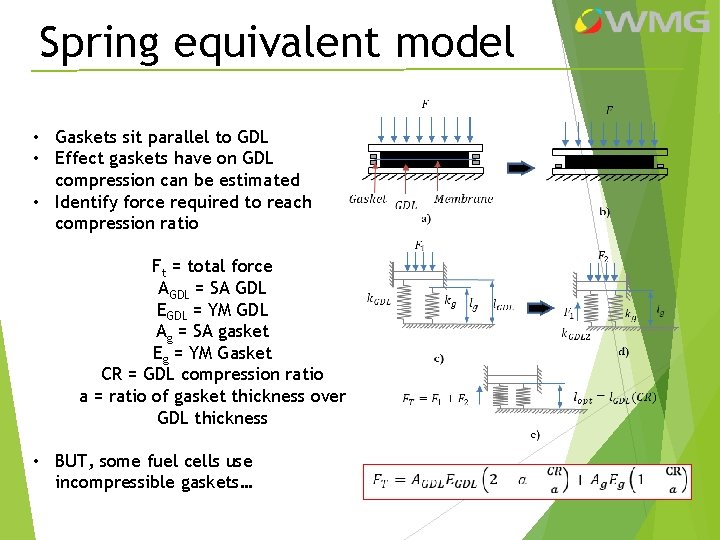
Spring equivalent model • Gaskets sit parallel to GDL • Effect gaskets have on GDL compression can be estimated • Identify force required to reach compression ratio Ft = total force AGDL = SA GDL EGDL = YM GDL Ag = SA gasket Eg = YM Gasket CR = GDL compression ratio a = ratio of gasket thickness over GDL thickness • BUT, some fuel cells use incompressible gaskets…
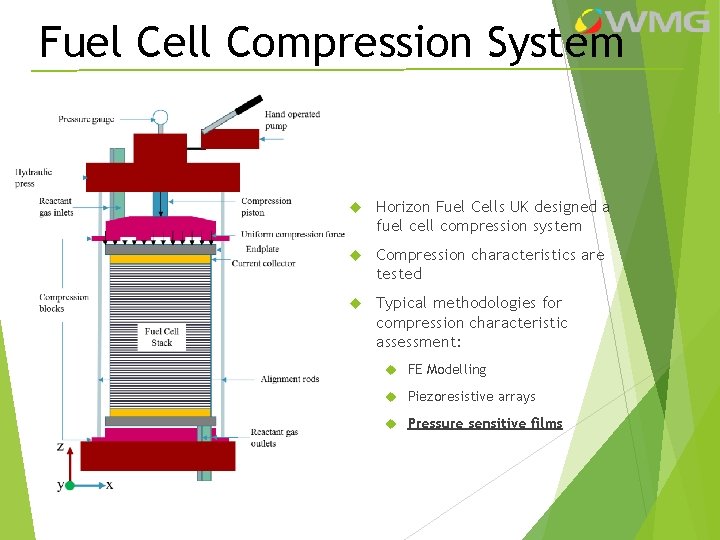
Fuel Cell Compression System Horizon Fuel Cells UK designed a fuel cell compression system Compression characteristics are tested Typical methodologies for compression characteristic assessment: FE Modelling Piezoresistive arrays Pressure sensitive films
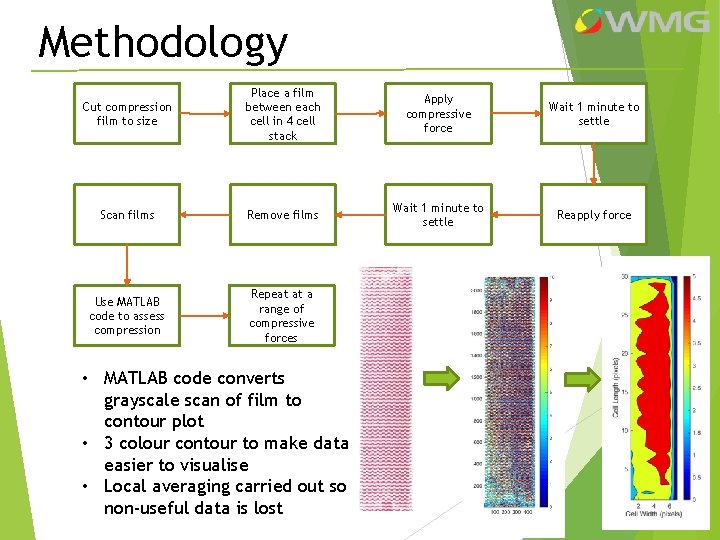
Methodology Cut compression film to size Place a film between each cell in 4 cell stack Apply compressive force Wait 1 minute to settle Scan films Remove films Wait 1 minute to settle Reapply force Use MATLAB code to assess compression Repeat at a range of compressive forces • MATLAB code converts grayscale scan of film to contour plot • 3 colour contour to make data easier to visualise • Local averaging carried out so non-useful data is lost
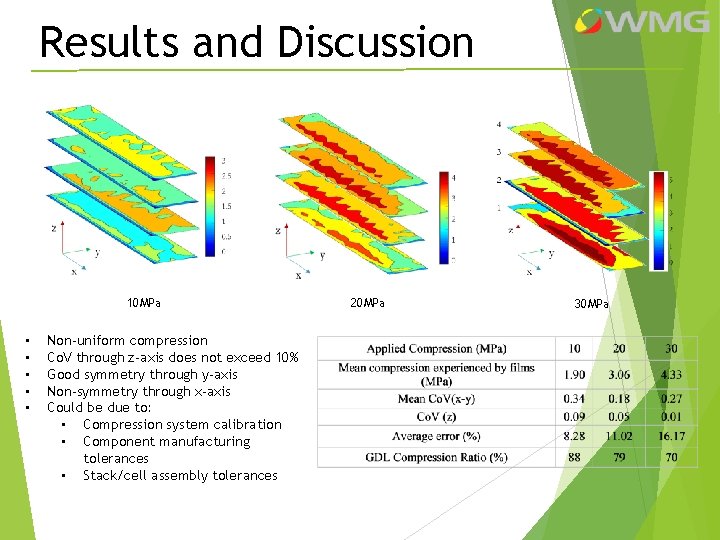
Results and Discussion 10 MPa • • • Non-uniform compression Co. V through z-axis does not exceed 10% Good symmetry through y-axis Non-symmetry through x-axis Could be due to: • Compression system calibration • Component manufacturing tolerances • Stack/cell assembly tolerances 20 MPa 30 MPa
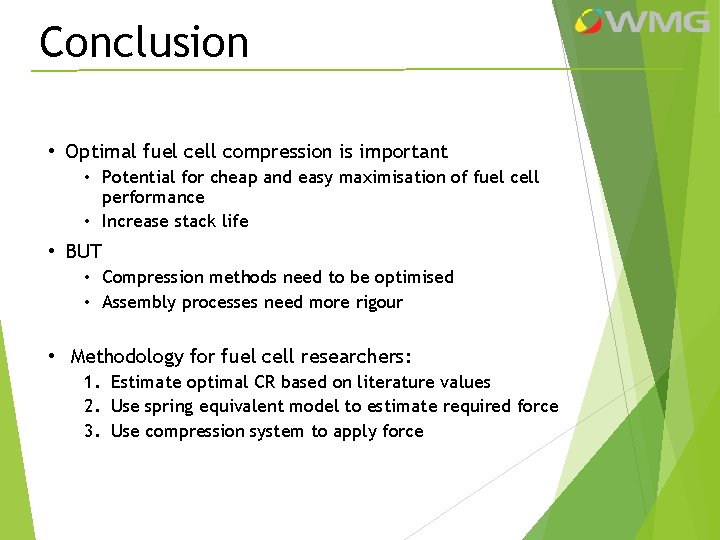
Conclusion • Optimal fuel cell compression is important • Potential for cheap and easy maximisation of fuel cell performance • Increase stack life • BUT • Compression methods need to be optimised • Assembly processes need more rigour • Methodology for fuel cell researchers: 1. Estimate optimal CR based on literature values 2. Use spring equivalent model to estimate required force 3. Use compression system to apply force
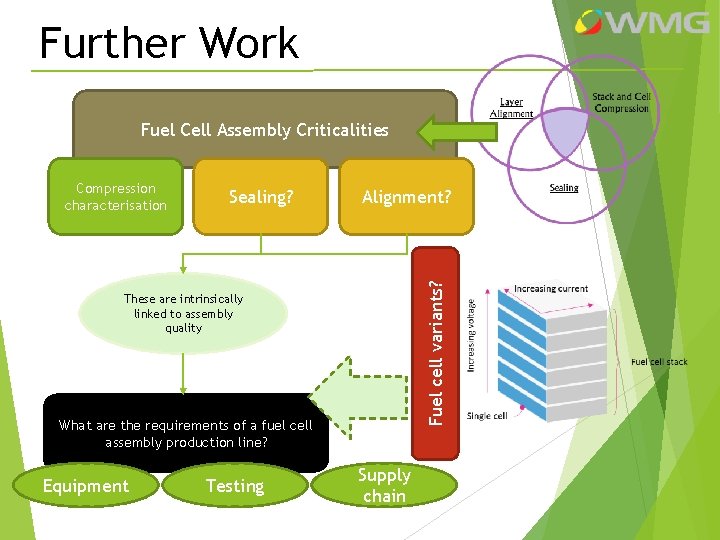
Further Work Fuel Cell Assembly Criticalities Sealing? Alignment? Fuel cell variants? Compression characterisation These are intrinsically linked to assembly quality What are the requirements of a fuel cell assembly production line? Equipment Testing Supply chain
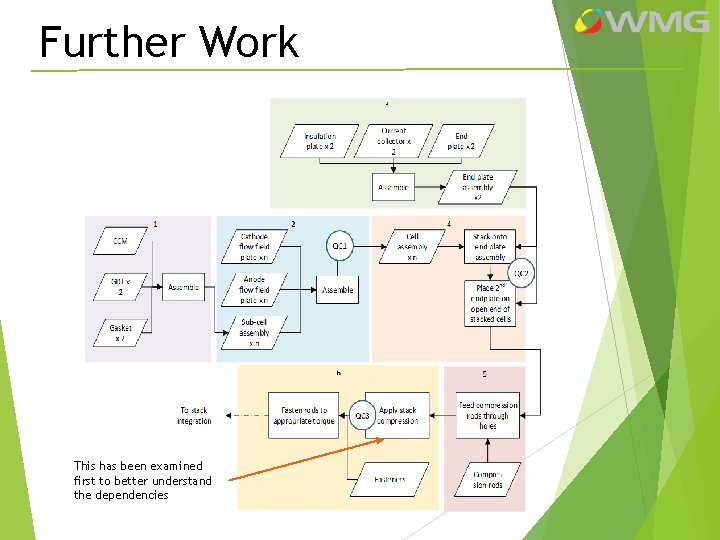
Further Work This has been examined first to better understand the dependencies
Questions Mussawar Ahmad, WMG mussawar. ahmad@warwick. ac. uk Academic Supervisors Industrial Supervisors Prof Robert Harrison, Automation Systems Group, Warwick University Dr Axel Bindel, HSSMI Dr James Meredith, Sheffield University Dr Ben Todd, Managing Director, Horizon Fuel Cells UK Acknowledgements
References Mason, T. J. , et al. , Effect of clamping pressure on ohmic resistance and compression of gas diffusion layers for polymer electrolyte fuel cells. Journal of Power Sources, 2012. 219: p. 52 -59 Wen, C. -Y. , Y. -S. Lin, and C. -H. Lu, Experimental study of clamping effects on the performances of a single proton exchange membrane fuel cell and a 10 -cell stack. Journal of Power Sources, 2009. 192(2): p. 475 -485 Lee, S. -J. , C. -D. Hsu, and C. -H. Huang, Analyses of the fuel cell stack assembly pressure. Journal of Power Sources, 2005. 145(2): p. 353 -361. Lee, W. -k. , et al. , The effects of compression and gas diffusion layers on the performance of a PEM fuel cell. Journal of power sources, 1999. 84(1): p. 45 -51. Xing, X. Q. , et al. , Optimization of assembly clamping pressure on performance of proton-exchange membrane fuel cells. Journal of Power Sources, 2010. 195(1): p. 62 -68. Montanini, R. , G. Squadrito, and G. Giacoppo, Measurement of the clamping pressure distribution in polymer electrolyte fuel cells using piezoresistive sensor arrays and digital image correlation techniques. Journal of Power Sources, 2011. 196(20): p. 8484 -8493. Gatto, I. , et al. , Influence of the bolt torque on PEFC performance with different gasket materials. International Journal of Hydrogen Energy, 2011. 36(20): p. 13043 -13050 Lin, P. Zhou, and C. W. Wu, A high efficient assembly technique for large PEMFC stacks. Journal of Power Sources, 2009. 194(1): p. 381 -390
- Slides: 17