
IQC best practice Annette Thomas Weqas Director Cardiff

IQC best practice Annette Thomas Weqas Director Cardiff and Vale University Health Board Chair IFCC C-AQ
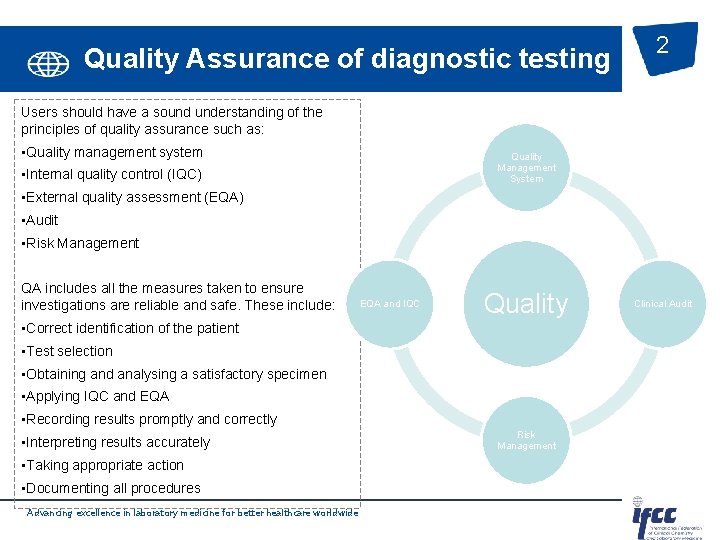
Quality Assurance of diagnostic testing 2 Users should have a sound understanding of the principles of quality assurance such as: • Quality management system Quality Management System • Internal quality control (IQC) • External quality assessment (EQA) • Audit • Risk Management QA includes all the measures taken to ensure investigations are reliable and safe. These include: EQA and IQC Quality • Correct identification of the patient • Test selection • Obtaining and analysing a satisfactory specimen • Applying IQC and EQA • Recording results promptly and correctly • Interpreting results accurately • Taking appropriate action • Documenting all procedures Advancing excellence in laboratory medicine for better healthcare worldwide Risk Management Clinical Audit
Definitions. 3 Quality Control (QC) refers to procedures for monitoring the work processes, detecting problems, and making corrections prior to delivery of products or services. Statistical process control, or statistical quality control, is the major procedure for monitoring the analytical performance of laboratory methods. Quality Assessment (QA) refers to the broader monitoring of other dimensions or characteristics of quality. Characteristics such as turnaround time, patient preparation, specimen acquisition, etc. , are monitored through QA activities. Proficiency testing (EQA) provides an external measure of analytical performance (also some pre and post analytical). Quality Improvement (QI) is aimed at determining the causes or sources of problems identified by QC and QA. May require problem-solving tools (such as the flowchart, Pareto diagram, Ishikawa cause and effect diagram, force field analysis, etc) Advancing excellence in laboratory medicine for better healthcare worldwide
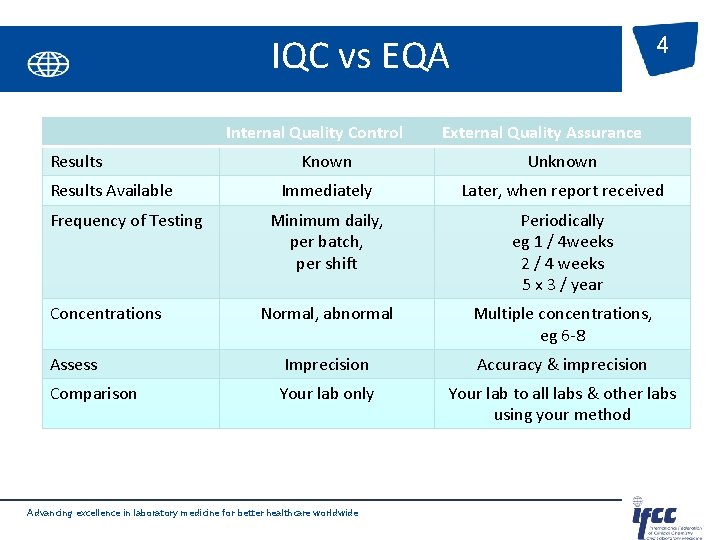
IQC vs EQA Internal Quality Control Results 4 External Quality Assurance Known Unknown Immediately Later, when report received Minimum daily, per batch, per shift Periodically eg 1 / 4 weeks 2 / 4 weeks 5 x 3 / year Normal, abnormal Multiple concentrations, eg 6 -8 Assess Imprecision Accuracy & imprecision Comparison Your lab only Your lab to all labs & other labs using your method Results Available Frequency of Testing Concentrations Advancing excellence in laboratory medicine for better healthcare worldwide

ISO 15189: 2012 - what does it say? 5 • Design– 5. 6. 2. The laboratory shall design quality control procedures that verify the attainment of the internal quality of results. Special attention should be given to elimination of mistakes in the pre and post examination processes. • Material– 5. 6. 2. 1 QC shall react to the exam system in a manner as close to patient • • samples as possible. QC should be periodically examined along with patient samples, with a frequency that is based on the stability of the procedure. Note: The lab should choose conc. of QC especially at or near clinical decision values that ensure the validity of decisions made. Note: Use of 3 rd part QC should be considered, either instead of, or in addition to any QC material supplied by the reagent or instrument manufacturer. Advancing excellence in laboratory medicine for better healthcare worldwide
ISO 15189: 2012 - what does it say? • QC Data – • • • 6 5. 6. 2. 2 The lab shall have a procedure to minimise the risk of significantly different or aberrant patient examination results being reported in the event of QC rule failure. This is poor wording as for a method that is excellent (6 S) two results could be statistically different but not clinically significant and a method that is poor (2 S), two results could be statistically insignificant but clinically significant. Note: When QC rules are violated, examination results should normally be rejected and relevant patient samples re-examined after the error condition has been corrected and within specification performance is verified. The lab should also evaluate the results from patient samples that were examined after the last successful QC event. QC data shall be reviewed at regular intervals to detect trends in exam performance that may indicate problems in the exam system. When such trends are noted preventive actions shall be taken and recorded. Note: Established statistical techniques such as Shewhart/ Levey-Jennings charts and process control rules should be used wherever possible to continuously monitor examination system performance. Advancing excellence in laboratory medicine for better healthcare worldwide

7 Advancing excellence in laboratory medicine for better healthcare worldwide

Design of IQC Define the quality required of the assay Determine the quality the assay can provide Identify candidate IQC strategy Select appropriate QC rules Advancing excellence in laboratory medicine for better healthcare worldwide 8
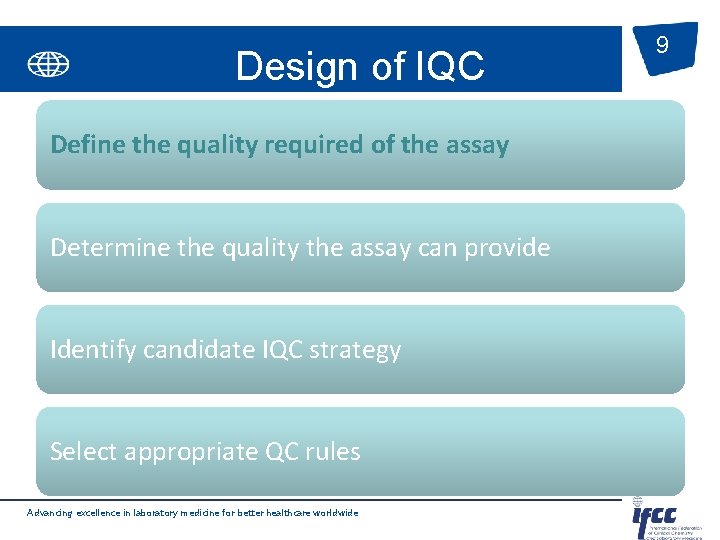
Design of IQC Define the quality required of the assay Determine the quality the assay can provide Identify candidate IQC strategy Select appropriate QC rules Advancing excellence in laboratory medicine for better healthcare worldwide 9
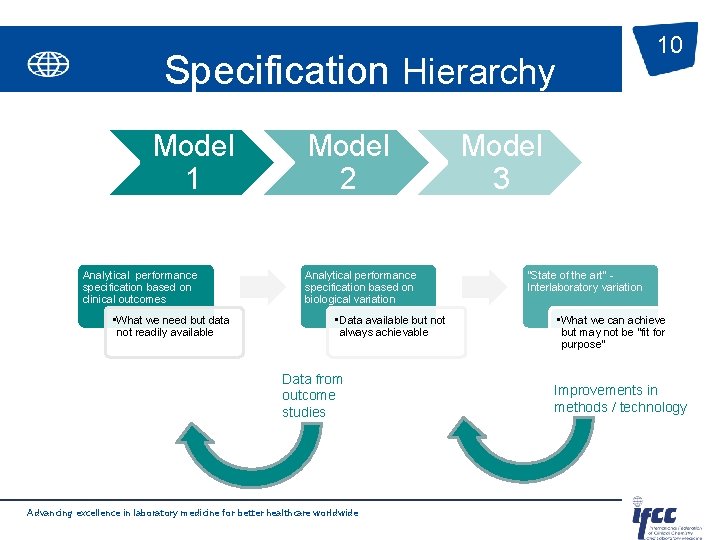
10 Specification Hierarchy Model 1 Analytical performance specification based on clinical outcomes • What we need but data not readily available Model 2 Analytical performance specification based on biological variation • Data available but not always achievable Data from outcome studies Advancing excellence in laboratory medicine for better healthcare worldwide Model 3 “State of the art” Interlaboratory variation • What we can achieve but may not be “fit for purpose” Improvements in methods / technology
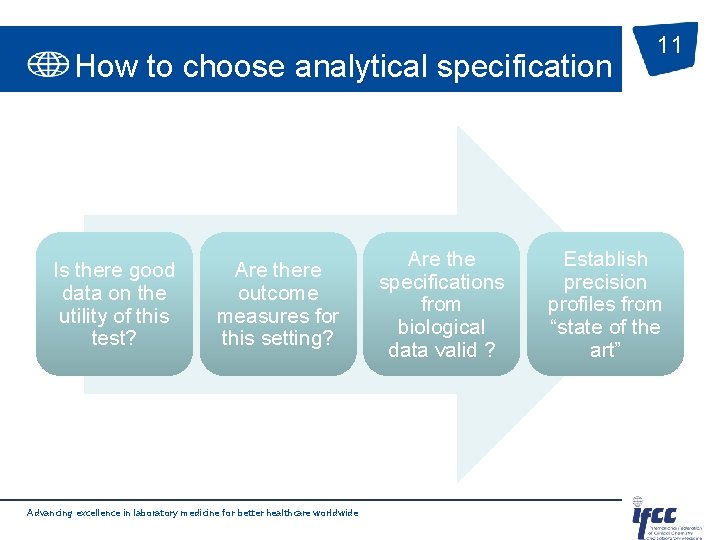
How to choose analytical specification Is there good data on the utility of this test? Are there outcome measures for this setting? Advancing excellence in laboratory medicine for better healthcare worldwide Are the specifications from biological data valid ? 11 Establish precision profiles from “state of the art”
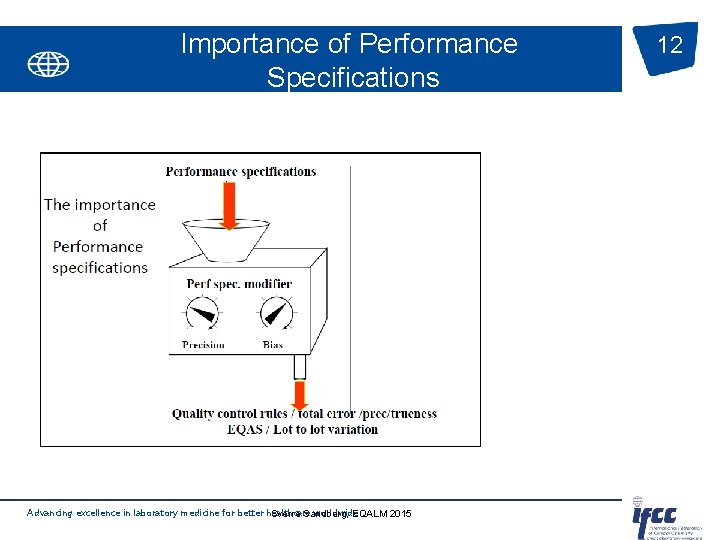
Importance of Performance Specifications Advancing excellence in laboratory medicine for better healthcare worldwide Sverre Sandberg, EQALM 2015 12
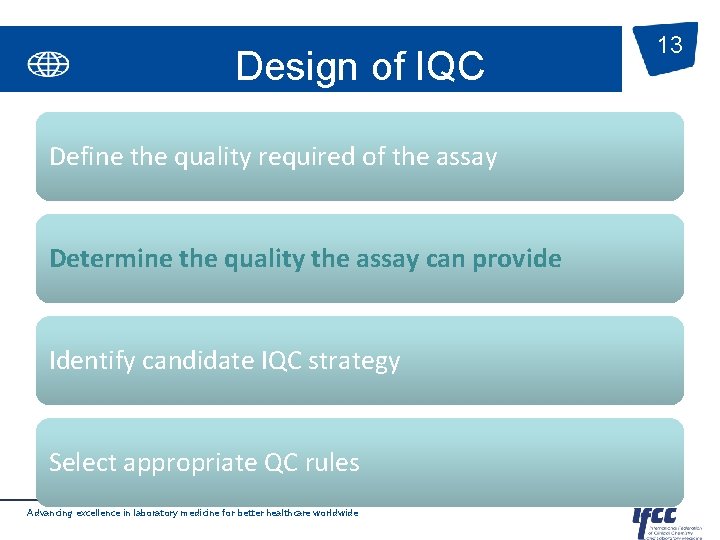
Design of IQC Define the quality required of the assay Determine the quality the assay can provide Identify candidate IQC strategy Select appropriate QC rules Advancing excellence in laboratory medicine for better healthcare worldwide 13
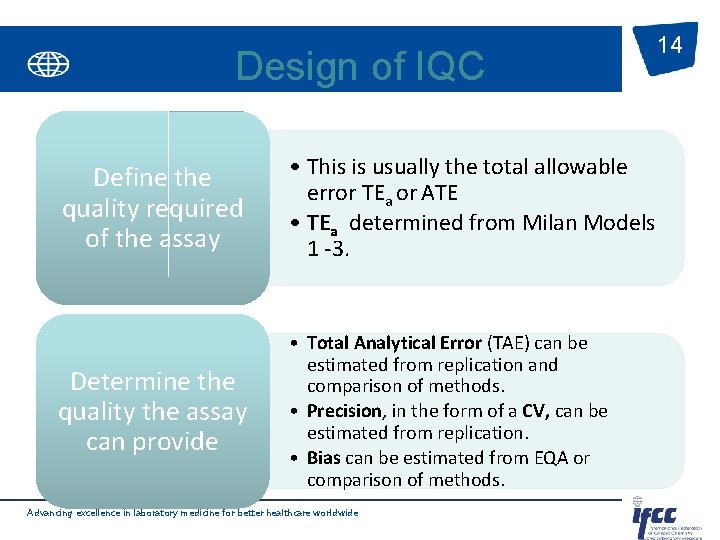
Design of IQC Define the quality required of the assay • This is usually the total allowable error TEa or ATE • TEa determined from Milan Models 1 -3. Determine the quality the assay can provide • Total Analytical Error (TAE) can be estimated from replication and comparison of methods. • Precision, in the form of a CV, can be estimated from replication. • Bias can be estimated from EQA or comparison of methods. Advancing excellence in laboratory medicine for better healthcare worldwide 14
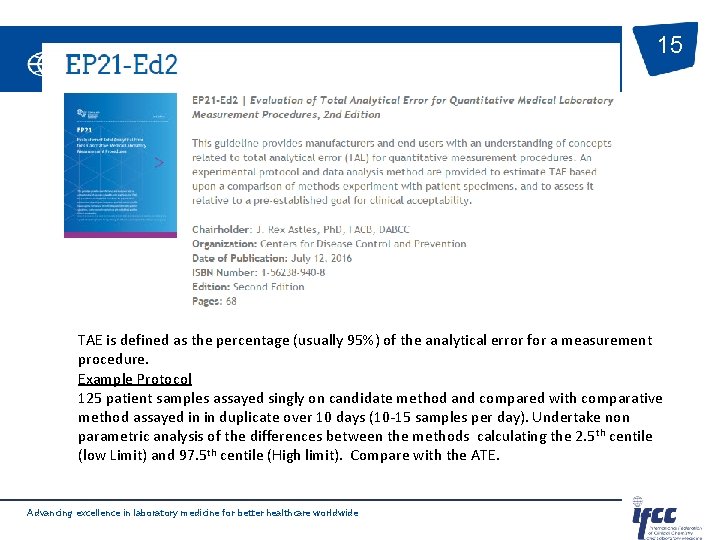
15 TAE is defined as the percentage (usually 95%) of the analytical error for a measurement procedure. Example Protocol 125 patient samples assayed singly on candidate method and compared with comparative method assayed in in duplicate over 10 days (10 -15 samples per day). Undertake non parametric analysis of the differences between the methods calculating the 2. 5 th centile (low Limit) and 97. 5 th centile (High limit). Compare with the ATE. Advancing excellence in laboratory medicine for better healthcare worldwide
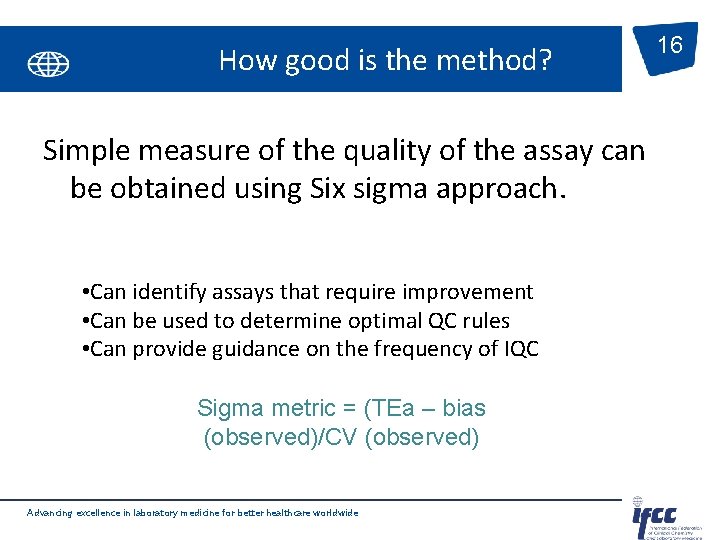
How good is the method? Simple measure of the quality of the assay can be obtained using Six sigma approach. • Can identify assays that require improvement • Can be used to determine optimal QC rules • Can provide guidance on the frequency of IQC Sigma metric = (TEa – bias (observed)/CV (observed) Advancing excellence in laboratory medicine for better healthcare worldwide 16
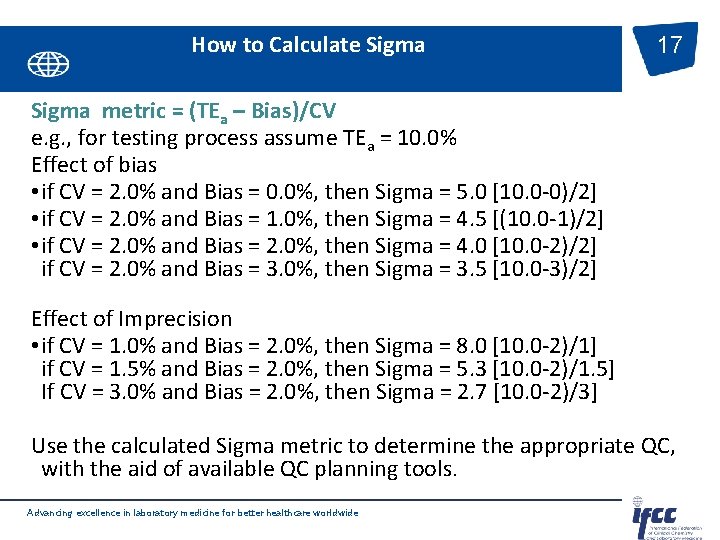
How to Calculate Sigma 17 Sigma metric = (TEa – Bias)/CV e. g. , for testing process assume TEa = 10. 0% Effect of bias • if CV = 2. 0% and Bias = 0. 0%, then Sigma = 5. 0 [10. 0 -0)/2] • if CV = 2. 0% and Bias = 1. 0%, then Sigma = 4. 5 [(10. 0 -1)/2] • if CV = 2. 0% and Bias = 2. 0%, then Sigma = 4. 0 [10. 0 -2)/2] if CV = 2. 0% and Bias = 3. 0%, then Sigma = 3. 5 [10. 0 -3)/2] Effect of Imprecision • if CV = 1. 0% and Bias = 2. 0%, then Sigma = 8. 0 [10. 0 -2)/1] if CV = 1. 5% and Bias = 2. 0%, then Sigma = 5. 3 [10. 0 -2)/1. 5] If CV = 3. 0% and Bias = 2. 0%, then Sigma = 2. 7 [10. 0 -2)/3] Use the calculated Sigma metric to determine the appropriate QC, with the aid of available QC planning tools. Advancing excellence in laboratory medicine for better healthcare worldwide
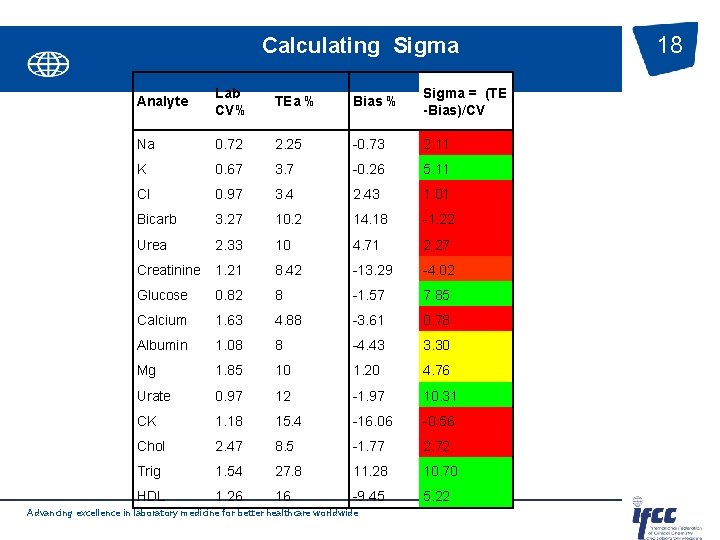
Calculating Sigma Analyte Lab CV% TEa % Bias % Sigma = (TE -Bias)/CV Na 0. 72 2. 25 -0. 73 2. 11 K 0. 67 3. 7 -0. 26 5. 11 Cl 0. 97 3. 4 2. 43 1. 01 Bicarb 3. 27 10. 2 14. 18 -1. 22 Urea 2. 33 10 4. 71 2. 27 Creatinine 1. 21 8. 42 -13. 29 -4. 02 Glucose 0. 82 8 -1. 57 7. 85 Calcium 1. 63 4. 88 -3. 61 0. 78 Albumin 1. 08 8 -4. 43 3. 30 Mg 1. 85 10 1. 20 4. 76 Urate 0. 97 12 -1. 97 10. 31 CK 1. 18 15. 4 -16. 06 -0. 56 Chol 2. 47 8. 5 -1. 77 2. 72 Trig 1. 54 27. 8 11. 28 10. 70 HDL 1. 26 16 -9. 45 5. 22 Advancing excellence in laboratory medicine for better healthcare worldwide 18
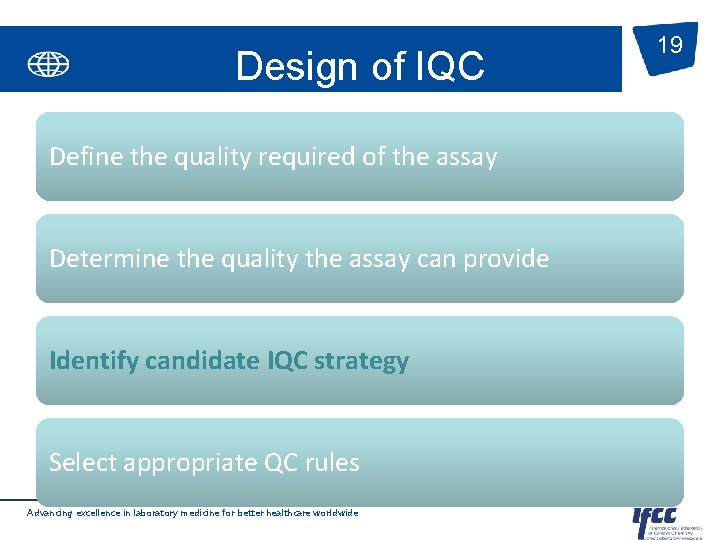
Design of IQC Define the quality required of the assay Determine the quality the assay can provide Identify candidate IQC strategy Select appropriate QC rules Advancing excellence in laboratory medicine for better healthcare worldwide 19
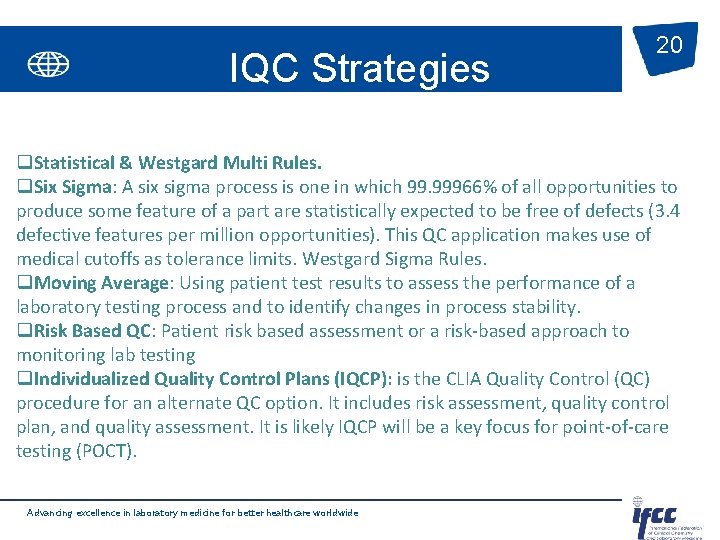
IQC Strategies 20 q. Statistical & Westgard Multi Rules. q. Six Sigma: A six sigma process is one in which 99. 99966% of all opportunities to produce some feature of a part are statistically expected to be free of defects (3. 4 defective features per million opportunities). This QC application makes use of medical cutoffs as tolerance limits. Westgard Sigma Rules. q. Moving Average: Using patient test results to assess the performance of a laboratory testing process and to identify changes in process stability. q. Risk Based QC: Patient risk based assessment or a risk-based approach to monitoring lab testing q. Individualized Quality Control Plans (IQCP): is the CLIA Quality Control (QC) procedure for an alternate QC option. It includes risk assessment, quality control plan, and quality assessment. It is likely IQCP will be a key focus for point-of-care testing (POCT). Advancing excellence in laboratory medicine for better healthcare worldwide
IQC Planning - Questions to consider 21 • What is the risk of getting it wrong? • How complex is my device? What is the performance? Is it for purpose? • I have an electronic QC, do I still need to perform IQC ? • What frequency should I be setting for testing IQC? • What acceptance limits should I set? • What material is available – is it simple to use, commutable, is it near the cut off? • What is the storage and stability? • How do I analyse trends? • How do I deal with qualitative tests? • What procedure do I need the user to follow if the results are outside acceptable limits? Advancing excellence in laboratory medicine for better healthcare worldwide
22 CLSI EP 23™—Laboratory Quality Control Based on Risk Management EP 23 describes good laboratory practice for developing a QCP based on the manufacturer’s risk mitigation information, applicable regulatory and accreditation requirements, and the individual health care and laboratory setting. James H. Nichols, Ph. D, DABCC, FACB, Chairholder of the document development committee Advancing excellence in laboratory medicine for better healthcare worldwide
Identify candidate IQC strategies 23 • the control materials used, • the number of control samples analyzed, • the location of these control samples in an analytical run, • the quality control rules Advancing excellence in laboratory medicine for better healthcare worldwide
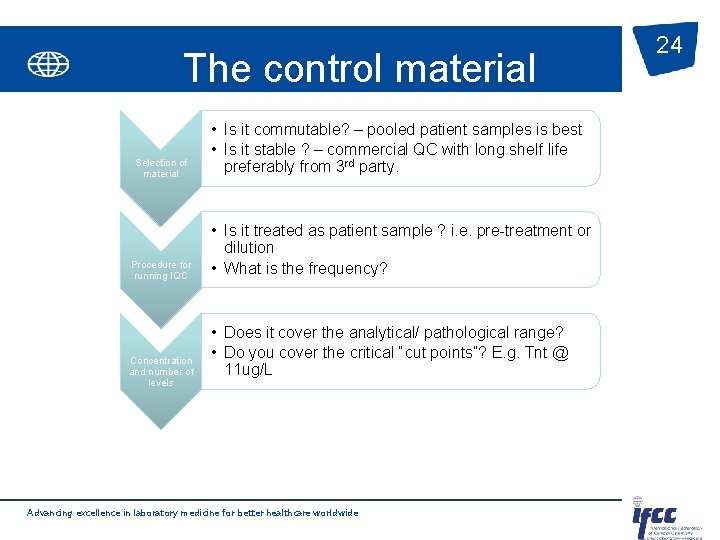
The control material Selection of material Procedure for running IQC Concentration and number of levels • Is it commutable? – pooled patient samples is best • Is it stable ? – commercial QC with long shelf life preferably from 3 rd party. • Is it treated as patient sample ? i. e. pre-treatment or dilution • What is the frequency? • Does it cover the analytical/ pathological range? • Do you cover the critical “cut points”? E. g. Tnt @ 11 ug/L Advancing excellence in laboratory medicine for better healthcare worldwide 24
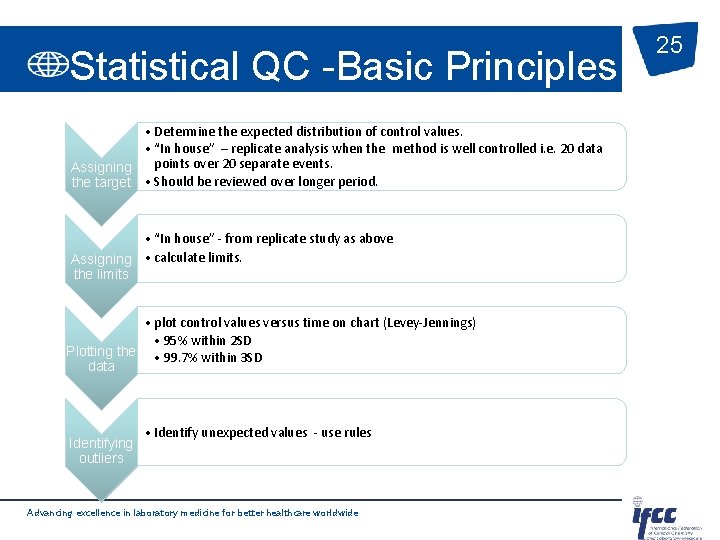
Statistical QC -Basic Principles • Determine the expected distribution of control values. • “In house” – replicate analysis when the method is well controlled i. e. 20 data points over 20 separate events. Assigning the target • Should be reviewed over longer period. • “In house” - from replicate study as above Assigning • calculate limits. the limits • plot control values versus time on chart (Levey-Jennings) • 95% within 2 SD Plotting the • 99. 7% within 3 SD data Identifying outliers • Identify unexpected values - use rules Advancing excellence in laboratory medicine for better healthcare worldwide 25
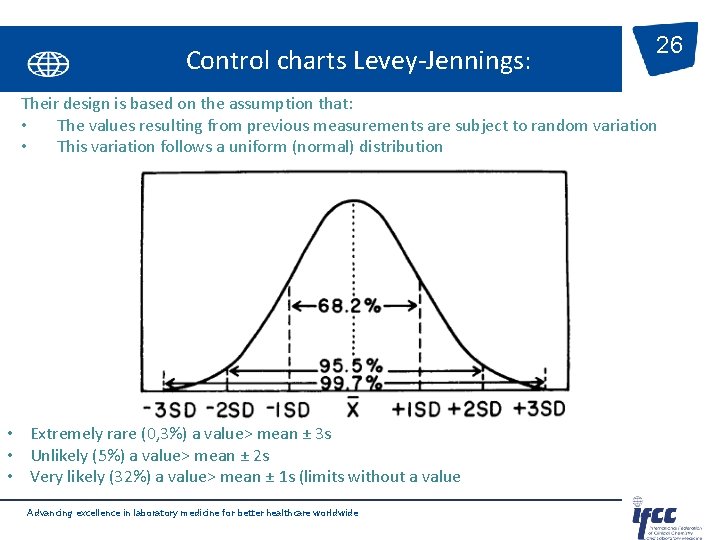
Control charts Levey-Jennings: 26 Their design is based on the assumption that: • The values resulting from previous measurements are subject to random variation • This variation follows a uniform (normal) distribution • Extremely rare (0, 3%) a value> mean ± 3 s • Unlikely (5%) a value> mean ± 2 s • Very likely (32%) a value> mean ± 1 s (limits without a value Advancing excellence in laboratory medicine for better healthcare worldwide
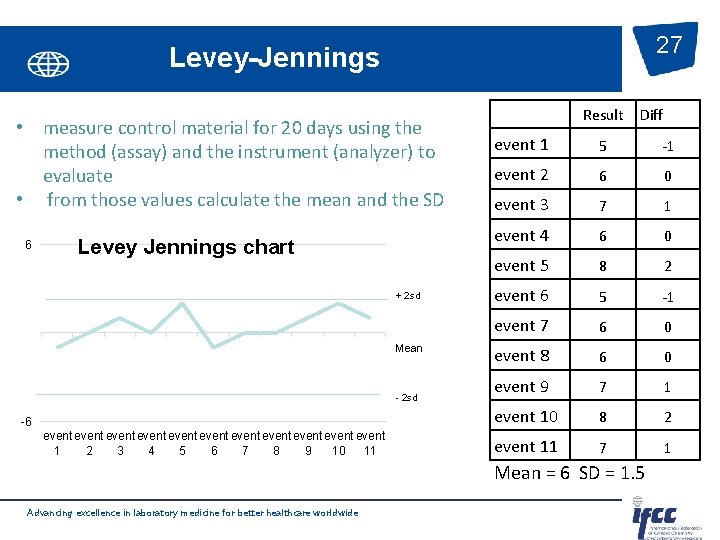
27 Levey-Jennings • measure control material for 20 days using the method (assay) and the instrument (analyzer) to evaluate • from those values calculate the mean and the SD 6 Levey Jennings chart + 2 sd Mean - 2 sd -6 event event event 1 2 3 4 5 6 7 8 9 10 11 Result Diff event 1 5 -1 event 2 6 0 event 3 7 1 event 4 6 0 event 5 8 2 event 6 5 -1 event 7 6 0 event 8 6 0 event 9 7 1 event 10 8 2 event 11 7 1 Mean = 6 SD = 1. 5 Advancing excellence in laboratory medicine for better healthcare worldwide
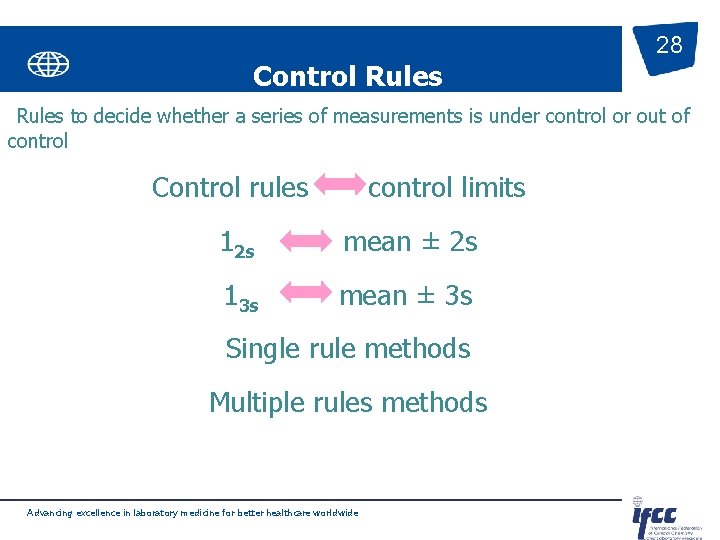
Control Rules 28 Rules to decide whether a series of measurements is under control or out of control Control rules control limits 12 s mean ± 2 s 13 s mean ± 3 s Single rule methods Multiple rules methods Advancing excellence in laboratory medicine for better healthcare worldwide
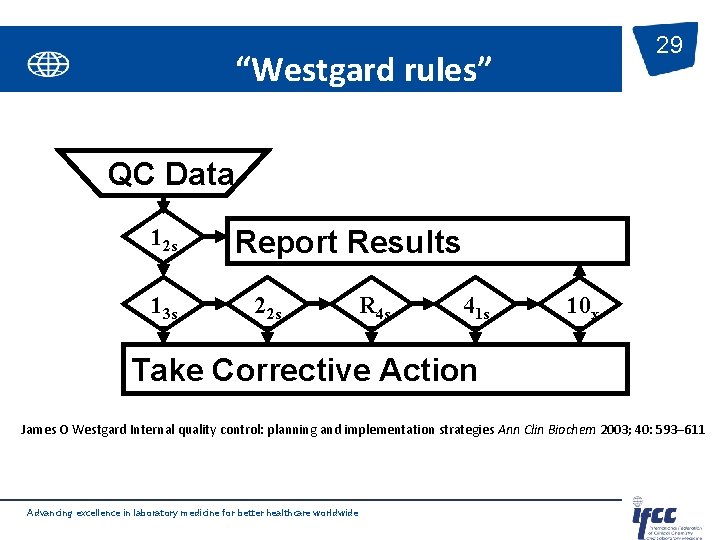
29 “Westgard rules” QC Data 12 s 13 s Report Results 22 s R 4 s 41 s 10 x Take Corrective Action James O Westgard Internal quality control: planning and implementation strategies Ann Clin Biochem 2003; 40: 593– 611 Advancing excellence in laboratory medicine for better healthcare worldwide
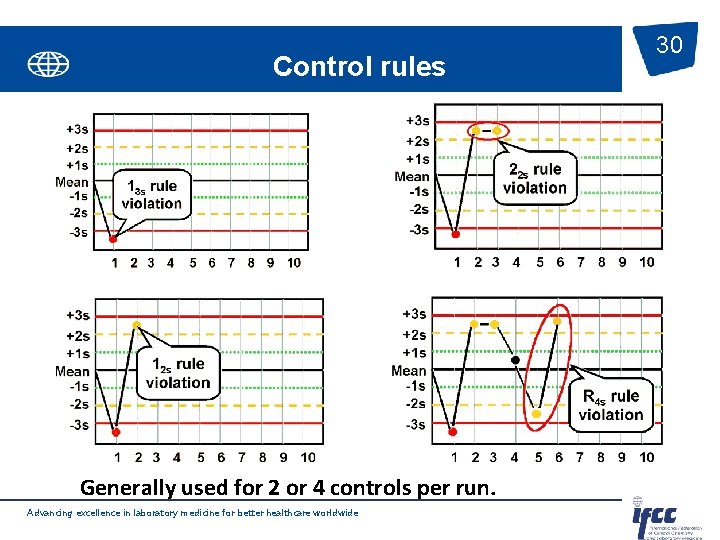
Control rules Generally used for 2 or 4 controls per run. Advancing excellence in laboratory medicine for better healthcare worldwide 30
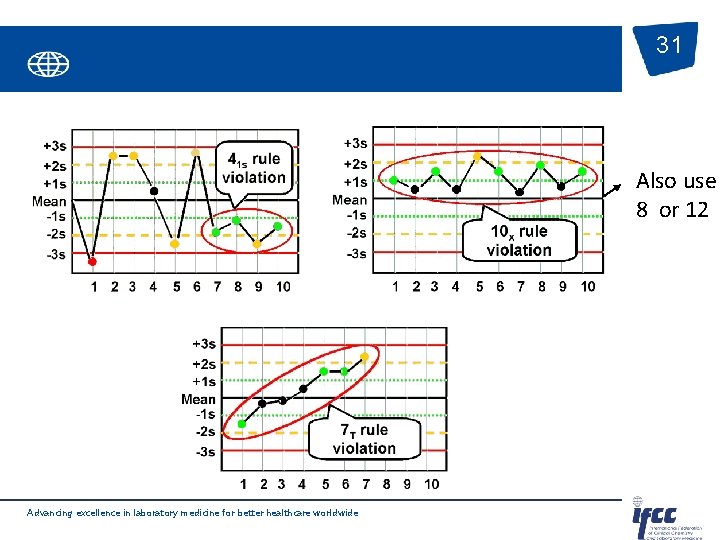
31 Also use 8 or 12 Advancing excellence in laboratory medicine for better healthcare worldwide
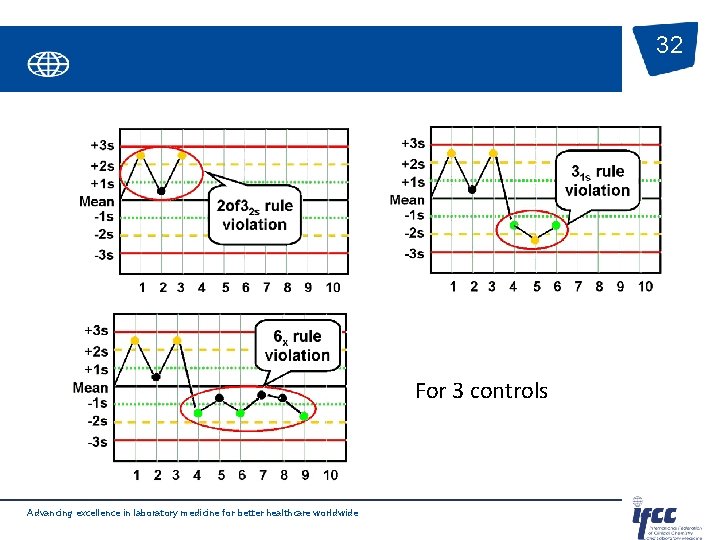
32 For 3 controls Advancing excellence in laboratory medicine for better healthcare worldwide
Design of IQC Define the quality required of the assay Determine the quality the assay can provide Identify candidate IQC strategy Select appropriate QC rules Advancing excellence in laboratory medicine for better healthcare worldwide 33
QC Tools to determine appropriate QC rules 34 The tools include power function graphs , criticalerror graphs , QC Selection Grids, charts of operating specifications (OPSpecs chart), and the QC Validator and EZ Rules 3 computer programs. – Simplest is to use: Westgard Sigma Rules. TM Advancing excellence in laboratory medicine for better healthcare worldwide
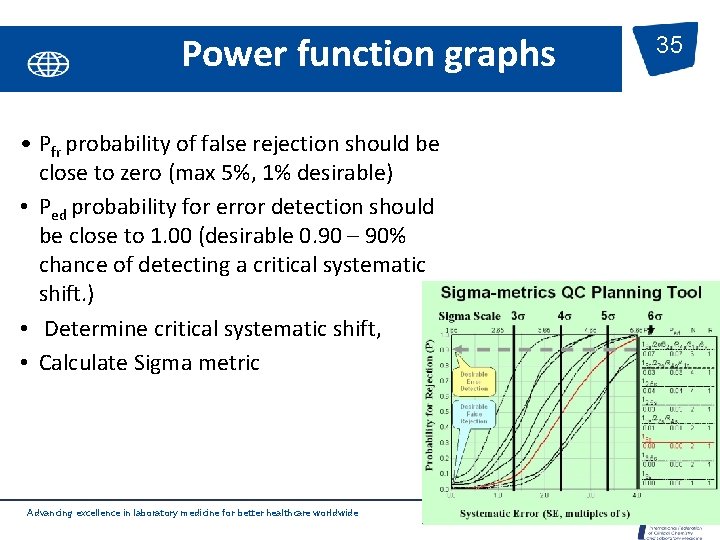
Power function graphs • Pfr probability of false rejection should be close to zero (max 5%, 1% desirable) • Ped probability for error detection should be close to 1. 00 (desirable 0. 90 – 90% chance of detecting a critical systematic shift. ) • Determine critical systematic shift, • Calculate Sigma metric Advancing excellence in laboratory medicine for better healthcare worldwide 35
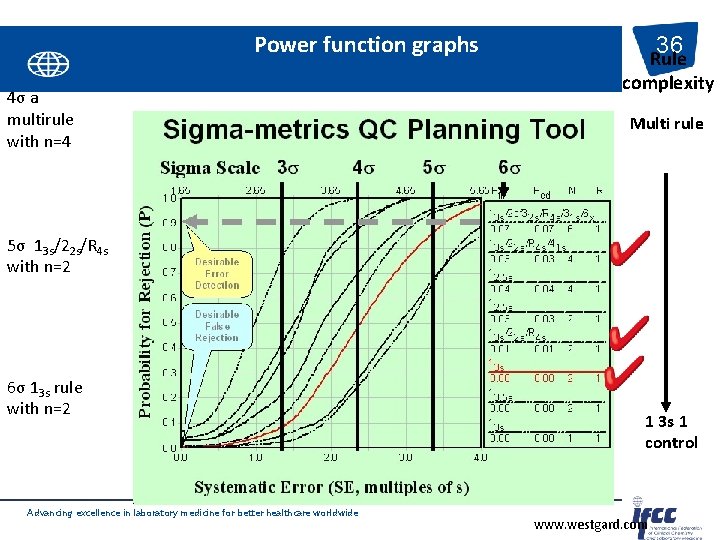
Power function graphs 4σ a multirule with n=4 36 Rule complexity Multi rule 5σ 13 s/22 s/R 4 s with n=2 6σ 13 s rule with n=2 Advancing excellence in laboratory medicine for better healthcare worldwide 1 3 s 1 control www. westgard. com
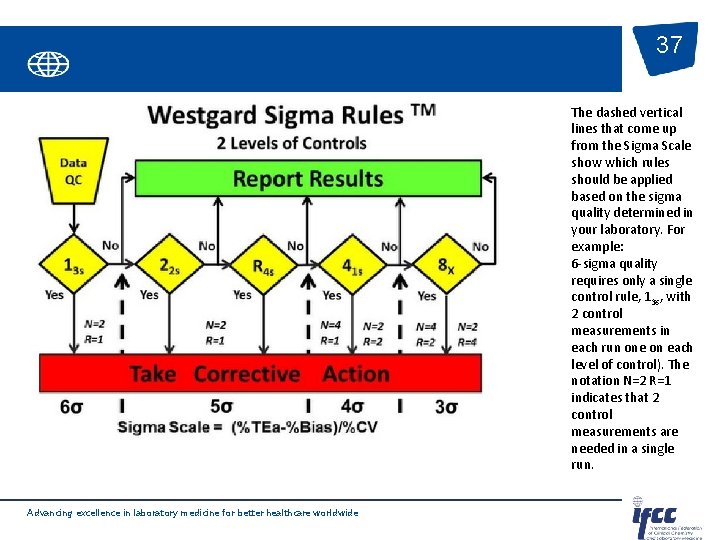
37 The dashed vertical lines that come up from the Sigma Scale show which rules should be applied based on the sigma quality determined in your laboratory. For example: 6 -sigma quality requires only a single control rule, 13 s, with 2 control measurements in each run one on each level of control). The notation N=2 R=1 indicates that 2 control measurements are needed in a single run. Advancing excellence in laboratory medicine for better healthcare worldwide
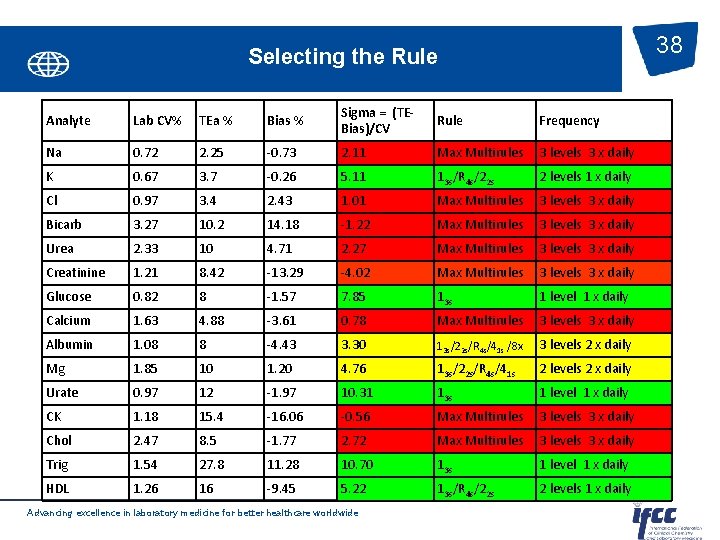
38 Selecting the Rule Analyte Lab CV% TEa % Bias % Sigma = (TEBias)/CV Rule Frequency Na 0. 72 2. 25 -0. 73 2. 11 Max Multirules 3 levels 3 x daily K 0. 67 3. 7 -0. 26 5. 11 13 s/R 4 s/22 s 2 levels 1 x daily Cl 0. 97 3. 4 2. 43 1. 01 Max Multirules 3 levels 3 x daily Bicarb 3. 27 10. 2 14. 18 -1. 22 Max Multirules 3 levels 3 x daily Urea 2. 33 10 4. 71 2. 27 Max Multirules 3 levels 3 x daily Creatinine 1. 21 8. 42 -13. 29 -4. 02 Max Multirules 3 levels 3 x daily Glucose 0. 82 8 -1. 57 7. 85 13 s 1 level 1 x daily Calcium 1. 63 4. 88 -3. 61 0. 78 Max Multirules 3 levels 3 x daily Albumin 1. 08 8 -4. 43 3. 30 13 s/22 s/R 4 s/41 s /8 x 3 levels 2 x daily Mg 1. 85 10 1. 20 4. 76 13 s/22 s/R 4 s/41 s 2 levels 2 x daily Urate 0. 97 12 -1. 97 10. 31 13 s 1 level 1 x daily CK 1. 18 15. 4 -16. 06 -0. 56 Max Multirules 3 levels 3 x daily Chol 2. 47 8. 5 -1. 77 2. 72 Max Multirules 3 levels 3 x daily Trig 1. 54 27. 8 11. 28 10. 70 13 s 1 level 1 x daily HDL 1. 26 16 -9. 45 5. 22 13 s/R 4 s/22 s 2 levels 1 x daily Advancing excellence in laboratory medicine for better healthcare worldwide
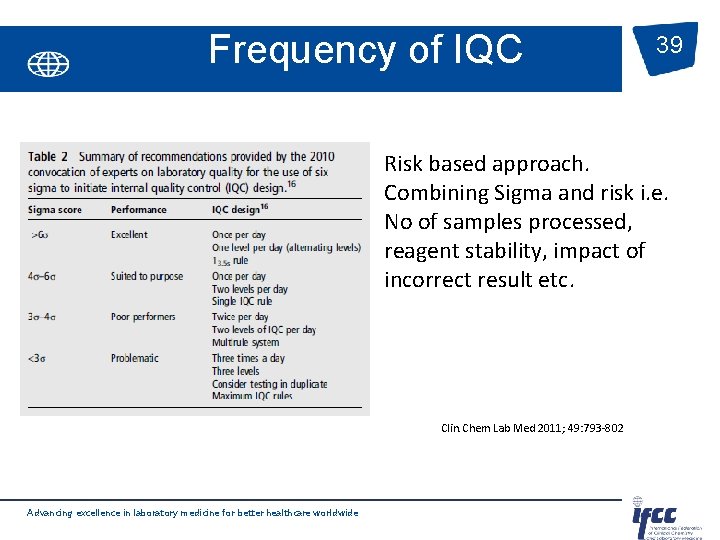
Frequency of IQC 39 Risk based approach. Combining Sigma and risk i. e. No of samples processed, reagent stability, impact of incorrect result etc. Clin. Chem Lab Med 2011; 49: 793 -802 Advancing excellence in laboratory medicine for better healthcare worldwide
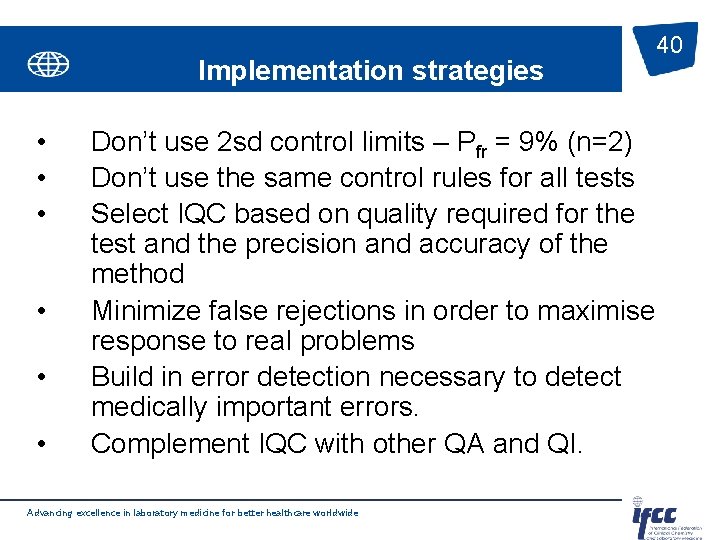
Implementation strategies • • • Don’t use 2 sd control limits – Pfr = 9% (n=2) Don’t use the same control rules for all tests Select IQC based on quality required for the test and the precision and accuracy of the method Minimize false rejections in order to maximise response to real problems Build in error detection necessary to detect medically important errors. Complement IQC with other QA and QI. Advancing excellence in laboratory medicine for better healthcare worldwide 40
- Slides: 40