
IQ Assessment Ms Reeti R Clinical Psychologist Department




- Slides: 27
IQ Assessment Ms. Reeti R. Clinical Psychologist Department of Psychiatry YMC Mangalore
Ø Intelligence is the capacity to learn or understand. Although intelligence is possessed by all people, it varies in amount for each person, and remains the same throughout life from approximately 18 years of age.
In psychology, intelligence is defined as the capacity to acquire knowledge or understanding, and to use it in novel situations.
What is IQ? IQ is the abbreviation for intelligence quotient. Intelligence quotient (IQ) is a total score derived from several standardized tests designed to assess human intelligence.
Ø The word ‘quotient’ means the result of dividing one quantity by another, and intelligence can be defined as mental ability and quickness of mind.
Ø IQ is a score obtained by dividing a person’s mental age score, obtained by administering intelligence test, by the person’s chronological age, both expressed in terms of years and months.
What is an Intelligence test? Ø Intelligence tests are psychological tests that are designed to measure a variety of mental functions, such as reasoning, comprehension and judgement.
purpose Ø The goal of an intelligence tests (IQ test) is, to obtain an idea of the person’s intellectual potential.
Ø When measuring the IQ of a child, that child is given an intelligence test that has already been given to thousands of other children, so that an average score has been established or each age group
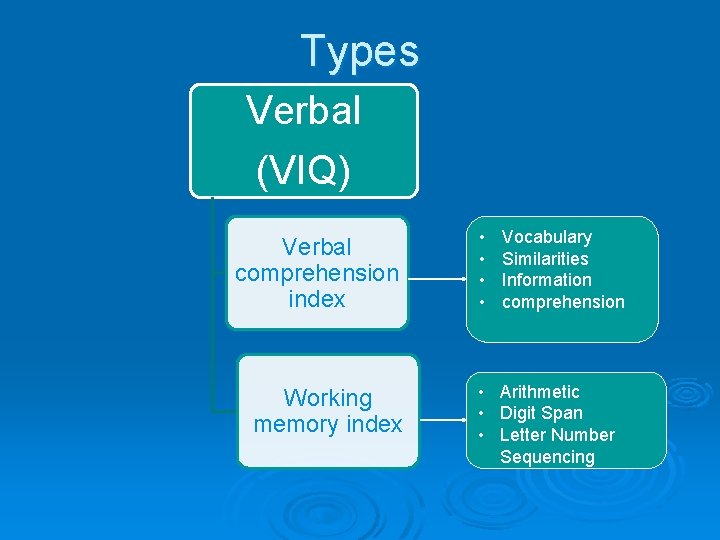
Types Verbal (VIQ) Verbal comprehension index Working memory index • • Vocabulary Similarities Information comprehension • Arithmetic • Digit Span • Letter Number Sequencing
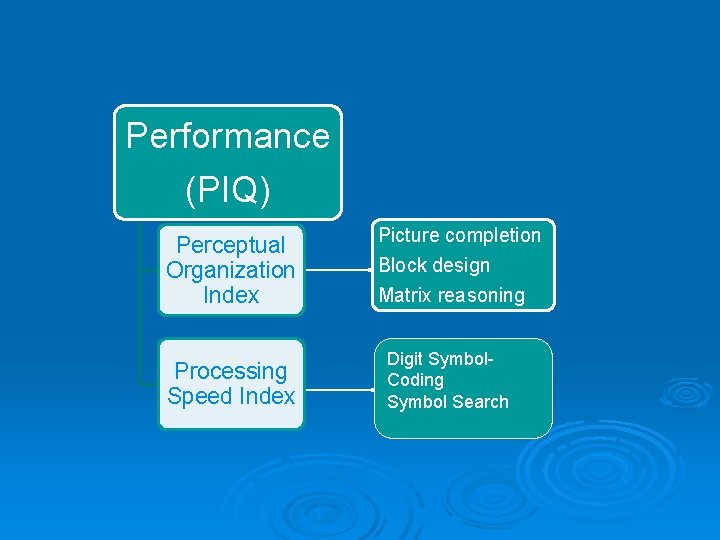
Performance (PIQ) Perceptual Organization Index Processing Speed Index Picture completion Block design Matrix reasoning Digit Symbol. Coding Symbol Search
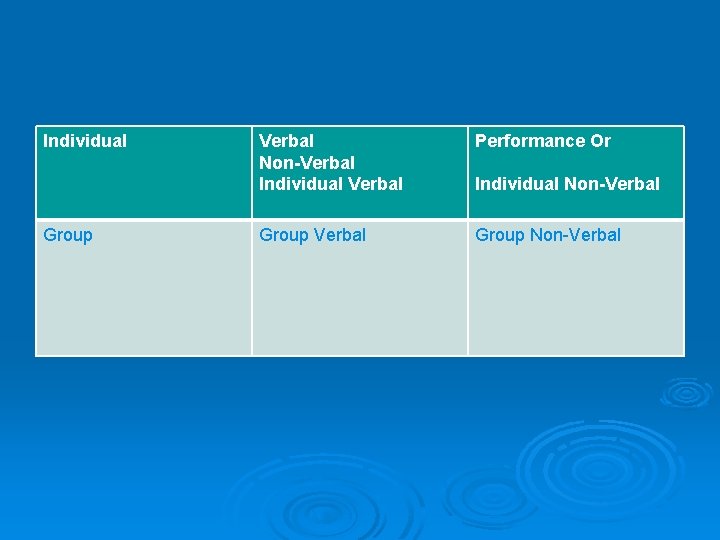
Individual Group Verbal Non-Verbal Individual Verbal Performance Or Group Verbal Group Non-Verbal Individual Non-Verbal
Verbal Tests Ø Verbal intelligence is crystallized by social interaction, experiences, schooling etc. Ø It continues to develop beyond the age of physiological maturation.
Binet Kulshresta Test Ø 3 -22 yrs, Ø Revised and adapted for Indian conditions. Ø It gives pattern analysis for 7 primary abilities namely language, memory conceptual thinking, reasoning, numerical reasoning, visuo-motor co-ordination and social intelligence.
Verbal Adult Intelligence Scale Ø Subtest of PGI BBD, Ø Developed by Prashad and Verma 1988, Ø Includes four subtests: information, digit span, arithmatic, comprehension Ø Used for people aged 20 or above, Ø TQ is calculated using the norms available for different age, gender, and education. Ø It focuses on capacity than on speed.
Performance Tests of Intelligence Ø Tests focus on the ability of a person to act upon certain problems which does not require language or verbal abilities, Ø These are usually speed tests.
Gessels Drawing Test Ø Can be used with very young or severely retarded children having mental age of at least 2 -3 years. Ø Child is suppose to make certain figures such as a circle, square, plus etc and MA is assigned to all these figures, Ø For this 3 trials are given to the patient.
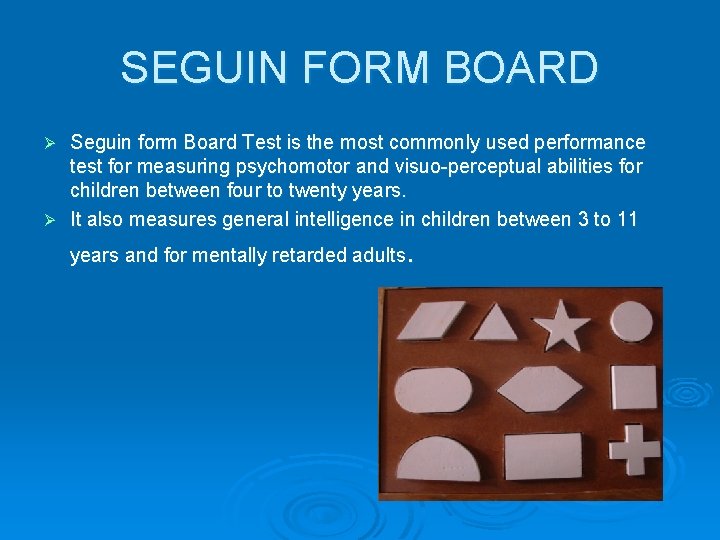
SEGUIN FORM BOARD Seguin form Board Test is the most commonly used performance test for measuring psychomotor and visuo-perceptual abilities for children between four to twenty years. Ø It also measures general intelligence in children between 3 to 11 Ø . years and for mentally retarded adults
Bhatia Battery of Performance for Intelligence. Ø CM Bhalia. Ø Estimates IQ on basis of performance. Developed because majority of illiterates who can't perform well in verbal test. Ø consists of: Block Design, Pass Along Test (Originally by Alexander, Pattern Drawing Test, Immediate Memory of Sounds/digits, Picture Construction Test Ø 11 -16 years of age
Malins Intelligence Scale for Indian children Ø 6– 15 yrs, Ø Developed by Malin, Ø Performance subscale of WISC adapted for Indian children.
Stanford Binet Intelligence scale
Ø Ø Ø Developed by Binet and Simon to identify Mentally Retarded Children is French schools First version published in 1905 - 30 items Adapted for use in US by Lewis Terman in 1966. Indian adaptation by Kulshreshtha It gives IQ – (Age scale)
Weschler Intelligence Scale Age range: 16 – 64 years Replaced 1955 by the Wechsler Adult Intelligence Scale (WAIS). 11 separate subtests, which are broken into the Verbal scale (6 subtests) and the Performance scale (5 subtests). Ø A person taking the test receives a full-scale IQ score, a verbal IQ score, a performance IQ score, as well as scaled scores on each of the subtests. Ø Ø Ø
Ravens Progressive Matrices Three forms color progressive matrices, standard progressive matrices, Advanced progressive matrices, Culture fair test, Ø It can't estimate the IQ, it estimates Average, mental retarded, Below average Ø 5 sets, 12 items each. Ø
Adaptive Behavior Scale Ø Vineland Social Maturity Scale (VSMS) (1953, E. A. Doll) Adapted by Malin, A. S. (1968) Adapted by Indian Children in 1992 by Bharat Raj, 0 -15 yrs. 89 items, 8 domains. Ø Impairment in adaptive behaviour for that VSMS used, how person doing in various adaptive behaviour.
Refernces Ø Kaufman, Alan, S. , and Elizabeth O. L. Assessing Adolescent and Adult Intelligence. Boston: Allyn and Bacon, 2001 Ø Matarazzo, J. D. Wechsler’s Measurement and Appraisal of Adult Intelligence. 5 th ed. New York: Oxford University Press, 1972