
IPv 6 In Depth ICMPv 6 PMTU for

- Slides: 63
IPv 6 In Depth ICMPv 6 PMTU for IPv 6 NDP for IPv 6 ICMPv 6 and NDP
Internet Control Message Protocol version 6 (ICMPv 6) ICMPv 6 and NDP
Protocol Overview l ICMPv 6 is a multipurpose protocol used for l l l Reporting errors encountered in processing packets Performing diagnostics Performing Neighbor Discovery Reporting multicast memberships. ICMP messages are transported within an IPv 6 packet in which extension headers can also be present. An ICMP message is identified by a value of 58 in the Next Header field of the IPv 6 header or of the preceding Header. ICMPv 6 and NDP 3
ICMPv 6: Introduction l l IPv 6 uses the ICMP as defined for IPv 4 with a number of changes. The resulting protocol is called ICMPv 6. ICMP messages, delivered in IP packets, are used for out-of-band messages related to network operation or mis-operation. ICMP uses IP, ICMP packet delivery is unreliable, so hosts can't count on receiving ICMP packets for any network problem. ICMPv 6 and NDP 4
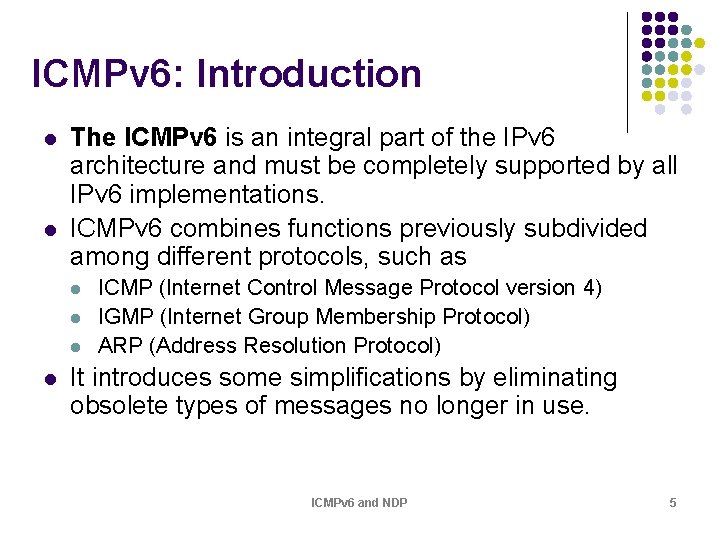
ICMPv 6: Introduction l l The ICMPv 6 is an integral part of the IPv 6 architecture and must be completely supported by all IPv 6 implementations. ICMPv 6 combines functions previously subdivided among different protocols, such as l l ICMP (Internet Control Message Protocol version 4) IGMP (Internet Group Membership Protocol) ARP (Address Resolution Protocol) It introduces some simplifications by eliminating obsolete types of messages no longer in use. ICMPv 6 and NDP 5
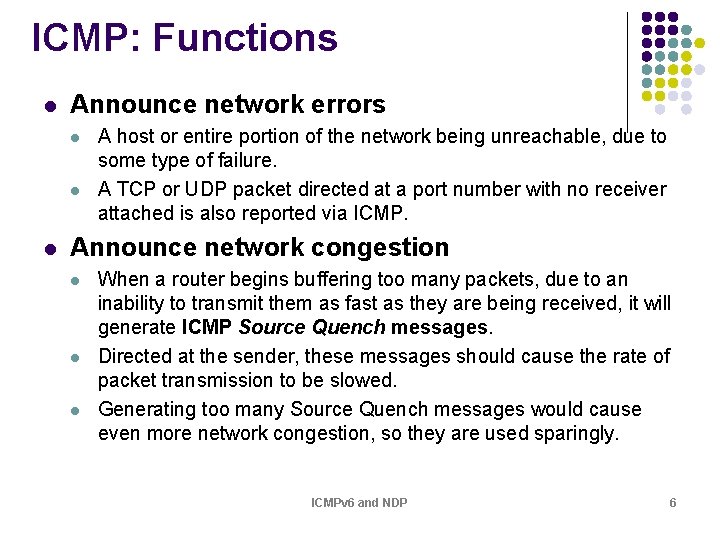
ICMP: Functions l Announce network errors l l l A host or entire portion of the network being unreachable, due to some type of failure. A TCP or UDP packet directed at a port number with no receiver attached is also reported via ICMP. Announce network congestion l l l When a router begins buffering too many packets, due to an inability to transmit them as fast as they are being received, it will generate ICMP Source Quench messages. Directed at the sender, these messages should cause the rate of packet transmission to be slowed. Generating too many Source Quench messages would cause even more network congestion, so they are used sparingly. ICMPv 6 and NDP 6
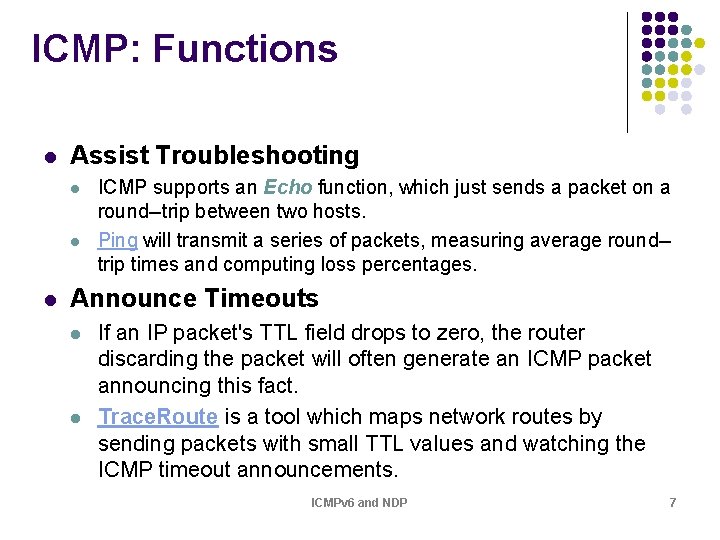
ICMP: Functions l Assist Troubleshooting l l l ICMP supports an Echo function, which just sends a packet on a round--trip between two hosts. Ping will transmit a series of packets, measuring average round-trip times and computing loss percentages. Announce Timeouts l l If an IP packet's TTL field drops to zero, the router discarding the packet will often generate an ICMP packet announcing this fact. Trace. Route is a tool which maps network routes by sending packets with small TTL values and watching the ICMP timeout announcements. ICMPv 6 and NDP 7
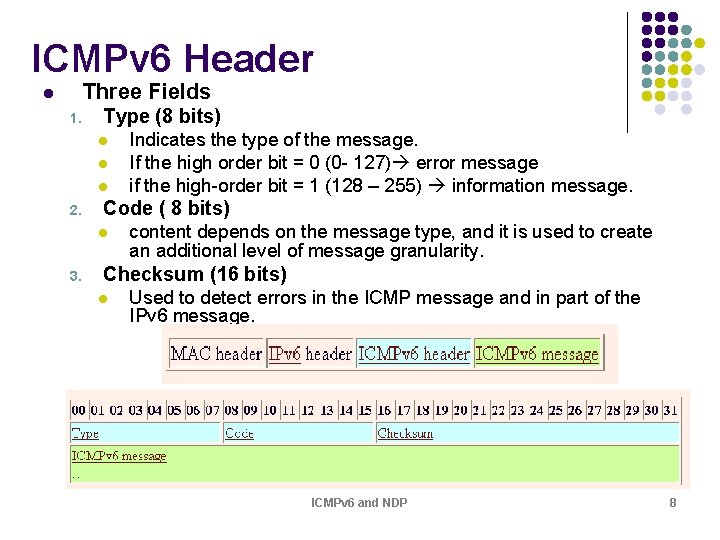
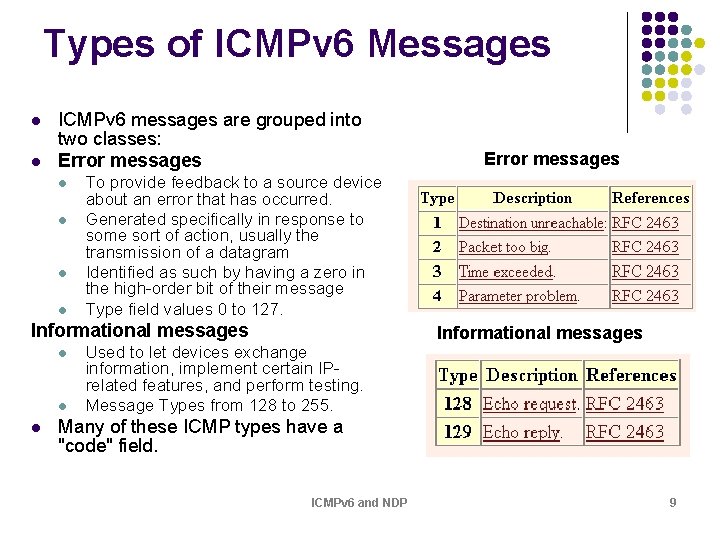
ICMPv 6 Header l Three Fields 1. Type (8 bits) l l l 2. Code ( 8 bits) l 3. Indicates the type of the message. If the high order bit = 0 (0 - 127) error message if the high-order bit = 1 (128 – 255) information message. content depends on the message type, and it is used to create an additional level of message granularity. Checksum (16 bits) l Used to detect errors in the ICMP message and in part of the IPv 6 message. ICMPv 6 and NDP 8
Types of ICMPv 6 Messages l l ICMPv 6 messages are grouped into two classes: Error messages l l To provide feedback to a source device about an error that has occurred. Generated specifically in response to some sort of action, usually the transmission of a datagram Identified as such by having a zero in the high-order bit of their message Type field values 0 to 127. Informational messages l l l Error messages Used to let devices exchange information, implement certain IPrelated features, and perform testing. Message Types from 128 to 255. Informational messages Many of these ICMP types have a "code" field. ICMPv 6 and NDP 9
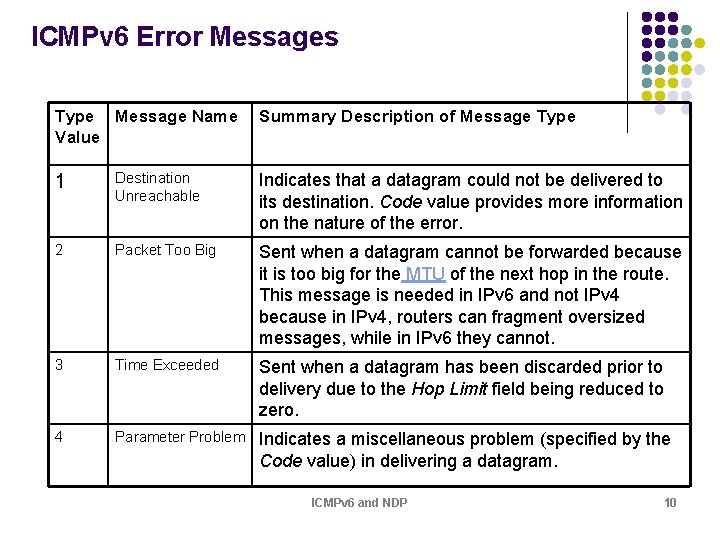
ICMPv 6 Error Messages Type Message Name Value Summary Description of Message Type 1 Destination Unreachable Indicates that a datagram could not be delivered to its destination. Code value provides more information on the nature of the error. 2 Packet Too Big Sent when a datagram cannot be forwarded because it is too big for the MTU of the next hop in the route. This message is needed in IPv 6 and not IPv 4 because in IPv 4, routers can fragment oversized messages, while in IPv 6 they cannot. 3 Time Exceeded Sent when a datagram has been discarded prior to delivery due to the Hop Limit field being reduced to zero. 4 Parameter Problem Indicates a miscellaneous problem (specified by the Code value) in delivering a datagram. ICMPv 6 and NDP 10
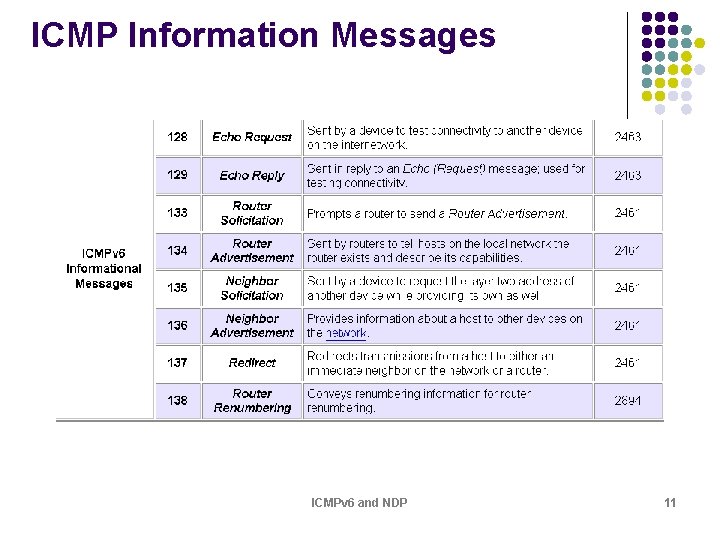
ICMP Information Messages ICMPv 6 and NDP 11
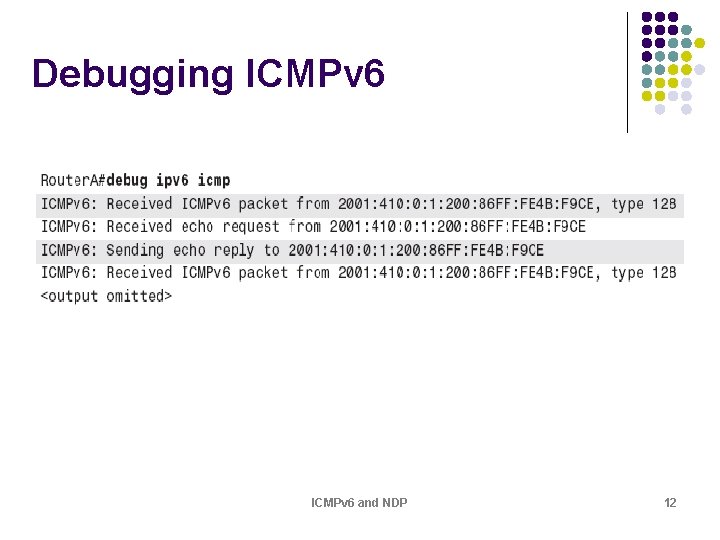
Debugging ICMPv 6 and NDP 12
Path MTU Discovery (PMTUD) for IPv 6 ICMPv 6 and NDP
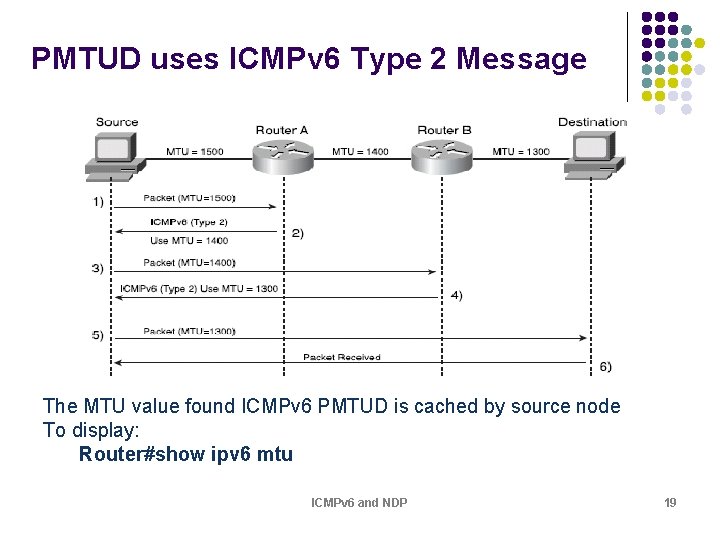
PMTUDv 6 - Overview l l To enable hosts to discover the min. MTU on a path to a particular destination. Fragmentation in IPv 6 is not performed by intermediary routers. The source node may fragment packets by itself only when the path MTU is smaller than the packets to deliver PMTUD for IPv 6 uses ICMPv 6 error message l l Type 2 Packet Too Big For detail info - http: //www. ietf. org/rfc 1981. txt ICMPv 6 and NDP 14
Differences between IPv 4 & IPv 6 MTU l Increased Default MTU l l In IPv 4, the minimum MTU that routers and physical links were required to handle = 576 bytes. In IPv 6, all links must handle a datagram size of at least 1280 bytes. improves efficiency by increasing the ratio of maximum payload to header length, and reduces the frequency with which fragmentation is required. Elimination of En Route Fragmentation l l l In IPv 4, datagrams may be fragmented by either the source device, or by routers during delivery. In IPv 6, only the source node can fragment; routers do not. The source must therefore fragment to the size of the smallest MTU on the route before transmission. ICMPv 6 and NDP 15
Differences between IPv 4 & IPv 6 MTU l MTU Size Error Feedback l l l Since routers cannot fragment datagrams, they must drop them if they are forced to try to send a too-large datagram over a physical link. A feedback process has been defined using ICMPv 6 that lets routers tell source devices that they are using datagrams that are too large for the route. Movement of Fragmentation Header Fields l To reflect the decreased importance of fragmentation in IPv 4, the permanent fields related to the process that were in the IPv 4 header have been farmed out to a Fragment extension header, included only when needed. ICMPv 6 and NDP 16
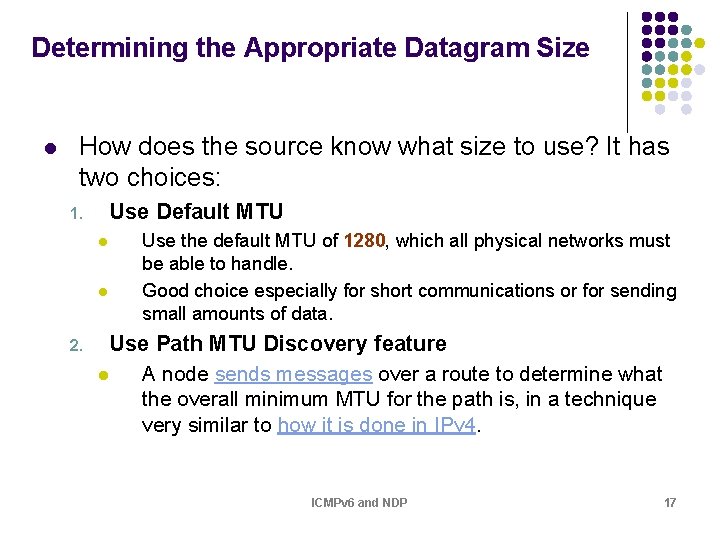
Determining the Appropriate Datagram Size l How does the source know what size to use? It has two choices: Use Default MTU 1. l l 2. Use the default MTU of 1280, which all physical networks must be able to handle. Good choice especially for short communications or for sending small amounts of data. Use Path MTU Discovery feature l A node sends messages over a route to determine what the overall minimum MTU for the path is, in a technique very similar to how it is done in IPv 4. ICMPv 6 and NDP 17
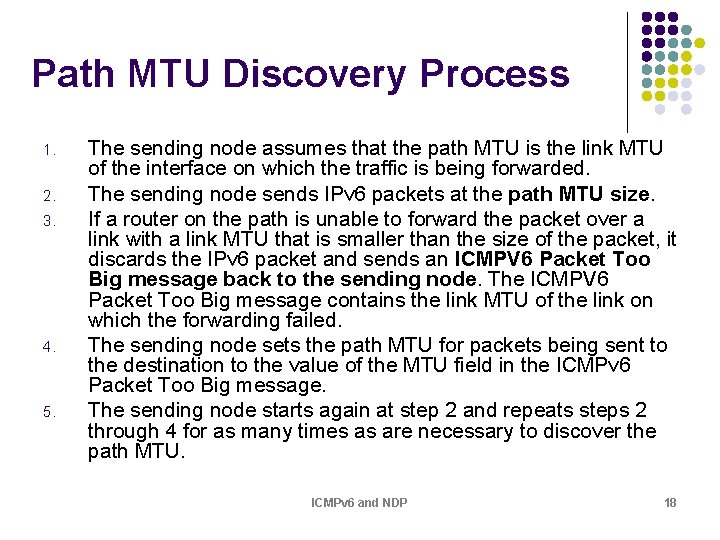
Path MTU Discovery Process 1. 2. 3. 4. 5. The sending node assumes that the path MTU is the link MTU of the interface on which the traffic is being forwarded. The sending node sends IPv 6 packets at the path MTU size. If a router on the path is unable to forward the packet over a link with a link MTU that is smaller than the size of the packet, it discards the IPv 6 packet and sends an ICMPV 6 Packet Too Big message back to the sending node. The ICMPV 6 Packet Too Big message contains the link MTU of the link on which the forwarding failed. The sending node sets the path MTU for packets being sent to the destination to the value of the MTU field in the ICMPv 6 Packet Too Big message. The sending node starts again at step 2 and repeats steps 2 through 4 for as many times as are necessary to discover the path MTU. ICMPv 6 and NDP 18
PMTUD uses ICMPv 6 Type 2 Message The MTU value found ICMPv 6 PMTUD is cached by source node To display: Router#show ipv 6 mtu ICMPv 6 and NDP 19
IPv 6 Fragmentation ICMPv 6 and NDP
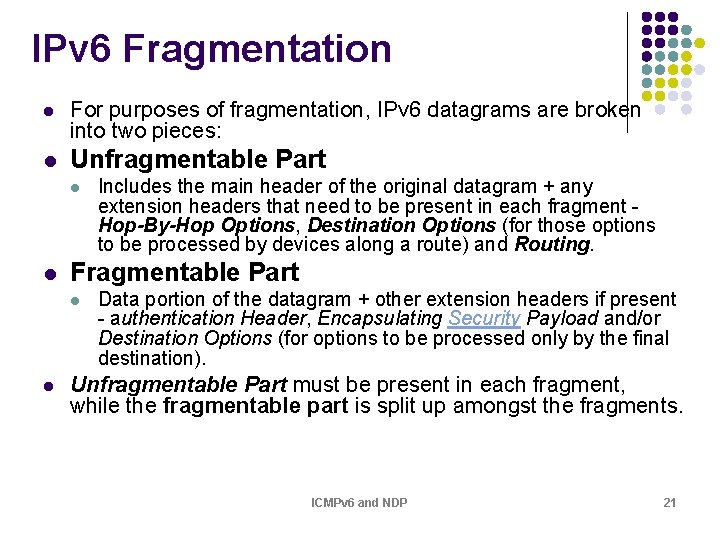
IPv 6 Fragmentation l For purposes of fragmentation, IPv 6 datagrams are broken into two pieces: l Unfragmentable Part l l Fragmentable Part l l Includes the main header of the original datagram + any extension headers that need to be present in each fragment Hop-By-Hop Options, Destination Options (for those options to be processed by devices along a route) and Routing. Data portion of the datagram + other extension headers if present - authentication Header, Encapsulating Security Payload and/or Destination Options (for options to be processed only by the final destination). Unfragmentable Part must be present in each fragment, while the fragmentable part is split up amongst the fragments. ICMPv 6 and NDP 21
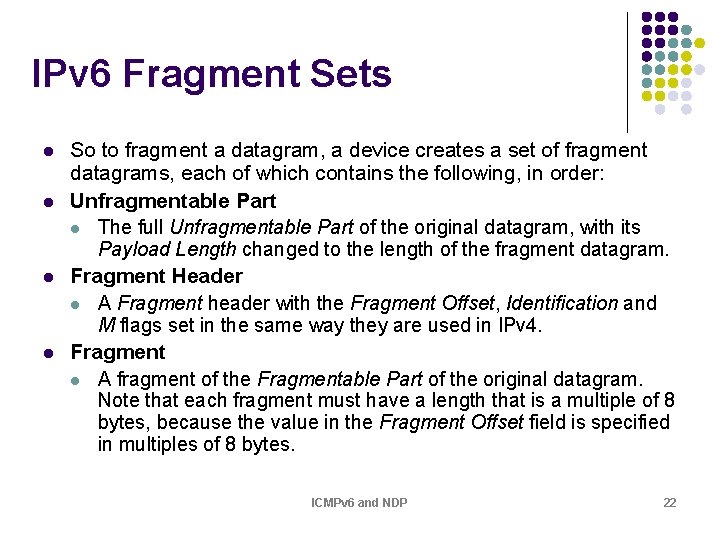
IPv 6 Fragment Sets l l So to fragment a datagram, a device creates a set of fragment datagrams, each of which contains the following, in order: Unfragmentable Part l The full Unfragmentable Part of the original datagram, with its Payload Length changed to the length of the fragment datagram. Fragment Header l A Fragment header with the Fragment Offset, Identification and M flags set in the same way they are used in IPv 4. Fragment l A fragment of the Fragmentable Part of the original datagram. Note that each fragment must have a length that is a multiple of 8 bytes, because the value in the Fragment Offset field is specified in multiples of 8 bytes. ICMPv 6 and NDP 22
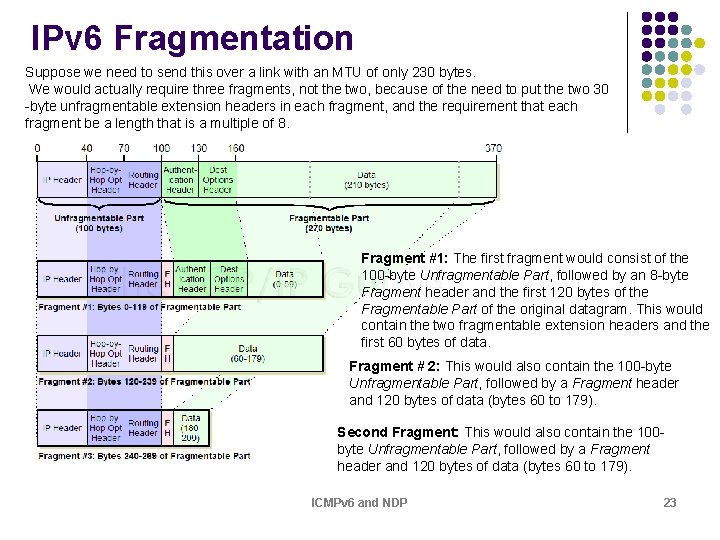
IPv 6 Fragmentation Suppose we need to send this over a link with an MTU of only 230 bytes. We would actually require three fragments, not the two, because of the need to put the two 30 -byte unfragmentable extension headers in each fragment, and the requirement that each fragment be a length that is a multiple of 8. Fragment #1: The first fragment would consist of the 100 -byte Unfragmentable Part, followed by an 8 -byte Fragment header and the first 120 bytes of the Fragmentable Part of the original datagram. This would contain the two fragmentable extension headers and the first 60 bytes of data. Fragment # 2: This would also contain the 100 -byte Unfragmentable Part, followed by a Fragment header and 120 bytes of data (bytes 60 to 179). Second Fragment: This would also contain the 100 byte Unfragmentable Part, followed by a Fragment header and 120 bytes of data (bytes 60 to 179). ICMPv 6 and NDP 23
IPv 6 Neighbour Discovery Protocol (NDP) ICMPv 6 and NDP
IPv 6 ND - Overview l l IPv 6 ND is a set of messages and processes that determine relationships between neighboring nodes. ND replaces ARP, ICMP Router Discovery, and ICMP Redirect used in IPv 4 and provides additional functionality. ICMPv 6 and NDP 25
IPv 6 ND - Overview l l l ND is used by hosts to: l Discover neighbouring routers. l Discover addresses, address prefixes, and other configuration parameters. ND is used by routers to: l Advertise their presence, host configuration parameters, and onlink prefixes. l Inform hosts of a better next-hop address to forward packets for a specific destination. ND is used by nodes to: l Resolve the link-layer address of a neighbouring node to which an IPv 6 packet is being forwarded and determine when the linklayer address of a neighbouring node has changed. l Determine whether a neighbour is still reachable. ICMPv 6 and NDP 26
IPv 6 ND – What is Neighbour? l l Neighbour is one that has been used for years in various networking standards and technologies to refer to devices that are local to each other. Two devices are neighbours if they are on the same local network, meaning that they can send information to each other directly. Most of the functions of the ND protocol are implemented using a set of five special ICMPv 6 control messages. ND is a messaging protocol. l It doesn't implement a single specific function but rather a group of activities that are performed through the exchange of messages. l ND standard describes nine specific functions performed by the protocol. ICMPv 6 and NDP 27
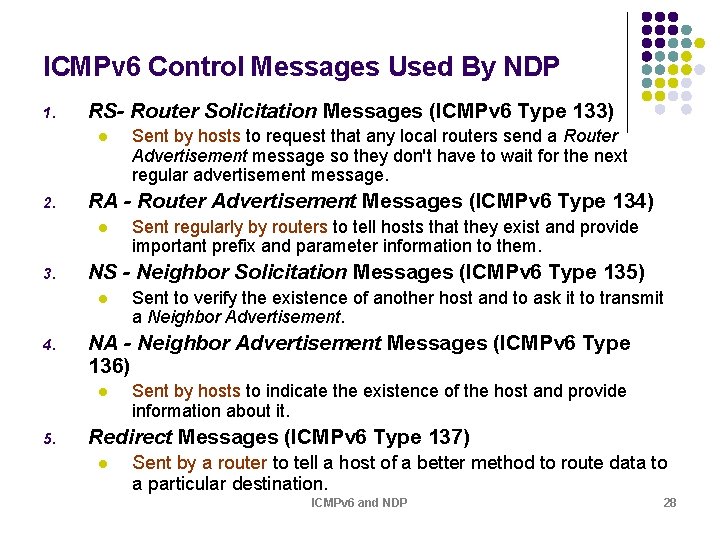
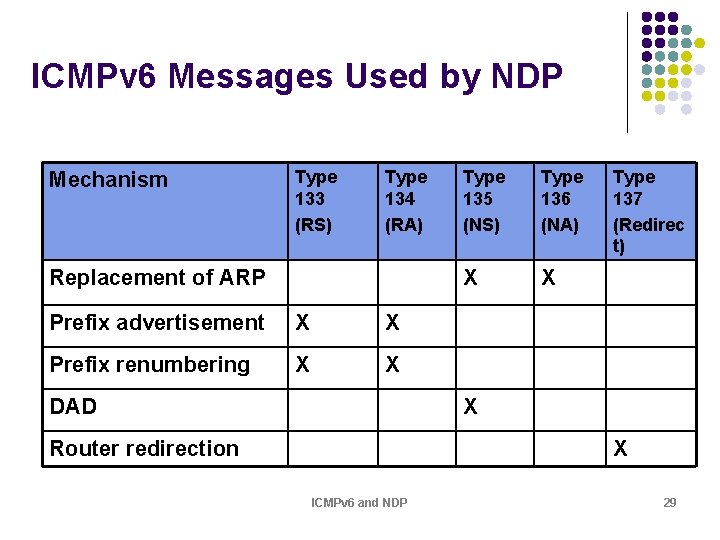
ICMPv 6 Control Messages Used By NDP 1. RS- Router Solicitation Messages (ICMPv 6 Type 133) l 2. RA - Router Advertisement Messages (ICMPv 6 Type 134) l 3. Sent to verify the existence of another host and to ask it to transmit a Neighbor Advertisement. NA - Neighbor Advertisement Messages (ICMPv 6 Type 136) l 5. Sent regularly by routers to tell hosts that they exist and provide important prefix and parameter information to them. NS - Neighbor Solicitation Messages (ICMPv 6 Type 135) l 4. Sent by hosts to request that any local routers send a Router Advertisement message so they don't have to wait for the next regular advertisement message. Sent by hosts to indicate the existence of the host and provide information about it. Redirect Messages (ICMPv 6 Type 137) l Sent by a router to tell a host of a better method to route data to a particular destination. ICMPv 6 and NDP 28
ICMPv 6 Messages Used by NDP Mechanism Type 133 (RS) Type 134 (RA) Replacement of ARP Prefix advertisement X X Prefix renumbering X X DAD Type 135 (NS) Type 136 (NA) X X Type 137 (Redirec t) X Router redirection X ICMPv 6 and NDP 29
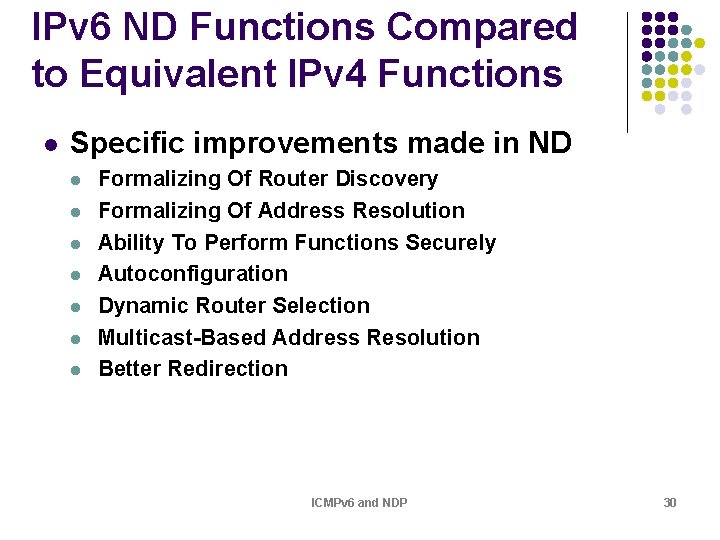
IPv 6 ND Functions Compared to Equivalent IPv 4 Functions l Specific improvements made in ND l l l l Formalizing Of Router Discovery Formalizing Of Address Resolution Ability To Perform Functions Securely Autoconfiguration Dynamic Router Selection Multicast-Based Address Resolution Better Redirection ICMPv 6 and NDP 30
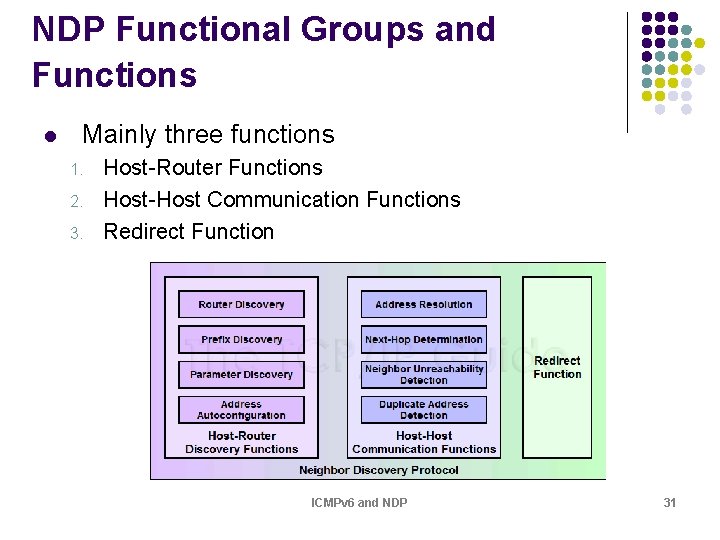
NDP Functional Groups and Functions l Mainly three functions 1. 2. 3. Host-Router Functions Host-Host Communication Functions Redirect Function ICMPv 6 and NDP 31
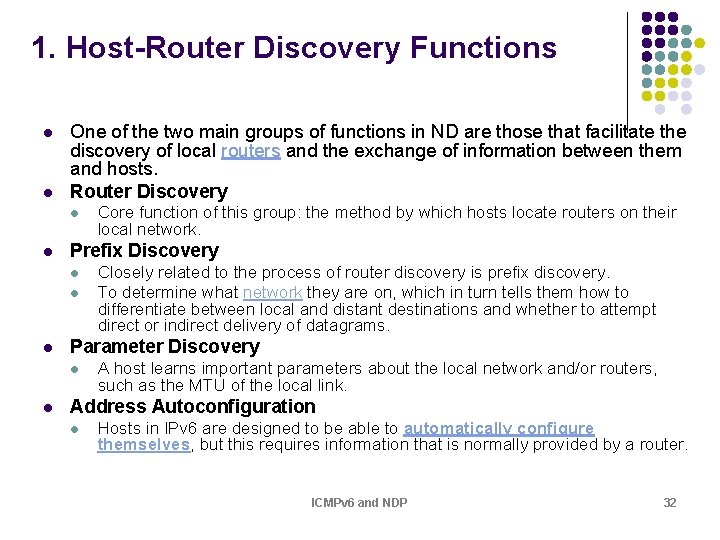
1. Host-Router Discovery Functions l l One of the two main groups of functions in ND are those that facilitate the discovery of local routers and the exchange of information between them and hosts. Router Discovery l l Prefix Discovery l l l Closely related to the process of router discovery is prefix discovery. To determine what network they are on, which in turn tells them how to differentiate between local and distant destinations and whether to attempt direct or indirect delivery of datagrams. Parameter Discovery l l Core function of this group: the method by which hosts locate routers on their local network. A host learns important parameters about the local network and/or routers, such as the MTU of the local link. Address Autoconfiguration l Hosts in IPv 6 are designed to be able to automatically configure themselves, but this requires information that is normally provided by a router. ICMPv 6 and NDP 32
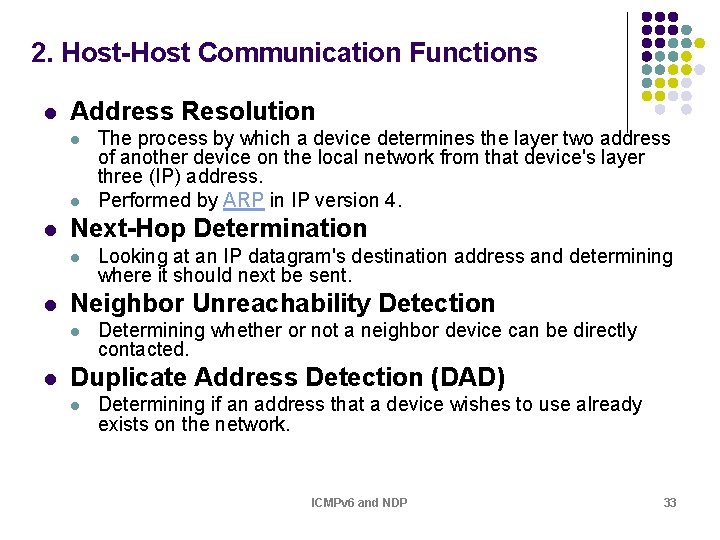
2. Host-Host Communication Functions l Address Resolution l l l Next-Hop Determination l l Looking at an IP datagram's destination address and determining where it should next be sent. Neighbor Unreachability Detection l l The process by which a device determines the layer two address of another device on the local network from that device's layer three (IP) address. Performed by ARP in IP version 4. Determining whether or not a neighbor device can be directly contacted. Duplicate Address Detection (DAD) l Determining if an address that a device wishes to use already exists on the network. ICMPv 6 and NDP 33
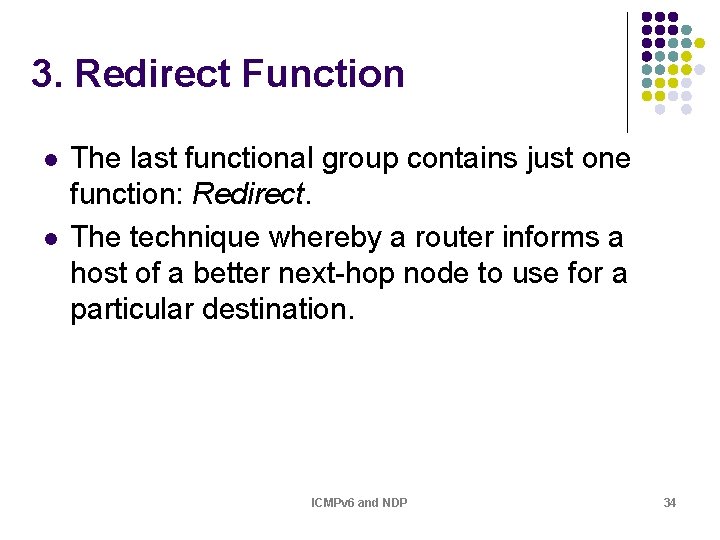
3. Redirect Function l l The last functional group contains just one function: Redirect. The technique whereby a router informs a host of a better next-hop node to use for a particular destination. ICMPv 6 and NDP 34
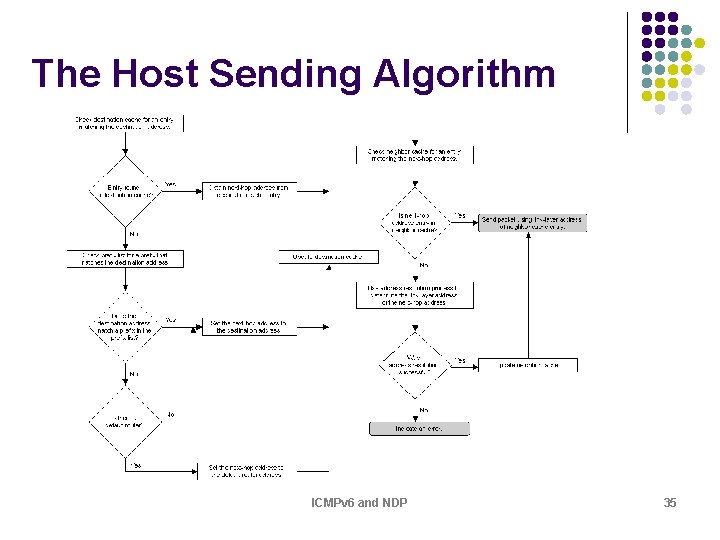
The Host Sending Algorithm ICMPv 6 and NDP 35
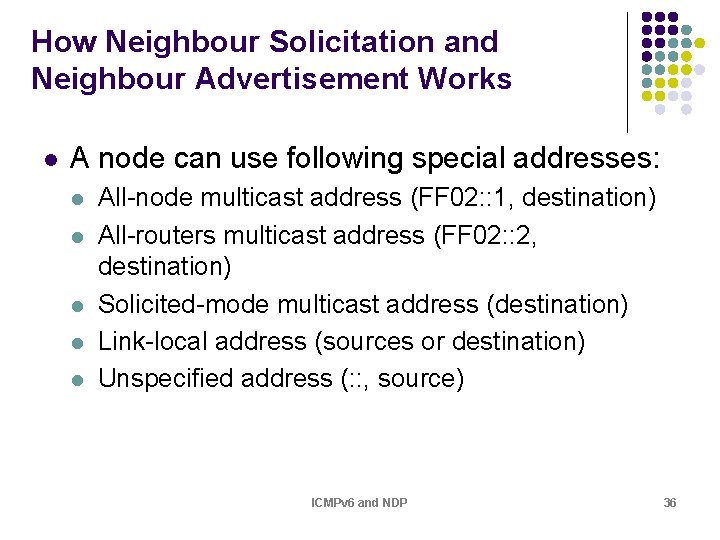
How Neighbour Solicitation and Neighbour Advertisement Works l A node can use following special addresses: l l l All-node multicast address (FF 02: : 1, destination) All-routers multicast address (FF 02: : 2, destination) Solicited-mode multicast address (destination) Link-local address (sources or destination) Unspecified address (: : , source) ICMPv 6 and NDP 36
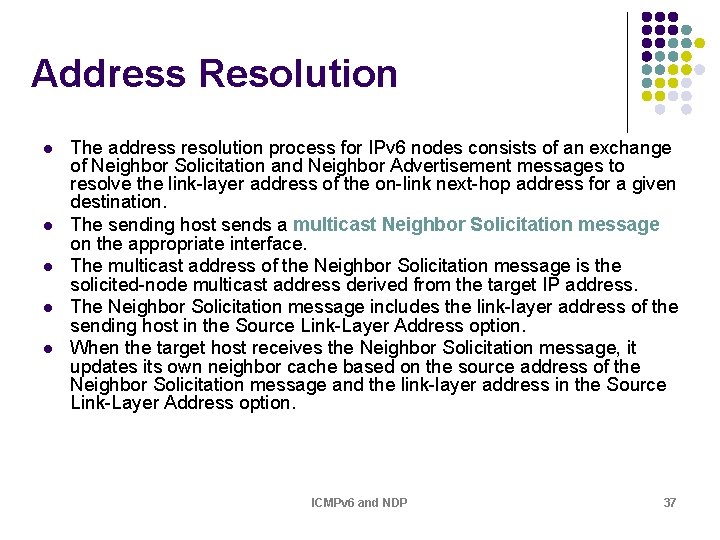
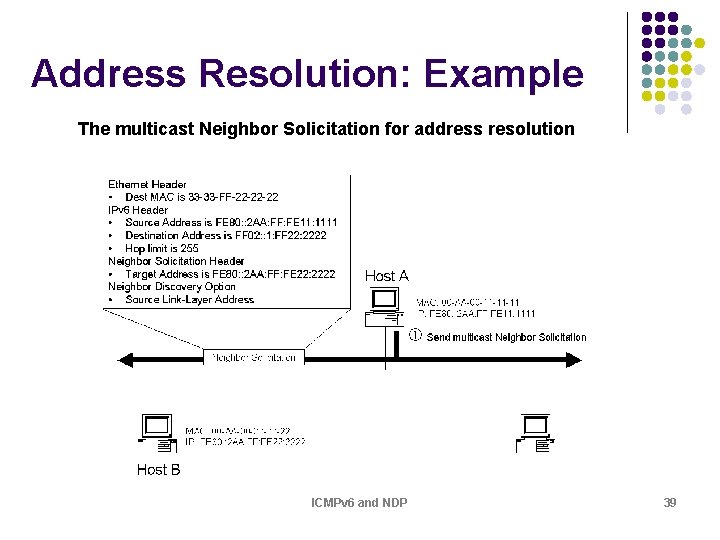
Address Resolution l l l The address resolution process for IPv 6 nodes consists of an exchange of Neighbor Solicitation and Neighbor Advertisement messages to resolve the link-layer address of the on-link next-hop address for a given destination. The sending host sends a multicast Neighbor Solicitation message on the appropriate interface. The multicast address of the Neighbor Solicitation message is the solicited-node multicast address derived from the target IP address. The Neighbor Solicitation message includes the link-layer address of the sending host in the Source Link-Layer Address option. When the target host receives the Neighbor Solicitation message, it updates its own neighbor cache based on the source address of the Neighbor Solicitation message and the link-layer address in the Source Link-Layer Address option. ICMPv 6 and NDP 37
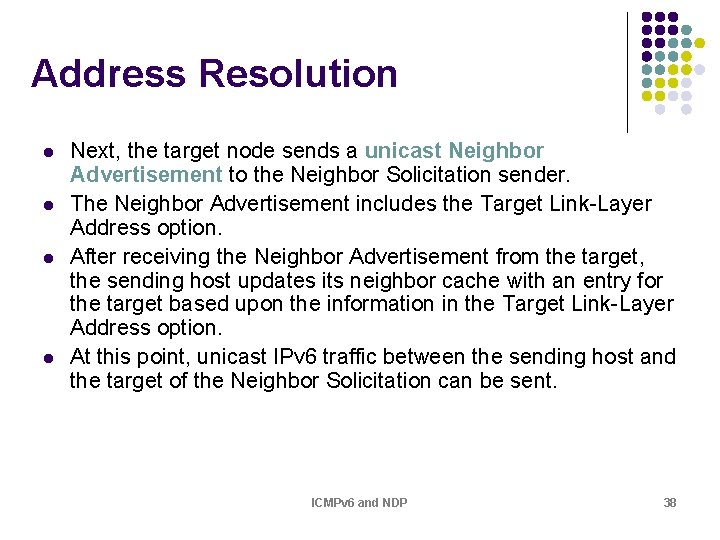
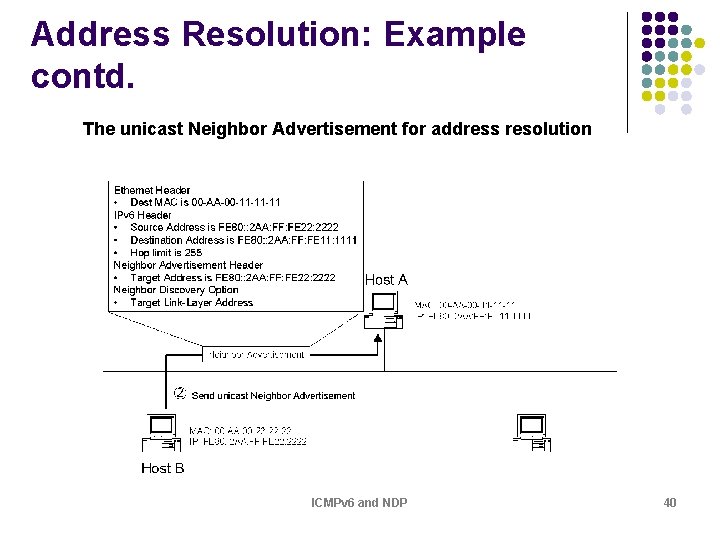
Address Resolution l l Next, the target node sends a unicast Neighbor Advertisement to the Neighbor Solicitation sender. The Neighbor Advertisement includes the Target Link-Layer Address option. After receiving the Neighbor Advertisement from the target, the sending host updates its neighbor cache with an entry for the target based upon the information in the Target Link-Layer Address option. At this point, unicast IPv 6 traffic between the sending host and the target of the Neighbor Solicitation can be sent. ICMPv 6 and NDP 38
Address Resolution: Example The multicast Neighbor Solicitation for address resolution ICMPv 6 and NDP 39
Address Resolution: Example contd. The unicast Neighbor Advertisement for address resolution ICMPv 6 and NDP 40
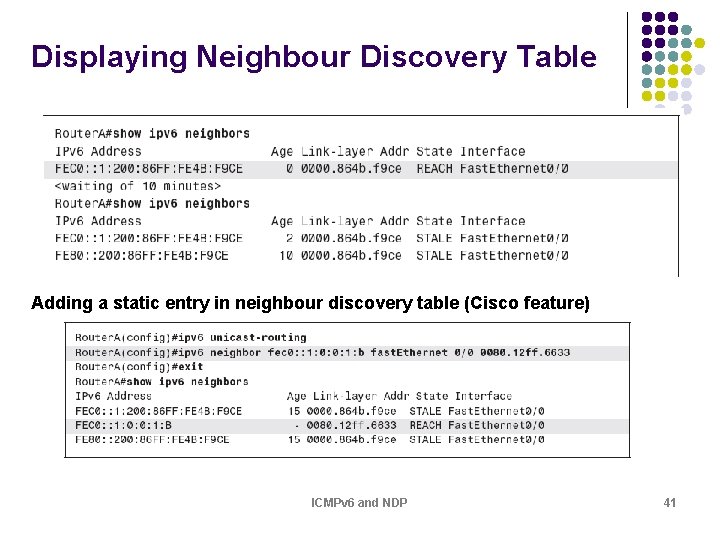
Displaying Neighbour Discovery Table Adding a static entry in neighbour discovery table (Cisco feature) ICMPv 6 and NDP 41
Prefix advertisement l It uses l l Router Advertisement (RA) message & All node mulicast address (FF 02: : 1) RA sent periodically on the local link to all node-multicast address Advertising an IPv 6 prefix on a Cisco router: l l l As soon site-local or aggregatable global unicast address with a prefix length is configured on a network interface Use command: ipv 6 address If multiple ip addresses with multiple prefixes to the same interface – all these advertised to hosts on the local link. ICMPv 6 and NDP 42
Router Advertisement Message Parameters l IPv 6 prefix l l Multiple ipv 6 prefixes can be advertised per local link By default – prefix length = 64 bits Nodes gets IPv 6 address, they append their link-layer in EUI-format to the prefix received = 128 bit IPv 6 node address. Life-time l l Lifetime mat vary from 0 to infinite. Two types of lifetime value per prefix: l Valid Lifetime: how long the node’s address remains in valid state l Preferred Lifetime: how long the address configured by a node remains preferred. It must be <= valid lifetime ICMPv 6 and NDP 43
Router Advertisement Message Parameters l Default router information l l l Information about the existence and lifetime of the default router’s ipv 6 address Deafult router’s address = router’s link local address Flags/options l Use flags to instruct nodes to use stateful configuration than stateless ICMPv 6 and NDP 44
Router Discovery l l Router discovery is the process through which nodes attempt to discover the set of routers on the local link. Router discovery in IPv 6 is similar to ICMP Router Discovery for IPv 4 described in RFC 1256. An important difference between ICMPv 4 Router Discovery and IPv 6 Router Discovery is the mechanism through which a new default router is selected when the current one becomes unavailable. In ICMPv 4 Router Discovery, the Router Advertisement message includes an Advertisement Lifetime field. l It is the time after which the router, upon receiving its last Router Advertisement message, can be considered unavailable. l In the worst case, a router can become unavailable and hosts will not attempt to discover a new default router until the Router Advertisement time has elapsed. ICMPv 6 and NDP 45
IPv 6 Router Discovery l l IPv 6 has a Router Lifetime field in the Router Advertisement message. It indicates the length of time that the router can be considered a default router. If the current default router becomes unavailable, the condition is detected through neighbor unreachability detection instead of the Router Lifetime field in the Router Advertisement message. Because neighbor unreachability detection determines that the router is no longer reachable, a new router is chosen immediately from the default router list. ICMPv 6 and NDP 46
Router Discovery - parameters l In addition to configuring a default router, IPv 6 router discovery also configures the following: l The default setting for the Hop Limit field in the IPv 6 header. l A determination of whether the node should use a stateful address protocol, such as DHCPv 6, for addresses and other configuration parameters. l The timers used in reachability detection and the retransmission of Neighbor Solicitations. l The list of network prefixes defined for the link. Each network prefix contains both the IPv 6 network prefix and its valid and preferred lifetimes. l l If indicated, a network prefix combined with the interface identifier creates a stateless IP address configuration for the receiving interface. A network prefix also defines the range of addresses for nodes on the local link. The MTU of the local link. ICMPv 6 and NDP 47
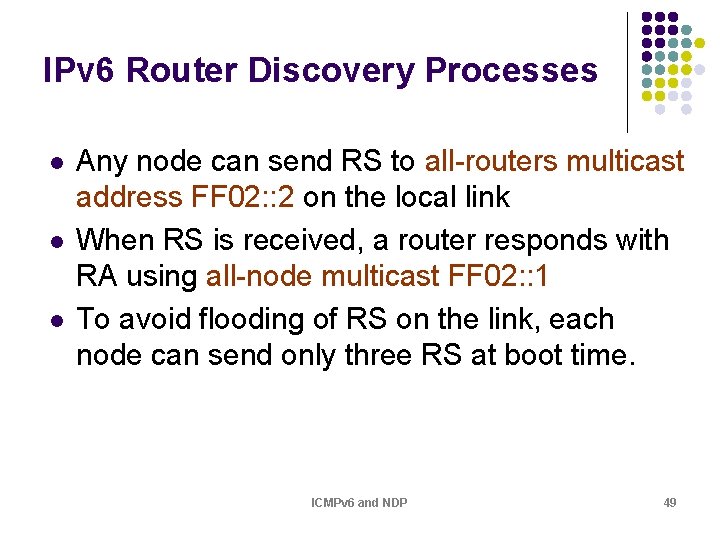
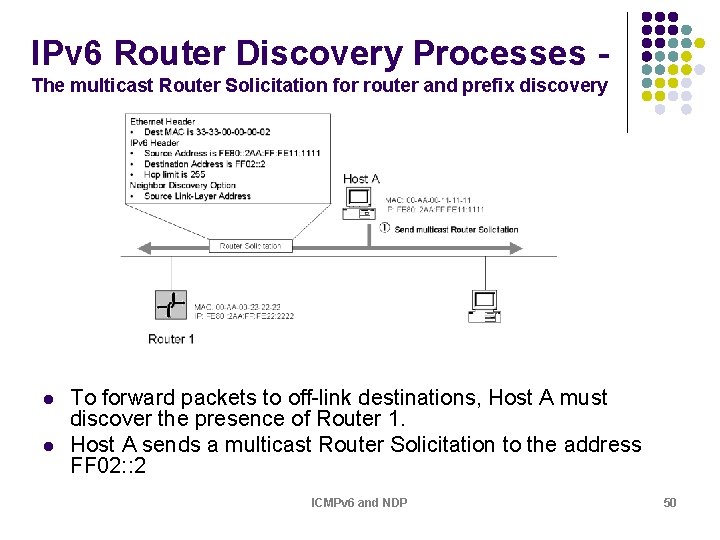
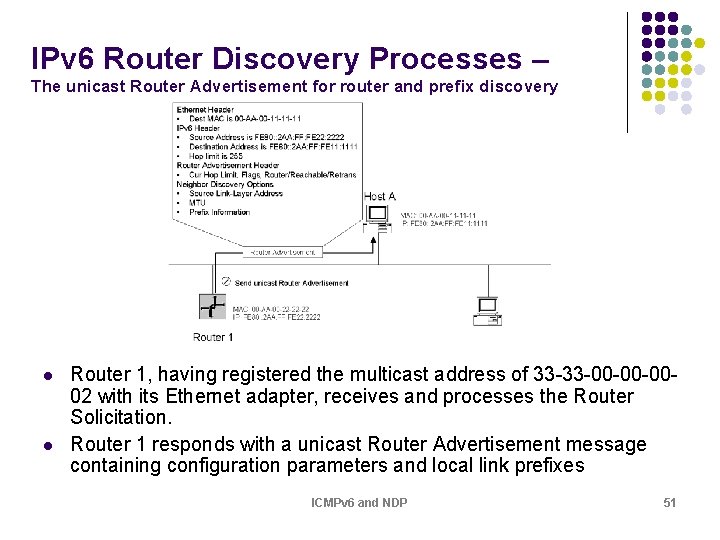
IPv 6 Router Discovery Processes l IPv 6 routers periodically send a Router Advertisement message on the local link advertising their existence as routers. l l l They also provide configuration parameters such as default hop limit, MTU, and prefixes. Active IPv 6 hosts on the local link receive the Router Advertisement messages and use the contents to maintain the default router list, the prefix list, and other configuration parameters. A host that is starting up sends a Router Solicitation message to the link-local scope all-routers multicast address (FF 02: : 2). Upon receipt of a Router Solicitation message, all routers on the local link send a unicast Router Advertisement message to the node that sent the Router Solicitation. The node receives the Router Advertisement messages and uses their contents to build the default router and prefix lists and set other configuration parameters. ICMPv 6 and NDP 48
IPv 6 Router Discovery Processes l l l Any node can send RS to all-routers multicast address FF 02: : 2 on the local link When RS is received, a router responds with RA using all-node multicast FF 02: : 1 To avoid flooding of RS on the link, each node can send only three RS at boot time. ICMPv 6 and NDP 49
IPv 6 Router Discovery Processes The multicast Router Solicitation for router and prefix discovery l l To forward packets to off-link destinations, Host A must discover the presence of Router 1. Host A sends a multicast Router Solicitation to the address FF 02: : 2 ICMPv 6 and NDP 50
IPv 6 Router Discovery Processes – The unicast Router Advertisement for router and prefix discovery l l Router 1, having registered the multicast address of 33 -33 -00 -00 -0002 with its Ethernet adapter, receives and processes the Router Solicitation. Router 1 responds with a unicast Router Advertisement message containing configuration parameters and local link prefixes ICMPv 6 and NDP 51
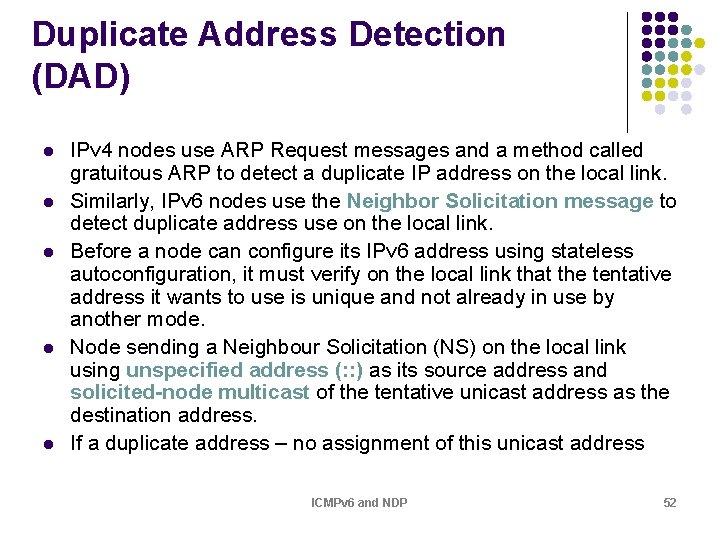
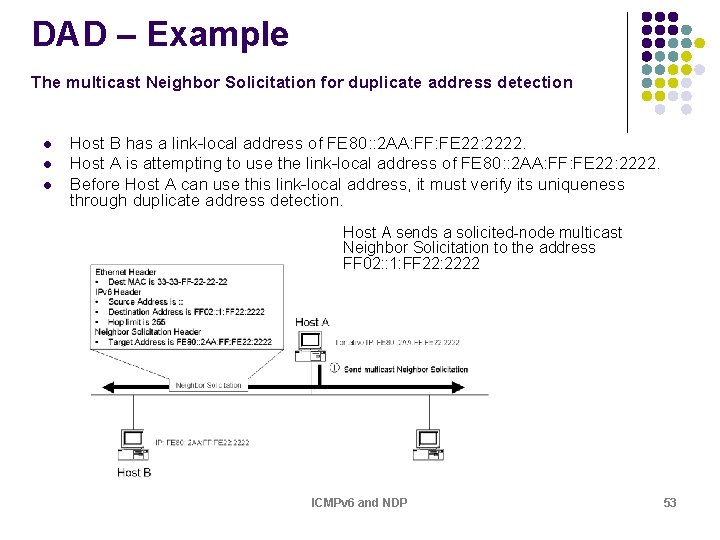
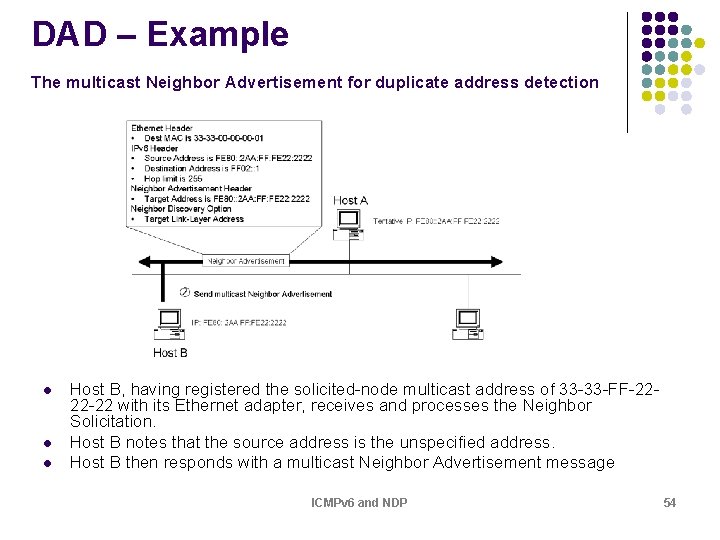
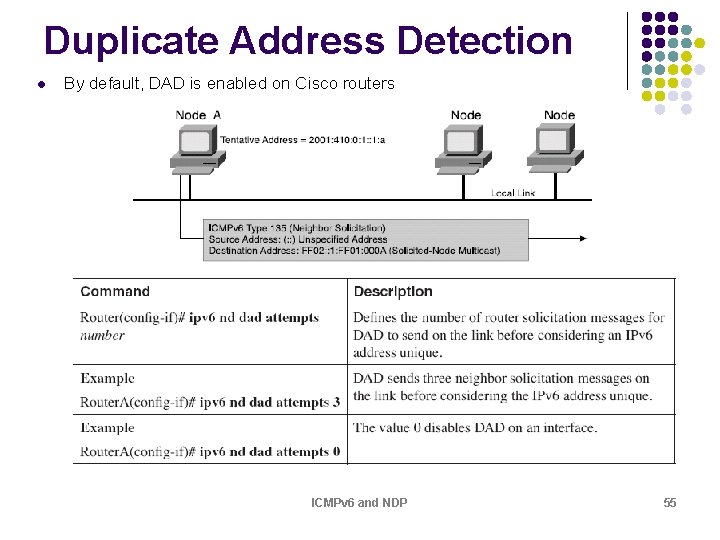
Duplicate Address Detection (DAD) l l l IPv 4 nodes use ARP Request messages and a method called gratuitous ARP to detect a duplicate IP address on the local link. Similarly, IPv 6 nodes use the Neighbor Solicitation message to detect duplicate address use on the local link. Before a node can configure its IPv 6 address using stateless autoconfiguration, it must verify on the local link that the tentative address it wants to use is unique and not already in use by another mode. Node sending a Neighbour Solicitation (NS) on the local link using unspecified address (: : ) as its source address and solicited-node multicast of the tentative unicast address as the destination address. If a duplicate address – no assignment of this unicast address ICMPv 6 and NDP 52
DAD – Example The multicast Neighbor Solicitation for duplicate address detection l l l Host B has a link-local address of FE 80: : 2 AA: FF: FE 22: 2222. Host A is attempting to use the link-local address of FE 80: : 2 AA: FF: FE 22: 2222. Before Host A can use this link-local address, it must verify its uniqueness through duplicate address detection. Host A sends a solicited-node multicast Neighbor Solicitation to the address FF 02: : 1: FF 22: 2222 ICMPv 6 and NDP 53
DAD – Example The multicast Neighbor Advertisement for duplicate address detection l l l Host B, having registered the solicited-node multicast address of 33 -33 -FF-2222 -22 with its Ethernet adapter, receives and processes the Neighbor Solicitation. Host B notes that the source address is the unspecified address. Host B then responds with a multicast Neighbor Advertisement message ICMPv 6 and NDP 54
Duplicate Address Detection l By default, DAD is enabled on Cisco routers ICMPv 6 and NDP 55
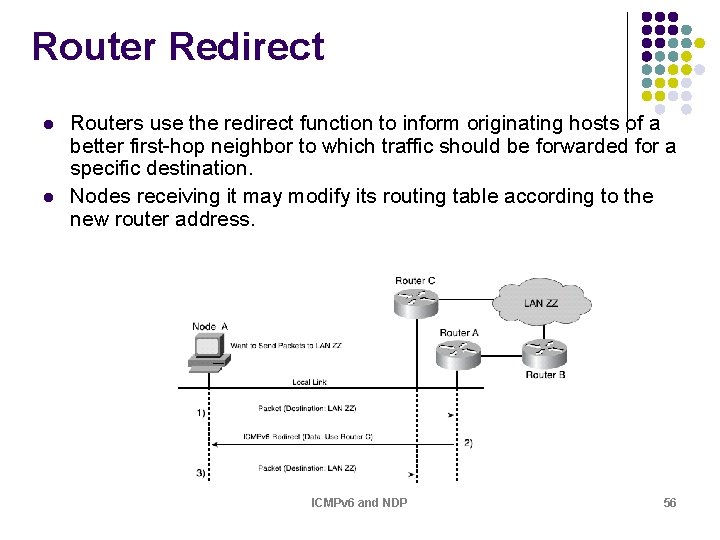
Router Redirect l l Routers use the redirect function to inform originating hosts of a better first-hop neighbor to which traffic should be forwarded for a specific destination. Nodes receiving it may modify its routing table according to the new router address. ICMPv 6 and NDP 56
Router Redirect l 1. 2. There are two instances where redirect is used: A router informs an originating host of the IP address of a router available on the local link that is “closer” to the destination. l “Closer” is routing metric function used to reach the destination network segment. l This condition can occur when there are multiple routers on a network segment and the originating host chooses a default router and it is not the best one to use to reach the destination. A router informs an originating host that the destination is a neighbor (it is on the same link as the originating host). l This condition can occur when the prefix list of a host does not include the prefix of the destination. l Because the destination does not match a prefix in the list, the originating host forwards the packet to its default router. ICMPv 6 and NDP 57
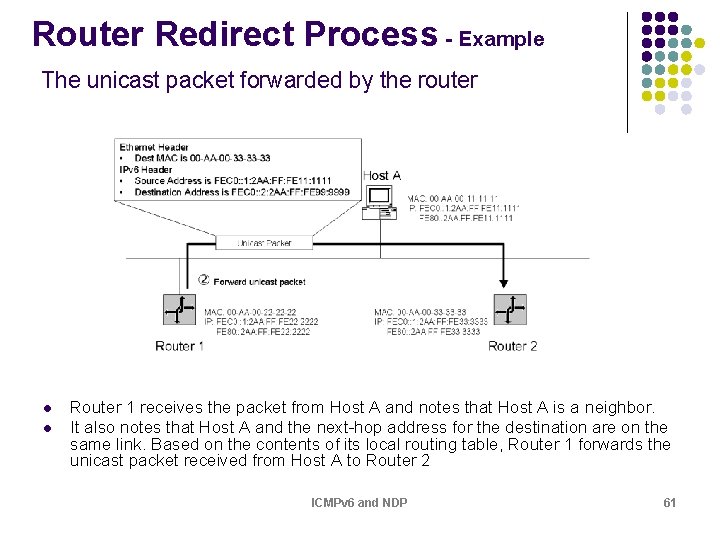
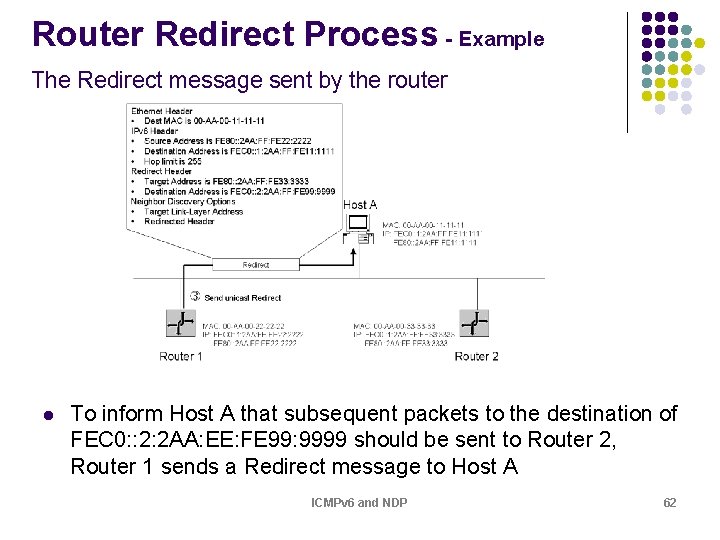
Router Redirect Process The originating host forwards a unicast packet to its default router. The router processes the packet and notes that the address of the originating host is a neighbor. 1. 2. l Additionally, it notes that the addresses of both the originating host and the next-hop are on the same link. The router forwards the packet to the appropriate next-hop address. The router sends the originating host a Redirect message. 3. 4. l In the Target Address field of the Redirect message is the next-hop address of the node to which the originating host should send packets addressed to the destination. ICMPv 6 and NDP 58
Router Redirect Process l l For packets redirected to a router, the Target Address field is set to the link-local address of the router. For packets redirected to a host, the Target Address field is set to the destination address of the packet originally sent. The Redirect message includes the Redirected Header option. It might also include the Target Link-Layer Address option. Upon receipt of the Redirect message, the originating host updates the destination address entry in the destination cache with the address in the Target Address field. l If the Target Link-Layer Address option is included in the Redirect message, its contents are used to create or update the corresponding neighbor cache entry. ICMPv 6 and NDP 59
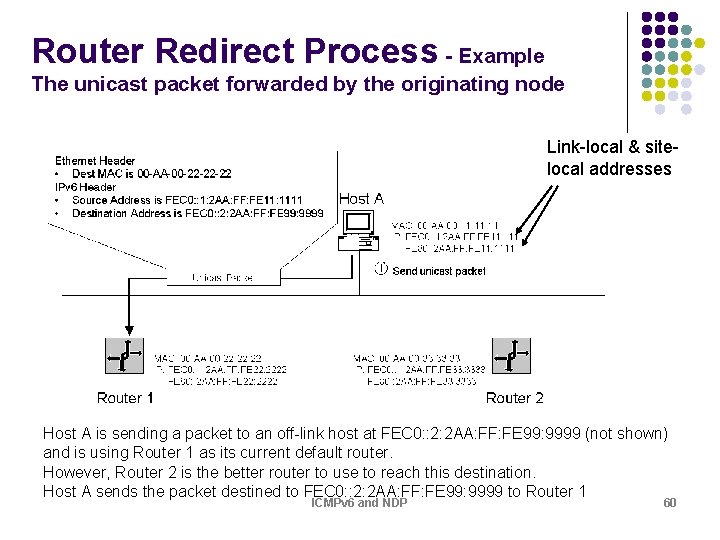
Router Redirect Process - Example The unicast packet forwarded by the originating node Link-local & sitelocal addresses Host A is sending a packet to an off-link host at FEC 0: : 2: 2 AA: FF: FE 99: 9999 (not shown) and is using Router 1 as its current default router. However, Router 2 is the better router to use to reach this destination. Host A sends the packet destined to FEC 0: : 2: 2 AA: FF: FE 99: 9999 to Router 1 ICMPv 6 and NDP 60
Router Redirect Process - Example The unicast packet forwarded by the router l l Router 1 receives the packet from Host A and notes that Host A is a neighbor. It also notes that Host A and the next-hop address for the destination are on the same link. Based on the contents of its local routing table, Router 1 forwards the unicast packet received from Host A to Router 2 ICMPv 6 and NDP 61
Router Redirect Process - Example The Redirect message sent by the router l To inform Host A that subsequent packets to the destination of FEC 0: : 2: 2 AA: EE: FE 99: 9999 should be sent to Router 2, Router 1 sends a Redirect message to Host A ICMPv 6 and NDP 62
ICMPv 6 and NDP