
IPV 4 VS IPV 6 Submitted to Mrs
IPV 4 VS IPV 6 Submitted to: Mrs. Kavita Taneja (lect. ) verma MMICT & BM Submitted by: Jasleen kaur Hitaishi MCA 4 th sem
INTRODUCTION The original intention was to assign a unique IP address to each computer that is connected to the Internet. But after the private networks developed and the address space needed to be conserved, this was found not to be always necessary. Today, Private Networks typically connect to the Internet using the Network Address Translation. Technologies such as “any cast” also allow multiple computers to use the same IP address but at different portions of the Internet, so that private networks can handle more consumers.
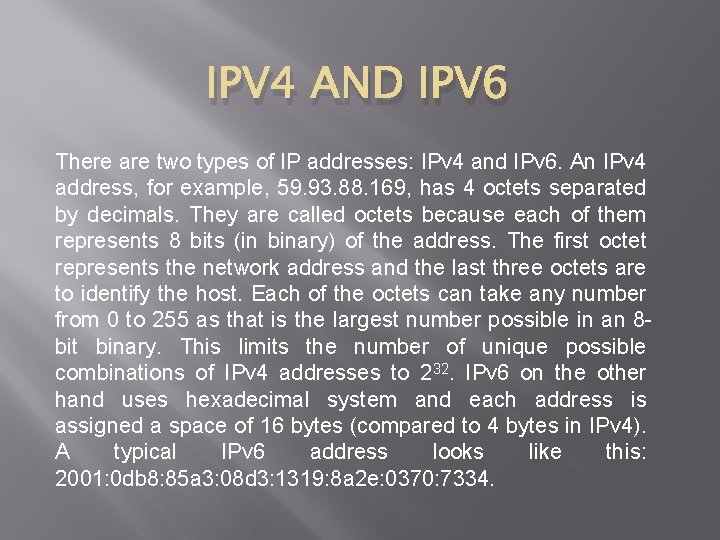
IPV 4 AND IPV 6 There are two types of IP addresses: IPv 4 and IPv 6. An IPv 4 address, for example, 59. 93. 88. 169, has 4 octets separated by decimals. They are called octets because each of them represents 8 bits (in binary) of the address. The first octet represents the network address and the last three octets are to identify the host. Each of the octets can take any number from 0 to 255 as that is the largest number possible in an 8 bit binary. This limits the number of unique possible combinations of IPv 4 addresses to 232. IPv 6 on the other hand uses hexadecimal system and each address is assigned a space of 16 bytes (compared to 4 bytes in IPv 4). A typical IPv 6 address looks like this: 2001: 0 db 8: 85 a 3: 08 d 3: 1319: 8 a 2 e: 0370: 7334.
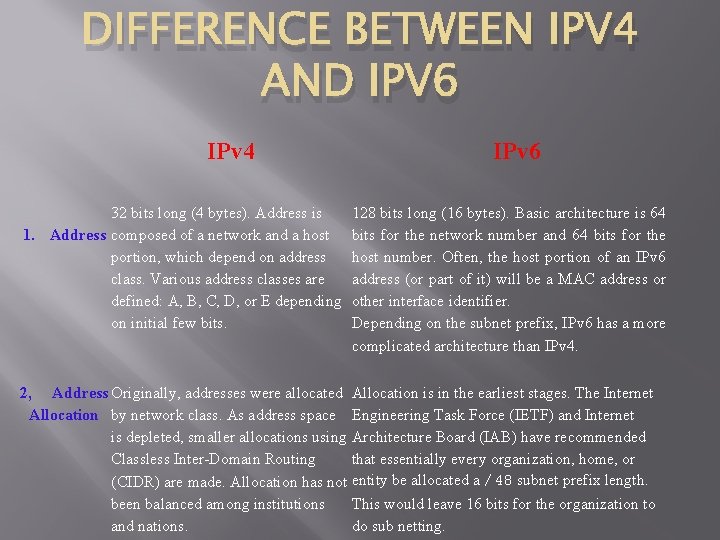
DIFFERENCE BETWEEN IPV 4 AND IPV 6 IPv 4 32 bits long (4 bytes). Address is 1. Address composed of a network and a host portion, which depend on address class. Various address classes are defined: A, B, C, D, or E depending on initial few bits. IPv 6 128 bits long (16 bytes). Basic architecture is 64 bits for the network number and 64 bits for the host number. Often, the host portion of an IPv 6 address (or part of it) will be a MAC address or other interface identifier. Depending on the subnet prefix, IPv 6 has a more complicated architecture than IPv 4. 2, Address Originally, addresses were allocated Allocation is in the earliest stages. The Internet Allocation by network class. As address space Engineering Task Force (IETF) and Internet is depleted, smaller allocations using Architecture Board (IAB) have recommended Classless Inter-Domain Routing that essentially every organization, home, or (CIDR) are made. Allocation has not entity be allocated a /48 subnet prefix length. been balanced among institutions This would leave 16 bits for the organization to and nations. do sub netting.
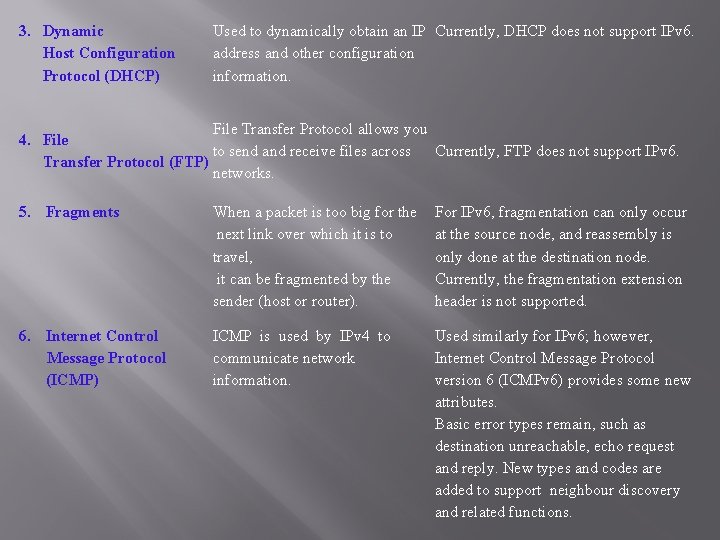
3. Dynamic Host Configuration Protocol (DHCP) Used to dynamically obtain an IP Currently, DHCP does not support IPv 6. address and other configuration information. File Transfer Protocol allows you 4. File to send and receive files across Currently, FTP does not support IPv 6. Transfer Protocol (FTP) networks. 5. Fragments When a packet is too big for the next link over which it is to travel, it can be fragmented by the sender (host or router). For IPv 6, fragmentation can only occur at the source node, and reassembly is only done at the destination node. Currently, the fragmentation extension header is not supported. 6. Internet Control Message Protocol (ICMP) ICMP is used by IPv 4 to communicate network information. Used similarly for IPv 6; however, Internet Control Message Protocol version 6 (ICMPv 6) provides some new attributes. Basic error types remain, such as destination unreachable, echo request and reply. New types and codes are added to support neighbour discovery and related functions.
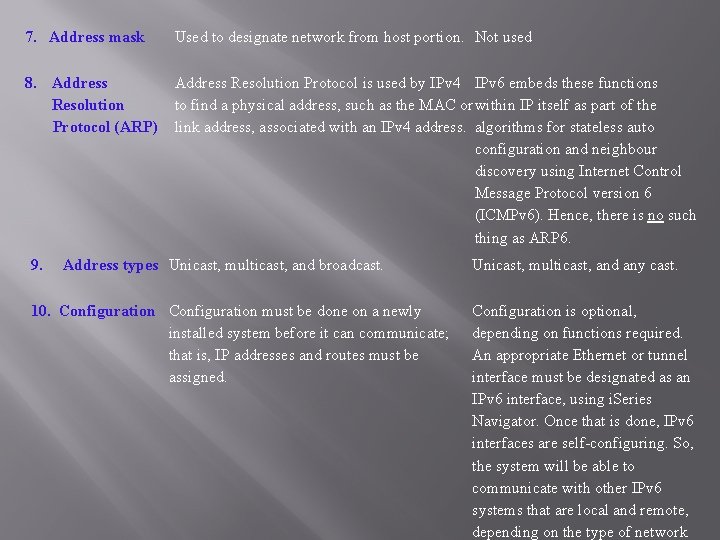
7. Address mask Used to designate network from host portion. Not used 8. Address Resolution Protocol (ARP) Address Resolution Protocol is used by IPv 4 IPv 6 embeds these functions to find a physical address, such as the MAC or within IP itself as part of the link address, associated with an IPv 4 address. algorithms for stateless auto configuration and neighbour discovery using Internet Control Message Protocol version 6 (ICMPv 6). Hence, there is no such thing as ARP 6. 9. Address types Unicast, multicast, and broadcast. 10. Configuration must be done on a newly installed system before it can communicate; that is, IP addresses and routes must be assigned. Unicast, multicast, and any cast. Configuration is optional, depending on functions required. An appropriate Ethernet or tunnel interface must be designated as an IPv 6 interface, using i. Series Navigator. Once that is done, IPv 6 interfaces are self-configuring. So, the system will be able to communicate with other IPv 6 systems that are local and remote, depending on the type of network
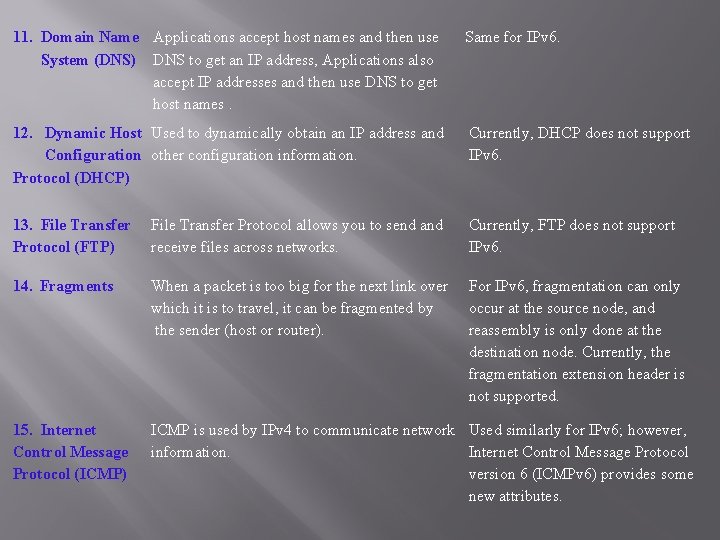
11. Domain Name Applications accept host names and then use System (DNS) DNS to get an IP address, Applications also accept IP addresses and then use DNS to get host names. Same for IPv 6. 12. Dynamic Host Used to dynamically obtain an IP address and Configuration other configuration information. Protocol (DHCP) Currently, DHCP does not support IPv 6. 13. File Transfer Protocol (FTP) File Transfer Protocol allows you to send and receive files across networks. Currently, FTP does not support IPv 6. 14. Fragments When a packet is too big for the next link over which it is to travel, it can be fragmented by the sender (host or router). For IPv 6, fragmentation can only occur at the source node, and reassembly is only done at the destination node. Currently, the fragmentation extension header is not supported. 15. Internet Control Message Protocol (ICMP) ICMP is used by IPv 4 to communicate network Used similarly for IPv 6; however, information. Internet Control Message Protocol version 6 (ICMPv 6) provides some new attributes.
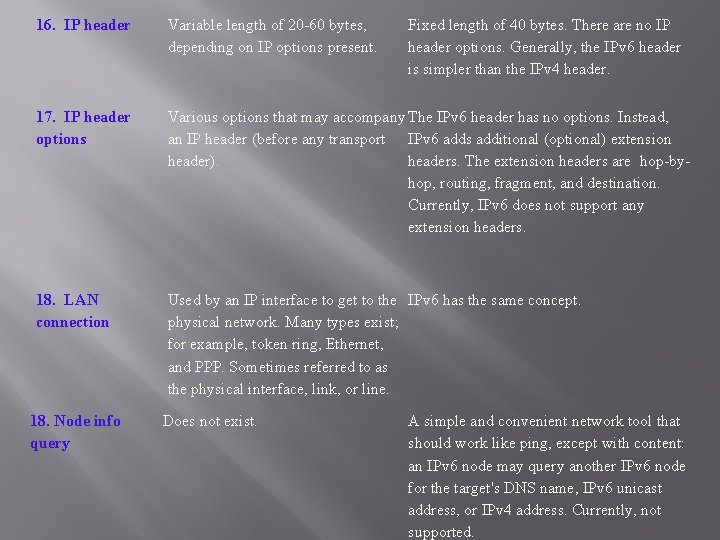
16. IP header Variable length of 20 -60 bytes, depending on IP options present. 17. IP header options Various options that may accompany The IPv 6 header has no options. Instead, an IP header (before any transport IPv 6 adds additional (optional) extension header). headers. The extension headers are hop-byhop, routing, fragment, and destination. Currently, IPv 6 does not support any extension headers. 18. LAN connection Used by an IP interface to get to the IPv 6 has the same concept. physical network. Many types exist; for example, token ring, Ethernet, and PPP. Sometimes referred to as the physical interface, link, or line. 18. Node info query Does not exist. Fixed length of 40 bytes. There are no IP header options. Generally, the IPv 6 header is simpler than the IPv 4 header. A simple and convenient network tool that should work like ping, except with content: an IPv 6 node may query another IPv 6 node for the target's DNS name, IPv 6 unicast address, or IPv 4 address. Currently, not supported.
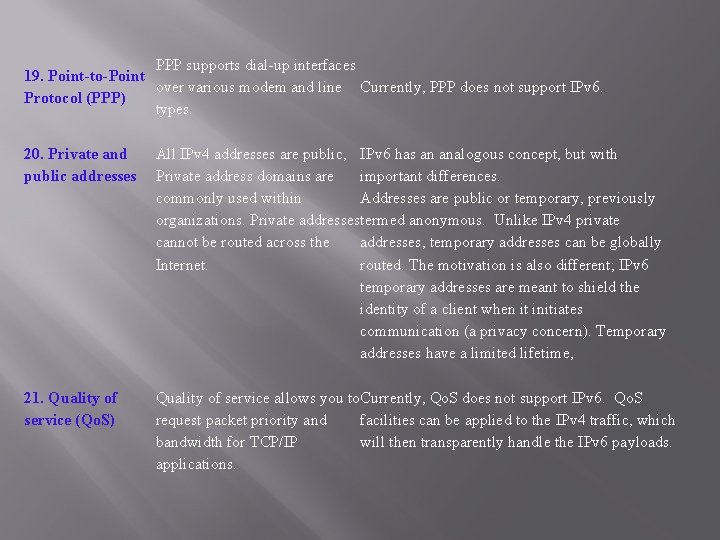
PPP supports dial-up interfaces 19. Point-to-Point over various modem and line Currently, PPP does not support IPv 6. Protocol (PPP) types. 20. Private and public addresses All IPv 4 addresses are public, IPv 6 has an analogous concept, but with Private address domains are important differences. commonly used within Addresses are public or temporary, previously organizations. Private addressestermed anonymous. Unlike IPv 4 private cannot be routed across the addresses, temporary addresses can be globally Internet. routed. The motivation is also different; IPv 6 temporary addresses are meant to shield the identity of a client when it initiates communication (a privacy concern). Temporary addresses have a limited lifetime, 21. Quality of service (Qo. S) Quality of service allows you to. Currently, Qo. S does not support IPv 6. Qo. S request packet priority and facilities can be applied to the IPv 4 traffic, which bandwidth for TCP/IP will then transparently handle the IPv 6 payloads. applications.

S K N A TH
- Slides: 10