
IPv 4 Overview CS 460 Cyber Security Lab
IPv 4 Overview CS 460 - Cyber Security Lab Spring 2009
Outline • • Review Layered Network Architecture Network Layer protocols Transport Layer Protocols Application Layer Protocols

Reading Material • Many texts on IP networking – Computer Networks, Andrew Tannenbaum – Data and Computer Communications, William Stallings – Internetworking with TCP/IP Vol 1, Douglas Comer • Plus all the originals from the Internet Engineering Task Force (IETF) – http: //ietf. org/
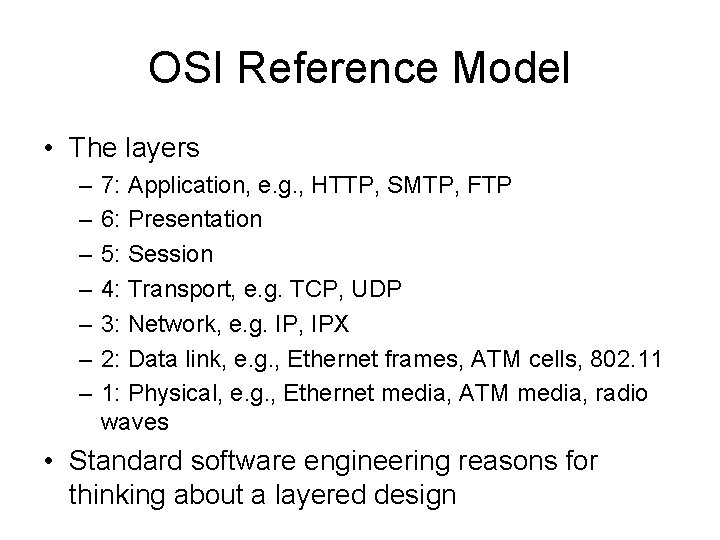
OSI Reference Model • The layers – – – – 7: Application, e. g. , HTTP, SMTP, FTP 6: Presentation 5: Session 4: Transport, e. g. TCP, UDP 3: Network, e. g. IP, IPX 2: Data link, e. g. , Ethernet frames, ATM cells, 802. 11 1: Physical, e. g. , Ethernet media, ATM media, radio waves • Standard software engineering reasons for thinking about a layered design
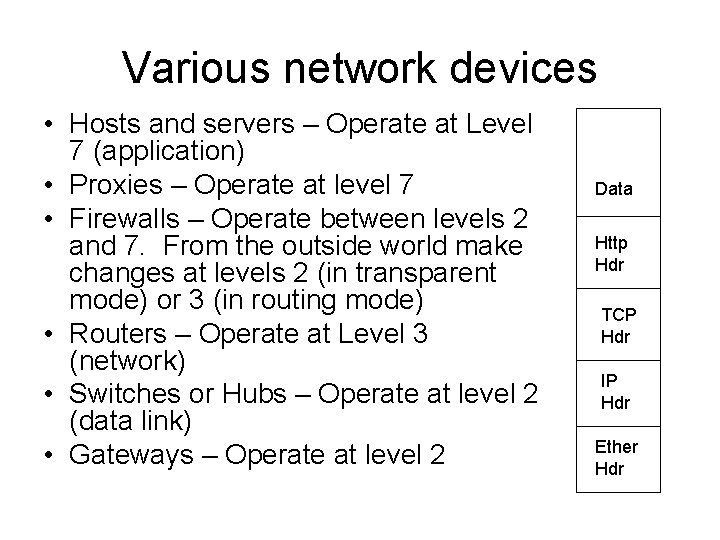
Various network devices • Hosts and servers – Operate at Level 7 (application) • Proxies – Operate at level 7 • Firewalls – Operate between levels 2 and 7. From the outside world make changes at levels 2 (in transparent mode) or 3 (in routing mode) • Routers – Operate at Level 3 (network) • Switches or Hubs – Operate at level 2 (data link) • Gateways – Operate at level 2 Data Http Hdr TCP Hdr IP Hdr Ether Hdr
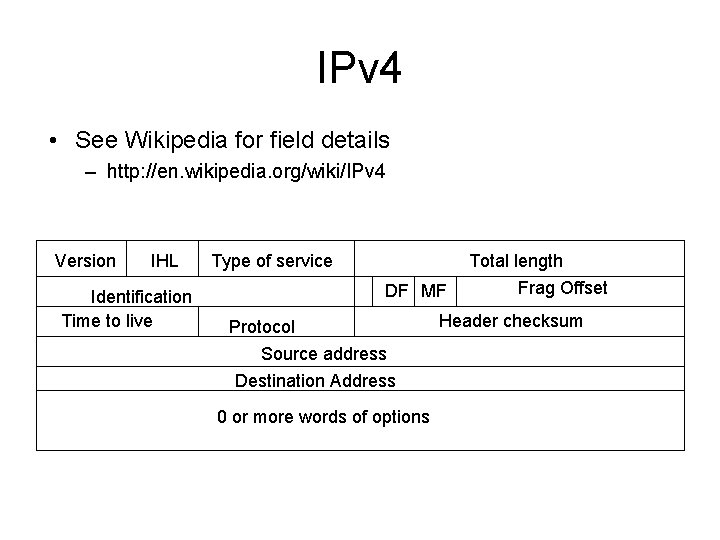
IPv 4 • See Wikipedia for field details – http: //en. wikipedia. org/wiki/IPv 4 Version IHL Identification Time to live Type of service Total length DF MF Protocol Source address Destination Address 0 or more words of options Frag Offset Header checksum
Ipv 4 Addressing • Each entity has at least one address • Addresses divided into networks • Addresses in your networks are “directly” connected – Broadcasts should reach them – No need to route packets to them
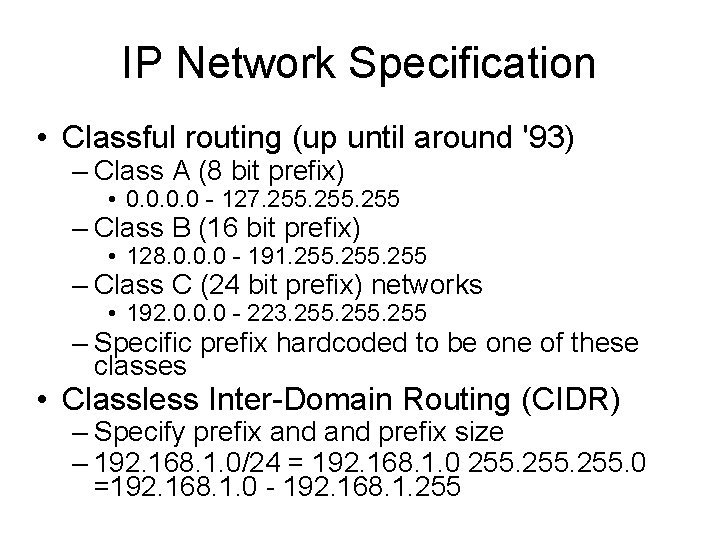
IP Network Specification • Classful routing (up until around '93) – Class A (8 bit prefix) • 0. 0 - 127. 255 – Class B (16 bit prefix) • 128. 0. 0. 0 - 191. 255 – Class C (24 bit prefix) networks • 192. 0. 0. 0 - 223. 255 – Specific prefix hardcoded to be one of these classes • Classless Inter-Domain Routing (CIDR) – Specify prefix and prefix size – 192. 168. 1. 0/24 = 192. 168. 1. 0 255. 0 =192. 168. 1. 0 - 192. 168. 1. 255
Switches • Original Ethernet broadcast all packets • Layer two means of passing packets – Learn or config which MAC's live behind which ports – Only pass traffic to the appropriate port • Span ports – Mirror all traffic
Address spoofing • Sender can put any source address in packets he sends: – Can be used to send unwelcome return traffic to the spoofed address – Can be used to bypass filters to get unwelcome traffic to the destination • Reverse Path verification can be used by routers to broadly catch some spoofers
Fragmentation • May need to fragment an IP packet if one data link along the way cannot handle the packet size – Perhaps path is a mix of different HW – Perhaps unexpected encapsulation makes the packet larger than the source expected – Hosts try to understand Maximum Transmission Unit (MTU) to avoid the need for fragmentation (which causes a performance hit) • Any device along the way can fragment – Identification field identifies all elements of the same fragment – Fragmentation stored in the MF (more fragments) and fragment offset fields – Devices can reassemble too – But generally the destination does the reassembly
Fragmentation Flaws? • Split packet to fool simple firewall and IDS – Intermediate content observers must do reassembly • Overlapping fragments – Can be used to trick IDS by hiding, e. g. a “get /etc/password” request – Different clients reassemble overlapping fragments differently – Just drop overlapping fragments • Bad fragment offsets exploit poor stack implementations – E. g. Teardrop attack, negative offsets or overlarge offsets cause buffer overflows – Firewalls can check for well formed packets. • Resource attacks on re-assemblers – Send all but one fragment for many packets
Address Resolution Protocol (ARP) • Used to discover mapping of neighboring ethernet MAC to IP addresses. – Need to find MAC for 192. 168. 1. 3 which is in your interface's subnetwork – Broadcast an ARP request on the link – Receive an ARP reply giving the correct MAC – The device stores this information in an ARP cache or ARP table
Does Anyone Remember ARP Cache Poisoning?
ARP cache poisoning • Bootstrap problem with respect to security. Anyone can send an ARP reply – The Ingredients to ARP Poison, http: //www. governmentsecurity. org/articles/The. Ingredientsto. ARP Poison. php • Classic Man-in-the-middle attack – Send arp reply messages to device so they think your machine is someone else – Better than simple sniffing because not just best effort. • Solutions – Encrypt all traffic – Monitoring programs like arpwatch to detect mapping changes • Which might be valid due to DHCP
Basic IPv 4 Routing • Static routing. Used by hosts, firewalls and routers. – Routing table consists of entries of • – – May have routing table per incoming interface To route a packet, take the destination address and find the best match network in the table. In case of a tie look at the metric • • – Network, Next hop address, metric, interface Use the corresponding next hop address and interface to send the packet on. The next hop address is on the same link as this device, so you use the next hop’s data-link address, e. g. ethernet MAC address Decrement “time to live” field in IP header at each hop. Drop packet when it reaches 0 • • Attempt to avoid routing loops As internet got bigger, TTL fields got set bigger. 225 maximum
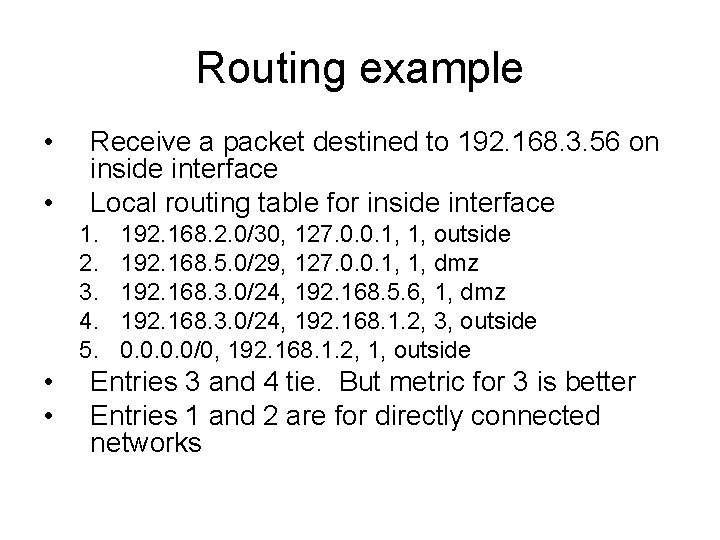
Routing example • • Receive a packet destined to 192. 168. 3. 56 on inside interface Local routing table for inside interface 1. 2. 3. 4. 5. • • 192. 168. 2. 0/30, 127. 0. 0. 1, 1, outside 192. 168. 5. 0/29, 127. 0. 0. 1, 1, dmz 192. 168. 3. 0/24, 192. 168. 5. 6, 1, dmz 192. 168. 3. 0/24, 192. 168. 1. 2, 3, outside 0. 0/0, 192. 168. 1. 2, 1, outside Entries 3 and 4 tie. But metric for 3 is better Entries 1 and 2 are for directly connected networks
Source Based Routing • In the IP Options field, can specify a source route – Was conceived of as a way to ensure some traffic could be delivered even if the routing table was completely screwed up. • Why is this bad? – Can be used by the bad guy to avoid security enforcing devices – Most folks configure routers to drop packets with source routes set
IP Options in General • Originally envisioned as a means to add more features to IP later • Most routers drop packets with IP options set – Stance of not passing traffic you don’t understand – Therefore, IP Option mechanisms never really took off • In addition to source routing, there are security Options – Used for DNSIX, a MLS network encryption scheme
Dynamic Routing Protocols • For scaling, discover topology and routing rather than statically constructing routing tables – Open Shortest Path First (OSPF): Used for routing within an administrative domain (Autonomous System) – RIP: not used much anymore – Border Gateway Protocol (BGP): Used for routing between administrative domains. Can encode nontechnical transit constraints, e. g. Domain X will only carry traffic of paying customers • Receives full paths from neighbors, so it avoids counts to infinity.
Dynamic Routing • Injecting unexpected routes a security concern. – BGP supports TCP MD 5 authentication • Creates a hash of the TCP header and data portion • Keyed with shared secret – Filter out route traffic from unexpected (external) points – OSPF has MD 5 authentication, and can statically configure neighbour routers, rather than discover them.
Secure BGP • Renewed government emphasis • BBN prototype done earlier this decade • Like Secure DNS add PKI – Bind certificates with ownership of address blocks and Autonomous systems • BBN Site – http: //www. ir. bbn. com/sbgp/ – Secure Border Gateway Protocol (S-BGP) Kent, S. ; Lynn, C. ; Seo, K. Selected Areas in Communications, IEEE Journal on Volume 18, Issue 4, Apr 2000
Internet Control Message Protocol (ICMP) • Used for diagnostics – – – – Destination unreachable Time exceeded, TTL hit 0 Parameter problem, bad header field Source quench, throttling mechanism rarely used Redirect, feedback on potential bad route Echo Request and Echo reply, ping Timestamp request and Timestamp reply, performance ping • Can use information to help map out a network – Some people block ICMP from outside domain
Smurf Attack • An amplification Do. S attack – A relatively small amount of information sent is expanded to a large amount of data • Send ICMP echo request to IP broadcast addresses. Spoof the victim's address as the source • The echo request receivers dutifully send echo replies to the victim overwhelming it • Fraggle is a UDP variant of the same attack
Transport layer • UDP and TCP • Transport flows are defined by source and destination ports – A pair of devices can have numerous flows operating simultaneously by communicating between different pairs of ports • Applications are associated with ports (generally just destination ports) – IANA organizes port assignments http: //www. iana. org/ • Source ports generally dynamically selected – Ports under 1024 are considered well-known ports – Would not expect source ports to come from the well-known range • Scanners probe for listening ports to understand the services running on various machines
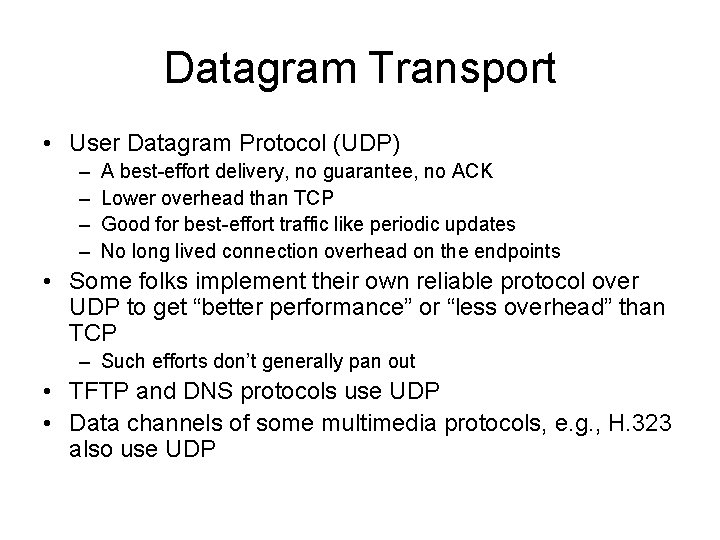
Datagram Transport • User Datagram Protocol (UDP) – – A best-effort delivery, no guarantee, no ACK Lower overhead than TCP Good for best-effort traffic like periodic updates No long lived connection overhead on the endpoints • Some folks implement their own reliable protocol over UDP to get “better performance” or “less overhead” than TCP – Such efforts don’t generally pan out • TFTP and DNS protocols use UDP • Data channels of some multimedia protocols, e. g. , H. 323 also use UDP
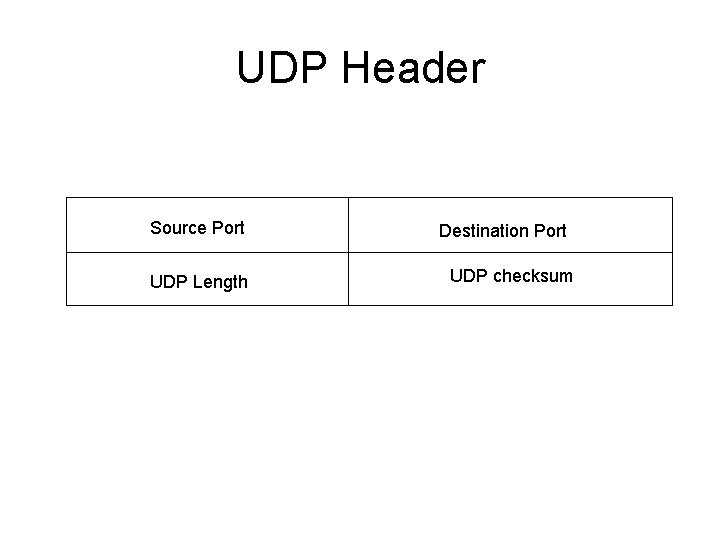
UDP Header Source Port UDP Length Destination Port UDP checksum
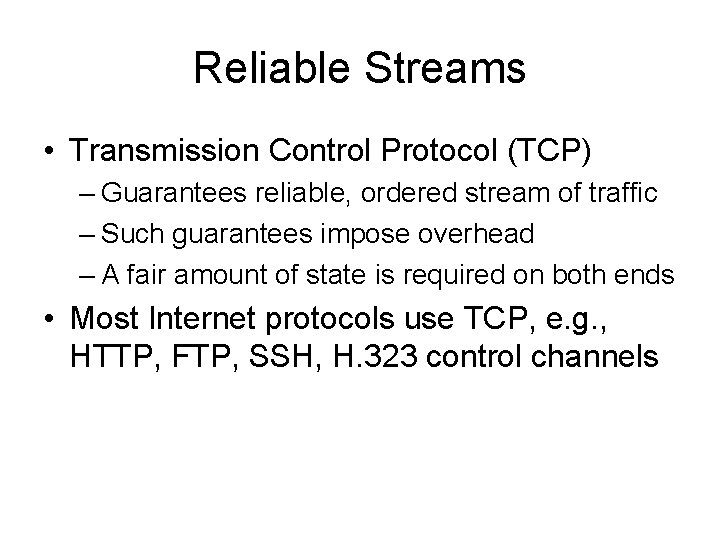
Reliable Streams • Transmission Control Protocol (TCP) – Guarantees reliable, ordered stream of traffic – Such guarantees impose overhead – A fair amount of state is required on both ends • Most Internet protocols use TCP, e. g. , HTTP, FTP, SSH, H. 323 control channels
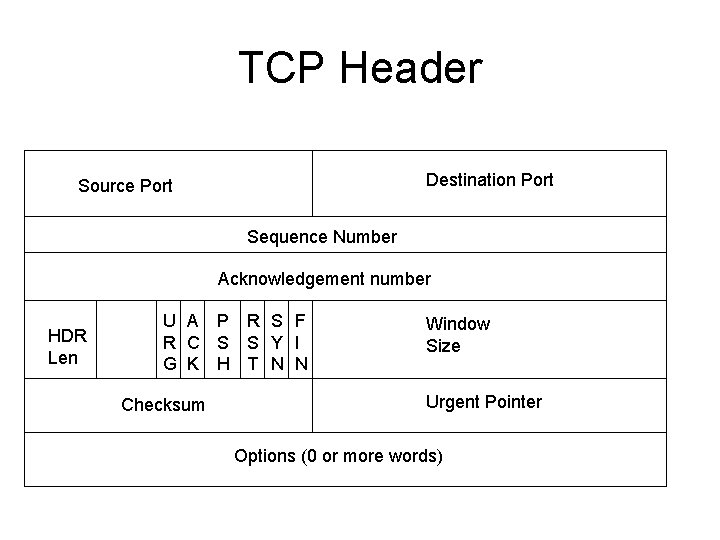
TCP Header Destination Port Source Port Sequence Number Acknowledgement number HDR Len U A P R S F R C S S Y I G K H T N N Checksum Window Size Urgent Pointer Options (0 or more words)
Three-way Handshake
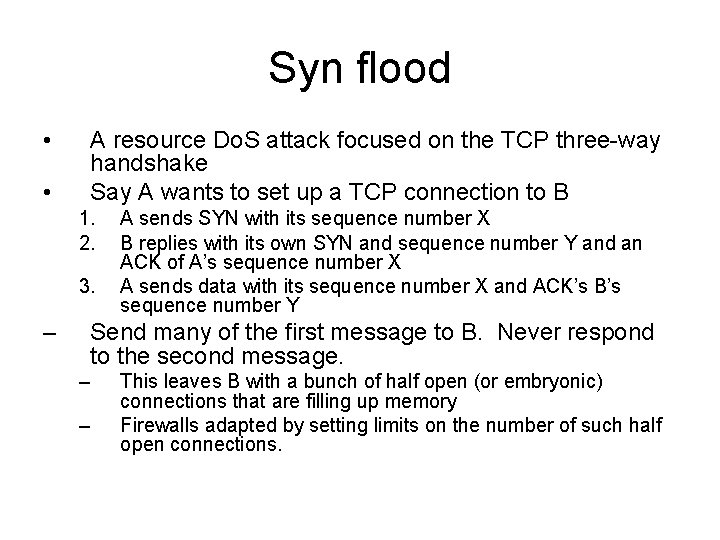
Syn flood • • A resource Do. S attack focused on the TCP three-way handshake Say A wants to set up a TCP connection to B 1. 2. 3. – A sends SYN with its sequence number X B replies with its own SYN and sequence number Y and an ACK of A’s sequence number X A sends data with its sequence number X and ACK’s B’s sequence number Y Send many of the first message to B. Never respond to the second message. – – This leaves B with a bunch of half open (or embryonic) connections that are filling up memory Firewalls adapted by setting limits on the number of such half open connections.
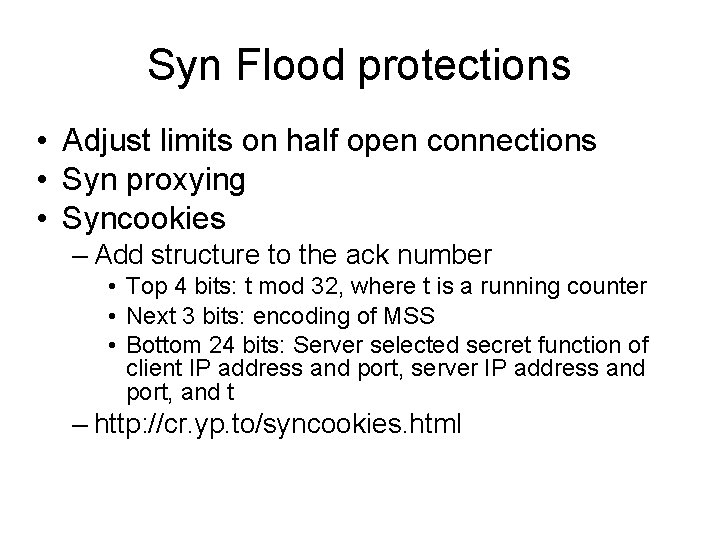
Syn Flood protections • Adjust limits on half open connections • Syn proxying • Syncookies – Add structure to the ack number • Top 4 bits: t mod 32, where t is a running counter • Next 3 bits: encoding of MSS • Bottom 24 bits: Server selected secret function of client IP address and port, server IP address and port, and t – http: //cr. yp. to/syncookies. html
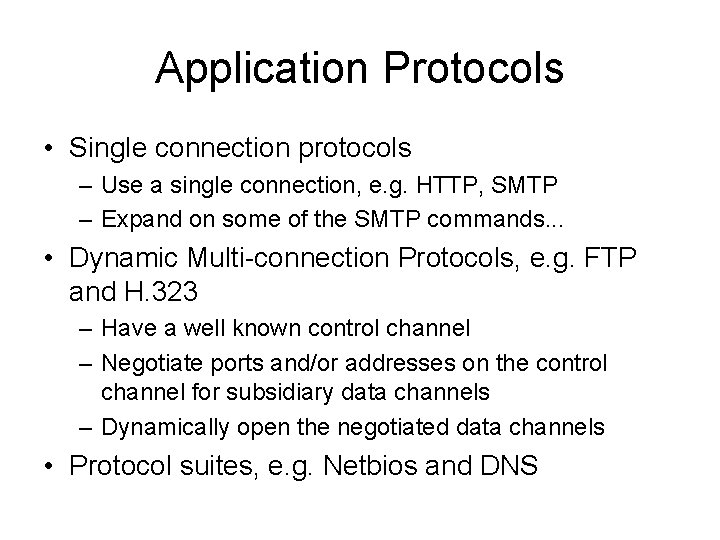
Application Protocols • Single connection protocols – Use a single connection, e. g. HTTP, SMTP – Expand on some of the SMTP commands. . . • Dynamic Multi-connection Protocols, e. g. FTP and H. 323 – Have a well known control channel – Negotiate ports and/or addresses on the control channel for subsidiary data channels – Dynamically open the negotiated data channels • Protocol suites, e. g. Netbios and DNS
Spoofing Applications • Often times ridiculously easy • Fake Client – Telnet to an SMTP server and enter mail from whoever you want – Authenticating email servers • Require a password • Require a mail download before server takes send requests • Fake server – Phishing: misdirect user to bogus server
Example • • > telnet target. com 25 HELO target. com MAIL FROM: <obama@whitehouse. gov> RCPT TO: <target@target. com> DATA Just kidding about that stimulus package. . QUIT • See RFC 821 for SMTP syntax
DHCP • Built on older BOOTP protocol (which was built on even older RARP protocol) – Used by diskless Suns • Enables dynamic allocation of IP address and related information • Runs over UDP • No security considered in the design. What are the problems? – Bogus DHCP servers handing out addresses of attackers choice – Hand out DNS and default gateways of attacker's choice – Bogus clients grabbing addresses • IETF attempted to add DHCP authentication but rather late in the game to do this. • Other solutions? – Physically secure networks – Use IPSec
Domain Name System (DNS) • Hierarchical service to resolve domain names to IP addresses. – The name space is divided into non-overlapping zones – E. g. , consider shinrich. cs. uiuc. edu. – DNS servers in the chain. One for. edu, one for. uiuc. edu, and one for. cs. uiuc. edu • Can have primary and secondary DNS servers per zone. Use TCP based zone transfer to keep up to date • Like DHCP, no security designed in – But at least the DNS server is not automatically discovered – Although this information can be dynamically set via DHCP
DNS Problems • DNS Open relays – Makes it look like good DNS server is authoritative server to bogus name – Enables amplification Do. S attack – http: //www. us-cert. gov/reading_room/DNSrecursion 121605. pdf • DNS Cache Poisoning – Change the name to address mapping to something more desirable to the attacker
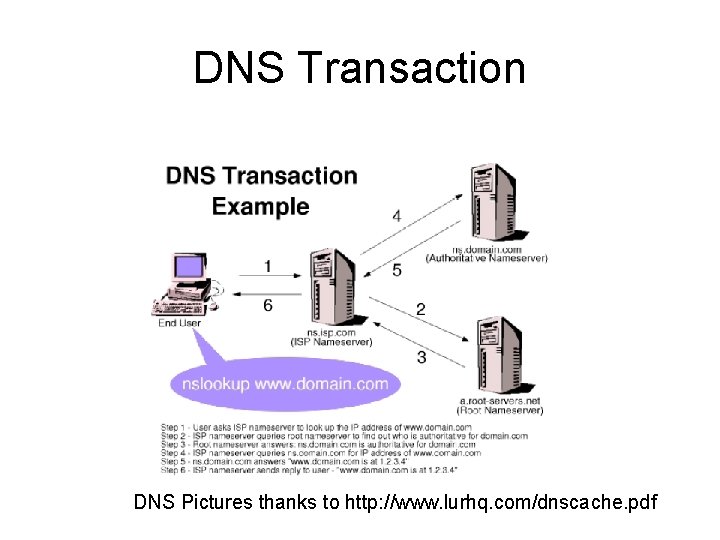
DNS Transaction DNS Pictures thanks to http: //www. lurhq. com/dnscache. pdf
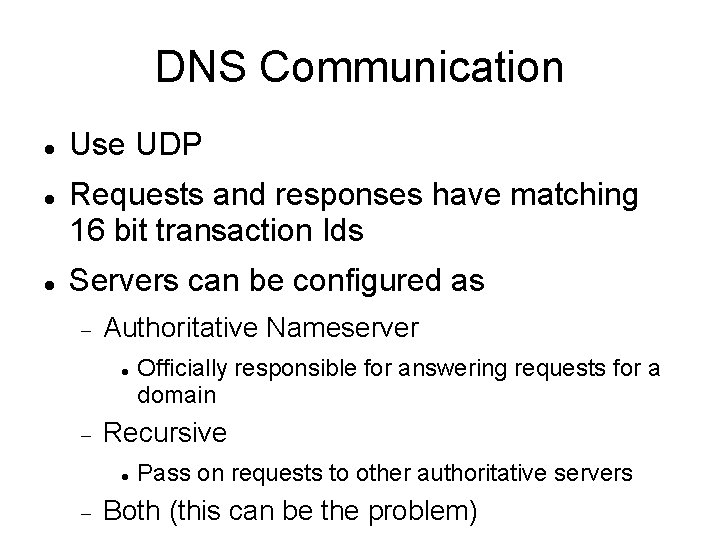
DNS Communication Use UDP Requests and responses have matching 16 bit transaction Ids Servers can be configured as Authoritative Nameserver Recursive Officially responsible for answering requests for a domain Pass on requests to other authoritative servers Both (this can be the problem)
DNS Open Relay
Good DNS Deployment
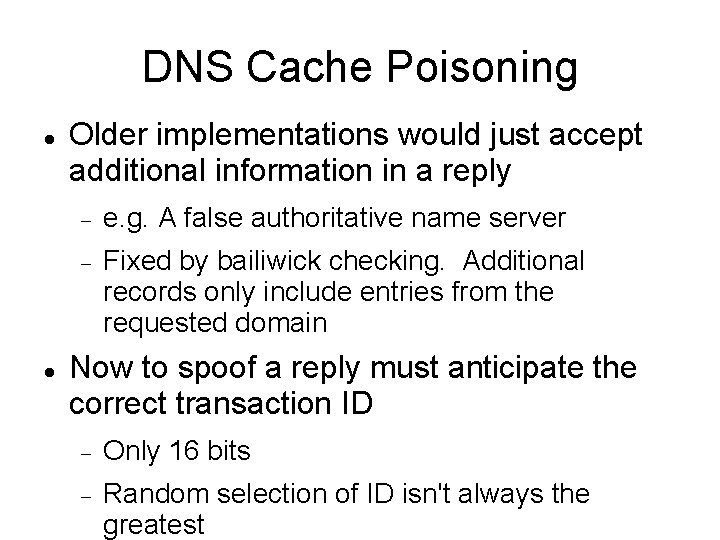
DNS Cache Poisoning Older implementations would just accept additional information in a reply e. g. A false authoritative name server Fixed by bailiwick checking. Additional records only include entries from the requested domain Now to spoof a reply must anticipate the correct transaction ID Only 16 bits Random selection of ID isn't always the greatest
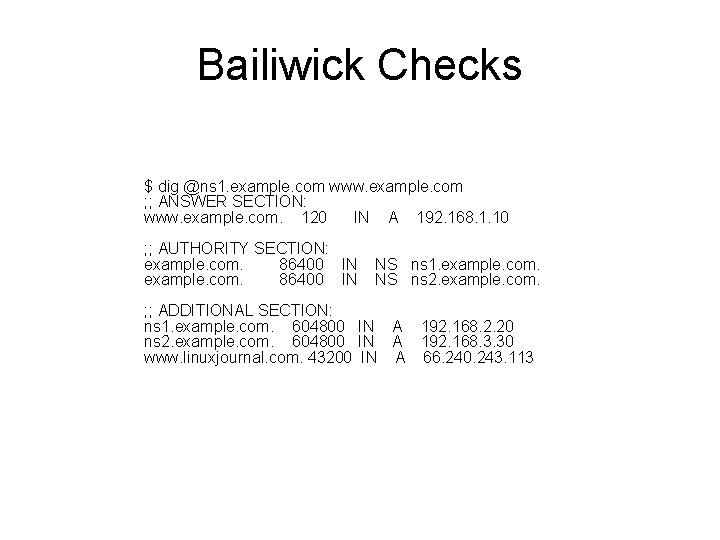
Bailiwick Checks $ dig @ns 1. example. com www. example. com ; ; ANSWER SECTION: www. example. com. 120 IN A 192. 168. 1. 10 ; ; AUTHORITY SECTION: example. com. 86400 IN NS ns 1. example. com. NS ns 2. example. com. ; ; ADDITIONAL SECTION: ns 1. example. com. 604800 IN A 192. 168. 2. 20 ns 2. example. com. 604800 IN A 192. 168. 3. 30 www. linuxjournal. com. 43200 IN A 66. 240. 243. 113
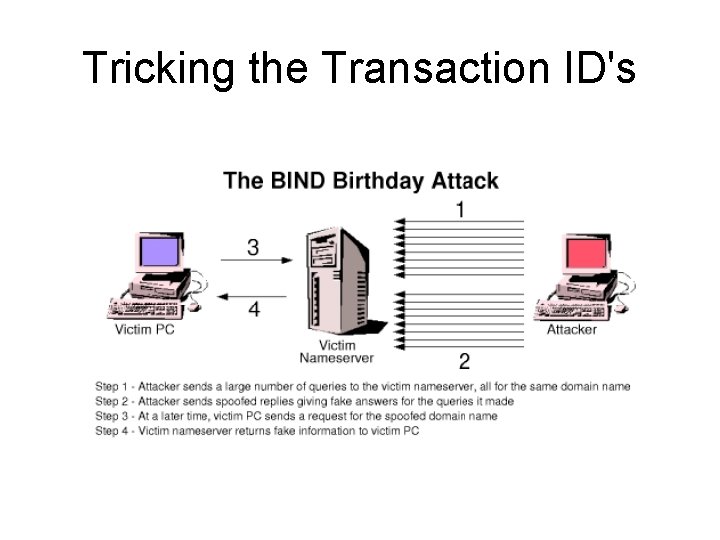
Tricking the Transaction ID's
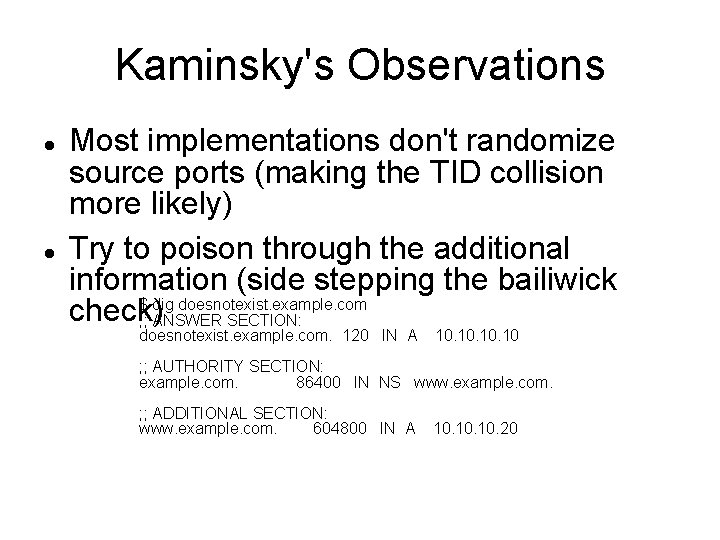
Kaminsky's Observations Most implementations don't randomize source ports (making the TID collision more likely) Try to poison through the additional information (side stepping the bailiwick $ dig doesnotexist. example. com check) ; ; ANSWER SECTION: doesnotexist. example. com. 120 IN A 10. 10. 10 ; ; AUTHORITY SECTION: example. com. 86400 IN NS www. example. com. ; ; ADDITIONAL SECTION: www. example. com. 604800 IN A 10. 10. 20
DNSSEC • Seeks to solve the trust issues of DNS • Uses a key hierarchy for verification • Has been under development for a decade and still not really deployed • Provides authentication, not confidentiality • DNS Threat Analysis in RFC 3833.
Summary • IPv 4 not designed with security in mind • Complexity can be exploited – Poor implementations – Edge cases in standards • Bootstrapping can be exploited – Easy of configuration vs strong trust
- Slides: 48