
IPTV01 How To Implement IPTV Networks Franchesca Walker


- Slides: 30
IPTV-01: How To Implement IPTV Networks Franchesca Walker Director, Enterprise Solutions Foundry Networks, Inc
Table of Contents • IPTV, Multi-Play Service Bundle: Why, What? • Components of an IPTV Network • IPTV Network Demands • Designing An IPTV Capable Network • Closing Thoughts 3
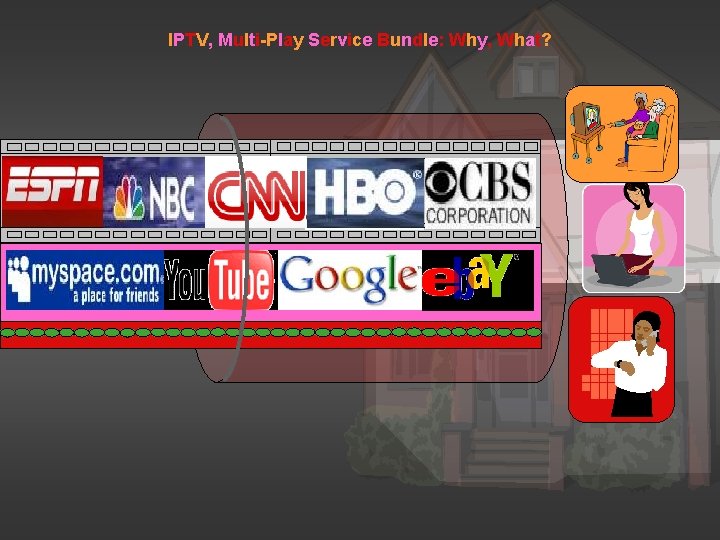
IPTV, Multi-Play Service Bundle: Why, What? 4 © 2006 Found ry
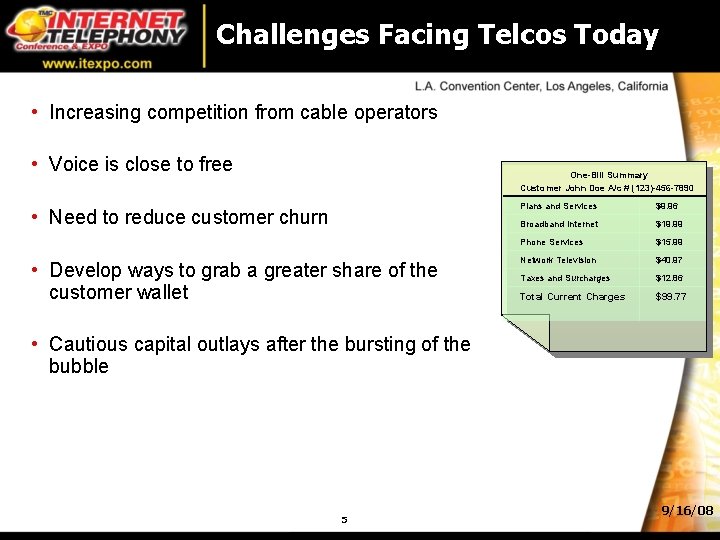
Challenges Facing Telcos Today • Increasing competition from cable operators • Voice is close to free One-Bill Summary Customer John Doe A/c # (123)-456 -7890 • Need to reduce customer churn • Develop ways to grab a greater share of the customer wallet Plans and Services $9. 96 Broadband Internet $19. 99 Phone Services $15. 99 Network Television $40. 97 Taxes and Surcharges $12. 86 Total Current Charges $99. 77 • Cautious capital outlays after the bursting of the bubble 5 9/16/08
IPTV: A Silver Bullet For Telcos? • The good news of high broadband adoption – >181 million broadband subscribers in OECD countries * • Value-added services possible through IPTV – Single bill for consumers • Extensive data on user viewing habits – Targeted ad insertion increases appeal to advertisers • More for less – Better utilization of installed infrastructure conserves cap-ex and op-ex • Telco operators have been busy pursuing a FTTx strategy to facilitate higher speeds to the consumer * Source: OECD Broadband Statistics 6
Components of an IPTV Network 7 © 2006 Found ry
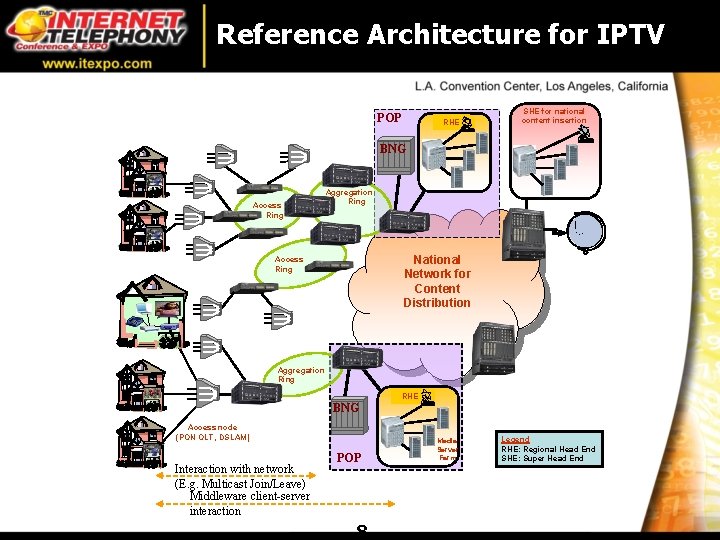
Reference Architecture for IPTV POP RHE SHE for national content insertion BNG Access Ring Aggregation Ring National Network for Content Distribution Access Ring Aggregation Ring RHE BNG Access node (PON OLT, DSLAM) Interaction with network (E. g. Multicast Join/Leave) Middleware client-server interaction POP 8 Media Server Farm Legend RHE: Regional Head End SHE: Super Head End
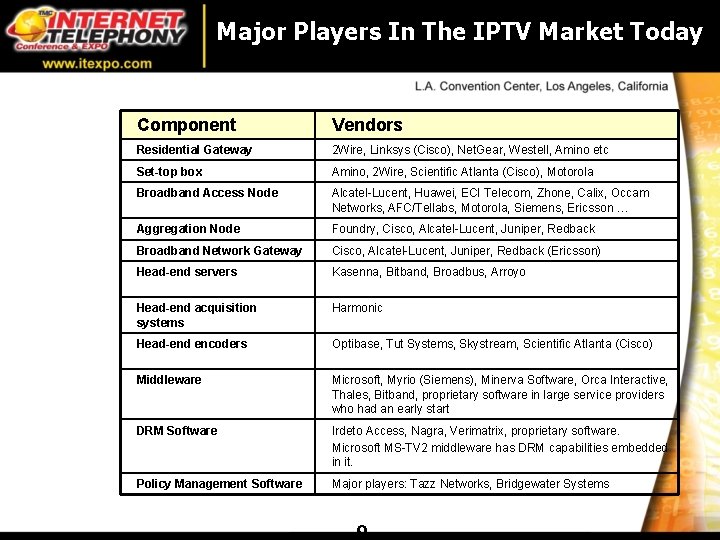
Major Players In The IPTV Market Today Component Vendors Residential Gateway 2 Wire, Linksys (Cisco), Net. Gear, Westell, Amino etc Set-top box Amino, 2 Wire, Scientific Atlanta (Cisco), Motorola Broadband Access Node Alcatel-Lucent, Huawei, ECI Telecom, Zhone, Calix, Occam Networks, AFC/Tellabs, Motorola, Siemens, Ericsson … Aggregation Node Foundry, Cisco, Alcatel-Lucent, Juniper, Redback Broadband Network Gateway Cisco, Alcatel-Lucent, Juniper, Redback (Ericsson) Head-end servers Kasenna, Bitband, Broadbus, Arroyo Head-end acquisition systems Harmonic Head-end encoders Optibase, Tut Systems, Skystream, Scientific Atlanta (Cisco) Middleware Microsoft, Myrio (Siemens), Minerva Software, Orca Interactive, Thales, Bitband, proprietary software in large service providers who had an early start DRM Software Irdeto Access, Nagra, Verimatrix, proprietary software. Microsoft MS-TV 2 middleware has DRM capabilities embedded in it. Policy Management Software Major players: Tazz Networks, Bridgewater Systems 9
IPTV Network Demands 10 © 2006 Found ry
IPTV Network Demands (1 of 3) • Need for high bandwidth – Standard Definition (SDTV) video: • Requires about 4 Mbps per stream (MPEG-2) – High Definition (HDTV) video: • Requires 14 -18 Mbps per stream (MPEG-2) • Importance of latency – High latency negatively affects user experience directly: • IPTV involves procedures such as DRM authorization, channel zapping, • Interactive applications such as Vo. D, content search under interactive TV / network PVR etc. – IGMP Join Latency 11
IPTV Network Demands (2 of 3) • Quality of Service – IPTV co-exists with other services such as high-speed Internet access, Vo. IP and interactive gaming • Optimization of channel change time in some middleware by sending a burst of unicast traffic before streaming multicast traffic • Wire-speed performance without packet loss an absolute requirement • Resiliency – Subscriber’s expectations of high availability are table stakes • High Density – Trend in access networks: compact platforms close to the subscriber 12
IPTV Network Demands (3 of 3) • Future-proof Infrastructure – IPTV is expected to accelerate the shift to IPv 6 • Flexibility in Service Delivery Models – Centralized transport through a BRAS • Network Infrastructure Security – Detect and prevent malicious attempts to take over the network 13
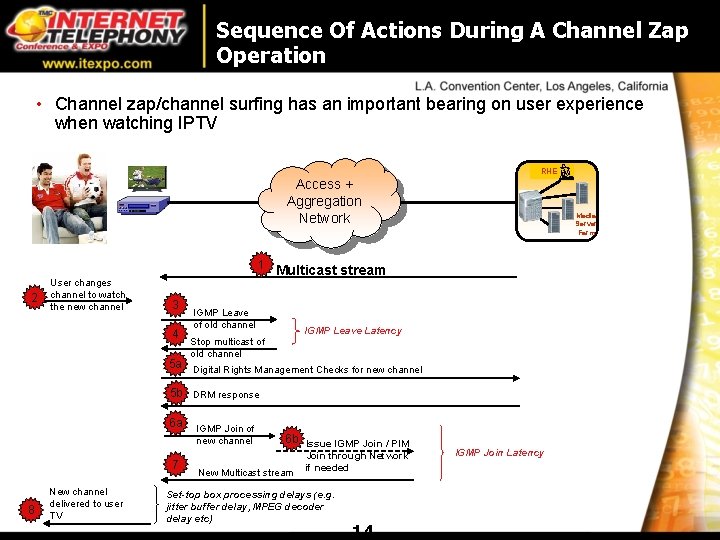
Sequence Of Actions During A Channel Zap Operation • Channel zap/channel surfing has an important bearing on user experience when watching IPTV RHE Access + Aggregation Network 1 2 User changes channel to watch the new channel 3 4 Media Server Farm Multicast stream IGMP Leave of old channel IGMP Leave Latency Stop multicast of old channel 5 a Digital Rights Management Checks for new channel 5 b DRM response 6 a 7 8 New channel delivered to user TV IGMP Join of new channel 6 b Issue IGMP Join / PIM New Multicast stream Join through Network if needed Set-top box processing delays (e. g. jitter buffer delay, MPEG decoder delay etc) 14 IGMP Join Latency
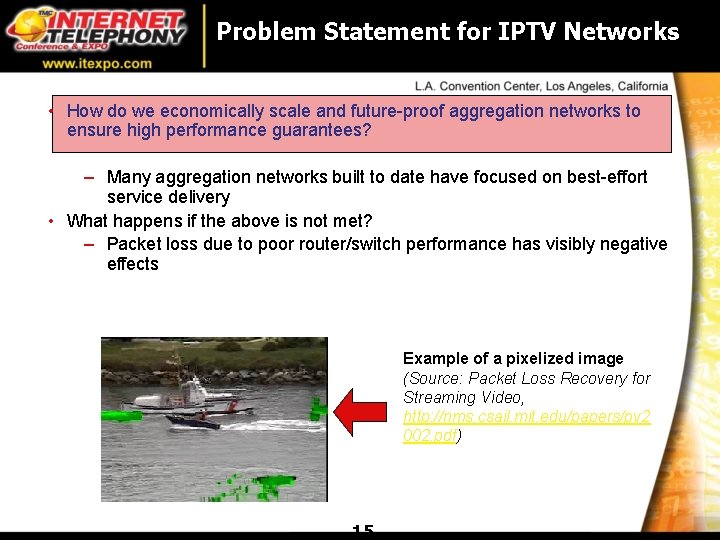
Problem Statement for IPTV Networks • How do we economically scale and future-proof aggregation networks to ensure high performance guarantees? – Many aggregation networks built to date have focused on best-effort service delivery • What happens if the above is not met? – Packet loss due to poor router/switch performance has visibly negative effects Example of a pixelized image (Source: Packet Loss Recovery for Streaming Video, http: //nms. csail. mit. edu/papers/pv 2 002. pdf) 15
Designing An IPTV Capable Network 16
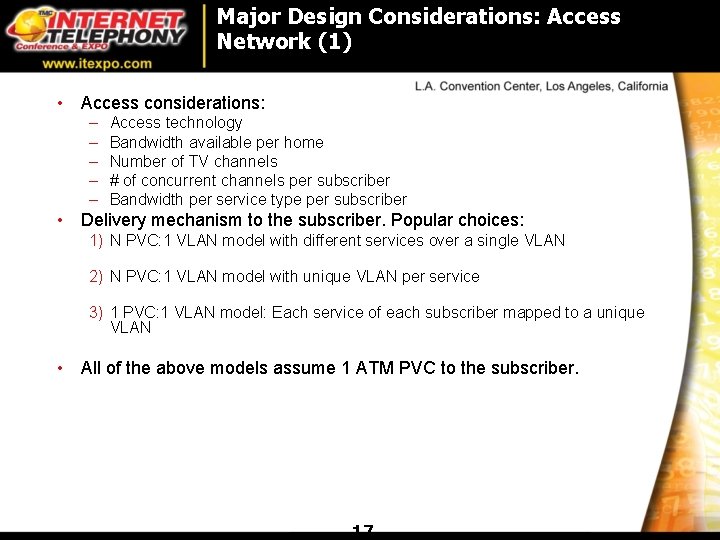
Major Design Considerations: Access Network (1) • Access considerations: – – – Access technology Bandwidth available per home Number of TV channels # of concurrent channels per subscriber Bandwidth per service type per subscriber • Delivery mechanism to the subscriber. Popular choices: 1) N PVC: 1 VLAN model with different services over a single VLAN 2) N PVC: 1 VLAN model with unique VLAN per service 3) 1 PVC: 1 VLAN model: Each service of each subscriber mapped to a unique VLAN • All of the above models assume 1 ATM PVC to the subscriber. 17
Major Design Considerations: Access Network (2) • Subscriber management and encapsulation. 2 most common choices: – DHCP – PPPo. E for data with IPTV traffic delivered over a separate VLAN. – Increasing number of IPTV deployments are moving away from PPPo. E to DHCP for data service also • For operators currently using PPPo. E, a recommended approach: – Use of PPPo. E for data service only – Use DHCP for video and voice traffic 18
Major Design Considerations: Aggregation Network (1) • Aggregation choices: – – Access-Aggregation Network interface Layer 2 or Layer 3 network? Layout of the network Location of video content • Bandwidth needs: – Number of broadcast/premium TV channels to be offered over the network – Amount of unicast-based services expected in the network – Using oversubscribed equipment not a good idea 19
Major Design Considerations: Aggregation Network (2) • Expected viewer habits: – Are some channels heavily watched? If yes, always have these channels delivered to the access node – Premium channels requested on demand • Desired resiliency: – Fast SONET-like (sub-50 millisecond) resiliency? – Are redundant links to access node desired? – Multicast redundancy • Security: – Prevent subscribers from “sourcing” multicast traffic – Encryption of transported video traffic – Ensure that Denial of Service (Do. S) guards are in place in aggregation network 20
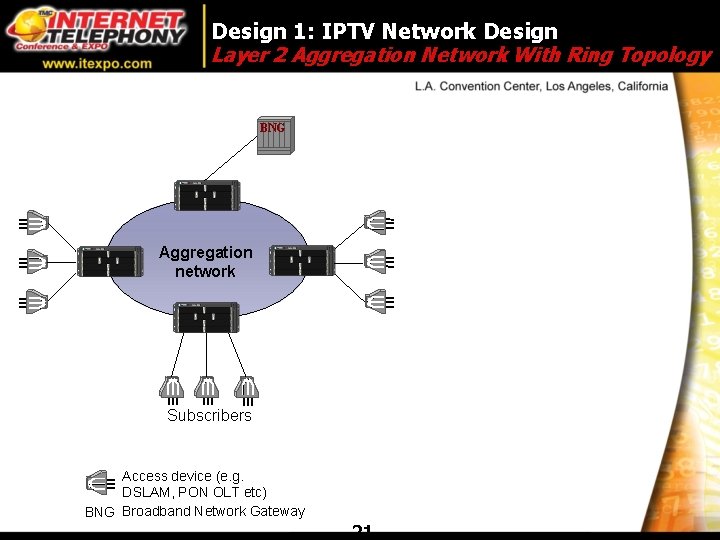
Design 1: IPTV Network Design Layer 2 Aggregation Network With Ring Topology BNG Aggregation network Subscribers Access device (e. g. DSLAM, PON OLT etc) BNG Broadband Network Gateway 21
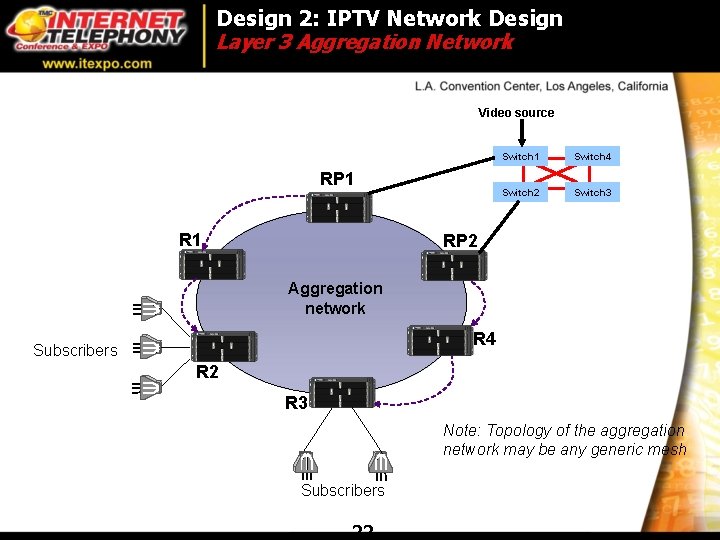
Design 2: IPTV Network Design Layer 3 Aggregation Network Video source RP 1 R 1 Switch 4 Switch 2 Switch 3 RP 2 Aggregation network R 4 Subscribers R 2 R 3 Note: Topology of the aggregation network may be any generic mesh Subscribers 22
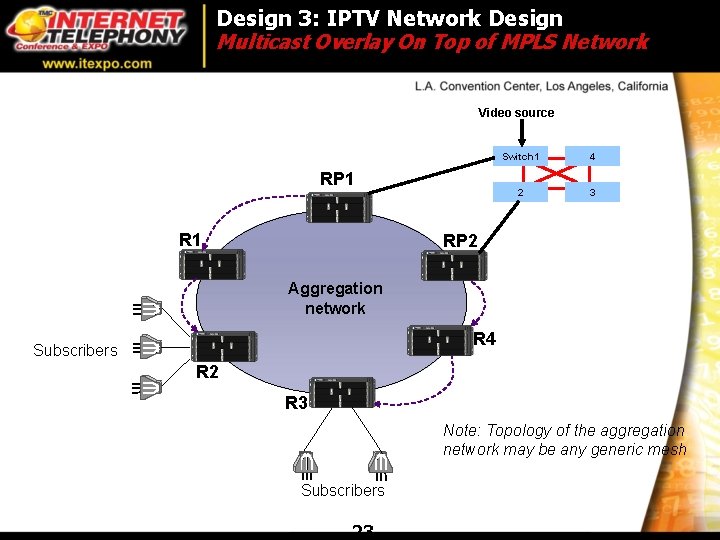
Design 3: IPTV Network Design Multicast Overlay On Top of MPLS Network Video source RP 1 R 1 Switch 1 4 2 3 RP 2 Aggregation network R 4 Subscribers R 2 R 3 Note: Topology of the aggregation network may be any generic mesh Subscribers 23
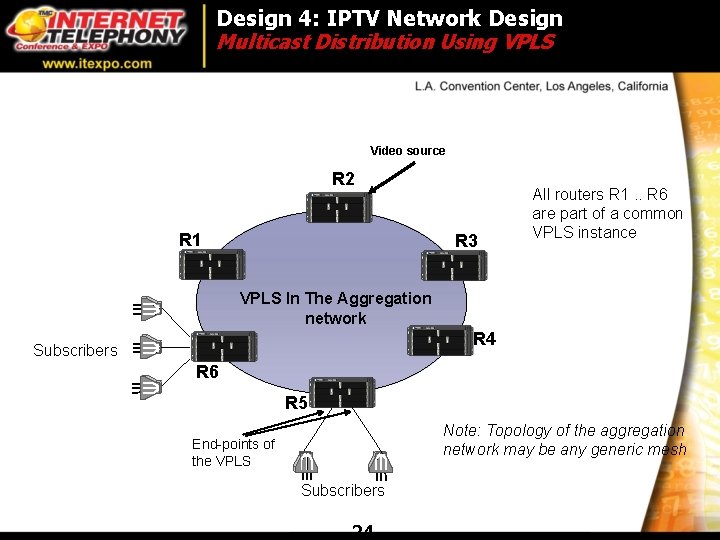
Design 4: IPTV Network Design Multicast Distribution Using VPLS Video source R 2 R 1 R 3 All routers R 1. . R 6 are part of a common VPLS instance VPLS In The Aggregation network R 4 Subscribers R 6 R 5 Note: Topology of the aggregation network may be any generic mesh End-points of the VPLS Subscribers 24
PIM-SSM and IGMPv 3: Why Source Specific Multicast? • Challenges with Any Source Multicast (ASM): – Poor access control in “traditional” Any Source Multicast (ASM) model – Inefficient handling of well-known sources – Limited multicast address space and address allocation 25
How to Implement IPTV Networks Closing Thoughts 26
Explosive Subscriber Growth in IPTV Source: Infonetics Research, “IPTV Equipment, Services and Subscribers Market Share and Forecast”, October 2006 • Explosive world-wide subscriber growth in this segment in the coming years • 2008 is the year the hockey stick effect takes shape! 27
Tremendous Growth Potential World-wide! Source: Infonetics Research, “IPTV Equipment, Services and Subscribers Market Share and Forecast”, October 2006 • Demand for world-wide edge routing and switching equipment for IPTV expected to grow 34% this year and 20+% over the next 2 years 28
What to look for in an IPTV Solution • • • Guaranteed wire-speed performance independent of packet size Advanced Qo. S architecture required for multi-play services Low latency architecture assures better user experience High Availability Architecture that minimizes service downtime High Density solutions available in a variety of cost optimal configurations • Future-proof infrastructure with readiness for 100 -Gb. E – The only IPTV aggregation platform with true 100 -Gb. E readiness today • High infrastructure security 29
How to Implement IPTV Networks Thank you 30