
IPSec Detailed Description and VPN Lecture 6 NETW
- Slides: 18
IPSec Detailed Description and VPN Lecture 6 – NETW 4006 -Lecture 06 1
IPSec is not a single protocol. Instead, IPSec provides a set of security algorithms plus a general framework that allows a pair of communicating entities to use whichever algorithms provide security appropriate for the communication. NETW 4006 -Lecture 06 2
IPSec o provides n n n o authentication confidentiality key management applicable to use over LANs, across public & private WANs, & for the Internet NETW 4006 -Lecture 06 3
Network Security Protocols • To manage and secure authentication, authorization, confidentiality, integrity, and non-repudiation • In Microsoft WS 2003 NW, major protocols used are Kerberos, NTLM, IPSec and their various sub-protocols NETW 4006 -Lecture 06 4
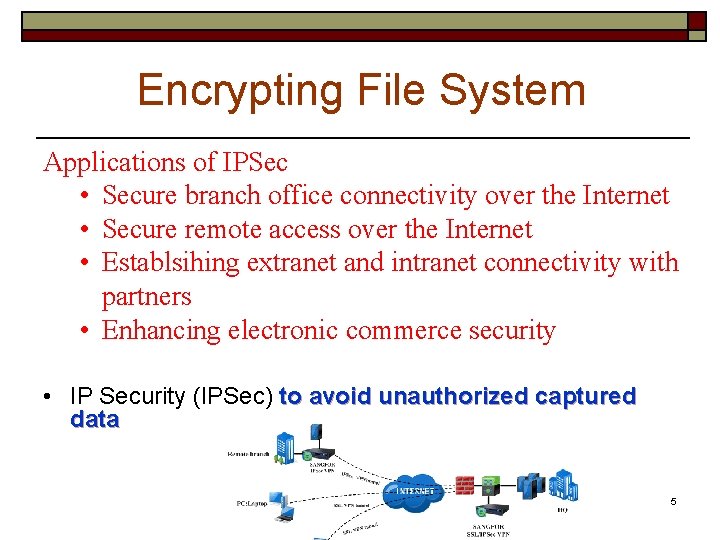
Encrypting File System Applications of IPSec • Secure branch office connectivity over the Internet • Secure remote access over the Internet • Establsihing extranet and intranet connectivity with partners • Enhancing electronic commerce security • IP Security (IPSec) to avoid unauthorized captured data NETW 4006 -Lecture 06 5
Protecting Data with IPSec • Digitally signing and encrypting it before transmission • IPSec encrypts the information in IP datagrams by encapsulating it so that even if the packets are captured, none of the data inside can be read • IP based-protocol, it provides end-to-end encryption • Intermediate systems, such as routers, treat the encrypted part of the packets purely as payload • Protocols besides IPSec, such as SSL or TLS, applicationlayer protocols that can encrypt only specific types of traffic (Web) NETW 4006 -Lecture 06 6
IPSec Functions (1) • Key generation • 2 C both must access to shared encryption key: Diffie– Hellman algorithm to compute shared key • Cryptographic checksums • cryptographic keys to calculate checksum for data in each packet, called a Hash Message Authentication Code (HMAC) • HMAC in combination with Message Digest 5 (MD 5) and HMAC in combination with Secure Hash Algorithm-1 (SHA 1): • SHA 1 160 -bit key and MD 5 128 -bit key • SHA 1 in USA for high-level security requirement NETW 4006 -Lecture 06 7
IPSec Functions (2) • Mutual authentication • end system/router can authenticate user/app • prevents address spoofing attacks by tracking sequence numbers • WS 2003 Kerberos, digital certificates, or pre-shared key • Replay prevention IPSec prevents replay by assigning a sequence number to each packet: anti-replay services • IP packet filtering • IPSec includes its own packet filtering mechanism: prevent Do. S attacks: NETW 4006 -Lecture 06 port, @, protocol 8
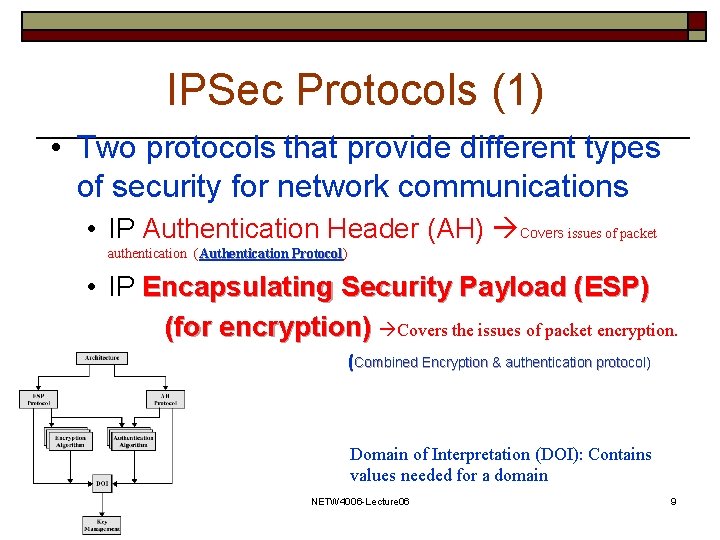
IPSec Protocols (1) • Two protocols that provide different types of security for network communications • IP Authentication Header (AH) Covers issues of packet authentication (Authentication Protocol) Protocol • IP Encapsulating Security Payload (ESP) (for encryption) Covers the issues of packet encryption. ( Combined Encryption & authentication protocol) Domain of Interpretation (DOI): Contains values needed for a domain NETW 4006 -Lecture 06 9
IPSec Protocols (2) IP Authentication Header (AH) – Extension header for authentication. • Does not encrypt the data in IP packets, but it does provide authentication, anti-replay, and integrity services • Integrity (Modification to packets while in transit are not possible. ) Authentication of a packet. >End system can verify the sender. >Prevents address spoofing attacks • AH by itself or in combination with ESP • AH alone provides basic security services, with relatively low overhead NETW 4006 -Lecture 06 10
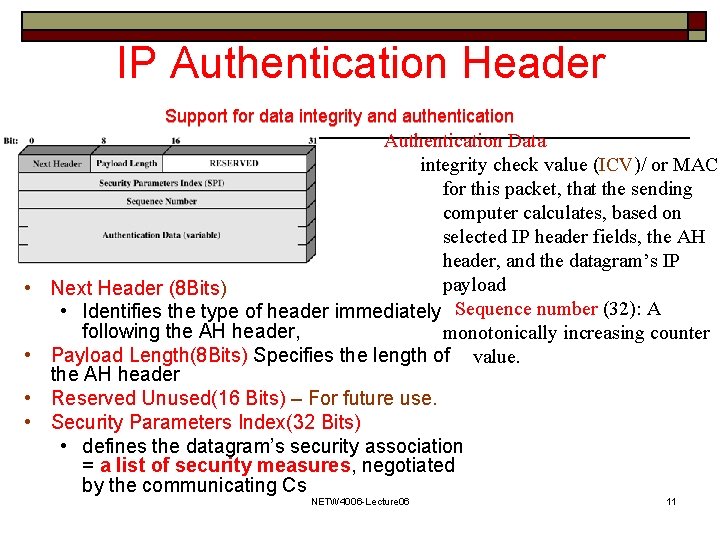
IP Authentication Header Support for data integrity and authentication • • Authentication Data integrity check value (ICV)/ or MAC for this packet, that the sending computer calculates, based on selected IP header fields, the AH header, and the datagram’s IP payload Next Header (8 Bits) • Identifies the type of header immediately Sequence number (32): A following the AH header, monotonically increasing counter Payload Length(8 Bits) Specifies the length of value. the AH header Reserved Unused(16 Bits) – For future use. Security Parameters Index(32 Bits) • defines the datagram’s security association = a list of security measures, negotiated by the communicating Cs NETW 4006 -Lecture 06 11
IPSec Protocols (6) IP Encapsulating Security Payload (ESP) Provides confidentiality services //confidentiality of the packet. // >Provides limited authentication service. //Authenticates the payload but not the header. // • Actually encrypts the data in an IP datagram • ESP also provides authentication, integrity, and anti-replay services NETW 4006 -Lecture 06 12
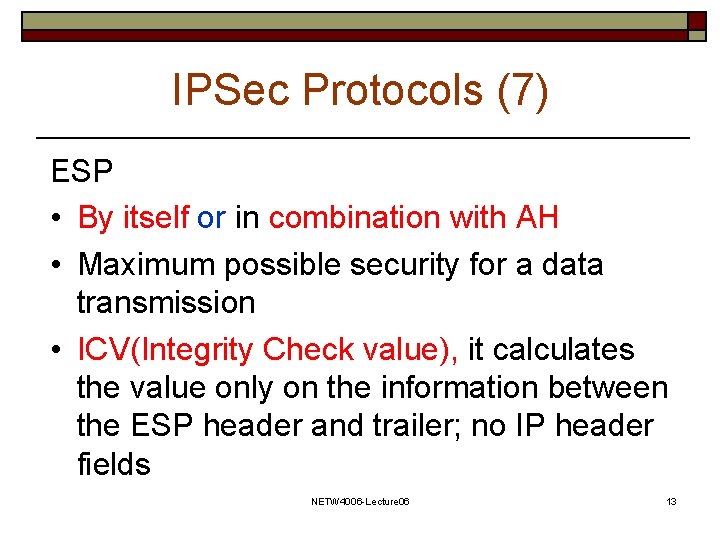
IPSec Protocols (7) ESP • By itself or in combination with AH • Maximum possible security for a data transmission • ICV(Integrity Check value), it calculates the value only on the information between the ESP header and trailer; no IP header fields NETW 4006 -Lecture 06 13
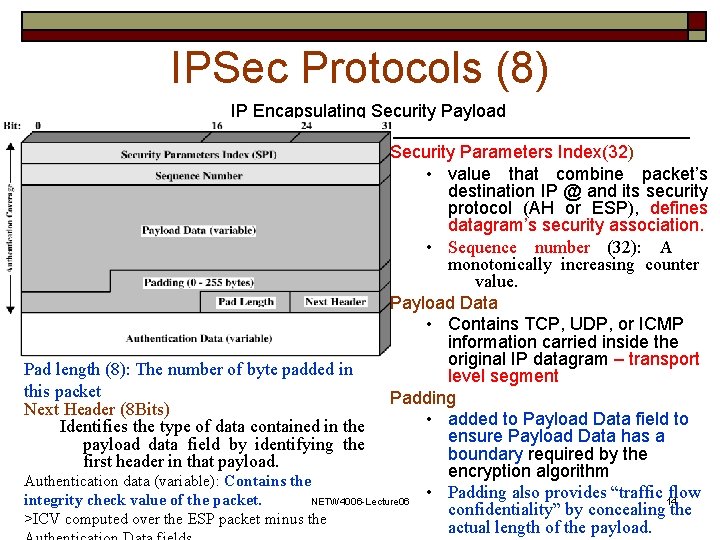
IPSec Protocols (8) IP Encapsulating Security Payload Security Parameters Index(32) • value that combine packet’s destination IP @ and its security protocol (AH or ESP), defines datagram’s security association. • Sequence number (32): A monotonically increasing counter value. Payload Data • Contains TCP, UDP, or ICMP information carried inside the original IP datagram – transport Pad length (8): The number of byte padded in level segment this packet Padding Next Header (8 Bits) • added to Payload Data field to Identifies the type of data contained in the ensure Payload Data has a payload data field by identifying the boundary required by the first header in that payload. encryption algorithm Authentication data (variable): Contains the • Padding also provides “traffic 14 flow integrity check value of the packet. NETW 4006 -Lecture 06 confidentiality” by concealing the >ICV computed over the ESP packet minus the actual length of the payload.
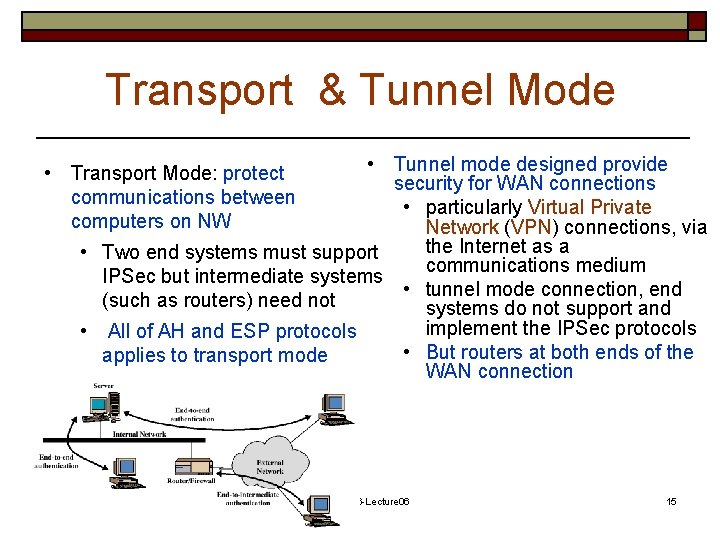
Transport & Tunnel Mode • Tunnel mode designed provide security for WAN connections • particularly Virtual Private Network (VPN) connections, via the Internet as a • Two end systems must support communications medium IPSec but intermediate systems • tunnel mode connection, end (such as routers) need not systems do not support and implement the IPSec protocols • All of AH and ESP protocols • But routers at both ends of the applies to transport mode WAN connection • Transport Mode: protect communications between computers on NW NETW 4006 -Lecture 06 15
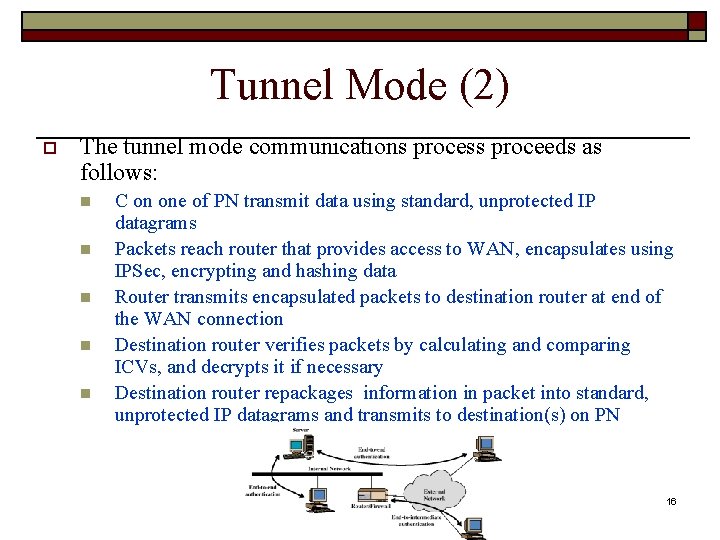
Tunnel Mode (2) o The tunnel mode communications process proceeds as follows: n n n C on one of PN transmit data using standard, unprotected IP datagrams Packets reach router that provides access to WAN, encapsulates using IPSec, encrypting and hashing data Router transmits encapsulated packets to destination router at end of the WAN connection Destination router verifies packets by calculating and comparing ICVs, and decrypts it if necessary Destination router repackages information in packet into standard, unprotected IP datagrams and transmits to destination(s) on PN NETW 4006 -Lecture 06 16
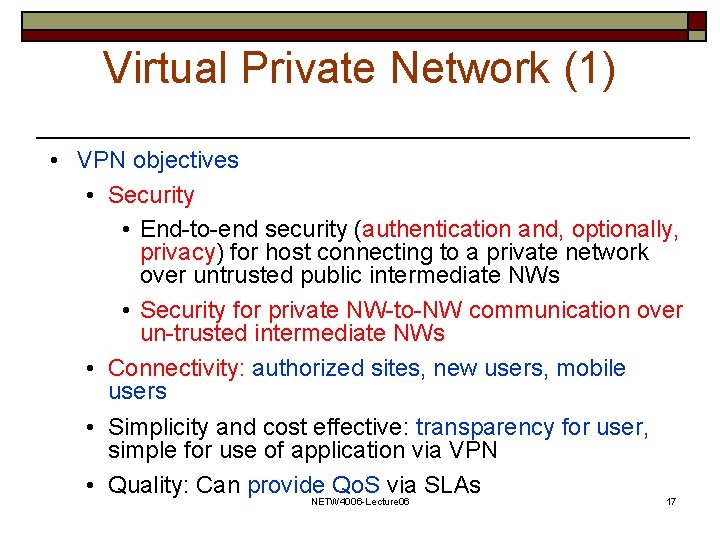
Virtual Private Network (1) • VPN objectives • Security • End-to-end security (authentication and, optionally, privacy) for host connecting to a private network over untrusted public intermediate NWs • Security for private NW-to-NW communication over un-trusted intermediate NWs • Connectivity: authorized sites, new users, mobile users • Simplicity and cost effective: transparency for user, simple for use of application via VPN • Quality: Can provide Qo. S via SLAs NETW 4006 -Lecture 06 17
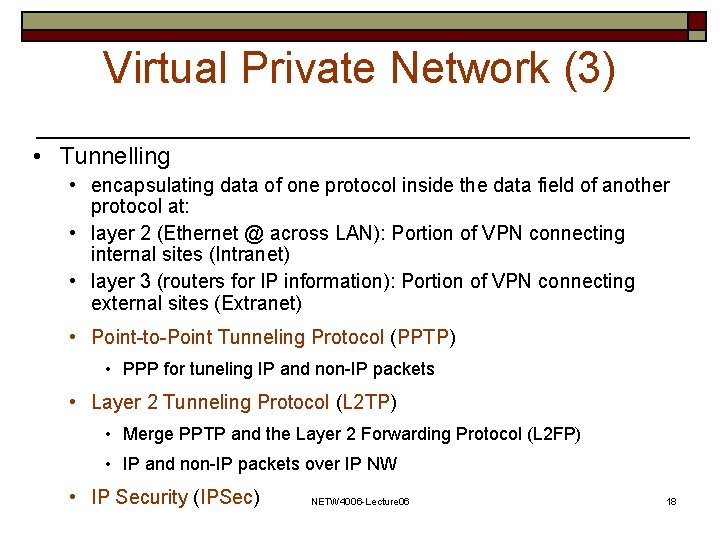
Virtual Private Network (3) • Tunnelling • encapsulating data of one protocol inside the data field of another protocol at: • layer 2 (Ethernet @ across LAN): Portion of VPN connecting internal sites (Intranet) • layer 3 (routers for IP information): Portion of VPN connecting external sites (Extranet) • Point-to-Point Tunneling Protocol (PPTP) • PPP for tuneling IP and non-IP packets • Layer 2 Tunneling Protocol (L 2 TP) • Merge PPTP and the Layer 2 Forwarding Protocol (L 2 FP) • IP and non-IP packets over IP NW • IP Security (IPSec) NETW 4006 -Lecture 06 18