
IPSAS Adoption at the United Nations Reform Progress
- Slides: 23
IPSAS Adoption at the United Nations Reform, Progress, Outlook Briefing at CFO Workshop, New York By Jayantilal M. Karia Director, Accounts Division, United Nations 11 December 2007
Contents l UNSAS: the Current Standards l Why the Change to IPSAS l The Structure of the IPSAS Project l The Strategy for IPSAS Adoption l IPSAS Adoption: The Challenges l IPSAS Adoption: Progress to date l Policy Adoption Progress l Communication and Training l The Road to IPSAS Adoption l How you can support the change 2 2
United Nations System Accounting Standards UNSAS – the current standards were … Ø Developed in early 1990 s by accounting professionals within the UN System in consultation with the Panel of External Auditors Ø Approved by the ACC in 1993 Ø Largely based on International Accounting Standards (IAS) Ø Developed on the basis of modified accrual. 3 3
Why the Change to IPSAS was chosen as these standards are … Ø A set of independently developed accounting standards => enhanced transparency, accountability of the financial processes; better quality and credibility of financial reports Ø Based on full accrual accounting which has become the accepted best practice => better information on costs as input into results based management Ø Based on International Financial Reporting Standards (IFRS), with only public sector specific differences. IPSAS will facilitate keeping abreast with best practices. 4 4
The Structure of the IPSAS Project (I) Two-level approach to IPSAS adoption … Firstly, is the approach at the system-wide level: Ø § § § The System-Wide Project : Manages the policy/guidance adoption process Addresses common implementation issues Develops policies/guidance to ensure consistency Develops system-wide training products Supports individual organizations. 5 5
The Structure of the IPSAS Project (II) Secondly: the approach at the individual organization level Ø § § § § Individual organizations: Gain governing body approval Establish internal project framework and plan Participate in development of harmonized policies Implement harmonized policies/guidance adopted Develop/implement detailed procedures Deploy training Initiate relevant IT and FR&R changes. 6 6
The Strategy for IPSAS Adoption Strategy at the system-wide level: Ø Phased Implementation: § § Ø “Early Adopters” => more advanced stage of IT readiness = adopt IPSAS by 2008 = WFP, ICAO, WHO “Fast Followers” => where significant IT changes are necessary, will benefit from the lessons learned = adopt IPSAS by 2010. Phased Rollout: § § UNSAS has been changed to allow adoption of IPSAS standard by standard Progressive implementation of detailed IPSAS requirements is encouraged if no conflict with UNSAS. 7 7
The Strategy for IPSAS Adoption (II) Strategy at the United Nations: Ø Phased Implementation: An IT systems change is required => the UN is targeting IPSAS adoption by 2010. Ø Phased Rollout: Current IT systems do not support adoption of individual standards. The strategy at the UN is to: § § move to IPSAS requirements to the extent that they do not conflict with UNSAS integrate IPSAS adoption into the project for the new ERP system. 8 8
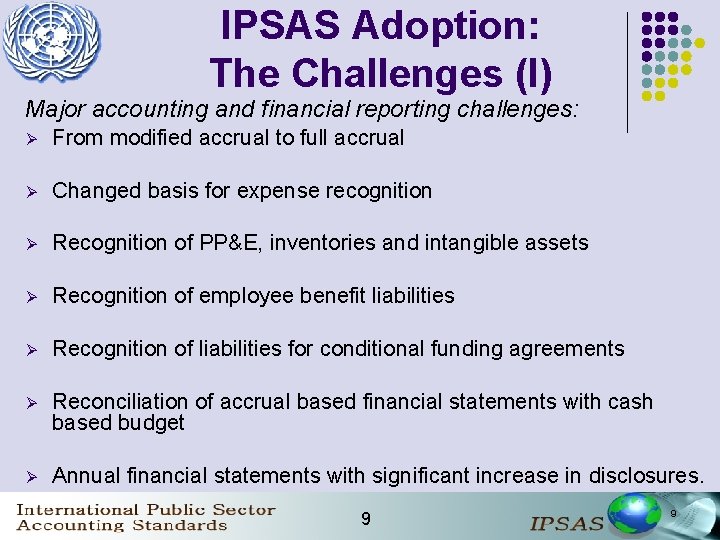
IPSAS Adoption: The Challenges (I) Major accounting and financial reporting challenges: Ø From modified accrual to full accrual Ø Changed basis for expense recognition Ø Recognition of PP&E, inventories and intangible assets Ø Recognition of employee benefit liabilities Ø Recognition of liabilities for conditional funding agreements Ø Reconciliation of accrual based financial statements with cash based budget Ø Annual financial statements with significant increase in disclosures. 9 9
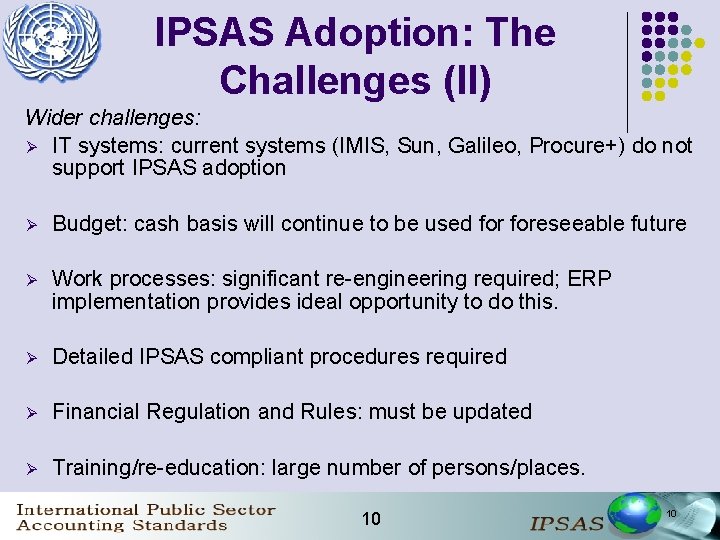
IPSAS Adoption: The Challenges (II) Wider challenges: Ø IT systems: current systems (IMIS, Sun, Galileo, Procure+) do not support IPSAS adoption Ø Budget: cash basis will continue to be used foreseeable future Ø Work processes: significant re-engineering required; ERP implementation provides ideal opportunity to do this. Ø Detailed IPSAS compliant procedures required Ø Financial Regulation and Rules: must be updated Ø Training/re-education: large number of persons/places. 10 10
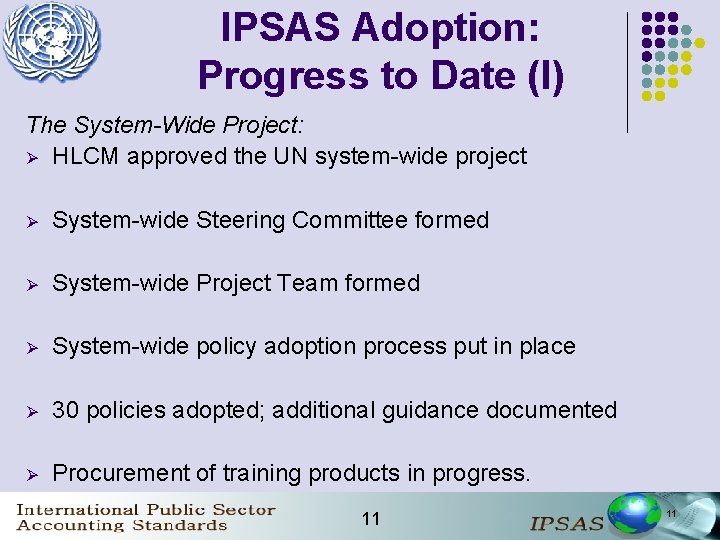
IPSAS Adoption: Progress to Date (I) The System-Wide Project: Ø HLCM approved the UN system-wide project Ø System-wide Steering Committee formed Ø System-wide Project Team formed Ø System-wide policy adoption process put in place Ø 30 policies adopted; additional guidance documented Ø Procurement of training products in progress. 11 11
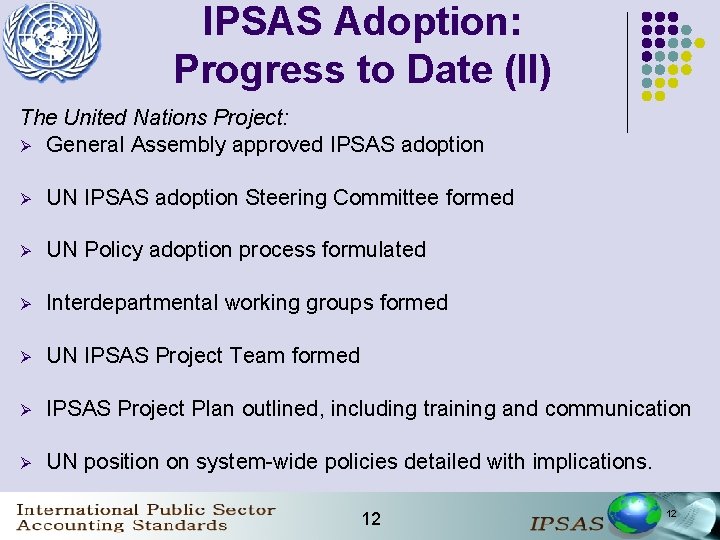
IPSAS Adoption: Progress to Date (II) The United Nations Project: Ø General Assembly approved IPSAS adoption Ø UN IPSAS adoption Steering Committee formed Ø UN Policy adoption process formulated Ø Interdepartmental working groups formed Ø UN IPSAS Project Team formed Ø IPSAS Project Plan outlined, including training and communication Ø UN position on system-wide policies detailed with implications. 12 12
Policy Adoption Progress Ø 30 system-wide accounting policies/recommended practices have been adopted, including: PP&E, inventories, intangibles, borrowing costs, actuarial gains/losses for employee benefits, transitional provisions, financial statement presentation, presentation of budget information, audit of financial statements. Ø Guidance provided on the following: Revenue, expenses, financial instruments, leases, foreign exchange transactions, model financial statements. 13 13
IPSAS Adoption Communication (I) Ø The Objective: To provide stakeholders with the knowledge and information needed to understand the impact and benefits of IPSAS adoption. Ø The Approach => two pronged: Procedural: communicate the procedural aspect of the move to full accrual accounting Strategic: aims to alter the perception of accounting information from being useful only for historic or control purposes to being employed as a decision making tool. 14 14
IPSAS Adoption Communication (II) The Target Audiences include: § § § The Member States Senior Management Accounts Staff Budget Staff Treasury Staff Executive Staff Procurement Staff Programme Staff OHRM Staff Central Support Staff Transportation and Logistics Staff § § § 15 Public information staff CFOs CAOs Property/inventory managers The ERP Project OIOS The BOA Other UN system entities UN system bodies Donors The Public 15
IPSAS Adoption Communication (III) The Communication Pathways include: Ø UN IPSAS Working Groups § § Ø cross-functional, OAH and DFS participation structured for full engagement in policy setting. UN IPSAS intranet page (coming 31 Dec 2007) § § § § Background information on the move to IPSAS The standards and guidance papers Details of the approved polices Project organization and timeline FAQ with answers Issue papers Useful links: CEB website, IFAC website. 16 16
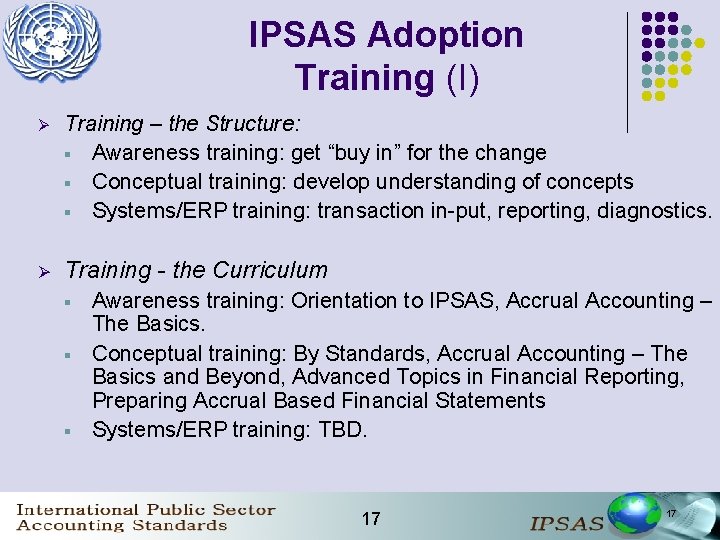
IPSAS Adoption Training (I) Ø Training – the Structure: § Awareness training: get “buy in” for the change § Conceptual training: develop understanding of concepts § Systems/ERP training: transaction in-put, reporting, diagnostics. Ø Training - the Curriculum § § § Awareness training: Orientation to IPSAS, Accrual Accounting – The Basics. Conceptual training: By Standards, Accrual Accounting – The Basics and Beyond, Advanced Topics in Financial Reporting, Preparing Accrual Based Financial Statements Systems/ERP training: TBD. 17 17
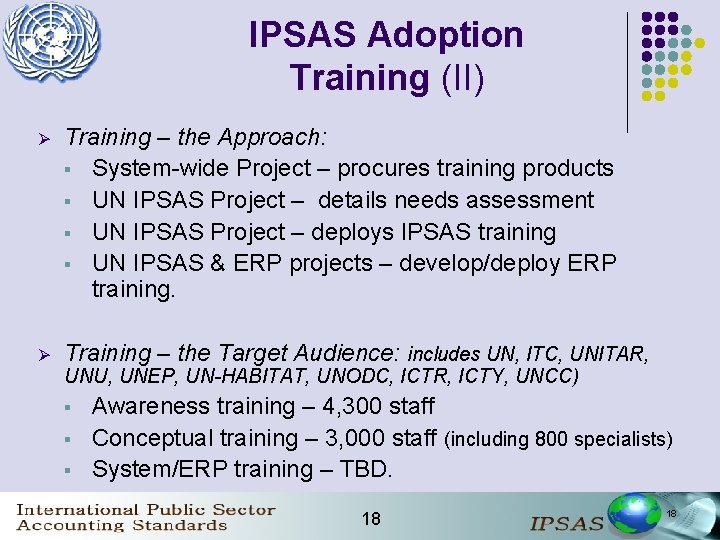
IPSAS Adoption Training (II) Ø Training – the Approach: § System-wide Project – procures training products § UN IPSAS Project – details needs assessment § UN IPSAS Project – deploys IPSAS training § UN IPSAS & ERP projects – develop/deploy ERP training. Ø Training – the Target Audience: includes UN, ITC, UNITAR, UNU, UNEP, UN-HABITAT, UNODC, ICTR, ICTY, UNCC) § § § Awareness training – 4, 300 staff Conceptual training – 3, 000 staff (including 800 specialists) System/ERP training – TBD. 18 18
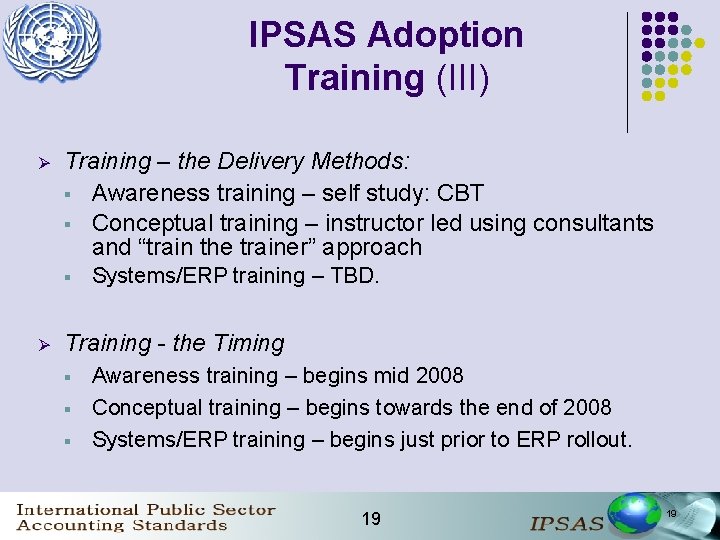
IPSAS Adoption Training (III) Ø Training – the Delivery Methods: § Awareness training – self study: CBT § Conceptual training – instructor led using consultants and “train the trainer” approach § Ø Systems/ERP training – TBD. Training - the Timing § § § Awareness training – begins mid 2008 Conceptual training – begins towards the end of 2008 Systems/ERP training – begins just prior to ERP rollout. 19 19
20 20
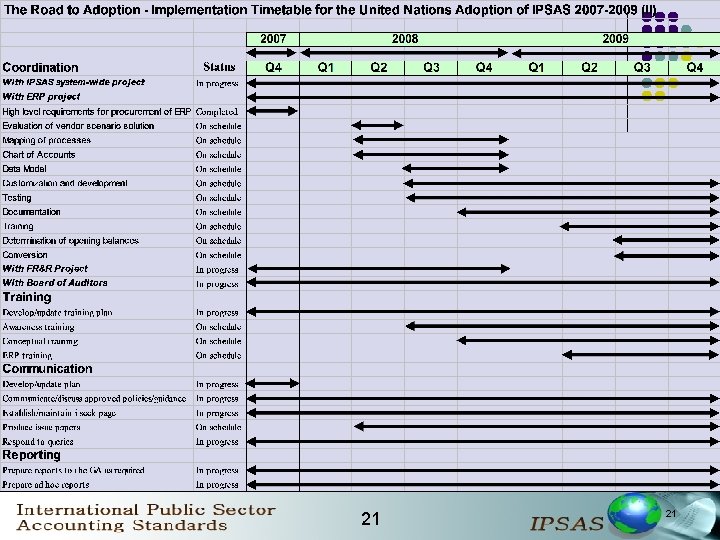
21 21
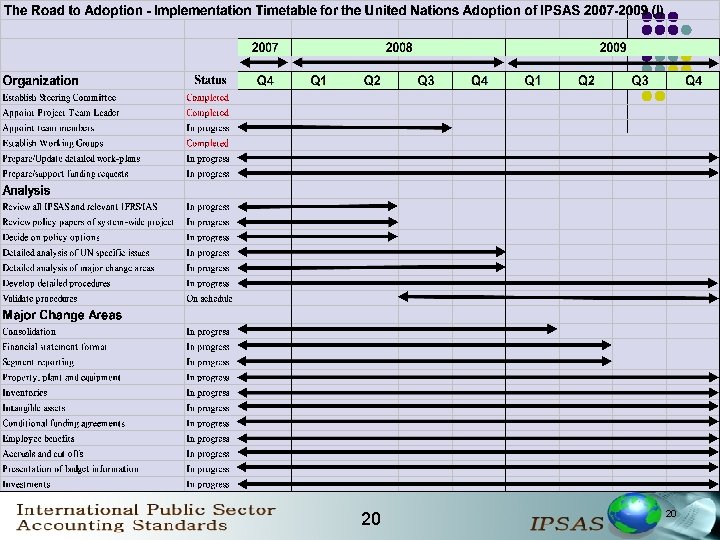
The Road to IPSAS Adoption (III) Ø The timetable highlights that the major issue for IPSAS adoption is the information system requirements: § The minimum required modules of the ERP must be in place in time to support IPSAS-compliant financial statements as at 31 December 2010. Ø Any delays in implementation of the new ERP will impact the timing of IPSAS tasks and the target date for adoption. Ø ACABQ report A/60/870: noted that the timetable for IPSAS adoption would need to be synchronized with the introduction of the new ERP system. 22 22
How you can support the change to IPSAS Ø Inform yourself: § § § the IPSAS page coming to i-seek https: //unsystemceb. org/reference/05 http: //www. ifac. org/Public. Sector. Ø Understand what changes IPSAS shall bring to your areas of work. Ø Communicate the change and its benefits. Ø Participate fully in upcoming training. 23 23