
IPS Unit 8 Periodic Table Section 1 Unit
IPS Unit 8 Periodic Table Section 1
Unit 8 – Section 1: Periodic Table Chemistry – The study of the composition, structure, and properties of matter and the changes it undergoes. Branches of Chemistry – – – Organic Chemistry Inorganic Chemistry Physical Chemistry Analytical Chemistry Biochemistry Theoretical Chemistry
Scientific Shorthand • Chemical symbols are made with one or two letters: • If one, it is capital. • If two, the first is capital and the second lowercase. • Some elements use the letter(s) of its name; some use the letter(s) of its name in another language (Latin)
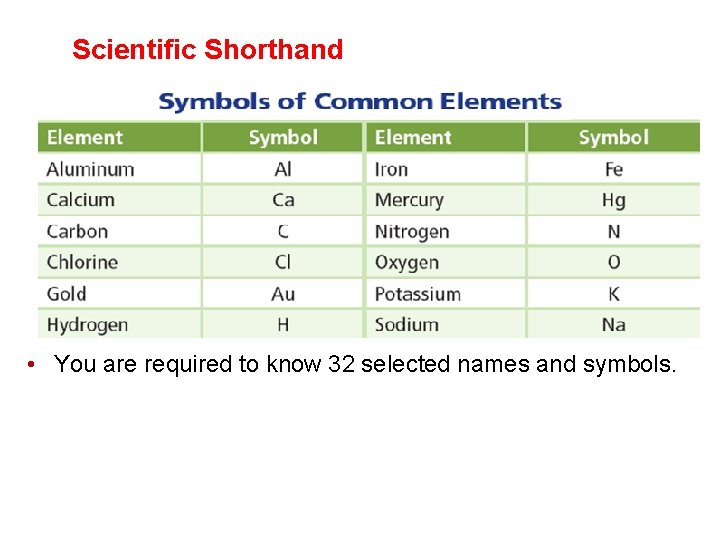
Scientific Shorthand • You are required to know 32 selected names and symbols.

Element • pure substance made of only one kind of atom Atom • smallest unit of an element that maintains the properties of that element • composed of particles called protons, neutrons, and electrons.
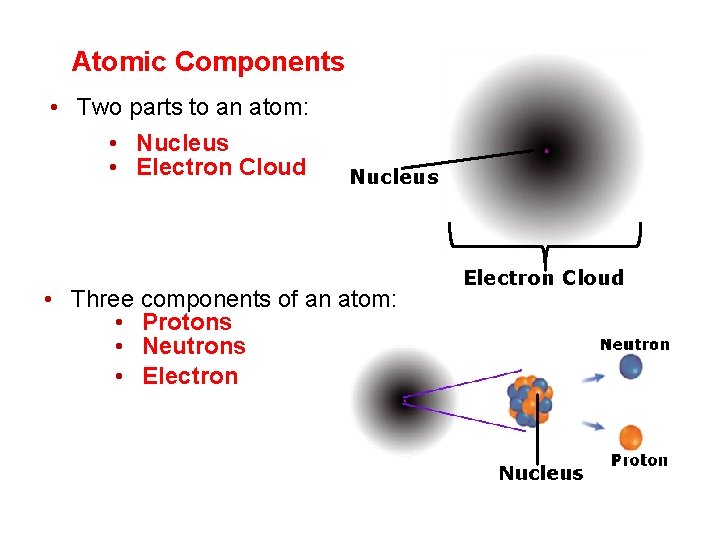
Atomic Components • Two parts to an atom: • Nucleus • Electron Cloud Nucleus • Three components of an atom: • Protons • Neutrons • Electron Cloud
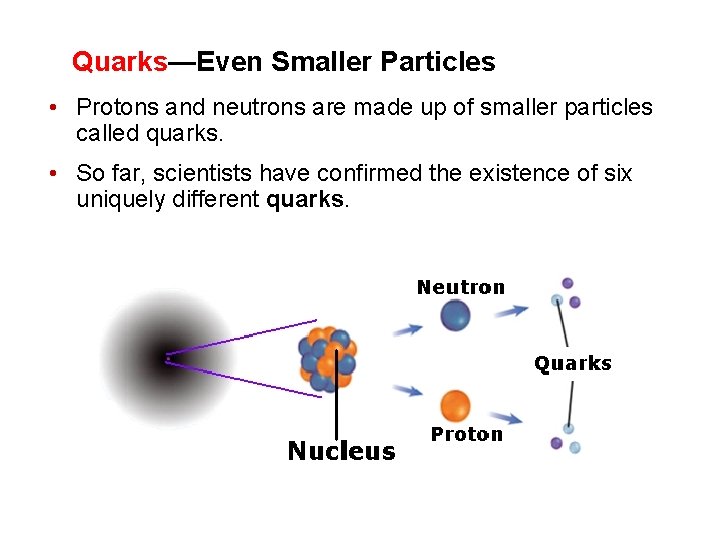
Quarks—Even Smaller Particles • Protons and neutrons are made up of smaller particles called quarks. • So far, scientists have confirmed the existence of six uniquely different quarks.
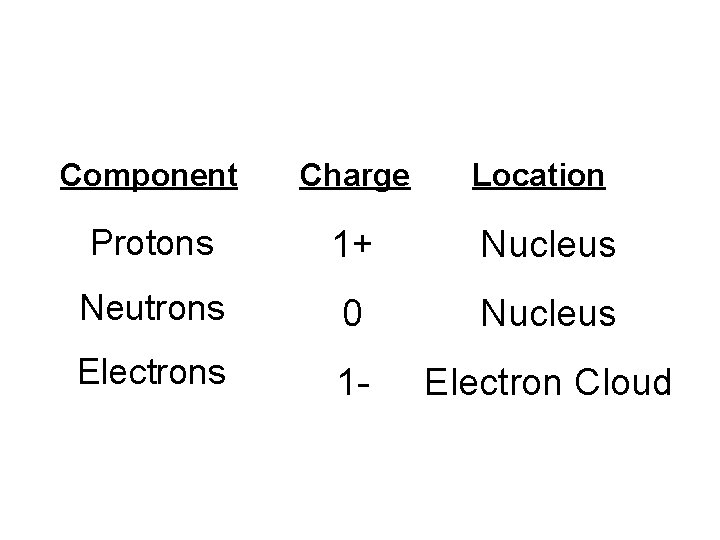
Component Charge Location Protons 1+ Nucleus Neutrons 0 Nucleus Electrons 1 - Electron Cloud
![ATOM [parts] NUCLEUS ELECTRON CLOUD [made of] PROTONS [charge] POSITIVE CHARGE NEUTRONS ELECTRONS [charge]](http://slidetodoc.com/presentation_image_h2/1fbbd0ec64ee69a4eeb9eed4dffef0b9/image-9.jpg "ATOM [parts] NUCLEUS ELECTRON CLOUD [made of] PROTONS [charge] POSITIVE CHARGE NEUTRONS ELECTRONS [charge]")
ATOM [parts] NUCLEUS ELECTRON CLOUD [made of] PROTONS [charge] POSITIVE CHARGE NEUTRONS ELECTRONS [charge] NEUTRAL CHARGE NEGATIVE CHARGE
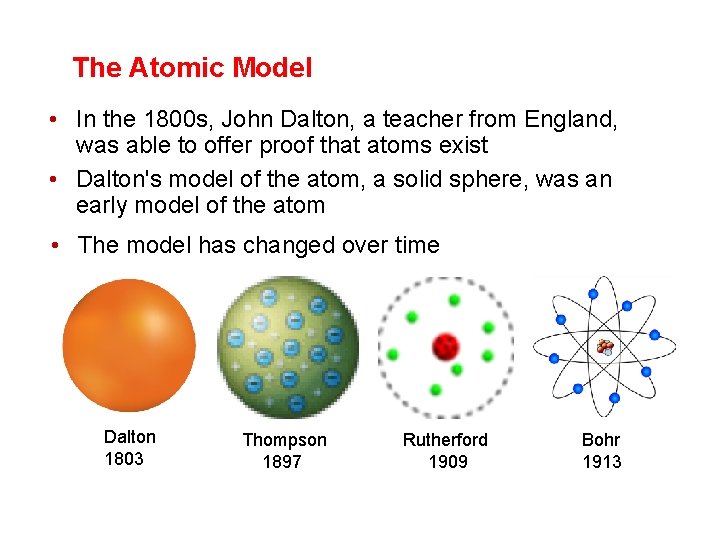
The Atomic Model • In the 1800 s, John Dalton, a teacher from England, was able to offer proof that atoms exist • Dalton's model of the atom, a solid sphere, was an early model of the atom • The model has changed over time Dalton 1803 Thompson 1897 Rutherford 1909 Bohr 1913
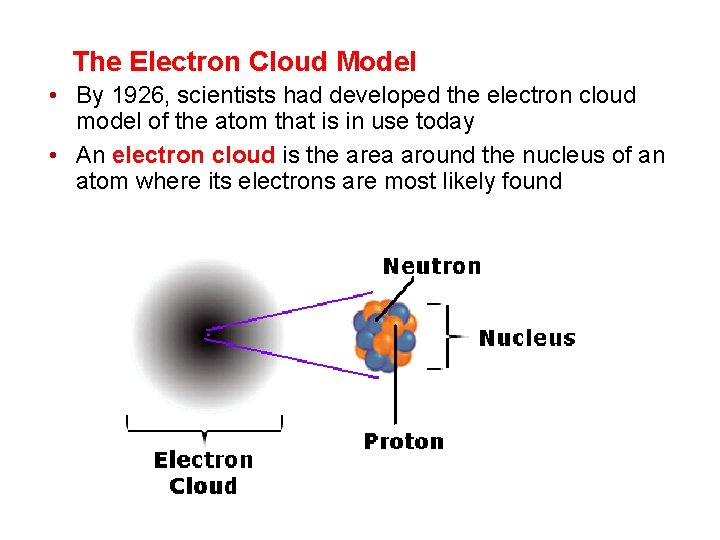
The Electron Cloud Model • By 1926, scientists had developed the electron cloud model of the atom that is in use today • An electron cloud is the area around the nucleus of an atom where its electrons are most likely found
The Electron Cloud Model • The electron cloud is 100, 000 times larger than the diameter of the nucleus • In contrast, each electron in the cloud is much smaller than a single proton • Because an electron's mass is small and the electron is moving so quickly around the nucleus, it is impossible to describe its exact location in an atom
- Slides: 12