
IPR AN INDUSTRIAL POINT OF VIEW IPR An
- Slides: 13
IPR – AN INDUSTRIAL POINT OF VIEW IPR – An industrial point of view Andrea Ceracchi CECOM
IPR – AN INDUSTRIAL POINT OF VIEW Technology Transfer, Invention and IPR Technology Transfer, is the exchange or movement of technology from the origin of the innovation to other entity (legal entity) The invention is the product or the process solving in an innovative way a problem. The Invention is the object of the technology transfer. Intellectual Property Rights, represent the legal form (copyright, patent, trade mark and trade secrets) to protect the inventor and allow the dissemination of the invention.
IPR – AN INDUSTRIAL POINT OF VIEW Innovation, RI and Industry • RI have been leading the innovation in a large variety of technologies and allowing the industries to implement their capabilities. Despite the innovation is a point of contact between RI and Industries, there are two different values: • For RI it represents somehow the mission or a way to achieve the mission itself. • For Industry it represents a necessity to be more competitive on the market (especially in the last 10 years, with the turbulence of the markets) and it is one of the result of the collaboration with RI. These two approaches confirm the importance of the innovation for both the players, and also that the innovation depends on RI and Industry.
IPR – AN INDUSTRIAL POINT OF VIEW Technology transfer The collaboration between the Research Institutes and the Industries may have the following cases: • Innovation already owned by RI and to be shared with the companies • Innovation already owned by Industry and to be developed with the RI • Innovation emerging from a collaboration between Industry and RI.
IPR – AN INDUSTRIAL POINT OF VIEW Innovation (patent) already owned by RI and to be shared with the companies – aspects to be considered (A) • How to regulate the access to the innovation in a fair ad equal way for the companies in Europe. • How to manage or regulate a fair process for the future call for tenders based on the patent • The IPR can be based on a specific know-how owned by the RI. Industry may be linked to the RI since not able to use the invention because of a lack of knowledge.
IPR – AN INDUSTRIAL POINT OF VIEW Innovation obtained starting from an idea already owned by Industry and to be developed with the RI (B) • Agreement to be find on the percentage of ownership of the innovation. It could be difficult to evaluate the contributions. • Will the RI be able (or obliged) to share with other industries the technological content of the study? Will the industry have a veto to avoid to allow a competitor to receive this innovation? • How to manage or regulate a fair process for the future call for tenders based on the innovation achieved. Citare esempio absorbers • The result – also in this case - can be based on a specific know-how owned by the RI, how this can be managed assuring the time to market.
IPR – AN INDUSTRIAL POINT OF VIEW Innovation emerging from a collaboration between Industry and RI (C) • Agreement to be find on the percentage of ownership of the innovation. It could be difficult to evaluate the contributions. • Will the RI be able (or obliged) to share with other industries the technological content of the study? Will the industry have a veto to avoid to allow a competitor to receive this innovation? • How to manage or regulate a fair process for the future call for tenders based on the innovation achieved. Citare esempio absorbers • The result – also in this case - can be based on a specific know-how owned by the RI, how this can be managed assuring the time to market
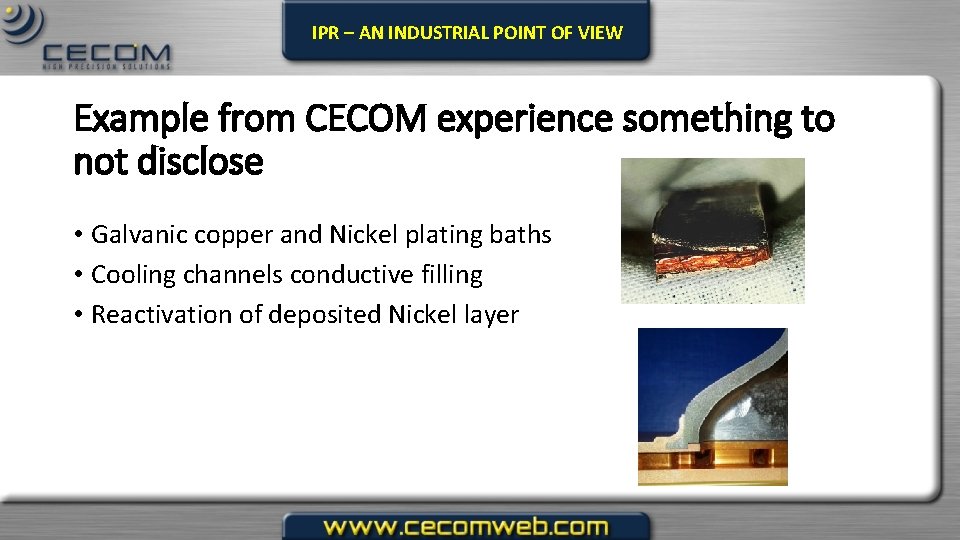
IPR – AN INDUSTRIAL POINT OF VIEW Example from CECOM experience something to not disclose • Galvanic copper and Nickel plating baths • Cooling channels conductive filling • Reactivation of deposited Nickel layer
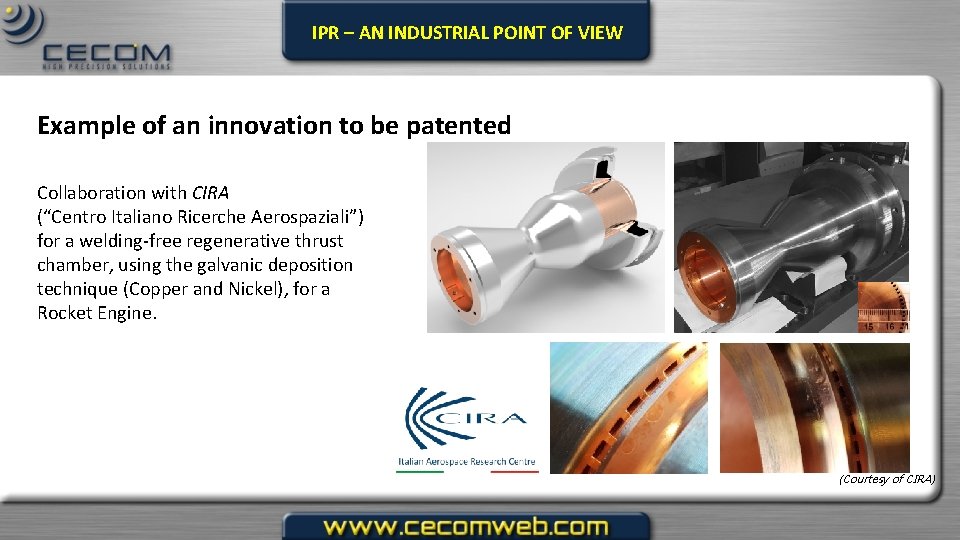
IPR – AN INDUSTRIAL POINT OF VIEW Example of an innovation to be patented Collaboration with CIRA (“Centro Italiano Ricerche Aerospaziali”) for a welding-free regenerative thrust chamber, using the galvanic deposition technique (Copper and Nickel), for a Rocket Engine. (Courtesy of CIRA)
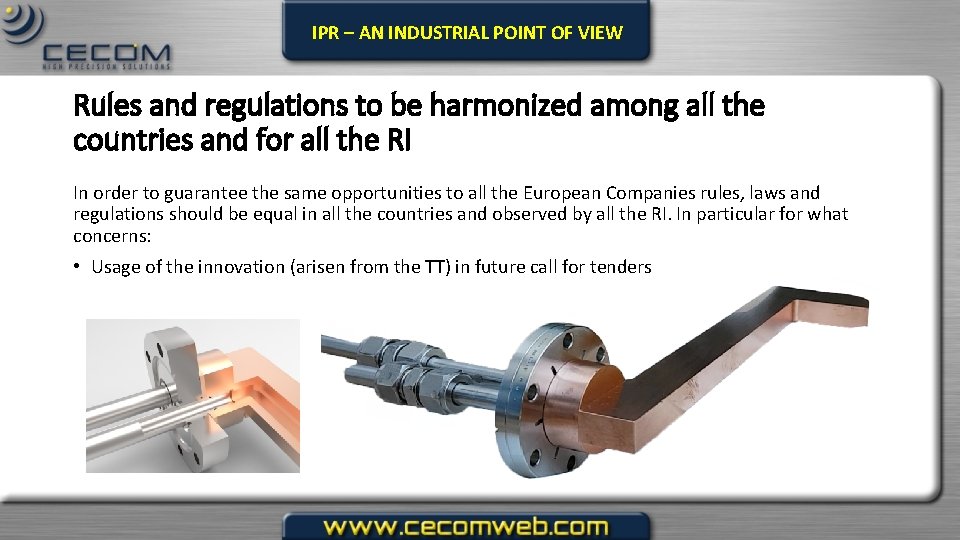
IPR – AN INDUSTRIAL POINT OF VIEW Rules and regulations to be harmonized among all the countries and for all the RI In order to guarantee the same opportunities to all the European Companies rules, laws and regulations should be equal in all the countries and observed by all the RI. In particular for what concerns: • Usage of the innovation (arisen from the TT) in future call for tenders
IPR – AN INDUSTRIAL POINT OF VIEW Rules and regulations to be harmonized among all the countries and for all the RI In order to guarantee the same opportunities to all the European Companies rules, laws and regulations should be equal in all the countries and observed by all the RI. In particular for what concerns: • Usage of the innovation (arisen from the TT) in future call for tenders • Access to the technology: before starting the TT: it has to be guaranteed the same opportunity to all the companies that may be interested in a specific technology object of TT. after the result of TT: the result of the TT would be a mixed contribution (B and C) and the Industry may have some issues in reveling the achievements. • Two different approaches to the IPR between RI and Industry. Priority in RI could be changed to allow the right time to market. In some cases Industries could be strongly linked to the RI knowledge
IPR – AN INDUSTRIAL POINT OF VIEW Technical mix, possible problems. • The innovation could depend on (in part or totally) knowledge owned by the RI this aspect may represent an issue to be solved. Industry cannot depend on RI. • Determination of the contributions for the innovation achieved by the collaboration between RI and Industry. • Dissemination of the results. Possibility to put a veto on it from a contributing industry.
IPR – AN INDUSTRIAL POINT OF VIEW Questions: • Considering the innovations coming from CERN (neglecting Internet) how many patents have brought to new products, new companies et cetera? • Which turnover these innovations have generated? • How many employments have been increased thanks to these technologies? • For which percentage of industries (normally present in the EU project) the business with the RI is the most relevant? For these industries (Like CECOM) the main business is now the RI field of applications.