
IPM in SchoolsThe Why and How of Implementation


- Slides: 32
IPM in Schools-The Why and How of Implementation Ann R. Waters Outreach and Training Coordinator NJDEP-Pesticide Control Program 609 -984 -5014 Ann. Waters@dep. state. nj. us http: //pcpnj. org
New Jersey School Integrated Pest Management Act Senate, No. 137
Upcoming Deadlines l By 12/12/03 -Model IPM policy to be developed by DEP, NJ School Boards, Comm. Of Ed. , and Rutgers Co-op. Extension l By 6/12/04 -adoption and implementation by all schools
What do we need to know? l What is Integrated Pest Management? l What pest management issues should I be aware of? l How do I go about implementing IPM in my school? l What are the costs-what are the benefits?
What is IPM (Integrated Pest Management)? l an effective & environmentally sensitive approach to pest management l controls pestsmay not eradicate entire population l relies on a combination of commonsense practices l may include the judicious use of pesticides
DEP’s Definition l “IPM is a sustainable approach to managing pests by using all appropriate technology and management practices in a way that minimizes health, environmental, and economic risks. IPM includes, but is not limited to, monitoring pest populations, consumer education, and when needed, cultivation practices, sanitation, solid waste management, structural maintenance, physical, mechanical, biological and chemical controls. ”
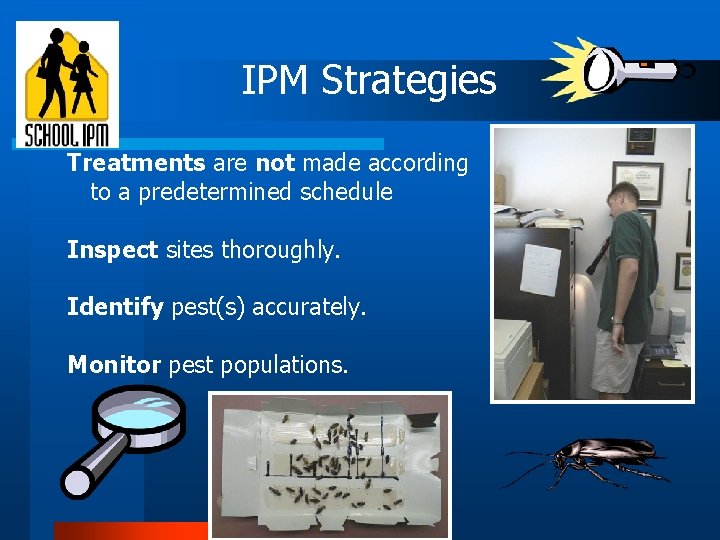
IPM Strategies Treatments are not made according to a predetermined schedule Inspect sites thoroughly. Identify pest(s) accurately. Monitor pest populations.
IPM Strategies Set Action Thresholds. Decide how many pests will be tolerated. • Initiate action when threshold is exceeded. • Based on results of monitoring Apply IPM Strategies Treatments are chosen & timed to be most effective Evaluate Results & Keep Accurate Records.
IPM Controls Physical controls Mechanical controls Sanitation Cultural Controls
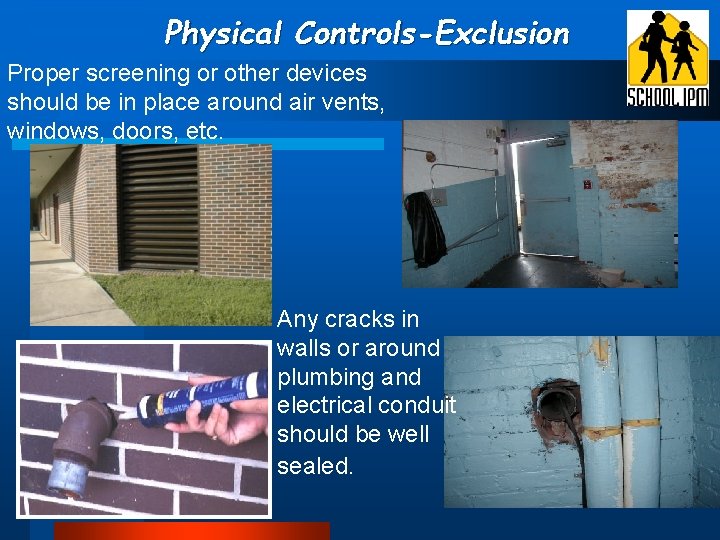
Physical Controls-Exclusion Proper screening or other devices should be in place around air vents, windows, doors, etc. Any cracks in walls or around plumbing and electrical conduit should be well sealed.
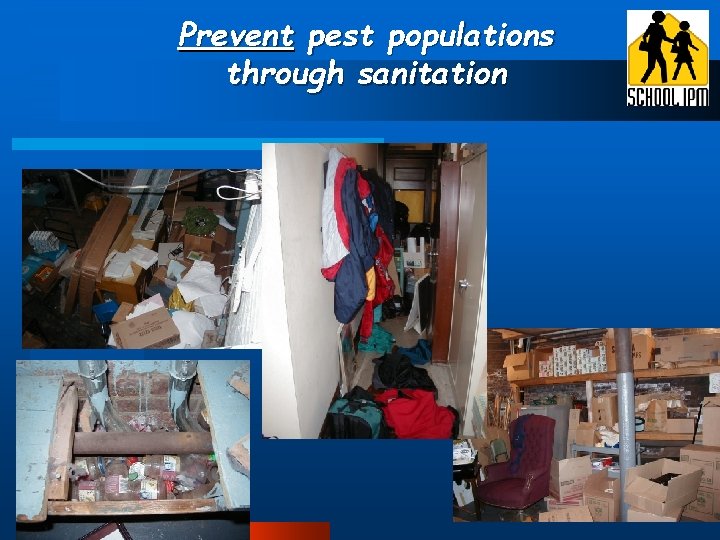
Prevent pest populations through sanitation
What pest management issues should I be aware of ? What are the pest problems at my school? – How are they managed? In-house vs. outside contractor-licensed vs. nonlicensed l Are routine applications made? – Am I notified-are postings done – What product is used-sprays, baits, traps? – Do I know the toxicity of that product? Did I request a label/MSDS? l
What pest management issues should I be aware of ? l Do I know the % of students and staff with asthma? l Does the school nurse have that info? l Does the absentee rate or illness complaints increase following pesticide applications? l Do I want to make my school a healthier environment for everyone?
How Do I Implement IPM In My School? l Step 1: Develop an Official IPM Policy Statement. Must state intent by administration to implement IPM l Should provide guidance on what is expected – incorporate IPM; education & involvement of students, staff, & pest manager l
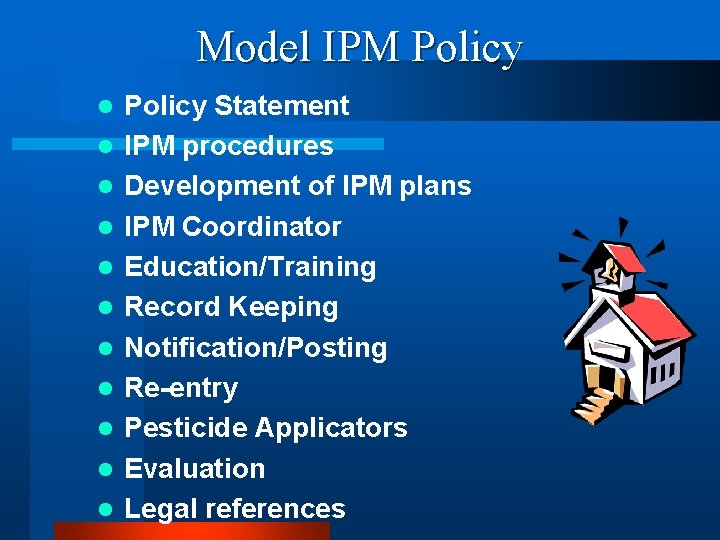
Model IPM Policy l l l Policy Statement IPM procedures Development of IPM plans IPM Coordinator Education/Training Record Keeping Notification/Posting Re-entry Pesticide Applicators Evaluation Legal references
Step 2: Designate Pest Management Roles. IPM Coordinator The Occupants (students and staff) The Parents The Pest Manager Decision-makers IPM Advisory Committee
IPM Advisory Committee l IPM Coordinator l School Principal l Teachers and student reps l Custodial staff-facilities maintenance l Cafeteria director l School nurse l PTA rep or other parent(s)
IPM Coordinator-as defined in School IPM Act • • • Appointed by Administration Maintains information about the school IPM policy Maintains information on pesticide applications Contact for IPM policy inquiries Maintains MSDS sheets, when available, and labels for pesticides used Certifies notification and posting completed prior to use of a non-low impact pesticide by Commercial Applicator
IPM Coordinator-Additional responsibilities l l l l Oversees all pest control matters-coordinates decisions Records all pest complaints Maintains records of applications-contact with CA Given authority to recommend improvements and repairs Ensures regulatory compliance Provides regular feedback to Administration Included in job description
Requirements of the Act l Designation of an IPM Coordinator for each school or school district l Annual universal notification to all parents and staff – provided by school boards, board of trustees or principal – IPM policy and IPM Coordinator contact info – list of any pesticide currently in use or having been used in previous 12 months
Requirements of the Act l 72 hour advance notification prior to pesticide application to all parents or guardians and staff – exception for use of low-impact pesticides (baits, gels, pastes, antimicrobials) – non-regulated, registration exempt as per FIFRA 72 hour advance posting of area(s) to be treated
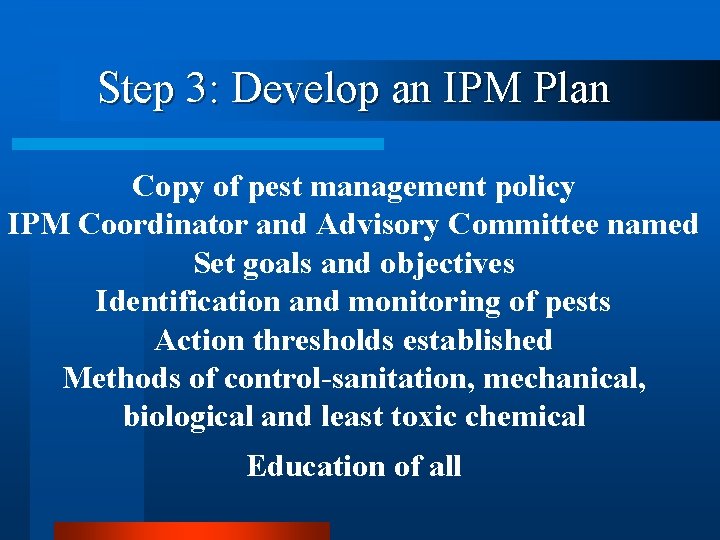
Step 3: Develop an IPM Plan Copy of pest management policy IPM Coordinator and Advisory Committee named Set goals and objectives Identification and monitoring of pests Action thresholds established Methods of control-sanitation, mechanical, biological and least toxic chemical Education of all
Step 4: Develop Bids for Contractors Step 5: Implement IPM components Step 6: Evaluate and Address necessary modifications
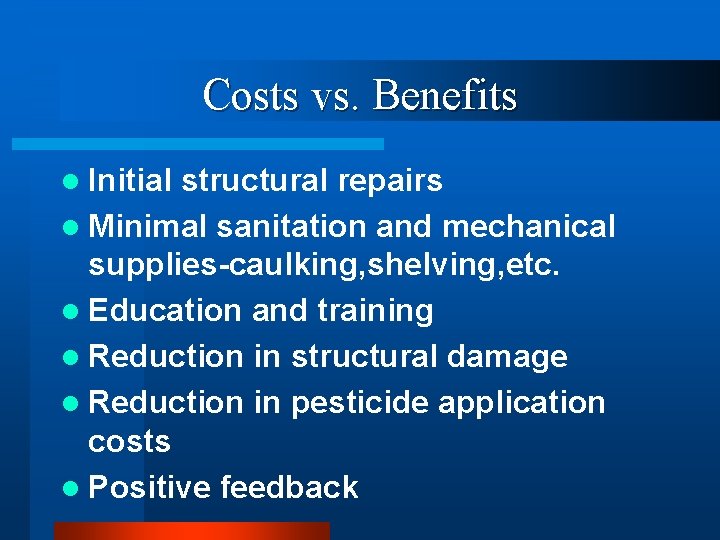
Costs vs. Benefits l Initial structural repairs l Minimal sanitation and mechanical supplies-caulking, shelving, etc. l Education and training l Reduction in structural damage l Reduction in pesticide application costs l Positive feedback
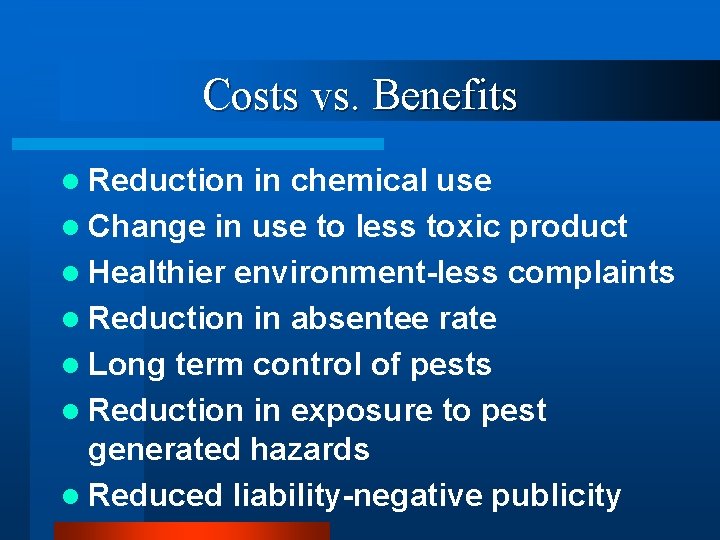
Costs vs. Benefits l Reduction in chemical use l Change in use to less toxic product l Healthier environment-less complaints l Reduction in absentee rate l Long term control of pests l Reduction in exposure to pest generated hazards l Reduced liability-negative publicity
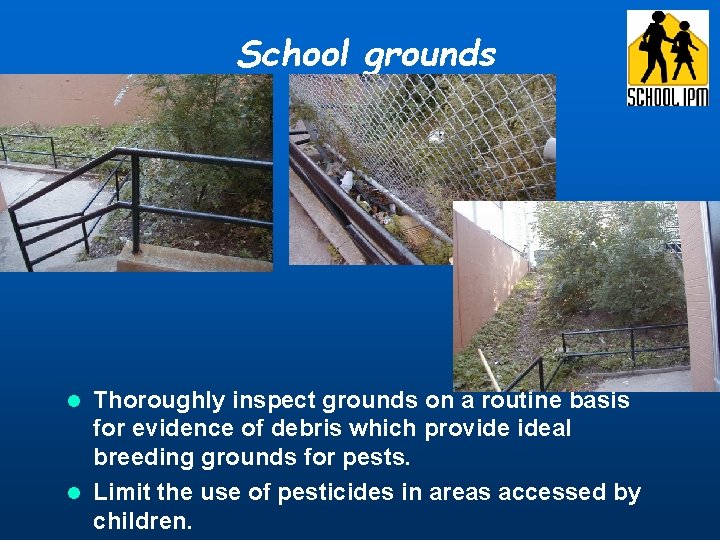
School grounds Thoroughly inspect grounds on a routine basis for evidence of debris which provide ideal breeding grounds for pests. l Limit the use of pesticides in areas accessed by children. l
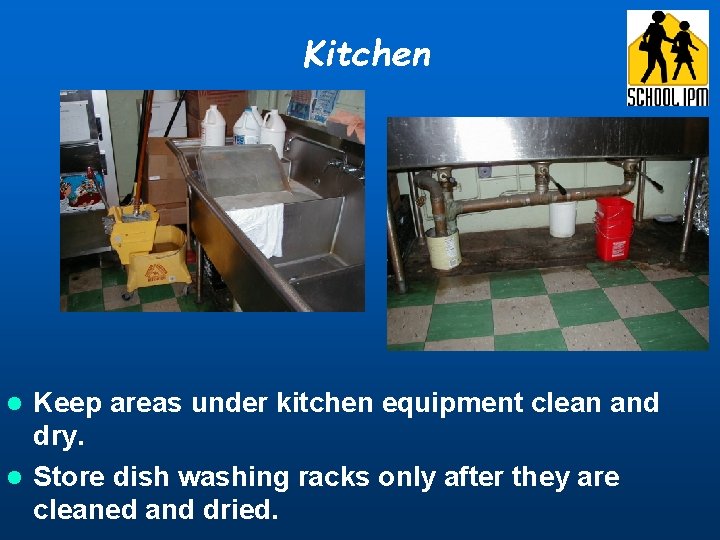
Kitchen Keep areas under kitchen equipment clean and dry. l Store dish washing racks only after they are cleaned and dried. l
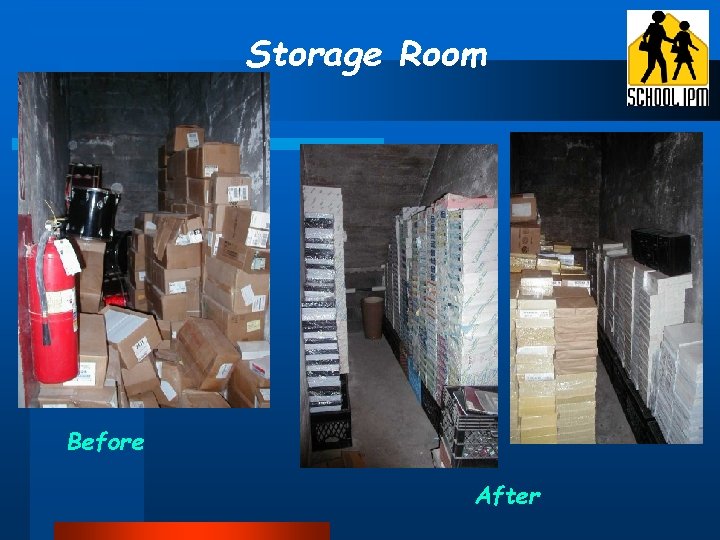
Storage Room Before After
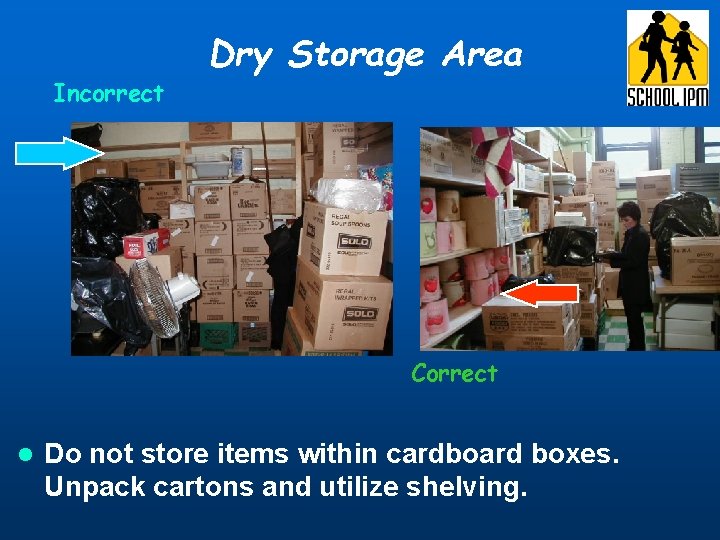
Incorrect Dry Storage Area Correct l Do not store items within cardboard boxes. Unpack cartons and utilize shelving.
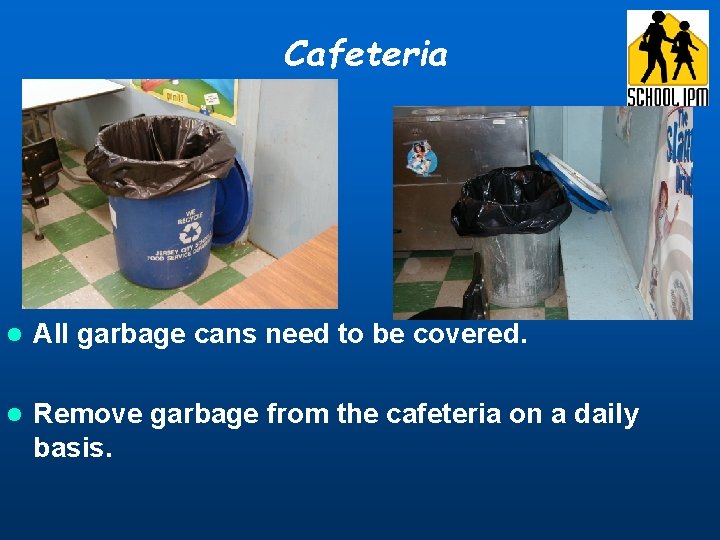
Cafeteria l All garbage cans need to be covered. l Remove garbage from the cafeteria on a daily basis.
Classrooms l All coats and backpacks should be placed on hooks or separate cubicles. NOT ON THE FLOOR!
Thanks for Listening! Ann R Waters, Outreach Coordinator NJ DEP Pesticide Control Program PO Box 411, Trenton, NJ 08625 -0411 (609) 984 -5014 email: Ann. Waters@dep. state. nj. us http: //pcpnj. org Acknowledgements: Clay W. Scherer, University of Florida Matthew B. Downey, University of Florida School IPM World Wide Web Site http: //schoolipm. ifas. ufl. edu/ Entomology and Nematology Department Copyright University of Florida 1998