
IPEN Almaty Kazakhstan July 2011 Mertens UNWOMENIPEN TRANSFORMATIVE

- Slides: 53
IPEN Almaty Kazakhstan July 2011 Mertens UNWOMEN/IPEN TRANSFORMATIVE MIXED METHODS EVALUATION: DAY 1 Prof. Donna M. Mertens Gallaudet University Almaty, Kazakhstan July 2011 1
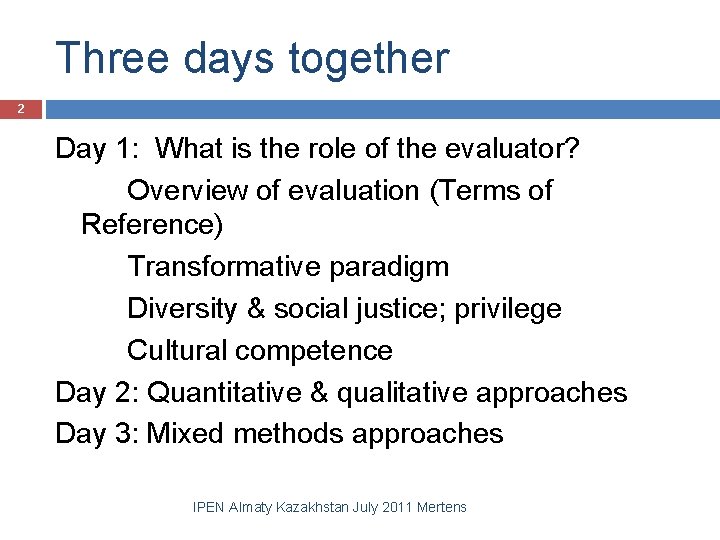
Three days together 2 Day 1: What is the role of the evaluator? Overview of evaluation (Terms of Reference) Transformative paradigm Diversity & social justice; privilege Cultural competence Day 2: Quantitative & qualitative approaches Day 3: Mixed methods approaches IPEN Almaty Kazakhstan July 2011 Mertens
Introduction/Expectations 3 Name, position, organization (no acronyms please). Where do you come from? What is your experience in research with multicultural and marginalized communities? What has been your experience with social justice? IPEN Almaty Kazakhstan July 2011 Mertens
Queries to Begin 4 What does social transformation mean? Can evaluation contribute to social transformation? What is the role of the evaluator in terms of social transformation? IPEN Almaty Kazakhstan July 2011 Mertens
Evaluator as Provocateur 5 IPEN Almaty Kazakhstan July 2011 Mertens
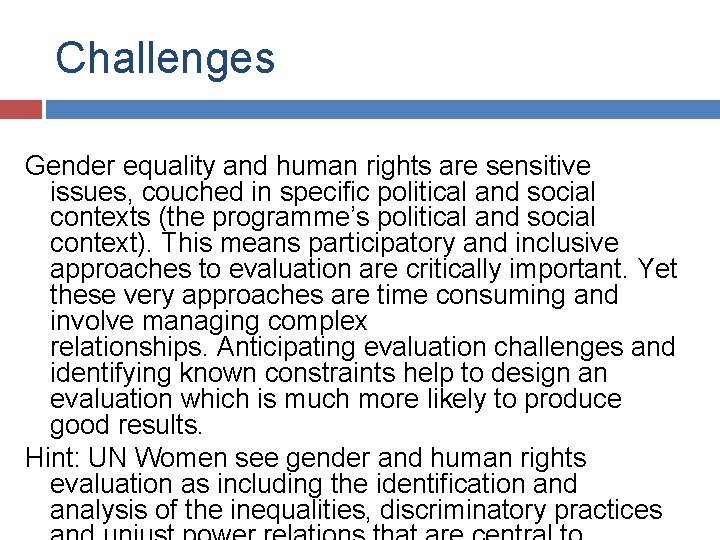
Challenges Gender equality and human rights are sensitive issues, couched in specific political and social contexts (the programme’s political and social context). This means participatory and inclusive approaches to evaluation are critically important. Yet these very approaches are time consuming and involve managing complex relationships. Anticipating evaluation challenges and identifying known constraints help to design an evaluation which is much more likely to produce good results. Hint: UN Women see gender and human rights evaluation as including the identification and analysis of the inequalities, discriminatory practices
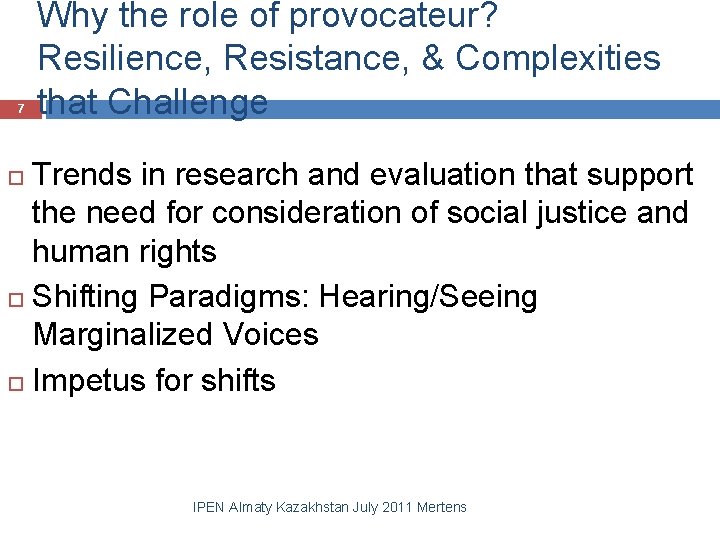
7 Why the role of provocateur? Resilience, Resistance, & Complexities that Challenge Trends in research and evaluation that support the need for consideration of social justice and human rights Shifting Paradigms: Hearing/Seeing Marginalized Voices Impetus for shifts IPEN Almaty Kazakhstan July 2011 Mertens
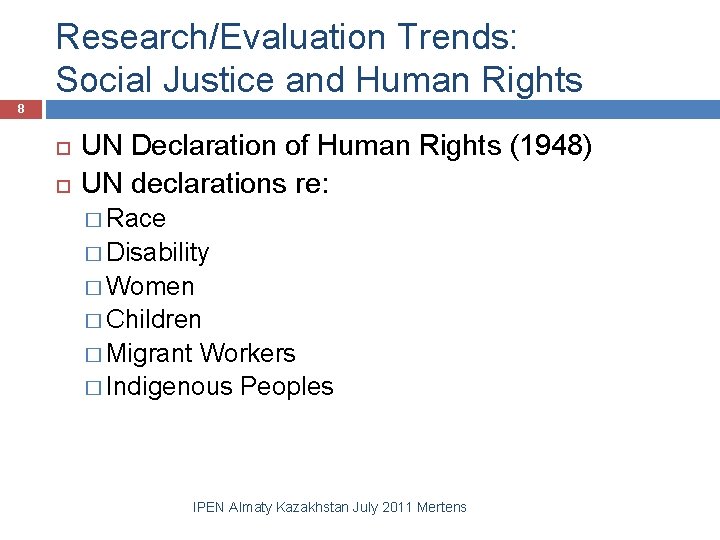
Research/Evaluation Trends: Social Justice and Human Rights 8 UN Declaration of Human Rights (1948) UN declarations re: � Race � Disability � Women � Children � Migrant Workers � Indigenous Peoples IPEN Almaty Kazakhstan July 2011 Mertens
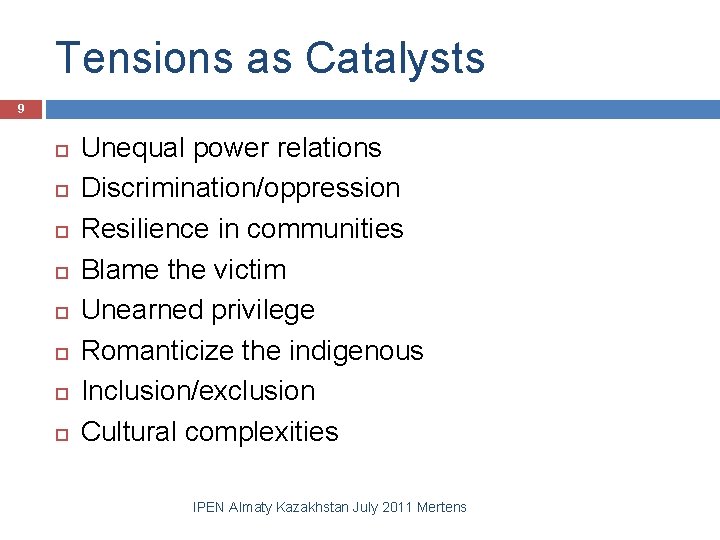
Tensions as Catalysts 9 Unequal power relations Discrimination/oppression Resilience in communities Blame the victim Unearned privilege Romanticize the indigenous Inclusion/exclusion Cultural complexities IPEN Almaty Kazakhstan July 2011 Mertens
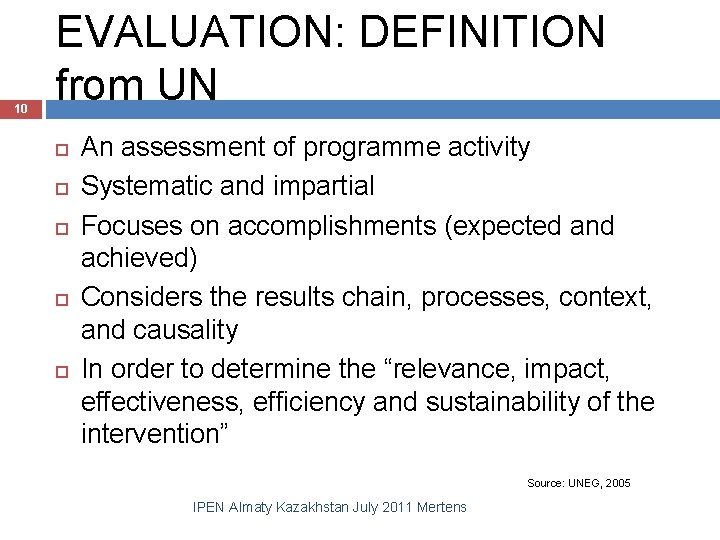
10 EVALUATION: DEFINITION from UN An assessment of programme activity Systematic and impartial Focuses on accomplishments (expected and achieved) Considers the results chain, processes, context, and causality In order to determine the “relevance, impact, effectiveness, efficiency and sustainability of the intervention” Source: UNEG, 2005 IPEN Almaty Kazakhstan July 2011 Mertens
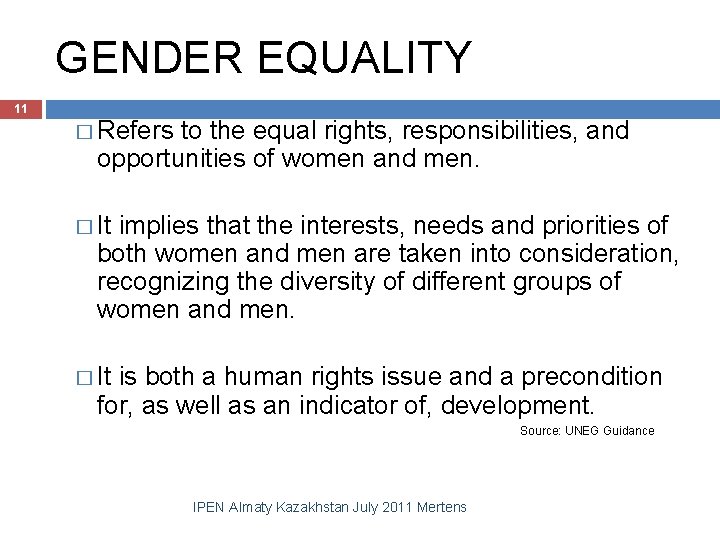
GENDER EQUALITY 11 � Refers to the equal rights, responsibilities, and opportunities of women and men. � It implies that the interests, needs and priorities of both women and men are taken into consideration, recognizing the diversity of different groups of women and men. � It is both a human rights issue and a precondition for, as well as an indicator of, development. Source: UNEG Guidance IPEN Almaty Kazakhstan July 2011 Mertens
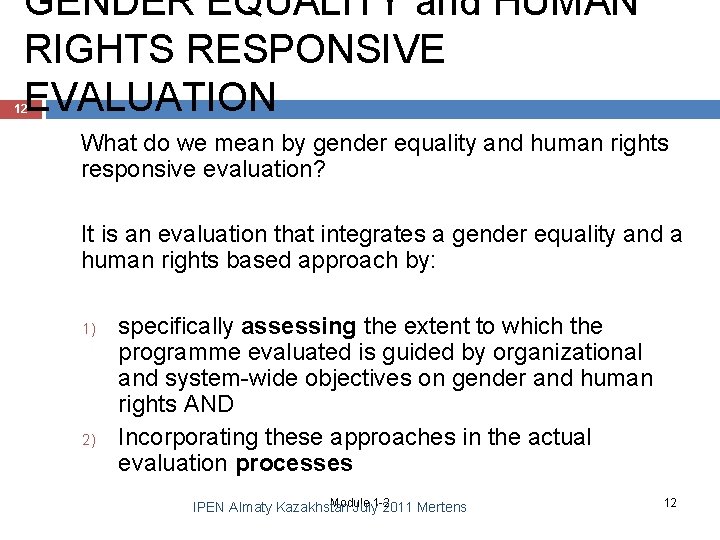
GENDER EQUALITY and HUMAN RIGHTS RESPONSIVE EVALUATION 12 What do we mean by gender equality and human rights responsive evaluation? It is an evaluation that integrates a gender equality and a human rights based approach by: 1) 2) specifically assessing the extent to which the programme evaluated is guided by organizational and system-wide objectives on gender and human rights AND Incorporating these approaches in the actual evaluation processes Module IPEN Almaty Kazakhstan July 1 -2 2011 Mertens 12
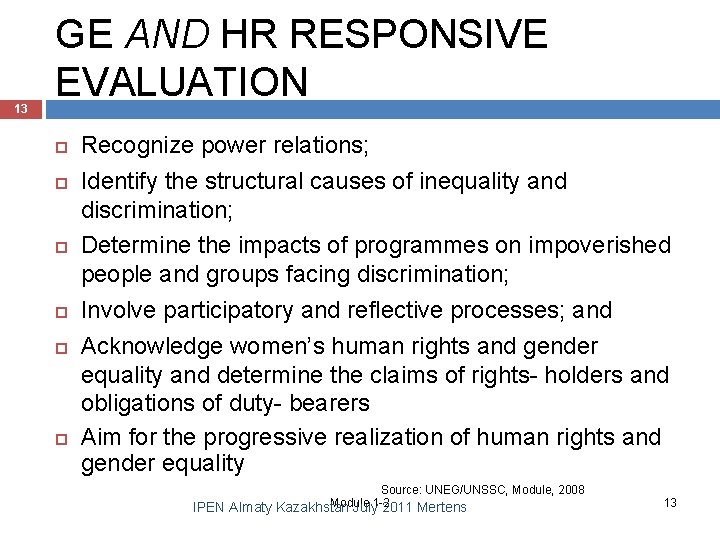
13 GE AND HR RESPONSIVE EVALUATION Recognize power relations; Identify the structural causes of inequality and discrimination; Determine the impacts of programmes on impoverished people and groups facing discrimination; Involve participatory and reflective processes; and Acknowledge women’s human rights and gender equality and determine the claims of rights- holders and obligations of duty- bearers Aim for the progressive realization of human rights and gender equality Source: UNEG/UNSSC, Module, 2008 Module 1 -2 IPEN Almaty Kazakhstan July 2011 Mertens 13
SO, WHAT’S DIFFERENT ABOUT GENDER EQUALITY PERSPECTIVES? 14 Conceptual: � Recognizes the gendered nature of development and the importance of gender equality to economic and social development � Recognizes that poor and marginalized groups of people are gendered, and women and men are differentiated by race, ethnicity, age, disability, class and caste � Recognizes that power relations exist within the home/family, and that these relationships intersect with power relationships in the society, polity, and economy. IPEN Almaty Kazakhstan Module July 1 -2 2011 Mertens 14
Terms of Reference An Evaluation Terms of Reference (To. R) provides definition for why the evaluation is being done (purpose), what it will examine (focus and key questions), how and when it will be conducted (methods and information sources) and who and how it will be used when completed. The To. R is organized under the adjacent sections / headings and direction on the content for each is found in UN Women Guidance on a Terms of Reference. The To. R affects all stages of the evaluation process as it is used in contracting evaluation resources, is a reference point for guiding the evaluation process (including interim deliverables and reporting), and provides clarity on the intended use of the evaluation once completed. UNWomen 2011
Terms of Reference Contents Title Background, Purpose & Use Context of the Intervention Description of the Intervention Scope of the Evaluation Questions Existing Information Sources Approach, Process & Methods Stakeholder Participation Expected Products Evaluation Team composition, skills & experience Management of Evaluation Ethical Code of Conduct
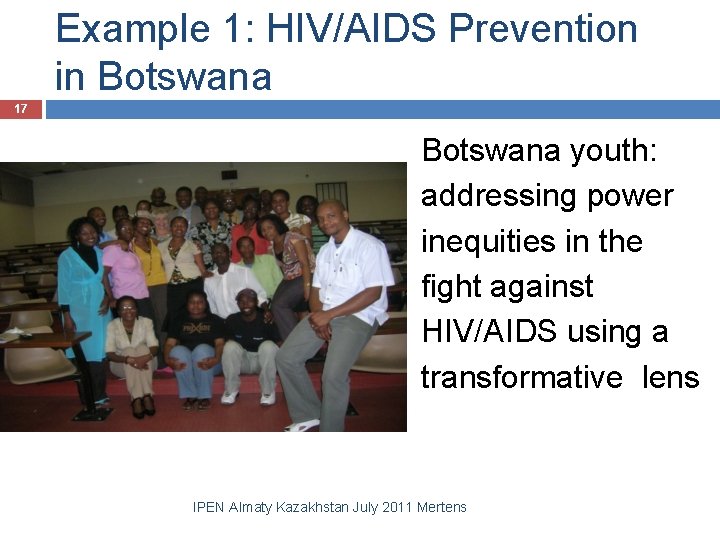
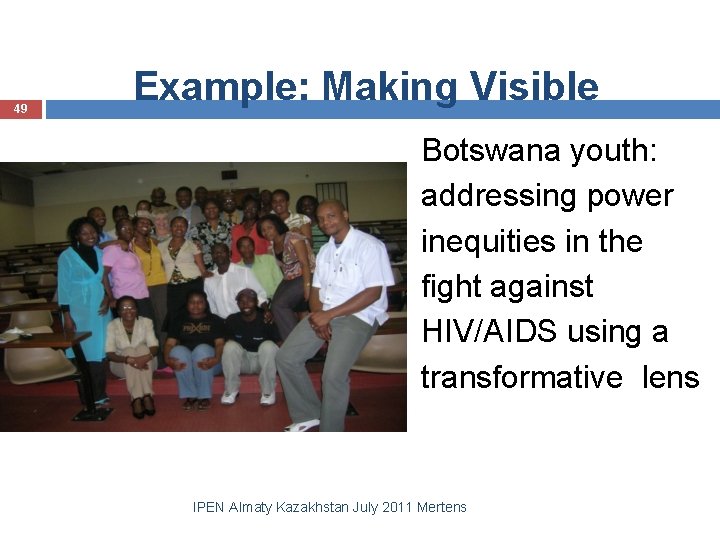
Example 1: HIV/AIDS Prevention in Botswana 17 Botswana youth: addressing power inequities in the fight against HIV/AIDS using a transformative lens IPEN Almaty Kazakhstan July 2011 Mertens
18 Example 2: UN Women Safe Cities IPEN Almaty Kazakhstan July 2011 Mertens
Sample To. R Evaluation of the say NO to violence against women campaign phase 1 http: //unifem. org/evaluation_manual/wpcontent/uploads/2010/02/Example-To. REvaluation-Say-NO-to-Violence-against. Women-Campaign 1. pdf UNWomen 2011
Paradigms: 20 Your worldview Your assumptions about � Ethics (axiology) � Reality (ontology) � Nature of Knowledge & relation between knower and would-be-known (epistemology) � The appropriate approach to systematic inquiry (methodology) IPEN Almaty Kazakhstan July 2011 Mertens
Transformative Paradigm A framework of belief systems that directly engages members of culturally diverse groups with a focus on increased social justice. A metaphysical umbrella: critical theories, feminist theories, human rights based, indigenous/postcolonial, culturally responsive 21 IPEN Almaty Kazakhstan July 2011 Mertens
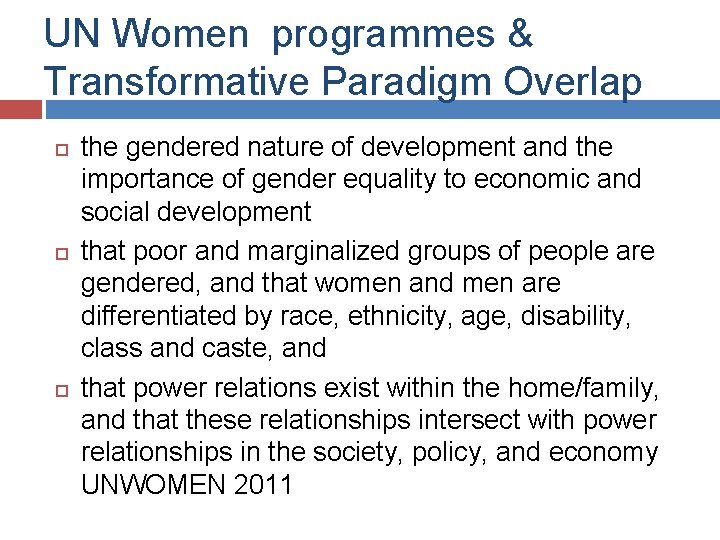
UN Women programmes & Transformative Paradigm Overlap the gendered nature of development and the importance of gender equality to economic and social development that poor and marginalized groups of people are gendered, and that women and men are differentiated by race, ethnicity, age, disability, class and caste, and that power relations exist within the home/family, and that these relationships intersect with power relationships in the society, policy, and economy UNWOMEN 2011
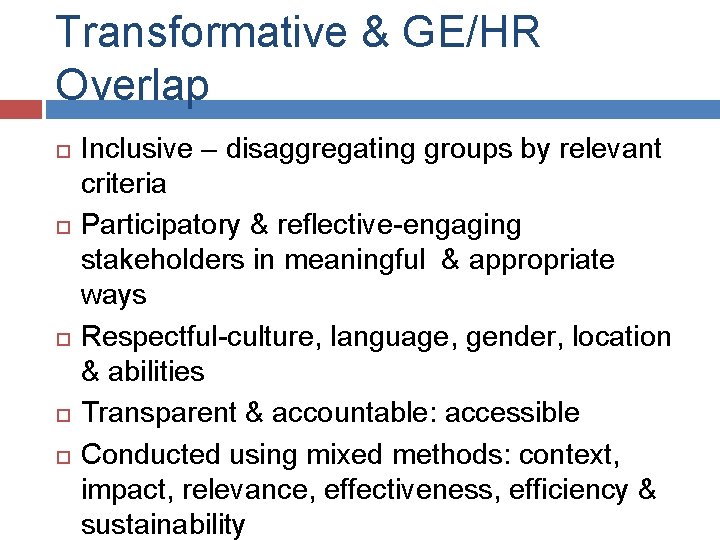
Transformative & GE/HR Overlap Inclusive – disaggregating groups by relevant criteria Participatory & reflective-engaging stakeholders in meaningful & appropriate ways Respectful-culture, language, gender, location & abilities Transparent & accountable: accessible Conducted using mixed methods: context, impact, relevance, effectiveness, efficiency & sustainability
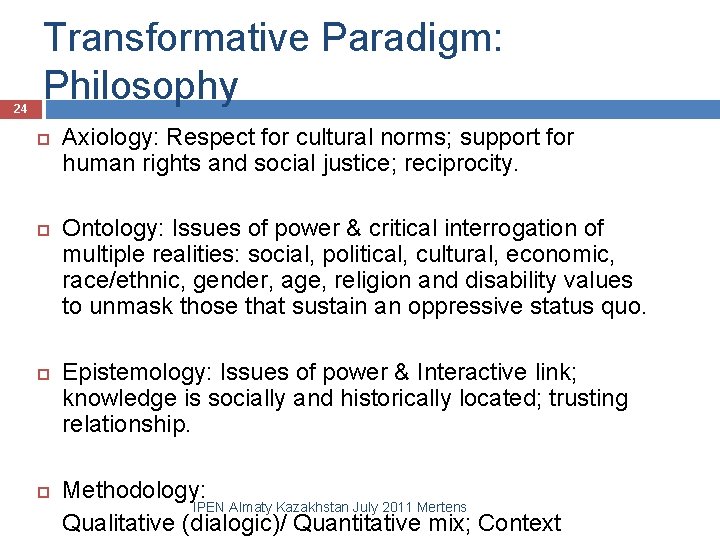
24 Transformative Paradigm: Philosophy Axiology: Respect for cultural norms; support for human rights and social justice; reciprocity. Ontology: Issues of power & critical interrogation of multiple realities: social, political, cultural, economic, race/ethnic, gender, age, religion and disability values to unmask those that sustain an oppressive status quo. Epistemology: Issues of power & Interactive link; knowledge is socially and historically located; trusting relationship. Methodology: IPEN Almaty Kazakhstan July 2011 Mertens Qualitative (dialogic)/ Quantitative mix; Context
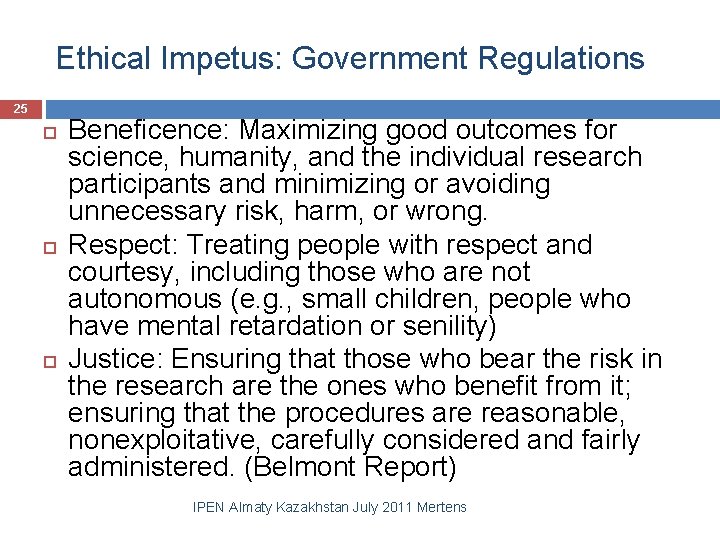
Ethical Impetus: Government Regulations 25 Beneficence: Maximizing good outcomes for science, humanity, and the individual research participants and minimizing or avoiding unnecessary risk, harm, or wrong. Respect: Treating people with respect and courtesy, including those who are not autonomous (e. g. , small children, people who have mental retardation or senility) Justice: Ensuring that those who bear the risk in the research are the ones who benefit from it; ensuring that the procedures are reasonable, nonexploitative, carefully considered and fairly administered. (Belmont Report) IPEN Almaty Kazakhstan July 2011 Mertens
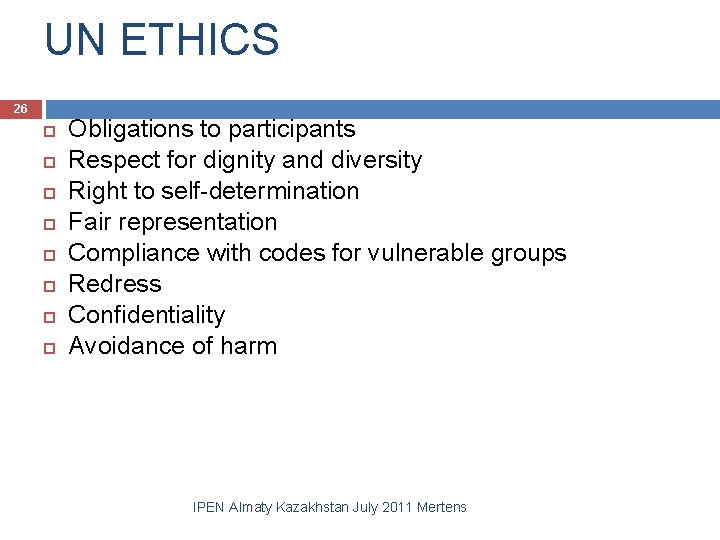
UN ETHICS 26 Obligations to participants Respect for dignity and diversity Right to self-determination Fair representation Compliance with codes for vulnerable groups Redress Confidentiality Avoidance of harm IPEN Almaty Kazakhstan July 2011 Mertens
Ethics UNEG Ethical Guidelines for Evaluation in the UN System UNEG Code of Conduct for Evaluators
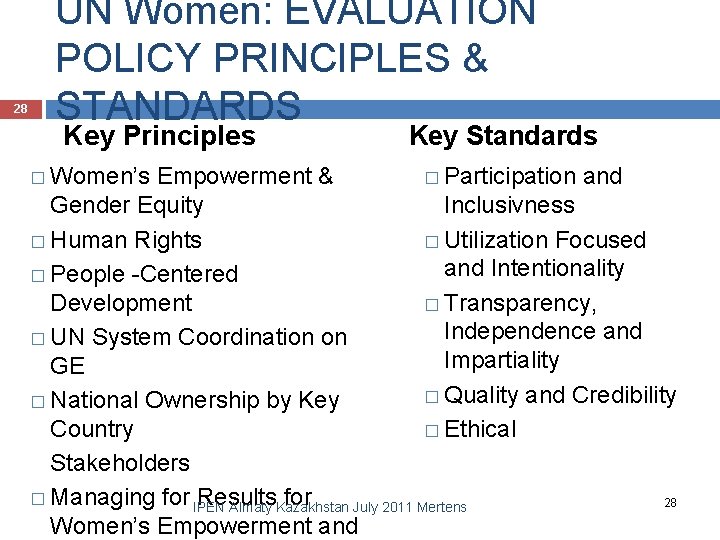
28 UN Women: EVALUATION POLICY PRINCIPLES & STANDARDS Key Principles � Women’s Key Standards Empowerment & � Participation and Gender Equity Inclusivness � Human Rights � Utilization Focused and Intentionality � People -Centered Development � Transparency, Independence and � UN System Coordination on Impartiality GE � Quality and Credibility � National Ownership by Key Country � Ethical Stakeholders � Managing for IPEN Results for 28 Almaty Kazakhstan July 2011 Mertens Women’s Empowerment and
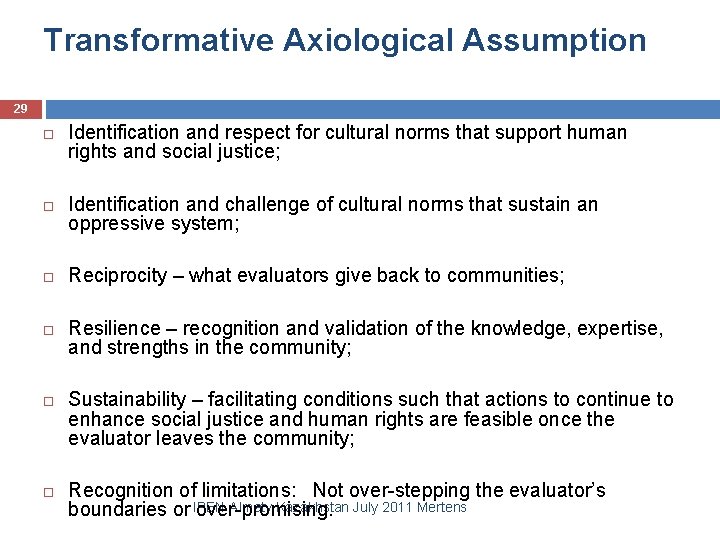
Transformative Axiological Assumption 29 Identification and respect for cultural norms that support human rights and social justice; Identification and challenge of cultural norms that sustain an oppressive system; Reciprocity – what evaluators give back to communities; Resilience – recognition and validation of the knowledge, expertise, and strengths in the community; Sustainability – facilitating conditions such that actions to continue to enhance social justice and human rights are feasible once the evaluator leaves the community; Recognition of limitations: Not over-stepping the evaluator’s Almaty Kazakhstan July 2011 Mertens boundaries or IPEN over-promising.
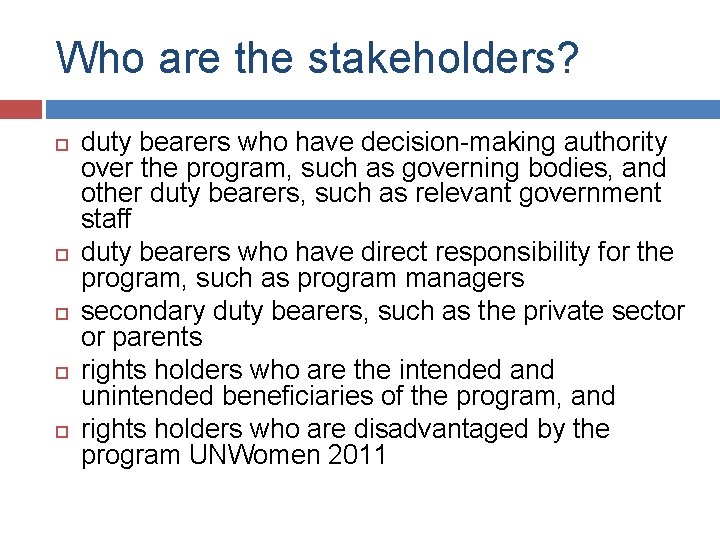
Who are the stakeholders? duty bearers who have decision-making authority over the program, such as governing bodies, and other duty bearers, such as relevant government staff duty bearers who have direct responsibility for the program, such as program managers secondary duty bearers, such as the private sector or parents rights holders who are the intended and unintended beneficiaries of the program, and rights holders who are disadvantaged by the program UNWomen 2011
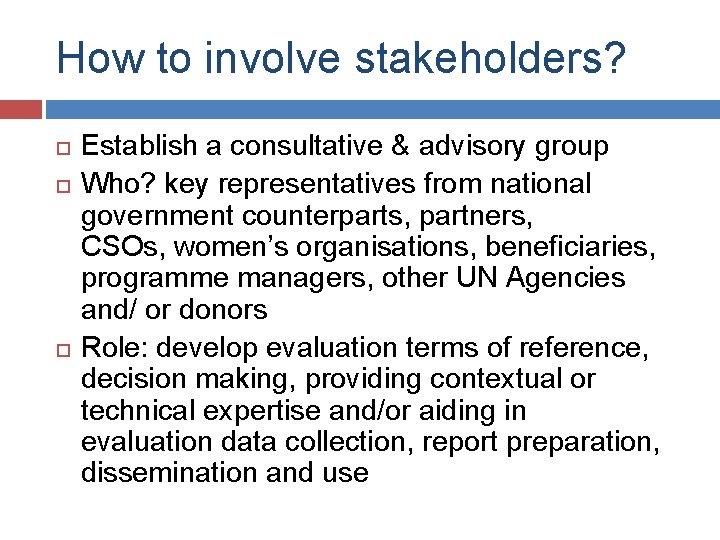
How to involve stakeholders? Establish a consultative & advisory group Who? key representatives from national government counterparts, partners, CSOs, women’s organisations, beneficiaries, programme managers, other UN Agencies and/ or donors Role: develop evaluation terms of reference, decision making, providing contextual or technical expertise and/or aiding in evaluation data collection, report preparation, dissemination and use
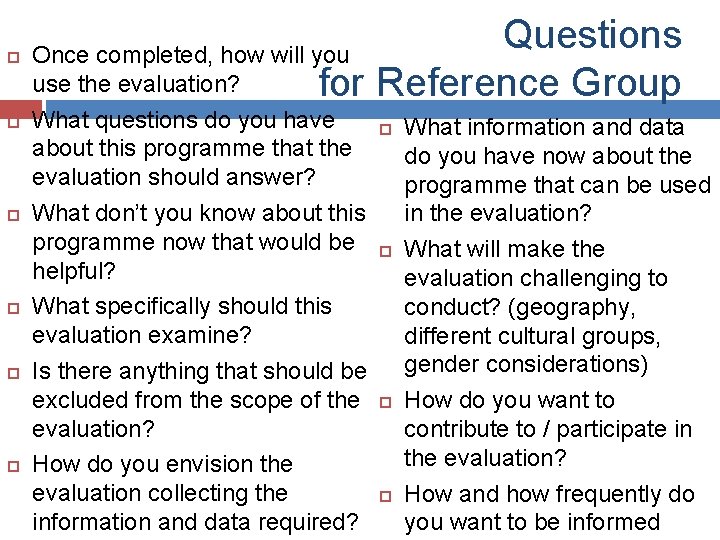
Questions Once completed, how will you use the evaluation? for Reference Group What questions do you have about this programme that the evaluation should answer? What don’t you know about this programme now that would be helpful? What specifically should this evaluation examine? Is there anything that should be excluded from the scope of the evaluation? How do you envision the evaluation collecting the information and data required? What information and data do you have now about the programme that can be used in the evaluation? What will make the evaluation challenging to conduct? (geography, different cultural groups, gender considerations) How do you want to contribute to / participate in the evaluation? How and how frequently do you want to be informed
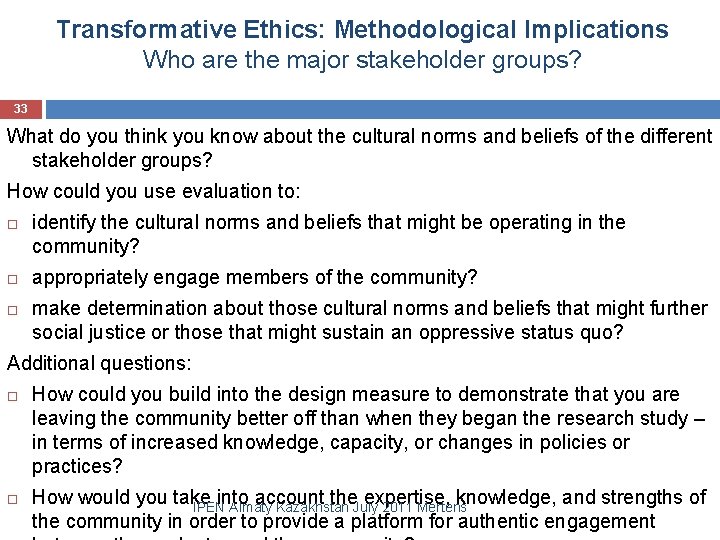
Transformative Ethics: Methodological Implications Who are the major stakeholder groups? 33 What do you think you know about the cultural norms and beliefs of the different stakeholder groups? How could you use evaluation to: identify the cultural norms and beliefs that might be operating in the community? appropriately engage members of the community? make determination about those cultural norms and beliefs that might further social justice or those that might sustain an oppressive status quo? Additional questions: How could you build into the design measure to demonstrate that you are leaving the community better off than when they began the research study – in terms of increased knowledge, capacity, or changes in policies or practices? How would you take into account the expertise, knowledge, and strengths of IPEN Almaty Kazakhstan July 2011 Mertens the community in order to provide a platform for authentic engagement
Transformative Ontological Assumption 34 Recognizes that different versions of reality exist; All versions of reality are not equal; Recognizes privilege given to what is perceived to be real based on: social, political, cultural, economic, ethnic, gender, religion, and disability positionality; Interrogates versions of reality that sustain oppressive systems; Makes visible versions of reality that have the Almaty Kazakhstan July 2011 Mertens potential IPEN to further human rights
Dimensions of Diversity (Petesch & Thalayasingam) Sri Lanka is a multiethnic country. About threequarters of its 21 million people are Sinhalese, and a large share of Sinhalese are Buddhists. 35 Another 18 percent are Tamils, who are primarily Hindu or Christian. The Tamils are heavily concentrated in the Northern, Eastern, Western, and Central provinces. NOTE: also Indian Tamils and Sri Lanka Tamils In 1956, Parliament passed the Sinhala Only Act, imposing Sinhala as the official language, and in 1972 they enacted legislation that was widely perceived to discriminate against Tamil university applicants. Muslims account for 7 percent, with the largest concentrations living in the cities and in the Central, Southern, and Eastern provinces. The 2004 tsunami struck the north, east, and south coasts, killing more than 30, 000 people and leaving tens of thousands displaced or missing. Of the districts visited for this Ampara in the East was IPENstudy, Almaty Kazakhstan July 2011 Mertens particularly affected.
36 Dimensions of Diversity (Petesch & Thalayasingam) Households at the bottom step are often seen to be disadvantaged in terms of their family composition: they may be large families with many dependents, female-headed families, or households with more female, elderly, disabled, or ill members, sometimes all surviving on a single income. Youths in the poorest families often have to IPEN Almaty Kazakhstan July 2011 Mertens perform daily wage labor to help make ends
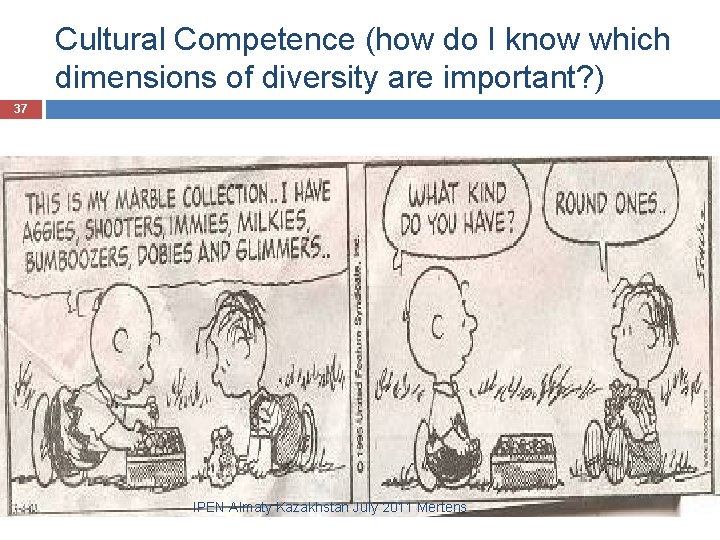
Cultural Competence (how do I know which dimensions of diversity are important? ) 37 IPEN Almaty Kazakhstan July 2011 Mertens
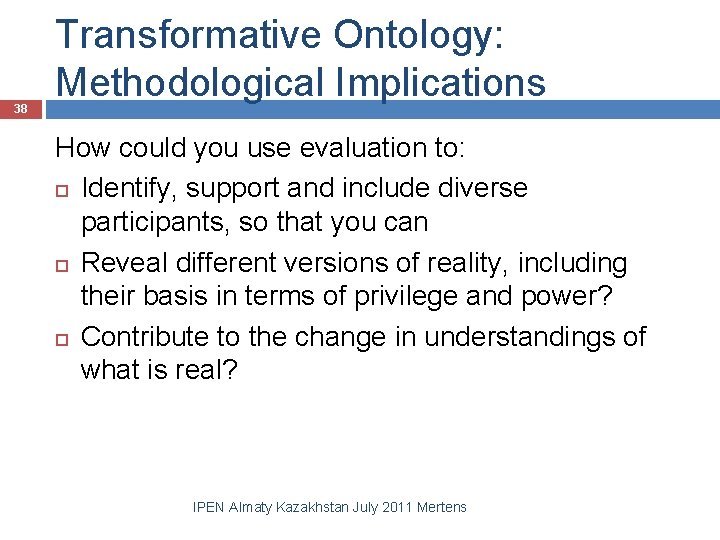
38 Transformative Ontology: Methodological Implications How could you use evaluation to: Identify, support and include diverse participants, so that you can Reveal different versions of reality, including their basis in terms of privilege and power? Contribute to the change in understandings of what is real? IPEN Almaty Kazakhstan July 2011 Mertens
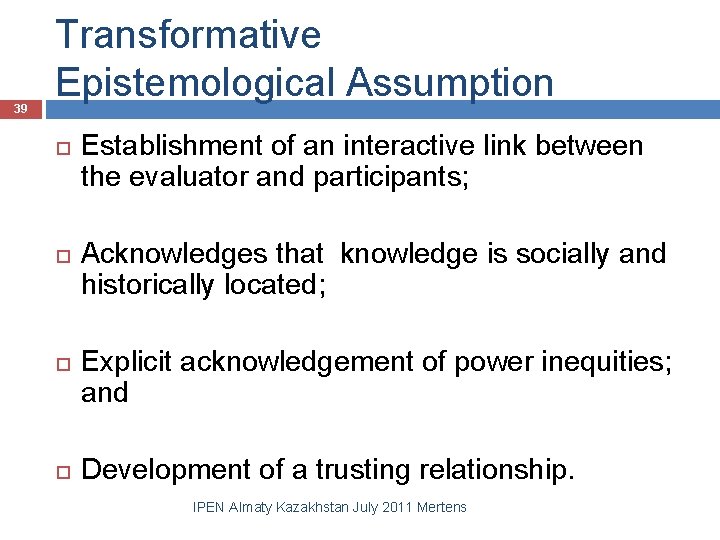
39 Transformative Epistemological Assumption Establishment of an interactive link between the evaluator and participants; Acknowledges that knowledge is socially and historically located; Explicit acknowledgement of power inequities; and Development of a trusting relationship. IPEN Almaty Kazakhstan July 2011 Mertens
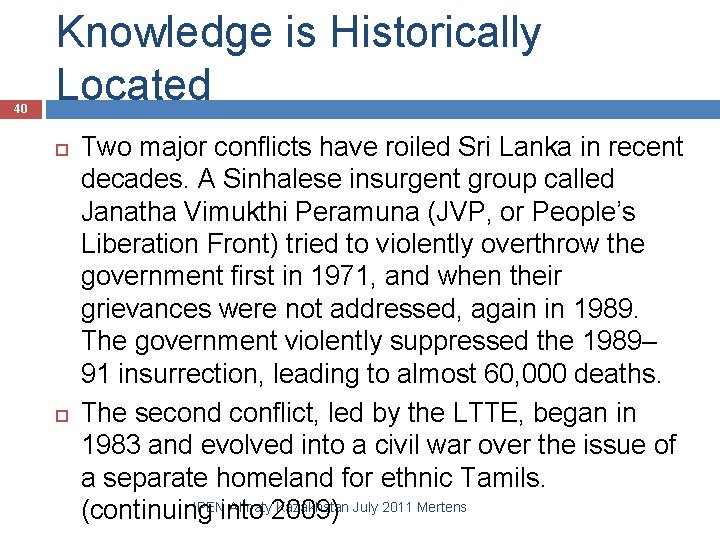
40 Knowledge is Historically Located Two major conflicts have roiled Sri Lanka in recent decades. A Sinhalese insurgent group called Janatha Vimukthi Peramuna (JVP, or People’s Liberation Front) tried to violently overthrow the government first in 1971, and when their grievances were not addressed, again in 1989. The government violently suppressed the 1989– 91 insurrection, leading to almost 60, 000 deaths. The second conflict, led by the LTTE, began in 1983 and evolved into a civil war over the issue of a separate homeland for ethnic Tamils. IPEN Almaty Kazakhstan July 2011 Mertens (continuing into 2009)
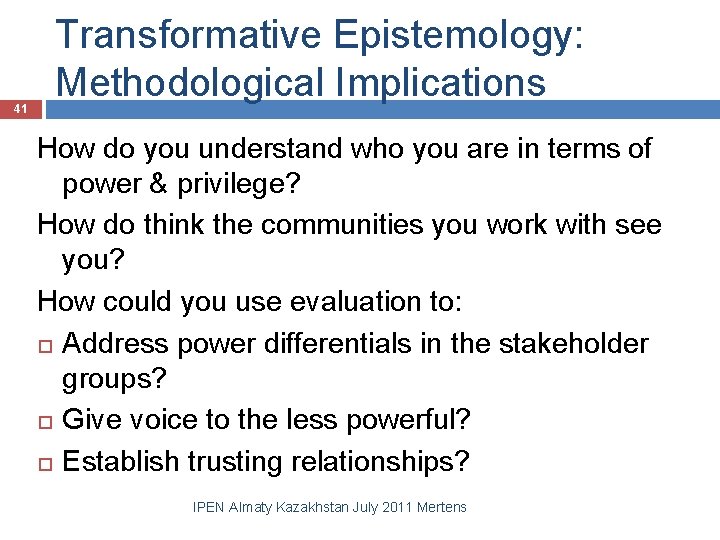
41 Transformative Epistemology: Methodological Implications How do you understand who you are in terms of power & privilege? How do think the communities you work with see you? How could you use evaluation to: Address power differentials in the stakeholder groups? Give voice to the less powerful? Establish trusting relationships? IPEN Almaty Kazakhstan July 2011 Mertens
AEA Guiding Principle: Cultural Competence Linkage with Transformative Epistemology 42 To ensure recognition, accurate interpretation, and respect for diversity, evaluators should ensure that the members of the evaluation team collectively demonstrate cultural competence (American Evaluation Association, Public Statement on Cultural Competence in Evaluation, 2011) IPEN Almaty Kazakhstan July 2011 Mertens
Evaluations reflect culture 43 Evaluations cannot be culture free. Those who engage in evaluation do so from perspectives that reflect their values, their ways of viewing the world, and their culture. Culture shapes the ways in which evaluation questions are conceptualized, which in turn influence what data are collected, how the data will be collected analyzed, and how data are interpreted. IPEN Almaty Kazakhstan July 2011 Mertens
What is cultural competence? 44 Cultural competence is not a state at which one arrives; rather, it is a process of learning, unlearning, and relearning. It is a sensibility cultivated throughout a lifetime. Cultural competence requires awareness of self, reflection on one’s own cultural position, awareness of others’ positions, and the ability to interact genuinely and respectfully with others. Culturally competent evaluators refrain from assuming they fully understand the perspectives of stakeholders whose backgrounds differ from their own. Cultural competence is context dependent. (AEA 2011) IPEN Almaty Kazakhstan July 2011 Mertens
Cultural competence & validity 45 • accurately and respectfully reflect the life experiences and perspectives of program participants • establish relationships that support trustworthy communication among all participants in the evaluation process. • draw upon culturally relevant, and in some cases culturally specific, theory in the design of the evaluation and the interpretation of findings. • select and implement design options and measurement strategies in ways that are compatible with the cultural context of the study. • consider intended and unintended social consequences in the overall assessment of their work. (AEA 2011) IPEN Almaty Kazakhstan July 2011 Mertens
Questions: cultural competency 46 What is your definition of cultural competency? What is the importance of cultural competency in evaluation? How do you develop cultural competency? How do you demonstrate cultural competency? What are the dangers associated with this concept? IPEN Almaty Kazakhstan July 2011 Mertens
Transformative Methodological Assumption 47 Researchers need qualitative/dialogic moments in the beginning of their planning in order to ascertain the cultural context in which they are working; Qualitative and quantitative data facilitate responsiveness to different participants and issues; Methods used need to capture the contextual complexity and be appropriate to the cultural groups in the research study; and A cyclical design can be used to make use of interim findings throughout the research study. IPEN Almaty Kazakhstan July 2011 Mertens
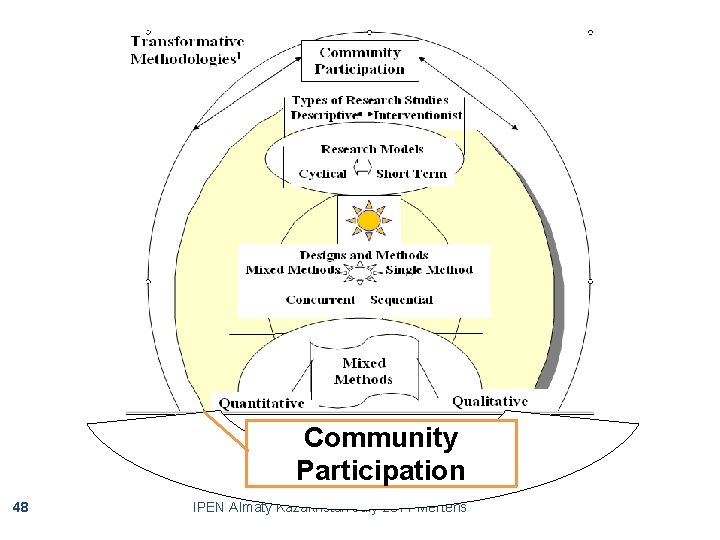
Community Participation 48 IPEN Almaty Kazakhstan July 2011 Mertens
49 Example: Making Visible Botswana youth: addressing power inequities in the fight against HIV/AIDS using a transformative lens IPEN Almaty Kazakhstan July 2011 Mertens
Transformative Methodological Assumption 50 How would you design your study to include: Qualitative/dialogic moments in the beginning of the planning in order to ascertain the cultural context in which you are working; Include both qualitative and quantitative data to facilitate responsiveness to different participants and issues; Use methods to capture the contextual complexity and be appropriate to the cultural groups in the research study; and Use a cyclical to make use of interim findings IPEN design Almaty Kazakhstan July 2011 Mertens throughout the research study.
Methodology & Quality 51 How can you use evaluation to engage with the full range of participants to gather data that enhances your/their understandings of the community? How can you use evaluation data collection to be responsive to the needs of diverse participants? How can you design evaluation to enhance use of the study findings to support the pursuit of social justice and human rights? IPEN Almaty Kazakhstan July 2011 Mertens
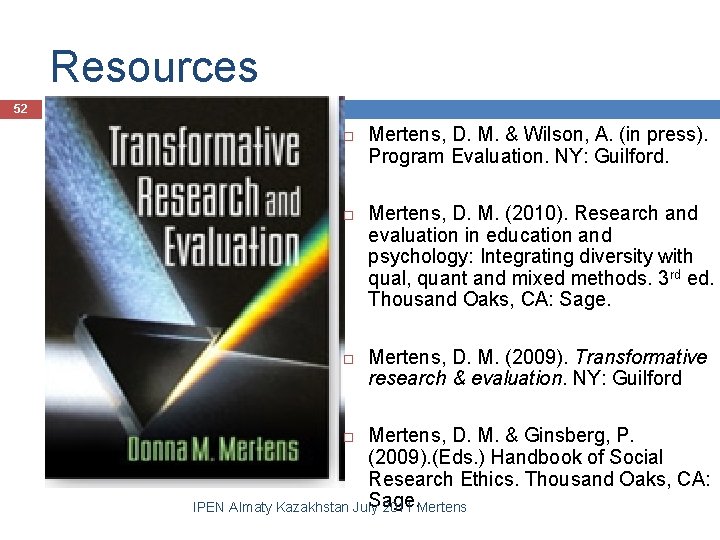
Resources 52 Mertens, D. M. & Wilson, A. (in press). Program Evaluation. NY: Guilford. Mertens, D. M. (2010). Research and evaluation in education and psychology: Integrating diversity with qual, quant and mixed methods. 3 rd ed. Thousand Oaks, CA: Sage. Mertens, D. M. (2009). Transformative research & evaluation. NY: Guilford Mertens, D. M. & Ginsberg, P. (2009). (Eds. ) Handbook of Social Research Ethics. Thousand Oaks, CA: Sage. IPEN Almaty Kazakhstan July 2011 Mertens
Contact information 53 Donna M. Mertens, Gallaudet University Donna. Mertens@Gallaudet. edu IPEN Almaty Kazakhstan July 2011 Mertens