
IPE MDY ZONE 2020 September 2020 Personality individual
IPE MDY ZONE 2020 September 2020
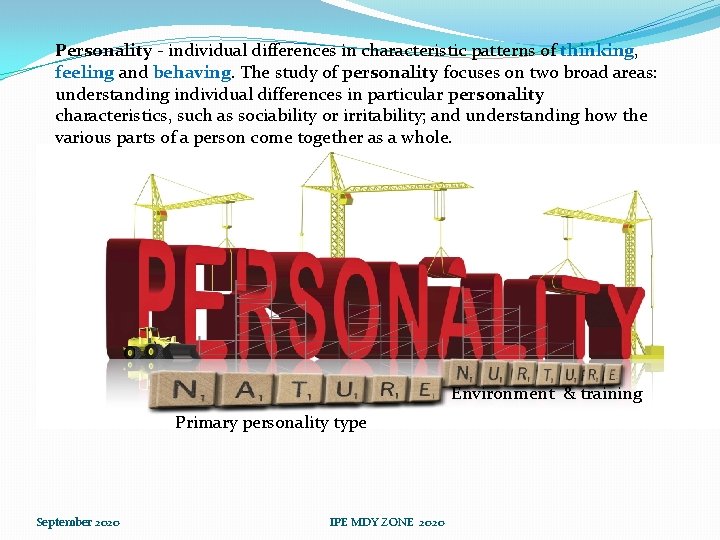
Personality - individual differences in characteristic patterns of thinking, feeling and behaving. The study of personality focuses on two broad areas: understanding individual differences in particular personality characteristics, such as sociability or irritability; and understanding how the various parts of a person come together as a whole. Environment & training Primary personality type September 2020 IPE MDY ZONE 2020
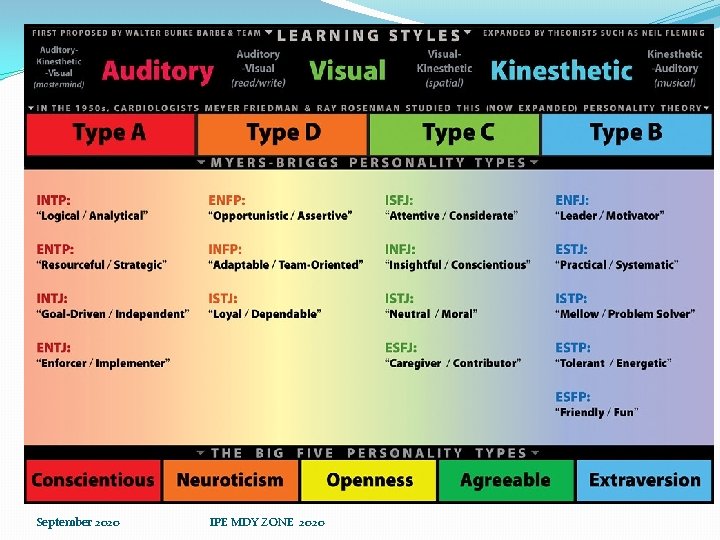
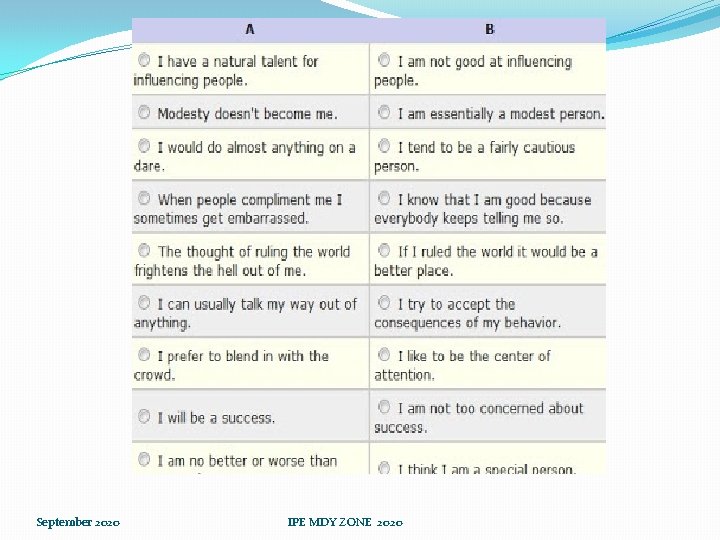
Primary personality types Dominance Type A) : Likes challenges, freedom, immediate results and rewards, bluntness, brevity, and capable leaders. Inducement(Type B) : Enjoys recognition and meeting people, as well as things that are new, different or unusual. Compliance (Type C) : Avoids risks, likes thorough research and quality work, and embraces cooperation. Steadiness (Type D) : Likes stability, predictability, titles, the feeling of belonging and repeated affirmation. WHAT TYPE ARE YOU? https: //www. personalityperfect. com/test/free-personality-test/ September 2020 IPE MDY ZONE 2020
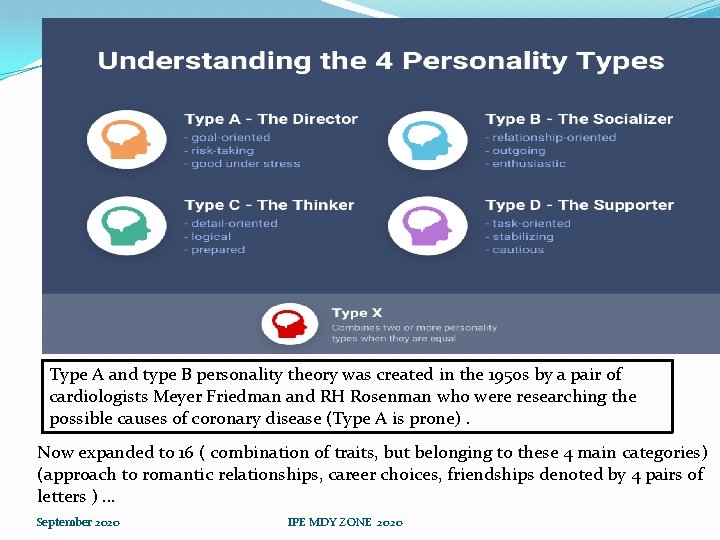
Type A and type B personality theory was created in the 1950 s by a pair of cardiologists Meyer Friedman and RH Rosenman who were researching the possible causes of coronary disease (Type A is prone). Now expanded to 16 ( combination of traits, but belonging to these 4 main categories) (approach to romantic relationships, career choices, friendships denoted by 4 pairs of letters ). . . September 2020 IPE MDY ZONE 2020
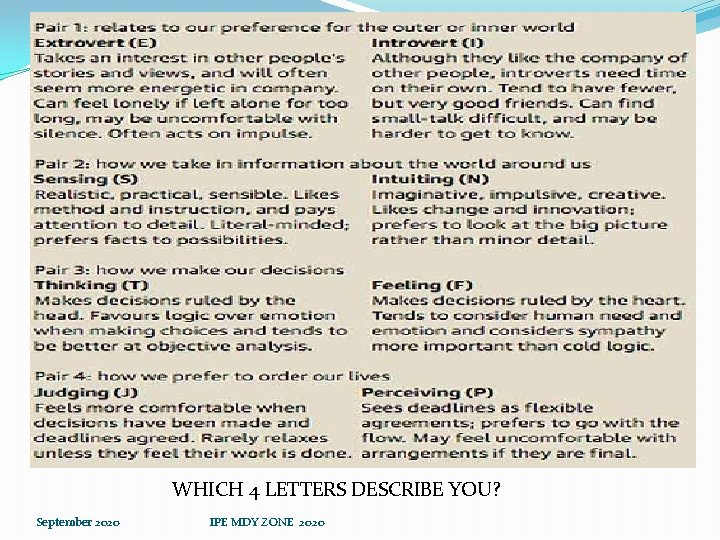
WHICH 4 LETTERS DESCRIBE YOU? September 2020 IPE MDY ZONE 2020
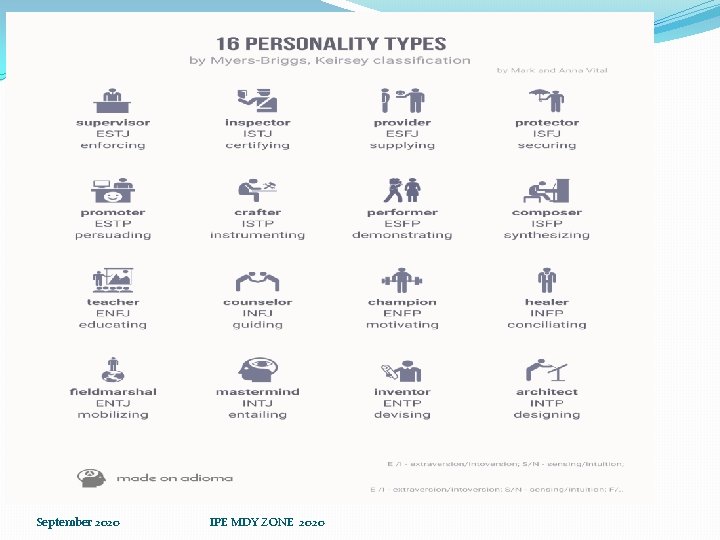
September 2020 IPE MDY ZONE 2020
September 2020 IPE MDY ZONE 2020
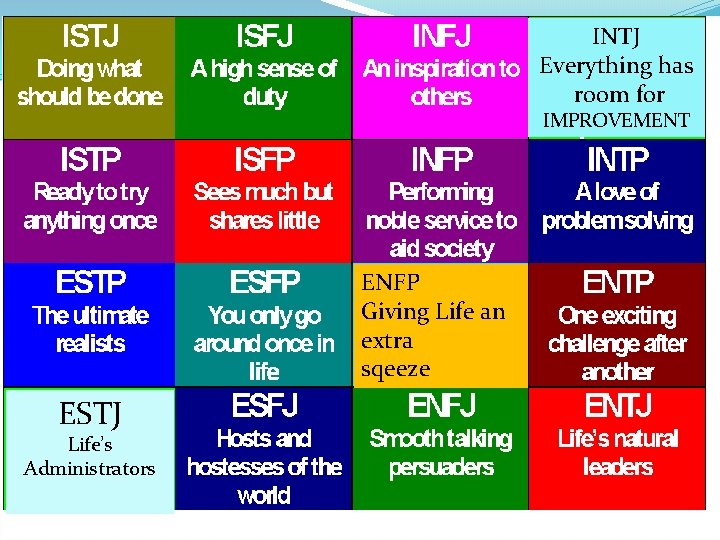
INTJ Everything has room for Type A IMPROVEMENT ENFP Giving Life an extra sqeeze ESTJ Life’s Administrators September 2020 IPE MDY ZONE 2020
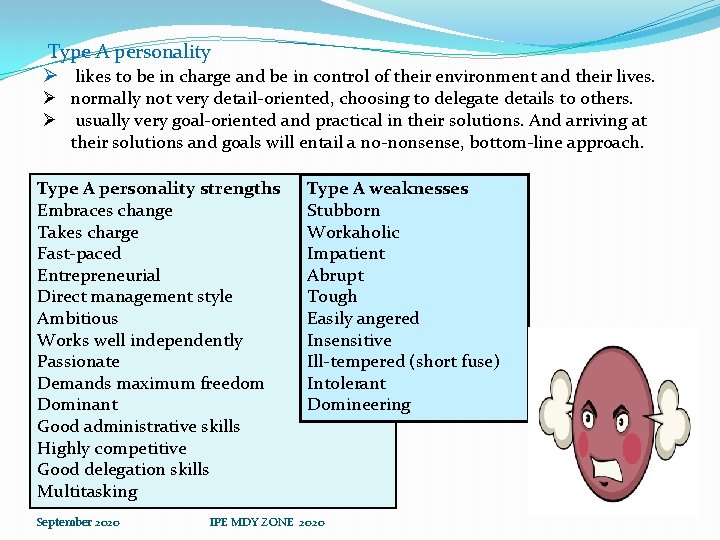
Type A personality Ø likes to be in charge and be in control of their environment and their lives. Ø normally not very detail-oriented, choosing to delegate details to others. Ø usually very goal-oriented and practical in their solutions. And arriving at their solutions and goals will entail a no-nonsense, bottom-line approach. Type A personality strengths Embraces change Takes charge Fast-paced Entrepreneurial Direct management style Ambitious Works well independently Passionate Demands maximum freedom Dominant Good administrative skills Highly competitive Good delegation skills Multitasking September 2020 Type A weaknesses Stubborn Workaholic Impatient Abrupt Tough Easily angered Insensitive Ill-tempered (short fuse) Intolerant Domineering IPE MDY ZONE 2020
Type B personality Ø very outgoing, energetic, and fast-paced individual Ø likes to be around people and enjoys being the center of attention Ø good relationship builders, and most people like them right away. Ø Their driving need is for approval, so they try to like everyone in hopes everyone will like them too. Compliments, acknowledgement of their achievements, words of admiration, and even applause from groups will be the most important thing you can do for them. Type B personality Enthusiasm Fun-loving Persuasiveness Easily liked by most people Friendliness Charismatic Idea person motivator Dreamer Lighthearted People-oriented Spontaneous Faster-paced Self-confident September 2020 IPE MDY ZONE 2020 Type B weaknesses Too self-involved May try to do too much at once Impatient Sometimes unrealistic Trouble being alone Doesn’t finish what was started Short attention span Arrogant or cocky Easily bored Self-indulgent Prone to sweeping generalizations Impulsive Procrastination Whimsical
September 2020 IPE MDY ZONE 2020
Type C personality Ø a very detail-oriented individual who likes to be involved in things that are controlled and stable Ø interested in accuracy, rationality, and logic. People who can't seem to control their emotions will bother them because Type C personalities believe being emotional makes objectivity difficult or perhaps impossible. Ø dislike being around people who are full of hype, since they desire facts, accuracy, and logic. Other people's emotions may not be a priority for them, as they tend to strive for the facts and let the chips fall where they may. Type C strengths Accuracy Creative Dependable Imaginative Independent Detailed Follow-through Plays by the rules Organized Intelligent Analytical Critical thinker Quality control Thoughtful September 2020 Type C weaknesses Worry about progress Can appear unsocial Critical behavior Likes to do things their own way Detached behavior Can see the glass half empty Skeptical, disbelieving May never have personal expectations met Disengagement IPE MDY ZONE 2020
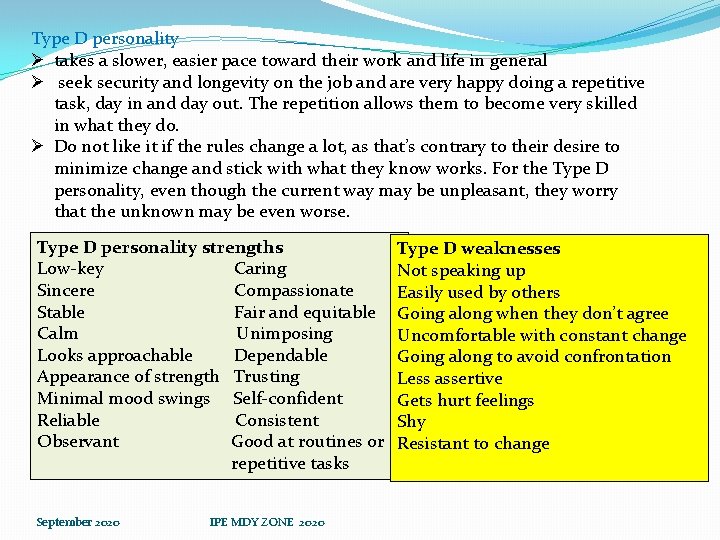
Type D personality Ø takes a slower, easier pace toward their work and life in general Ø seek security and longevity on the job and are very happy doing a repetitive task, day in and day out. The repetition allows them to become very skilled in what they do. Ø Do not like it if the rules change a lot, as that’s contrary to their desire to minimize change and stick with what they know works. For the Type D personality, even though the current way may be unpleasant, they worry that the unknown may be even worse. Type D personality strengths Low-key Caring Sincere Compassionate Stable Fair and equitable Calm Unimposing Looks approachable Dependable Appearance of strength Trusting Minimal mood swings Self-confident Reliable Consistent Observant Good at routines or repetitive tasks September 2020 IPE MDY ZONE 2020 Type D weaknesses Not speaking up Easily used by others Going along when they don’t agree Uncomfortable with constant change Going along to avoid confrontation Less assertive Gets hurt feelings Shy Resistant to change
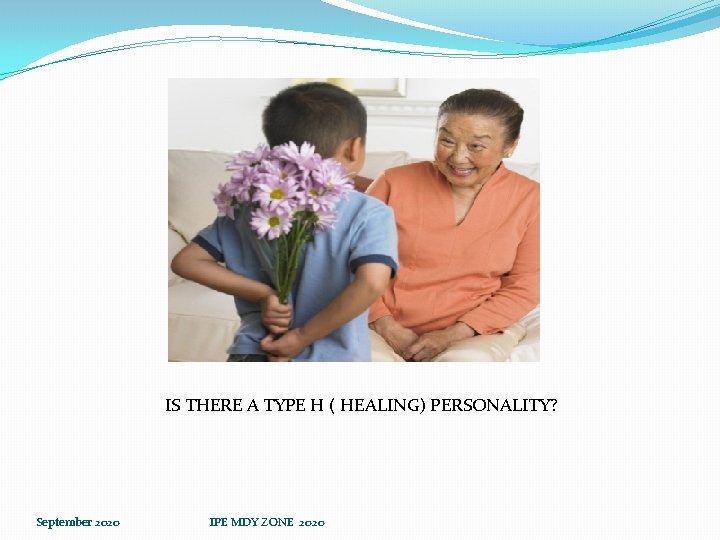
IS THERE A TYPE H ( HEALING) PERSONALITY? September 2020 IPE MDY ZONE 2020
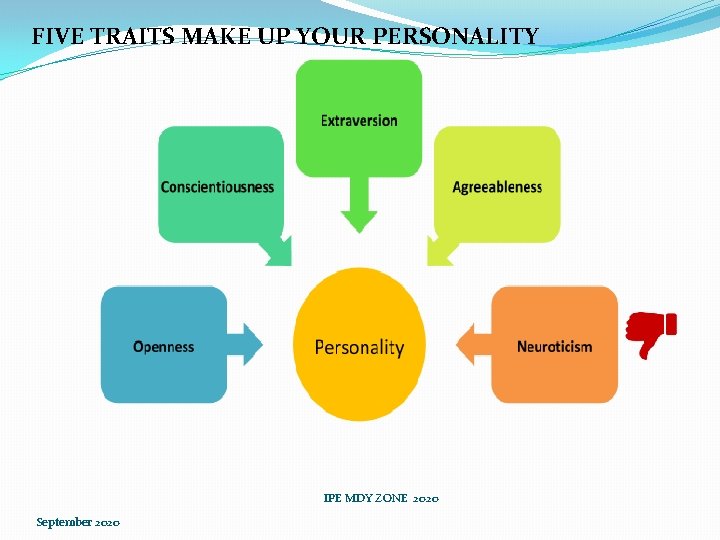
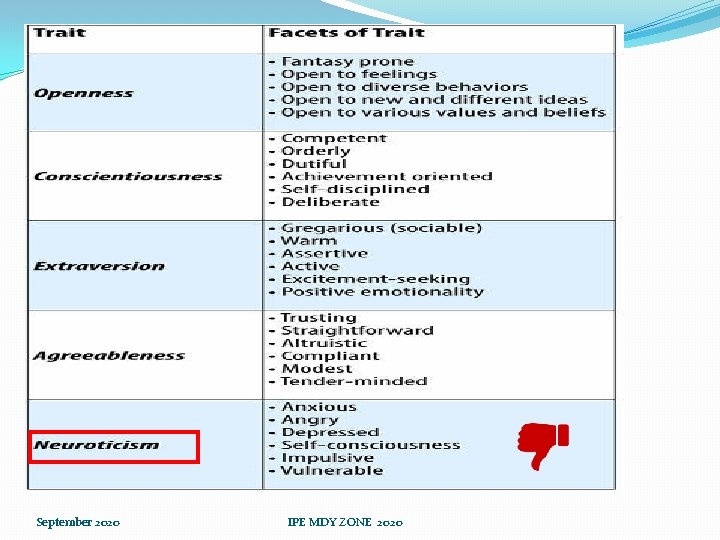
FIVE TRAITS MAKE UP YOUR PERSONALITY IPE MDY ZONE 2020 September 2020
September 2020 IPE MDY ZONE 2020
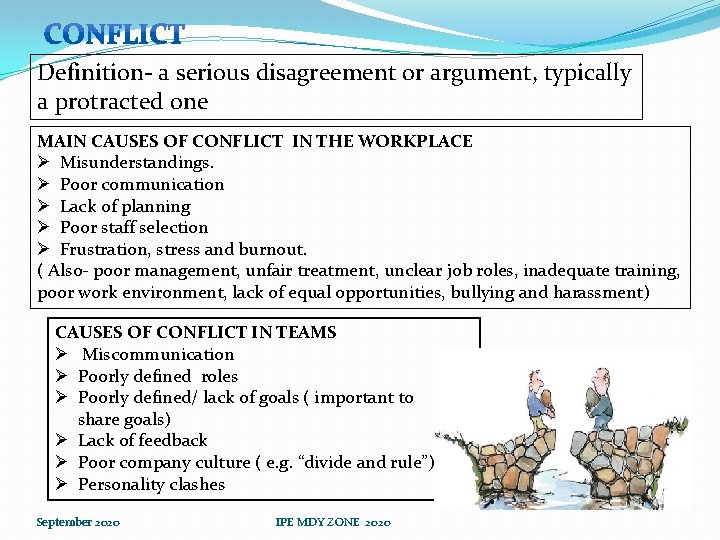
Definition- a serious disagreement or argument, typically a protracted one MAIN CAUSES OF CONFLICT IN THE WORKPLACE Ø Misunderstandings. Ø Poor communication Ø Lack of planning Ø Poor staff selection Ø Frustration, stress and burnout. ( Also- poor management, unfair treatment, unclear job roles, inadequate training, poor work environment, lack of equal opportunities, bullying and harassment) CAUSES OF CONFLICT IN TEAMS Ø Miscommunication Ø Poorly defined roles Ø Poorly defined/ lack of goals ( important to share goals) Ø Lack of feedback Ø Poor company culture ( e. g. “divide and rule”) Ø Personality clashes September 2020 IPE MDY ZONE 2020
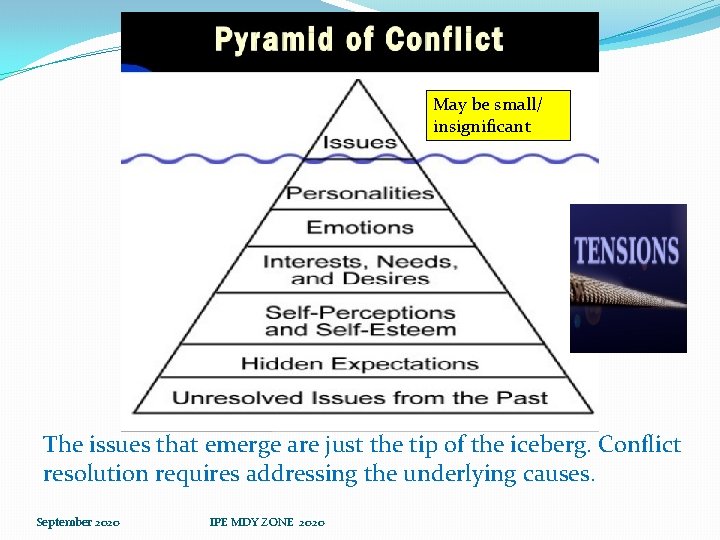
May be small/ insignificant The issues that emerge are just the tip of the iceberg. Conflict resolution requires addressing the underlying causes. September 2020 IPE MDY ZONE 2020
Four Key Myths on Workplace Conflict 1. Conflict is always going to happen. It’s unavoidable. The world comprises different personality types, belief systems, priorities and outlooks, leading to tension ( which is NOT the same as conflict) 2. Conflict never ends well. Tension often arrives from change and differing viewpoints. An absence of different views leaves a team static, stale and moribund. Use this tension to explore new ideas, invite feedback, and improve how your team does things. Conflict can be the door to improvement. 3. Personalities will always clash Not necessarily. It is what we do which festers conflict, not who we are. 4. Conflict is an excuse for poor behaviour Poor behaviour is neither inevitable, necessary or justified Managing conflict requires effort, energy and the use of learned skills. Manage tensions and to use them to drive growth. September 2020 IPE MDY ZONE 2020
Five Types of High-Conflict People ( HCP) They share 4 characteristics: 1. Preoccupation with blaming others (their Targets of Blame) 2. Lots of all-or-nothing thinking (and solutions) 3. Unmanaged emotions (which often throw them off-track) 4. Extreme behaviors (that 90% of people would never do) 1. Borderline HCPs – mood swings, sudden explosive anger 2. Narcissistic HCPs- wants to be seen as superior, wants to be admired, puts others down, lacks empathy 3. Histrionic HCPs- Preoccupation with drawing attention to themselves ; superficial emotions and relationships, dramatic stories and manner of speaking 4. Paranoid HCPs- Mistrust and suspiciousness of the intentions of others Fear of conspiracies against them by those close to them (partners, co-workers) A drive to attack those they fear will attack them (verbally, legally, physically) 5. Antisocial HCPs- A drive to dominate others; highly-aggressive energy and risk-taking; constant deceitfulness (lying and conning) September 2020 IPE MDY ZONE 2020
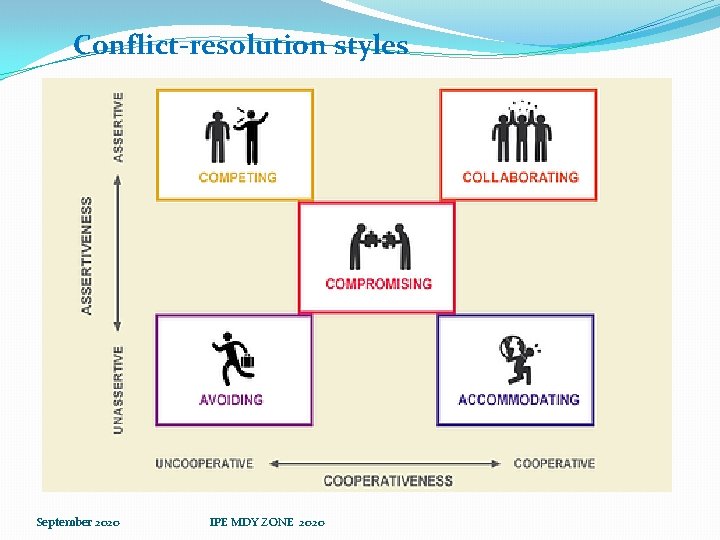
Conflict-resolution styles September 2020 IPE MDY ZONE 2020
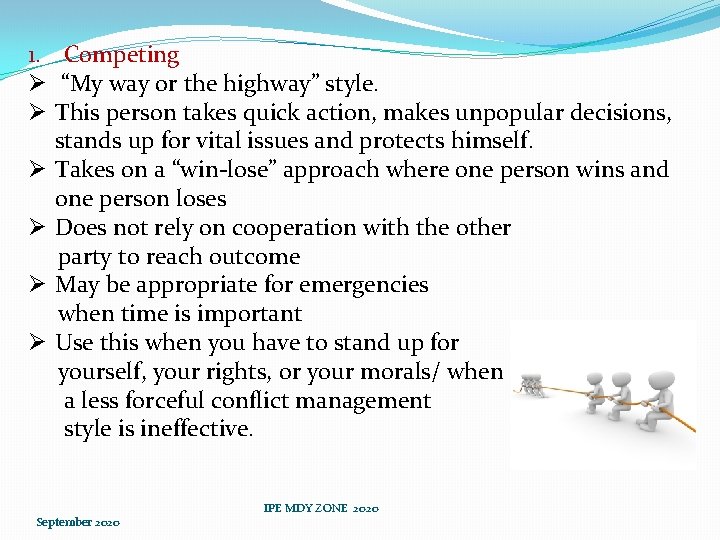
1. Competing Ø “My way or the highway” style. Ø This person takes quick action, makes unpopular decisions, stands up for vital issues and protects himself. Ø Takes on a “win-lose” approach where one person wins and one person loses Ø Does not rely on cooperation with the other party to reach outcome Ø May be appropriate for emergencies when time is important Ø Use this when you have to stand up for yourself, your rights, or your morals/ when a less forceful conflict management style is ineffective. September 2020 IPE MDY ZONE 2020
2. Accommodating Ø Your Way / “It would be my pleasure” approach. Ø This person is reasonable, wants to create goodwill and keep the peace, and tends to retreat if pushed by others. Ø This style can often be seen as weak, but this is not the case. A big part of conflict management is. realizing when elongating the resolution process will only make things worse. Ø Use this when you are wrong/ the issue is more important to the other person/ when there is no point in arguing. September 2020 IPE MDY ZONE 2020
3. Avoiding Ø The “No Way” approach Ø “I’ll think about it tomorrow” strategy. But “Tomorrow never comes”. Ø This type wants to avoid tension, and so is adept at sidestepping issues or buying time before making decisions Ø Use this when the conflict is meaningless/ you don’t have the time to manage the conflict/you aren’t sure how you feel about the issue yet. May be a wise response for the moment …. [ Don’t promise when you are happy, don’t reply when you are angry, and don’t decide when you are sad]. . but follow it up at an appropriate time. September 2020 IPE MDY ZONE 2020
3. Collaborating Ø “Two heads are better than one” methodology. Ø This type is skilled at relationship-building, merging different perspectives and winning commitment from others. Ø Win-Win solution Ø Use this when the relationship is important/ the final solution will have a significant impact/ interests, needs, and beliefs of all involved people need to be considered. September 2020 IPE MDY ZONE 2020
5. Compromising Ø “Let’s make a deal” approach. Ø “You win some, you lose some” approach. Ø This type is good at finding temporary solutions to a conflict, especially when dealing with time constraints, even if the solution is not ideal. Ø Use it when reaching a solution is more important than the solution itself/ you need a temporary solution/you are at a standstill. September 2020 IPE MDY ZONE 2020
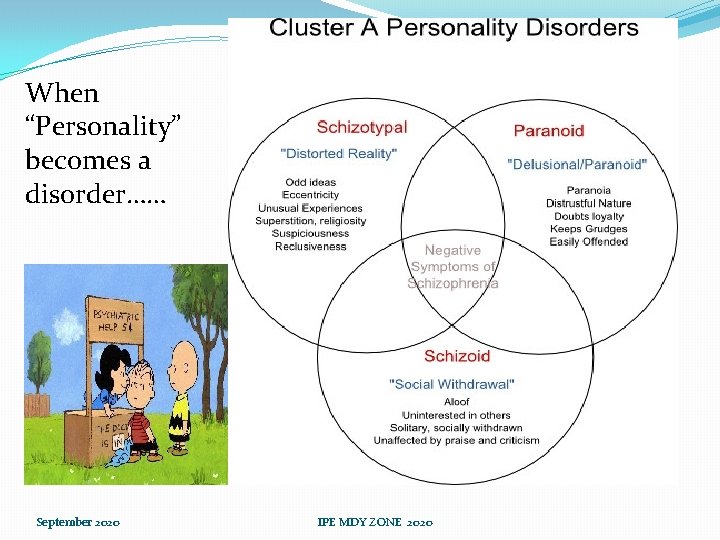
When “Personality” becomes a disorder…… September 2020 IPE MDY ZONE 2020
September 2020 IPE MDY ZONE 2020
- Slides: 28