
IPDET Module 9 Choosing the Sampling Strategy Introduction


- Slides: 29
IPDET Module 9: Choosing the Sampling Strategy
Introduction • Introduction to Sampling • Types of Samples: Random and Nonrandom • Determining the Sample Size IPDET © 2009 2
Sampling • Is it possible to collect data from the entire population? (census) – If so, we can talk about what is true for the entire population – Often we cannot (time/cost) – If not, we can use a smaller subset: a SAMPLE IPDET © 2009 3
Concepts • Population – the total set of units • Census – collection of data from an entire population • Sample – a subset of the population • Sampling Frame – list from which to select your sample IPDET © 2009 4
More Sampling Concepts • Sample Design – methods of sampling (probability or nonprobability) • Parameter – characteristic of the population • Statistic – characteristic of a sample IPDET © 2009 5
Random Sampling • Lottery, each unit has a equal chance of being selected • Can make estimates about the larger population based on the subset • Advantages: – eliminates selection bias – able to generalize to the population – Often cost-effective IPDET © 2009 6
Types of Random Sampling • • • Simple random sample Random interval sample Random-start and fixed-interval sample Stratified random sample Random cluster sample Multistage random sample IPDET © 2009 7
Simple Random Samples • Most common and simplest • Establish a sample size and proceed to randomly select units until we reach the sample size • Uses a random number table to select units IPDET © 2009 8
Random Interval Samples • Use when there is a sequential population that is not already enumerated and would be difficult or time consuming to enumerate • Uses a random number table to select intervals IPDET © 2009 9
Random-Start and Fixed. Interval Samples • Starting point is random, but the interval is NOT random • Systematic sampling, starting from a random place and then selecting every nth case IPDET © 2009 10
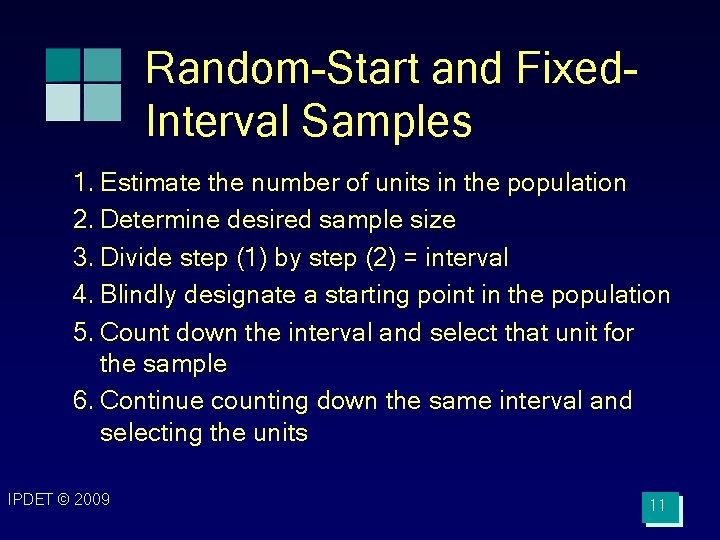
Random-Start and Fixed. Interval Samples 1. Estimate the number of units in the population 2. Determine desired sample size 3. Divide step (1) by step (2) = interval 4. Blindly designate a starting point in the population 5. Count down the interval and select that unit for the sample 6. Continue counting down the same interval and selecting the units IPDET © 2009 11
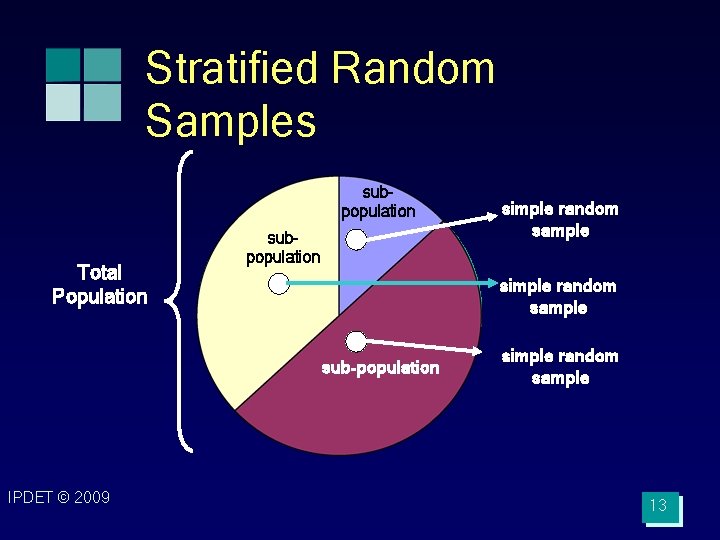
Stratified Random Samples • Use when specific groups must be included that might otherwise be missed by using a simple random sample – usually a small proportion of the population IPDET © 2009 12
Stratified Random Samples subpopulation Total Population subpopulation simple random sample sub-population IPDET © 2009 simple random sample 13
Random Cluster Samples • Another form of random sampling • Any naturally occurring aggregate of the units that are to be sampled that can be used when: – you do not have a complete list of everyone in the population of interest but have a list of the clusters in which they occur or – you have a complete list of everyone, but they are so widely distributed that it would be too time consuming and expensive to send data collectors out to a simple random sample IPDET © 2009 14
Multistage Random Samples • Combines two or more forms of random sampling • Most commonly, it begins with random cluster sampling and then applies simple random sampling or stratified random sampling IPDET © 2009 15
Drawback of Random Cluster and Multistage Random Sampling • May not yield an accurate representation of the population IPDET © 2009 16
Nonrandom Sampling • Can be more focused • Can help make sure a small sample is representative • Cannot make inferences to a larger population (you cannot generalize if you do not randomize…) IPDET © 2009 17
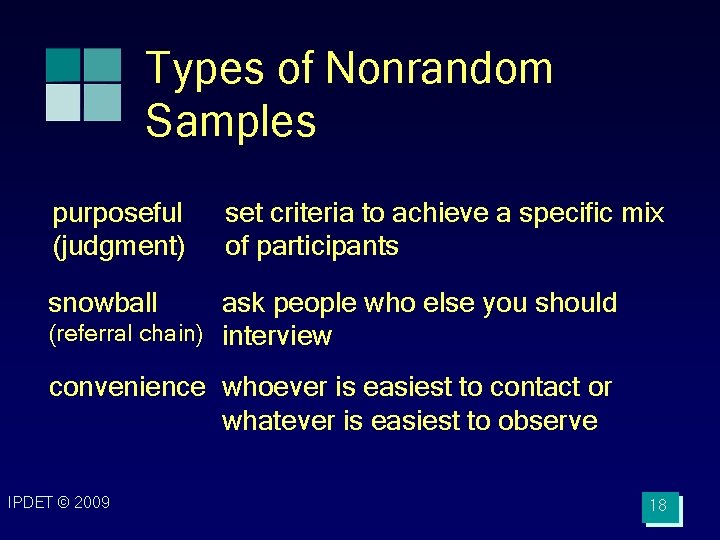
Types of Nonrandom Samples purposeful (judgment) set criteria to achieve a specific mix of participants snowball ask people who else you should (referral chain) interview convenience whoever is easiest to contact or whatever is easiest to observe IPDET © 2009 18
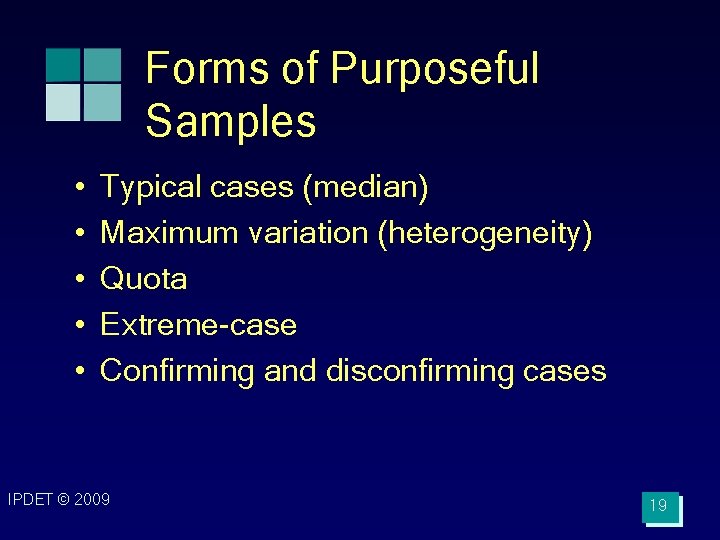
Forms of Purposeful Samples • • • Typical cases (median) Maximum variation (heterogeneity) Quota Extreme-case Confirming and disconfirming cases IPDET © 2009 19
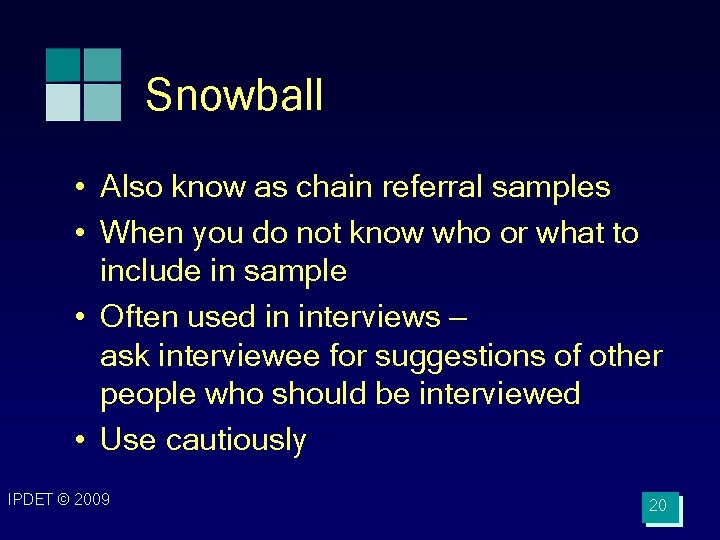
Snowball • Also know as chain referral samples • When you do not know who or what to include in sample • Often used in interviews — ask interviewee for suggestions of other people who should be interviewed • Use cautiously IPDET © 2009 20
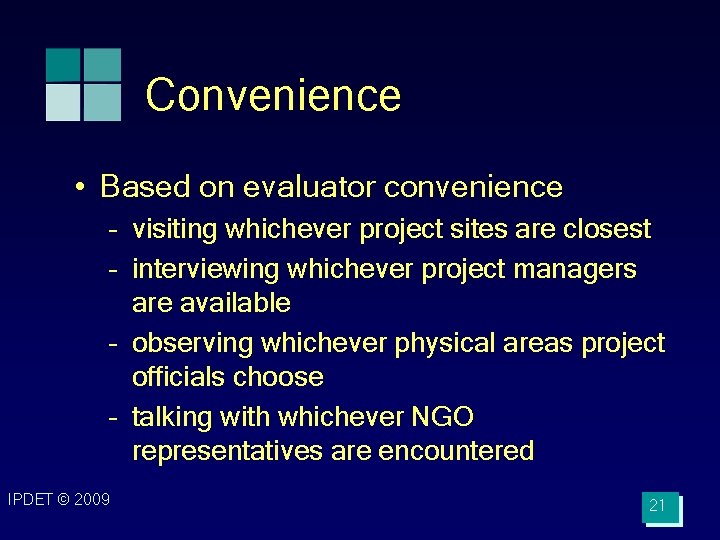
Convenience • Based on evaluator convenience – visiting whichever project sites are closest – interviewing whichever project managers are available – observing whichever physical areas project officials choose – talking with whichever NGO representatives are encountered IPDET © 2009 21
Shortcomings of Nonrandom Sampling • Can be subject to all types of bias • Are they substantially different from the rest of the population? – collect some data to show that the people selected are fairly similar to the larger population (e. g. demographics) IPDET © 2009 22
Combined Sampling Strategies • Example: – Nonrandomly select two schools from poorest communities and two from the wealthiest communities – Select a random sample of students from these four schools IPDET © 2009 23
Determining the Sample Size • Statistics are used to estimate the probability that the sample results are representative of the population as a whole • Evaluators must choose how confident they need to be IPDET © 2009 24
Confidence Level • Generally use 95% confidence level – 95 times out of 100, sample results will accurately reflect the population as a whole • The higher confidence level, the larger sample needed IPDET © 2009 25
Sample Size and Population • By increasing sample size, you increase accuracy and decrease margin of error • The smaller the population, the larger the needed ratio of the sample size to the population size • Aim for is a 95% confidence level and a ± 5% confidence level IPDET © 2009 26
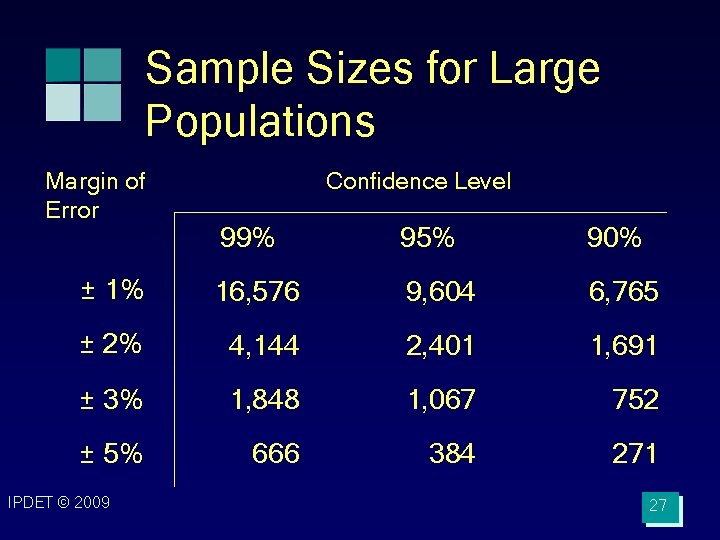
Sample Sizes for Large Populations Margin of Error Confidence Level 99% 95% 90% ± 1% 16, 576 9, 604 6, 765 ± 2% 4, 144 2, 401 1, 691 ± 3% 1, 848 1, 067 752 ± 5% 666 384 271 IPDET © 2009 27
Summary of Sampling Size Issues • Accuracy and precision can be improved by increasing the sample size • The standard to aim for is a 95% confidence level and a margin of error of +/- 5% • The larger the margin of error, the less precise the results will be • The smaller the population, the larger the needed ratio of the sample size to the population size IPDET © 2009 28
A Final Note…. “The world will not stop and think − it never does, it is not its way; its way is to generalize from a single sample” -- Mark Twain Questions? IPDET © 2009 29