
IPDET Module 8 Selecting and Constructing Data Collection



- Slides: 59
IPDET Module 8: Selecting and Constructing Data Collection Instruments
Introduction • • Data Collection Strategies Characteristics of Good Measures Quantitative and Qualitative Data Tools for Collecting Data IPDET © 2009 2
Data Collection Strategies • No one best way: decision depends on: – – – IPDET © 2009 What you need to know: numbers or stories Where the data reside: environment, files, people Resources and time available Complexity of the data to be collected Frequency of data collection Intended forms of data analysis 3
Rules for Collecting Data • Use multiple data collection methods • Use available data, but need to know – – IPDET © 2009 how the measures were defined how the data were collected and cleaned the extent of missing data how accuracy of the data was ensured 4
Rules for Collecting Data • If must collect original data: – be sensitive to burden on others – pre-test, pre-test – establish procedures and follow them (protocol) – maintain accurate records of definitions and coding – verify accuracy of coding, data input IPDET © 2009 5
Structured Approach • All data collected in the same way • Especially important for multi-site and cluster evaluations so you can compare • Important when you need to make comparisons with alternate interventions IPDET © 2009 6
Use Structured Approach When: • • • need to address extent questions have a large sample or population know what needs to be measured need to show results numerically need to make comparisons across different sites or interventions IPDET © 2009 7
Semi-structured Approach • Systematic and follow general procedures but data are not collected in exactly the same way every time • More open and fluid • Does not follow a rigid script – may ask for more detail – people can tell what they want in their own way IPDET © 2009 8
Use Semi-structured Approach when: • conducting exploratory work • seeking understanding, themes, and/or issues • need narratives or stories • want in-depth, rich, “backstage” information • seek to understand results of data that are unexpected IPDET © 2009 9
Characteristics of Good Measures • • Is the measure relevant? Is the measure credible? Is the measure valid? Is the measure reliable? IPDET © 2009 10
Relevance Does the measure capture what matters? IPDET © 2009 Do not measure what is easy instead of what is needed 11
Credibility Is the measure believable? Will it be viewed as a reasonable and appropriate way to capture the information sought? IPDET © 2009 12
Internal Validity How well does the measure capture what it is supposed to? IPDET © 2009 Are waiting lists a valid measure of demand? 13
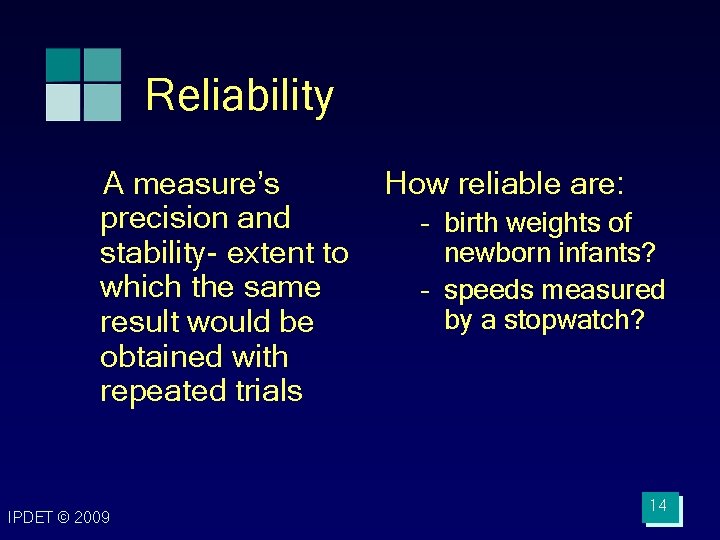
Reliability A measure’s precision and stability- extent to which the same result would be obtained with repeated trials IPDET © 2009 How reliable are: – birth weights of newborn infants? – speeds measured by a stopwatch? 14
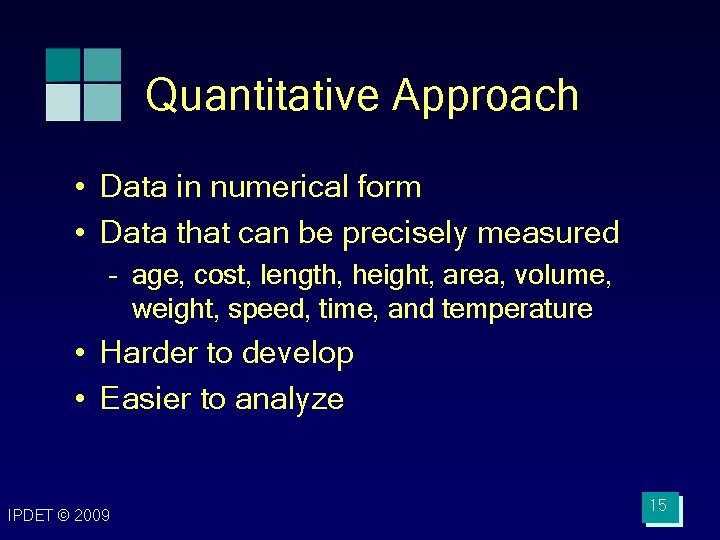
Quantitative Approach • Data in numerical form • Data that can be precisely measured – age, cost, length, height, area, volume, weight, speed, time, and temperature • Harder to develop • Easier to analyze IPDET © 2009 15
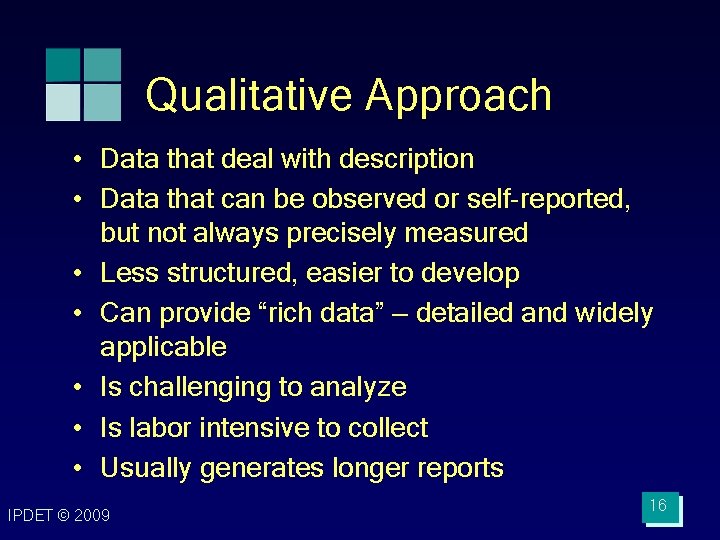
Qualitative Approach • Data that deal with description • Data that can be observed or self-reported, but not always precisely measured • Less structured, easier to develop • Can provide “rich data” — detailed and widely applicable • Is challenging to analyze • Is labor intensive to collect • Usually generates longer reports IPDET © 2009 16
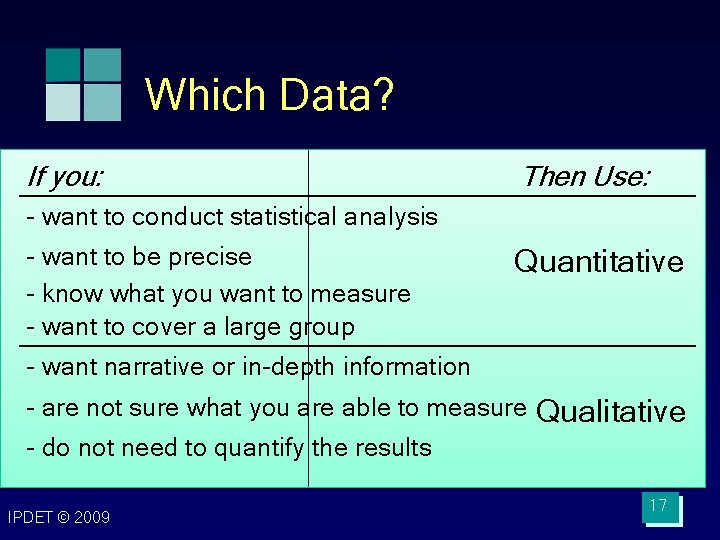
Which Data? If you: Then Use: - want to conduct statistical analysis - want to be precise - know what you want to measure - want to cover a large group Quantitative - want narrative or in-depth information - are not sure what you are able to measure Qualitative - do not need to quantify the results IPDET © 2009 17
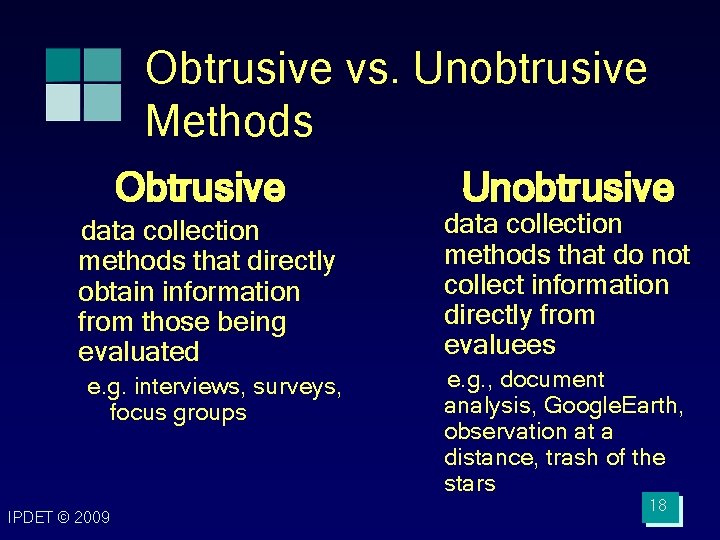
Obtrusive vs. Unobtrusive Methods Obtrusive data collection methods that directly obtain information from those being evaluated e. g. interviews, surveys, focus groups IPDET © 2009 Unobtrusive data collection methods that do not collect information directly from evaluees e. g. , document analysis, Google. Earth, observation at a distance, trash of the stars 18
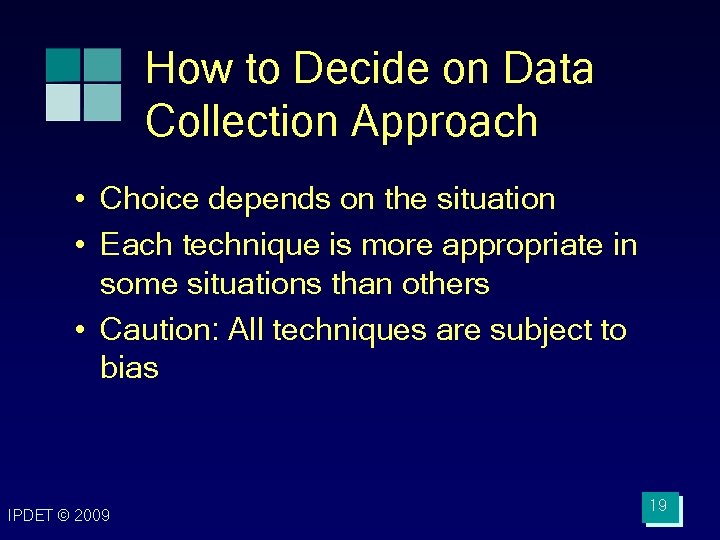
How to Decide on Data Collection Approach • Choice depends on the situation • Each technique is more appropriate in some situations than others • Caution: All techniques are subject to bias IPDET © 2009 19
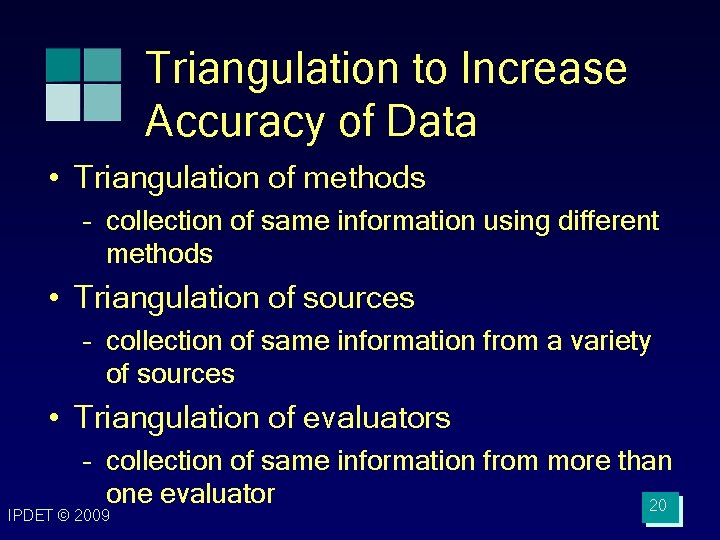
Triangulation to Increase Accuracy of Data • Triangulation of methods – collection of same information using different methods • Triangulation of sources – collection of same information from a variety of sources • Triangulation of evaluators – collection of same information from more than one evaluator 20 IPDET © 2009
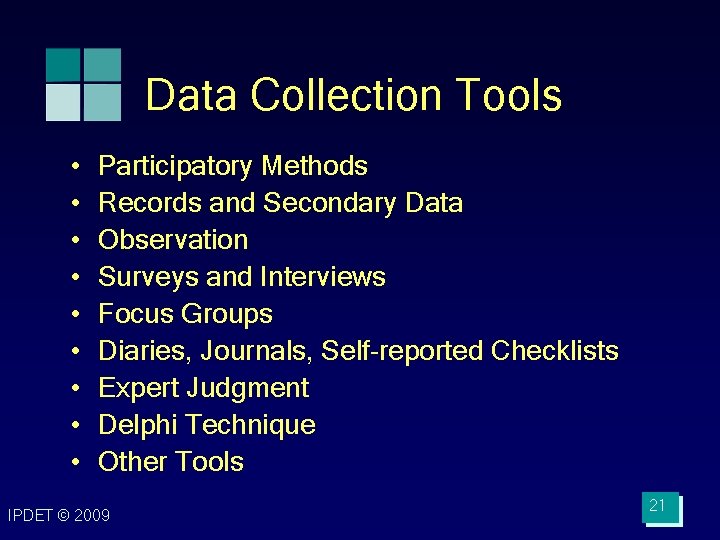
Data Collection Tools • • • Participatory Methods Records and Secondary Data Observation Surveys and Interviews Focus Groups Diaries, Journals, Self-reported Checklists Expert Judgment Delphi Technique Other Tools IPDET © 2009 21
Tool 1: Participatory Methods • Involve groups or communities heavily in data collection • Examples: – community meetings – mapping – transect walks IPDET © 2009 22
Community Meetings • One of the most common participatory methods • Must be well organized – agree on purpose – establish ground rules • who will speak • time allotted for speakers • format for questions and answers IPDET © 2009 23
Mapping • Drawing or using existing maps • Useful tool to involve stakeholders – increases understanding of the community – generates discussions, verifies secondary sources of information, perceived changes • Types of mapping: – natural resources, social, health, individual or civic assets, wealth, land use, demographics IPDET © 2009 24
Transect Walks • Evaluator walks around community observing people, surroundings, and resources • Need good observation skills • Walk a transect line through a map of a community — line should go through all zones of the community IPDET © 2009 25
Tool 2: Records and Secondary Data • Examples of sources: – – – – files/records computer data bases industry or government reports other reports or prior evaluations census data and household survey data electronic mailing lists and discussion groups documents (budgets, organizational charts, policies and procedures, maps, monitoring reports) – newspapers and television reports IPDET © 2009 26
Using Existing Data Sets Key issues: validity, reliability, accuracy, response rates, data dictionaries, and missing data rates IPDET © 2009 27
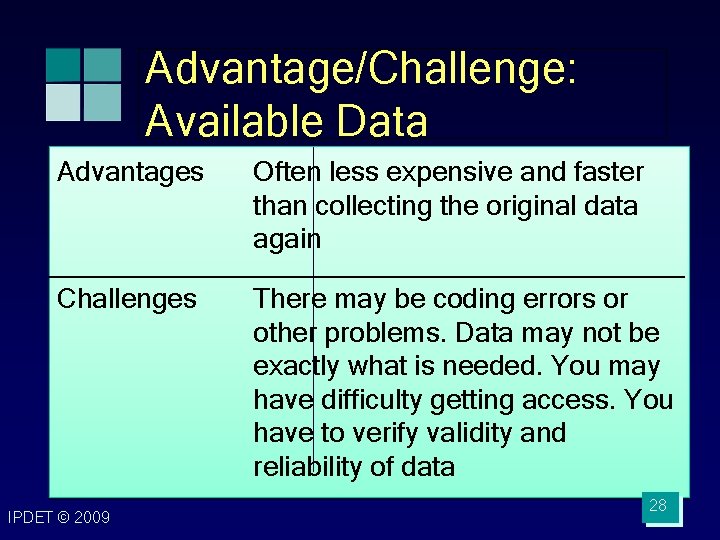
Advantage/Challenge: Available Data Advantages Often less expensive and faster than collecting the original data again Challenges There may be coding errors or other problems. Data may not be exactly what is needed. You may have difficulty getting access. You have to verify validity and reliability of data IPDET © 2009 28
Tool 3: Observation • See what is happening – – – – IPDET © 2009 traffic patterns land use patterns layout of city and rural areas quality of housing condition of roads conditions of buildings who goes to a health clinic 29
Observation is Helpful when: • need direct information • trying to understand ongoing behavior • there is physical evidence, products, or outputs than can be observed • need to provide alternative when other data collection is infeasible or inappropriate IPDET © 2009 30
Degree of Structure of Observations • Structured: determine, before the observation, precisely what will be observed before the observation • Unstructured: select the method depending upon the situation with no pre-conceived ideas or a plan on what to observe • Semi-structured: a general idea of what to observe but no specific plan IPDET © 2009 31
Google Earth • Maps and satellite images for complex or pinpointed regional searches • Has an Advanced version and an Earth Outreach version • Web site for Google Earth – http: //earth. google. com/ IPDET © 2009 32
Ways to Record Information from Observations • Observation guide – printed form with space to record • Recording sheet or checklist – Yes/no options; tallies, rating scales • Field notes – least structured, recorded in narrative, descriptive style IPDET © 2009 33
Guidelines for Planning Observations • Have more than one observer, if feasible • Train observers so they observe the same things • Pilot test the observation data collection instrument • For less structured approach, have a few key questions in mind IPDET © 2009 34
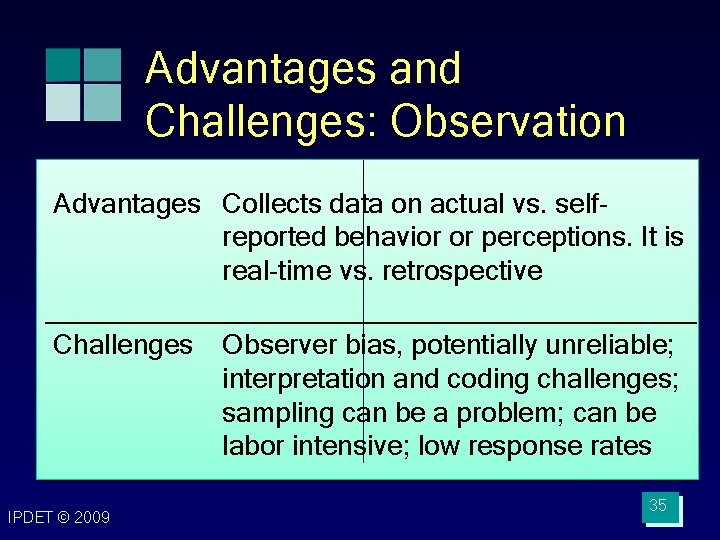
Advantages and Challenges: Observation Advantages Collects data on actual vs. selfreported behavior or perceptions. It is real-time vs. retrospective Challenges IPDET © 2009 Observer bias, potentially unreliable; interpretation and coding challenges; sampling can be a problem; can be labor intensive; low response rates 35
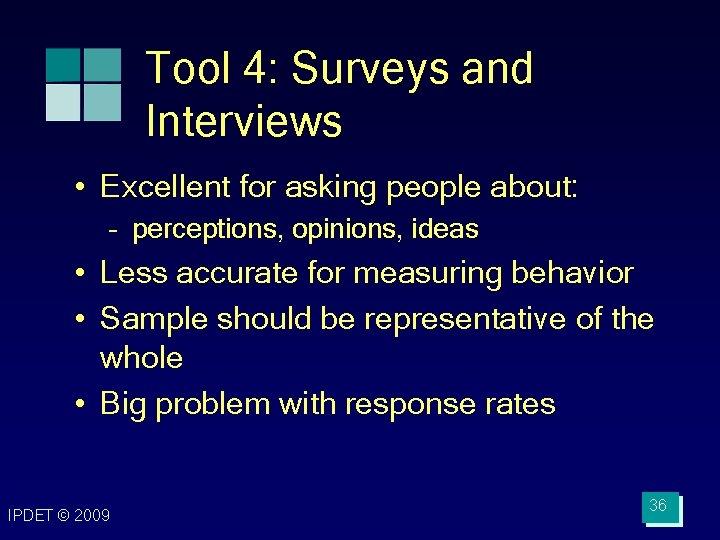
Tool 4: Surveys and Interviews • Excellent for asking people about: – perceptions, opinions, ideas • Less accurate for measuring behavior • Sample should be representative of the whole • Big problem with response rates IPDET © 2009 36
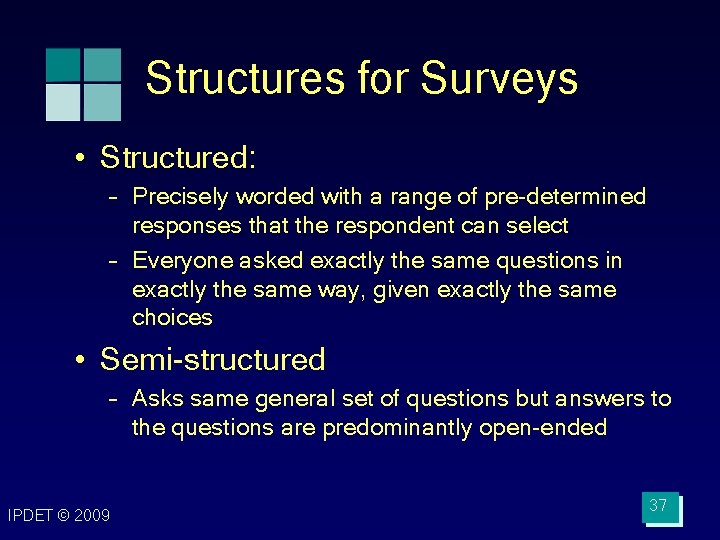
Structures for Surveys • Structured: – Precisely worded with a range of pre-determined responses that the respondent can select – Everyone asked exactly the same questions in exactly the same way, given exactly the same choices • Semi-structured – Asks same general set of questions but answers to the questions are predominantly open-ended IPDET © 2009 37
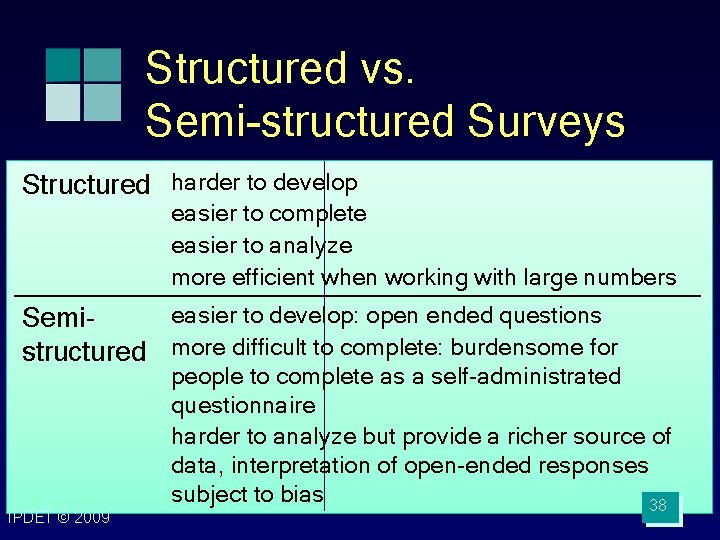
Structured vs. Semi-structured Surveys Structured harder to develop easier to complete easier to analyze more efficient when working with large numbers easier to develop: open ended questions Semistructured more difficult to complete: burdensome for IPDET © 2009 people to complete as a self-administrated questionnaire harder to analyze but provide a richer source of data, interpretation of open-ended responses subject to bias 38
Modes of Survey Administration • Telephone surveys • Self-administered questionnaires distributed by mail, e-mail, or websites • Administered questionnaires, common in the development context • In development context, often issues of language and translation IPDET © 2009 39
Mail / Phone / Internet Surveys • Literacy issues • Consider accessibility – reliability of postal service – turn-around time • Consider bias – What population segment has telephone access? Internet access? IPDET © 2009 40
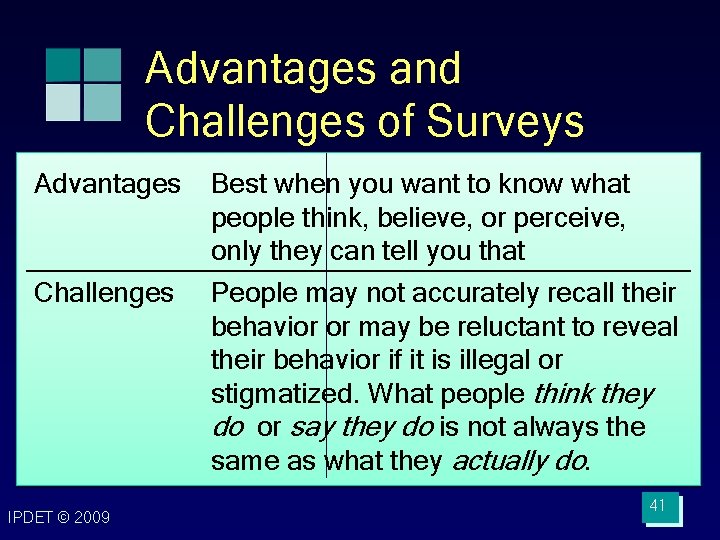
Advantages and Challenges of Surveys Advantages Challenges IPDET © 2009 Best when you want to know what people think, believe, or perceive, only they can tell you that People may not accurately recall their behavior or may be reluctant to reveal their behavior if it is illegal or stigmatized. What people think they do or say they do is not always the same as what they actually do. 41
Interviews • Often semi-structured • Used to explore complex issues in depth • Forgiving of mistakes: unclear questions can be clarified during the interview and changed for subsequent interviews • Can provide evaluators with an intuitive sense of the situation IPDET © 2009 42
Challenges of Interviews • Can be expensive, labor intensive, and time consuming • Selective hearing on the part of the interviewer may miss information that does not conform to pre-existing beliefs • Cultural sensitivity: e. g. , gender issues IPDET © 2009 43
Tool 5: Focus Groups • Type of qualitative research where small homogenous groups of people are brought together to informally discuss specific topics under the guidance of a moderator • Purpose: to identify issues and themes, not just interesting information, and not “counts” IPDET © 2009 44
Focus Groups Are Inappropriate when: • language barriers are insurmountable • evaluator has little control over the situation • trust cannot be established • free expression cannot be ensured • confidentiality cannot be assured IPDET © 2009 45
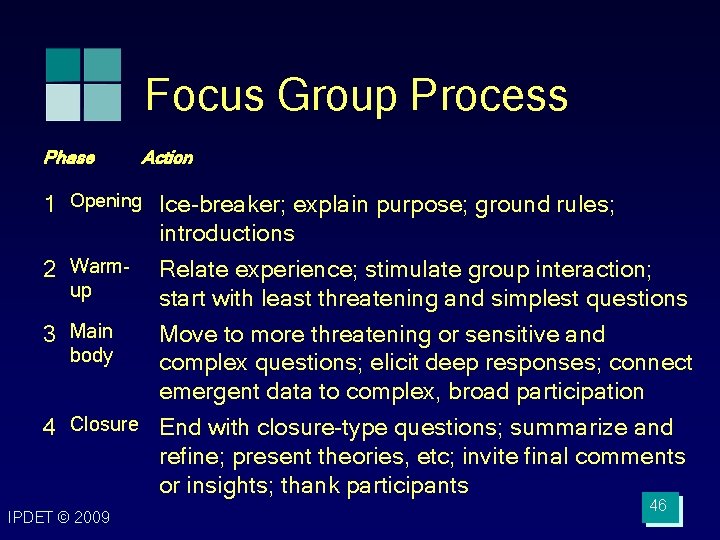
Focus Group Process Phase 1 Action Opening Ice-breaker; explain purpose; ground rules; introductions 2 Warm- Relate experience; stimulate group interaction; start with least threatening and simplest questions 3 Main Move to more threatening or sensitive and complex questions; elicit deep responses; connect emergent data to complex, broad participation up body 4 Closure End with closure-type questions; summarize and refine; present theories, etc; invite final comments or insights; thank participants IPDET © 2009 46
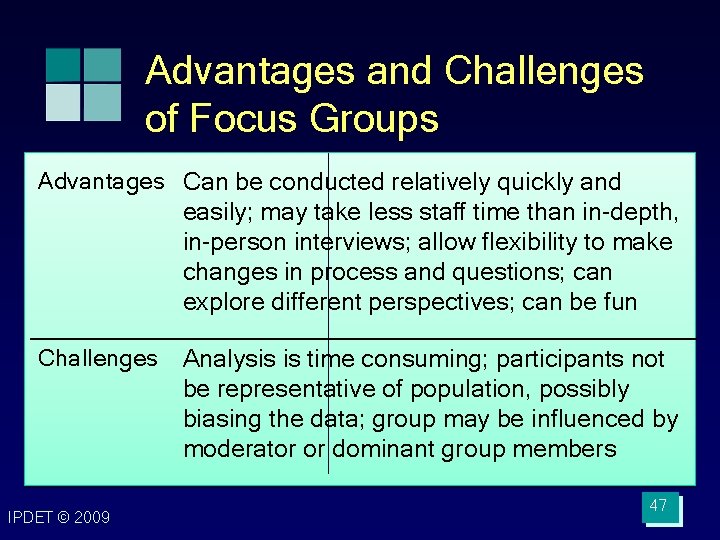
Advantages and Challenges of Focus Groups Advantages Can be conducted relatively quickly and easily; may take less staff time than in-depth, in-person interviews; allow flexibility to make changes in process and questions; can explore different perspectives; can be fun Challenges IPDET © 2009 Analysis is time consuming; participants not be representative of population, possibly biasing the data; group may be influenced by moderator or dominant group members 47
Tool 6: Diaries and Self. Reported Checklists • Use when you want to capture information about events in people’s daily lives • Participants capture experiences in realtime not later in a questionnaire • Used to supplement other data collection IPDET © 2009 48
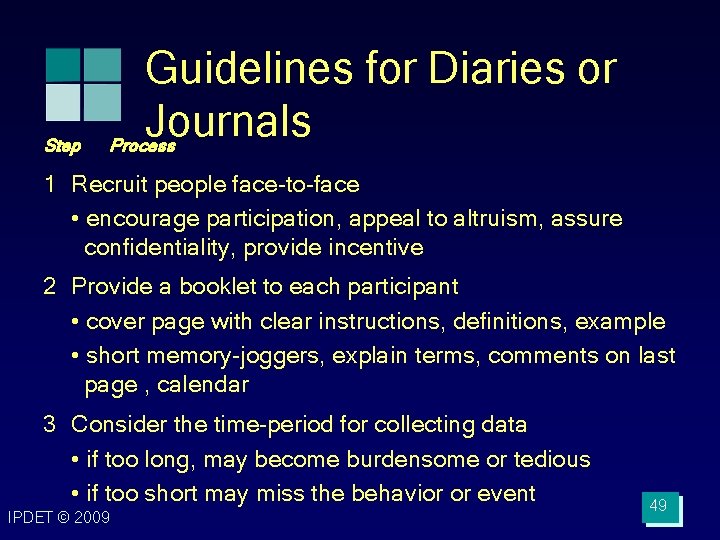
Step Guidelines for Diaries or Journals Process 1 Recruit people face-to-face • encourage participation, appeal to altruism, assure confidentiality, provide incentive 2 Provide a booklet to each participant • cover page with clear instructions, definitions, example • short memory-joggers, explain terms, comments on last page , calendar 3 Consider the time-period for collecting data • if too long, may become burdensome or tedious • if too short may miss the behavior or event IPDET © 2009 49
Self-reported Checklists • Cross between a questionnaire and a diary • The evaluator specifies a list of behaviors or events and asks the respondents to complete the checklist • Done over a period of time to capture the event or behavior • More quantitative approach than diary IPDET © 2009 50
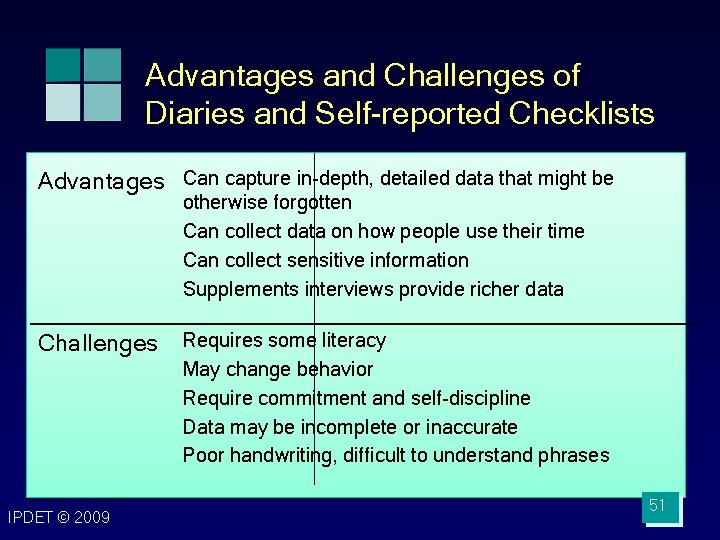
Advantages and Challenges of Diaries and Self-reported Checklists Advantages Can capture in-depth, detailed data that might be otherwise forgotten Can collect data on how people use their time Can collect sensitive information Supplements interviews provide richer data Challenges IPDET © 2009 Requires some literacy May change behavior Require commitment and self-discipline Data may be incomplete or inaccurate Poor handwriting, difficult to understand phrases 51
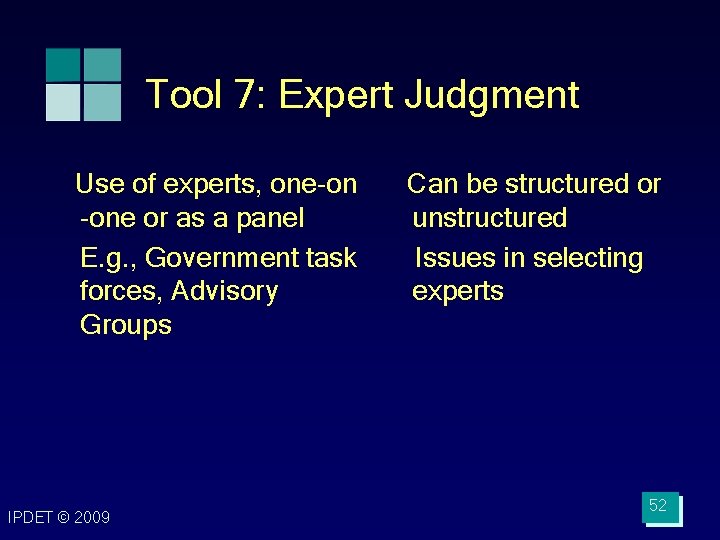
Tool 7: Expert Judgment Use of experts, one-on -one or as a panel E. g. , Government task forces, Advisory Groups IPDET © 2009 Can be structured or unstructured Issues in selecting experts 52
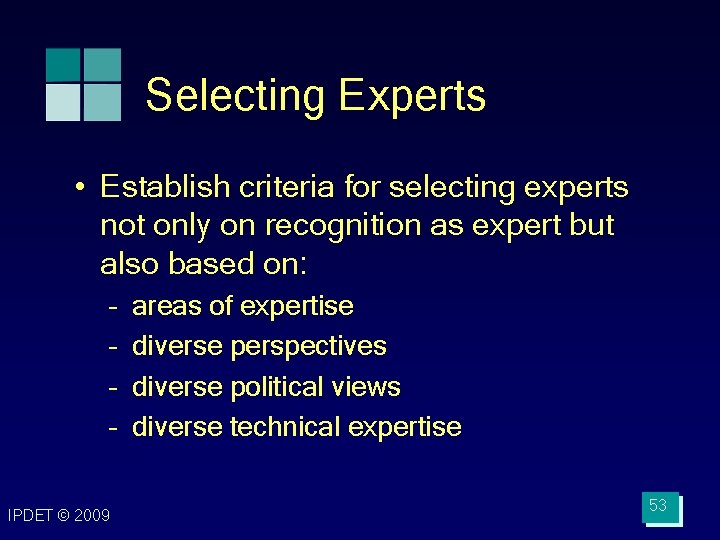
Selecting Experts • Establish criteria for selecting experts not only on recognition as expert but also based on: – – IPDET © 2009 areas of expertise diverse perspectives diverse political views diverse technical expertise 53
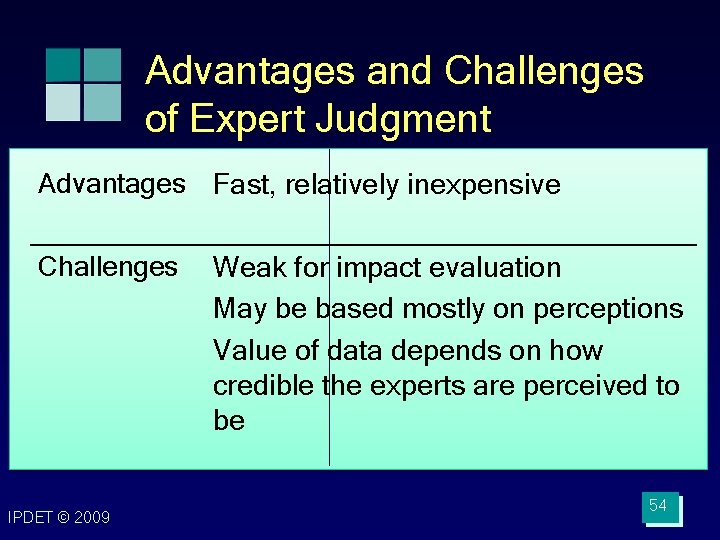
Advantages and Challenges of Expert Judgment Advantages Fast, relatively inexpensive Challenges IPDET © 2009 Weak for impact evaluation May be based mostly on perceptions Value of data depends on how credible the experts are perceived to be 54
Tool 8: Delphi Technique • Enables experts to engage remotely in a dialogue and reach consensus, often about priorities • Experts asked specific questions; often rank choices • Responses go to a central source, are summarized and fed back to the experts without attribution • Experts can agree or argue with others’ comments • Process may be iterative IPDET © 2009 55
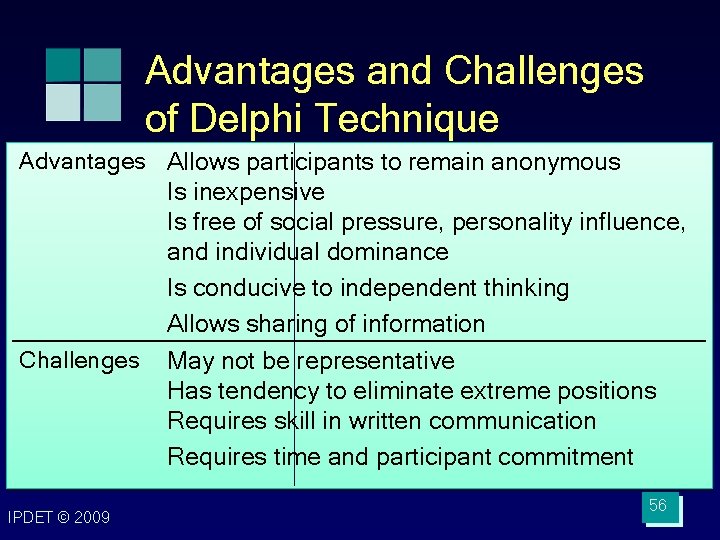
Advantages and Challenges of Delphi Technique Advantages Allows participants to remain anonymous Is inexpensive Is free of social pressure, personality influence, and individual dominance Is conducive to independent thinking Allows sharing of information Challenges IPDET © 2009 May not be representative Has tendency to eliminate extreme positions Requires skill in written communication Requires time and participant commitment 56
Other Measurement Tools - scales (weight) - tape measure - stop watches - chemical tests : i. e. quality of water IPDET © 2009 - health testing tools: i. e. blood pressure - aptitude and achievement tests -citizen report cards 57
Data Collection Summary Choose more than one data collection technique No “best” tool Do not let the tool drive your work but rather choose the right tool to address the evaluation question IPDET © 2009 58
A Final Note…. “I never guess. It is a capital mistake to theorize before one has data. Insensibly one begins to twist facts and theories, instead of theories to suit facts. ” --Sir Arthur Conan Doyle Questions? IPDET © 2009 59