
IPDET Module 6 Developing Evaluation Questions Starting the

- Slides: 35
IPDET Module 6: Developing Evaluation Questions & Starting the Design Matrix
Introduction • • • Sources of Questions Types of Questions Identifying and Selecting Questions Developing Good Evaluation Questions Designing the Evaluation IPDET © 2009 2
Evaluation Questions • Give direction to an evaluation • Reflect key issues • Critical element to help make decisions IPDET © 2009 3
Sources of Questions • Findings from prior evaluations of this intervention • Findings from prior evaluations of similar interventions • Assumptions and contextual factors identified in developing theory of change • Clients and stakeholders concerns and issues • Professional standards, checklists, guidelines • Views and knowledge of expert consultants • The evaluator’s own professional judgment IPDET © 2009 4
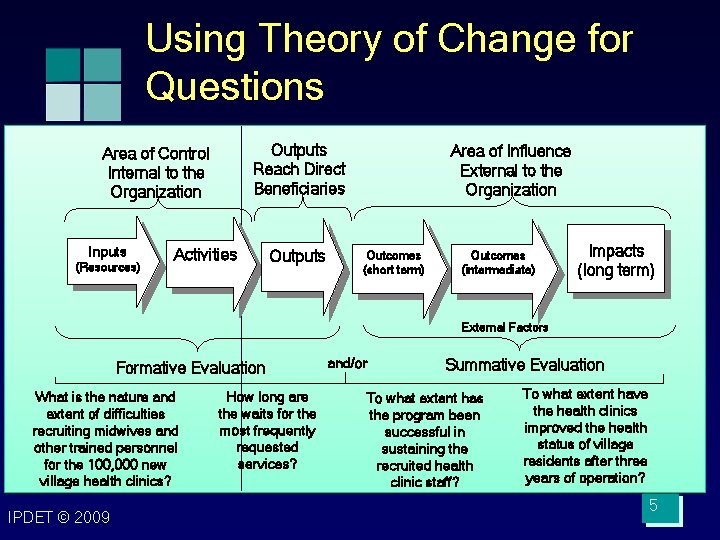
Using Theory of Change for Questions Outputs Reach Direct Beneficiaries Area of Control Internal to the Organization Inputs (Resources) Activities Outputs Area of Influence External to the Organization Outcomes (short term) Outcomes (intermediate) Impacts (long term) External Factors Formative Evaluation What is the nature and extent of difficulties recruiting midwives and other trained personnel for the 100, 000 new village health clinics? IPDET © 2009 How long are the waits for the most frequently requested services? and/or Summative Evaluation To what extent has the program been successful in sustaining the recruited health clinic staff? To what extent have the health clinics improved the health status of village residents after three years of operation? 5
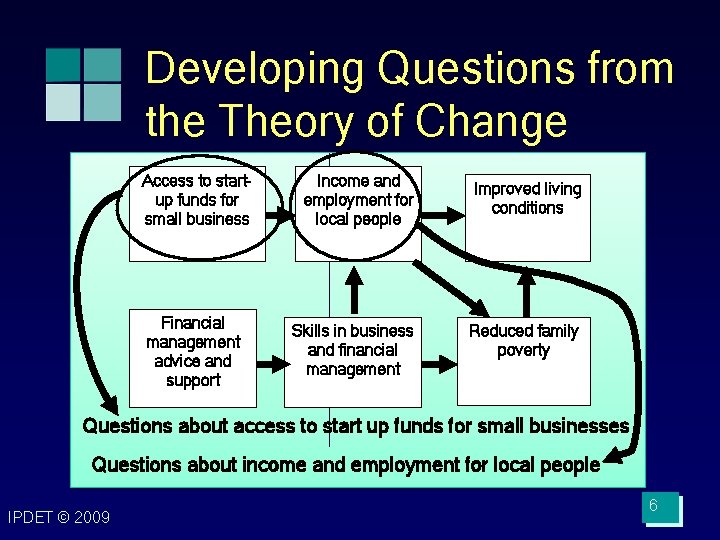
Developing Questions from the Theory of Change Access to startup funds for small business Financial management advice and support Income and employment for local people Improved living conditions Skills in business and financial management Reduced family poverty Questions about access to start up funds for small businesses Questions about income and employment for local people IPDET © 2009 6
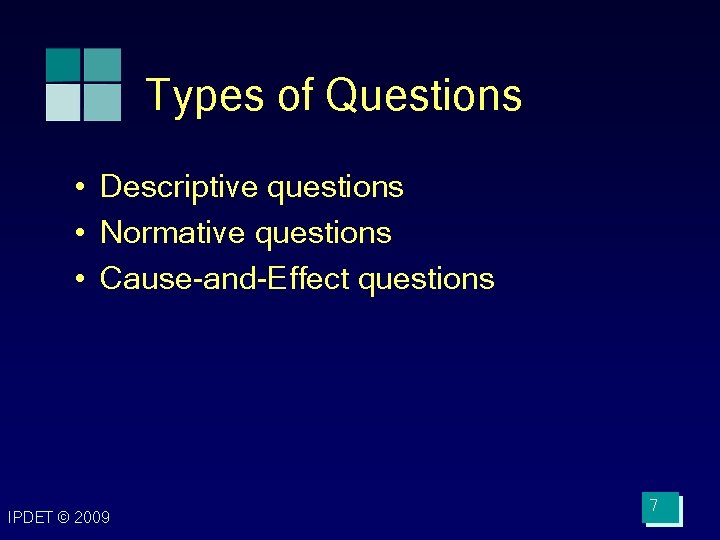
Types of Questions • Descriptive questions • Normative questions • Cause-and-Effect questions IPDET © 2009 7
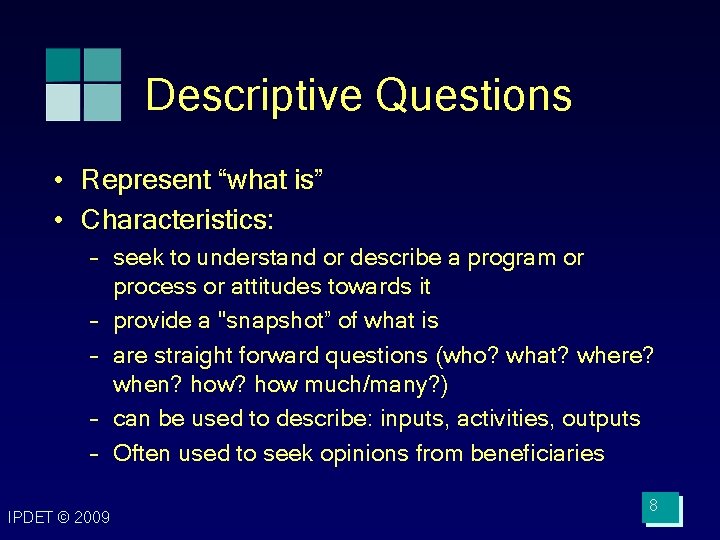
Descriptive Questions • Represent “what is” • Characteristics: – seek to understand or describe a program or process or attitudes towards it – provide a "snapshot” of what is – are straight forward questions (who? what? where? when? how much/many? ) – can be used to describe: inputs, activities, outputs – Often used to seek opinions from beneficiaries IPDET © 2009 8
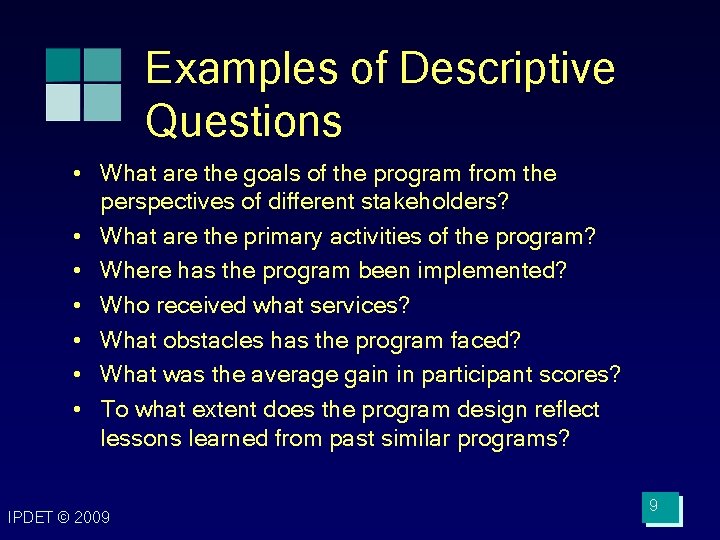
Examples of Descriptive Questions • What are the goals of the program from the perspectives of different stakeholders? • What are the primary activities of the program? • Where has the program been implemented? • Who received what services? • What obstacles has the program faced? • What was the average gain in participant scores? • To what extent does the program design reflect lessons learned from past similar programs? IPDET © 2009 9
More Examples • To what extent are there systematic differences across sites in how the program has been implemented? • What are the qualifications of service providers? • When was the program fully implemented? • What proportion of women participated in the program? • How does the cost of the program compare with the costs of similar programs? • What are the informal communication channels inside the organization? • How useful did participants find the program? IPDET © 2009 10
Important Note 1 Questions about the proportion of clients who find the program useful or the proportion that like the training are still descriptive questions* * Unless there is an established norm or standard IPDET © 2009 11
Important Note 2 Questions about gains or changes over a period of time– whether concerning crop production, traffic flows, trade patterns, test scores, attitudes or behaviors- are descriptive questions* *When no attribution is being sought IPDET © 2009 12
Normative Questions • Compare “what is” to “what should be” • Similar to questions asked in performance auditing • Measuring against previously established criteria IPDET © 2009 13
Standards for Normative Questions • Often found in program authorizing documents • May be indicators with specific targets in monitoring systems • May come from accreditation systems, blue-ribbon panels, professional organizations IPDET © 2009 14
Examples of Normative Questions • Did we spend as much as we had budgeted? • Was the budget spent efficiently? • Were 80% of the nation’s children vaccinated as set as a target? • Did we meet the objective of draining 100, 000 hectares of land? • Was the process for selecting participants fair and equitable? • To what extent does the program reflect principles of gender equity? IPDET © 2009 15
If there are no standards, can the evaluator set them? IPDET © 2009 16
Cause and Effect Questions • Seek to determine what difference the intervention makes • Ask whether the desired results have been achieved AND whether it is the intervention that has caused the results • Imply before & after and with & without comparisons • Impact evaluations focus on cause & effect questions IPDET © 2009 17
Examples of Cause and Effect Questions • Did the three-country partnership strategy preserve the biodiversity of the affected area while sustaining livelihoods? • As a result of the job training program, do participants have higher paying jobs than they otherwise would have? • Did the microenterprise program reduce the poverty rates in the townships in which they operated? • Did the increased tax on gasoline improve air quality? • Did the government increase in financial penalties for violating firms reduce the use of under-age children in the garment industry? IPDET © 2009 18
To Determine Cause: • • Theory of change Time order Co-variation Elimination of rival explanations IPDET © 2009 19
Identifying and Selecting Questions • Two phases: – divergent phase: develop a comprehensive list of questions – convergent phase: narrow down the list IPDET © 2009 20
Divergent Phase • Generate questions • Examine the questions • Organize the questions – classify each question as it fits into the main study issues or other organizer IPDET © 2009 21
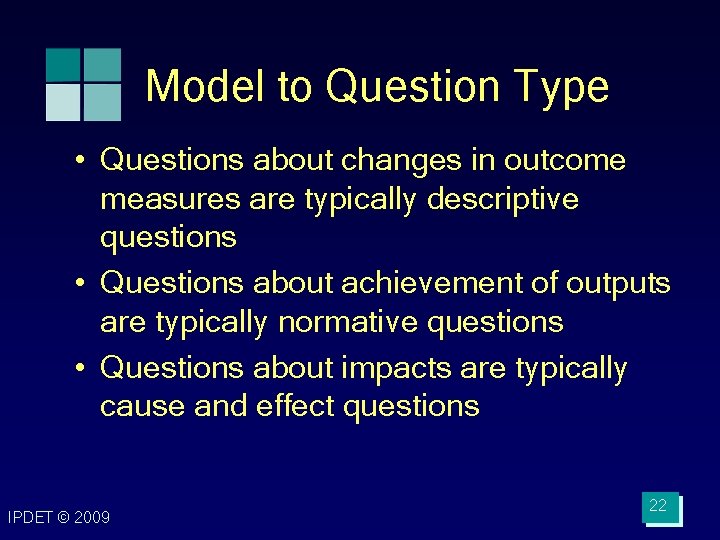
Model to Question Type • Questions about changes in outcome measures are typically descriptive questions • Questions about achievement of outputs are typically normative questions • Questions about impacts are typically cause and effect questions IPDET © 2009 22
Convergent Phase • Be selective in identifying the study questions • Eliminate interesting but not essential questions IPDET © 2009 23
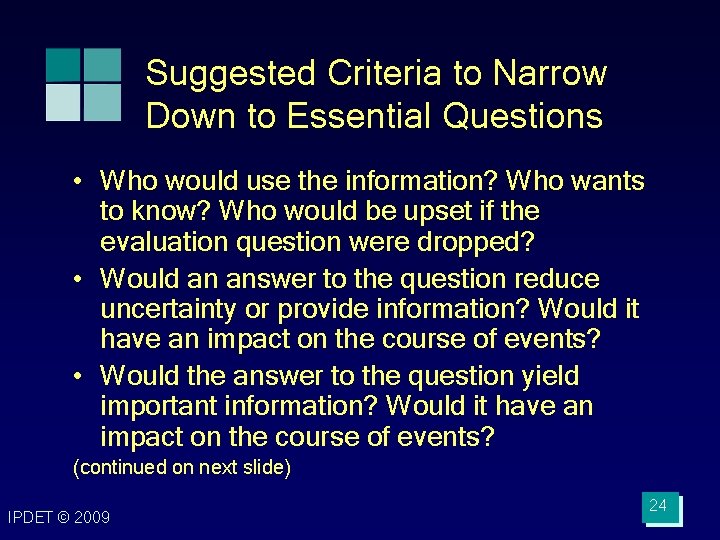
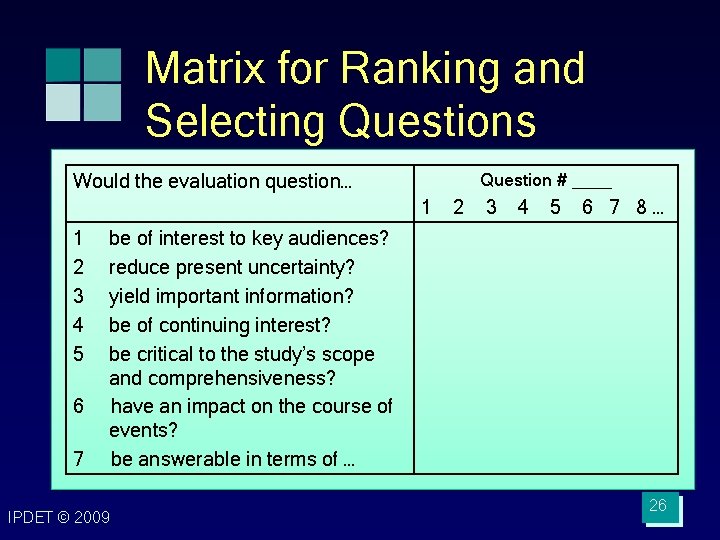
Suggested Criteria to Narrow Down to Essential Questions • Who would use the information? Who wants to know? Who would be upset if the evaluation question were dropped? • Would an answer to the question reduce uncertainty or provide information? Would it have an impact on the course of events? • Would the answer to the question yield important information? Would it have an impact on the course of events? (continued on next slide) IPDET © 2009 24
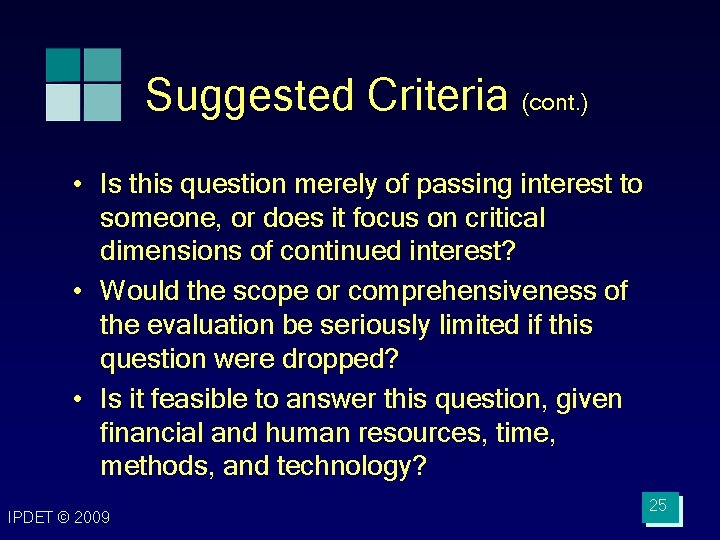
Suggested Criteria (cont. ) • Is this question merely of passing interest to someone, or does it focus on critical dimensions of continued interest? • Would the scope or comprehensiveness of the evaluation be seriously limited if this question were dropped? • Is it feasible to answer this question, given financial and human resources, time, methods, and technology? IPDET © 2009 25
Matrix for Ranking and Selecting Questions Question # ____ Would the evaluation question… 1 1 2 3 4 5 6 7 8… be of interest to key audiences? reduce present uncertainty? yield important information? be of continuing interest? be critical to the study’s scope and comprehensiveness? have an impact on the course of events? be answerable in terms of … IPDET © 2009 26
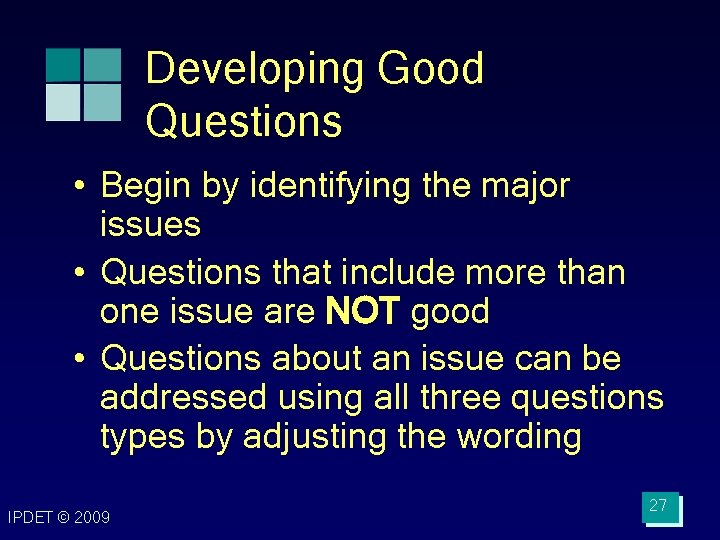
Developing Good Questions • Begin by identifying the major issues • Questions that include more than one issue are NOT good • Questions about an issue can be addressed using all three questions types by adjusting the wording IPDET © 2009 27
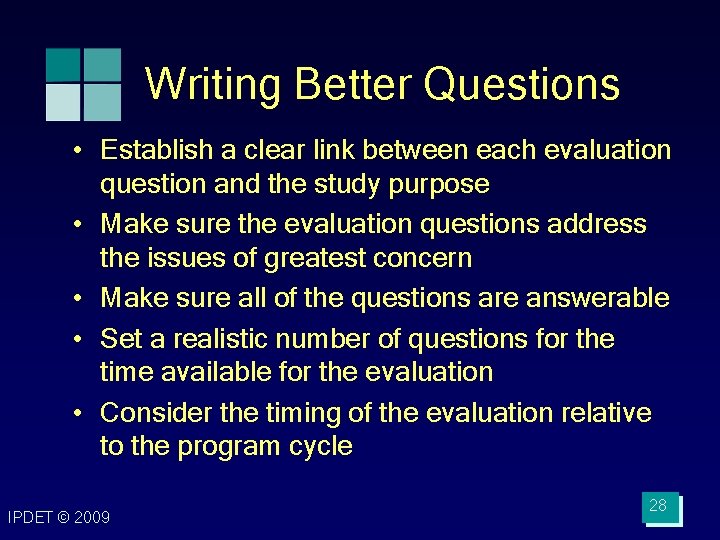
Writing Better Questions • Establish a clear link between each evaluation question and the study purpose • Make sure the evaluation questions address the issues of greatest concern • Make sure all of the questions are answerable • Set a realistic number of questions for the time available for the evaluation • Consider the timing of the evaluation relative to the program cycle IPDET © 2009 28
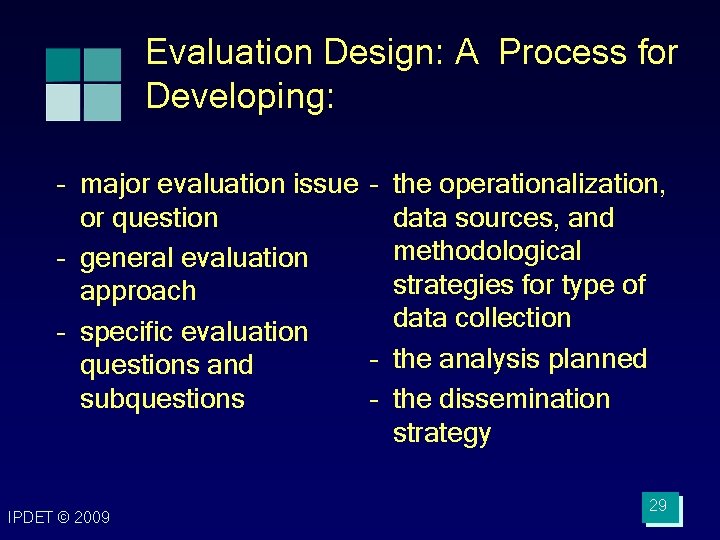
Evaluation Design: A Process for Developing: – major evaluation issue – the operationalization, or question data sources, and methodological – general evaluation strategies for type of approach data collection – specific evaluation – the analysis planned questions and subquestions – the dissemination strategy IPDET © 2009 29
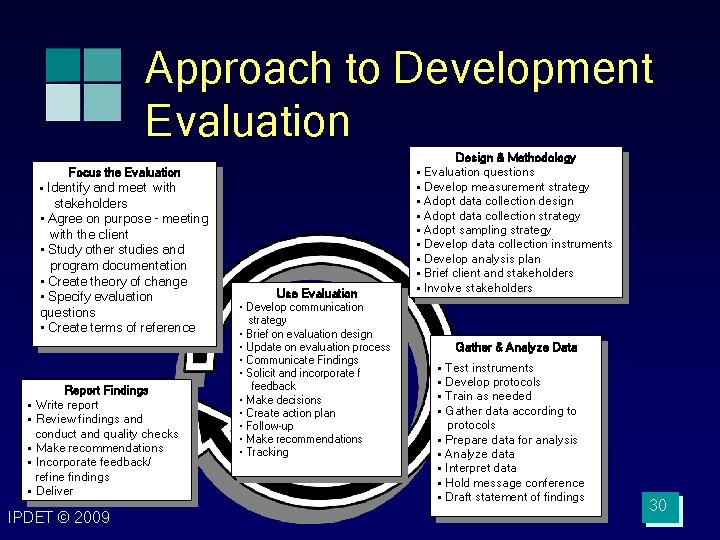
Approach to Development Evaluation Focus the Evaluation ▪ Identify and meet with stakeholders ▪ Agree on purpose – meeting with the client ▪ Study other studies and program documentation ▪ Create theory of change ▪ Specify evaluation questions ▪ Create terms of reference Report Findings ▪ Write report ▪ Review findings and conduct and quality checks ▪ Make recommendations ▪ Incorporate feedback/ refine findings ▪ Deliver IPDET © 2009 Use Evaluation ▪ Develop communication strategy ▪ Brief on evaluation design ▪ Update on evaluation process ▪ Communicate Findings ▪ Solicit and incorporate f feedback ▪ Make decisions ▪ Create action plan ▪ Follow-up ▪ Make recommendations ▪ Tracking Design & Methodology ▪ Evaluation questions ▪ Develop measurement strategy ▪ Adopt data collection design ▪ Adopt data collection strategy ▪ Adopt sampling strategy ▪ Develop data collection instruments ▪ Develop analysis plan ▪ Brief client and stakeholders ▪ Involve stakeholders Gather & Analyze Data ▪ Test instruments ▪ Develop protocols ▪ Train as needed ▪ Gather data according to protocols ▪ Prepare data for analysis ▪ Analyze data ▪ Interpret data ▪ Hold message conference ▪ Draft statement of findings 30
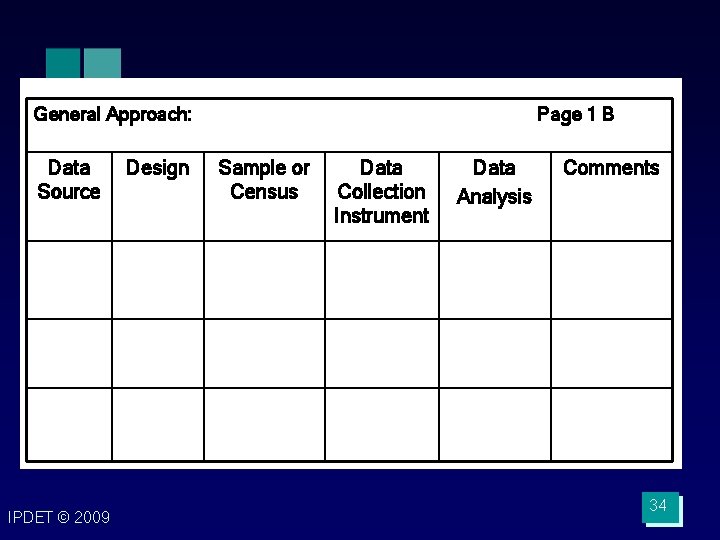
Design Matrix • An organizing tool to help plan an evaluation • Organizes questions and the plans for collecting information to answer questions IPDET © 2009 31
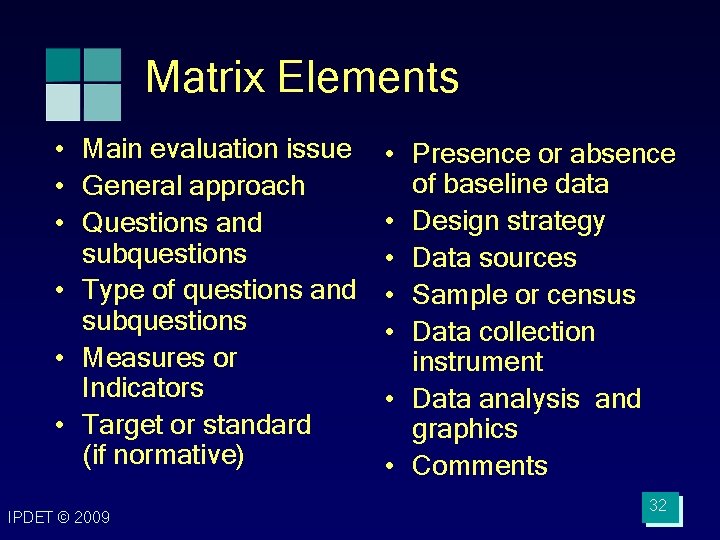
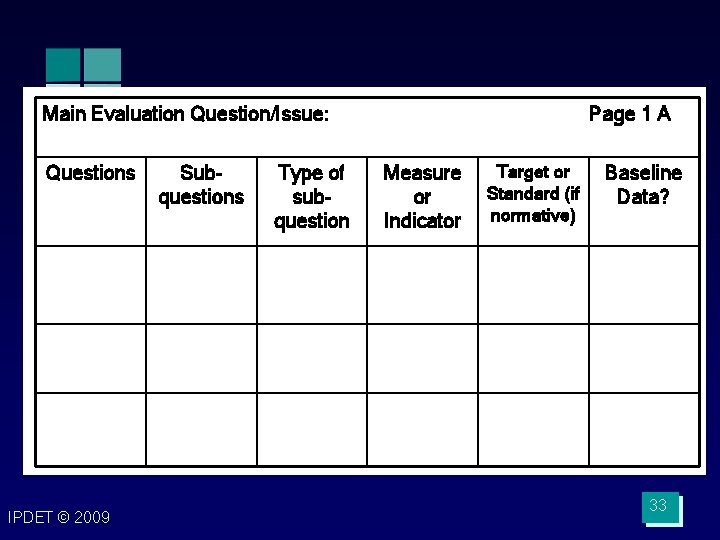
Matrix Elements • Main evaluation issue • General approach • Questions and subquestions • Type of questions and subquestions • Measures or Indicators • Target or standard (if normative) IPDET © 2009 • Presence or absence of baseline data • Design strategy • Data sources • Sample or census • Data collection instrument • Data analysis and graphics • Comments 32
Main Evaluation Question/Issue: Questions IPDET © 2009 Subquestions Type of subquestion Page 1 A Measure or Indicator Target or Standard (if normative) Baseline Data? 33
General Approach: Data Source IPDET © 2009 Design Page 1 B Sample or Census Data Collection Instrument Data Analysis Comments 34
A Final Note…. “Every why has a wherefore. ” -- William Shakespeare Questions? IPDET © 2009 35