
IPCC National Greenhouse Gas Inventory Programme Task Force
- Slides: 29
IPCC National Greenhouse Gas Inventory Programme Task Force on INTERGOVERNMENTAL PANEL ON CLIMATE CHANGE Inventories IPCC Guidelines for National GHG Inventories and Reporting for Forest land Nalin Srivastava IPCC National Greenhouse Gas Inventories Program World Forestry Week/19 th Committee on Forestry Sessions in Rome, March 16 -20, 2009 Rome
PANEL ON CLIMATE CHANGE Task Force on INTERGOVERNMENTAL Inventories Outline • IPCC Guidelines on national greenhouse gas inventories • Relevance of IPCC Guidelines in the context of UNFCCC • IPCC methodologies for estimation of emissions from land use and land use change • Data requirements for implementation of IPCC methods for Forest land • Role of NFMA in supporting national GHG inventories and REDD • Conclusion
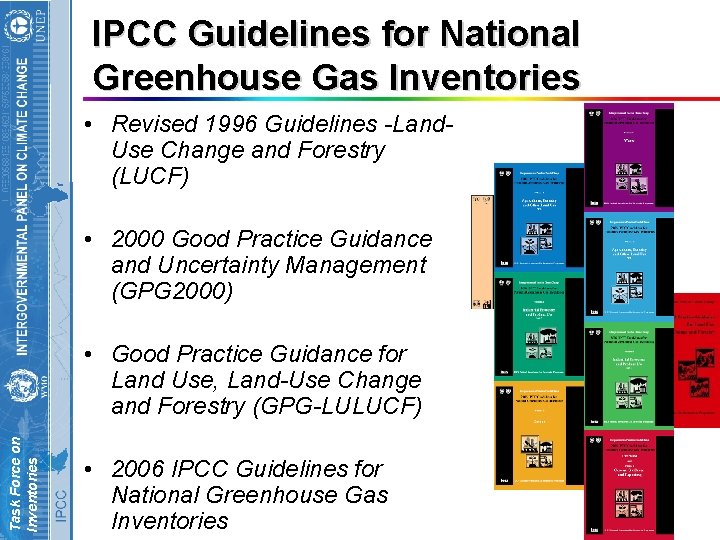
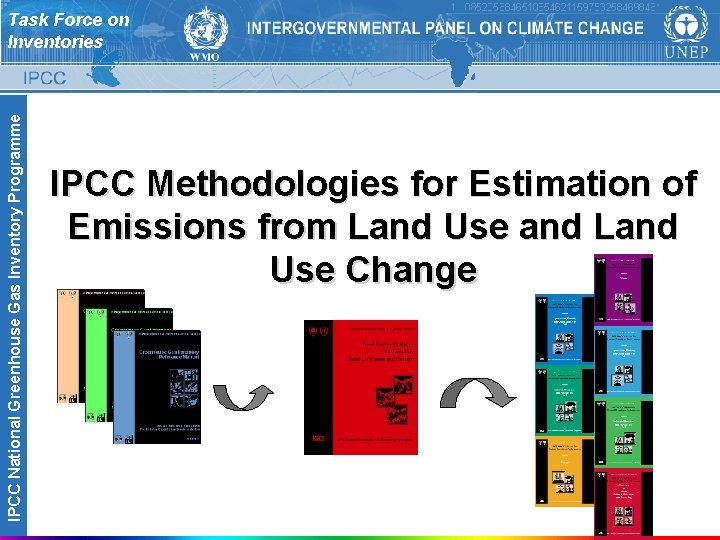
PANEL ON CLIMATE CHANGE Task Force on INTERGOVERNMENTAL Inventories IPCC Guidelines for National Greenhouse Gas Inventories • Revised 1996 Guidelines -Land. Use Change and Forestry (LUCF) • 2000 Good Practice Guidance and Uncertainty Management (GPG 2000) • Good Practice Guidance for Land Use, Land-Use Change and Forestry (GPG-LULUCF) • 2006 IPCC Guidelines for National Greenhouse Gas Inventories
PANEL ON CLIMATE CHANGE Task Force on INTERGOVERNMENTAL Inventories Evolution of IPCC Guidelines on Land Use and Land Use Change(1) • 1996 IPCC Guidelines – Agriculture and Land Use and Change and Forestry (LUCF) separate sectors – Focus on the most important activities resulting in GHG emissions/removals – Implicit assumption about estimating emissions and removals only over lands subject to human intervention • GPG 2000 & GPG-LULUCF – Specifically address good practice and uncertainty management in national GHG inventory development – GPG-LULUCF re-organized all emissions and removals from land use activities into six broad land-use categories – GPG-LULUCF first used managed land as a proxy for anthropogenic emissions
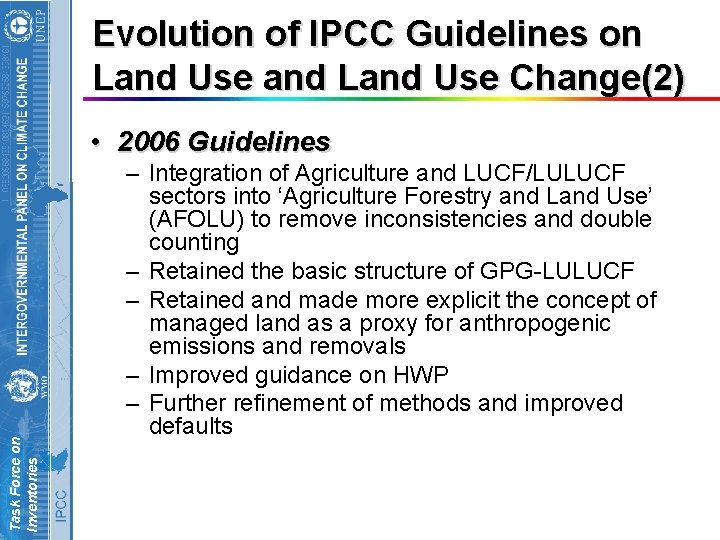
PANEL ON CLIMATE CHANGE Task Force on INTERGOVERNMENTAL Inventories Evolution of IPCC Guidelines on Land Use and Land Use Change(2) • 2006 Guidelines – Integration of Agriculture and LUCF/LULUCF sectors into ‘Agriculture Forestry and Land Use’ (AFOLU) to remove inconsistencies and double counting – Retained the basic structure of GPG-LULUCF – Retained and made more explicit the concept of managed land as a proxy for anthropogenic emissions and removals – Improved guidance on HWP – Further refinement of methods and improved defaults
PANEL ON CLIMATE CHANGE Task Force on INTERGOVERNMENTAL Inventories Relevance of IPCC Guidelines in the context of UNFCCC • UNFCCC and Kyoto Protocol require the parties to report their national greenhouse gas inventories using the IPCC Guidelines • GPG 2000 and GPG-LULUCF are mandatory for the Annex I countries while Non-Annex I countries are encouraged to use them for reporting their GHG inventories to the UNFCCC • Decision 2/CP. 13 of ‘Bali Action Plan’ encourages the use of the most recent (GPGLULUCF) IPCC Guidelines as a basis for reporting greenhouse gas emissions from deforestation
IPCC National Greenhouse Gas Inventory Programme Task Force on INTERGOVERNMENTAL PANEL ON CLIMATE CHANGE Inventories IPCC Methodologies for Estimation of Emissions from Land Use and Land Use Change
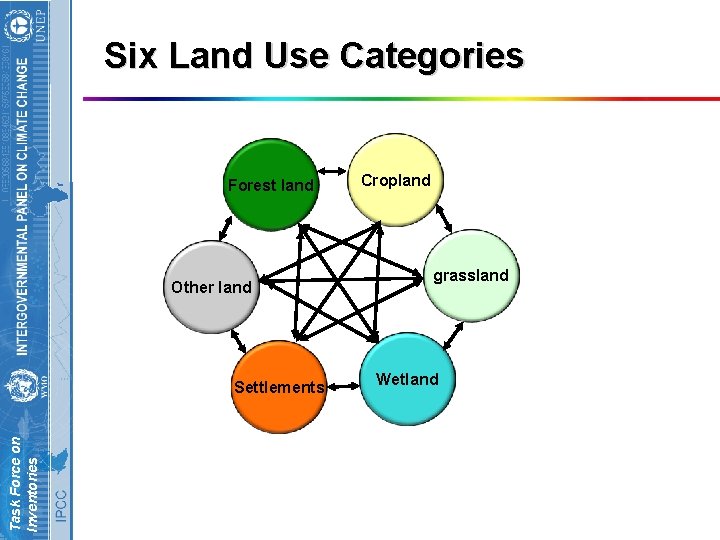
PANEL ON CLIMATE CHANGE Task Force on INTERGOVERNMENTAL Inventories Six Land Use Categories Forest land Other land Settlements Cropland grassland Wetland
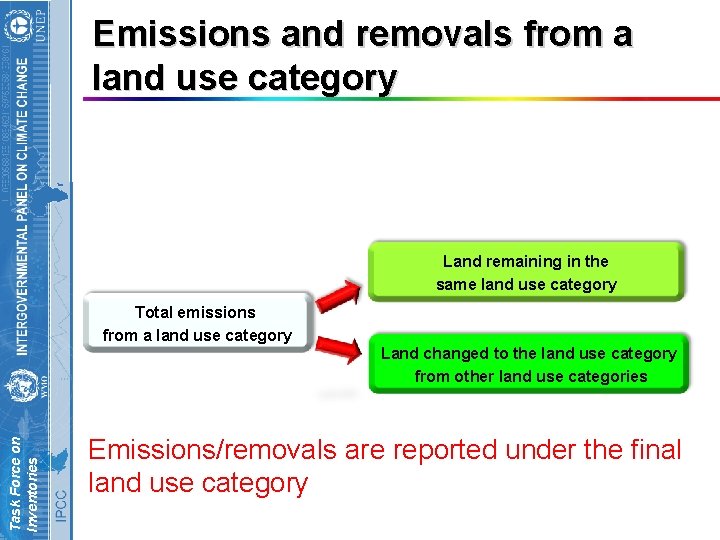
PANEL ON CLIMATE CHANGE Task Force on INTERGOVERNMENTAL Inventories Emissions and removals from a land use category Land remaining in the same land use category Total emissions from a land use category Land changed to the land use category from other land use categories Emissions/removals are reported under the final land use category
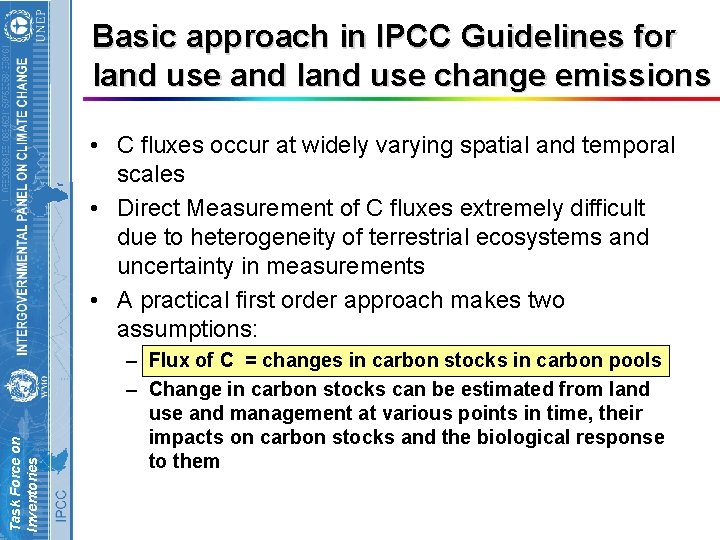
PANEL ON CLIMATE CHANGE Task Force on INTERGOVERNMENTAL Inventories Basic approach in IPCC Guidelines for land use and land use change emissions • C fluxes occur at widely varying spatial and temporal scales • Direct Measurement of C fluxes extremely difficult due to heterogeneity of terrestrial ecosystems and uncertainty in measurements • A practical first order approach makes two assumptions: – Flux of C = changes in carbon stocks in carbon pools – Change in carbon stocks can be estimated from land use and management at various points in time, their impacts on carbon stocks and the biological response to them
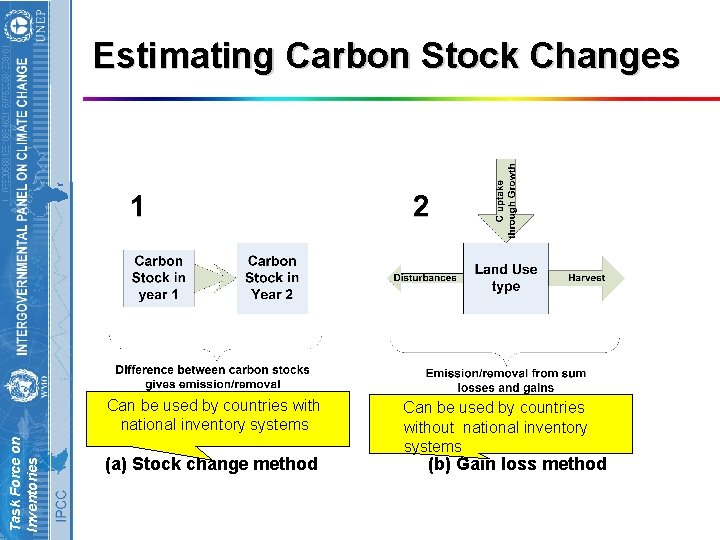
PANEL ON CLIMATE CHANGE Task Force on INTERGOVERNMENTAL Inventories Estimating Carbon Stock Changes Can be used by countries with national inventory systems (a) Stock change method Can be used by countries without national inventory systems (b) Gain loss method
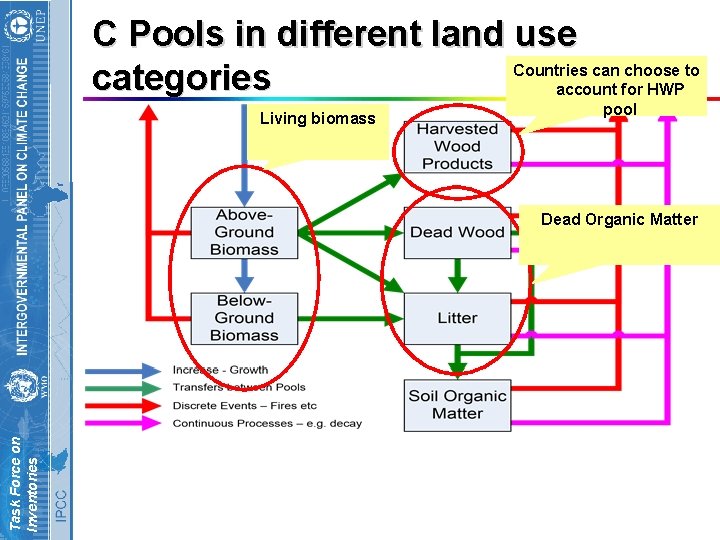
PANEL ON CLIMATE CHANGE Task Force on INTERGOVERNMENTAL Inventories C Pools in different land use Countries can choose to categories account for HWP Living biomass pool Dead Organic Matter
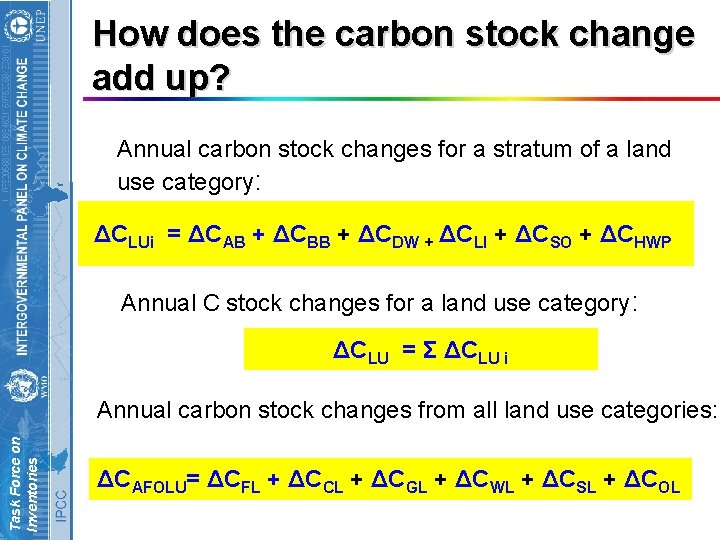
PANEL ON CLIMATE CHANGE Task Force on INTERGOVERNMENTAL Inventories How does the carbon stock change add up? Annual carbon stock changes for a stratum of a land use category: ΔCLUi = ΔCAB + ΔCBB + ΔCDW + ΔCLI + ΔCSO + ΔCHWP Annual C stock changes for a land use category: ΔCLU = Σ ΔCLU i Annual carbon stock changes from all land use categories: ΔCAFOLU= ΔCFL + ΔCCL + ΔCGL + ΔCWL + ΔCSL + ΔCOL
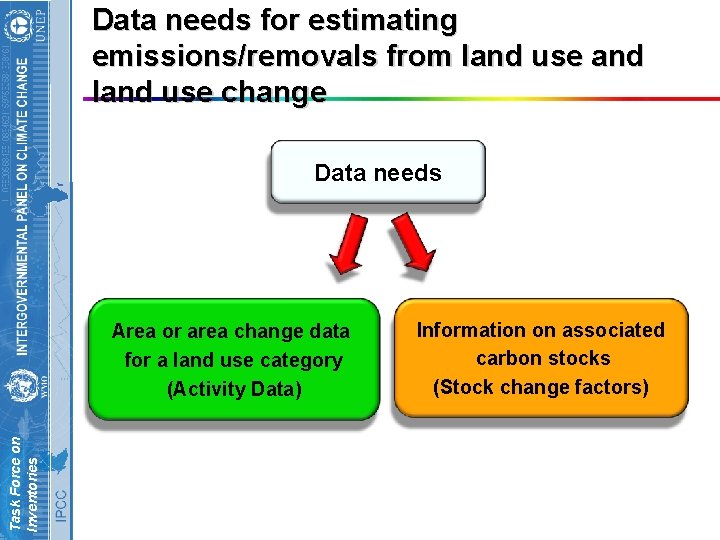
PANEL ON CLIMATE CHANGE Task Force on INTERGOVERNMENTAL Inventories Data needs for estimating emissions/removals from land use and land use change Data needs Area or area change data for a land use category (Activity Data) Information on associated carbon stocks (Stock change factors)
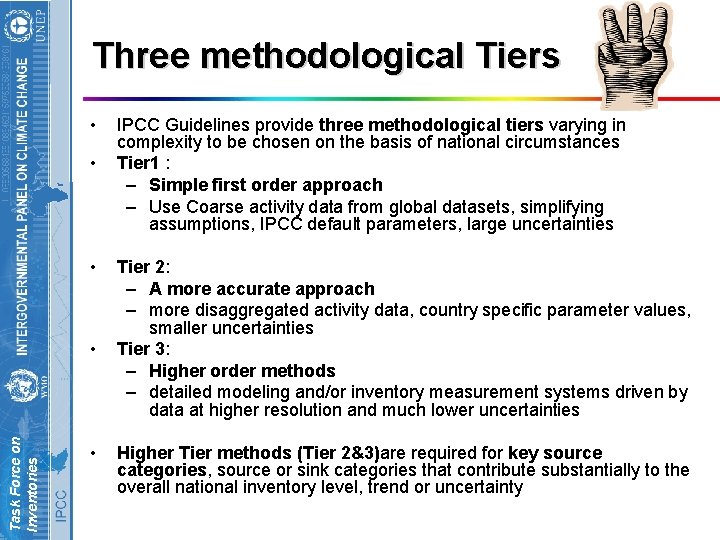
PANEL ON CLIMATE CHANGE Task Force on INTERGOVERNMENTAL Inventories Three methodological Tiers • • • IPCC Guidelines provide three methodological tiers varying in complexity to be chosen on the basis of national circumstances Tier 1 : – Simple first order approach – Use Coarse activity data from global datasets, simplifying assumptions, IPCC default parameters, large uncertainties Tier 2: – A more accurate approach – more disaggregated activity data, country specific parameter values, smaller uncertainties Tier 3: – Higher order methods – detailed modeling and/or inventory measurement systems driven by data at higher resolution and much lower uncertainties Higher Tier methods (Tier 2&3)are required for key source categories, source or sink categories that contribute substantially to the overall national inventory level, trend or uncertainty
IPCC National Greenhouse Gas Inventory Programme Task Force on INTERGOVERNMENTAL PANEL ON CLIMATE CHANGE Inventories Data Requirements for Implementation of IPCC Methods for Forest land
PANEL ON CLIMATE CHANGE Task Force on INTERGOVERNMENTAL Inventories Carbon stock information • Carbon stocks in the forest land vary by climate, soil, forest type, management practices, disturbance regime etc. • Simplest IPCC methods (Tier 1) use default data on carbon stocks on broad continental scales stratified by climate, eco-zone, forest type and continent and do not capture the differences due to human induced disturbances etc.
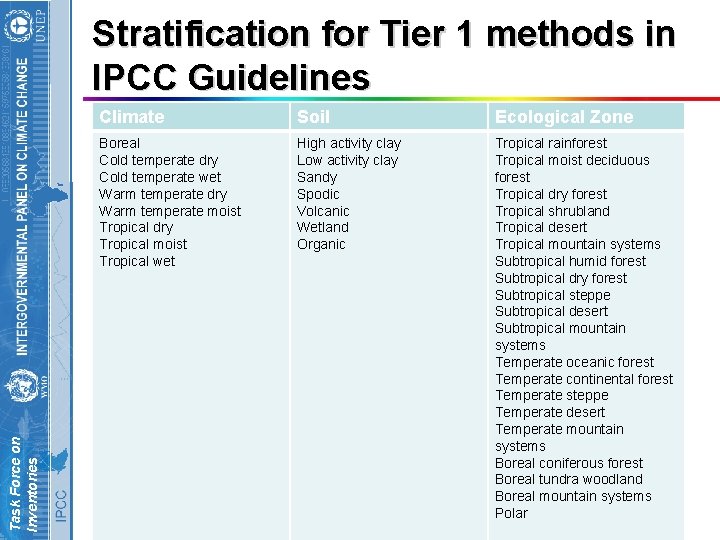
PANEL ON CLIMATE CHANGE Task Force on INTERGOVERNMENTAL Inventories Stratification for Tier 1 methods in IPCC Guidelines Climate Soil Ecological Zone Boreal Cold temperate dry Cold temperate wet Warm temperate dry Warm temperate moist Tropical dry Tropical moist Tropical wet High activity clay Low activity clay Sandy Spodic Volcanic Wetland Organic Tropical rainforest Tropical moist deciduous forest Tropical dry forest Tropical shrubland Tropical desert Tropical mountain systems Subtropical humid forest Subtropical dry forest Subtropical steppe Subtropical desert Subtropical mountain systems Temperate oceanic forest Temperate continental forest Temperate steppe Temperate desert Temperate mountain systems Boreal coniferous forest Boreal tundra woodland Boreal mountain systems Polar
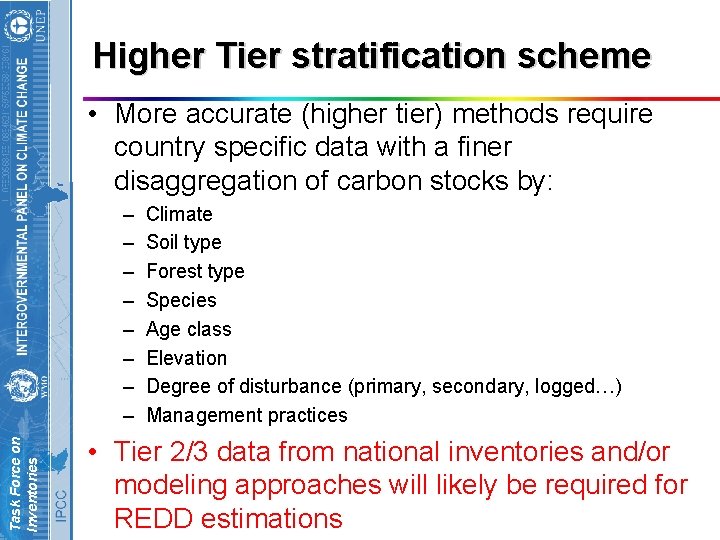
PANEL ON CLIMATE CHANGE Task Force on INTERGOVERNMENTAL Inventories Higher Tier stratification scheme • More accurate (higher tier) methods require country specific data with a finer disaggregation of carbon stocks by: – – – – Climate Soil type Forest type Species Age class Elevation Degree of disturbance (primary, secondary, logged…) Management practices • Tier 2/3 data from national inventories and/or modeling approaches will likely be required for REDD estimations
PANEL ON CLIMATE CHANGE Task Force on INTERGOVERNMENTAL Inventories Data on area and area changes • The land use and land use change area should be disaggregated to match the carbon stock information • Area stratification scheme for Tier 1 methods is based on the classification scheme for the default Carbon stocks and other parameters given in IPCC Guidelines • Higher tier methods require finer level of area stratification to match the more disaggregated information on C stocks
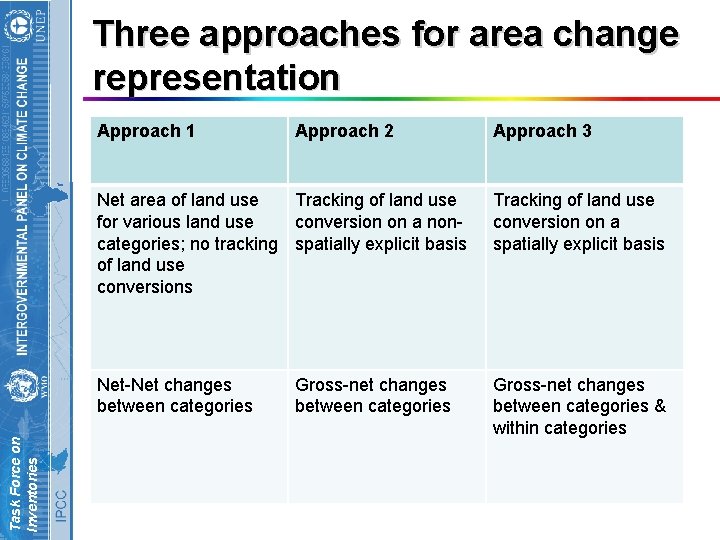
PANEL ON CLIMATE CHANGE Task Force on INTERGOVERNMENTAL Inventories Three approaches for area change representation Approach 1 Approach 2 Approach 3 Net area of land use Tracking of land use for various land use conversion on a noncategories; no tracking spatially explicit basis of land use conversions Tracking of land use conversion on a spatially explicit basis Net-Net changes between categories Gross-net changes between categories & within categories Gross-net changes between categories
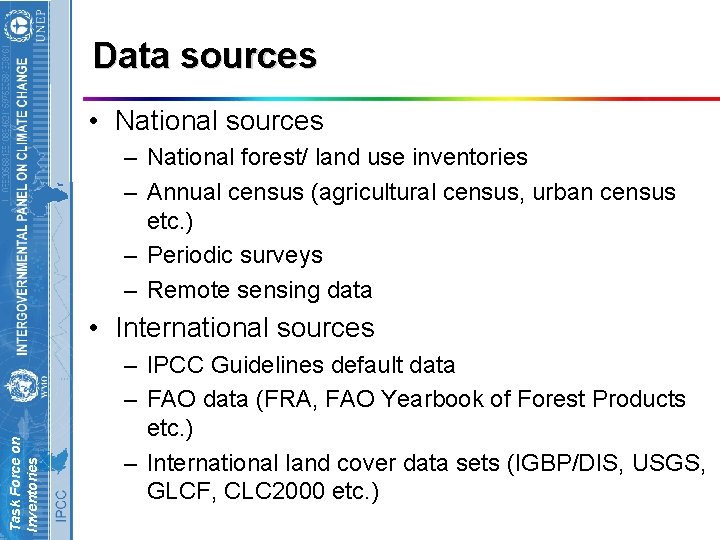
PANEL ON CLIMATE CHANGE Task Force on INTERGOVERNMENTAL Inventories Data sources • National sources – National forest/ land use inventories – Annual census (agricultural census, urban census etc. ) – Periodic surveys – Remote sensing data • International sources – IPCC Guidelines default data – FAO data (FRA, FAO Yearbook of Forest Products etc. ) – International land cover data sets (IGBP/DIS, USGS, GLCF, CLC 2000 etc. )
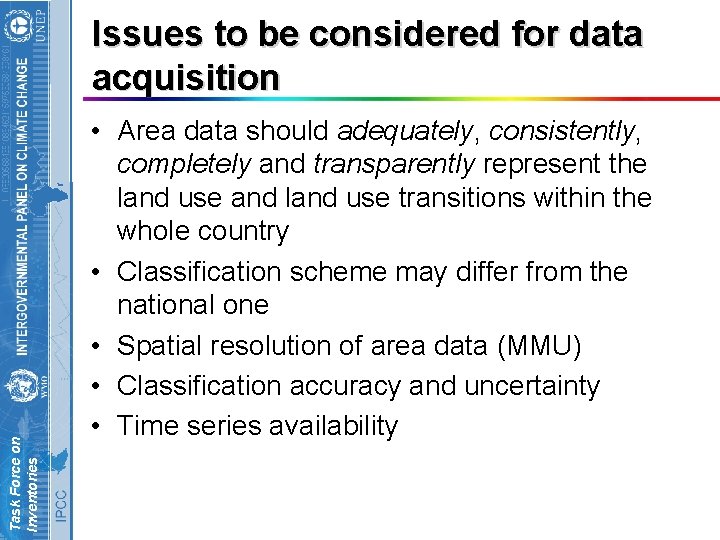
PANEL ON CLIMATE CHANGE Task Force on INTERGOVERNMENTAL Inventories Issues to be considered for data acquisition • Area data should adequately, consistently, completely and transparently represent the land use and land use transitions within the whole country • Classification scheme may differ from the national one • Spatial resolution of area data (MMU) • Classification accuracy and uncertainty • Time series availability
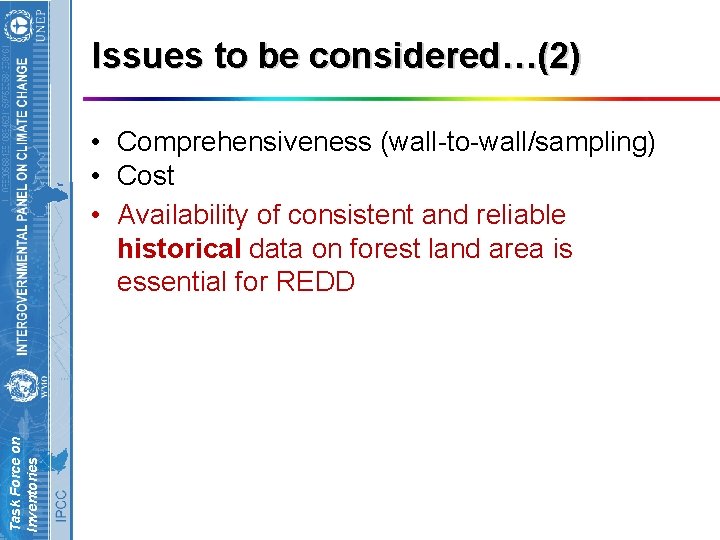
PANEL ON CLIMATE CHANGE Task Force on INTERGOVERNMENTAL Inventories Issues to be considered…(2) • Comprehensiveness (wall-to-wall/sampling) • Cost • Availability of consistent and reliable historical data on forest land area is essential for REDD
IPCC National Greenhouse Gas Inventory Programme Task Force on INTERGOVERNMENTAL PANEL ON CLIMATE CHANGE Inventories Role of NFMA in Supporting National GHG Inventories and REDD
PANEL ON CLIMATE CHANGE Task Force on INTERGOVERNMENTAL Inventories Role of NFMA in supporting national GHG inventories and REDD • Accurate, robust and reliable information on forests and other land uses critical to UNFCCC GHG reporting, future REDD regime and other international processes • NFMA has the potential to respond effectively to the information needs of UNFCCC process and others • NFMA should support regular and consistent monitoring of C stocks, area and area changes of forestland other land uses
PANEL ON CLIMATE CHANGE Task Force on INTERGOVERNMENTAL Inventories Role of NFMA…(2) • NFMA should help gather information of all C pools at a higher level of disaggregation to support higher tier methods • The data collection efforts and sampling intensity should aim at a level of reliability that can be applicable to higher tier methods and REDD requirements • NFMA should aim at creating and enhancing national technical and institutional capacity to undertake regular monitoring of forests and other land uses.
PANEL ON CLIMATE CHANGE Task Force on INTERGOVERNMENTAL Inventories Conclusion • IPCC methodologies give detailed methods with varying degrees of complexity for different national circumstances for estimation of national GHG emissions and removals and can potentially be applied to REDD • Reliable and consistent Information on C stocks and areas of land use and land use changes is essential for estimating national GHG emissions and removals and REDD • NFMA process can be fine-tuned to adequately respond to the increased data needs for UNFCCC processes
IPCC National Greenhouse Gas Inventory Programme Task Force on INTERGOVERNMENTAL PANEL ON CLIMATE CHANGE Inventories Thank You IPCC Guidelines in all UN languages can be downloaded from www. ipcc-nggip. or. jp