
IPCC 2013 Chapter 1 Figure 1 1 Main



- Slides: 30
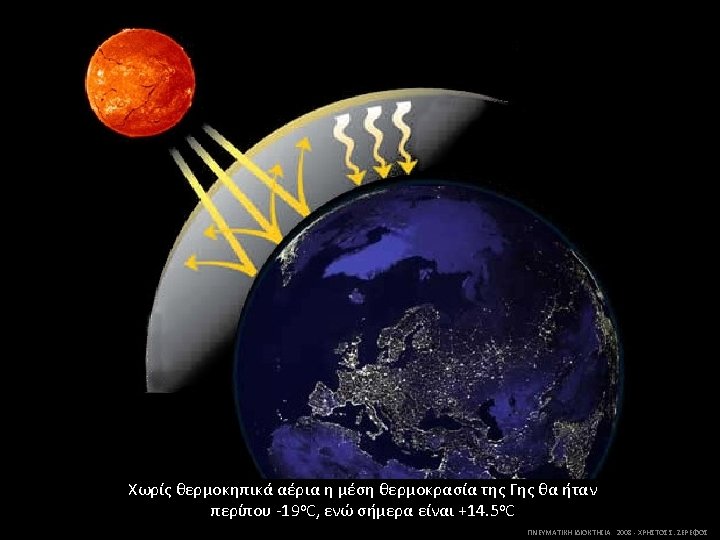
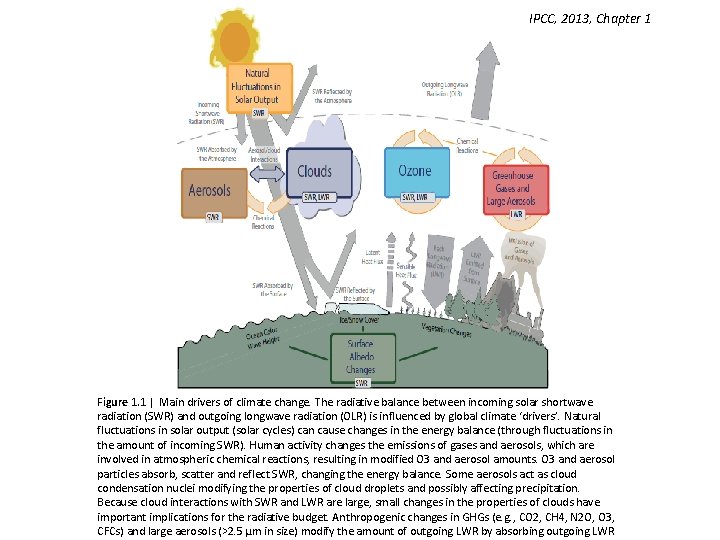
IPCC, 2013, Chapter 1 Figure 1. 1 | Main drivers of climate change. The radiative balance between incoming solar shortwave radiation (SWR) and outgoing longwave radiation (OLR) is influenced by global climate ‘drivers’. Natural fluctuations in solar output (solar cycles) can cause changes in the energy balance (through fluctuations in the amount of incoming SWR). Human activity changes the emissions of gases and aerosols, which are involved in atmospheric chemical reactions, resulting in modified O 3 and aerosol amounts. O 3 and aerosol particles absorb, scatter and reflect SWR, changing the energy balance. Some aerosols act as cloud condensation nuclei modifying the properties of cloud droplets and possibly affecting precipitation. Because cloud interactions with SWR and LWR are large, small changes in the properties of clouds have important implications for the radiative budget. Anthropogenic changes in GHGs (e. g. , CO 2, CH 4, N 2 O, O 3, CFCs) and large aerosols (>2. 5 μm in size) modify the amount of outgoing LWR by absorbing outgoing LWR
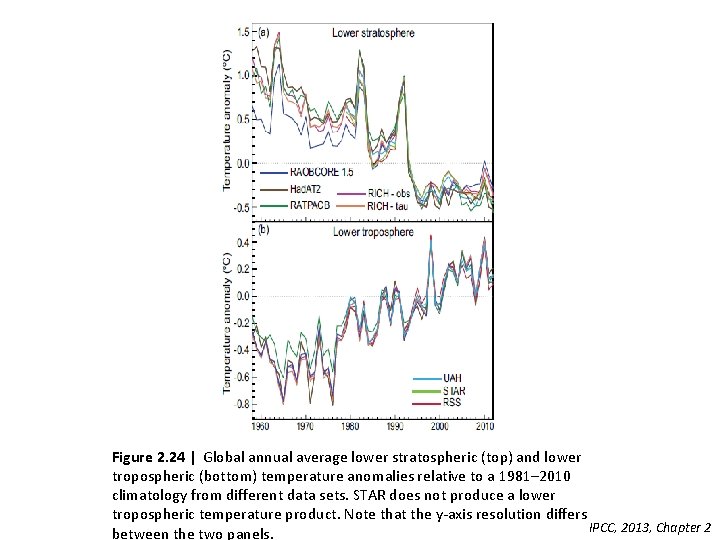
Figure 2. 24 | Global annual average lower stratospheric (top) and lower tropospheric (bottom) temperature anomalies relative to a 1981– 2010 climatology from different data sets. STAR does not produce a lower tropospheric temperature product. Note that the y-axis resolution differs IPCC, 2013, Chapter 2 between the two panels.
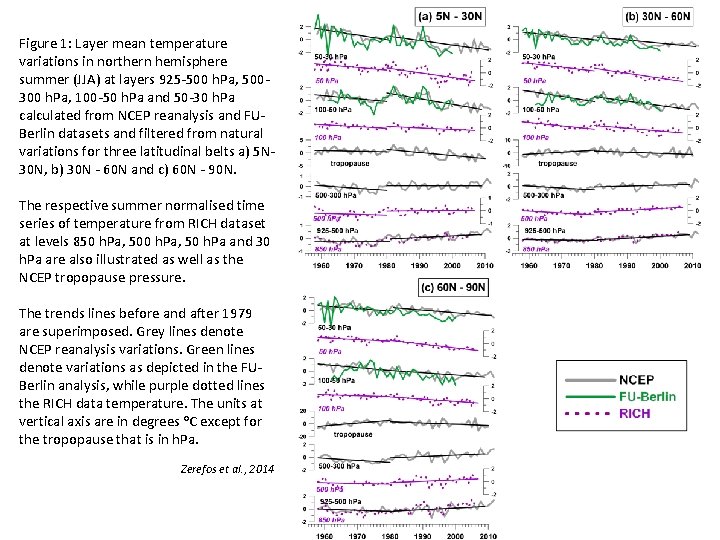
Figure 1: Layer mean temperature variations in northern hemisphere summer (JJA) at layers 925 -500 h. Pa, 500300 h. Pa, 100 -50 h. Pa and 50 -30 h. Pa calculated from NCEP reanalysis and FUBerlin datasets and filtered from natural variations for three latitudinal belts a) 5 N 30 N, b) 30 N - 60 N and c) 60 N - 90 N. The respective summer normalised time series of temperature from RICH dataset at levels 850 h. Pa, 50 h. Pa and 30 h. Pa are also illustrated as well as the NCEP tropopause pressure. The trends lines before and after 1979 are superimposed. Grey lines denote NCEP reanalysis variations. Green lines denote variations as depicted in the FUBerlin analysis, while purple dotted lines the RICH data temperature. The units at vertical axis are in degrees o. C except for the tropopause that is in h. Pa. Zerefos et al. , 2014
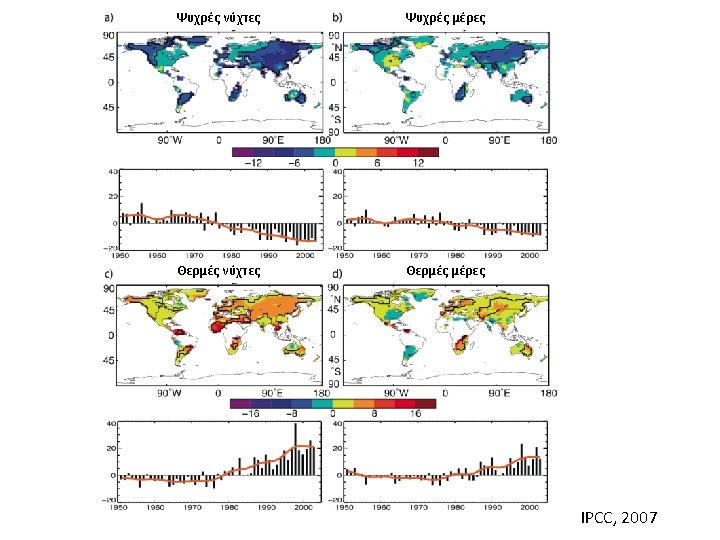
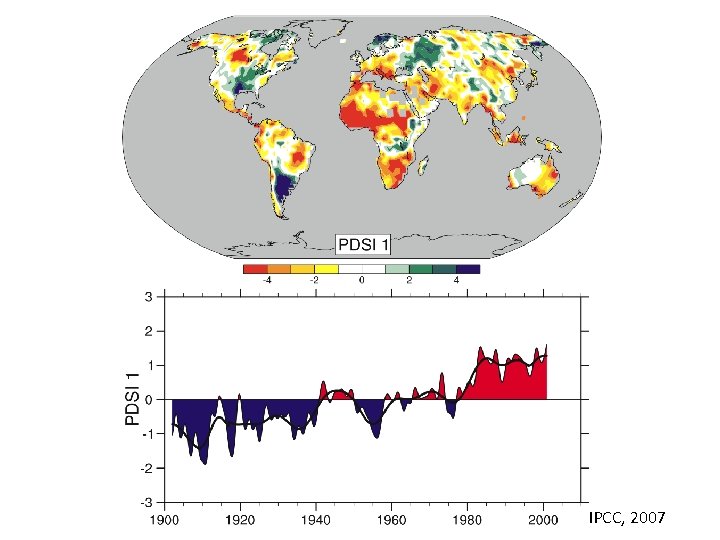
IPCC, 2007
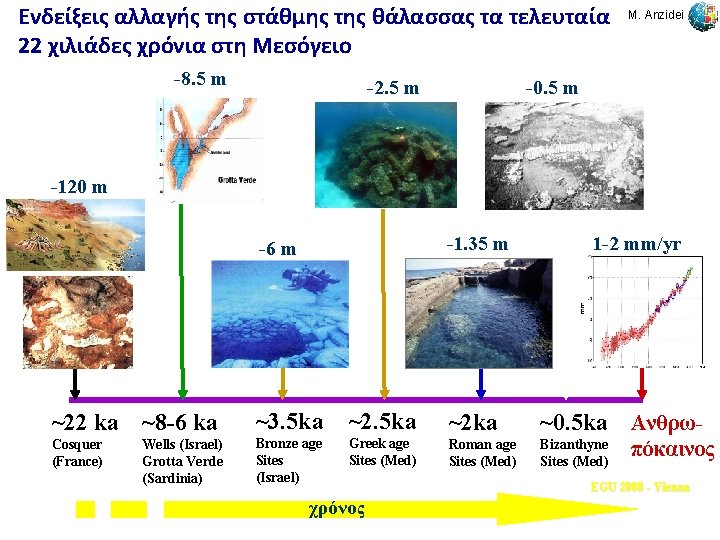
Ενδείξεις αλλαγής της στάθμης της θάλασσας τα τελευταία 22 χιλιάδες χρόνια στη Μεσόγειο -8. 5 m -2. 5 m M. Anzidei -0. 5 m -120 m -1. 35 m -6 m 1 -2 mm/yr ~22 ka ~8 -6 ka ~3. 5 ka ~2 ka ~0. 5 ka Ανθρω- Cosquer (France) Bronze age Sites (Israel) Greek age Sites (Med) Roman age Sites (Med) Bizanthyne Sites (Med) Wells (Israel) Grotta Verde (Sardinia) χρόνος πόκαινος EGU 2008 - Vienna
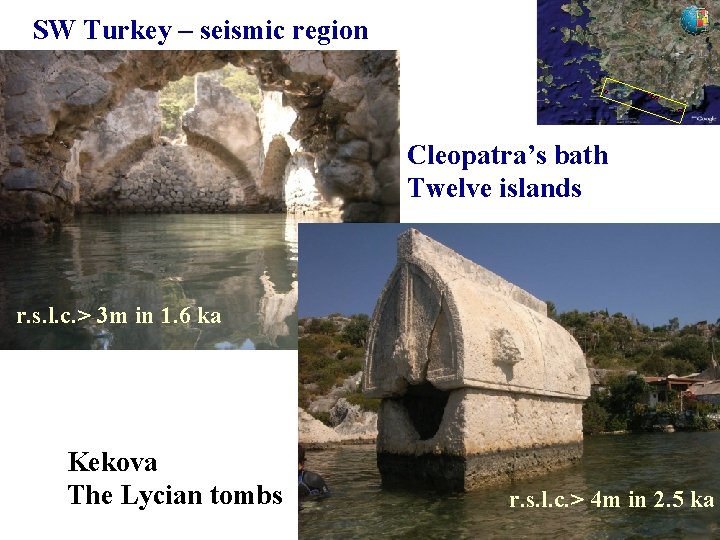
SW Turkey – seismic region Cleopatra’s bath Twelve islands r. s. l. c. > 3 m in 1. 6 ka Kekova The Lycian tombs r. s. l. c. > 4 m in 2. 5 ka
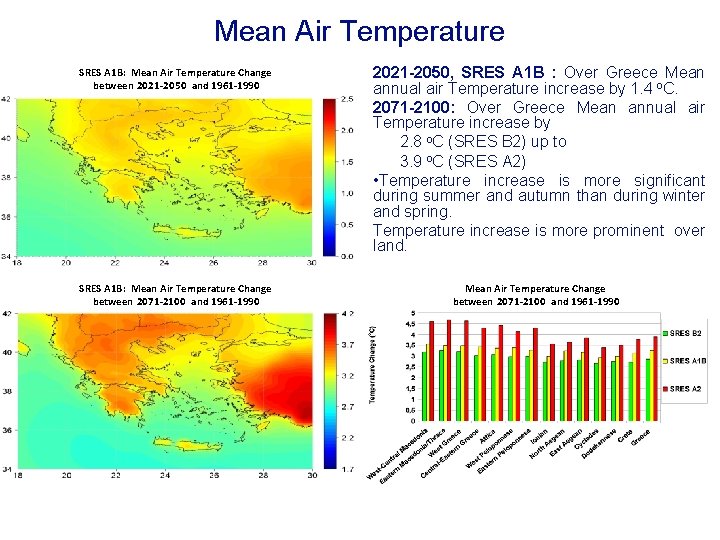
Mean Air Temperature SRES A 1 B: Mean Air Temperature Change between 2021 -2050 and 1961 -1990 2021 -2050, SRES A 1 B : Over Greece Mean annual air Temperature increase by 1. 4 o. C. 2071 -2100: Over Greece Mean annual air Temperature increase by 2. 8 o. C (SRES B 2) up to 3. 9 o. C (SRES A 2) • Temperature increase is more significant during summer and autumn than during winter and spring. Temperature increase is more prominent over land. SRES A 1 B: Mean Air Temperature Change between 2071 -2100 and 1961 -1990
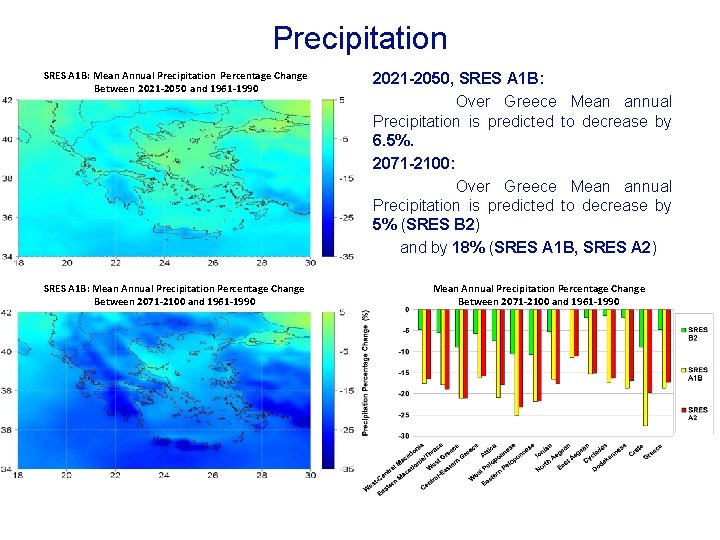
Precipitation SRES A 1 B: Mean Annual Precipitation Percentage Change Between 2021 -2050 and 1961 -1990 SRES A 1 B: Mean Annual Precipitation Percentage Change Between 2071 -2100 and 1961 -1990 2021 -2050, SRES A 1 B: Over Greece Mean annual Precipitation is predicted to decrease by 6. 5%. 2071 -2100: Over Greece Mean annual Precipitation is predicted to decrease by 5% (SRES B 2) and by 18% (SRES A 1 B, SRES A 2) Mean Annual Precipitation Percentage Change Between 2071 -2100 and 1961 -1990
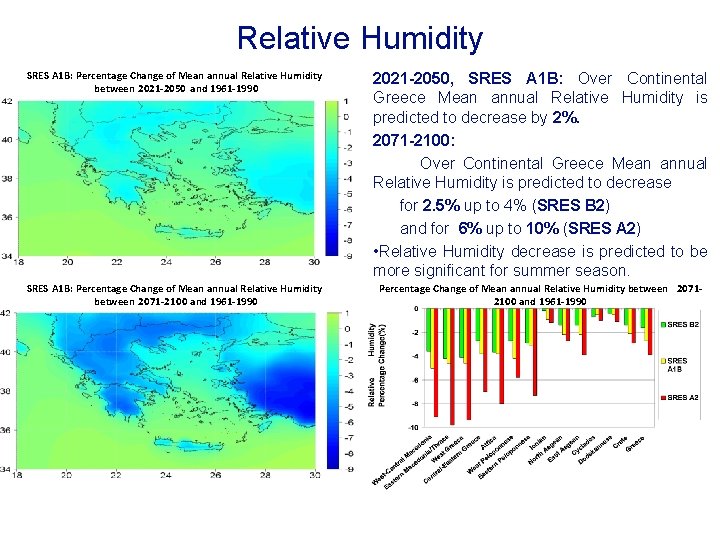
Relative Humidity SRES A 1 B: Percentage Change of Mean annual Relative Humidity between 2021 -2050 and 1961 -1990 2021 -2050, SRES A 1 B: Over Continental Greece Mean annual Relative Humidity is predicted to decrease by 2%. 2071 -2100: Over Continental Greece Mean annual Relative Humidity is predicted to decrease for 2. 5% up to 4% (SRES B 2) and for 6% up to 10% (SRES A 2) • Relative Humidity decrease is predicted to be more significant for summer season. SRES A 1 B: Percentage Change of Mean annual Relative Humidity between 2071 -2100 and 1961 -1990 Percentage Change of Mean annual Relative Humidity between 20712100 and 1961 -1990
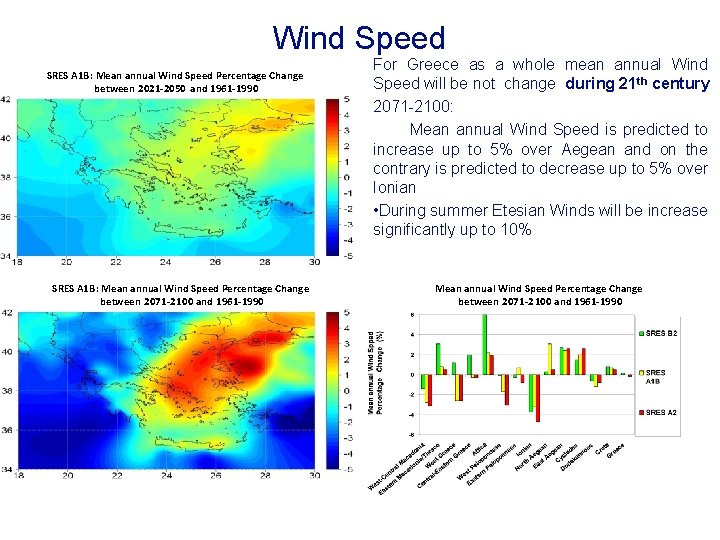
Wind Speed SRES A 1 B: Mean annual Wind Speed Percentage Change between 2021 -2050 and 1961 -1990 SRES A 1 B: Mean annual Wind Speed Percentage Change between 2071 -2100 and 1961 -1990 For Greece as a whole mean annual Wind Speed will be not change during 21 th century 2071 -2100: Mean annual Wind Speed is predicted to increase up to 5% over Aegean and on the contrary is predicted to decrease up to 5% over Ionian • During summer Etesian Winds will be increase significantly up to 10% Mean annual Wind Speed Percentage Change between 2071 -2100 and 1961 -1990
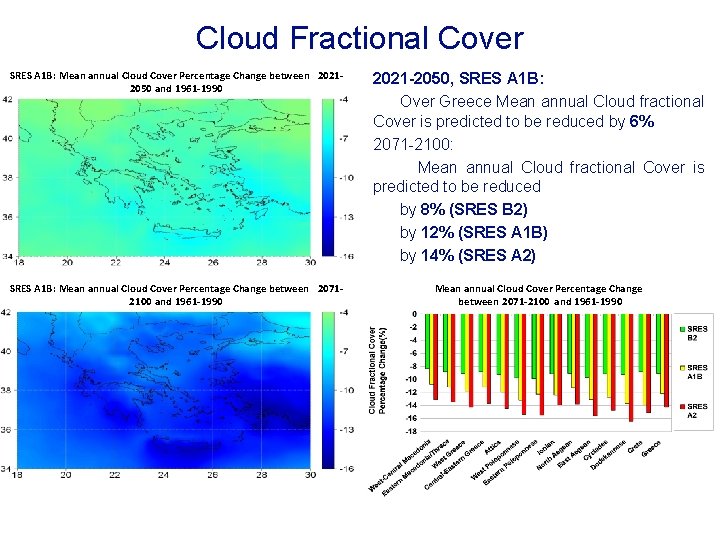
Cloud Fractional Cover SRES A 1 B: Mean annual Cloud Cover Percentage Change between 20212050 and 1961 -1990 2021 -2050, SRES A 1 B: Over Greece Mean annual Cloud fractional Cover is predicted to be reduced by 6% 2071 -2100: Mean annual Cloud fractional Cover is predicted to be reduced by 8% (SRES B 2) by 12% (SRES A 1 B) by 14% (SRES A 2) SRES A 1 B: Mean annual Cloud Cover Percentage Change between 20712100 and 1961 -1990 Mean annual Cloud Cover Percentage Change between 2071 -2100 and 1961 -1990
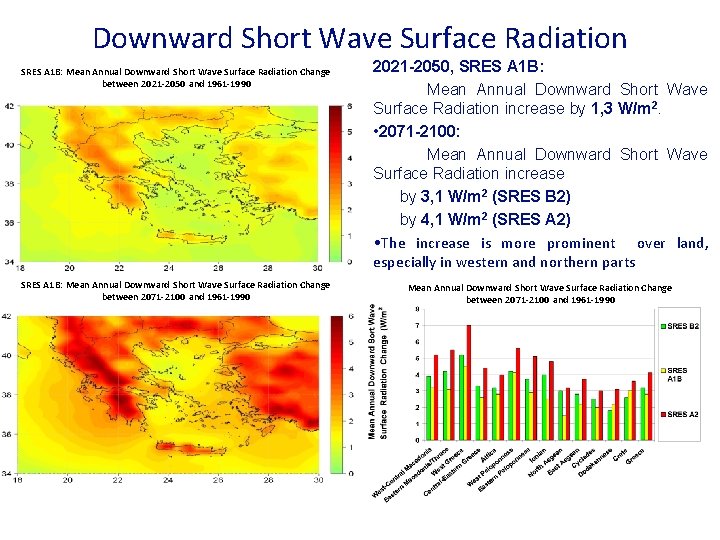
Downward Short Wave Surface Radiation SRES A 1 B: Mean Annual Downward Short Wave Surface Radiation Change between 2021 -2050 and 1961 -1990 SRES A 1 B: Mean Annual Downward Short Wave Surface Radiation Change between 2071 -2100 and 1961 -1990 2021 -2050, SRES A 1 B: Mean Annual Downward Short Wave Surface Radiation increase by 1, 3 W/m 2. • 2071 -2100: Mean Annual Downward Short Wave Surface Radiation increase by 3, 1 W/m 2 (SRES B 2) by 4, 1 W/m 2 (SRES A 2) • The increase is more prominent over land, especially in western and northern parts Mean Annual Downward Short Wave Surface Radiation Change between 2071 -2100 and 1961 -1990
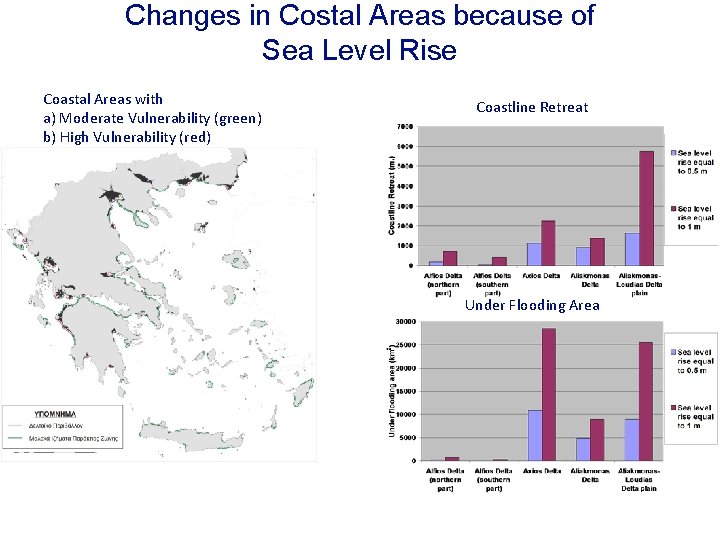
Changes in Costal Areas because of Sea Level Rise Coastal Areas with a) Moderate Vulnerability (green) b) High Vulnerability (red) Coastline Retreat Under Flooding Area
Conclusions for Greece 2021 -2050, SRES A 1 B : Over Greece Mean annual air Temperature increase by 1. 4 o. C. 2071 -2100: Over Greece Mean annual air Temperature increase for 2. 8 o. C (SRES B 2) up to 3. 9 o. C (SRES A 2) • Temperature increase is more significant during summer and autumn than during winter and spring. Temperature increase is more prominent over land. 2021 -2050, SRES A 1 B: Over Greece Mean annual Precipitation is predicted to decrease by 6. 5%. 2071 -2100: Over Greece Mean annual Precipitation is predicted to decrease by 5% under SRES B 2 and by 18% under SRES A 1 B and SRES A 2 2021 -2050, SRES A 1 B: Over Continental Greece Mean annual Relative Humidity is predicted to decrease by 2%. 2071 -2100: Over Continental Greece Mean annual Relative Humidity is predicted to decrease for 2. 5% up to 4% under SRES B 2 and for 6% up to 10% under SRES A 2 • Relative Humidity decrease is predicted to be more significant for summer season.
Conclusions for Greece For Greece as a whole mean annual Wind Speed will be not change during 21 th century 2071 -2100: Mean annual Wind Speed is predicted to increase up to 5% over Aegean and on the contrary is predicted to decrease up to 5% over Ionian • During summer Etesian Winds will be increase significantly up to 10% • 2021 -2050, SRES A 1 B: Over Greece Mean annual Cloud fractional Cover is predicted to be reduced by 6% 2071 -2100: Mean annual Cloud fractional Cover is predicted to be reduced by 8% under SRES B 2, by 12% under SRES A 1 B and by 14% under SRES A 2 2021 -2050, SRES A 1 B: Mean Annual Downward Short Wave Surface Radiation increase by 1, 3 W/m 2. • 2071 -2100: Mean Annual Downward Short Wave Surface Radiation increase by 3, 1 W/m 2 under SRES B 2 and by 4, 1 W/m 2 under SRES A 2 • The increase is more prominent over land, especially in western and northern parts Transportation Cost for the infrastructure maintenance € 594, 8 m/year to € 195 m/year depending on the GHG emissions Cost of delays in service due to climate change (extreme events, overheating of infrastructure etc. ): € 28 bn to € 9. 3 bn