
IPC International Patent Classification Introduction IPC Section World
- Slides: 27
IPC - International Patent Classification Introduction IPC Section, World Intellectual Property Organization (WIPO) October 2014
What is the IPC ? ü Similar to library classification systems, e. g. § Dewey Decimal Classification (DDC) § Library of Congress Classification (LCC) ü Somewhat similar to other classification systems: § ICD: International Classification of Diseases (WHO) § ISCO: International Standard Classification of Occupations (ILO) § CAS registry numbers (Chemical Abstracts Sevice) § Nice Classification: International Classification of Goods and Services for the Purposes of the Registrations of Marks § Locarno Classification: International Classification for Industrial Designs § Vienna Classification: International Classification of the Figurative Elements of Marks (WIPO) 2
What is the IPC ? ü System for classifying technical subject matter, mainly patent documents § Specially adapted for needs of patent documents § Applied to >95% of patent documents worldwide § Available in most databases for patent search Ø Efficient tool for searching patent documents 3
Purposes of the IPC ü Primary purposes: § effective search tool for the retrieval of patent documents § ordering patent documents in order to facilitate access to the technological and legal information ü Other purposes: § selective dissemination of patent information § investigation of the state of the art § preparation of industrial property statistics 4
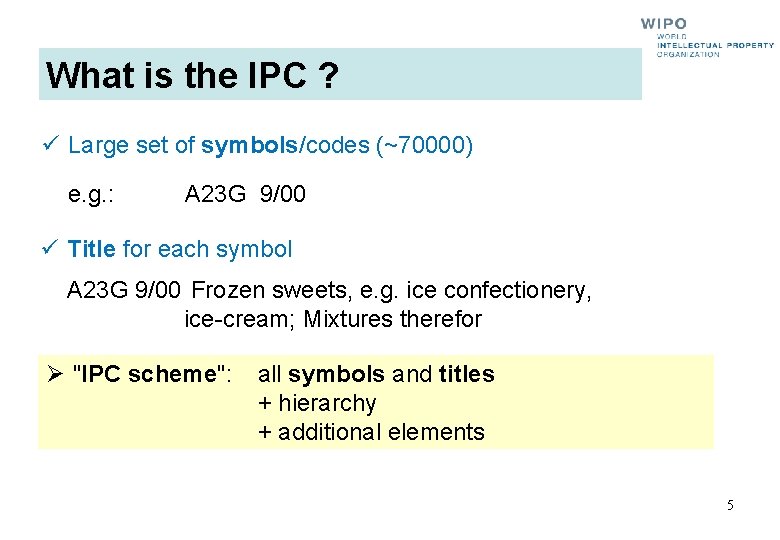
What is the IPC ? ü Large set of symbols/codes (~70000) e. g. : A 23 G 9/00 ü Title for each symbol A 23 G 9/00 Frozen sweets, e. g. ice confectionery, ice-cream; Mixtures therefor Ø "IPC scheme": all symbols and titles + hierarchy + additional elements 5
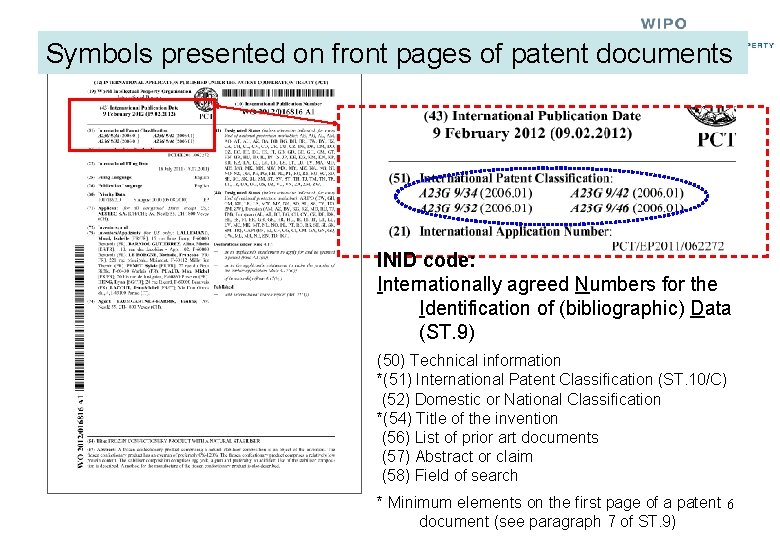
Symbols presented on front pages of patent documents INID code: Internationally agreed Numbers for the Identification of (bibliographic) Data (ST. 9) (50) Technical information *(51) International Patent Classification (ST. 10/C) (52) Domestic or National Classification *(54) Title of the invention (56) List of prior art documents (57) Abstract or claim (58) Field of search * Minimum elements on the first page of a patent 6 document (see paragraph 7 of ST. 9)
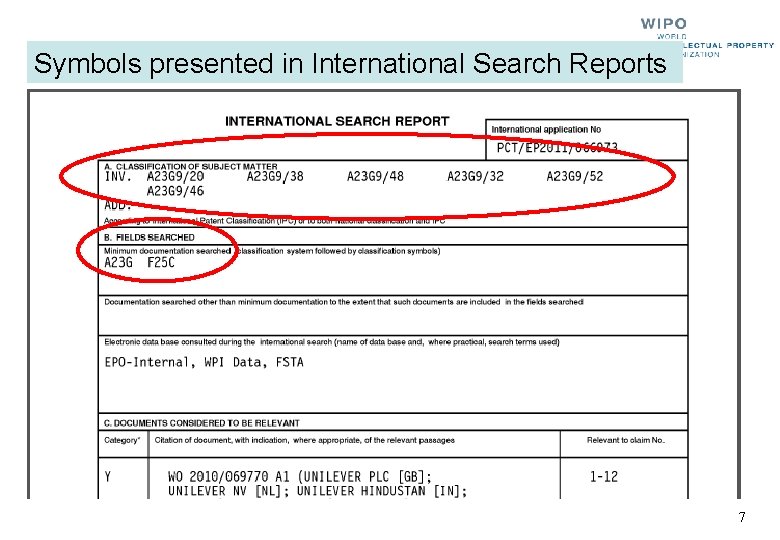
Symbols presented in International Search Reports 7
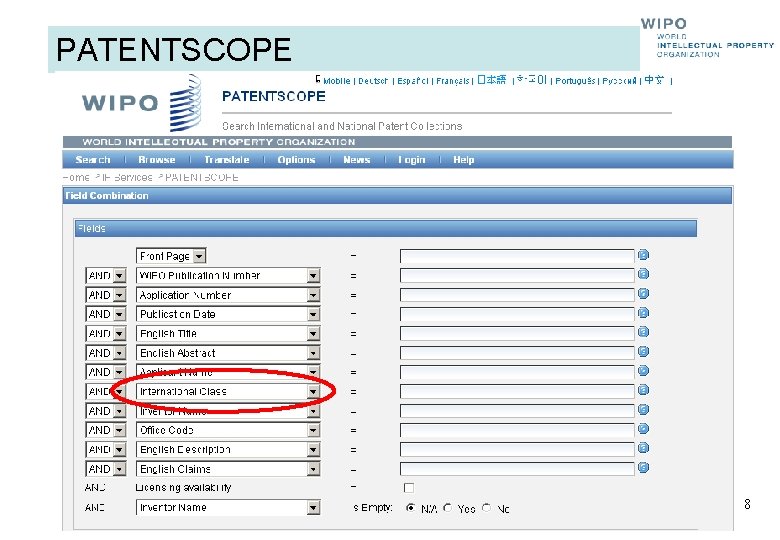
PATENTSCOPE 8
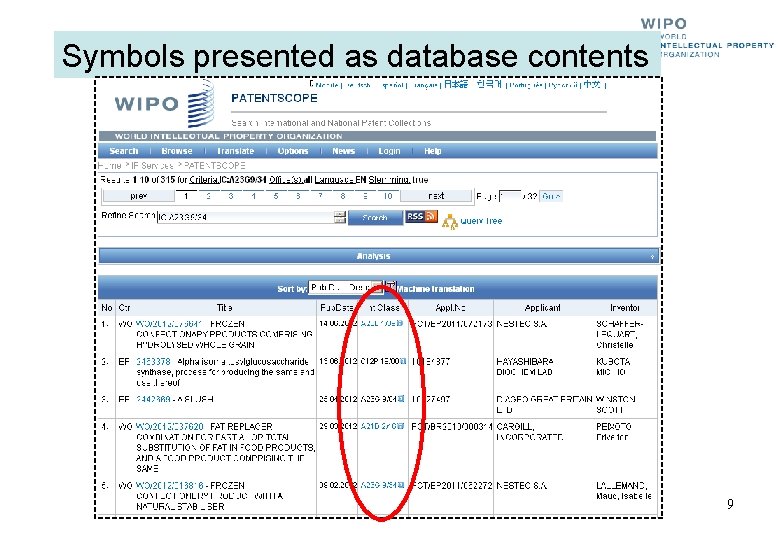
Symbols presented as database contents 9
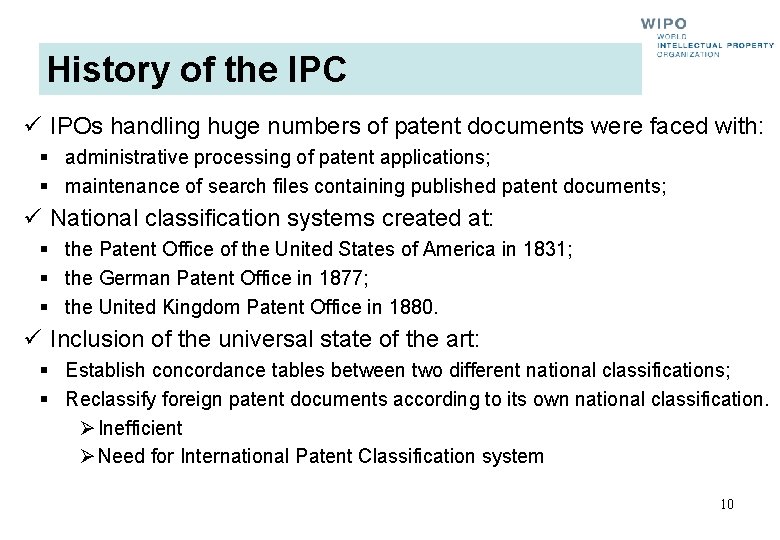
History of the IPC ü IPOs handling huge numbers of patent documents were faced with: § administrative processing of patent applications; § maintenance of search files containing published patent documents; ü National classification systems created at: § the Patent Office of the United States of America in 1831; § the German Patent Office in 1877; § the United Kingdom Patent Office in 1880. ü Inclusion of the universal state of the art: § Establish concordance tables between two different national classifications; § Reclassify foreign patent documents according to its own national classification. Ø Inefficient Ø Need for International Patent Classification system 10
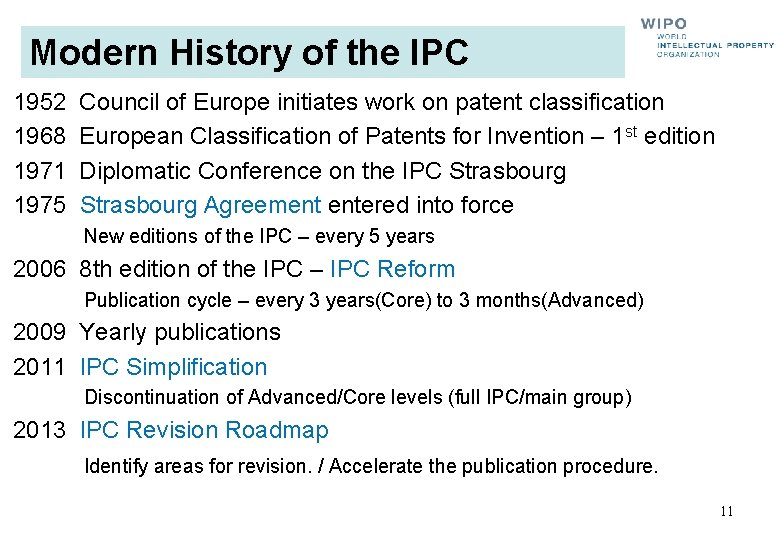
Modern History of the IPC 1952 1968 1971 1975 Council of Europe initiates work on patent classification European Classification of Patents for Invention – 1 st edition Diplomatic Conference on the IPC Strasbourg Agreement entered into force New editions of the IPC – every 5 years 2006 8 th edition of the IPC – IPC Reform Publication cycle – every 3 years(Core) to 3 months(Advanced) 2009 Yearly publications 2011 IPC Simplification Discontinuation of Advanced/Core levels (full IPC/main group) 2013 IPC Revision Roadmap Identify areas for revision. / Accelerate the publication procedure. 11
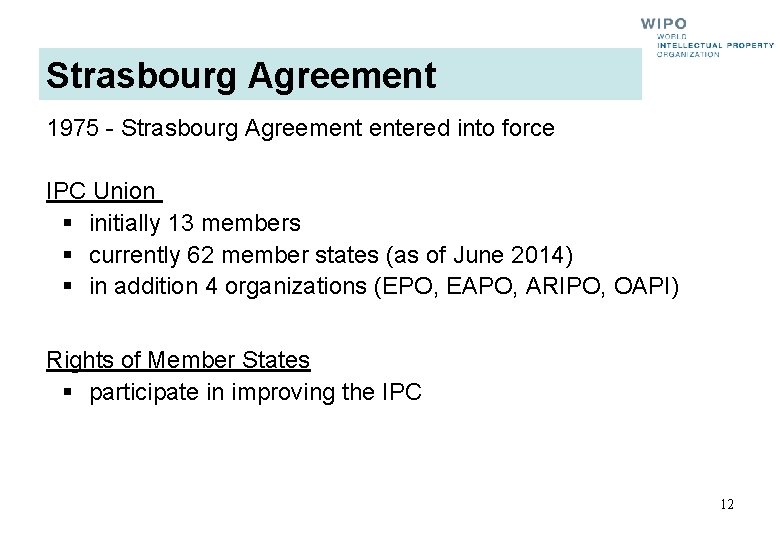
Strasbourg Agreement 1975 - Strasbourg Agreement entered into force IPC Union § initially 13 members § currently 62 member states (as of June 2014) § in addition 4 organizations (EPO, EAPO, ARIPO, OAPI) Rights of Member States § participate in improving the IPC 12
Strasbourg Agreement Obligation of Member States § allot IPC symbols to national published patent documents. Option of classifying in main groups only § IPOs that do not have sufficient expertise for classifying to a detailed level have the option to classify in main groups only. ü IPC applied by more than 100 countries (e. g. 148 PCT members as of June 2014) 13
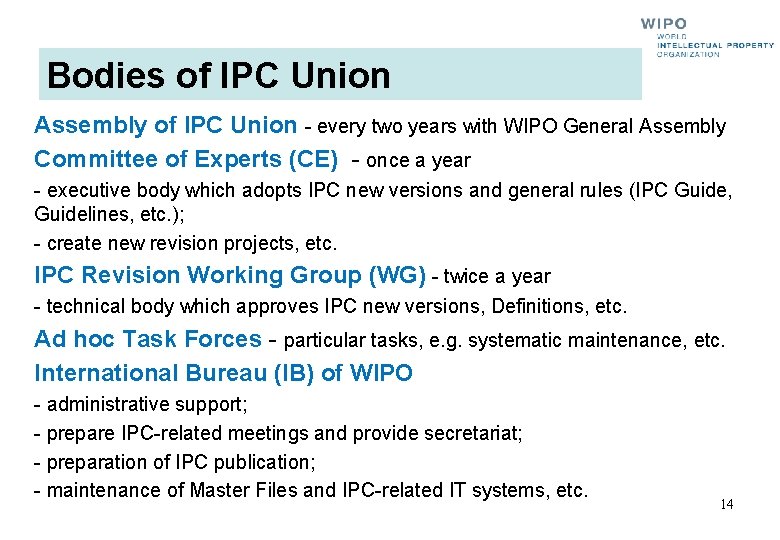
Bodies of IPC Union Assembly of IPC Union - every two years with WIPO General Assembly Committee of Experts (CE) - once a year - executive body which adopts IPC new versions and general rules (IPC Guide, Guidelines, etc. ); - create new revision projects, etc. IPC Revision Working Group (WG) - twice a year - technical body which approves IPC new versions, Definitions, etc. Ad hoc Task Forces - particular tasks, e. g. systematic maintenance, etc. International Bureau (IB) of WIPO - administrative support; - prepare IPC-related meetings and provide secretariat; - preparation of IPC publication; - maintenance of Master Files and IPC-related IT systems, etc. 14
Why use classification? ü Databases can be searched by keywords, specific terms. ü More sophisticated approaches, e. g. § Natural language search § Text mining techniques Advantage of using IPC in comparison to keyword search? 15
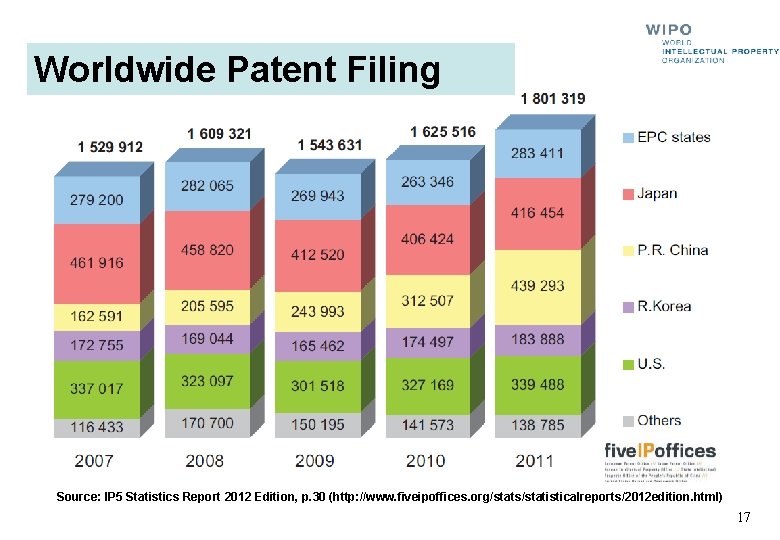
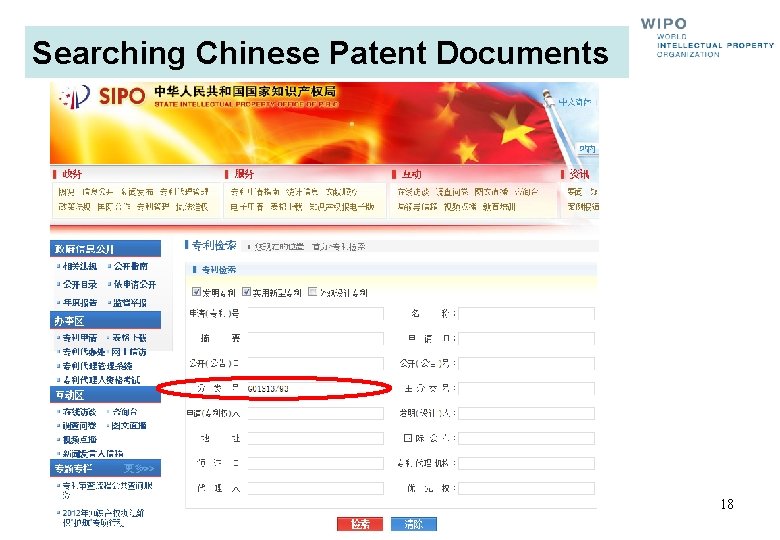
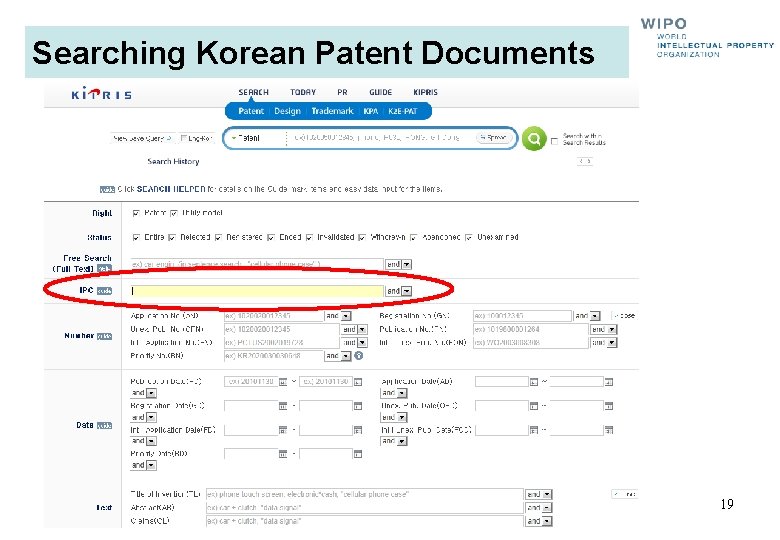
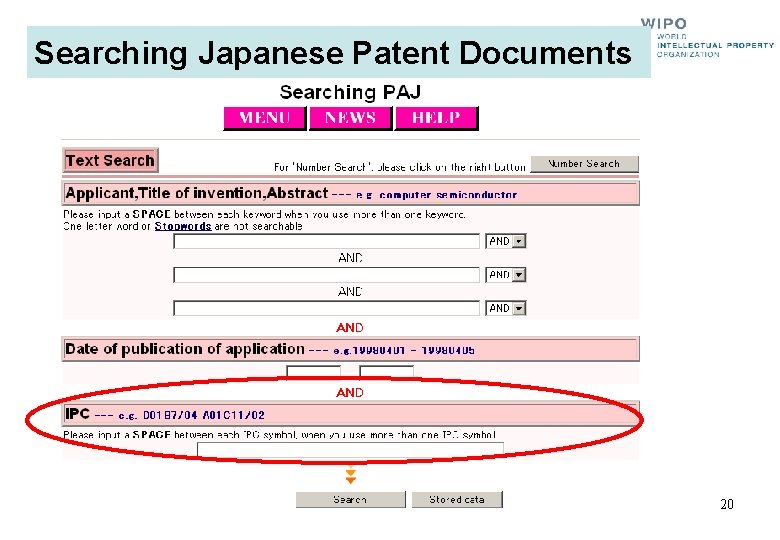
Advantages of using IPC ü Language independent § e. g. searching Chinese, Korean, Japanese patent documents (> 50% of weekly publications) § often only English abstracts, titles 16
Worldwide Patent Filing Source: IP 5 Statistics Report 2012 Edition, p. 30 (http: //www. fiveipoffices. org/stats/statisticalreports/2012 edition. html) 17
Searching Chinese Patent Documents 18
Searching Korean Patent Documents 19
Searching Japanese Patent Documents 20
Advantages of using IPC ü Terminology / “jargon” independent Scientific literature Patent documents/specifications often written by lawyers: > non-experts: not familiar with specific terminology > prefer generic, unspecific terminology for legal reasons, e. g. to avoid any unnecessary limitation of the scope of protection as defined by claims 21
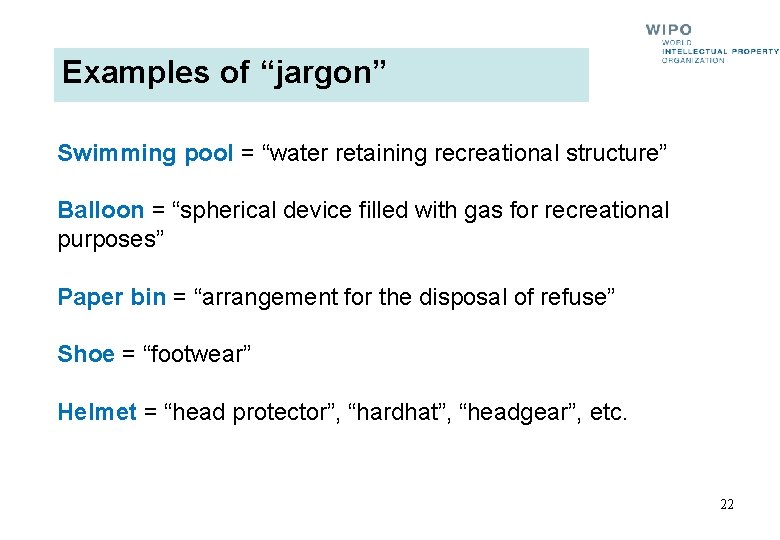
Examples of “jargon” Swimming pool = “water retaining recreational structure” Balloon = “spherical device filled with gas for recreational purposes” Paper bin = “arrangement for the disposal of refuse” Shoe = “footwear” Helmet = “head protector”, “hardhat”, “headgear”, etc. 22
Advantages of using IPC ü Terminology / ”jargon” independent Problems with keyword searching: § Use of inappropriate terminology, avoiding appropriate terminology § Occurring of unwanted/“competing” terminology § Variety of options for describing features § Different content of different parts of specification 23
Advantages of using IPC ü Standardized application to documents by experts of patent offices Ø indexing, added value § Early classification after application > used for publication (18 months after filing) § Reviewed by examiner at examination > classification of granted patents may differ. 24
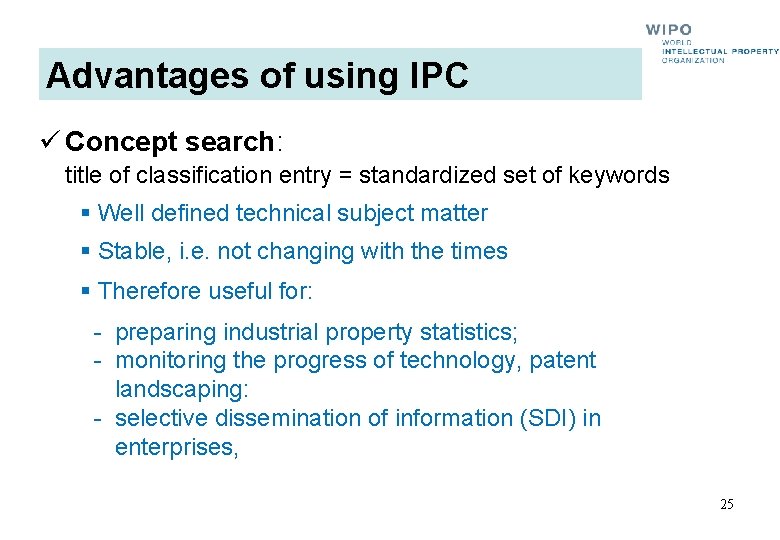
Advantages of using IPC ü Concept search: title of classification entry = standardized set of keywords § Well defined technical subject matter § Stable, i. e. not changing with the times § Therefore useful for: - preparing industrial property statistics; - monitoring the progress of technology, patent landscaping: - selective dissemination of information (SDI) in enterprises, 25
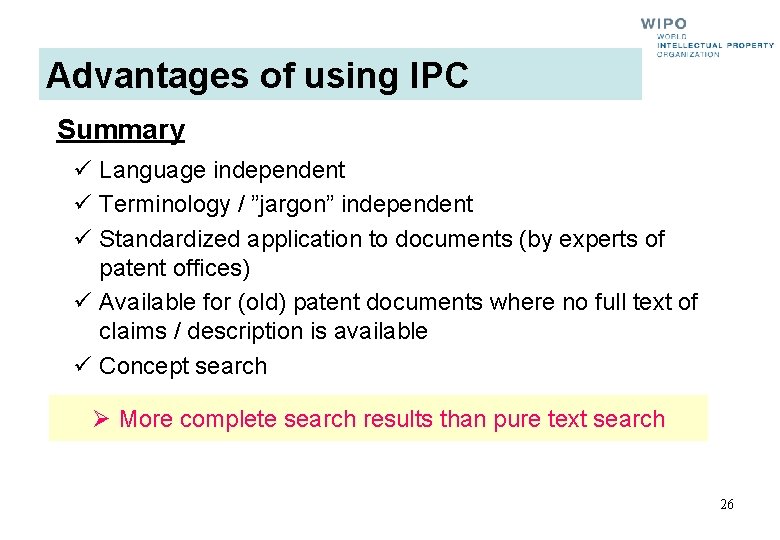
Advantages of using IPC Summary ü Language independent ü Terminology / ”jargon” independent ü Standardized application to documents (by experts of patent offices) ü Available for (old) patent documents where no full text of claims / description is available ü Concept search Ø More complete search results than pure text search 26
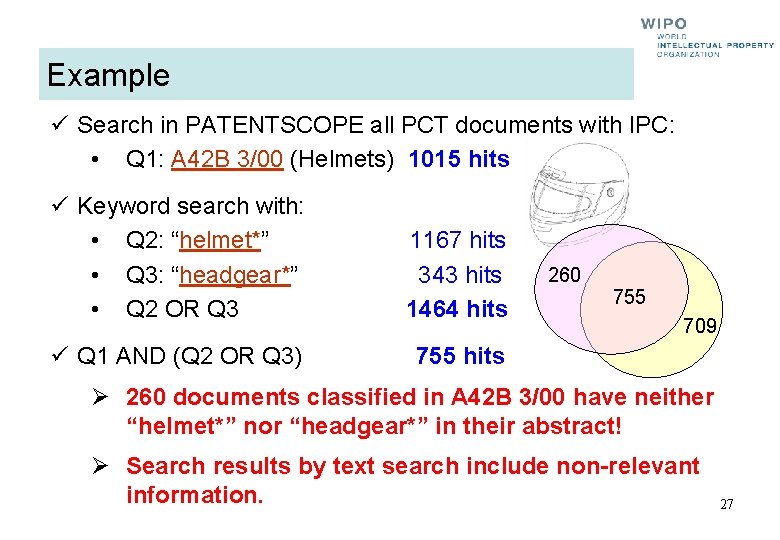
Example ü Search in PATENTSCOPE all PCT documents with IPC: • Q 1: A 42 B 3/00 (Helmets) 1015 hits ü Keyword search with: • Q 2: “helmet*” • Q 3: “headgear*” • Q 2 OR Q 3 1167 hits 343 hits 1464 hits ü Q 1 AND (Q 2 OR Q 3) 755 hits 260 755 709 Ø 260 documents classified in A 42 B 3/00 have neither “helmet*” nor “headgear*” in their abstract! Ø Search results by text search include non-relevant information. 27