
IPC 4 a Calculate speed momentum acceleration work


- Slides: 27
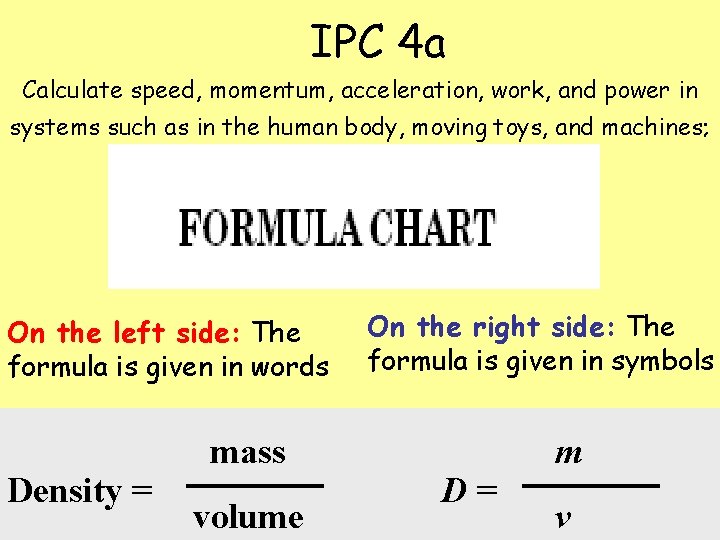
IPC 4 a Calculate speed, momentum, acceleration, work, and power in systems such as in the human body, moving toys, and machines; On the left side: The formula is given in words Density = mass volume On the right side: The formula is given in symbols D= m v
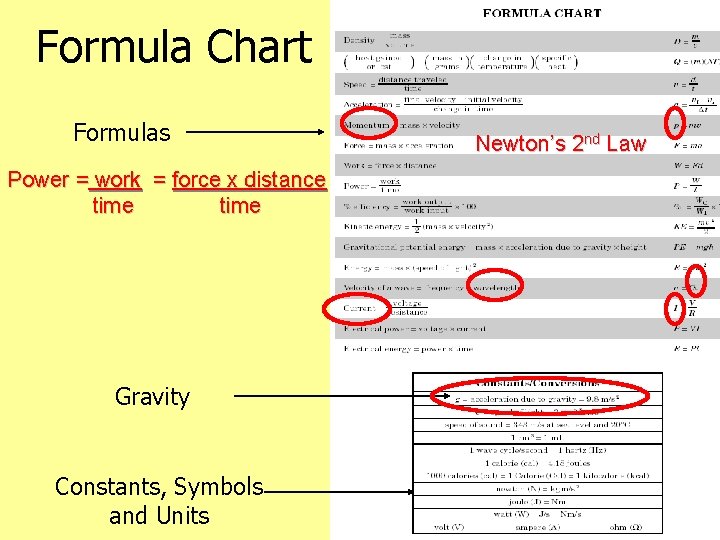
Formula Chart Formulas Power = work = force x distance time Gravity Constants, Symbols and Units Newton’s 2 nd Law
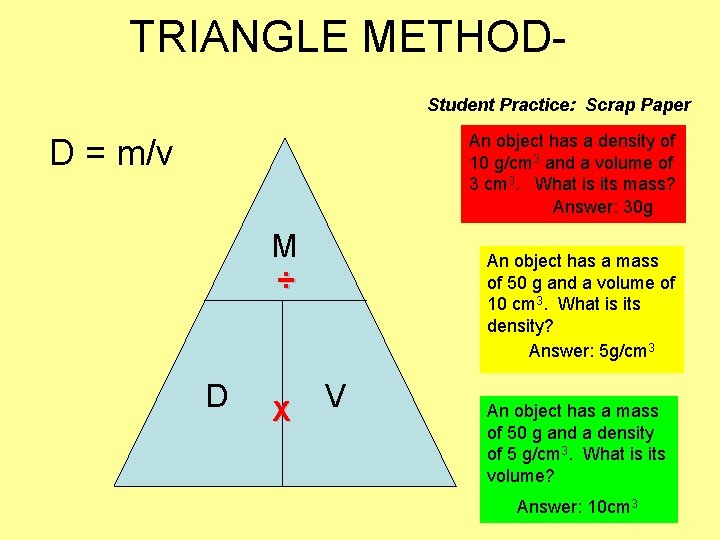
TRIANGLE METHODStudent Practice: Scrap Paper An object has a density of 10 g/cm 3 and a volume of 3 cm 3. What is its mass? Answer: 30 g D = m/v M ÷ D X An object has a mass of 50 g and a volume of 10 cm 3. What is its density? Answer: 5 g/cm 3 V An object has a mass of 50 g and a density of 5 g/cm 3. What is its volume? Answer: 10 cm 3
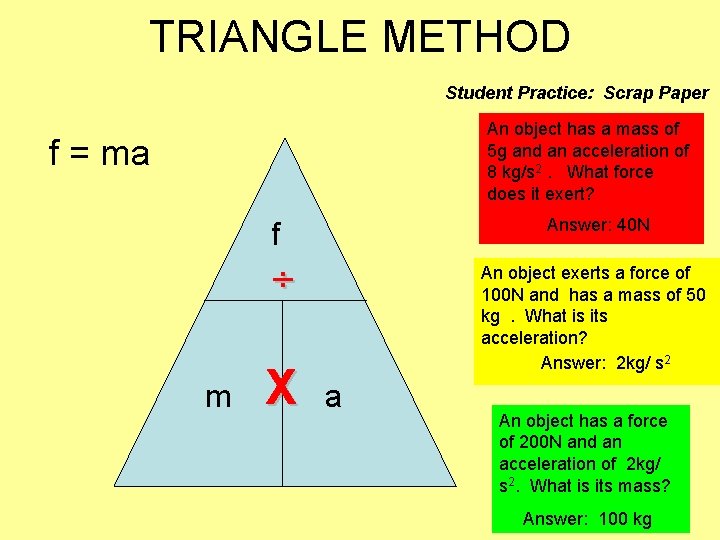
TRIANGLE METHOD Student Practice: Scrap Paper An object has a mass of 5 g and an acceleration of 8 kg/s 2. What force does it exert? f = ma Answer: 40 N f ÷ m X An object exerts a force of 100 N and has a mass of 50 kg. What is its acceleration? Answer: 2 kg/ s 2 a An object has a force of 200 N and an acceleration of 2 kg/ s 2. What is its mass? Answer: 100 kg
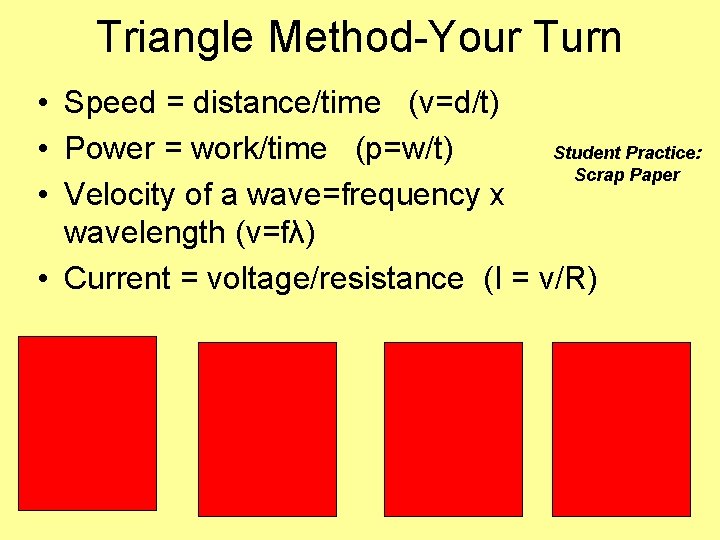
Triangle Method-Your Turn • Speed = distance/time (v=d/t) • Power = work/time (p=w/t) Student Practice: Scrap Paper • Velocity of a wave=frequency x wavelength (v=fλ) • Current = voltage/resistance (I = v/R) d v w t P v v t f λ I R
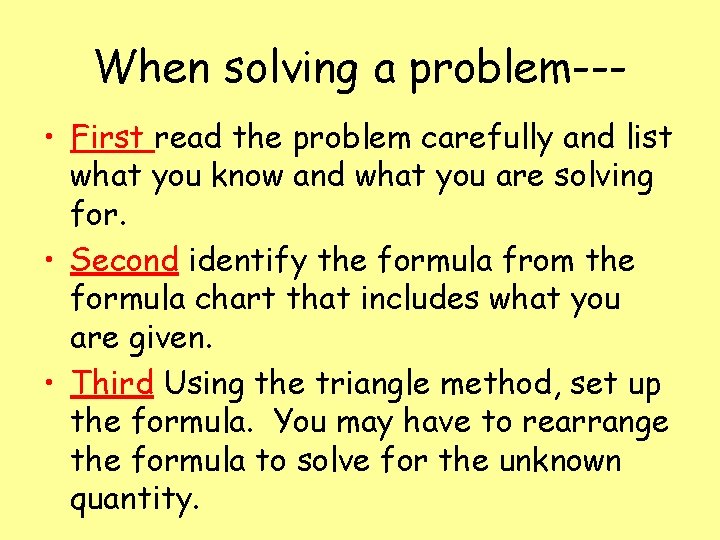
When solving a problem-- • First read the problem carefully and list what you know and what you are solving for. • Second identify the formula from the formula chart that includes what you are given. • Third Using the triangle method, set up the formula. You may have to rearrange the formula to solve for the unknown quantity.
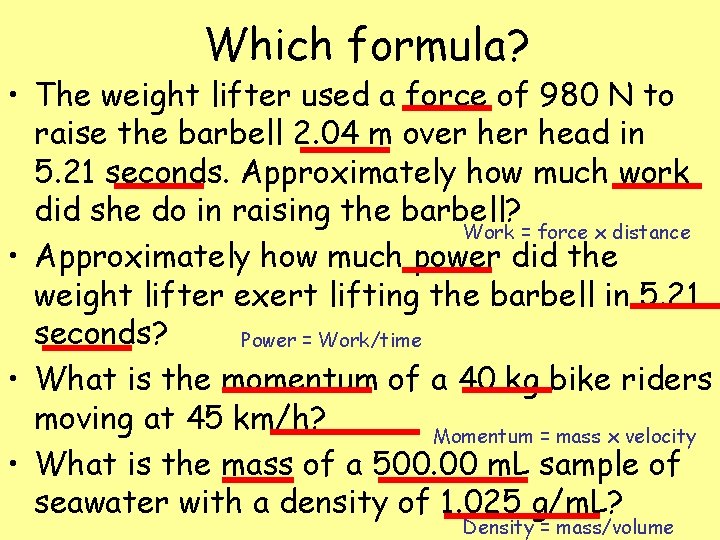
Which formula? • The weight lifter used a force of 980 N to raise the barbell 2. 04 m over head in 5. 21 seconds. Approximately how much work did she do in raising the barbell? Work = force x distance • Approximately how much power did the weight lifter exert lifting the barbell in 5. 21 seconds? Power = Work/time • What is the momentum of a 40 kg bike riders moving at 45 km/h? Momentum = mass x velocity • What is the mass of a 500. 00 m. L sample of seawater with a density of 1. 025 g/m. L? Density = mass/volume
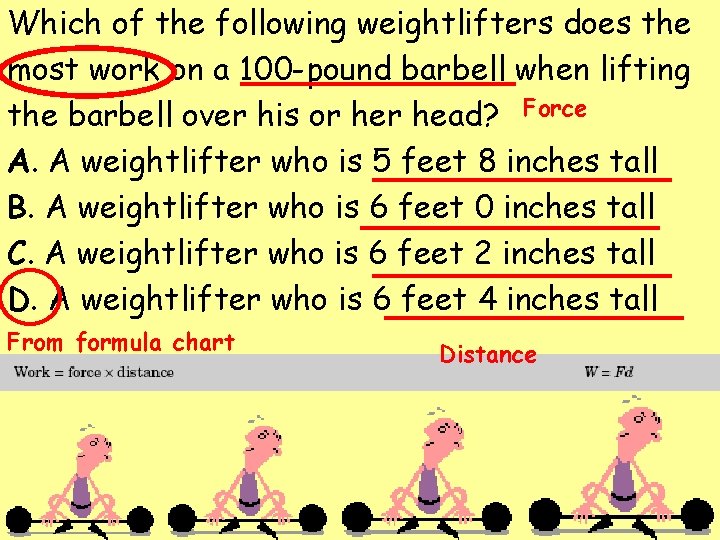
Which of the following weightlifters does the most work on a 100 -pound barbell when lifting the barbell over his or head? Force A. A weightlifter who is 5 feet 8 inches tall B. A weightlifter who is 6 feet 0 inches tall C. A weightlifter who is 6 feet 2 inches tall D. A weightlifter who is 6 feet 4 inches tall From formula chart Distance
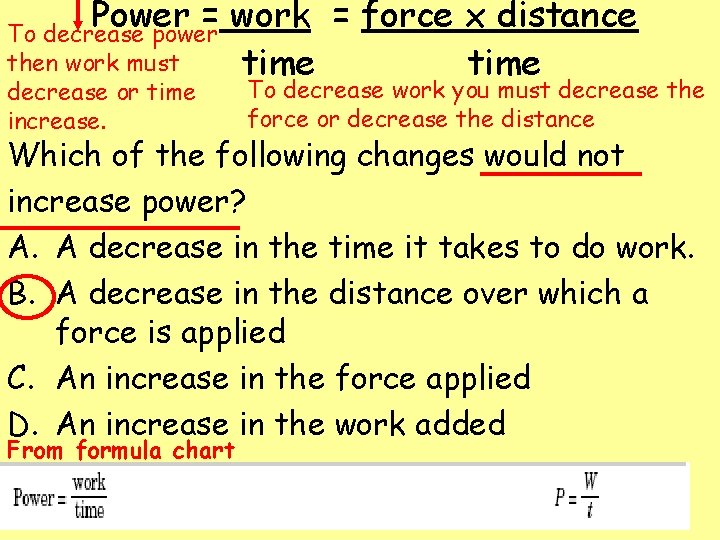
Power = work = force x distance To decrease power then work must time decrease or time increase. To decrease work you must decrease the force or decrease the distance Which of the following changes would not increase power? A. A decrease in the time it takes to do work. B. A decrease in the distance over which a force is applied C. An increase in the force applied D. An increase in the work added From formula chart
When solving a problem-- • First read the problem carefully and list what you know and what you are solving for. • Second identify the formula from the formula chart that includes what you are given. • Third Using the triangle method, set up the formula. You may have to rearrange the formula to solve for the unknown quantity.
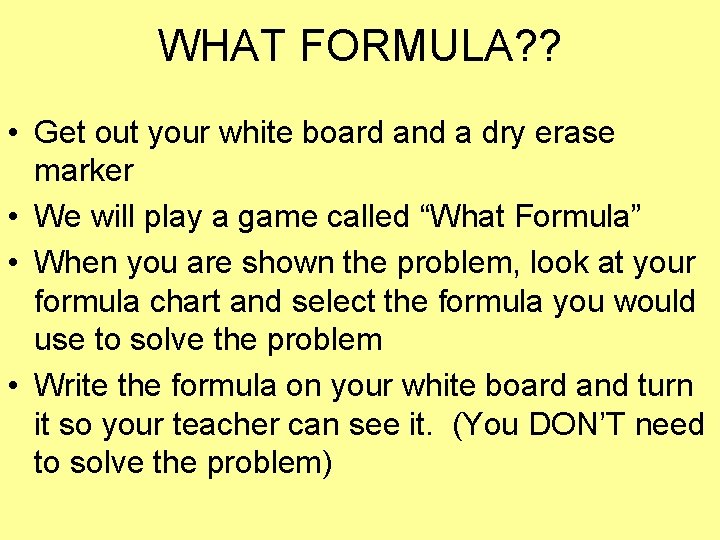
WHAT FORMULA? ? • Get out your white board and a dry erase marker • We will play a game called “What Formula” • When you are shown the problem, look at your formula chart and select the formula you would use to solve the problem • Write the formula on your white board and turn it so your teacher can see it. (You DON’T need to solve the problem)
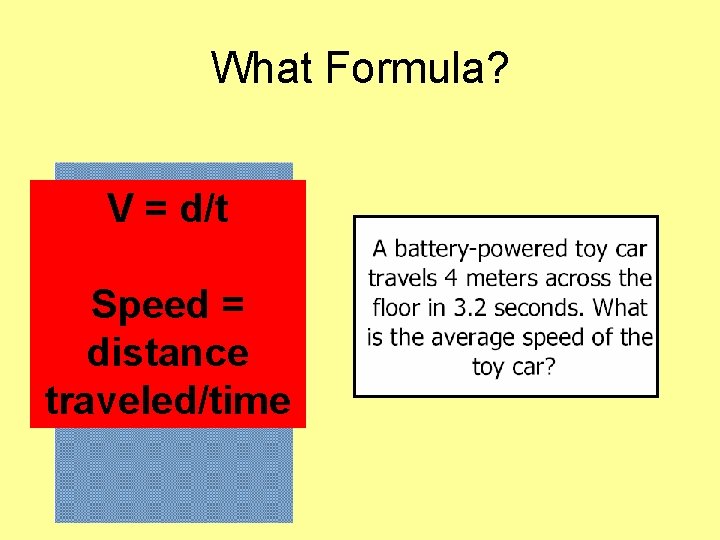
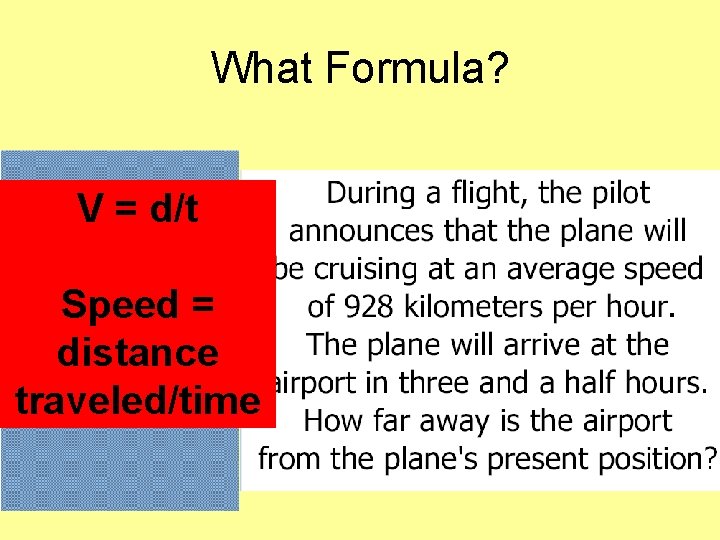
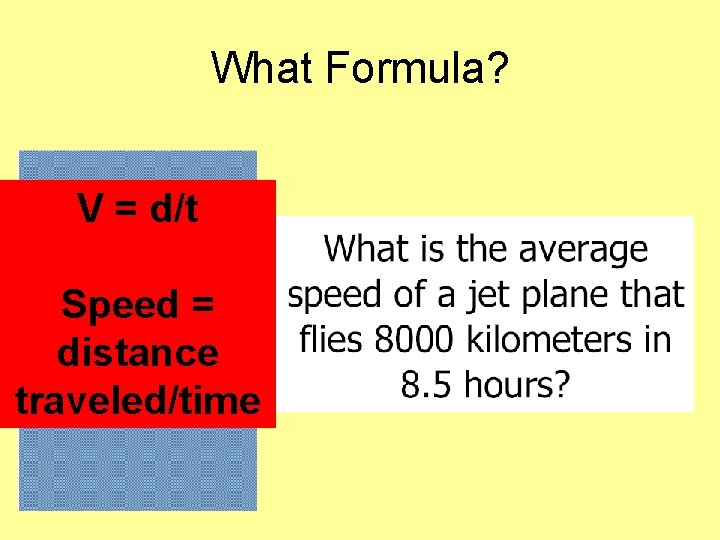
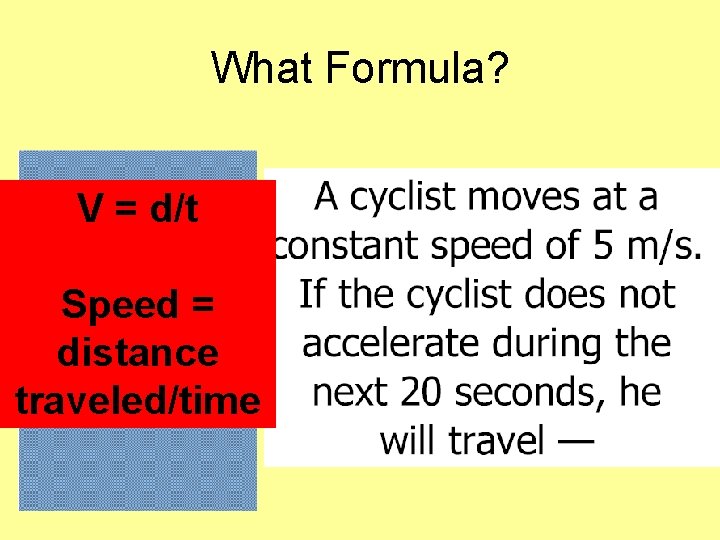
What Formula? V = d/t Speed = distance traveled/time
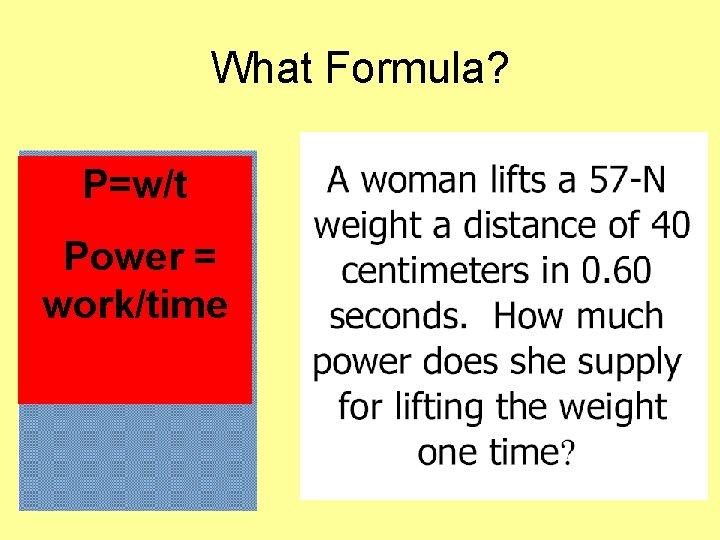
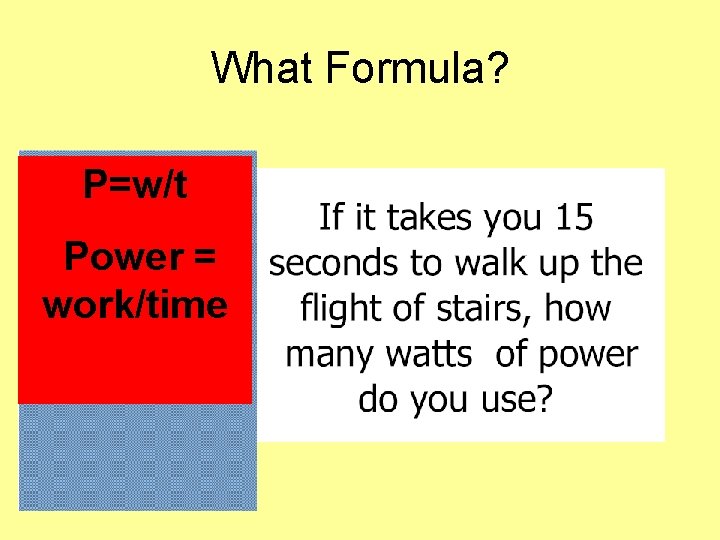
What Formula? P=w/t Power = work/time
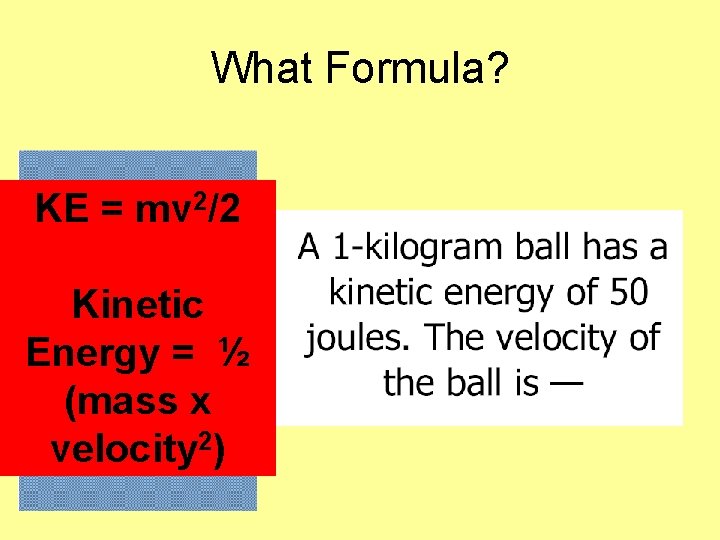
What Formula? KE = mv 2/2 Kinetic Energy = ½ (mass x velocity 2)
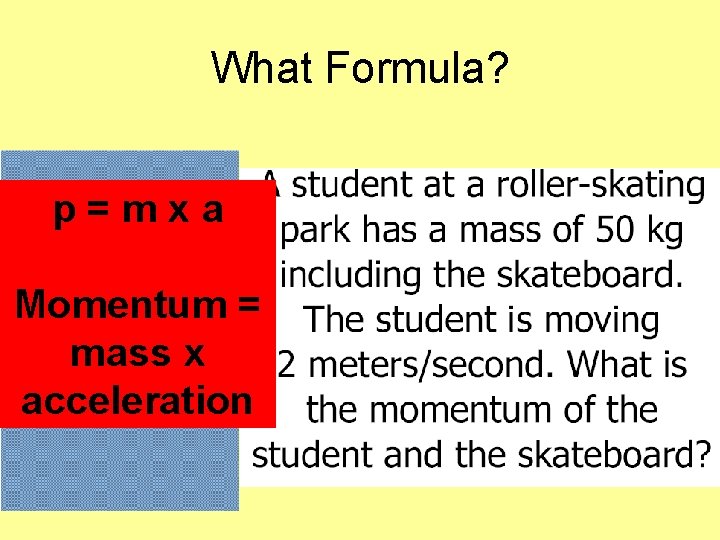
What Formula? p=mxa Momentum = mass x acceleration
What Formula? V = d/t Speed = distance traveled/time
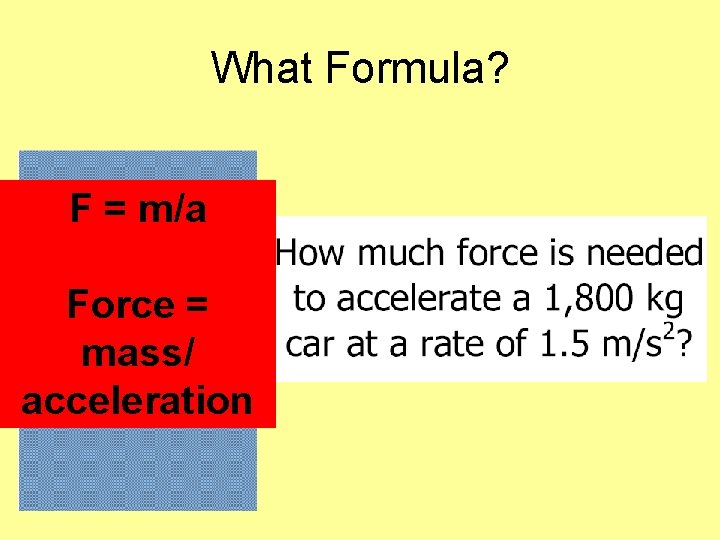
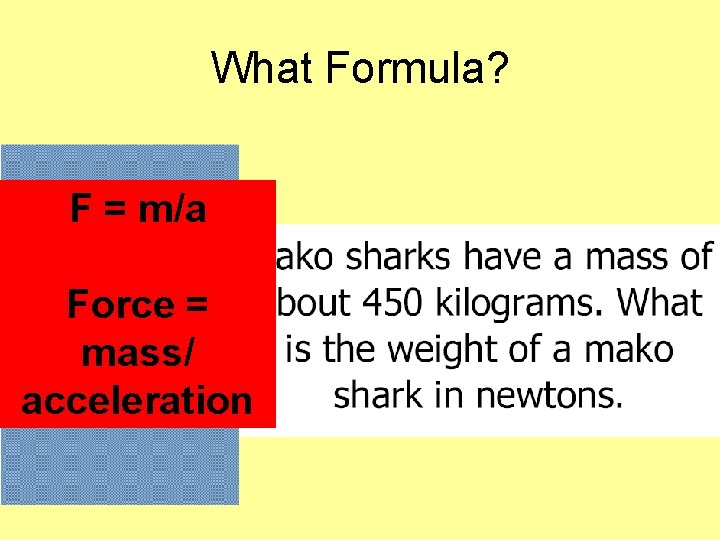
What Formula? F = m/a Force = mass/ acceleration
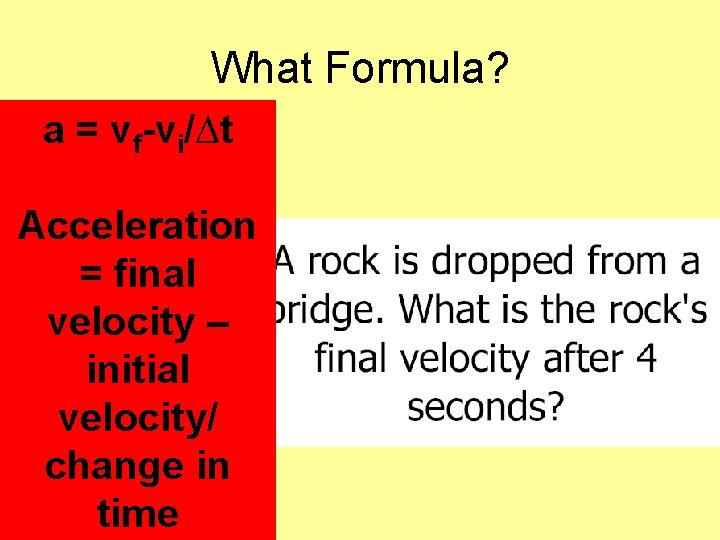
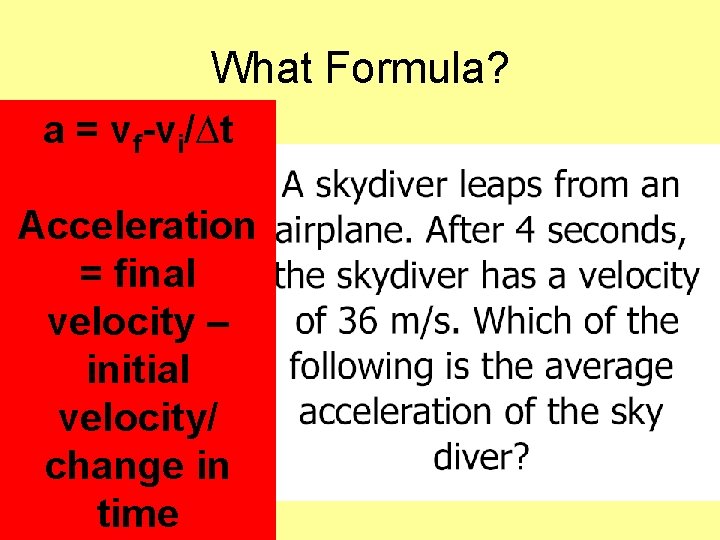
What Formula? a = vf-vi/∆t Acceleration = final velocity – initial velocity/ change in time
What Formula? V = d/t Speed = distance traveled/time
What Formula? P=w/t Power = work/time
What Formula? F = m/a Force = mass/ acceleration
What Formula? a = vf-vi/∆t Acceleration = final velocity – initial velocity/ change in time
What Formula? V = d/t Speed = distance traveled/time
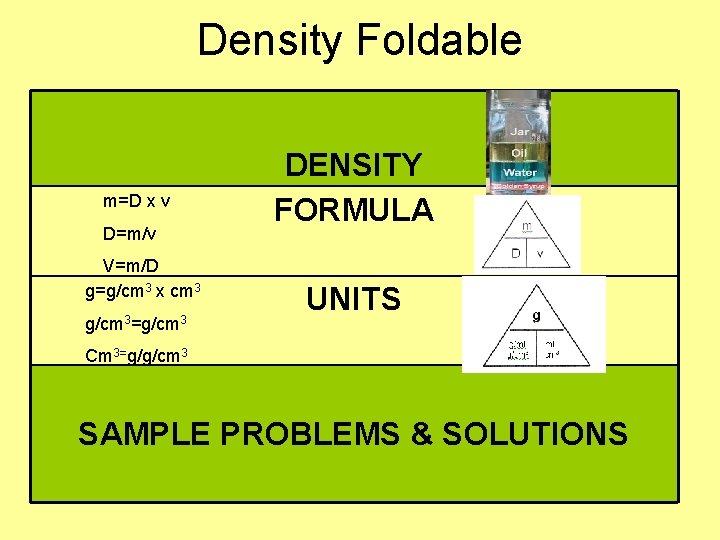
Density Foldable We will now make a Density foldable
Density Foldable m=D x v D=m/v V=m/D g=g/cm 3 x cm 3 g/cm 3=g/cm 3 DENSITY FORMULA UNITS Cm 3=g/g/cm 3 SAMPLE PROBLEMS & SOLUTIONS
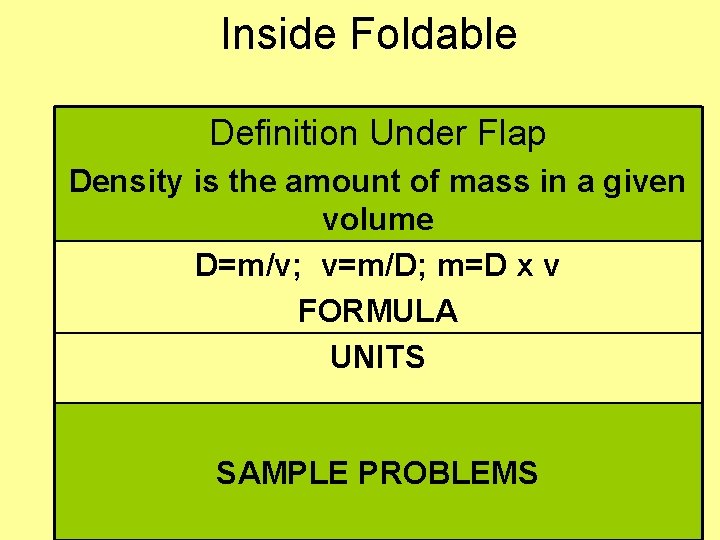
Inside Foldable Definition Under Flap Density is the amount of mass in a given volume D=m/v; v=m/D; m=D x v FORMULA UNITS SAMPLE PROBLEMS
GOOD LUCK!!!!