
IPASS Improving Disseminating and Sustaining Safer Handoffs Christopher
- Slides: 30
I-PASS: Improving, Disseminating, and Sustaining Safer Handoffs Christopher P. Landrigan, MD, MPH Massachusetts Coalition for the Prevention of Medical Errors March 30, 2017
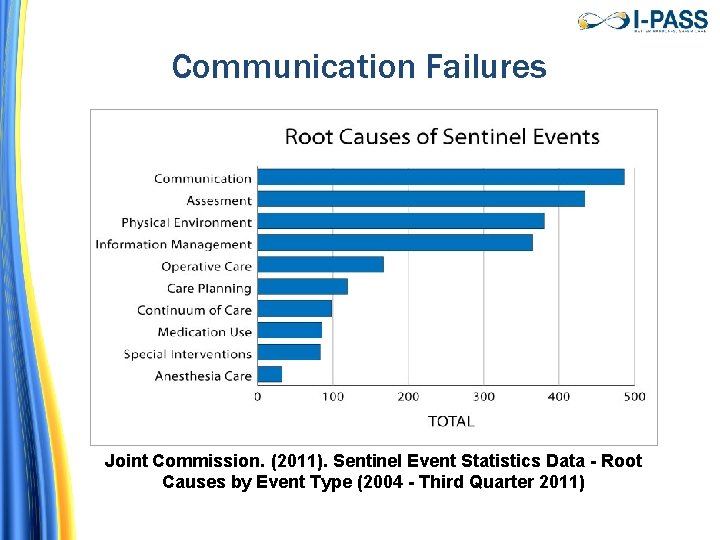
Communication Failures Joint Commission. (2011). Sentinel Event Statistics Data - Root Causes by Event Type (2004 - Third Quarter 2011)
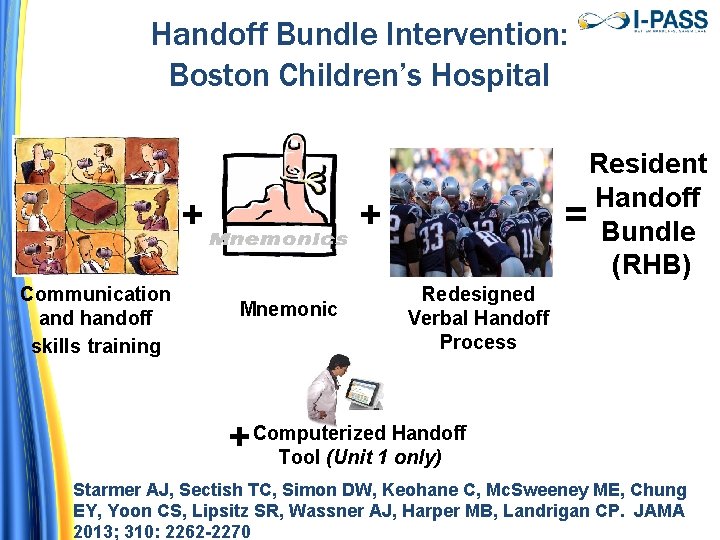
Handoff Bundle Intervention: Boston Children’s Hospital + Communication and handoff skills training Resident Handoff = Bundle (RHB) + Mnemonic Redesigned Verbal Handoff Process Handoff +Computerized Tool (Unit 1 only) Starmer AJ, Sectish TC, Simon DW, Keohane C, Mc. Sweeney ME, Chung EY, Yoon CS, Lipsitz SR, Wassner AJ, Harper MB, Landrigan CP. JAMA 2013; 310: 2262 -2270
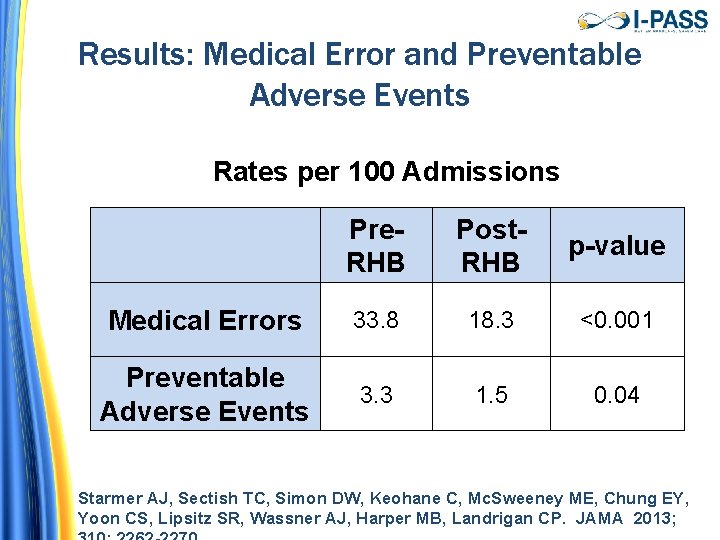
Results: Medical Error and Preventable Adverse Events Rates per 100 Admissions Pre. RHB Post. RHB p-value Medical Errors 33. 8 18. 3 <0. 001 Preventable Adverse Events 3. 3 1. 5 0. 04 Starmer AJ, Sectish TC, Simon DW, Keohane C, Mc. Sweeney ME, Chung EY, Yoon CS, Lipsitz SR, Wassner AJ, Harper MB, Landrigan CP. JAMA 2013;
From Pilot Study to Multi-center Intervention Project… IIPE-PRIS Accelerating Safe Sign-outs § Multisite study to implement refined handoff bundle for resident physician change of shift handoffs at 9 pediatric institutions
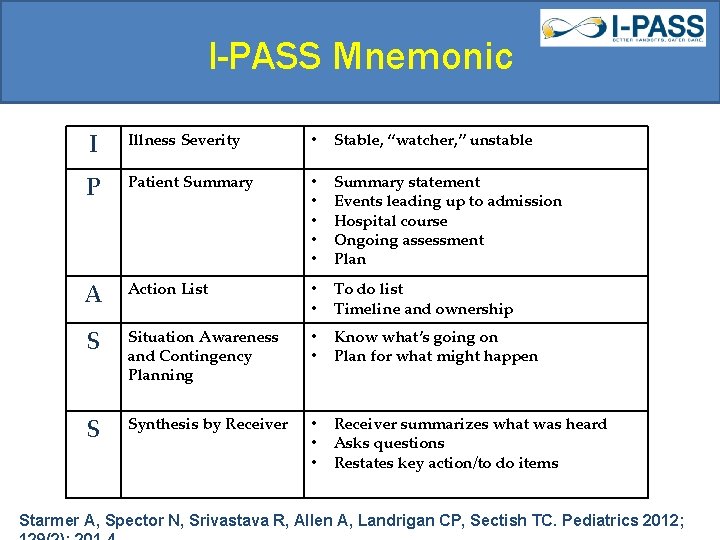
I-PASS Mnemonic I Illness Severity • Stable, “watcher, ” unstable P Patient Summary • • • Summary statement Events leading up to admission Hospital course Ongoing assessment Plan A Action List • • To do list Timeline and ownership S Situation Awareness and Contingency Planning • • Know what’s going on Plan for what might happen S Synthesis by Receiver • • • Receiver summarizes what was heard Asks questions Restates key action/to do items Starmer A, Spector N, Srivastava R, Allen A, Landrigan CP, Sectish TC. Pediatrics 2012;
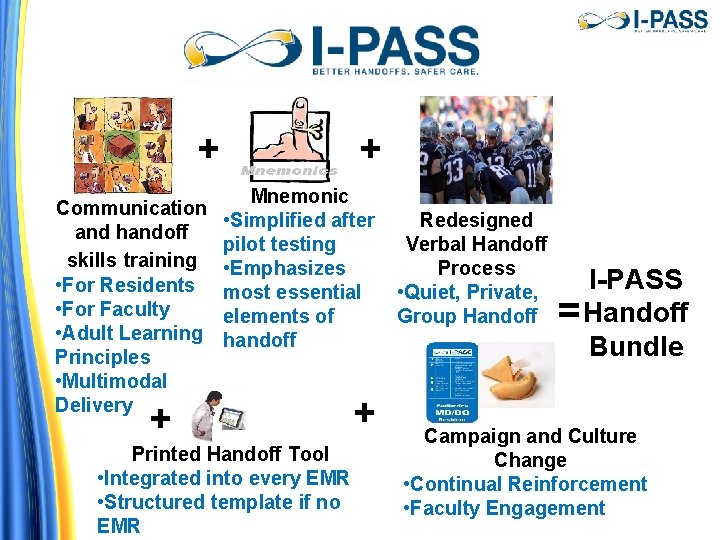
+ + Communication and handoff skills training • For Residents • For Faculty • Adult Learning Principles • Multimodal Delivery Mnemonic • Simplified after pilot testing • Emphasizes most essential elements of handoff + Printed Handoff Tool • Integrated into every EMR • Structured template if no EMR + Redesigned Verbal Handoff Process • Quiet, Private, Group Handoff I-PASS = Handoff Bundle Campaign and Culture Change • Continual Reinforcement • Faculty Engagement
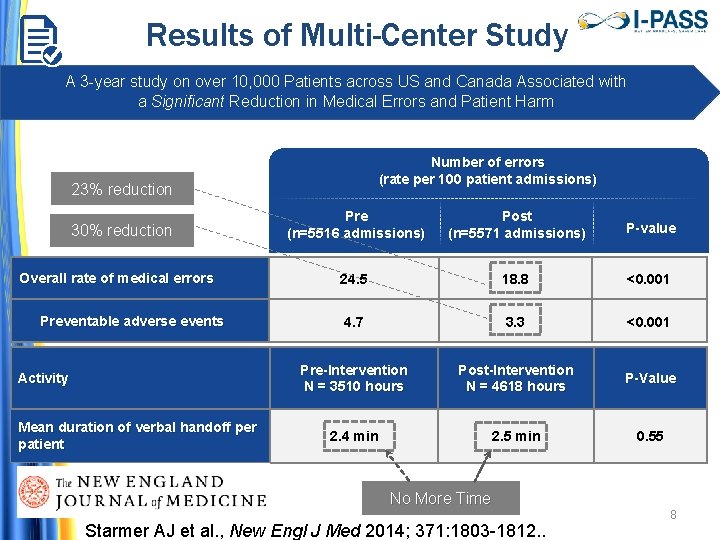
Results of Multi-Center Study A 3 -year study on over 10, 000 Patients across US and Canada Associated with a Significant Reduction in Medical Errors and Patient Harm Number of errors (rate per 100 patient admissions) 23% reduction 30% reduction Overall rate of medical errors Preventable adverse events Activity Mean duration of verbal handoff per patient Pre (n=5516 admissions) Post (n=5571 admissions) P-value 24. 5 18. 8 <0. 001 4. 7 3. 3 <0. 001 Pre-Intervention N = 3510 hours Post-Intervention N = 4618 hours P-Value 2. 4 min 2. 5 min 0. 55 No More Time Starmer AJ et al. , New Engl J Med 2014; 371: 1803 -1812. . 8
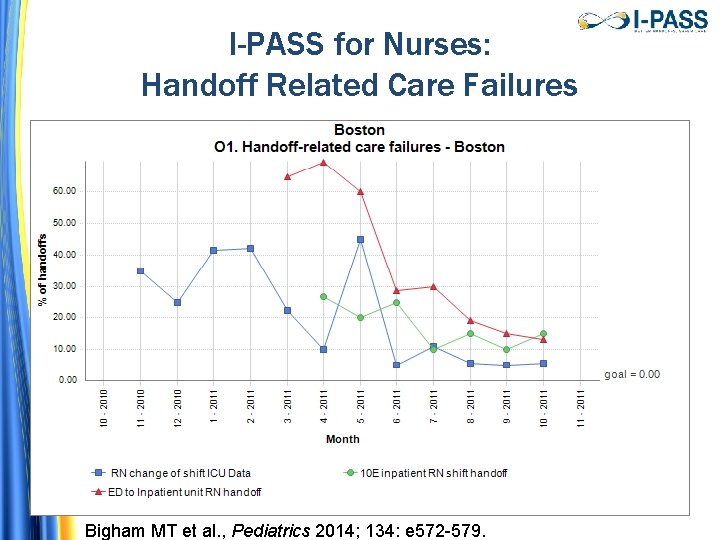
I-PASS for Nurses: Handoff Related Care Failures Bigham MT et al. , Pediatrics 2014; 134: e 572 -579.
I-PASS Dissemination and Extension
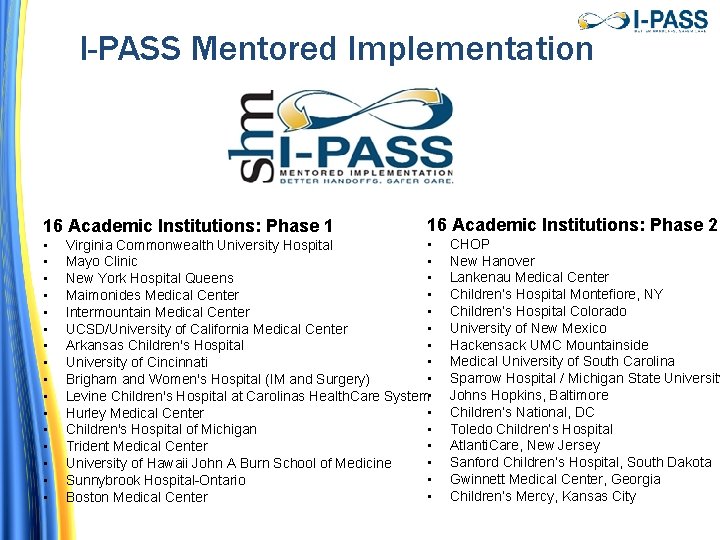
I-PASS Mentored Implementation 16 Academic Institutions: Phase 1 • • • • 16 Academic Institutions: Phase 2 • Virginia Commonwealth University Hospital • Mayo Clinic • New York Hospital Queens • Maimonides Medical Center • Intermountain Medical Center • UCSD/University of California Medical Center • Arkansas Children's Hospital • University of Cincinnati • Brigham and Women's Hospital (IM and Surgery) Levine Children's Hospital at Carolinas Health. Care System • • Hurley Medical Center • Children's Hospital of Michigan • Trident Medical Center • University of Hawaii John A Burn School of Medicine • Sunnybrook Hospital-Ontario • Boston Medical Center CHOP New Hanover Lankenau Medical Center Children’s Hospital Montefiore, NY Children’s Hospital Colorado University of New Mexico Hackensack UMC Mountainside Medical University of South Carolina Sparrow Hospital / Michigan State University Johns Hopkins, Baltimore Children’s National, DC Toledo Children’s Hospital Atlanti. Care, New Jersey Sanford Children’s Hospital, South Dakota Gwinnett Medical Center, Georgia Children’s Mercy, Kansas City
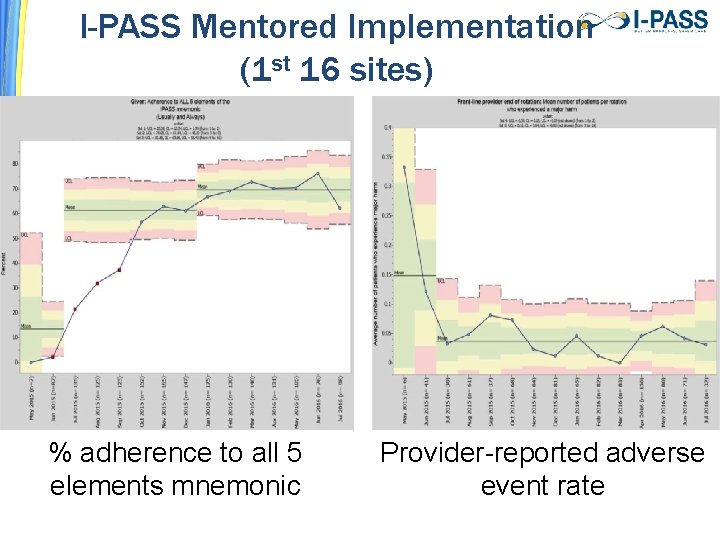
I-PASS Mentored Implementation (1 st 16 sites) % adherence to all 5 elements mnemonic Provider-reported adverse event rate
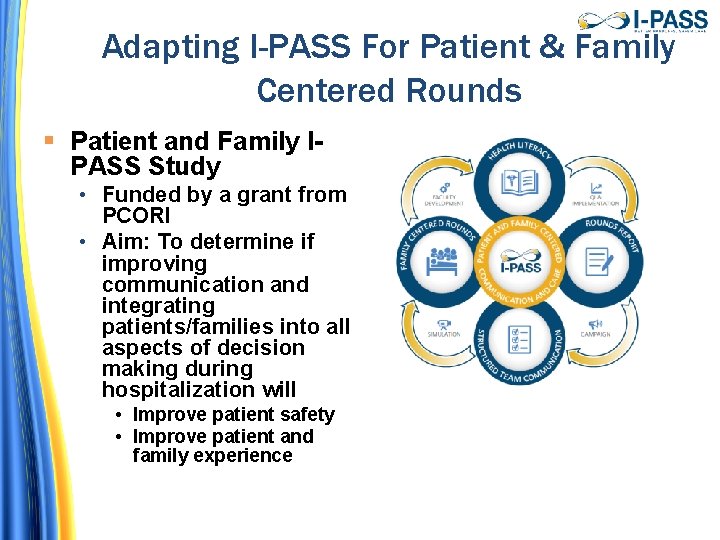
Adapting I-PASS For Patient & Family Centered Rounds § Patient and Family IPASS Study • Funded by a grant from PCORI • Aim: To determine if improving communication and integrating patients/families into all aspects of decision making during hospitalization will • Improve patient safety • Improve patient and family experience
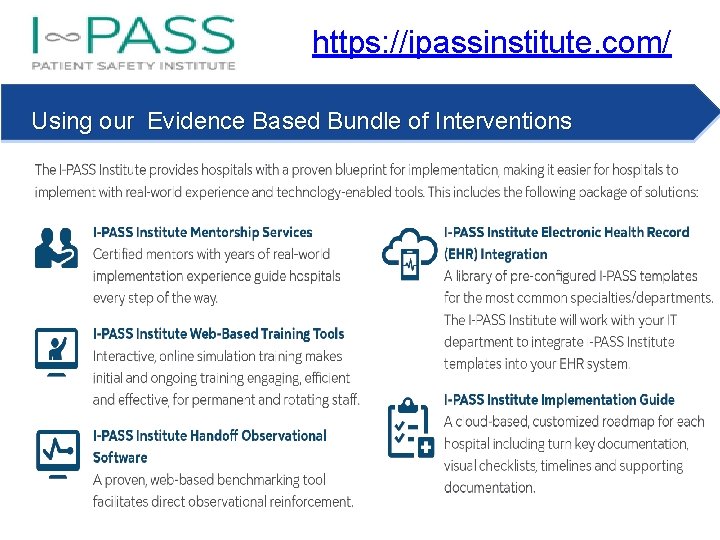
https: //ipassinstitute. com/ Using our Evidence Based Bundle of Interventions 14
Contact Information Christopher P. Landrigan, MD, MPH David M. Shahian, MD Professor of Surgery, Harvard Medical School Vice President, Massachusetts General Hospital Center for Quality and Safety Email: DSHAHIAN@mgh. harvard. edu Principal Investigator, I-PASS Study Group Pediatric Hospitalist at Boston Children’s Hospital Associate Professor of Pediatrics and Medicine at Harvard Medical School Founder and Board Member of the IPASS Patient Safety Institute Email: CLANDRIGAN@PARTNERS. ORG 15
Large scale I-PASS Implementation at a Tertiary Academic Medical Center David M. Shahian, MD Professor of Surgery, Harvard Medical School Vice President, MGH Center for Quality and Safety March 30, 2017
Handovers have not evolved with changes in healthcare § Healthcare has changed dramatically and handovers, which were never very good, have now become dangerously inadequate • Greater range of diagnoses and treatments • More practitioners involved in most patient’s care • More sites where care is delivered (inpatient, ambulatory) • Team-based care • Work hours restrictions, cross-coverage, night floats § AMCs particularly vulnerable • Size, case mix acuity, complexity • Educational mission § We lag far behind other high reliability professions 17
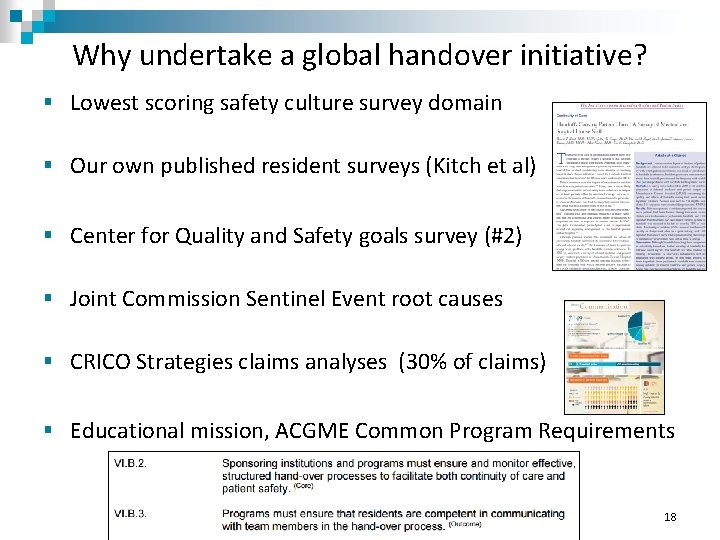
Why undertake a global handover initiative? § Lowest scoring safety culture survey domain § Our own published resident surveys (Kitch et al) § Center for Quality and Safety goals survey (#2) § Joint Commission Sentinel Event root causes § CRICO Strategies claims analyses (30% of claims) § Educational mission, ACGME Common Program Requirements 18
Why I-PASS? § Simple and intuitive § Accommodates multiple complex problems/tasks § Specifically designed for use in healthcare § Developed locally (Boston Children’s Hospital)—great colleagues! § Extensive educational materials § Widespread national and international interest § Empirical data demonstrating effectiveness 19
Why I-PASS? • Standardized content, structure, sequence • Verbal and written information transfer • Interactive communication/dialogue • Incorporates basic Team. STEPPS training • Deal with urgent or acute issues before handoffs • “Sterile cockpit”—limit interruptions, focus on handover • Explicit contingency planning • Verification—”read-back” or “check back” 20
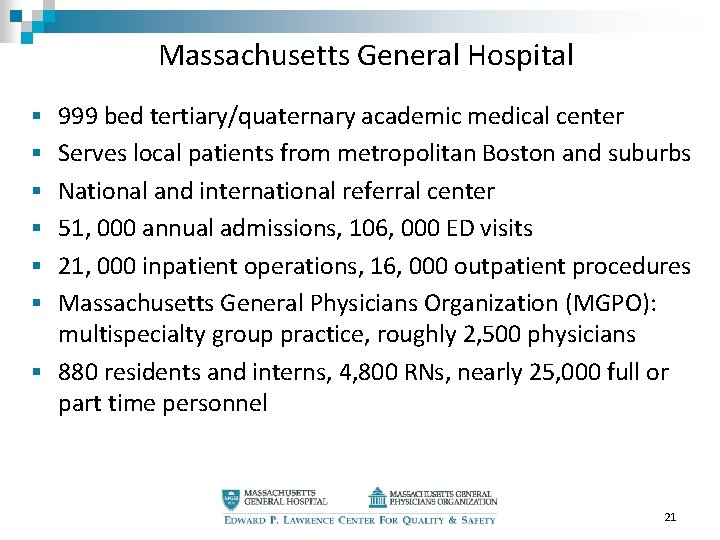
Massachusetts General Hospital § 999 bed tertiary/quaternary academic medical center § Serves local patients from metropolitan Boston and suburbs § National and international referral center § 51, 000 annual admissions, 106, 000 ED visits § 21, 000 inpatient operations, 16, 000 outpatient procedures § Massachusetts General Physicians Organization (MGPO): multispecialty group practice, roughly 2, 500 physicians § 880 residents and interns, 4, 800 RNs, nearly 25, 000 full or part time personnel 21
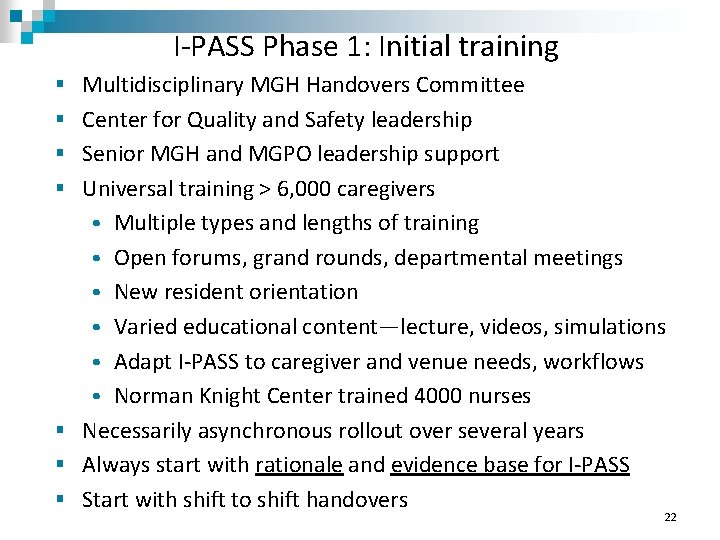
I-PASS Phase 1: Initial training § Multidisciplinary MGH Handovers Committee § Center for Quality and Safety leadership § Senior MGH and MGPO leadership support § Universal training > 6, 000 caregivers • Multiple types and lengths of training • Open forums, grand rounds, departmental meetings • New resident orientation • Varied educational content—lecture, videos, simulations • Adapt I-PASS to caregiver and venue needs, workflows • Norman Knight Center trained 4000 nurses § Necessarily asynchronous rollout over several years § Always start with rationale and evidence base for I-PASS § Start with shift to shift handovers 22
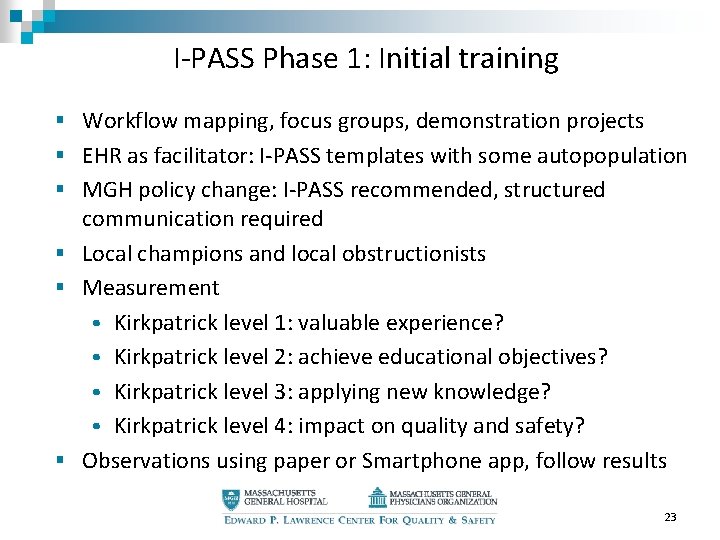
I-PASS Phase 1: Initial training § Workflow mapping, focus groups, demonstration projects § EHR as facilitator: I-PASS templates with some autopopulation § MGH policy change: I-PASS recommended, structured communication required § Local champions and local obstructionists § Measurement • Kirkpatrick level 1: valuable experience? • Kirkpatrick level 2: achieve educational objectives? • Kirkpatrick level 3: applying new knowledge? • Kirkpatrick level 4: impact on quality and safety? § Observations using paper or Smartphone app, follow results 23
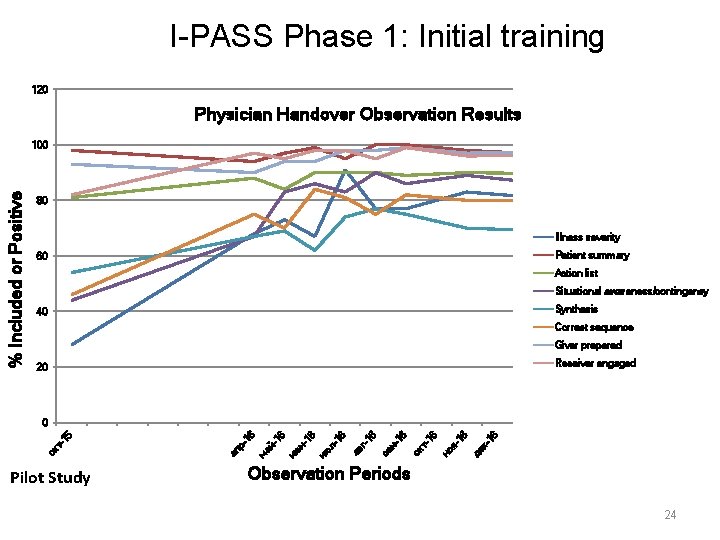
I-PASS Phase 1: Initial training 120 Physician Handover Observation Results % Included or Positive 100 80 Illness severity Patient summary 60 Action list Situational awareness/contingency Synthesis 40 Correct sequence Giver prepared Receiver engaged 20 Pilot Study 6 16 кде -1 но я ок т- 16 16 нсе 16 гав 16 л- ию н 16 -1 ай ию 6 6 м 6 -1 ап р -1 ар м ев -1 6 16 ф вян 15 кде 5 -1 но я ок т- 15 0 Observation Periods 24
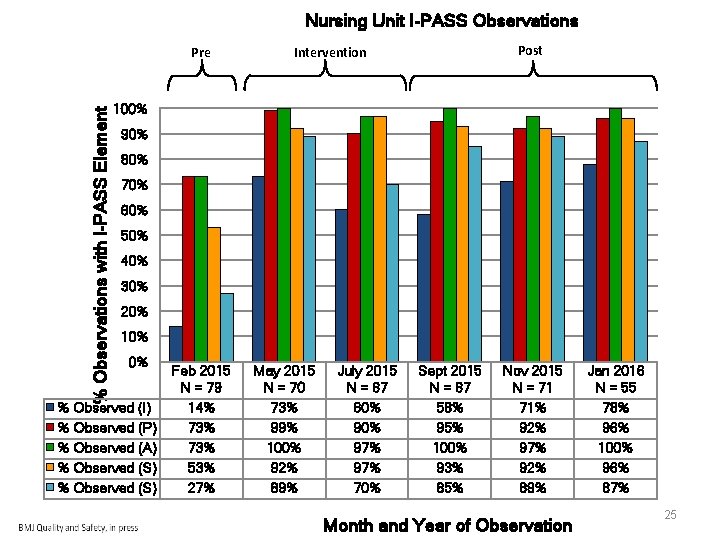
Nursing Unit I-PASS Observations % Observations with I-PASS Element Pre Post Intervention 100% 90% 80% 70% 60% 50% 40% 30% 20% 10% 0% % Observed (I) % Observed (P) % Observed (A) % Observed (S) Feb 2015 N = 79 14% 73% 53% 27% May 2015 N = 70 73% 99% 100% 92% 89% July 2015 N = 67 60% 97% 97% 70% Sept 2015 N = 67 58% 95% 100% 93% 85% Nov 2015 N = 71 71% 92% 97% 92% 89% Month and Year of Observation Jan 2016 N = 55 78% 96% 100% 96% 87% 25
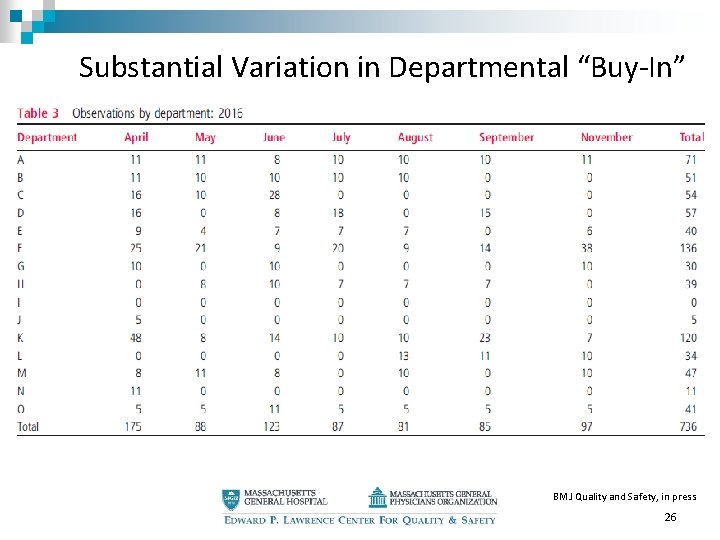
Substantial Variation in Departmental “Buy-In” BMJ Quality and Safety, in press 26
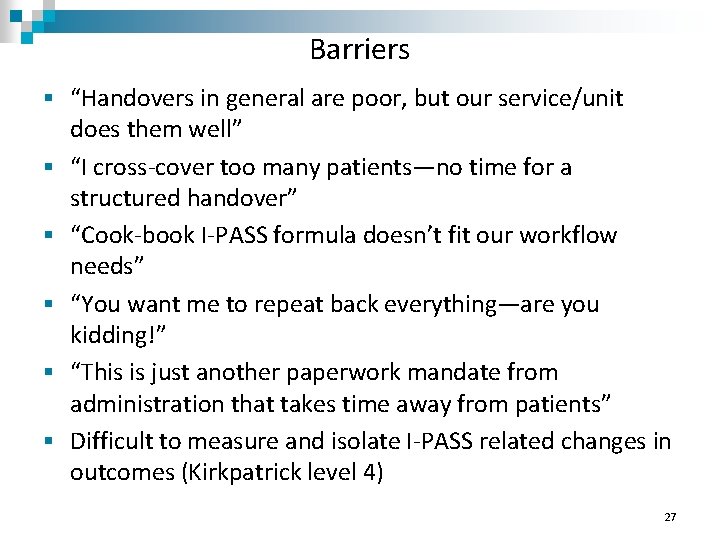
Barriers § “Handovers in general are poor, but our service/unit § § § does them well” “I cross-cover too many patients—no time for a structured handover” “Cook-book I-PASS formula doesn’t fit our workflow needs” “You want me to repeat back everything—are you kidding!” “This is just another paperwork mandate from administration that takes time away from patients” Difficult to measure and isolate I-PASS related changes in outcomes (Kirkpatrick level 4) 27
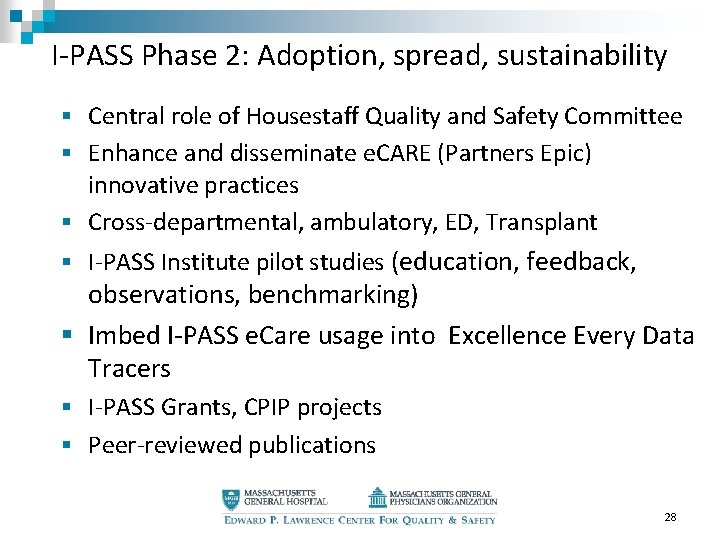
I-PASS Phase 2: Adoption, spread, sustainability § Central role of Housestaff Quality and Safety Committee § Enhance and disseminate e. CARE (Partners Epic) innovative practices § Cross-departmental, ambulatory, ED, Transplant § I-PASS Institute pilot studies (education, feedback, observations, benchmarking) § Imbed I-PASS e. Care usage into Excellence Every Data Tracers § I-PASS Grants, CPIP projects § Peer-reviewed publications 28
I-PASS Phase 2: Adoption, spread, sustainability § Measuring success • Kirkpatrick level 4 proxies—housestaff surveys? • Repeat safety culture survey • Handover-related safety reports § Imbed I-PASS into MGH culture 29
Contact Information Christopher P. Landrigan, MD, MPH David M. Shahian, MD Principal Investigator, I-PASS Study Group Pediatric Hospitalist at Boston Children’s Hospital Associate Professor of Pediatrics and Medicine at Harvard Medical School Founder and Board Member of the I-PASS Patient Safety Institute Email: CLANDRIGAN@PARTNERS. ORG Professor of Surgery, Harvard Medical School Vice President, Massachusetts General Hospital Center for Quality and Safety Email: DSHAHIAN@mgh. harvard. edu 30