
IP Update Patent Litigation and AI Judith Robinson
IP Update : Patent Litigation and AI Judith Robinson judith. robinson@nortonrosefulbright. com 2018 CAN-TECH LAW 22 nd Annual Conference Montreal October 29, 2018
“Whereas from Mary Shelley’s Frankenstein’s Monster to the classical myth of Pygmalion, through the story of Prague’s Golem to the robot of Karel Capek, who coined the word, people have fantasised about the possibility of building intelligent machines, more often than not androids with human features; Whereas now that humankind stands on the threshold of an era when ever more sophisticated robots, androids and other manifestations of artificial intelligence (AI) seem to be poised to unleash a new industrial revolution, which is likely to leave no stratum of society untouched, it is vitally important for the legislature to consider its legal and ethical implications and effects, without stifling innovation; (…)” ▪ Motion for a European Parliament Resolution with recommendations to the Commission on Civil Law Rules on Robotics (2015/2013(INL) dated January 1, 2017 2
No single definition of AI: Ø Broadly defined: a computerized system exhibiting behavior commonly thought of as requiring intelligence or / Ø a system capable of rationally solving complex problems or taking appropriate action or / Ø described based on the problem space; for example, natural language processing or / Ø by subfields like machine learning, deep learning, robotics, artificial neural networks 3
or / Ø based on intelligence level: artificial general intelligence (AGI) and narrow AI (specific tasks) ▪ Artificial Intelligence collides with Patent Law, April 2018, White Paper of the World Economic Forum citing 3 reports issued by the Obama administration 4
Growth of AI investment and business penetration Global revenue from cognitive systems and AI expected to grow from about $8 billion in 2016 to more than $47 billion in 2020 AI penetration in businesses is estimated at 38%, and its adoption is predicted to grow to 62% in 2018 5
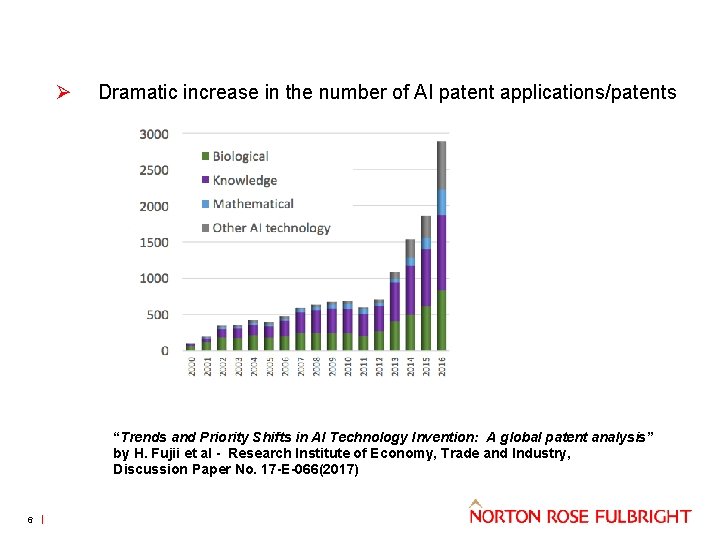
Ø Dramatic increase in the number of AI patent applications/patents “Trends and Priority Shifts in AI Technology Invention: A global patent analysis” by H. Fujii et al - Research Institute of Economy, Trade and Industry, Discussion Paper No. 17 -E-066(2017) 6
Ø This will lead to an increase in AI related patent litigation Ø The introduction of a non-human actor and related subject matter will challenge the usual rules and principles of patent litigation Ø What are some of the issues on the horizon (or right in our face now)? 7
Inventorship Who (or what) is the inventor? – ‘inventor’ is not defined in the Patent Act – Patent legislation does not provide for non-human inventors – The USPTO and CIPO do not recognize non-human inventors ▪ 8 Recognizing AI as authors and inventors under US IP Law, Russ Pearlman, 24 RICH J. L. & Tech no. 2018
– inventor is the person who conceived of the original inventive concept and reduced it into a practical form ▪ Apotex Inc. V. Wellcome Foundation 2002 SCC 77 What about collaborations? – What was the contribution to the inventive concept? Do these principles apply to AI? – Can an agreement between the parties be taken into consideration? ▪Weatherford Canada Ltd V. Corlac Inc 2011 FCA 228 9
Identifying Proper Plaintiffs Section 55 Patent Act: A person who infringes a patent is liable to the patentee and all persons claiming under the patentee for all damage sustained by the patentee or by any such person after the grant of the patent, by reason of the infringement – understood to include patent licensees (whether by virtue of written, oral or implied license) – consider the chain of damage / loss suffered by acts of infringement – add necessary parties to make out a chain of loss under the Canadian patent – need to counterbalance necessary participation in the action with exposure to discovery obligations 10
Who are the infringers ? Section 42 Patent Act: a patent grants the exclusive right, privilege and liberty of making, constructing and using the invention, and selling it to others to be used – Infringement is any act that interferes, in whole or in part, with the patentee’s exclusive rights to make, use, offer for sale, sell, export and import into Canada ▪ Beloit Canada Ltd. v. Valmet-Dominion (1997) 73 CPR 321 (FCA) – the chain of infringement may be complex for AI systems and products – AI may not initially infringe: it may evolve to infringe, or infringe in a transient manner 11
For example: Ø Ø AI program is developed by A Co. AI program is sold to B Co operated by C Co. trained by D Co …to make an infringing product Direct infringement by each of the above? Does it depend on whether the AI program could infringe as developed? And whether / when it had to be used or trained… and by who? This raises issues of causation in the AI world… and territoriality. ▪ 12 A mind of its own – direct infringement by users of artificial intelligence systems, Bridget Watson, 58 IDEA 65 (2017)
Indirect Infringement In Canada, requires: – a direct infringer has infringed – the alleged inducer has influenced the direct infringer such that the direct infringer would not infringe without this influence; and – the alleged inducer knows that its influence will result in the completion of the direct infringement ▪ Weatherford Canada Ltd. v. Corlac Inc. , 2011 FCA 228 at [162] – How would this play out in the AI scenario given above? – Can AI “induce”? – Contributory patent infringement is not recognized in Canada ▪ Apotex Inc. v. Nycomed Canada Inc. , 2011 FC 1441 – What of joint liability or common law notions of joint tortfeasorship? – Will these be used as principles in the causation analysis for AI? 13
Pleading and Proving Infringement − How does the patentee plead particularity of infringement? And prove it? − The pleading must provide material facts: how the system / device / product has the essential elements of the patent claim − How does one do this against evolving AI technology? − Where the features and elements may not be easily detectable prior to discovery? − What if the infringement is transient? − It is possible to capture operational data or temporal data? Ø THE ROLE OF PRESERVATION ORDERS MAY BECOME IMPORTANT 14
Third party discovery may be necessary: – Algorithm developers? – AI trainers? – Users ? – Customers? 15
§ Motion for a European Parliament Resolution with recommendations to the Commission on Civil Law Rules on Robotics (2015/2013(INL) dated January 1, 2017 – Today, AI cannot be liable for damage to third parties, for example patent infringement – AI’s act must be traced back to a human agent: a manufacturer, operator, owner, user – Could human agent have foreseen / avoided AI’s harmful behavior? – Are new principles of liability required in light of the rapid progress of AI’s autonomous and cognitive features? 16
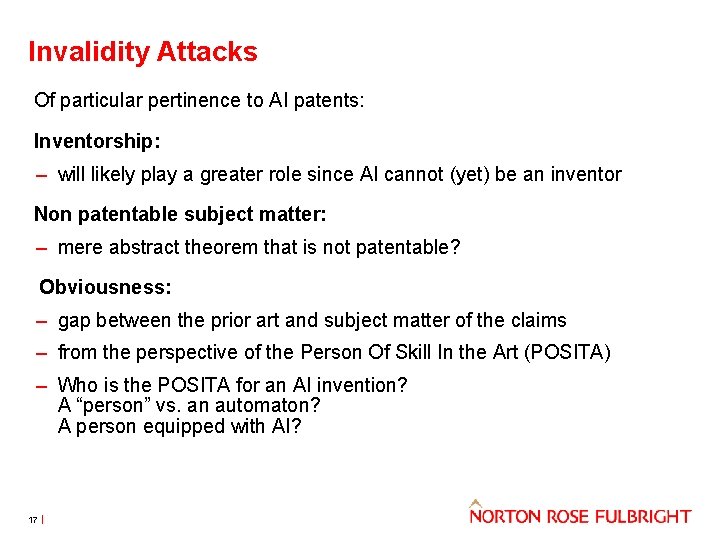
Invalidity Attacks Of particular pertinence to AI patents: Inventorship: – will likely play a greater role since AI cannot (yet) be an inventor Non patentable subject matter: – mere abstract theorem that is not patentable? Obviousness: – gap between the prior art and subject matter of the claims – from the perspective of the Person Of Skill In the Art (POSITA) – Who is the POSITA for an AI invention? A “person” vs. an automaton? A person equipped with AI? 17
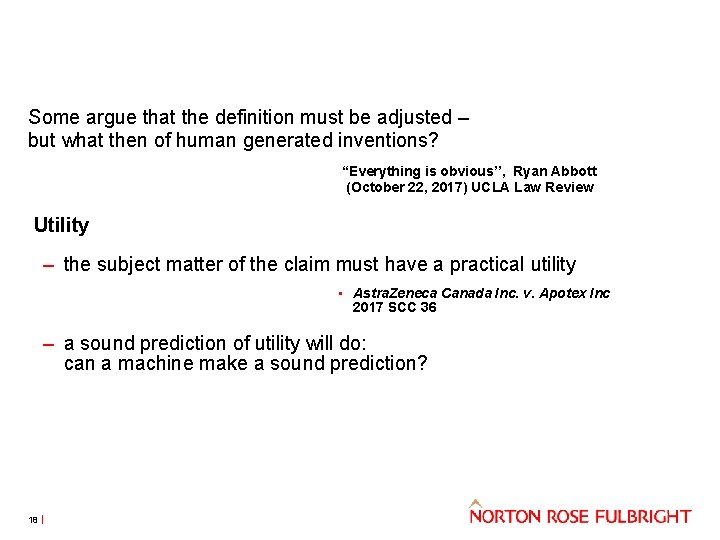
Some argue that the definition must be adjusted – but what then of human generated inventions? “Everything is obvious’’, Ryan Abbott (October 22, 2017) UCLA Law Review Utility – the subject matter of the claim must have a practical utility ▪ Astra. Zeneca Canada Inc. v. Apotex Inc 2017 SCC 36 – a sound prediction of utility will do: can a machine make a sound prediction? 18
Remedies for Patent Infringement − injunction − monetary damages (plaintiff’s lost profits) − election of defendant’s profits may be awarded exceptionally − delivery up 19
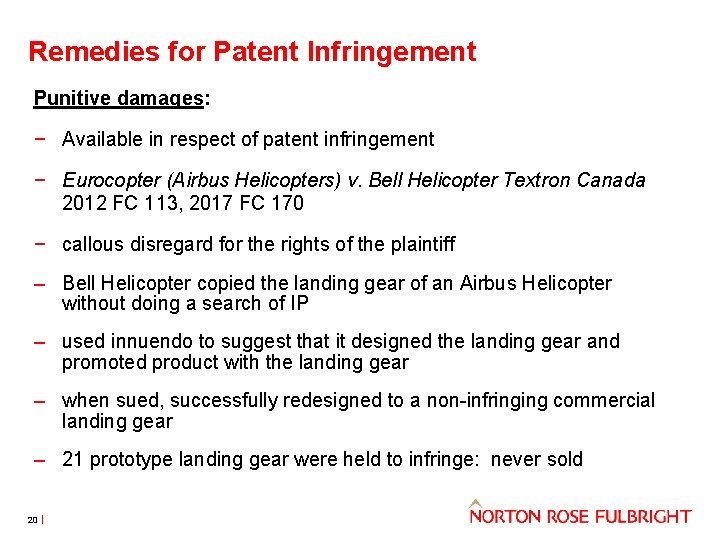
Remedies for Patent Infringement Punitive damages: − Available in respect of patent infringement − Eurocopter (Airbus Helicopters) v. Bell Helicopter Textron Canada 2012 FC 113, 2017 FC 170 − callous disregard for the rights of the plaintiff – Bell Helicopter copied the landing gear of an Airbus Helicopter without doing a search of IP – used innuendo to suggest that it designed the landing gear and promoted product with the landing gear – when sued, successfully redesigned to a non-infringing commercial landing gear – 21 prototype landing gear were held to infringe: never sold 20
− Federal Court awarded $ 500 000 in compensatory damages and $1 million in punitive damages − The Court placed emphasis on Bell Helicopter being a large and sophisticated technology company − It was unacceptable that no one would verify IP rights before embarking on a research program involving the study of a competitive product − Airbus appeal on quantum under reserve − Implications for AI and sophisticated technology companies? Ø ensure that IP polices and training are in place Ø conduct IP searches Ø role of freedom to operate / invalidity opinions? 21
Disclaimer Norton Rose Fulbright US LLP, Norton Rose Fulbright Australia, Norton Rose Fulbright Canada LLP and Norton Rose Fulbright South Africa Inc are separate legal entities and all of them are members of Norton Rose Fulbright Verein, a Swiss verein. Norton Rose Fulbright Verein helps coordinate the activities of the members but does not itself provide legal services to clients. References to ‘Norton Rose Fulbright’, ‘the law firm’ and ‘legal practice’ are to one or more of the Norton Rose Fulbright members or to one of their respective affiliates (together ‘Norton Rose Fulbright entity/entities’). No individual who is a member, partner, shareholder, director, employee or consultant of, in or to any Norton Rose Fulbright entity (whether or not such individual is described as a ‘partner’) accepts or assumes responsibility, or has any liability, to any person in respect of this communication. Any reference to a partner or director is to a member, employee or consultant with equivalent standing and qualifications of the relevant Norton Rose Fulbright entity. The purpose of this communication is to provide general information of a legal nature. It does not contain a full analysis of the law nor does it constitute an opinion of any Norton Rose Fulbright entity on the points of law discussed. You must take specific legal advice on any particular matter which concerns you. If you require any advice or further information, please speak to your usual contact at Norton Rose Fulbright. 22
- Slides: 22