
IP Telephony Security Cisco Systems 2004 Cisco Systems
- Slides: 13
IP Telephony Security Cisco Systems © 2004, Cisco Systems, Inc. All rights reserved 1
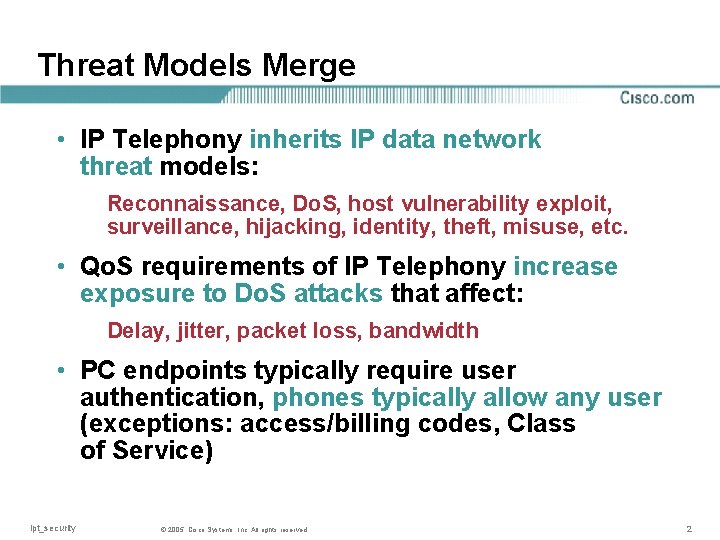
Threat Models Merge • IP Telephony inherits IP data network threat models: Reconnaissance, Do. S, host vulnerability exploit, surveillance, hijacking, identity, theft, misuse, etc. • Qo. S requirements of IP Telephony increase exposure to Do. S attacks that affect: Delay, jitter, packet loss, bandwidth • PC endpoints typically require user authentication, phones typically allow any user (exceptions: access/billing codes, Class of Service) ipt_security © 2005, Cisco Systems, Inc. All rights reserved 2
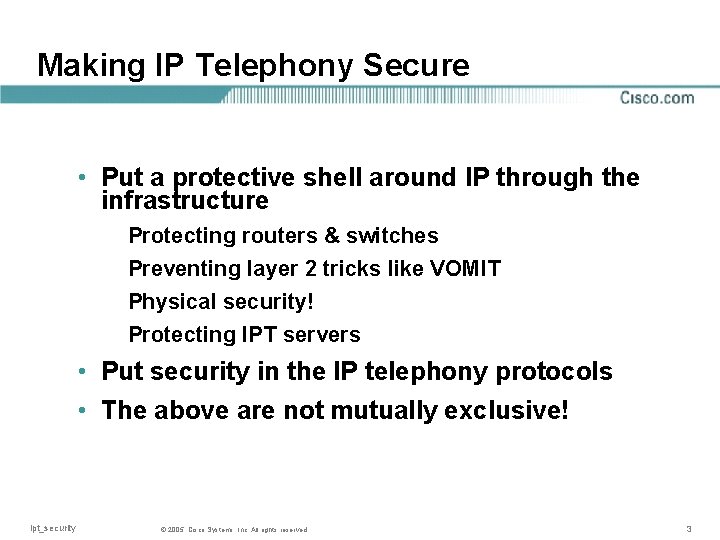
Making IP Telephony Secure • Put a protective shell around IP through the infrastructure Protecting routers & switches Preventing layer 2 tricks like VOMIT Physical security! Protecting IPT servers • Put security in the IP telephony protocols • The above are not mutually exclusive! ipt_security © 2005, Cisco Systems, Inc. All rights reserved 3
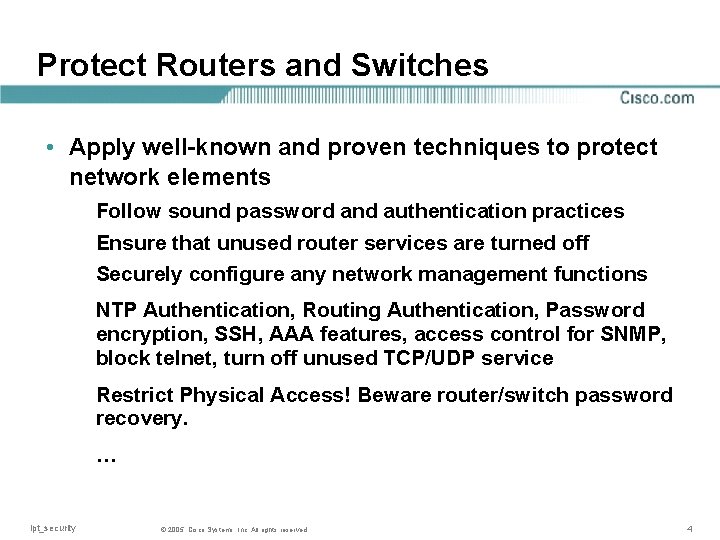
Protect Routers and Switches • Apply well-known and proven techniques to protect network elements Follow sound password and authentication practices Ensure that unused router services are turned off Securely configure any network management functions NTP Authentication, Routing Authentication, Password encryption, SSH, AAA features, access control for SNMP, block telnet, turn off unused TCP/UDP service Restrict Physical Access! Beware router/switch password recovery. … ipt_security © 2005, Cisco Systems, Inc. All rights reserved 4
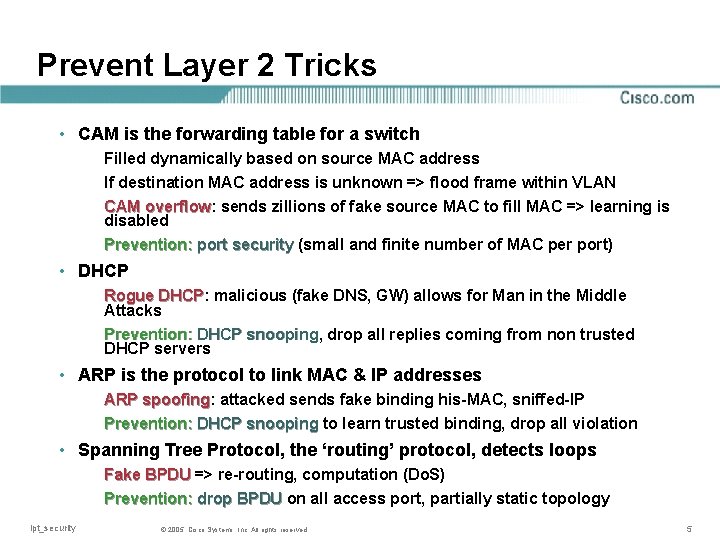
Prevent Layer 2 Tricks • CAM is the forwarding table for a switch Filled dynamically based on source MAC address If destination MAC address is unknown => flood frame within VLAN CAM overflow: overflow sends zillions of fake source MAC to fill MAC => learning is disabled Prevention: port security (small and finite number of MAC per port) • DHCP Rogue DHCP: DHCP malicious (fake DNS, GW) allows for Man in the Middle Attacks Prevention: DHCP snooping, snooping drop all replies coming from non trusted DHCP servers • ARP is the protocol to link MAC & IP addresses ARP spoofing: spoofing attacked sends fake binding his-MAC, sniffed-IP Prevention: DHCP snooping to learn trusted binding, drop all violation • Spanning Tree Protocol, the ‘routing’ protocol, detects loops Fake BPDU => re-routing, computation (Do. S) Prevention: drop BPDU on all access port, partially static topology ipt_security © 2005, Cisco Systems, Inc. All rights reserved 5
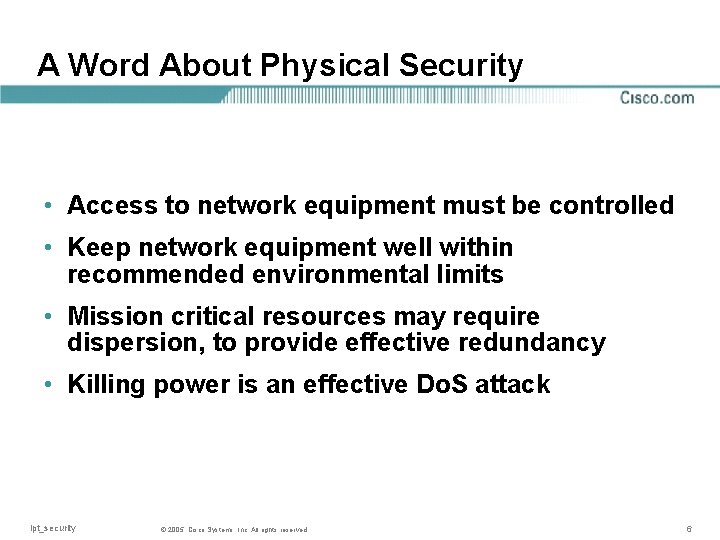
A Word About Physical Security • Access to network equipment must be controlled • Keep network equipment well within recommended environmental limits • Mission critical resources may require dispersion, to provide effective redundancy • Killing power is an effective Do. S attack ipt_security © 2005, Cisco Systems, Inc. All rights reserved 6
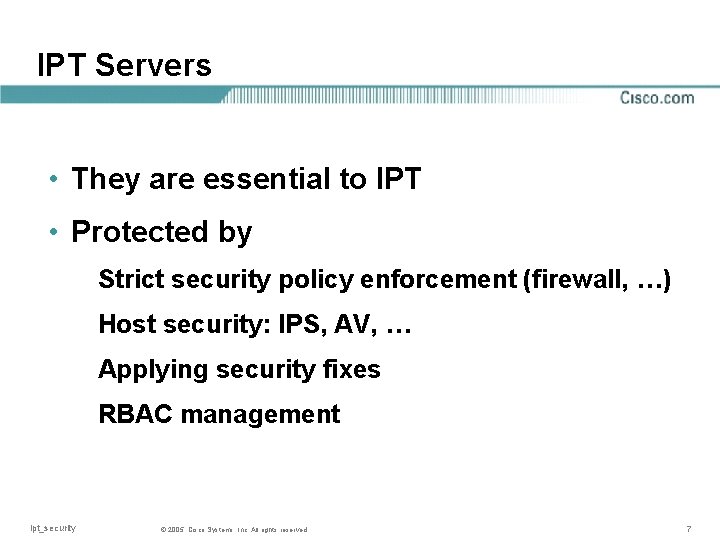
IPT Servers • They are essential to IPT • Protected by Strict security policy enforcement (firewall, …) Host security: IPS, AV, … Applying security fixes RBAC management ipt_security © 2005, Cisco Systems, Inc. All rights reserved 7
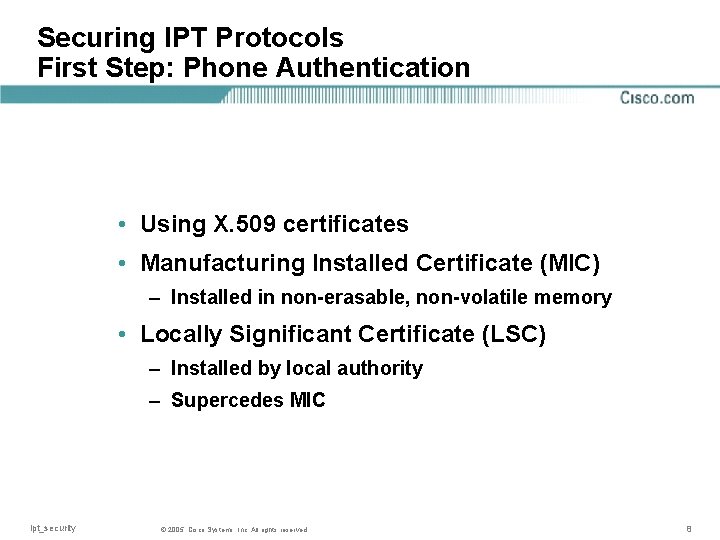
Securing IPT Protocols First Step: Phone Authentication • Using X. 509 certificates • Manufacturing Installed Certificate (MIC) – Installed in non-erasable, non-volatile memory • Locally Significant Certificate (LSC) – Installed by local authority – Supercedes MIC ipt_security © 2005, Cisco Systems, Inc. All rights reserved 8
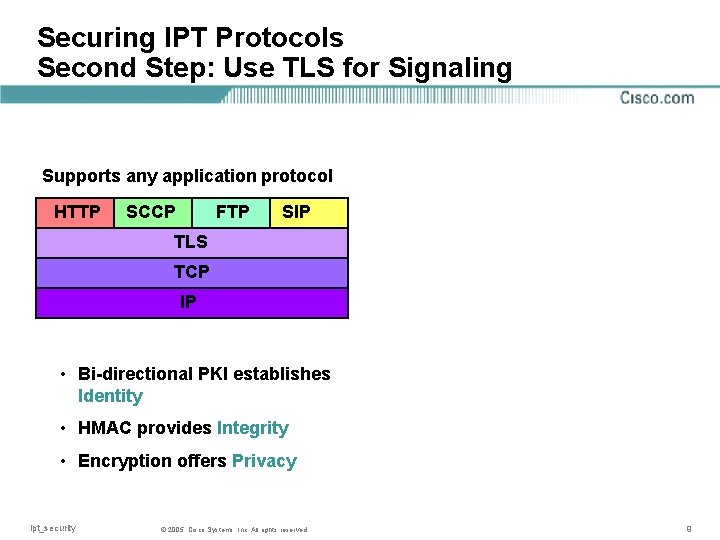
Securing IPT Protocols Second Step: Use TLS for Signaling Supports any application protocol HTTP SCCP FTP SIP TLS TCP IP • Bi-directional PKI establishes Identity • HMAC provides Integrity • Encryption offers Privacy ipt_security © 2005, Cisco Systems, Inc. All rights reserved 9
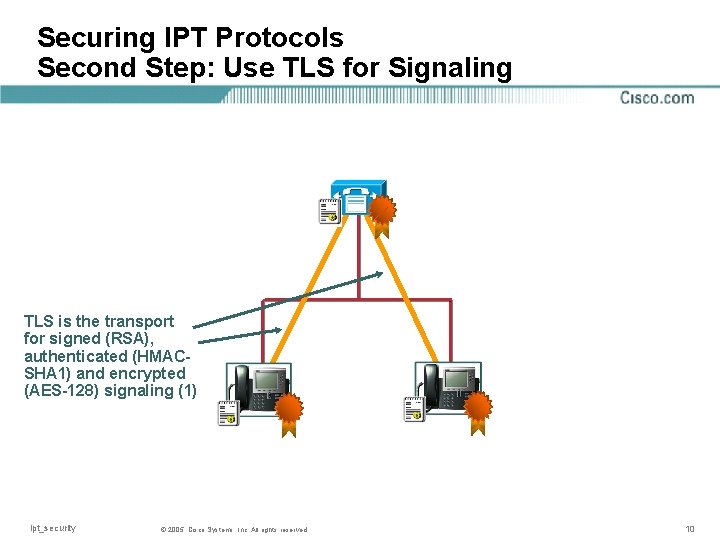
Securing IPT Protocols Second Step: Use TLS for Signaling TLS is the transport for signed (RSA), authenticated (HMACSHA 1) and encrypted (AES-128) signaling (1) ipt_security © 2005, Cisco Systems, Inc. All rights reserved 10
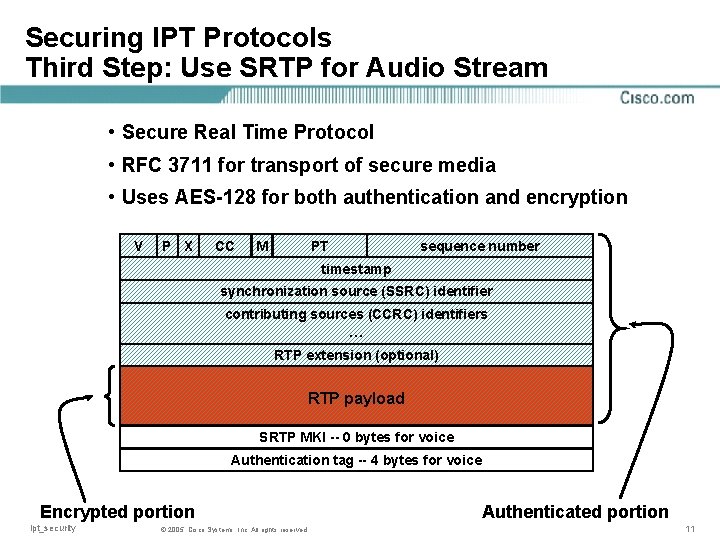
Securing IPT Protocols Third Step: Use SRTP for Audio Stream • Secure Real Time Protocol • RFC 3711 for transport of secure media • Uses AES-128 for both authentication and encryption V P X CC M PT sequence number timestamp synchronization source (SSRC) identifier contributing sources (CCRC) identifiers … RTP extension (optional) RTP payload SRTP MKI -- 0 bytes for voice Authentication tag -- 4 bytes for voice Encrypted portion ipt_security © 2005, Cisco Systems, Inc. All rights reserved Authenticated portion 11
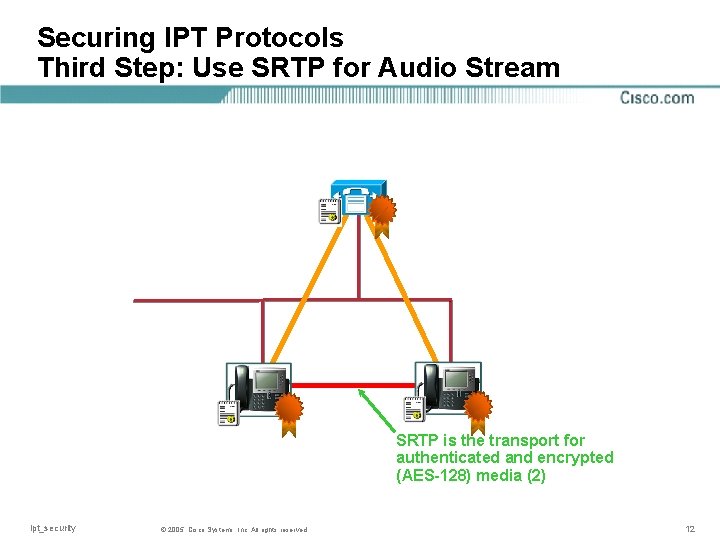
Securing IPT Protocols Third Step: Use SRTP for Audio Stream SRTP is the transport for authenticated and encrypted (AES-128) media (2) ipt_security © 2005, Cisco Systems, Inc. All rights reserved 12
Conclusion • Security for IPT is usually desirable • Security for IPT can be delivered Within the network infrastructure By the IPT protocols • Security is not a barrier for deployment • BTW: apply the same paranoia to data as well ipt_security © 2005, Cisco Systems, Inc. All rights reserved 13