
IP Security Lawrence Taub taubufl edu IPSEC IP
IP Security Lawrence Taub taub@ufl. edu
IPSEC • IP security — security built into the IP layer • Provides host-to-host (or router-to-router) encryption and authentication • Required for IPv 6, optional for IPv 4 • Comprised of two parts: – IPSEC proper (authentication and encryption) – IPSEC key management
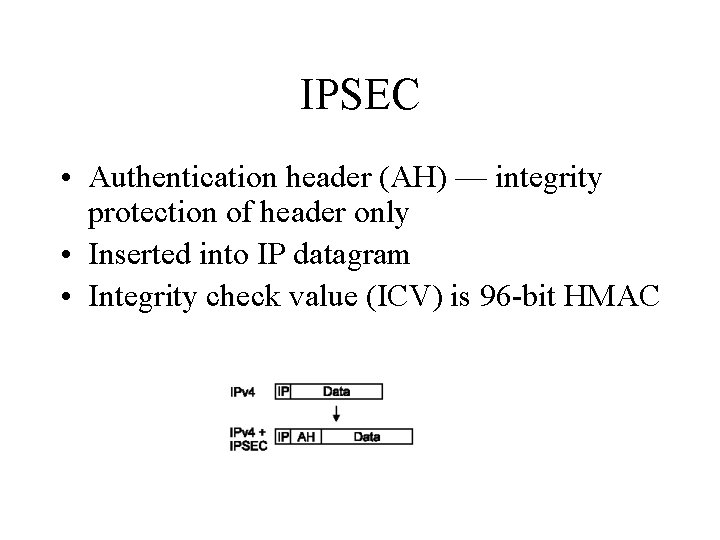
IPSEC • Authentication header (AH) — integrity protection of header only • Inserted into IP datagram • Integrity check value (ICV) is 96 -bit HMAC
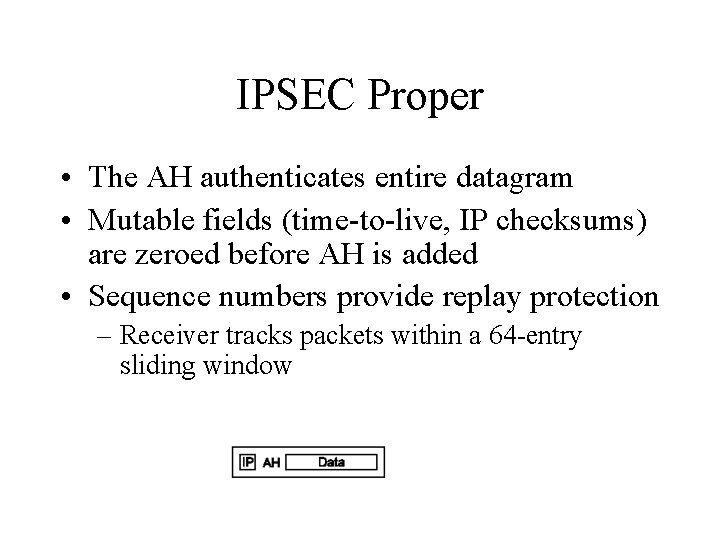
IPSEC Proper • The AH authenticates entire datagram • Mutable fields (time-to-live, IP checksums) are zeroed before AH is added • Sequence numbers provide replay protection – Receiver tracks packets within a 64 -entry sliding window
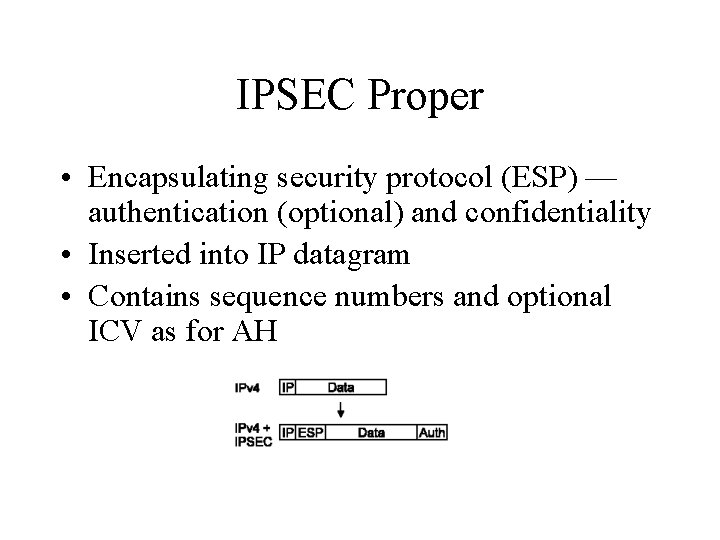
IPSEC Proper • Encapsulating security protocol (ESP) — authentication (optional) and confidentiality • Inserted into IP datagram • Contains sequence numbers and optional ICV as for AH
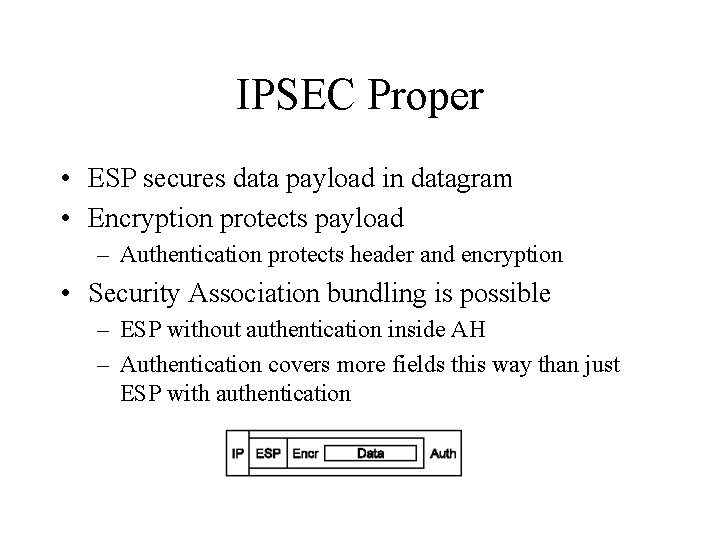
IPSEC Proper • ESP secures data payload in datagram • Encryption protects payload – Authentication protects header and encryption • Security Association bundling is possible – ESP without authentication inside AH – Authentication covers more fields this way than just ESP with authentication
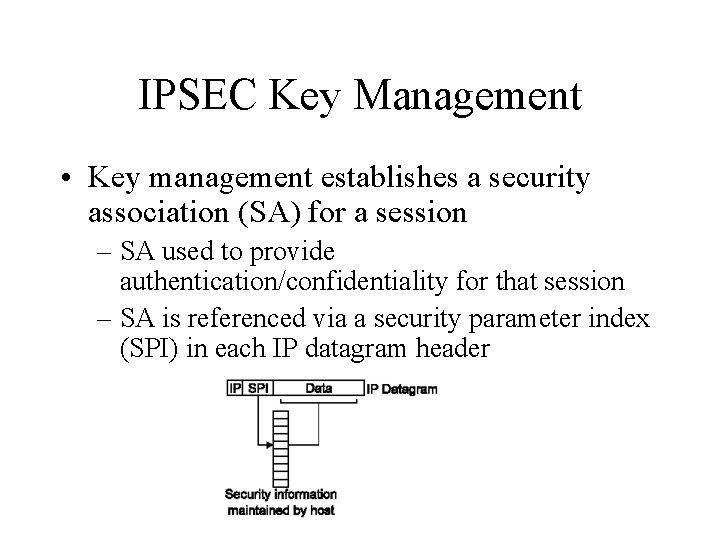
IPSEC Key Management • Key management establishes a security association (SA) for a session – SA used to provide authentication/confidentiality for that session – SA is referenced via a security parameter index (SPI) in each IP datagram header
IPSEC Processing • • Use SPI to look up security association (SA) Perform authentication check using SA Perform decryption of authenticated data using SA Operates in two modes – Transport mode (secure IP), protects payload – Tunneling mode (secure IP inside standard IP), protects entire packet • Popular in routers • Communicating hosts don’t have to implement IPSEC themselves • Nested tunneling possible
IPSEC Key Management • ISAKMP – Internet Security Association and Key Management Protocol • Oakley – DH-based key management protocol • Photuris – DH-based key management protocol • SKIP – Sun’s DH-based key management protocol • Protocols changed considerably over time, most borrowed ideas from each other
Photuris • Latin for “firefly”, Firefly is the NSA’s key exchange protocol for STU-III secure phones • Three-stage protocol – 1. Exchange cookies – 2. Use D-H to establish a shared secret • Agree on security parameters – 3. Identify other party • Authenticate data exchanged in steps 1 and 2 – n. Change session keys or update security parameters
Photuris • Cookie based on IP address and port, stops flooding attacks – Attacker requests many key exchanges and bogs down host (clogging attack) • Cookie depends on – IP address and port – Secret known only to host – Cookie = hash( source and dest IP and port + local secret ) • Host can recognize a returned cookie – Attacker can’t generate fake cookies • Later adopted by other IPSEC key management protocols
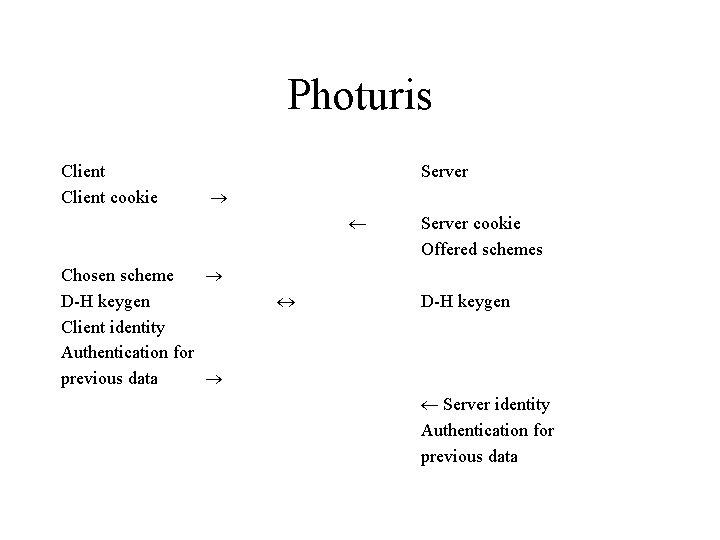
Photuris Client cookie Server ® ¬ Chosen scheme ® D-H keygen Client identity Authentication for previous data ® « Server cookie Offered schemes D-H keygen ¬ Server identity Authentication for previous data
SKIP • Each machine has a public DH value authenticated via – X. 509 certificates – PGP certificates – Secure DNS • Public D-H value is used as an implicit shared key calculation parameter – Shared key is used once to exchange encrypted session key – Session key is used for further encryption/authentication • Clean-room non-US version developed by Sun partner in Moscow – US government forced Sun to halt further work with non-US version
Oakley • Exchange messages containing any of – – Client/server cookies DH information Offered/chosen security parameters Client/server ID’s • until both sides are satisfied • Oakley is extremely open-ended, with many variations possible – Exact details of messages exchange depends on exchange requirements • • Speed vs thoroughness Identification vs anonymity New session establishment vs rekey D-H exchange vs shared secrets vs PKC-based exchange
ISAKMP • NSA-designed protocol to exchange security parameters (but not establish keys) – Protocol to establish, modify, and delete IPSEC security associations – Provides a general framework for exchanging cookies, security parameters, and key management and identification information – Exact details left to other protocols • Two phases – 1. Establish secure, authenticated channel (“SA”) – 2. Negotiate security parameters (“KMP”)
IKE (ISAKMP/Oakley) • ISAKMP merged with Oakley – ISAKMP provides the protocol framework – Oakley provides the security mechanisms • Combined version clarifies both protocols, resolves ambiguities
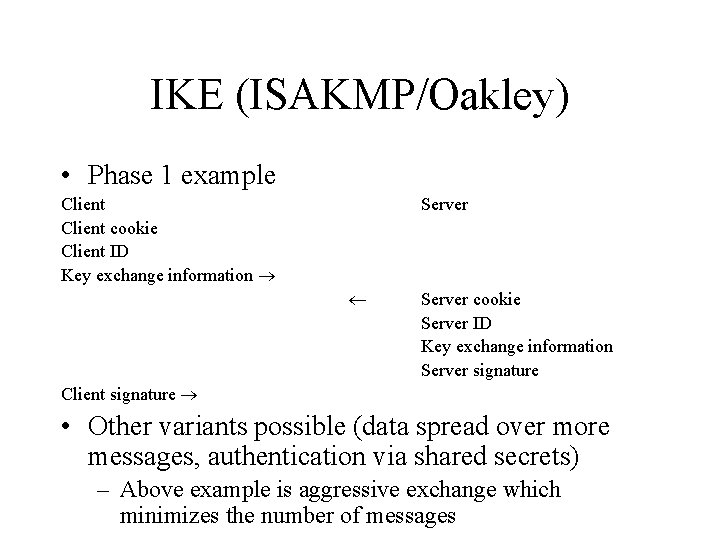
IKE (ISAKMP/Oakley) • Phase 1 example Client cookie Client ID Key exchange information ® Server ¬ Server cookie Server ID Key exchange information Server signature Client signature ® • Other variants possible (data spread over more messages, authentication via shared secrets) – Above example is aggressive exchange which minimizes the number of messages
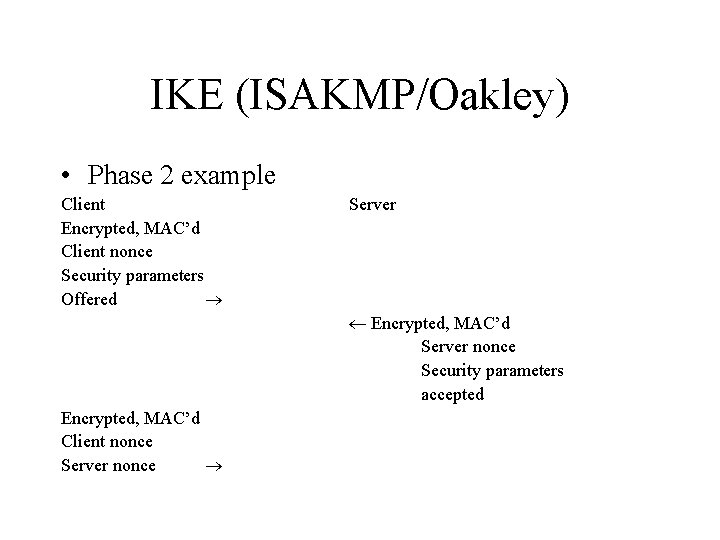
IKE (ISAKMP/Oakley) • Phase 2 example Client Encrypted, MAC’d Client nonce Security parameters Offered ® Server ¬ Encrypted, MAC’d Server nonce Security parameters accepted Encrypted, MAC’d Client nonce Server nonce ®
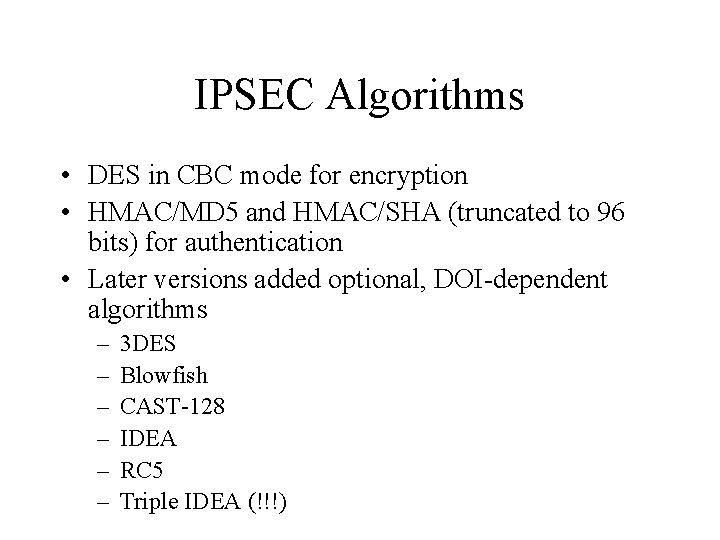
IPSEC Algorithms • DES in CBC mode for encryption • HMAC/MD 5 and HMAC/SHA (truncated to 96 bits) for authentication • Later versions added optional, DOI-dependent algorithms – – – 3 DES Blowfish CAST-128 IDEA RC 5 Triple IDEA (!!!)
- Slides: 19