
IP Routing Principles NetworkLayer Protocol Operations X Y

- Slides: 38
IP Routing Principles
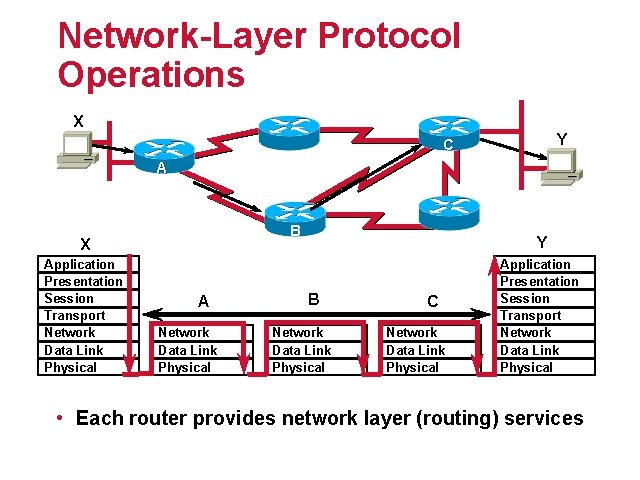
Network-Layer Protocol Operations X Y C A B X Application Presentation Session Transport Network Data Link Physical A Network Data Link Physical Y B Network Data Link Physical C Network Data Link Physical Application Presentation Session Transport Network Data Link Physical • Each router provides network layer (routing) services
Static versus Dynamic Routes • Static route Uses a protocol route that a network administrator enters into the router • Dynamic route Uses a route that a network routing protocol adjusts automatically for topology or traffic changes
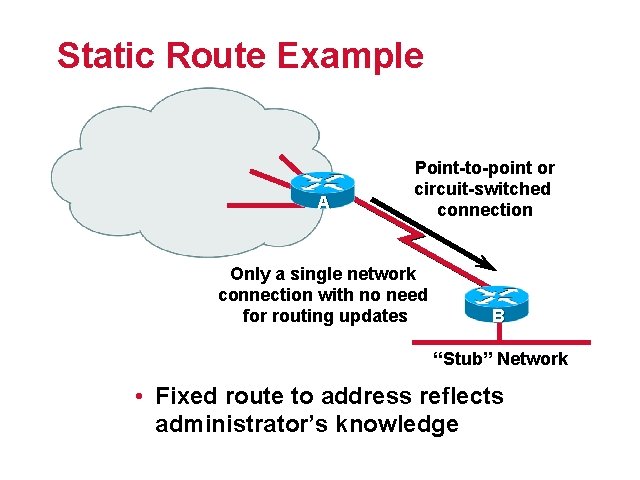
Static Route Example A Point-to-point or circuit-switched connection Only a single network connection with no need for routing updates B “Stub” Network • Fixed route to address reflects administrator’s knowledge
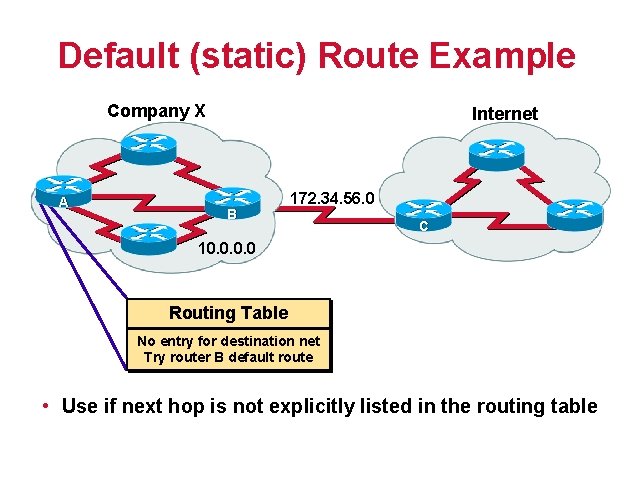
Default (static) Route Example Company X A Internet B 172. 34. 56. 0 C 10. 0 Routing Table No entry for destination net Try router B default route • Use if next hop is not explicitly listed in the routing table
Dynamic routing
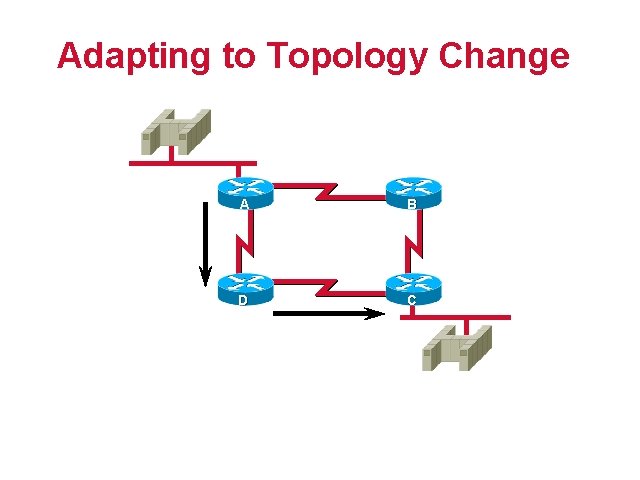
Adapting to Topology Change A B D C
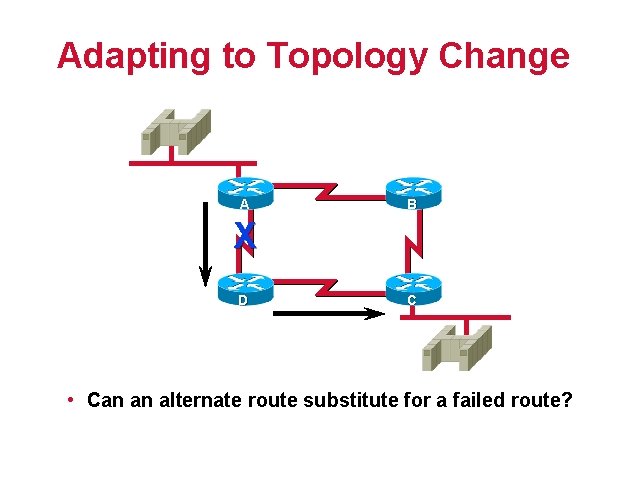
Adapting to Topology Change A B X D C • Can an alternate route substitute for a failed route?
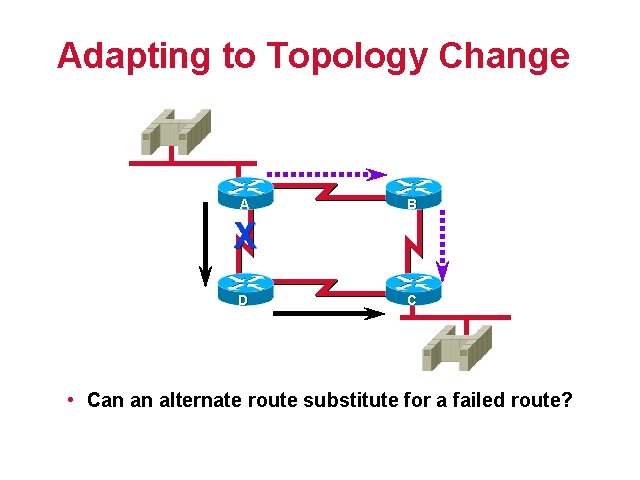
Adapting to Topology Change A B X D C • Can an alternate route substitute for a failed route?
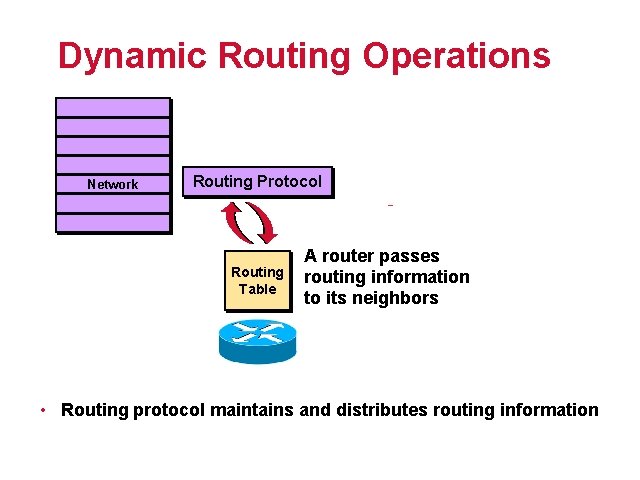
Dynamic Routing Operations Network Routing Protocol Routing Table A router passes routing information to its neighbors • Routing protocol maintains and distributes routing information
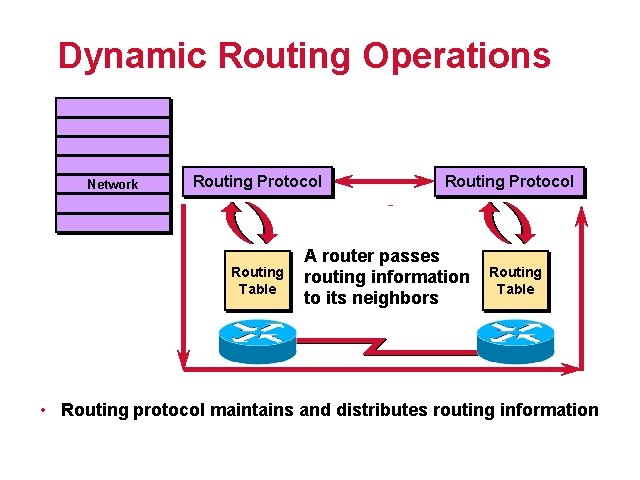
Dynamic Routing Operations Network Routing Protocol Routing Table Routing Protocol A router passes routing information to its neighbors Routing Table • Routing protocol maintains and distributes routing information
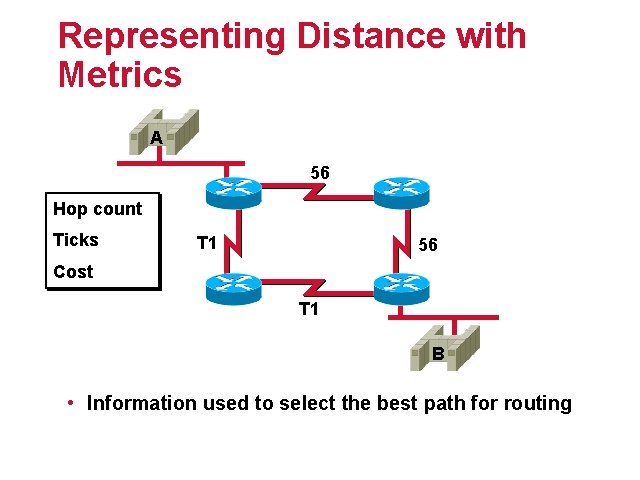
Representing Distance with Metrics A 56 Hop count Ticks T 1 56 Cost T 1 B • Information used to select the best path for routing
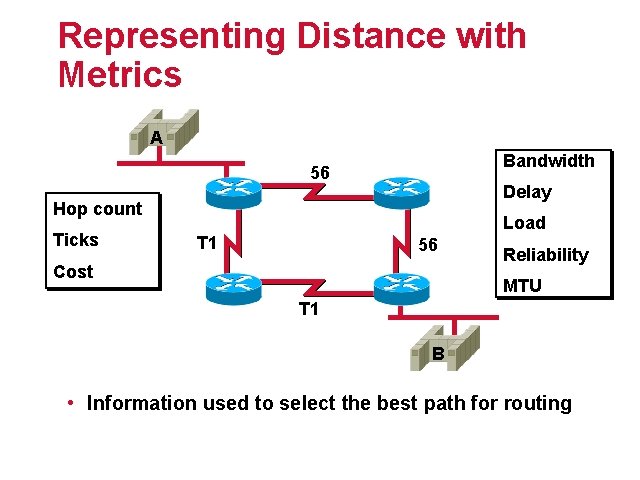
Representing Distance with Metrics A Bandwidth 56 Delay Hop count Ticks Load T 1 56 Cost Reliability MTU T 1 B • Information used to select the best path for routing
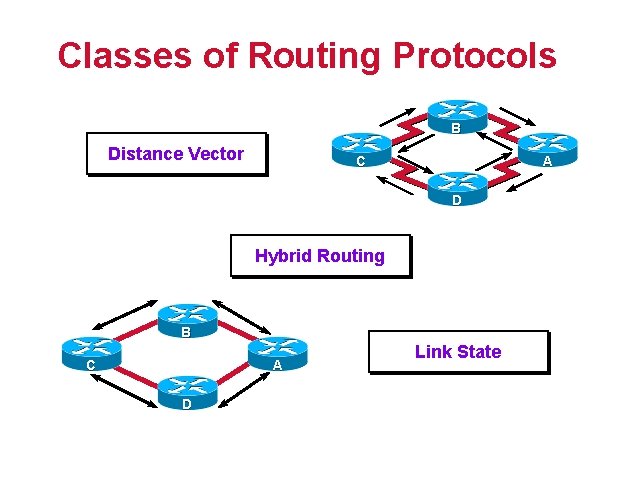
Classes of Routing Protocols B Distance Vector A C D Hybrid Routing B A C D Link State
One Issue: Time to Convergence • Convergence occurs when all routers use a consistent perspective of network topology • After a topology changes, routers must recompute routes, which disrupts routing • The process and time required for router reconvergence varies in routing protocols
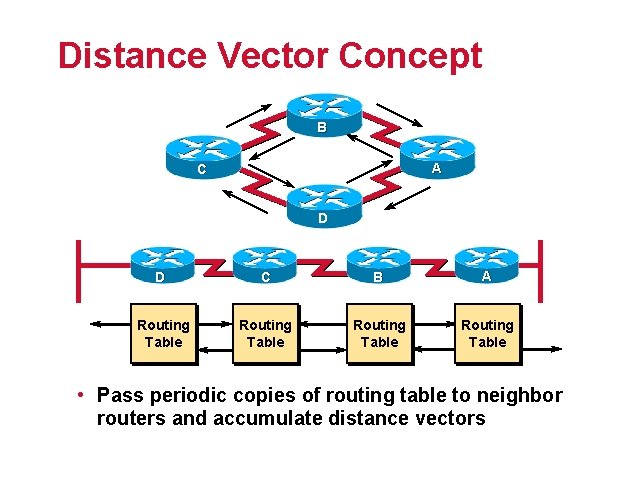
Distance Vector Concept B A C D D C B A Routing Table • Pass periodic copies of routing table to neighbor routers and accumulate distance vectors
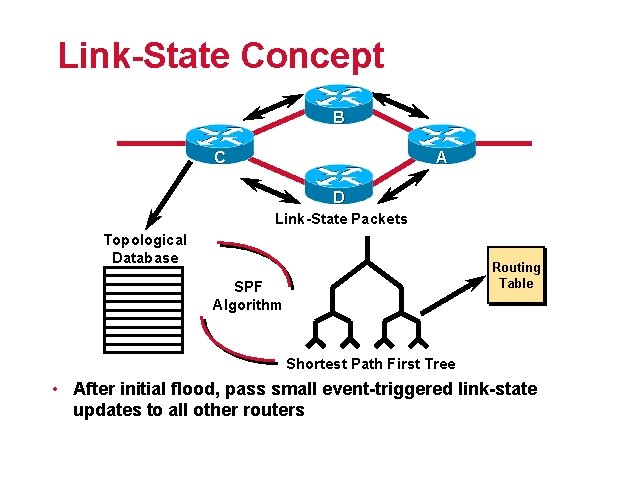
Link-State Concept B C A D Link-State Packets Topological Database Routing Table SPF Algorithm Shortest Path First Tree • After initial flood, pass small event-triggered link-state updates to all other routers
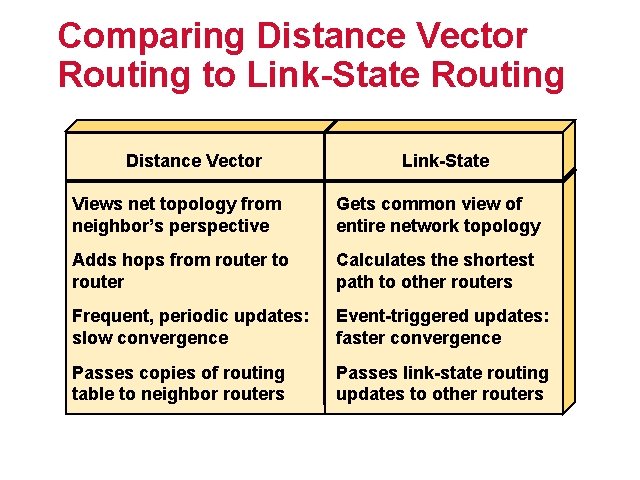
Comparing Distance Vector Routing to Link-State Routing Distance Vector Link-State Views net topology from neighbor’s perspective Gets common view of entire network topology Adds hops from router to router Calculates the shortest path to other routers Frequent, periodic updates: slow convergence Event-triggered updates: faster convergence Passes copies of routing table to neighbor routers Passes link-state routing updates to other routers
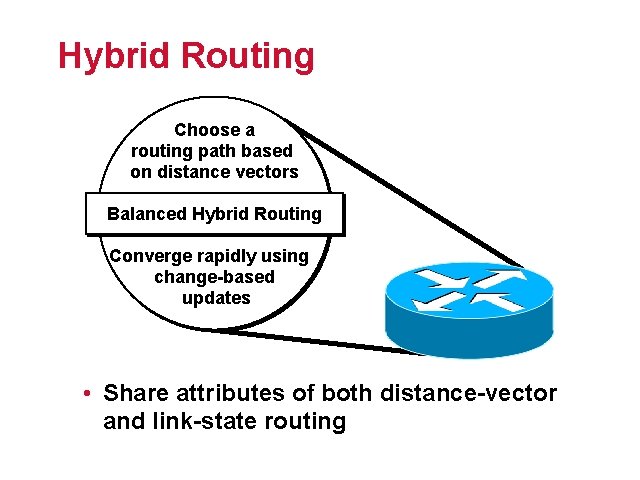
Hybrid Routing Choose a routing path based on distance vectors Balanced Hybrid Routing Converge rapidly using change-based updates • Share attributes of both distance-vector and link-state routing
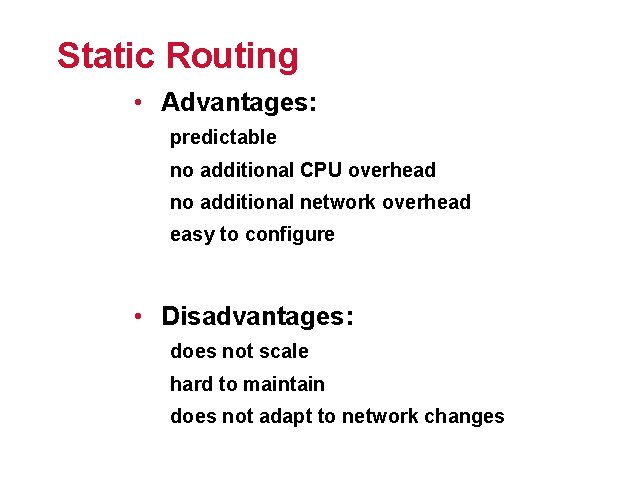
Static Routing • Advantages: predictable no additional CPU overhead no additional network overhead easy to configure • Disadvantages: does not scale hard to maintain does not adapt to network changes
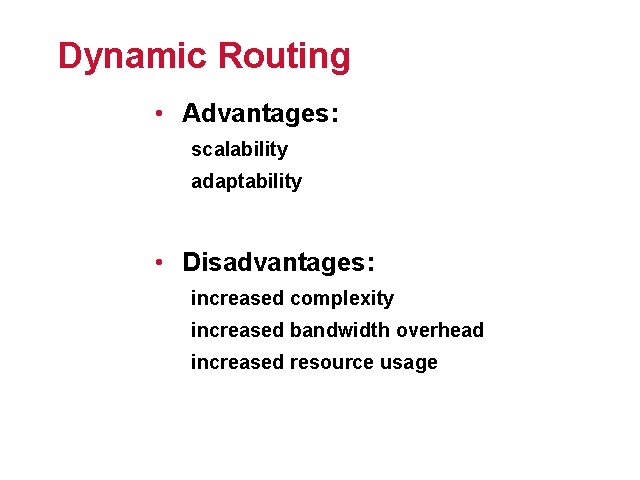
Dynamic Routing • Advantages: scalability adaptability • Disadvantages: increased complexity increased bandwidth overhead increased resource usage
Dynamic Routing • Moral of the story: Use static routing where you can, use dynamic routing only where you must
Autonomous Systems • Internetwork • The big “I” Internet • AS = a group of routers and their networks (administered by the same owner) • AS peering
Routing Protocols • Where is it used? Interior Gateway Protocols (IGP) RIP OSPF EIGRP (IS-IS) Exterior Gateway Protocols (EGP) BGP
Routing Protocols • How does it work? Distance-Vector Protocols RIP EIGRP BGP Link State OSPF
Protocol Features • RIPv 2 hop count metric unreliable transport passive RIP simple
Protocol Features • OSPF full CIDR support trust route injection hierarchical routing a smarter protocol
Protocol Features • EIGRP more information in advertisements improved convergence properties partial and incremental updates no support for areas
Protocol Features • BGP-4: RFC 1771 created to support CIDR even more information Policy routing Reliable transport can also be used as an IGP (IBGP) high overhead
Real World Routing • multiple routing protocols are generally necessary • interior routing is a LOT different than exterior routing • multi-protocol issues
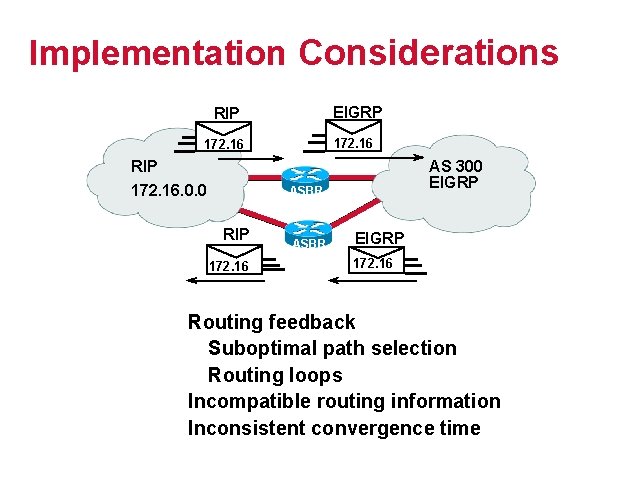
Implementation Considerations EIGRP RIP 172. 16. 0. 0 AS 300 EIGRP ASBR RIP 172. 16 ASBR EIGRP 172. 16 Routing feedback Suboptimal path selection Routing loops Incompatible routing information Inconsistent convergence time
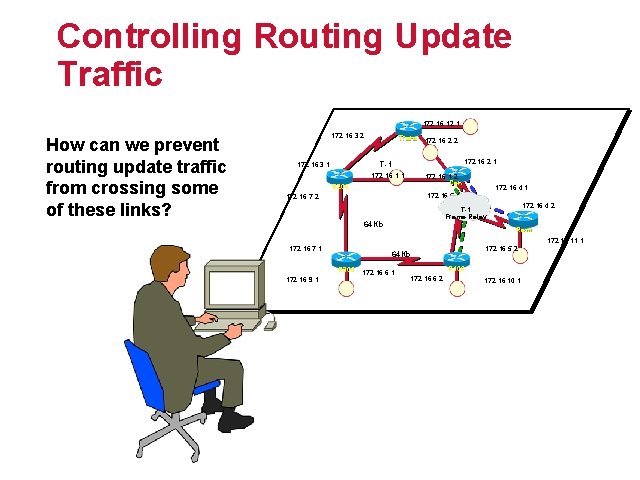
Controlling Routing Update Traffic 172. 16. 12. 1 How can we prevent routing update traffic from crossing some of these links? 172. 16. 3. 2 Trans 172. 16. 2. 2 172. 16. 2. 1 T-1 172. 16. 3. 1 172. 16. 1. 2 Cen R 200 172. 16. 9. 1 172. 16. 4. 2 T-1 Frame Relay 64 Kb 172. 16. 7. 1 172. 16. 4. 1 172. 16. 5. 1 172. 16. 7. 2 Rem 172. 16. 5. 2 64 Kb R 300 172. 16. 6. 1 R 100 172. 16. 6. 2 172. 16. 10. 1 172. 16. 11. 1
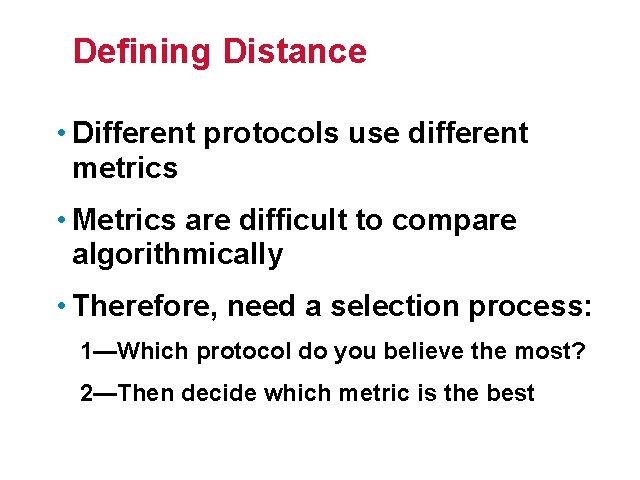
Defining Distance • Different protocols use different metrics • Metrics are difficult to compare algorithmically
Defining Distance • Different protocols use different metrics • Metrics are difficult to compare algorithmically • Therefore, need a selection process: 1—Which protocol do you believe the most? 2—Then decide which metric is the best
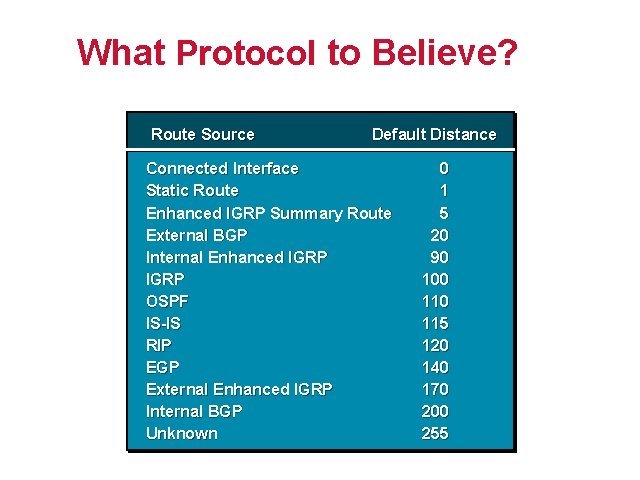
What Protocol to Believe? Route Source Default Distance Connected Interface Static Route Enhanced IGRP Summary Route External BGP Internal Enhanced IGRP OSPF IS-IS RIP EGP External Enhanced IGRP Internal BGP Unknown 0 1 5 20 90 100 115 120 140 170 200 255
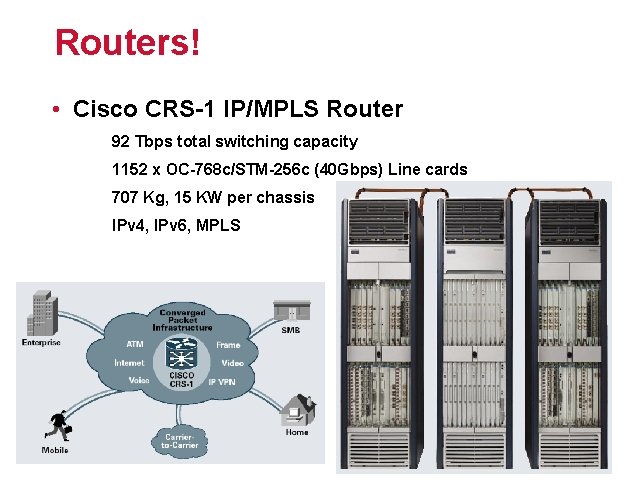
Routers! • Cisco CRS-1 IP/MPLS Router 92 Tbps total switching capacity 1152 x OC-768 c/STM-256 c (40 Gbps) Line cards 707 Kg, 15 KW per chassis IPv 4, IPv 6, MPLS
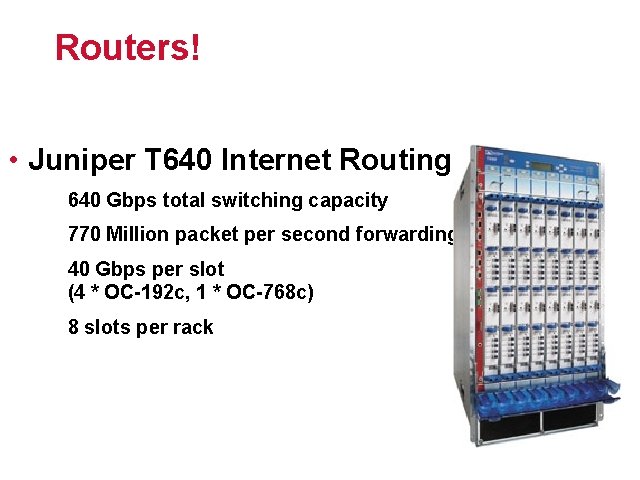
Routers! • Juniper T 640 Internet Routing Node 640 Gbps total switching capacity 770 Million packet per second forwarding 40 Gbps per slot (4 * OC-192 c, 1 * OC-768 c) 8 slots per rack
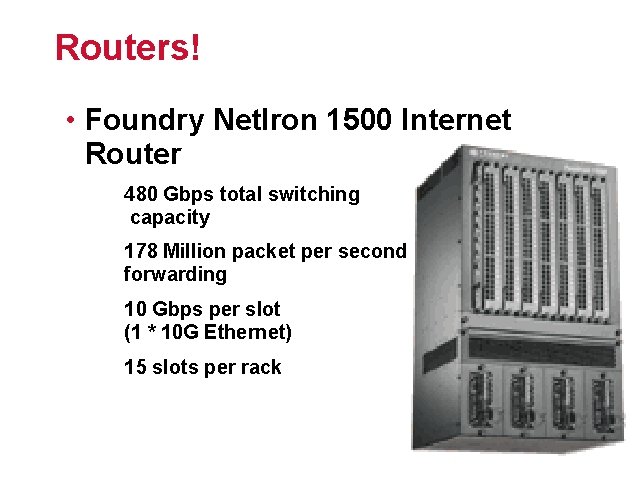
Routers! • Foundry Net. Iron 1500 Internet Router 480 Gbps total switching capacity 178 Million packet per second forwarding 10 Gbps per slot (1 * 10 G Ethernet) 15 slots per rack