
IP Phone Bazaar Choosing the Right Device Neal
IP Phone Bazaar: Choosing the Right Device Neal Shact CEO 888 -795 -7222
Who is Communi. Tech? v. Established in 1983 v. Privately-held company v. Founded by Neal Shact and Melissa Vokoun v 4 Divisions v. Communi. Tech Services v. Clarisys v. Dytel

Factors: Vo. IP Migration Plan IP Phone Options IP Phone Protocols Personnel Considerations Location Considerations Selecting the IP Phone
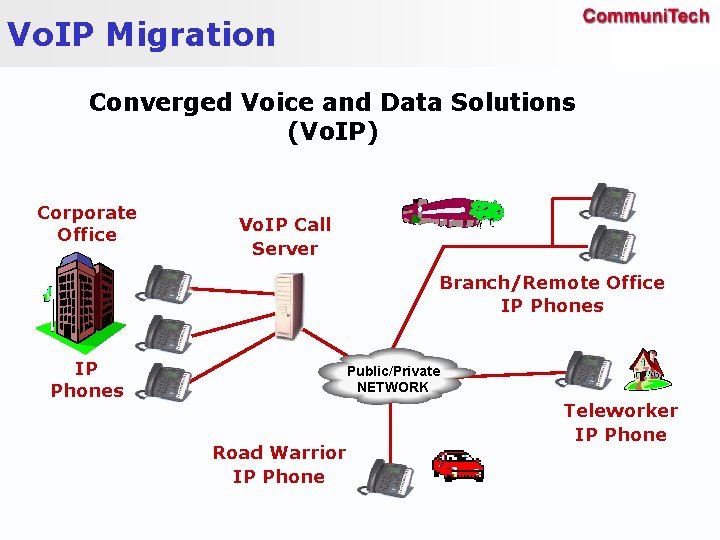
Vo. IP Migration Converged Voice and Data Solutions (Vo. IP) Corporate Office Vo. IP Call Server Branch/Remote Office IP Phones Public/Private NETWORK Road Warrior IP Phone Teleworker IP Phone
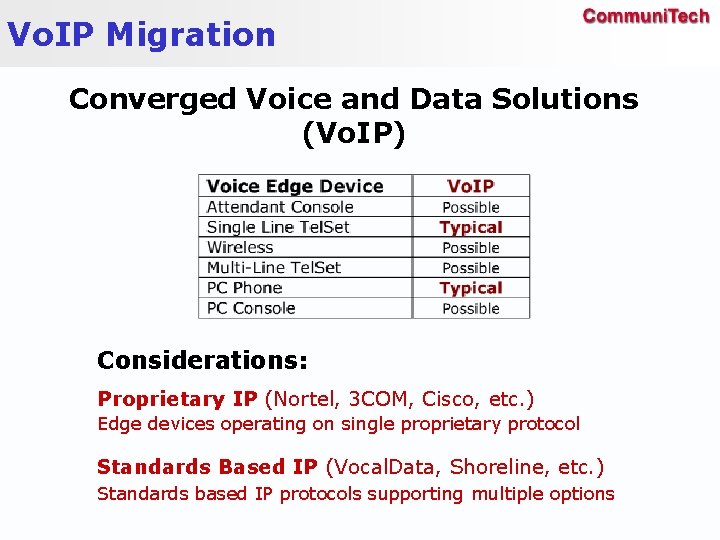
Vo. IP Migration Converged Voice and Data Solutions (Vo. IP) Considerations: Proprietary IP (Nortel, 3 COM, Cisco, etc. ) Edge devices operating on single proprietary protocol Standards Based IP (Vocal. Data, Shoreline, etc. ) Standards based IP protocols supporting multiple options

Vo. IP Migration IP Enabled Legacy Solutions Legacy Key/PBX Vo. IP Gateway with Legacy Phones IP Phone Public/Private NETWORK Vo. IP Adapter with Legacy Phone Remote IP Phone
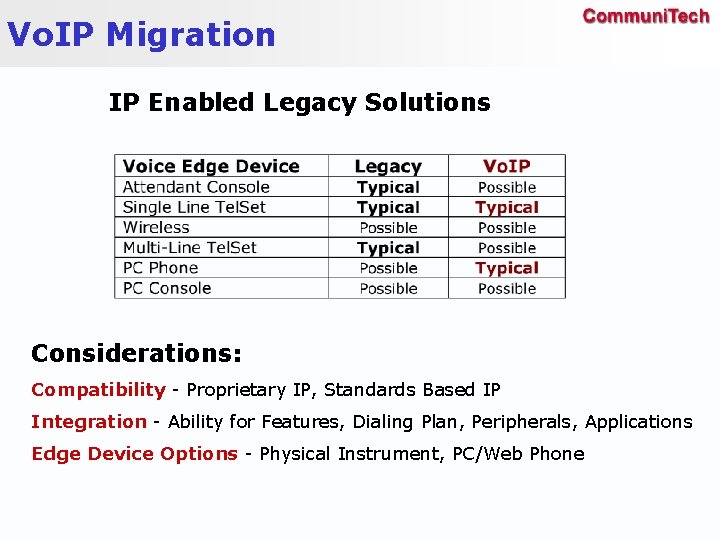
Vo. IP Migration IP Enabled Legacy Solutions Considerations: Compatibility - Proprietary IP, Standards Based IP Integration - Ability for Features, Dialing Plan, Peripherals, Applications Edge Device Options - Physical Instrument, PC/Web Phone
IP Phone Options v. Attendant Console v. Single-Line Phone v. Multi-Line Phone v. Softphone with USB phone, handset or headset
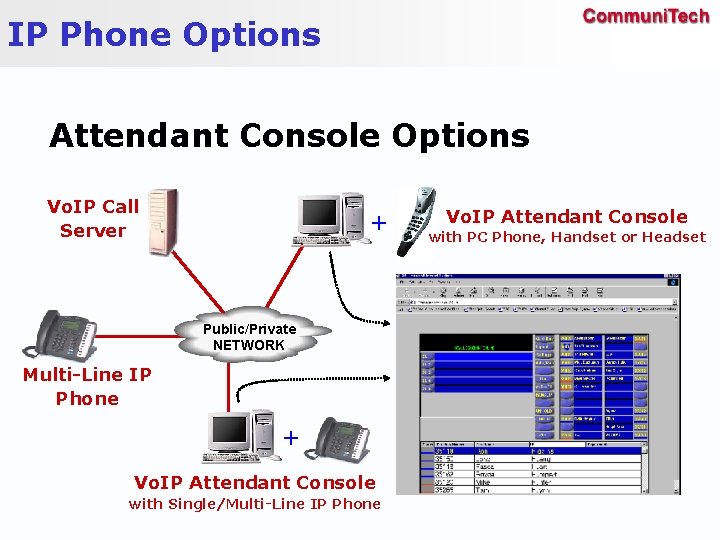
IP Phone Options Attendant Console Options Vo. IP Call Server + Public/Private NETWORK Multi-Line IP Phone + Vo. IP Attendant Console with Single/Multi-Line IP Phone Vo. IP Attendant Console with PC Phone, Handset or Headset
IP Phone Options Attendant Console Consideration: IP Attendant Consoles are available on PC Platforms only Multi-Line IP Phone should be considered v. More User Friendly v. Easier to Answer and Transfer callers v. Provides quicker answering for better service
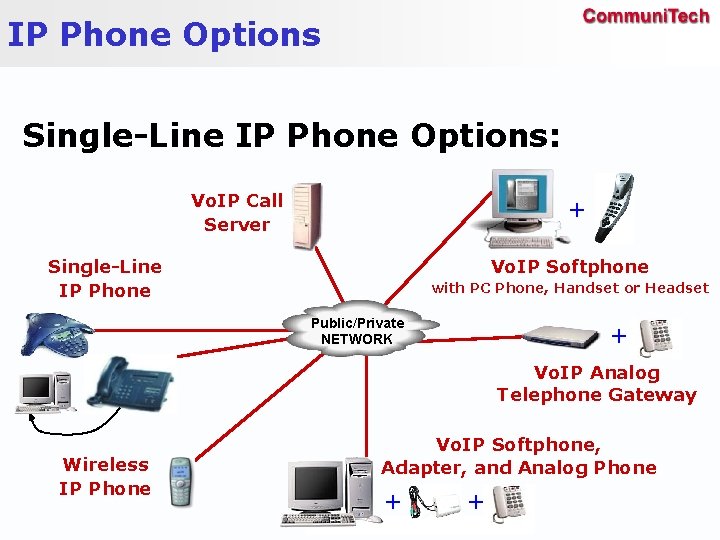
IP Phone Options Single-Line IP Phone Options: Vo. IP Call Server + Single-Line IP Phone Vo. IP Softphone with PC Phone, Handset or Headset Public/Private NETWORK + Vo. IP Analog Telephone Gateway Wireless IP Phone Vo. IP Softphone, Adapter, and Analog Phone + +
IP Phone Options Single-Line IP Phone Consideration: Where will it be used (Production floor, lobby, breakroom, mobile user, etc. ) ? In a Common Office Area: Use single-line IP Phone or IP Adaptor with Analog Phone to avoid “training” issues. If Used Repeatedly by the Same Individual: Use a Single-Line IP Phone, IP Adaptor with Analog Phone, Vo. IP Softphone, or wireless IP Phone for mobile office personnel.
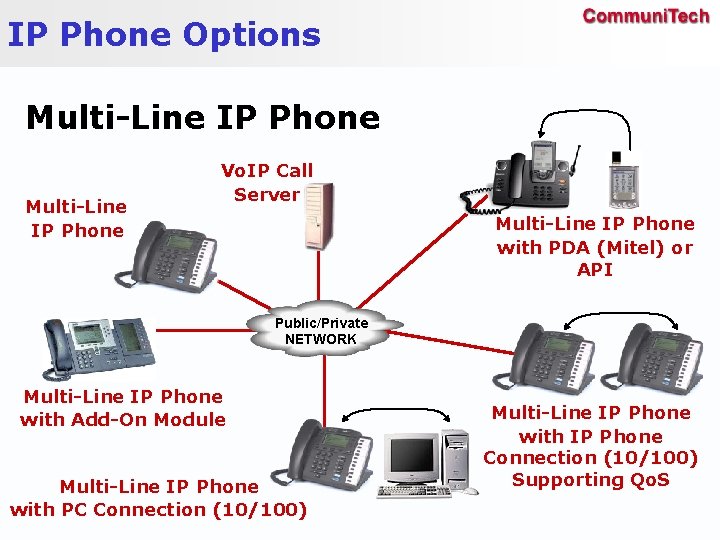
IP Phone Options Multi-Line IP Phone Vo. IP Call Server Multi-Line IP Phone with PDA (Mitel) or API Public/Private NETWORK Multi-Line IP Phone with Add-On Module Multi-Line IP Phone with PC Connection (10/100) Multi-Line IP Phone with IP Phone Connection (10/100) Supporting Qo. S
IP Phone Options Multi-Line IP Phone Consideration: Are there enough line appearances to fulfill the user’s call processing responsibilities? Buy IP Phones with as many line appearances as possible to accommodate future expansion and ease of use.
IP Phone Options Multi-Line IP Phone Consideration: Will additional IP devices be connected to the IP phone (PC, IP Phone, etc. )? Buy compatible multi-line IP Phones with multiple Ethernet ports.
IP Phone Protocols Supported or Needed: v. H. 323/248 v. MGCP v. SIP v. Proprietary (SCCP, Unistim, etc. )
Personnel Considerations-Types Executive Typical Calling Patterns: v. Moderate Call Volume v. Simplicity/Ease of Use v. Speakerphone v. Speed Dial and/or One-touch Feature Access Ideal for Feature Rich, Multi-Line IP Phone
Personnel Considerations-Types Administrative Typical Calling Patterns: v. Moderate to Heavy Call Volume v. Ease of Use, Quick Call Processing v. May Need Speakerphone v. One-touch Feature Access Ideal for Feature Rich, Multi-Line IP Phone
Personnel Considerations-Types Call Center Typical Calling Patterns: v. Heavy Call Volume v. Quick Call Processing v. Departmental Call Coverage/Processing v. Multiple Calls Simultaneously Queued v. Headset Compatibility v. One-touch Feature Access Ideal for Feature Rich Multi-Line IP Phone
Personnel Considerations-Types Labor Typical Calling Patterns: v. Light Call Volume v. One phone to many personnel/customers v. Ease of Use v. Mobile Office Worker (Wireless) Ideal for Single-Line/Wireless IP Phone
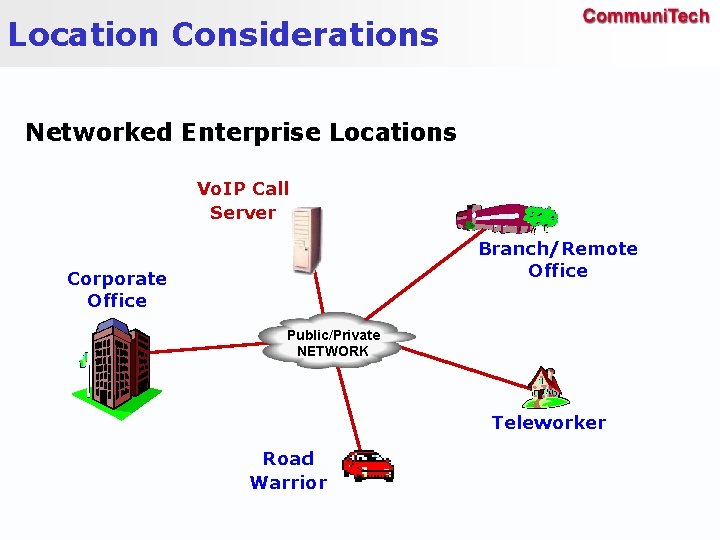
Location Considerations Networked Enterprise Locations Vo. IP Call Server Branch/Remote Office Corporate Office Public/Private NETWORK Teleworker Road Warrior
Location Considerations Corporate Office Frequent Communications requiring more integrated services: v. Multiple Line Appearances v. Multiple Call Queuing v. Busy Lamp Appearance Ideal for feature rich, multi-line IP phone
Location Considerations: Branch/Remote Office Frequent communications requiring higher level of integrated services: v. Multiple Line Appearances - Higher requirement to see other offices v. Busy Lamp Appearance - Higher requirement to see other personnel v. Simple Integration to branch and Corporate offices v“Need” to feel as part of Corporate Office Ideal for feature rich, multi-mine IP phone
Location Considerations: Teleworker High Volume Voice Traffic: v. Busy Lamp Appearance - Higher requirement to see other personnel v. Simple Integration to Branch and Corporate Offices v“Need” to feel as part of Corporate Office Ideal for feature rich, multi-line IP phone
Location Considerations Teleworker Low Volume Voice Traffic: v. Fewer Inbound/Outbound Calling Requirements v. Ability to mainly place/receive calls v. Voice Mail message waiting notification v. Reduced need for telephony features/functionality Ideal for single-line IP phone, IP Softphone
Location Considerations Road Warrior Low Volume Voice Traffic: v. Away from the telephone the majority of the day v. Fewer Inbound/Outbound Calling Requirements v. Ability to mainly place/receive calls v. Reduced need for telephony features/functionality Ideal for IP Softphone or Single-line IP phone
Selecting an IP Phone Identify compatible IP Phones: v What IP Phones are available from the manufacturer/platform? v What other IP Phones are compatible/recommended? Identify Personnel Requirements: v What are the Traffic Requirements (High, Medium, Low)? v How often are Speakerphone and System Features used? Identify Location: v What are the Traffic Requirements (High, Medium, Low)? v What are the available services (VPN, Single phone connection, etc. )? Identify Cost of Ownership: v Does IP Phone require Feature Codes, or have Feature Keys? v Can IP Phone handle additional calls in Queue grow?
Selecting an IP Phone Multi-line Phones: Tel. Strat (16 lines) Cisco (4 and 6 lines*) Polycom (3 lines) Swissvoice (2 lines) Teledex (2 lines) Mitel Single Phones: Snom Cisco Teledex Pingtel Swissvoice Mitel
Selecting an IP Phone Softphone: v. Avaya v. Cisco v. IPblue v. Pingtel Softphone Hardware: v. Clarisys USB Phone v. GN Netcom USB headset v. Plantronics USB Headset Attendant Console (no physical consoles) v. Tel. Strat v. Cisco with Sidecars
- Slides: 29