
IP over CDMA Digital Cellular Phil Karn karnqualcomm
- Slides: 14
IP over CDMA Digital Cellular Phil Karn karn@qualcomm. com
Data on CDMA Cellular Channels • IS-95 CDMA (e. g. , Sprint. PCS, Airtouch Powerband) – IS-707 data standards – No modifications required to cell sites • major advantage given widespread IS-95 deployment • Globalstar – very similar to IS-95 wrt data – fervent hope that packet data will avoid Iridium’s fate
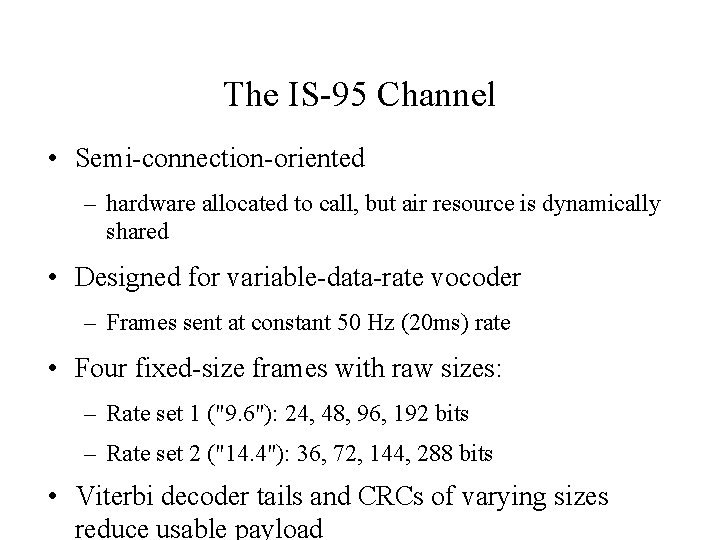
The IS-95 Channel • Semi-connection-oriented – hardware allocated to call, but air resource is dynamically shared • Designed for variable-data-rate vocoder – Frames sent at constant 50 Hz (20 ms) rate • Four fixed-size frames with raw sizes: – Rate set 1 ("9. 6"): 24, 48, 96, 192 bits – Rate set 2 ("14. 4"): 36, 72, 144, 288 bits • Viterbi decoder tails and CRCs of varying sizes reduce usable payload
Data on IS-95 CDMA • The IS-95 physical channel was designed for voice; data was an afterthought • Voice delay considerations limit frame size – limited interleaving for slow fading – power control helps • Typical frame loss rates: 1 -2% – acceptable for voice – unacceptable for data
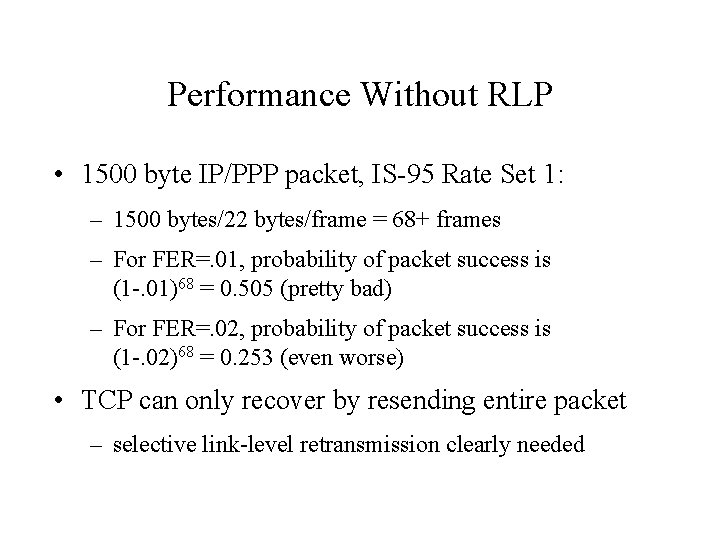
Performance Without RLP • 1500 byte IP/PPP packet, IS-95 Rate Set 1: – 1500 bytes/22 bytes/frame = 68+ frames – For FER=. 01, probability of packet success is (1 -. 01)68 = 0. 505 (pretty bad) – For FER=. 02, probability of packet success is (1 -. 02)68 = 0. 253 (even worse) • TCP can only recover by resending entire packet – selective link-level retransmission clearly needed
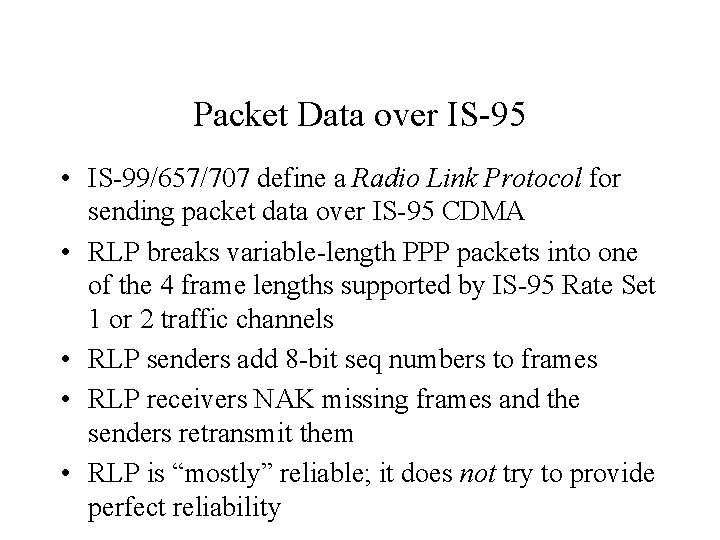
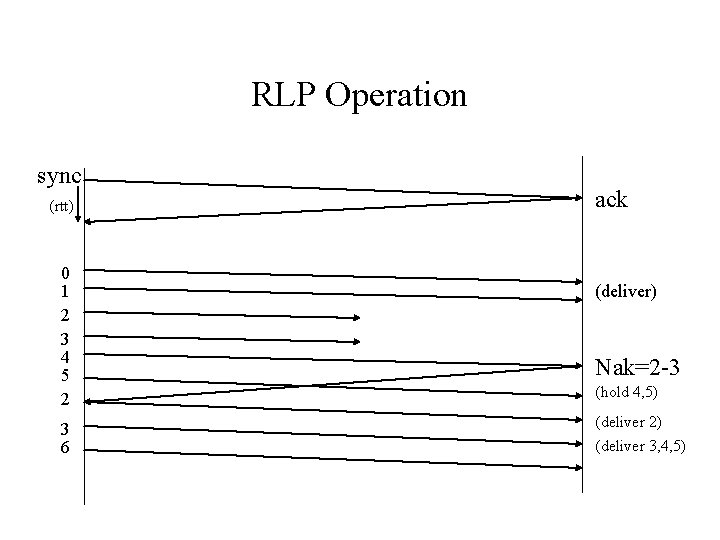
Packet Data over IS-95 • IS-99/657/707 define a Radio Link Protocol for sending packet data over IS-95 CDMA • RLP breaks variable-length PPP packets into one of the 4 frame lengths supported by IS-95 Rate Set 1 or 2 traffic channels • RLP senders add 8 -bit seq numbers to frames • RLP receivers NAK missing frames and the senders retransmit them • RLP is “mostly” reliable; it does not try to provide perfect reliability
RLP Operation sync (rtt) 0 1 2 3 4 5 2 3 6 ack (deliver) Nak=2 -3 (hold 4, 5) (deliver 2) (deliver 3, 4, 5)
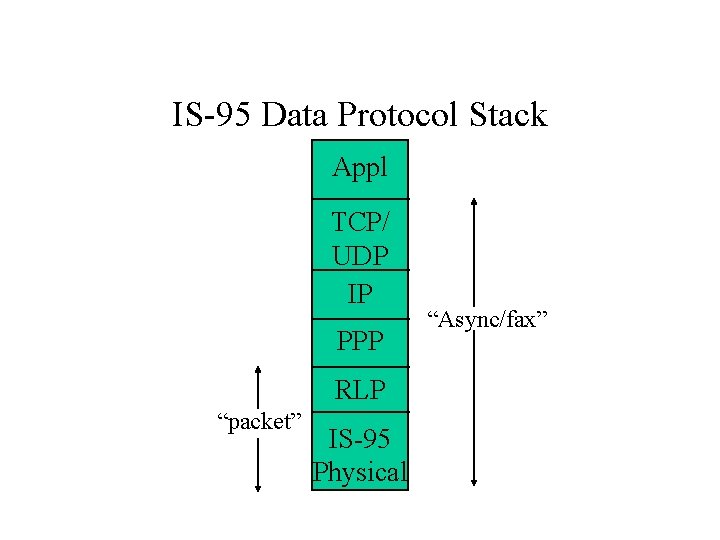
IS-95 Data Protocol Stack Appl TCP/ UDP IP PPP RLP “packet” IS-95 Physical “Async/fax”
Quick Net Connect (QNC) • Original concept: IP packet data support with “dormant mode” – similar to demand-dialed ISDN • Political obstacles to CDMA packet data – lackluster carrier interest – vendor resistance (CDPD competition? ) – inability to appreciate importance of Internet • some telcos still think “data” == “modems” • Asynch data/fax service based on TCP/IP – this was the “hook” for QNC
HDR • High speed wireless packet data system under development at Qualcomm • Physical layer borrows from IS-95, but redesigned specifically for packet data – will require BTS overlays (like CDPD) • 1. 2288 MHz spread BW (same as IS-95) • Semi-connection-oriented (like IS-95) • Throughput depends on loading and distance – somewhat like ADSL
HDR Forward Link • Single stream of 128 -byte frames – somewhat like ATM • Fixed symbol rate • Modulation alphabet and FEC code rate determine user data rate • Constant transmit power • Data rate controlled by mobile request – 38. 4 kb/s up to 2. 4 Mb/s – rate depends on SNR
HDR Reverse Link • Fixed-time 53 ms frames • Pilot subchannel • Data rate varies from 4. 8 kb/s - 307 kb/s – depends again on link margin • Closed loop power control – similar to IS-95
Speed Considerations • The higher the data rate, the slower the relative fading – larger packets are good – higher data rates are bad (unfortunately) • Ergo, ARQ link protocol still required • HDR RLP similar to IS-707/IS-95 – byte-numbered vs frame-numbered
Cellular Data Summary • IS-95 is inherently cellular-based – asymmetric fwd & rev links on different frequencies – no direct mobile-to-mobile communication – systems centrally managed • Service model: telephone company or ISP • Unanswered question: proper role of cellular data vs. wireless LANs on unlicensed spectrum (e. g. , IEEE 802. 11)