
IP over CCSDS Results Loren Clare Jet Propulsion
- Slides: 16
IP over CCSDS Results Loren Clare Jet Propulsion Laboratory, California Institute of Technology CCSDS 2009 Spring Meeting 20 April 2009 National Aeronautics and Space Administration
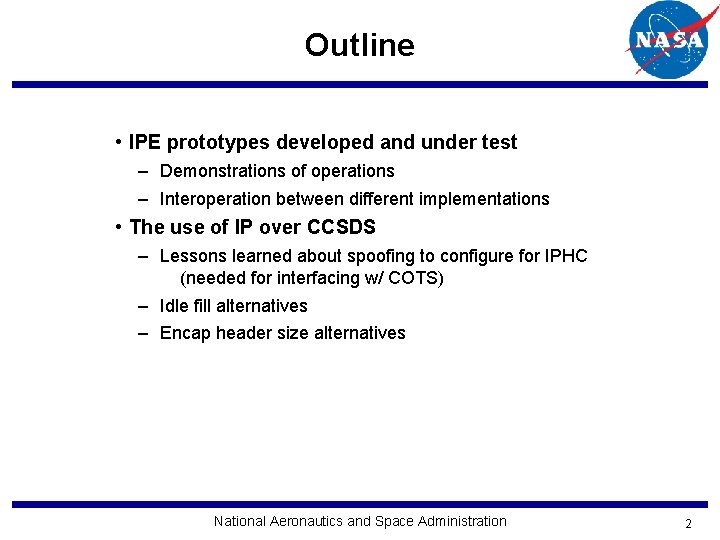
Outline • IPE prototypes developed and under test – Demonstrations of operations – Interoperation between different implementations • The use of IP over CCSDS – Lessons learned about spoofing to configure for IPHC (needed for interfacing w/ COTS) – Idle fill alternatives – Encap header size alternatives National Aeronautics and Space Administration 2
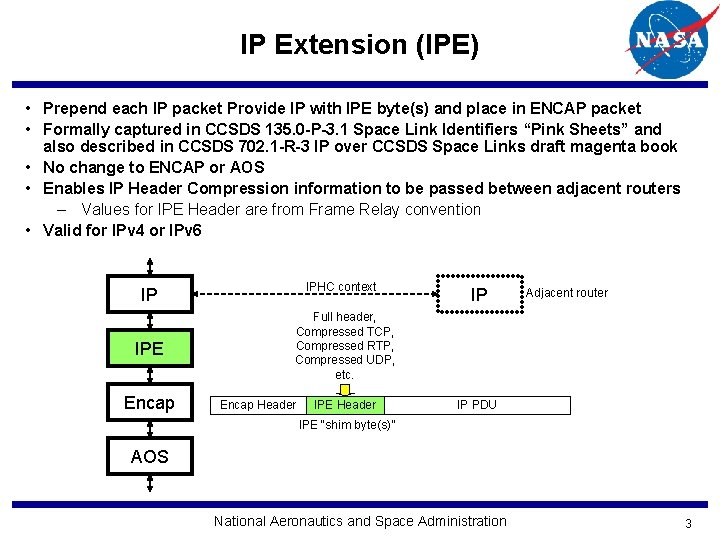
IP Extension (IPE) • Prepend each IP packet Provide IP with IPE byte(s) and place in ENCAP packet • Formally captured in CCSDS 135. 0 -P-3. 1 Space Link Identifiers “Pink Sheets” and also described in CCSDS 702. 1 -R-3 IP over CCSDS Space Links draft magenta book • No change to ENCAP or AOS • Enables IP Header Compression information to be passed between adjacent routers – Values for IPE Header are from Frame Relay convention • Valid for IPv 4 or IPv 6 IPHC context IP IPE Encap IP Adjacent router Full header, Compressed TCP, Compressed RTP, Compressed UDP, etc. Encap Header IPE Header IP PDU IPE “shim byte(s)” AOS National Aeronautics and Space Administration 3
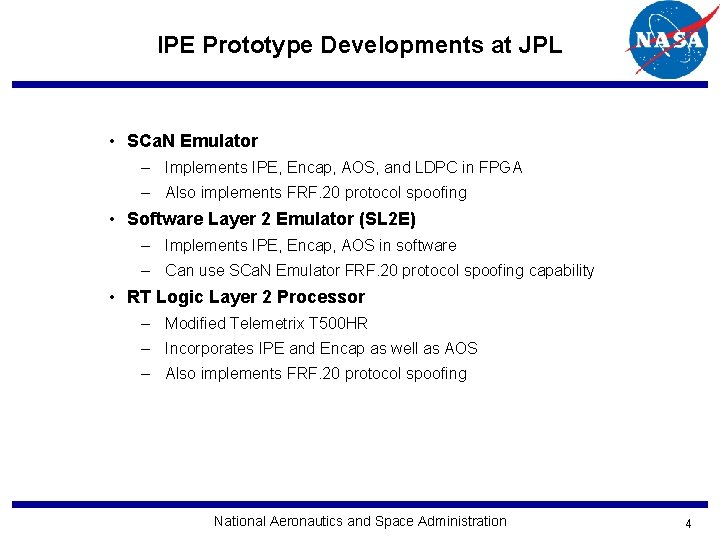
IPE Prototype Developments at JPL • SCa. N Emulator – Implements IPE, Encap, AOS, and LDPC in FPGA – Also implements FRF. 20 protocol spoofing • Software Layer 2 Emulator (SL 2 E) – Implements IPE, Encap, AOS in software – Can use SCa. N Emulator FRF. 20 protocol spoofing capability • RT Logic Layer 2 Processor – Modified Telemetrix T 500 HR – Incorporates IPE and Encap as well as AOS – Also implements FRF. 20 protocol spoofing National Aeronautics and Space Administration 4
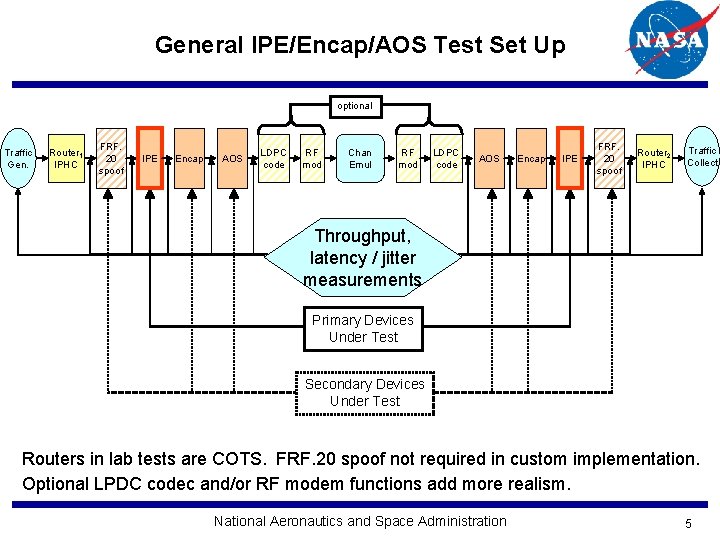
General IPE/Encap/AOS Test Set Up optional Traffic Gen. Router 1 IPHC FRF. 20 spoof IPE Encap AOS LDPC code RF mod Chan Emul RF mod LDPC code AOS Encap IPE FRF. 20 spoof Router 2 IPHC Traffic Collect Throughput, latency / jitter measurements Primary Devices Under Test Secondary Devices Under Test Routers in lab tests are COTS. FRF. 20 spoof not required in custom implementation. Optional LPDC codec and/or RF modem functions add more realism. National Aeronautics and Space Administration 5
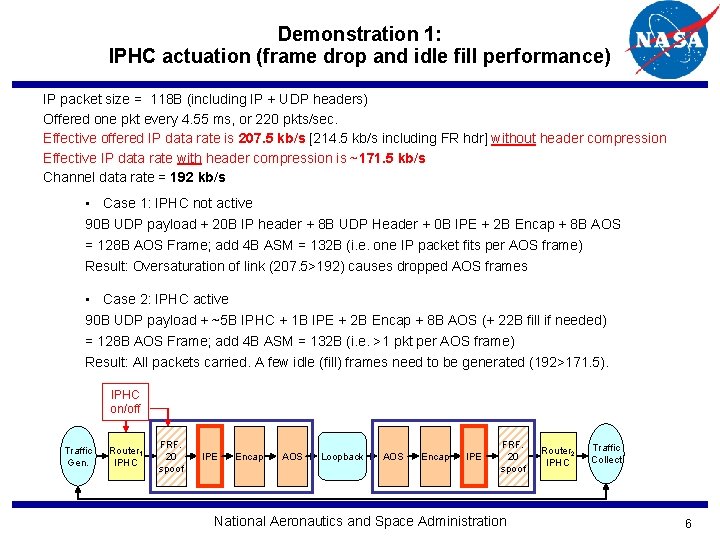
Demonstration 1: IPHC actuation (frame drop and idle fill performance) IP packet size = 118 B (including IP + UDP headers) Offered one pkt every 4. 55 ms, or 220 pkts/sec. Effective offered IP data rate is 207. 5 kb/s [214. 5 kb/s including FR hdr] without header compression Effective IP data rate with header compression is ~171. 5 kb/s Channel data rate = 192 kb/s • Case 1: IPHC not active 90 B UDP payload + 20 B IP header + 8 B UDP Header + 0 B IPE + 2 B Encap + 8 B AOS = 128 B AOS Frame; add 4 B ASM = 132 B (i. e. one IP packet fits per AOS frame) Result: Oversaturation of link (207. 5>192) causes dropped AOS frames • Case 2: IPHC active 90 B UDP payload + ~5 B IPHC + 1 B IPE + 2 B Encap + 8 B AOS (+ 22 B fill if needed) = 128 B AOS Frame; add 4 B ASM = 132 B (i. e. >1 pkt per AOS frame) Result: All packets carried. A few idle (fill) frames need to be generated (192>171. 5). IPHC on/off Traffic Gen. Router 1 IPHC FRF. 20 spoof IPE Encap AOS Loopback AOS Encap IPE FRF. 20 spoof National Aeronautics and Space Administration Router 2 IPHC Traffic Collect 6
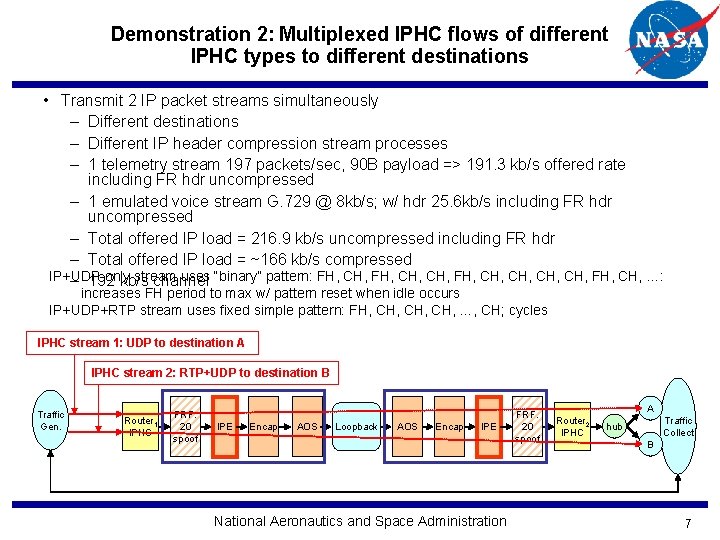
Demonstration 2: Multiplexed IPHC flows of different IPHC types to different destinations • Transmit 2 IP packet streams simultaneously – Different destinations – Different IP header compression stream processes – 1 telemetry stream 197 packets/sec, 90 B payload => 191. 3 kb/s offered rate including FR hdr uncompressed – 1 emulated voice stream G. 729 @ 8 kb/s; w/ hdr 25. 6 kb/s including FR hdr uncompressed – Total offered IP load = 216. 9 kb/s uncompressed including FR hdr – Total offered IP load = ~166 kb/s compressed IP+UDP-only stream uses “binary” pattern: FH, CH, CH, FH, CH, …: – 192 kb/s channel increases FH period to max w/ pattern reset when idle occurs IP+UDP+RTP stream uses fixed simple pattern: FH, CH, CH, …, CH; cycles IPHC stream 1: UDP to destination A IPHC stream 2: RTP+UDP to destination B Traffic Gen. Router 1 IPHC FRF. 20 spoof IPE Encap AOS Loopback AOS Encap IPE National Aeronautics and Space Administration FRF. 20 spoof A Router 2 IPHC Traffic Collect hub B 7
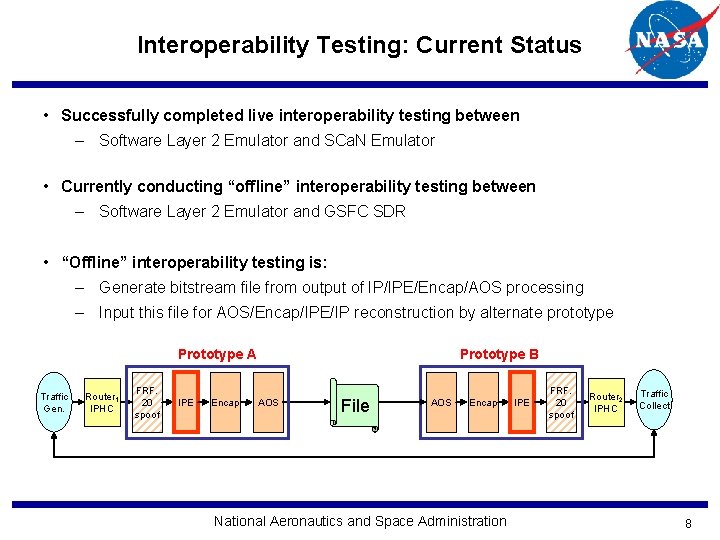
Interoperability Testing: Current Status • Successfully completed live interoperability testing between – Software Layer 2 Emulator and SCa. N Emulator • Currently conducting “offline” interoperability testing between – Software Layer 2 Emulator and GSFC SDR • “Offline” interoperability testing is: – Generate bitstream file from output of IP/IPE/Encap/AOS processing – Input this file for AOS/Encap/IPE/IP reconstruction by alternate prototype Prototype A Traffic Gen. Router 1 IPHC FRF. 20 spoof IPE Encap Prototype B AOS File AOS Encap National Aeronautics and Space Administration IPE FRF. 20 spoof Router 2 IPHC Traffic Collect 8
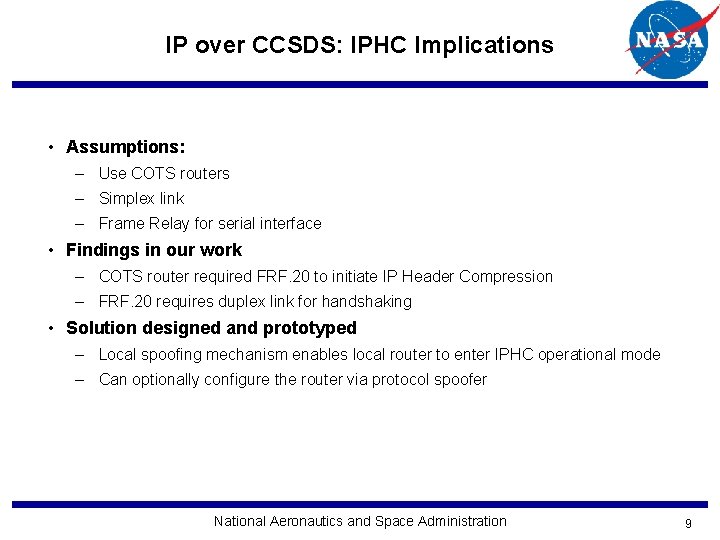
IP over CCSDS: IPHC Implications • Assumptions: – Use COTS routers – Simplex link – Frame Relay for serial interface • Findings in our work – COTS router required FRF. 20 to initiate IP Header Compression – FRF. 20 requires duplex link for handshaking • Solution designed and prototyped – Local spoofing mechanism enables local router to enter IPHC operational mode – Can optionally configure the router via protocol spoofer National Aeronautics and Space Administration 9
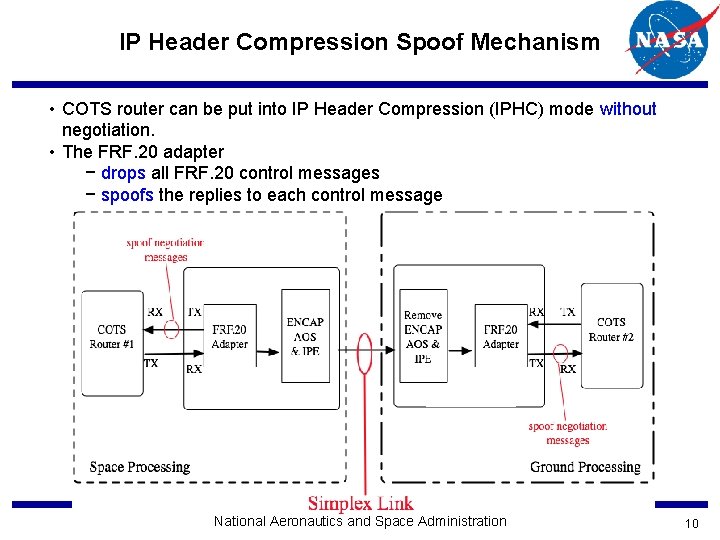
IP Header Compression Spoof Mechanism • COTS router can be put into IP Header Compression (IPHC) mode without negotiation. • The FRF. 20 adapter − drops all FRF. 20 control messages − spoofs the replies to each control message National Aeronautics and Space Administration 10
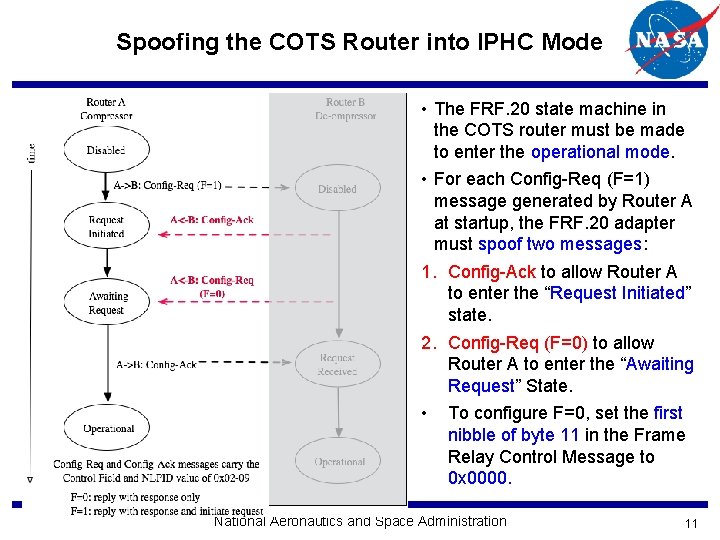
Spoofing the COTS Router into IPHC Mode • The FRF. 20 state machine in the COTS router must be made to enter the operational mode. • For each Config-Req (F=1) message generated by Router A at startup, the FRF. 20 adapter must spoof two messages: 1. Config-Ack to allow Router A to enter the “Request Initiated” state. 2. Config-Req (F=0) to allow Router A to enter the “Awaiting Request” State. • To configure F=0, set the first nibble of byte 11 in the Frame Relay Control Message to 0 x 0000. National Aeronautics and Space Administration 11
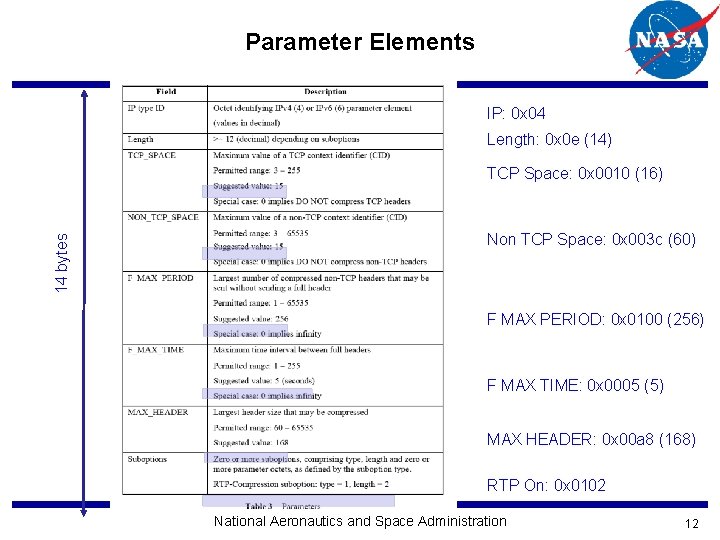
Parameter Elements IP: 0 x 04 Length: 0 x 0 e (14) 14 bytes TCP Space: 0 x 0010 (16) Non TCP Space: 0 x 003 c (60) F MAX PERIOD: 0 x 0100 (256) F MAX TIME: 0 x 0005 (5) MAX HEADER: 0 x 00 a 8 (168) RTP On: 0 x 0102 National Aeronautics and Space Administration 12
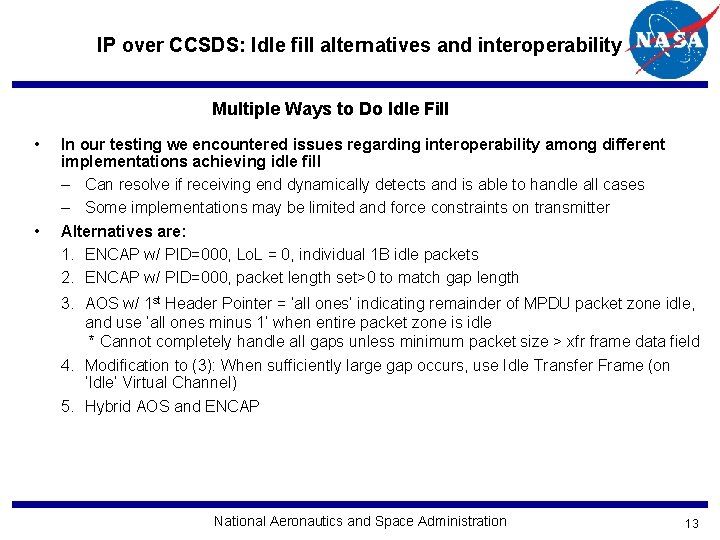
IP over CCSDS: Idle fill alternatives and interoperability Multiple Ways to Do Idle Fill • • In our testing we encountered issues regarding interoperability among different implementations achieving idle fill – Can resolve if receiving end dynamically detects and is able to handle all cases – Some implementations may be limited and force constraints on transmitter Alternatives are: 1. ENCAP w/ PID=000, Lo. L = 0, individual 1 B idle packets 2. ENCAP w/ PID=000, packet length set>0 to match gap length 3. AOS w/ 1 st Header Pointer = ‘all ones’ indicating remainder of MPDU packet zone idle, and use ‘all ones minus 1’ when entire packet zone is idle * Cannot completely handle all gaps unless minimum packet size > xfr frame data field 4. Modification to (3): When sufficiently large gap occurs, use Idle Transfer Frame (on ‘Idle’ Virtual Channel) 5. Hybrid AOS and ENCAP National Aeronautics and Space Administration 13
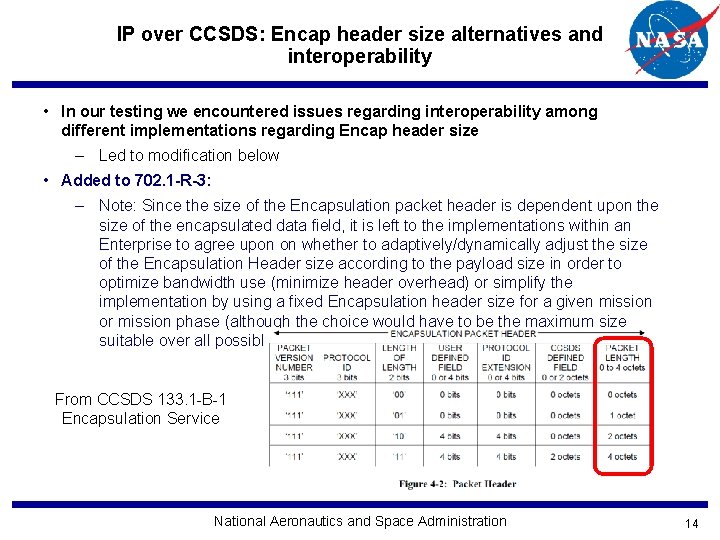
IP over CCSDS: Encap header size alternatives and interoperability • In our testing we encountered issues regarding interoperability among different implementations regarding Encap header size – Led to modification below • Added to 702. 1 -R-3: – Note: Since the size of the Encapsulation packet header is dependent upon the size of the encapsulated data field, it is left to the implementations within an Enterprise to agree upon on whether to adaptively/dynamically adjust the size of the Encapsulation Header size according to the payload size in order to optimize bandwidth use (minimize header overhead) or simplify the implementation by using a fixed Encapsulation header size for a given mission or mission phase (although the choice would have to be the maximum size suitable over all possible mission payloads). From CCSDS 133. 1 -B-1 Encapsulation Service National Aeronautics and Space Administration 14
BACKUP National Aeronautics and Space Administration 15
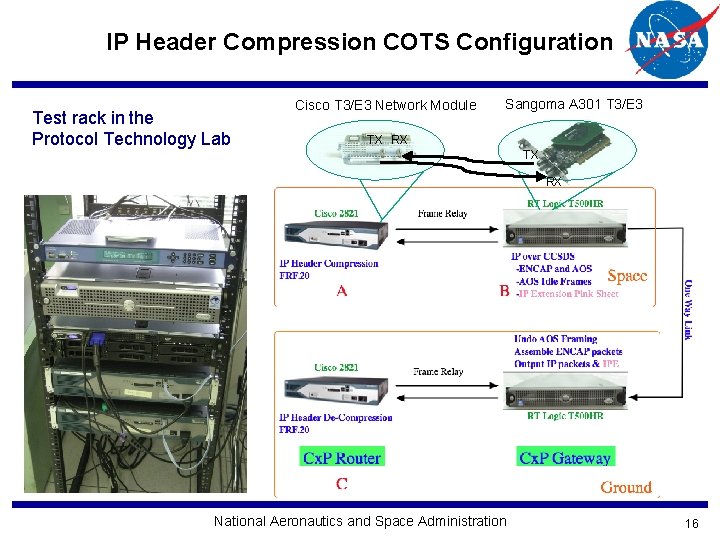
IP Header Compression COTS Configuration Test rack in the Protocol Technology Lab Cisco T 3/E 3 Network Module Sangoma A 301 T 3/E 3 TX RX National Aeronautics and Space Administration 16