
IP Next Generation IPv 6 what why when

- Slides: 16
IP Next Generation (IPv 6) • • • what? why? when? IPv 6 5 A 7 CE 1
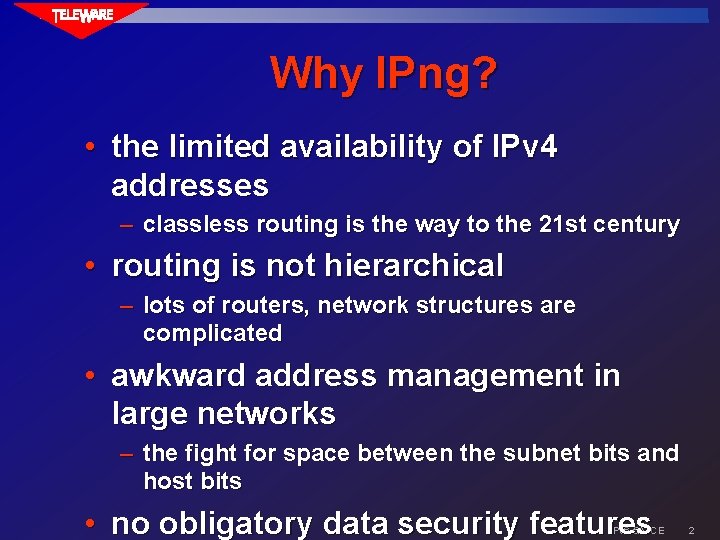
Why IPng? • the limited availability of IPv 4 addresses – classless routing is the way to the 21 st century • routing is not hierarchical – lots of routers, network structures are complicated • awkward address management in large networks – the fight for space between the subnet bits and host bits • no obligatory data security features IPv 6 5 A 7 CE 2
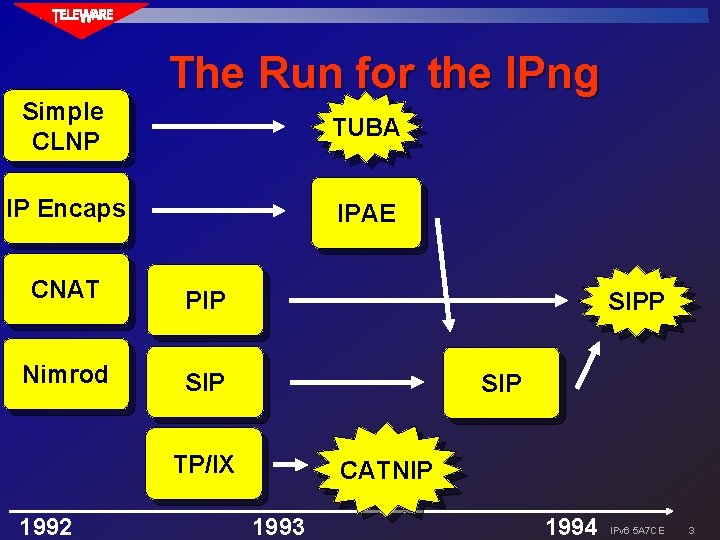
Simple CLNP The Run for the IPng TUBA IP Encaps IPAE CNAT PIP Nimrod SIPP SIP TP/IX 1992 CATNIP 1993 1994 IPv 6 5 A 7 CE 3
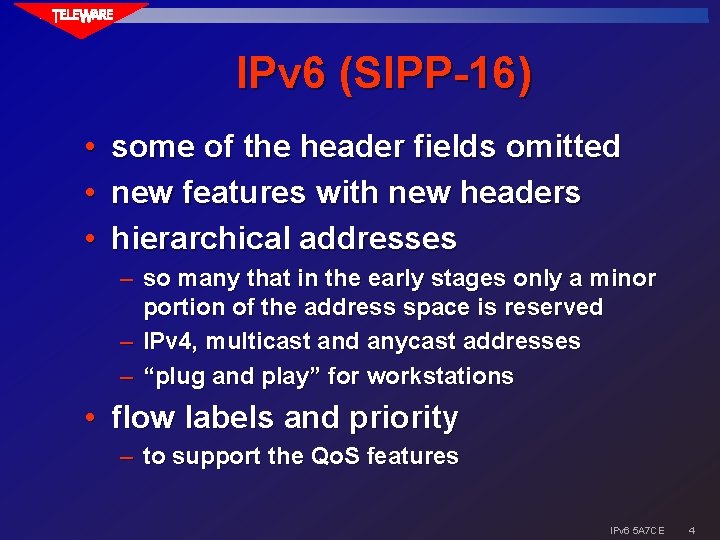
IPv 6 (SIPP-16) • • • some of the header fields omitted new features with new headers hierarchical addresses – so many that in the early stages only a minor portion of the address space is reserved – IPv 4, multicast and anycast addresses – “plug and play” for workstations • flow labels and priority – to support the Qo. S features IPv 6 5 A 7 CE 4
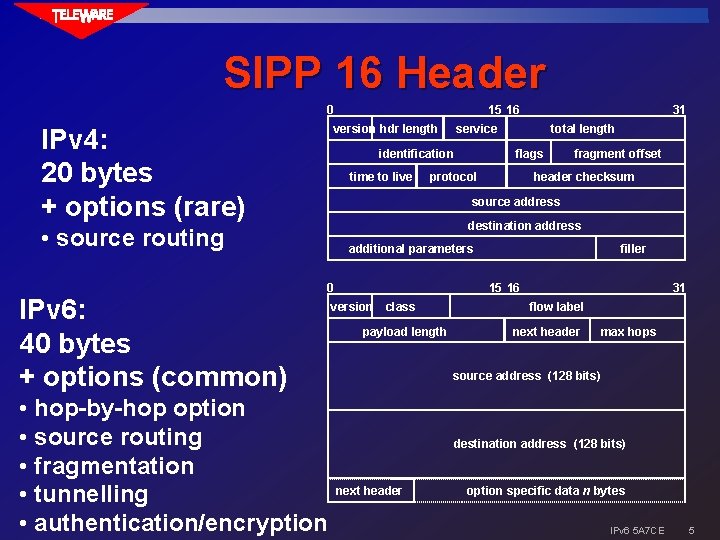
SIPP 16 Header 0 identification time to live 31 service version hdr length IPv 4: 20 bytes + options (rare) total length flags protocol fragment offset header checksum source address destination address • source routing IPv 6: 40 bytes + options (common) 15 16 additional parameters 0 • hop-by-hop option • source routing • fragmentation • tunnelling • authentication/encryption filler 15 16 version class payload length 31 flow label next header max hops source address (128 bits) destination address (128 bits) next header option specific data n bytes IPv 6 5 A 7 CE 5
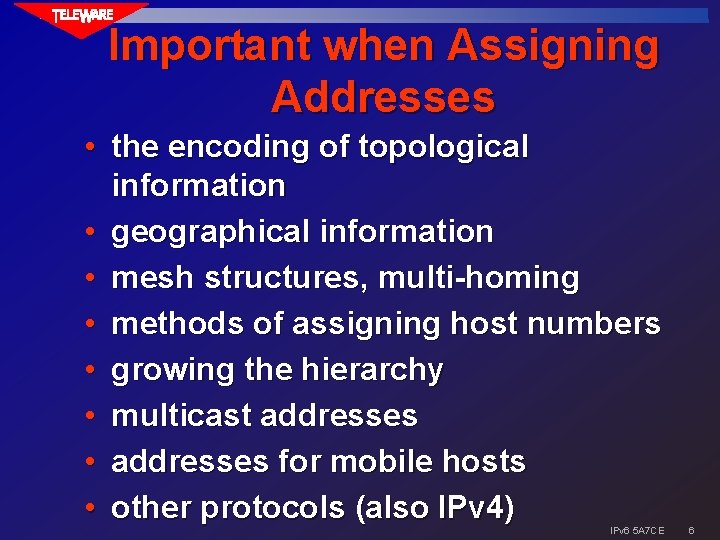
Important when Assigning Addresses • the encoding of topological information • geographical information • mesh structures, multi-homing • methods of assigning host numbers • growing the hierarchy • multicast addresses • addresses for mobile hosts • other protocols (also IPv 4) IPv 6 5 A 7 CE 6
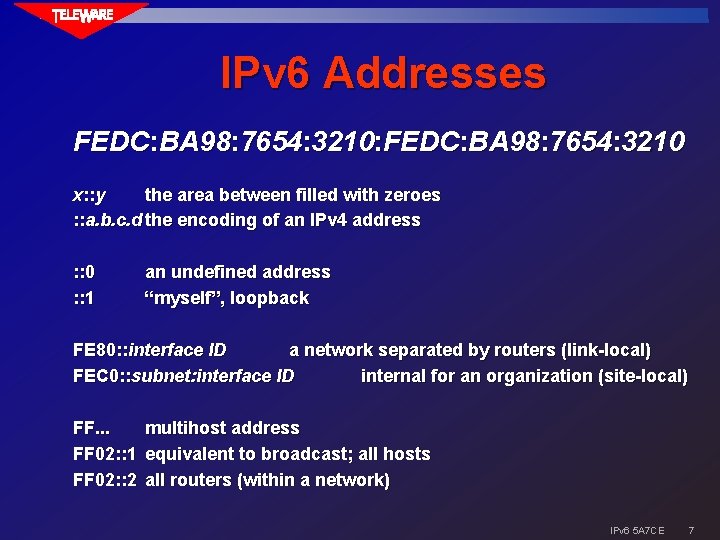
IPv 6 Addresses FEDC: BA 98: 7654: 3210: FEDC: BA 98: 7654: 3210 x: : y the area between filled with zeroes : : a. b. c. d the encoding of an IPv 4 address : : 0 : : 1 an undefined address “myself”, loopback FE 80: : interface ID a network separated by routers (link-local) FEC 0: : subnet: interface ID internal for an organization (site-local) FF. . . FF 02: : 1 FF 02: : 2 multihost address equivalent to broadcast; all hosts all routers (within a network) IPv 6 5 A 7 CE 7
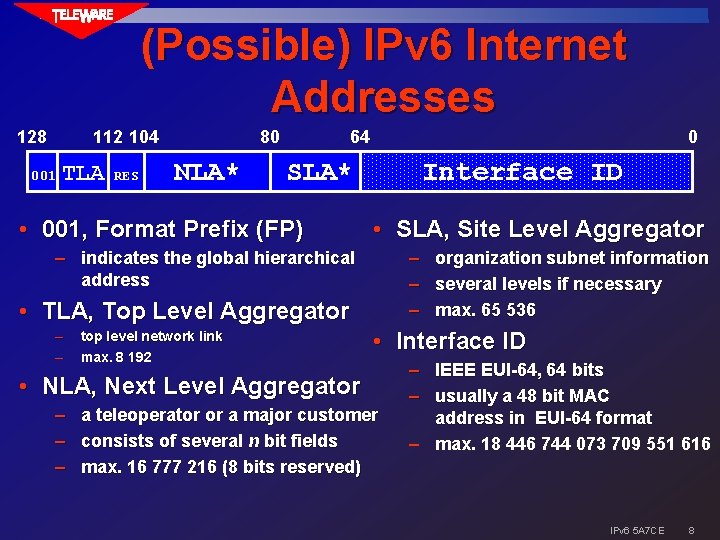
(Possible) IPv 6 Internet Addresses 128 112 104 001 TLA RES 80 NLA* 64 0 SLA* • 001, Format Prefix (FP) Interface ID • SLA, Site Level Aggregator – indicates the global hierarchical address – – – • TLA, Top Level Aggregator – – top level network link max. 8 192 organization subnet information several levels if necessary max. 65 536 • Interface ID • NLA, Next Level Aggregator – a teleoperator or a major customer – consists of several n bit fields – max. 16 777 216 (8 bits reserved) – IEEE EUI-64, 64 bits – usually a 48 bit MAC address in EUI-64 format – max. 18 446 744 073 709 551 616 IPv 6 5 A 7 CE 8
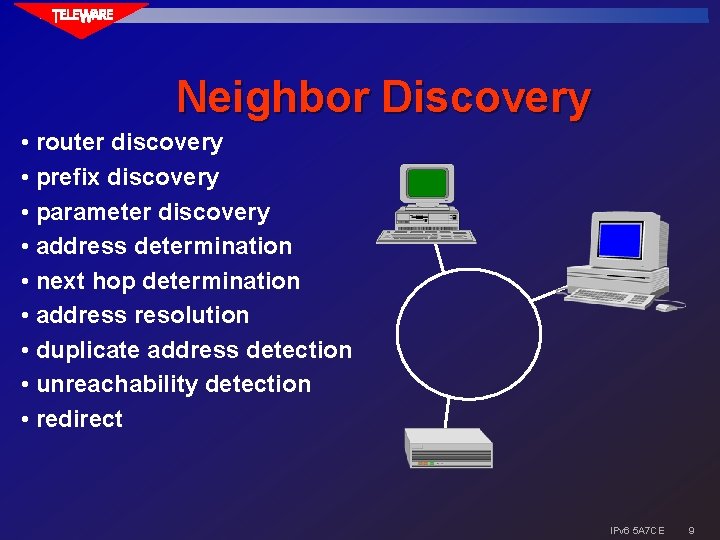
Neighbor Discovery • router discovery • prefix discovery • parameter discovery • address determination • next hop determination • address resolution • duplicate address detection • unreachability detection • redirect IPv 6 5 A 7 CE 9
Neighbor Solicitation IPv 6 5 A 7 CE 10
Neighbor Advertisement IPv 6 5 A 7 CE 11
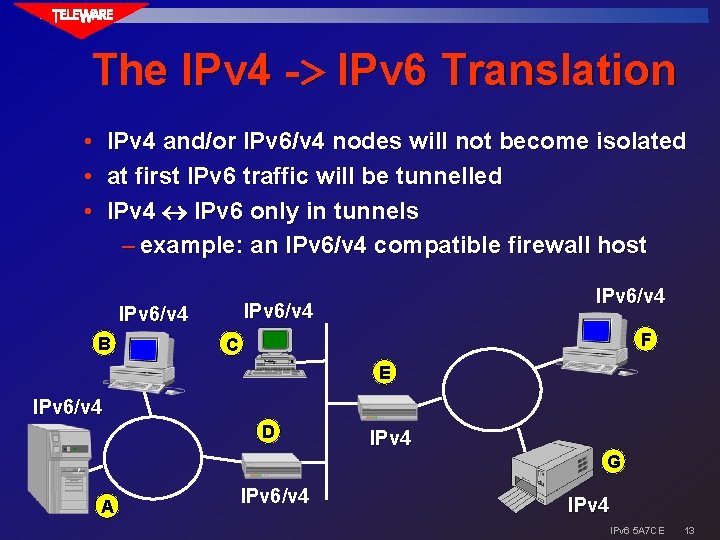
The IPv 4 -> IPv 6 Translation • IPv 4 and/or IPv 6/v 4 nodes will not become isolated • at first IPv 6 traffic will be tunnelled • IPv 4 IPv 6 only in tunnels – example: an IPv 6/v 4 compatible firewall host IPv 6/v 4 B IPv 6/v 4 F C E IPv 6/v 4 D IPv 4 G A IPv 6/v 4 IPv 6 5 A 7 CE 13
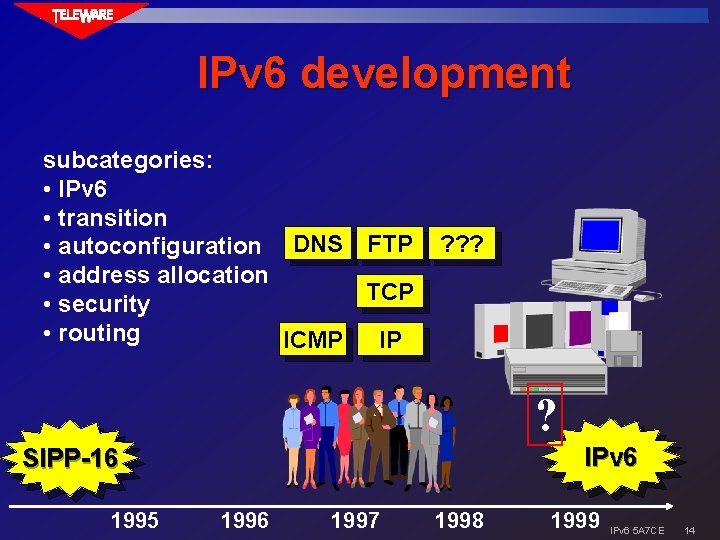
IPv 6 development subcategories: • IPv 6 • transition • autoconfiguration DNS FTP • address allocation TCP • security • routing ICMP IP ? ? ? ? IPv 6 SIPP-16 1995 1996 1997 1998 1999 IPv 6 5 A 7 CE 14
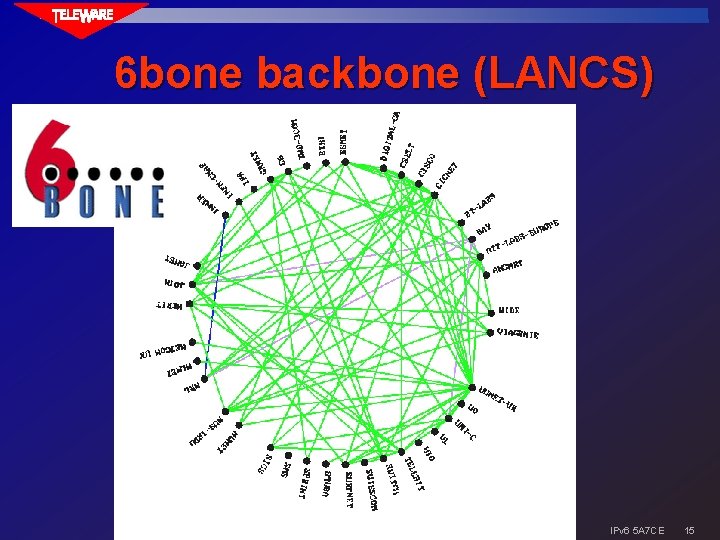
6 bone backbone (LANCS) IPv 6 5 A 7 CE 15
Testing Address Hierarchy IPv 6 5 A 7 CE 16
Further Information on IPv 6 5 A 7 CE 17