
IP Multicasting IGMP and Layer 2 Issues BSCI
IP Multicasting: IGMP and Layer 2 Issues BSCI Module 7 Lesson 2 © 2006 Cisco Systems, Inc. All rights reserved. Cisco Public 1
Objectives § Explain the operations of IGMPv 2 and how IGMPv 2 utilizes Join Group and Leave Group messages. § Explain the operations of IGMPv 3 and how IGMPv 2 and IGMPv 3 interoperate. § Describe the methods used to deal with multicast in a Layer 2 switching environment. BSCI Module 7 Lesson 2 © 2006 Cisco Systems, Inc. All rights reserved. Cisco Public 2

IGMP Overview BSCI Module 7 Lesson 2 © 2006 Cisco Systems, Inc. All rights reserved. Cisco Public 3
Internet Group Management Protocol (IGMP) How hosts tell routers about group membership § Routers solicit group membership from directly connected hosts RFC 1112 specifies IGMPv 1 Supported on Windows 95 RFC 2236 specifies IGMPv 2 Supported on latest service pack for Windows and most UNIX systems RFC 3376 specifies IGMPv 3 Supported in Window XP and various UNIX systems BSCI Module 7 Lesson 2 © 2006 Cisco Systems, Inc. All rights reserved. Cisco Public 4
IGMPv 2 RFC 2236 § Group-specific query Router sends query membership message to a single group rather than all hosts (reduces traffic). § Leave group message Host sends leave message if it leaves the group and is the last member (reduces leave latency in comparison to v 1). § Query-interval response time The Query router sets the maximum Query-Response time (controls burstiness and fine-tunes leave latencies). § Querier election process IGMPv 2 routers can elect the Query Router without relying on the multicast routing protocol. BSCI Module 7 Lesson 2 © 2006 Cisco Systems, Inc. All rights reserved. Cisco Public 5
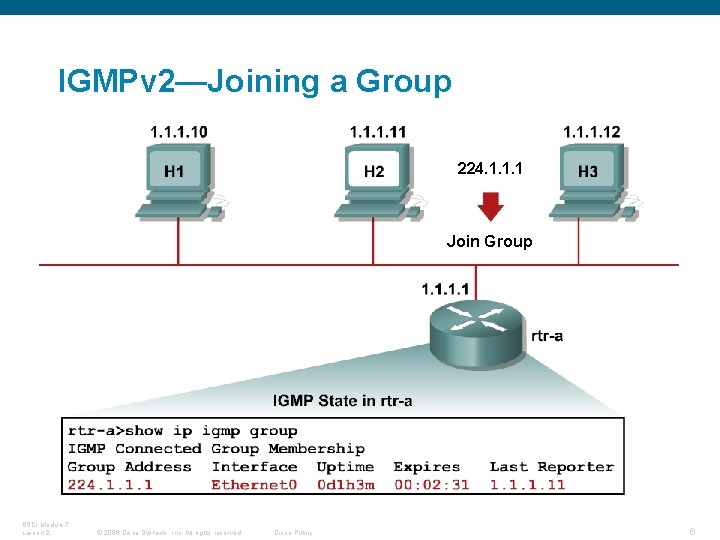
IGMPv 2—Joining a Group 224. 1. 1. 1 Join Group BSCI Module 7 Lesson 2 © 2006 Cisco Systems, Inc. All rights reserved. Cisco Public 6
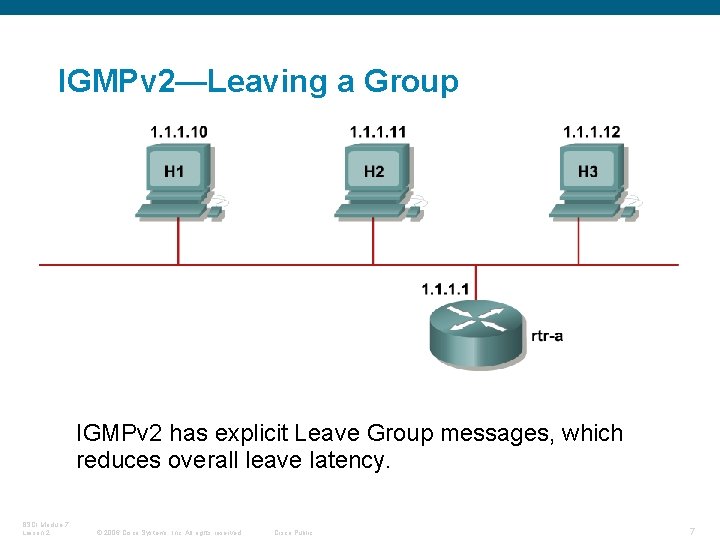
IGMPv 2—Leaving a Group IGMPv 2 has explicit Leave Group messages, which reduces overall leave latency. BSCI Module 7 Lesson 2 © 2006 Cisco Systems, Inc. All rights reserved. Cisco Public 7
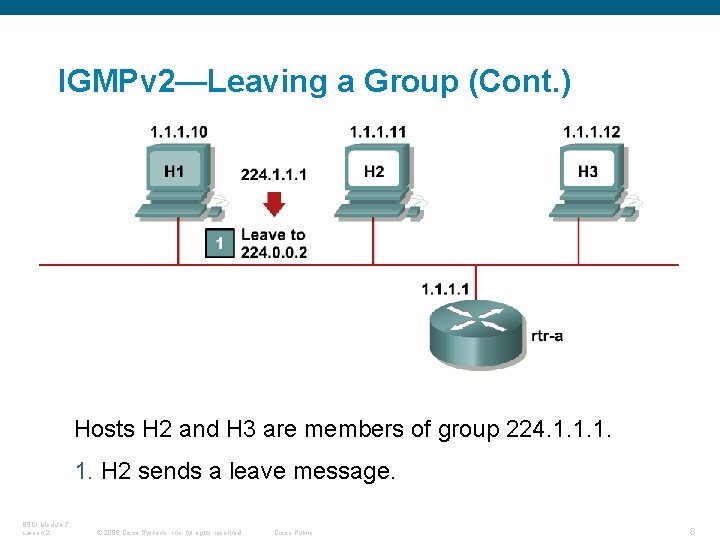
IGMPv 2—Leaving a Group (Cont. ) Hosts H 2 and H 3 are members of group 224. 1. 1. 1. H 2 sends a leave message. BSCI Module 7 Lesson 2 © 2006 Cisco Systems, Inc. All rights reserved. Cisco Public 8
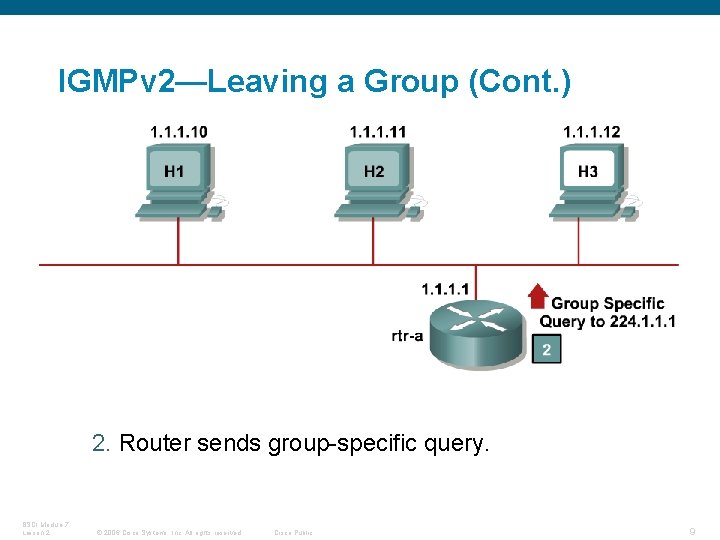
IGMPv 2—Leaving a Group (Cont. ) 2. Router sends group-specific query. BSCI Module 7 Lesson 2 © 2006 Cisco Systems, Inc. All rights reserved. Cisco Public 9
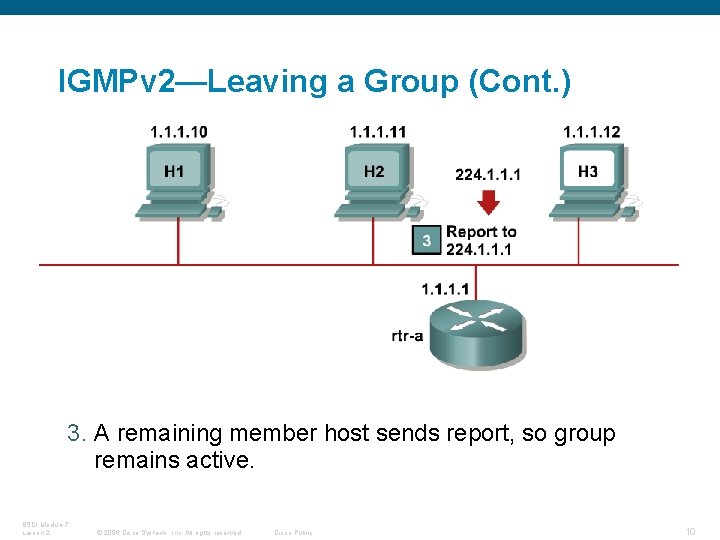
IGMPv 2—Leaving a Group (Cont. ) 3. A remaining member host sends report, so group remains active. BSCI Module 7 Lesson 2 © 2006 Cisco Systems, Inc. All rights reserved. Cisco Public 10
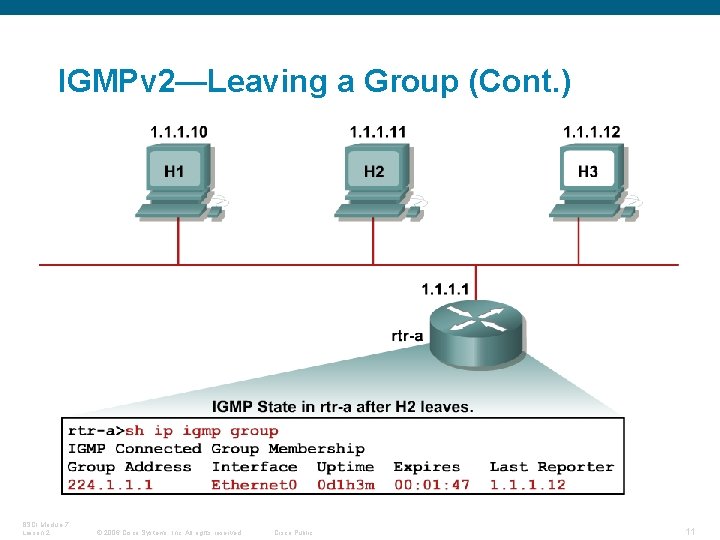
IGMPv 2—Leaving a Group (Cont. ) BSCI Module 7 Lesson 2 © 2006 Cisco Systems, Inc. All rights reserved. Cisco Public 11
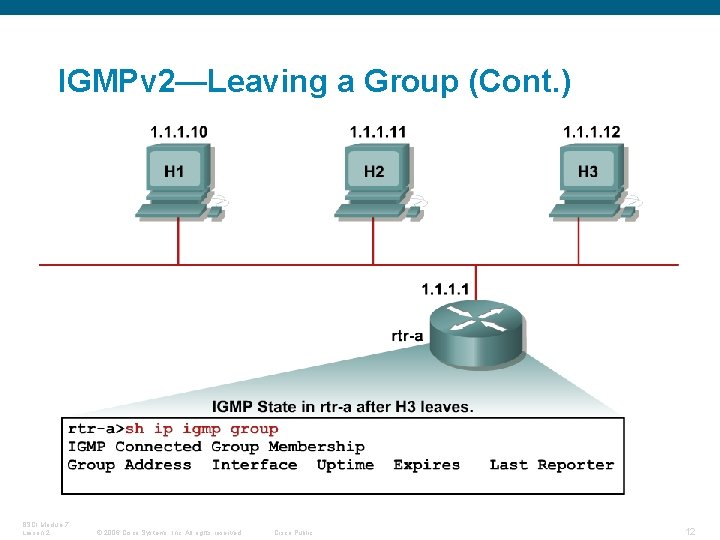
IGMPv 2—Leaving a Group (Cont. ) BSCI Module 7 Lesson 2 © 2006 Cisco Systems, Inc. All rights reserved. Cisco Public 12
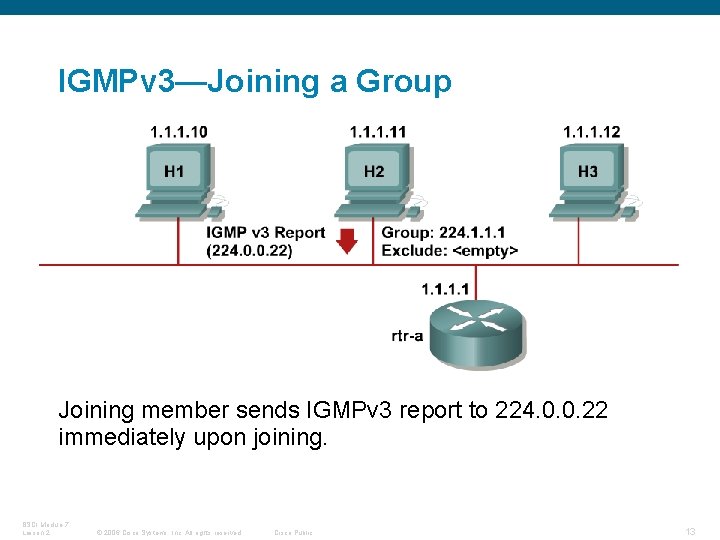
IGMPv 3—Joining a Group Joining member sends IGMPv 3 report to 224. 0. 0. 22 immediately upon joining. BSCI Module 7 Lesson 2 © 2006 Cisco Systems, Inc. All rights reserved. Cisco Public 13
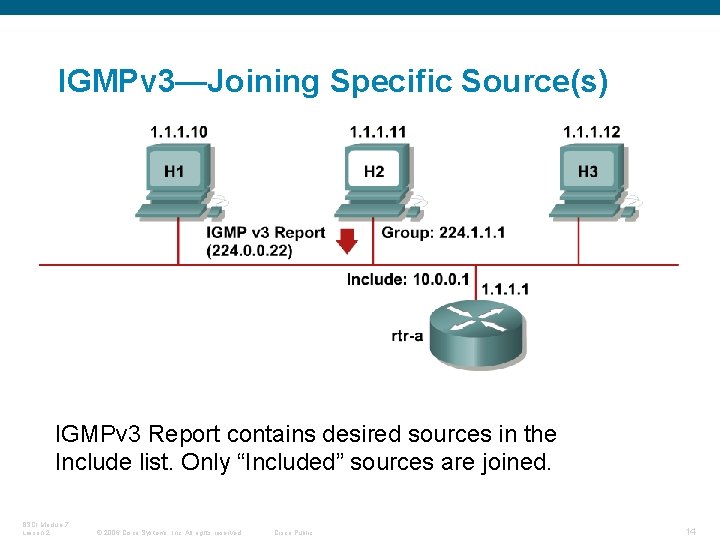
IGMPv 3—Joining Specific Source(s) IGMPv 3 Report contains desired sources in the Include list. Only “Included” sources are joined. BSCI Module 7 Lesson 2 © 2006 Cisco Systems, Inc. All rights reserved. Cisco Public 14
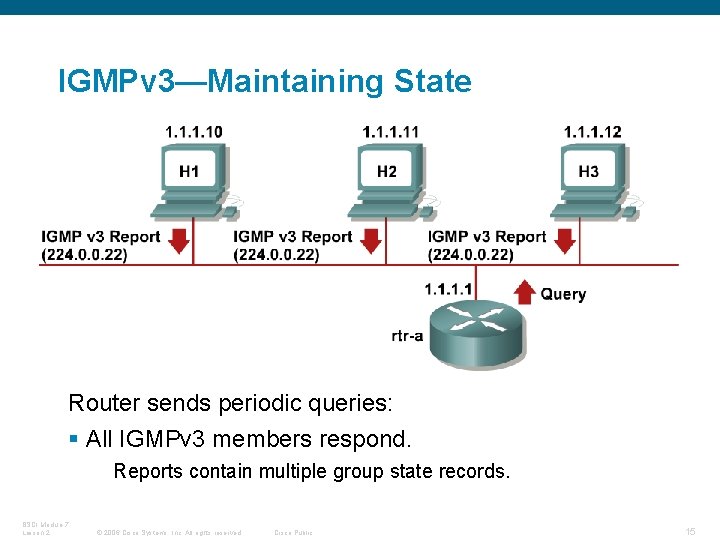
IGMPv 3—Maintaining State Router sends periodic queries: § All IGMPv 3 members respond. Reports contain multiple group state records. BSCI Module 7 Lesson 2 © 2006 Cisco Systems, Inc. All rights reserved. Cisco Public 15
Self Check 1. What is the primary purpose of IGMP? 2. When 2 IGMP routers are located on the same Ethernet segment, which router will be the designated querier? 3. What does the ICMPv 2 Query router doe when it receives a Leave Message? BSCI Module 7 Lesson 2 © 2006 Cisco Systems, Inc. All rights reserved. Cisco Public 16
IGMP Layer 2 Issues BSCI Module 7 Lesson 2 © 2006 Cisco Systems, Inc. All rights reserved. Cisco Public 17
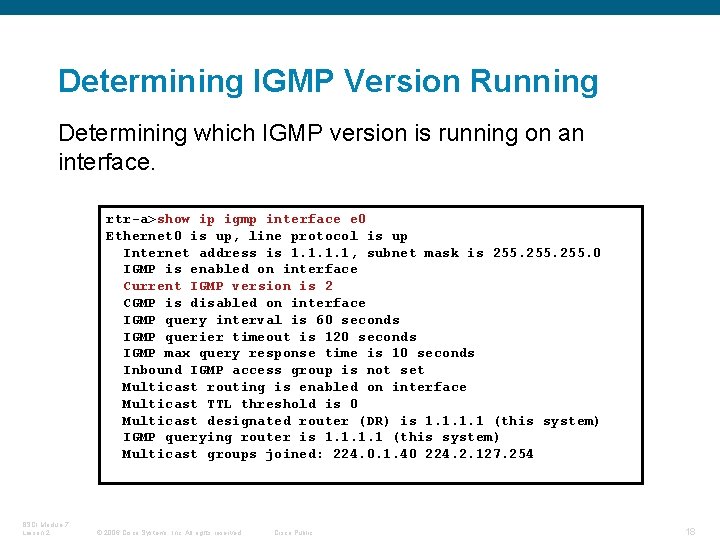
Determining IGMP Version Running Determining which IGMP version is running on an interface. rtr-a>show ip igmp interface e 0 Ethernet 0 is up, line protocol is up Internet address is 1. 1, subnet mask is 255. 0 IGMP is enabled on interface Current IGMP version is 2 CGMP is disabled on interface IGMP query interval is 60 seconds IGMP querier timeout is 120 seconds IGMP max query response time is 10 seconds Inbound IGMP access group is not set Multicast routing is enabled on interface Multicast TTL threshold is 0 Multicast designated router (DR) is 1. 1 (this system) IGMP querying router is 1. 1 (this system) Multicast groups joined: 224. 0. 1. 40 224. 2. 127. 254 BSCI Module 7 Lesson 2 © 2006 Cisco Systems, Inc. All rights reserved. Cisco Public 18
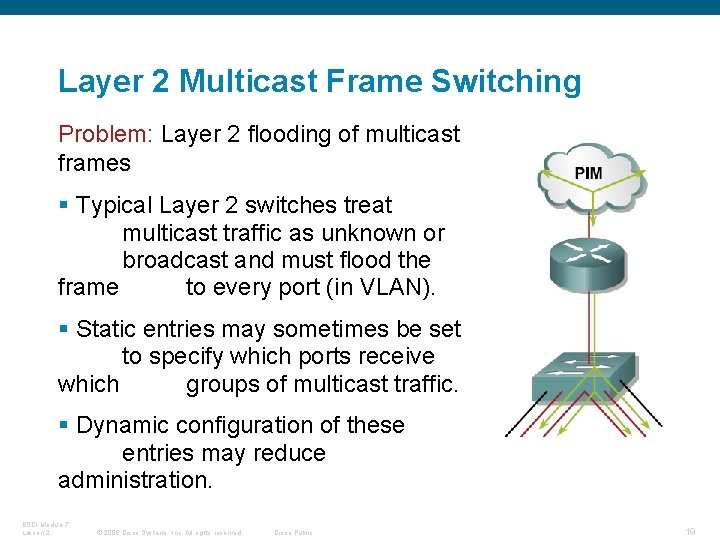
Layer 2 Multicast Frame Switching Problem: Layer 2 flooding of multicast frames § Typical Layer 2 switches treat multicast traffic as unknown or broadcast and must flood the frame to every port (in VLAN). § Static entries may sometimes be set to specify which ports receive which groups of multicast traffic. § Dynamic configuration of these entries may reduce administration. BSCI Module 7 Lesson 2 © 2006 Cisco Systems, Inc. All rights reserved. Cisco Public 19
Layer 2 Multicast Switching Solutions § Cisco Group Management Protocol (CGMP): Simple, proprietary; routers and switches § IGMP snooping: Complex, standardized, proprietary implementations; switches only BSCI Module 7 Lesson 2 © 2006 Cisco Systems, Inc. All rights reserved. Cisco Public 20
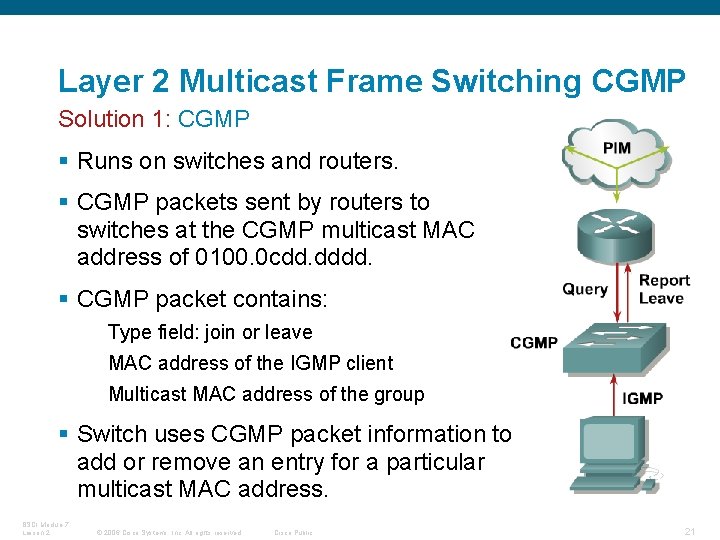
Layer 2 Multicast Frame Switching CGMP Solution 1: CGMP § Runs on switches and routers. § CGMP packets sent by routers to switches at the CGMP multicast MAC address of 0100. 0 cdd. dddd. § CGMP packet contains: Type field: join or leave MAC address of the IGMP client Multicast MAC address of the group § Switch uses CGMP packet information to add or remove an entry for a particular multicast MAC address. BSCI Module 7 Lesson 2 © 2006 Cisco Systems, Inc. All rights reserved. Cisco Public 21
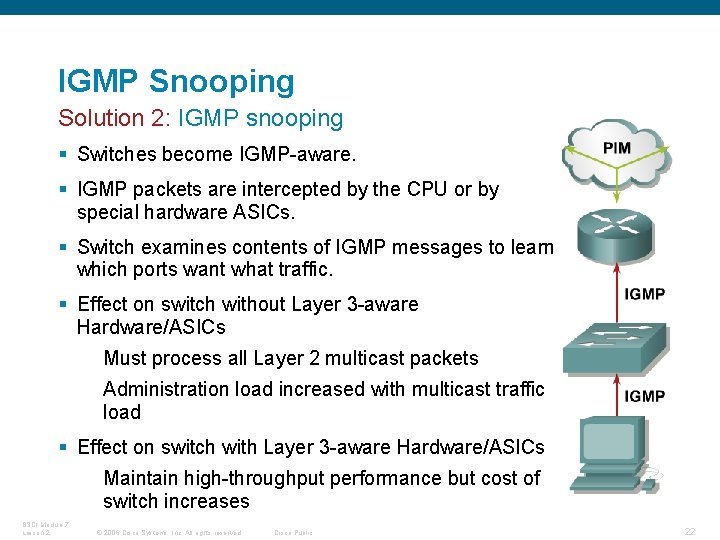
IGMP Snooping Solution 2: IGMP snooping § Switches become IGMP-aware. § IGMP packets are intercepted by the CPU or by special hardware ASICs. § Switch examines contents of IGMP messages to learn which ports want what traffic. § Effect on switch without Layer 3 -aware Hardware/ASICs Must process all Layer 2 multicast packets Administration load increased with multicast traffic load § Effect on switch with Layer 3 -aware Hardware/ASICs Maintain high-throughput performance but cost of switch increases BSCI Module 7 Lesson 2 © 2006 Cisco Systems, Inc. All rights reserved. Cisco Public 22
IGMPv 3 and IGMP Snooping § Impact of IGMPv 3 on IGMP Snooping IGMPv 3 Reports are sent to a separate group (224. 0. 0. 22) reduces load on switch CPU No Report Suppression in IGMPv 3 § IGMP Snooping should not cause a serious performance problem once IGMPv 3 is implemented. BSCI Module 7 Lesson 2 © 2006 Cisco Systems, Inc. All rights reserved. Cisco Public 23
Self Check 1. What command is used to determine the version of IGMP active on an interface? 2. How does a typical layer 2 switch treat multicast traffic? 3. What is CGMP? 4. What type of switch is recommending for use with IGMP snooping? BSCI Module 7 Lesson 2 © 2006 Cisco Systems, Inc. All rights reserved. Cisco Public 24
Summary § IGMPv 2 is a protocol used by multicast clients to join a multicast group. § IGMPv 3 allows a receiver to specify a source. § If controls such as CGMP and IGMP snooping are not added at the Ethernet switching level, all multicast frames are flooded. § CGMP is a Cisco proprietary protocol used to implement multicast efficiently. § IGMP snooping is a standard protocol that has a function similar to CGMP. BSCI Module 7 Lesson 2 © 2006 Cisco Systems, Inc. All rights reserved. Cisco Public 25
Q and A BSCI Module 7 Lesson 2 © 2006 Cisco Systems, Inc. All rights reserved. Cisco Public 26
Resources § Wikipedia IGMP article http: //en. wikipedia. org/wiki/IGMP § Multicast in a Campus Network: CGMP and IGMP Snooping http: //www. cisco. com/warp/public/473/22. html § IP Multicast Glossary of Terms http: //www. cisco. com/en/US/tech/tk 828/tech_brief 0900 aecd 801 bca 26. html BSCI Module 7 Lesson 2 © 2006 Cisco Systems, Inc. All rights reserved. Cisco Public 27

BSCI Module 7 Lesson 2 © 2006 Cisco Systems, Inc. All rights reserved. Cisco Public 28
- Slides: 28