
IP FABRIC ARCHITECTURE FOR GRNET AUTOMATING THE DATACENTER
IP FABRIC ARCHITECTURE FOR GRNET AUTOMATING THE DATACENTER Christos Argyropoulos cargious@noc. grnet. gr GRNET June 13, 2018, TNC 18: Trondheim
2 The problem Expanding from Two small DCs One larger one: 22 racks To three new datacenters Athens: 36 racks (with the expansion) Knossos: 26 racks Louros: 14 racks Network architecture? Address existing problems Balance between already tested and more innovative solutions Satisfy new requirement: VLAN stretch between datacenters IP Fabric solution for GRNET Datacenters 13 Jun 2018, TNC 18, Trondheim

3 Typical GRNET DC Rack Storage Lane Distributed Object Storage: Debian, Ceph/RADOS Networking Lane Virtual Machines Lane Also: - Traditional SAN/NAS - Baremetal servers or Colocated third party servers - Monitoring stations, PDUs, TS, … Debian, KVM, Ganeti, okeanos/vima No routing protocols between hosts & network. Simple linux bridging or ARP proxying IP Fabric solution for GRNET Datacenters 13 Jun 2018, TNC 18, Trondheim

4 GRNET DC Network GRNET Core DC Network Single switching fabric across the entire datacenter VLANs stretching DC router(s) Server Connectivity IP Fabric solution for GRNET Datacenters Intervlan routing Routing with GRNET IP core Firewalling Active/Active (LACP) Active/Backup Single homed 13 Jun 2018, TNC 18, Trondheim

5 Previous Architectures: Ethernet + IP Core Router A Core Router B Legacy Ethernet + IP DC Router A DC Router B Stacked Switch Limitations IP Fabric solution for GRNET Datacenters HW redundancy: two of everything First Hop Redundancy: VRRP Redundant connections to the IP Network No Spanning Tree Servers are multihomed no LACP Poor link utilization (no active/active scenario) BUM & Mac learning problems due to the topology Inter. DC VLAN stretch without redundancy (L 2 VPNs) Mixed mode stacking not so problem free 13 Jun 2018, TNC 18, Trondheim

Previous Architectures: (closed) Fabric architectures 6 Core Router A Core Router B Aggregat ion Switch Limitations: Linecar d switch LACP Link for multi-chassis synchronization Complex implementations often problematic in large scale Difficulty in debugging due to ‘closed’ proprietary solutions Often platforms are immature which results to bugs Eventually too many hours wasted in troubleshooting and bringing the solution to ‘production ready’ state. All tested solutions already outdated Looking for something new to avoid vendor ‘black box’ solutions IP Fabric solution for GRNET Datacenters LACP 13 Jun 2018, TNC 18, Trondheim

7 IP Fabric (aka IP Clos): the recipe Topology: Build a decades old topology IP Clos Make use of existing hardware Juniper QFX 5 K as To. R switches Add two new powerhouse Devices for the spine layer Juniper QFX 10 K Overlay Networking with EVPN as control plane All traffic is L 3 with: VXLAN IP Fabric solution for GRNET Datacenters In theory decouple the network from the physical hardware programmatically provisioned in a much larger scale All_active physical topologies Anycast layer 3 gateways Dataplane encapsulation for Overlay Tunnels Limitations: network overhead since all VM traffic is now encapsulated with VXLAN header (+64 bits) No STP / no MC-LAG 13 Jun 2018, TNC 18, Trondheim

8 VXLAN: Brief introduction Overview RFC 7348 Tunneling (overlay) protocol that encapsulates all traffic in IP/UDP Can be described as MAC-over. UDP with a globally unique identifier VLAN-like separation, according to VXLAN ID Tunnels are build between VXLAN Tunnel Endpoints (VTEPs) Need of a control plane to minimize flooding and better facilitate learning Forward traffic between IP Fabric nodes referred to as the underlay Outer IP IP Fabric solution for GRNET Datacenters All traffic is L 3 no need for VXLAN VNID STP Payload Service Separation 13 Jun 2018, TNC 18, Trondheim
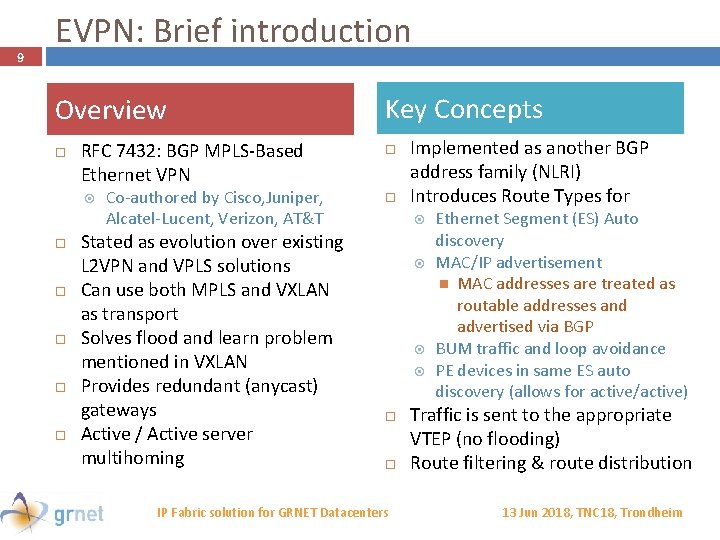
9 EVPN: Brief introduction Overview Key Concepts RFC 7432: BGP MPLS-Based Ethernet VPN Co-authored by Cisco, Juniper, Alcatel-Lucent, Verizon, AT&T Stated as evolution over existing L 2 VPN and VPLS solutions Can use both MPLS and VXLAN as transport Solves flood and learn problem mentioned in VXLAN Provides redundant (anycast) gateways Active / Active server multihoming Implemented as another BGP address family (NLRI) Introduces Route Types for IP Fabric solution for GRNET Datacenters Ethernet Segment (ES) Auto discovery MAC/IP advertisement MAC addresses are treated as routable addresses and advertised via BGP BUM traffic and loop avoidance PE devices in same ES auto discovery (allows for active/active) Traffic is sent to the appropriate VTEP (no flooding) Route filtering & route distribution 13 Jun 2018, TNC 18, Trondheim

10 GRNET IP Fabric topology Core Router A Spine & Leaf topology SPINE: Juniper QFX 1002 Core Router B Juniper QFX 10 K LEAF: Juniper QFX 5100 Juniper QFX 5 K nx 10 G uplink to GRNET core 2 x 40 G uplink Server: 2 x 1/10 G UTP Multihoming: In pairs of racks IP Fabric solution for GRNET Datacenters LACP or Active-Backup 13 Jun 2018, TNC 18, Trondheim
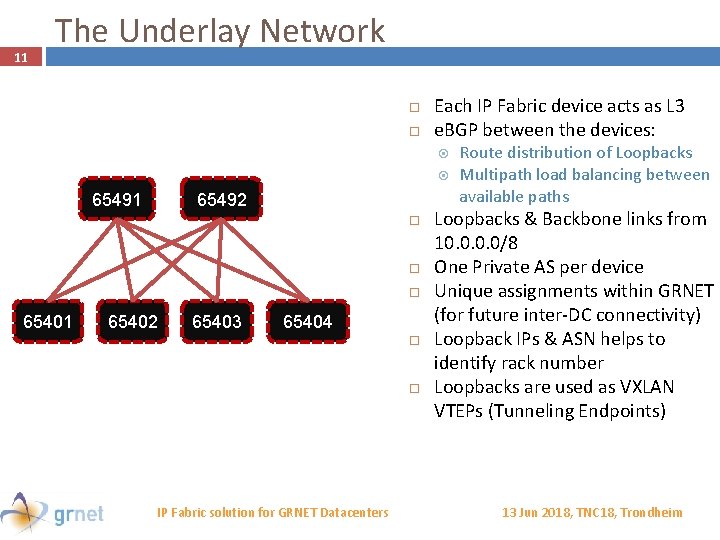
11 The Underlay Network Each IP Fabric device acts as L 3 e. BGP between the devices: 65491 65492 65401 65402 65403 65404 IP Fabric solution for GRNET Datacenters Route distribution of Loopbacks Multipath load balancing between available paths Loopbacks & Backbone links from 10. 0/8 One Private AS per device Unique assignments within GRNET (for future inter-DC connectivity) Loopback IPs & ASN helps to identify rack number Loopbacks are used as VXLAN VTEPs (Tunneling Endpoints) 13 Jun 2018, TNC 18, Trondheim
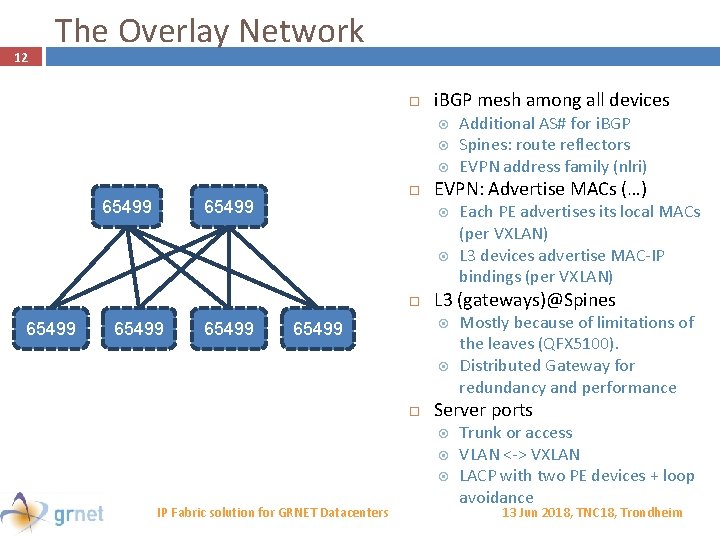
12 The Overlay Network i. BGP mesh among all devices 65499 EVPN: Advertise MACs (…) 65499 Mostly because of limitations of the leaves (QFX 5100). Distributed Gateway for redundancy and performance Server ports IP Fabric solution for GRNET Datacenters Each PE advertises its local MACs (per VXLAN) L 3 devices advertise MAC-IP bindings (per VXLAN) L 3 (gateways)@Spines 65499 Additional AS# for i. BGP Spines: route reflectors EVPN address family (nlri) Trunk or access VLAN <-> VXLAN LACP with two PE devices + loop avoidance 13 Jun 2018, TNC 18, Trondheim
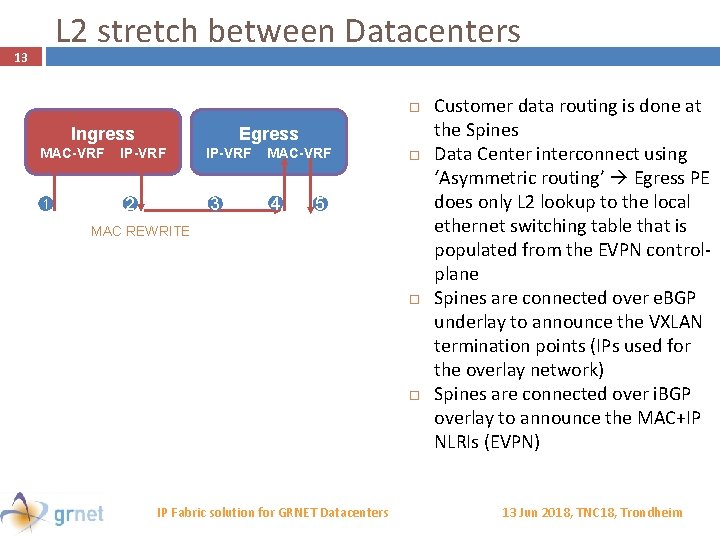
L 2 stretch between Datacenters 13 Ingress MAC-VRF 1 Egress IP-VRF 2 IP-VRF 3 MAC-VRF 4 5 MAC REWRITE IP Fabric solution for GRNET Datacenters Customer data routing is done at the Spines Data Center interconnect using ‘Asymmetric routing’ Egress PE does only L 2 lookup to the local ethernet switching table that is populated from the EVPN controlplane Spines are connected over e. BGP underlay to announce the VXLAN termination points (IPs used for the overlay network) Spines are connected over i. BGP overlay to announce the MAC+IP NLRIs (EVPN) 13 Jun 2018, TNC 18, Trondheim
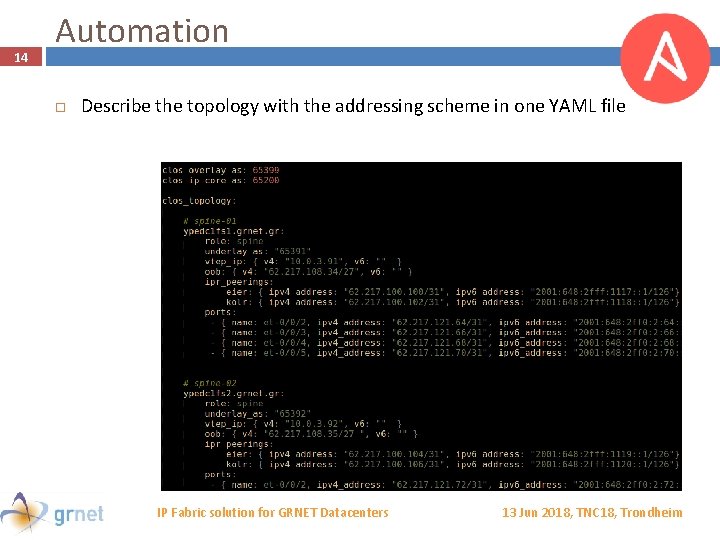
14 Automation Describe the topology with the addressing scheme in one YAML file IP Fabric solution for GRNET Datacenters 13 Jun 2018, TNC 18, Trondheim
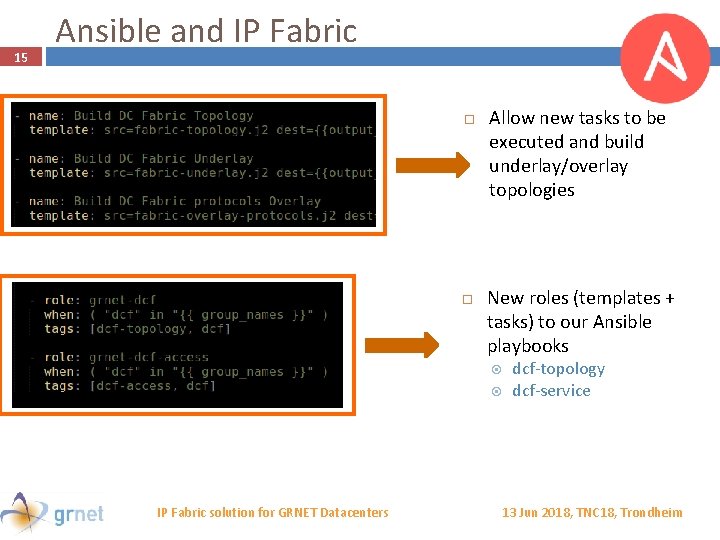
15 Ansible and IP Fabric Allow new tasks to be executed and build underlay/overlay topologies New roles (templates + tasks) to our Ansible playbooks IP Fabric solution for GRNET Datacenters dcf-topology dcf-service 13 Jun 2018, TNC 18, Trondheim
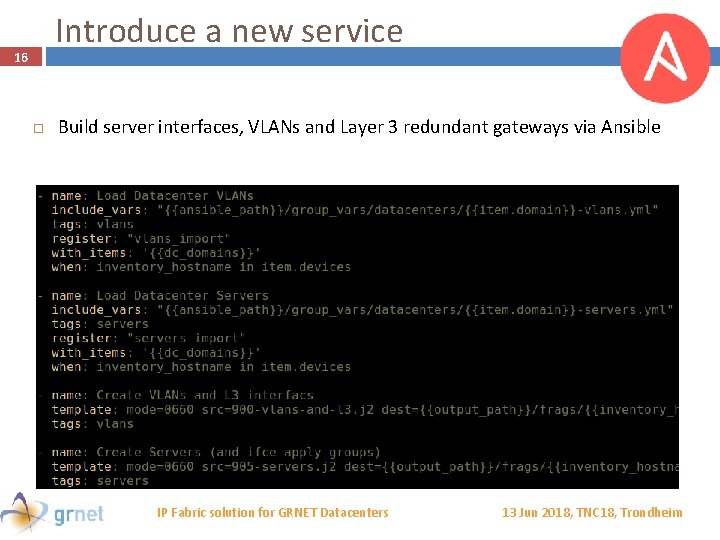
Introduce a new service 16 Build server interfaces, VLANs and Layer 3 redundant gateways via Ansible IP Fabric solution for GRNET Datacenters 13 Jun 2018, TNC 18, Trondheim
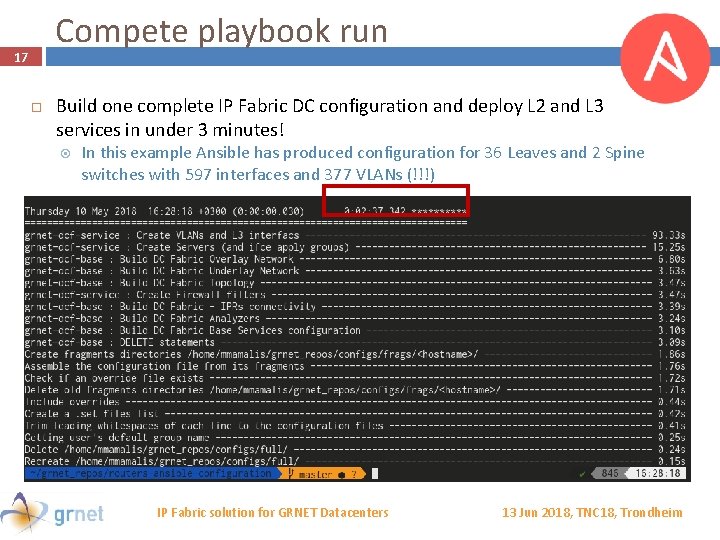
Compete playbook run 17 Build one complete IP Fabric DC configuration and deploy L 2 and L 3 services in under 3 minutes! In this example Ansible has produced configuration for 36 Leaves and 2 Spine switches with 597 interfaces and 377 VLANs (!!!) IP Fabric solution for GRNET Datacenters 13 Jun 2018, TNC 18, Trondheim
18 Reality: An adventure Addressing scheme for Many limitations on the Broadcom chipset on QFX 5100 Early adoption of EVPN implementation on QFX platforms VTEP IPs IN-band management -> loopbacks Eventually a new carrier VRF to completely separate the management traffic Underlay ASNs Multiply by number of DCs Bugs… Easier troubleshooting due to openness of the solution Lot of support/attention from Juniper (win-win case) Netconf support from the beginning: ease of service deployment and configuration changes with Ansible IP Fabric solution for GRNET Datacenters 13 Jun 2018, TNC 18, Trondheim
19 Thank you! IP Fabric solution for GRNET Datacenters 13 Jun 2018, TNC 18, Trondheim
- Slides: 19