
IP Basics 1 2 3 4 5 1
IP Basics 1. 2. 3. 4. 5. 1 st Octet Values for Class A, B, C, D, & E HOB (High Order Bits) in the 1 st Octet Format for Network and Host Bits Subnetmasks (Default) ‘ANDing’ (to determine Network & Host Bits) © 2003, Cisco Systems, Inc. All rights reserved. 1
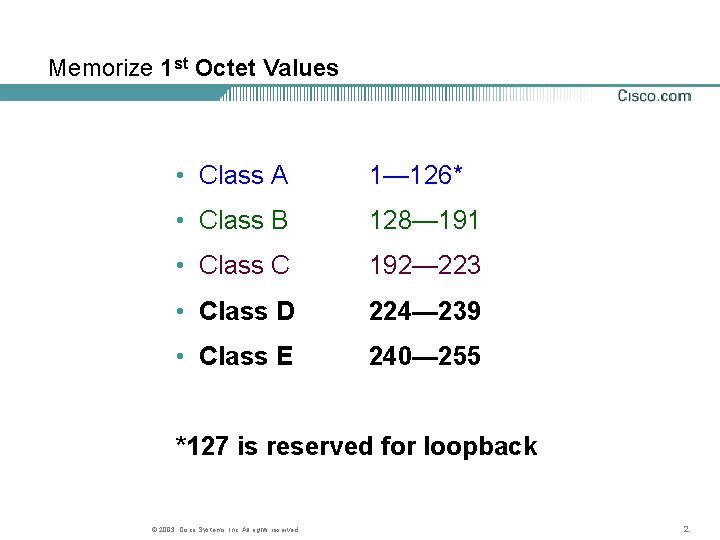
Memorize 1 st Octet Values • Class A 1— 126* • Class B 128— 191 • Class C 192— 223 • Class D 224— 239 • Class E 240— 255 *127 is reserved for loopback © 2003, Cisco Systems, Inc. All rights reserved. 2
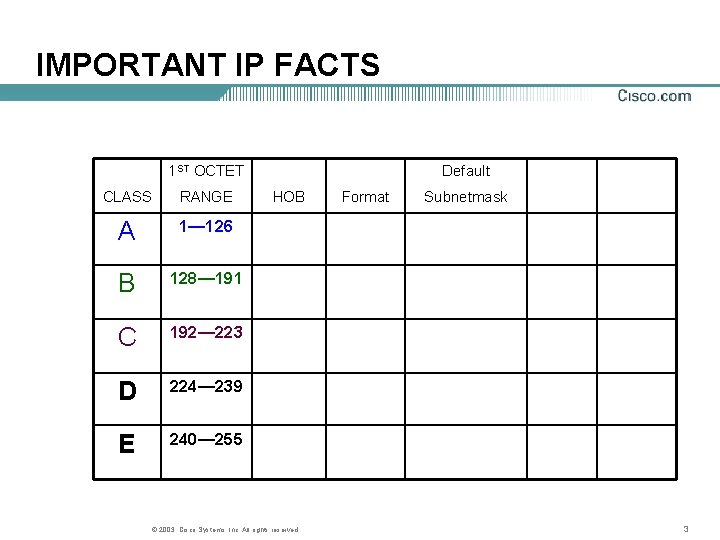
IMPORTANT IP FACTS 1 ST OCTET CLASS RANGE A 1— 126 B 128— 191 C 192— 223 D 224— 239 E 240— 255 Default HOB © 2003, Cisco Systems, Inc. All rights reserved. Format Subnetmask 3
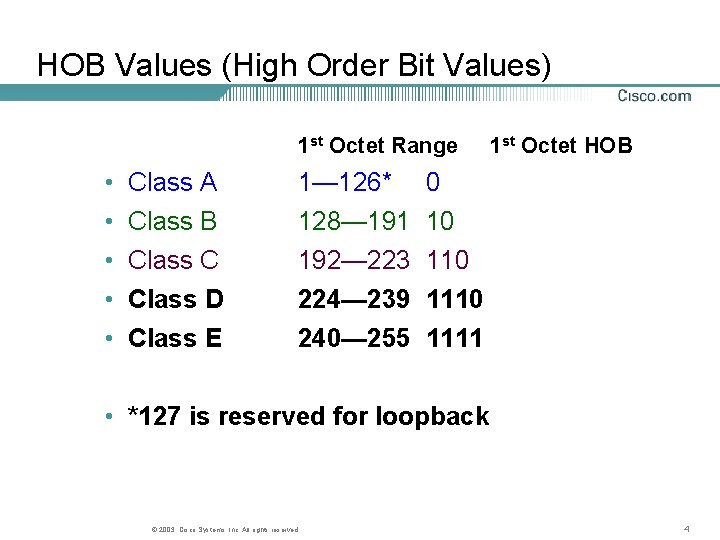
HOB Values (High Order Bit Values) 1 st Octet Range • • • Class A Class B 1— 126* 0 128— 191 10 Class C 192— 223 110 Class D Class E 224— 239 1110 240— 255 1111 1 st Octet HOB • *127 is reserved for loopback © 2003, Cisco Systems, Inc. All rights reserved. 4
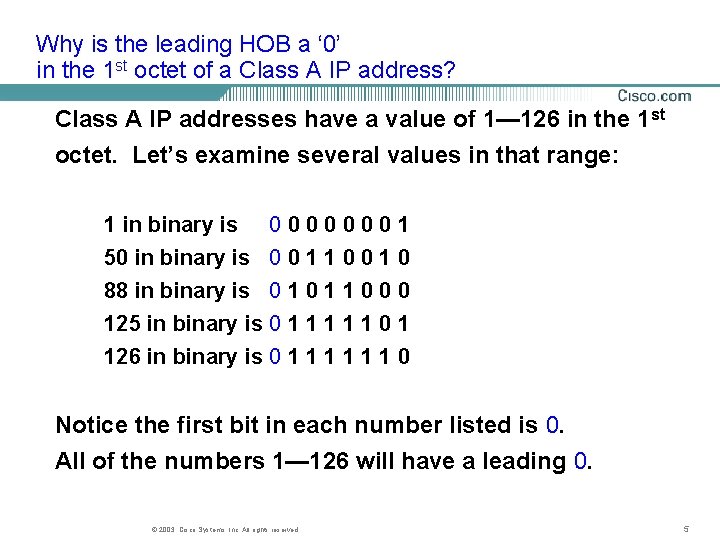
Why is the leading HOB a ‘ 0’ in the 1 st octet of a Class A IP address? Class A IP addresses have a value of 1— 126 in the 1 st octet. Let’s examine several values in that range: 1 in binary is 0 0 0 0 1 50 in binary is 0 0 1 1 0 0 1 0 88 in binary is 0 1 1 0 0 0 125 in binary is 0 1 1 1 0 1 126 in binary is 0 1 1 1 0 Notice the first bit in each number listed is 0. All of the numbers 1— 126 will have a leading 0. © 2003, Cisco Systems, Inc. All rights reserved. 5
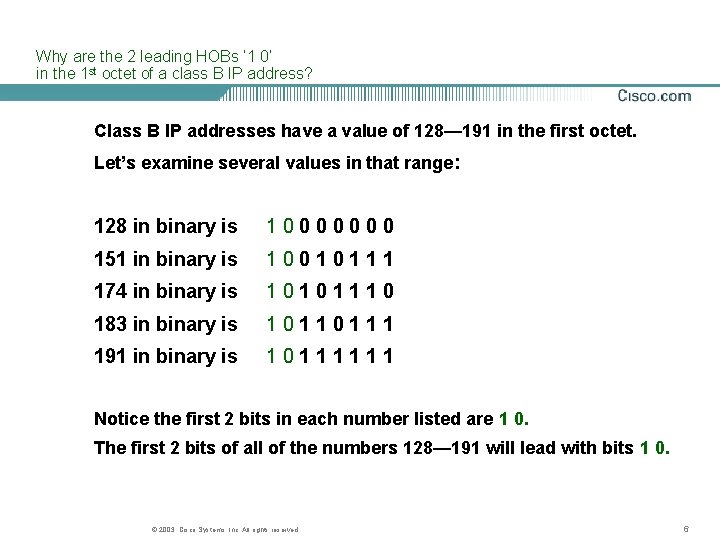
Why are the 2 leading HOBs ‘ 1 0’ in the 1 st octet of a class B IP address? Class B IP addresses have a value of 128— 191 in the first octet. Let’s examine several values in that range: 128 in binary is 10000000 151 in binary is 10010111 174 in binary is 10101110 183 in binary is 10110111 191 in binary is 10111111 Notice the first 2 bits in each number listed are 1 0. The first 2 bits of all of the numbers 128— 191 will lead with bits 1 0. © 2003, Cisco Systems, Inc. All rights reserved. 6
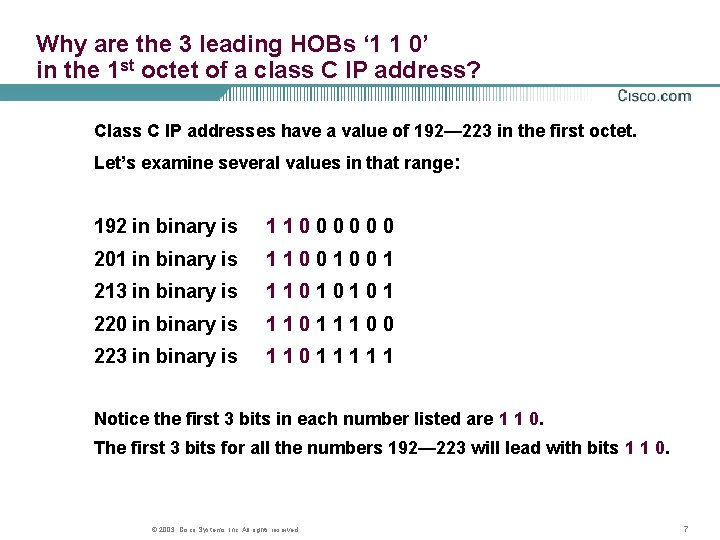
Why are the 3 leading HOBs ‘ 1 1 0’ in the 1 st octet of a class C IP address? Class C IP addresses have a value of 192— 223 in the first octet. Let’s examine several values in that range: 192 in binary is 11000000 201 in binary is 11001001 213 in binary is 11010101 220 in binary is 11011100 223 in binary is 11011111 Notice the first 3 bits in each number listed are 1 1 0. The first 3 bits for all the numbers 192— 223 will lead with bits 1 1 0. © 2003, Cisco Systems, Inc. All rights reserved. 7
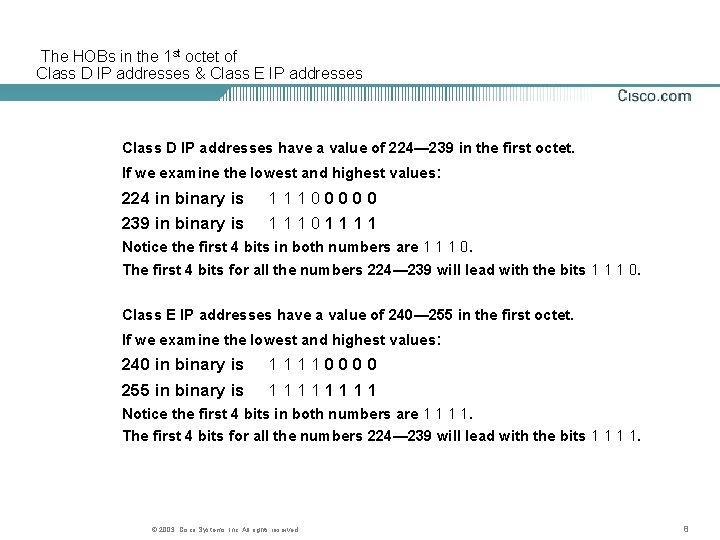
The HOBs in the 1 st octet of Class D IP addresses & Class E IP addresses Class D IP addresses have a value of 224— 239 in the first octet. If we examine the lowest and highest values: 224 in binary is 239 in binary is 11100000 11101111 Notice the first 4 bits in both numbers are 1 1 1 0. The first 4 bits for all the numbers 224— 239 will lead with the bits 1 1 1 0. Class E IP addresses have a value of 240— 255 in the first octet. If we examine the lowest and highest values: 240 in binary is 255 in binary is 11110000 1111 Notice the first 4 bits in both numbers are 1 1. The first 4 bits for all the numbers 224— 239 will lead with the bits 1 1. © 2003, Cisco Systems, Inc. All rights reserved. 8
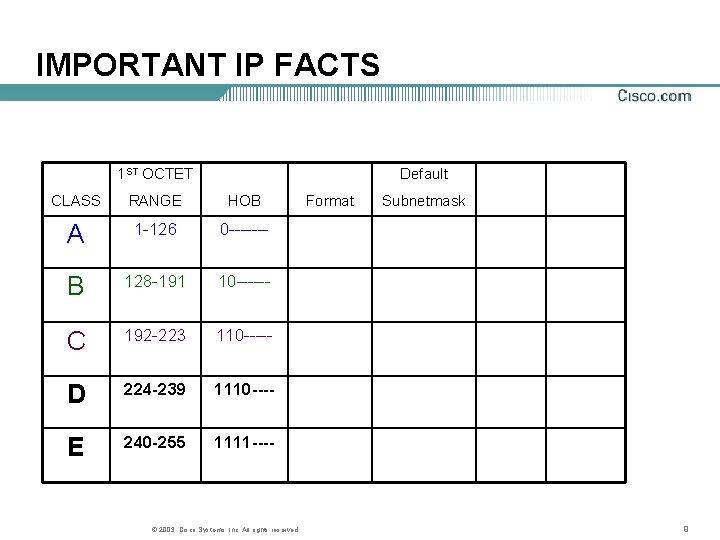
IMPORTANT IP FACTS 1 ST OCTET Default CLASS RANGE HOB A 1 -126 0 ------- B 128 -191 10 ------ C 192 -223 110 ----- D 224 -239 1110 ---- E 240 -255 1111 ---- © 2003, Cisco Systems, Inc. All rights reserved. Format Subnetmask 9
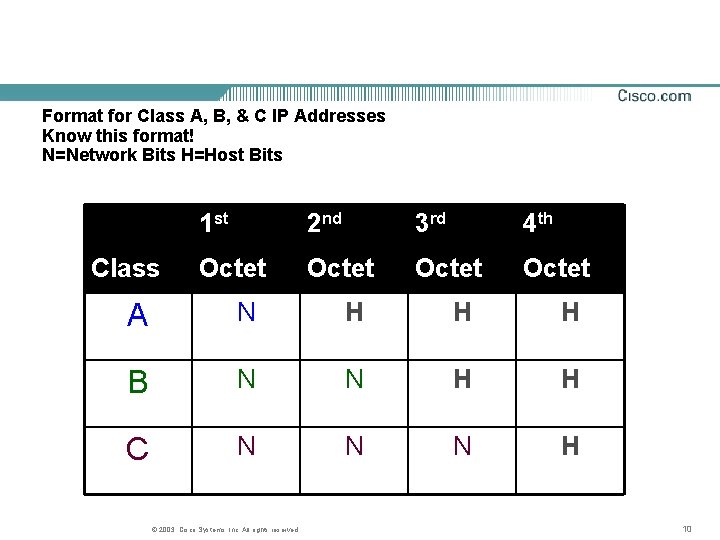
Format for Class A, B, & C IP Addresses Know this format! N=Network Bits H=Host Bits Class 1 st 2 nd 3 rd 4 th Octet A N H H H B N N H H C N N N H © 2003, Cisco Systems, Inc. All rights reserved. 10
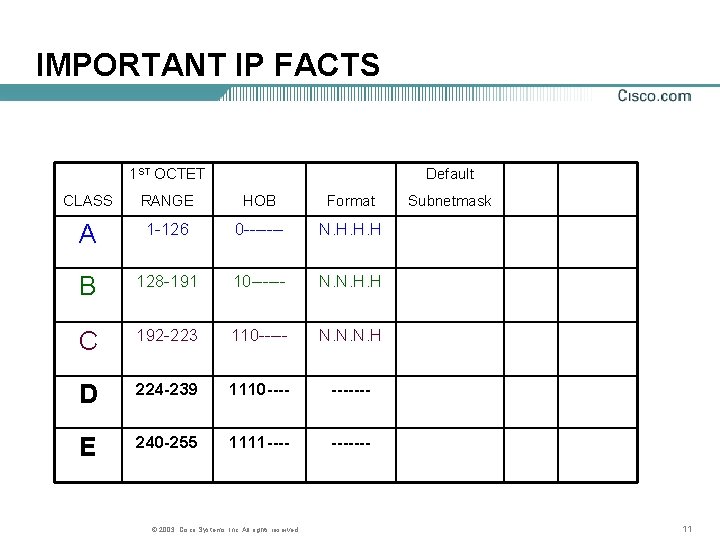
IMPORTANT IP FACTS 1 ST OCTET Default CLASS RANGE HOB Format A 1 -126 0 ------- N. H. H. H B 128 -191 10 ------ N. N. H. H C 192 -223 110 ----- N. N. N. H D 224 -239 1110 ------- E 240 -255 1111 ------- © 2003, Cisco Systems, Inc. All rights reserved. Subnetmask 11
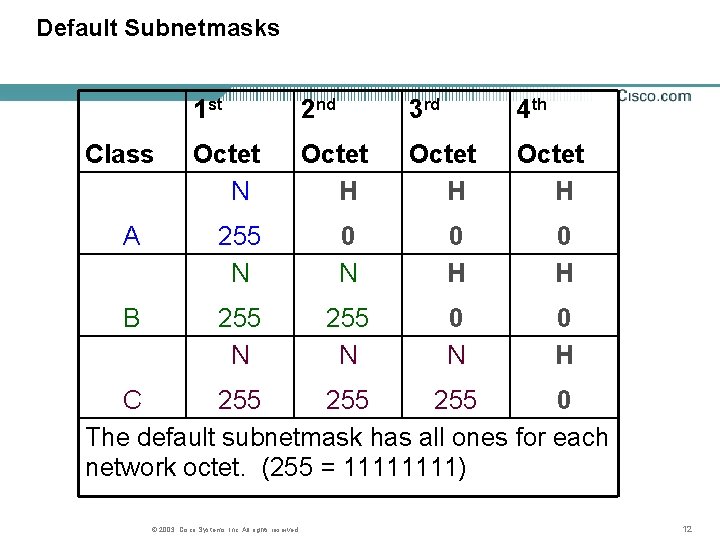
Default Subnetmasks Class 1 st 2 nd 3 rd 4 th Octet N Octet H A 255 N 0 H 0 H B 255 N 0 N 0 H C 255 255 0 The default subnetmask has all ones for each network octet. (255 = 1111) © 2003, Cisco Systems, Inc. All rights reserved. 12
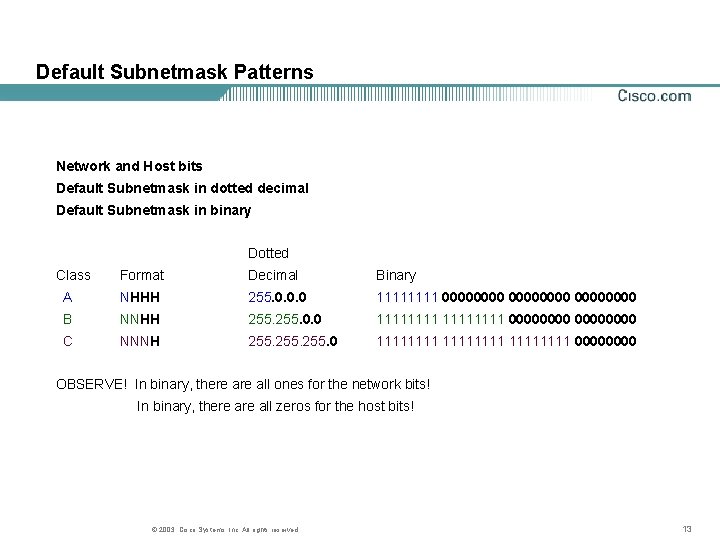
Default Subnetmask Patterns Network and Host bits Default Subnetmask in dotted decimal Default Subnetmask in binary Dotted Class Format Decimal Binary A NHHH 255. 0. 0. 0 1111 00000000 B NNHH 255. 0. 0 11111111 00000000 C NNNH 255. 0 11111111 0000 OBSERVE! In binary, there all ones for the network bits! In binary, there all zeros for the host bits! © 2003, Cisco Systems, Inc. All rights reserved. 13
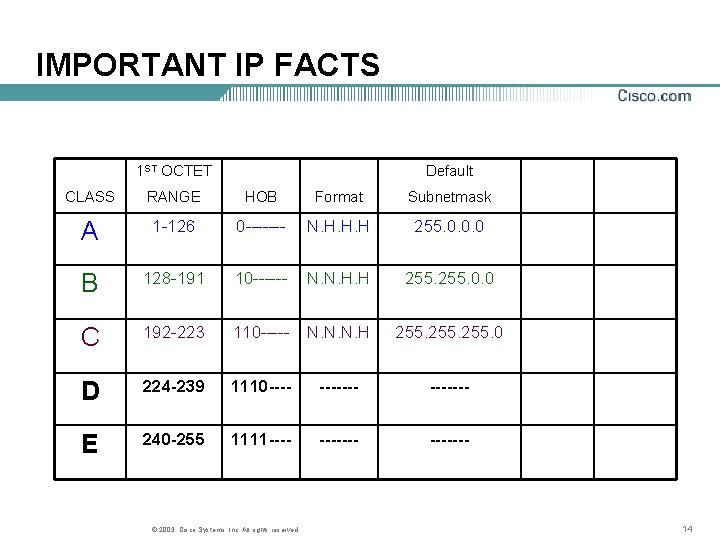
IMPORTANT IP FACTS 1 ST OCTET Default CLASS RANGE HOB Format Subnetmask A 1 -126 0 ------- N. H. H. H 255. 0. 0. 0 B 128 -191 10 ------ N. N. H. H 255. 0. 0 C 192 -223 110 ----- N. N. N. H 255. 0 D 224 -239 1110 ------- E 240 -255 1111 ------- © 2003, Cisco Systems, Inc. All rights reserved. 14
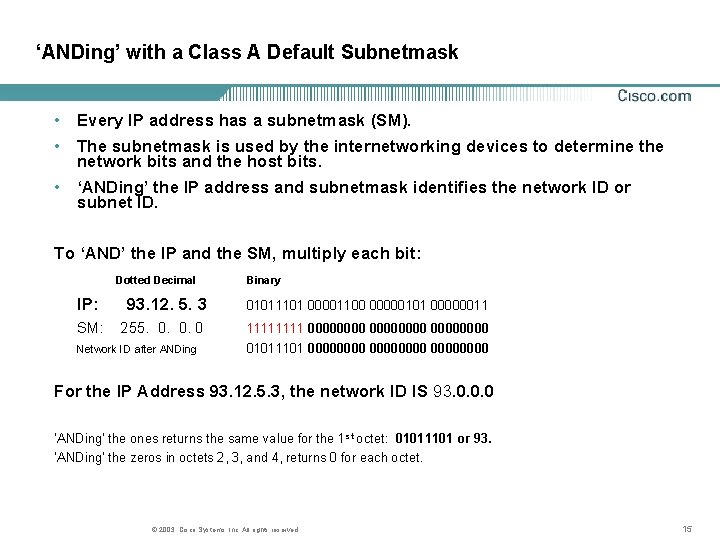
‘ANDing’ with a Class A Default Subnetmask • Every IP address has a subnetmask (SM). • The subnetmask is used by the internetworking devices to determine the network bits and the host bits. • ‘ANDing’ the IP address and subnetmask identifies the network ID or subnet ID. To ‘AND’ the IP and the SM, multiply each bit: Dotted Decimal IP: SM: Binary 93. 12. 5. 3 01011101 00001100 00000101 00000011 255. 0. 0. 0 1111 00000000 Network ID after ANDing 01011101 00000000 For the IP Address 93. 12. 5. 3, the network ID IS 93. 0. 0. 0 ‘ANDing’ the ones returns the same value for the 1 st octet: 01011101 or 93. ‘ANDing’ the zeros in octets 2, 3, and 4, returns 0 for each octet. © 2003, Cisco Systems, Inc. All rights reserved. 15
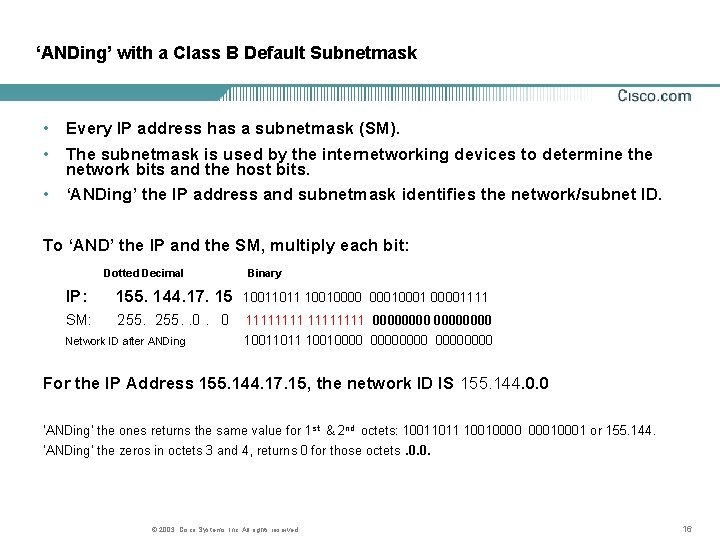
‘ANDing’ with a Class B Default Subnetmask • Every IP address has a subnetmask (SM). • The subnetmask is used by the internetworking devices to determine the network bits and the host bits. • ‘ANDing’ the IP address and subnetmask identifies the network/subnet ID. To ‘AND’ the IP and the SM, multiply each bit: Dotted Decimal Binary IP: 155. 144. 17. 15 10011011 10010000 0001 00001111 SM: 255. . 0. 0 11111111 00000000 Network ID after ANDing 10011011 100100000000 For the IP Address 155. 144. 17. 15, the network ID IS 155. 144. 0. 0 ‘ANDing’ the ones returns the same value for 1 st & 2 nd octets: 10011011 10010000 0001 or 155. 144. ‘ANDing’ the zeros in octets 3 and 4, returns 0 for those octets. 0. 0. © 2003, Cisco Systems, Inc. All rights reserved. 16
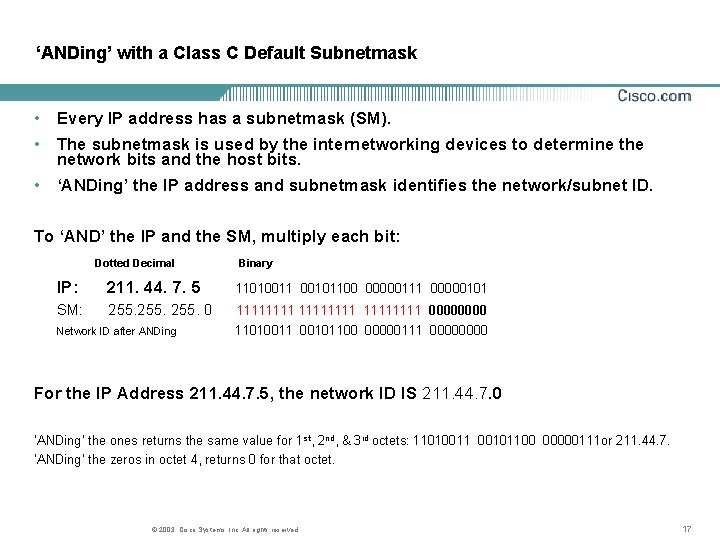
‘ANDing’ with a Class C Default Subnetmask • Every IP address has a subnetmask (SM). • The subnetmask is used by the internetworking devices to determine the network bits and the host bits. • ‘ANDing’ the IP address and subnetmask identifies the network/subnet ID. To ‘AND’ the IP and the SM, multiply each bit: Dotted Decimal Binary IP: 211. 44. 7. 5 11010011 00101100 00000111 00000101 SM: 255. 0 11111111 0000 Network ID after ANDing 11010011 00101100 00000111 0000 For the IP Address 211. 44. 7. 5, the network ID IS 211. 44. 7. 0 ‘ANDing’ the ones returns the same value for 1 st, 2 nd, & 3 rd octets: 11010011 00101100 00000111 or 211. 44. 7. ‘ANDing’ the zeros in octet 4, returns 0 for that octet. © 2003, Cisco Systems, Inc. All rights reserved. 17
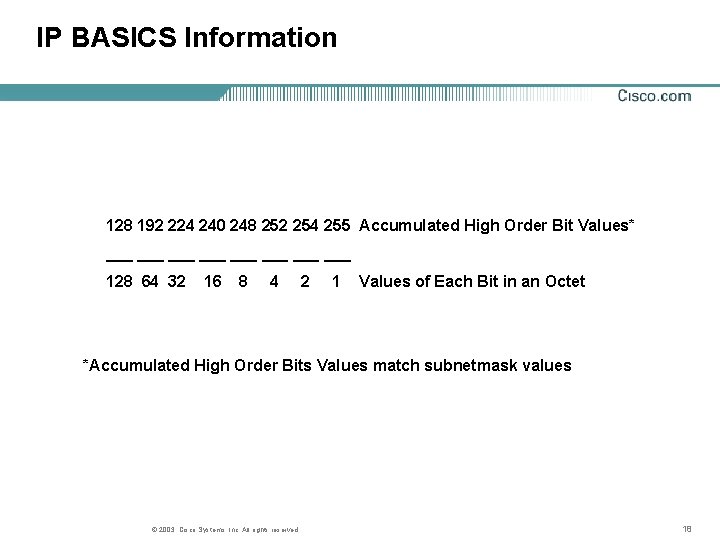
IP BASICS Information 128 192 224 240 248 252 254 255 Accumulated High Order Bit Values* ___ ___ 128 64 32 16 8 4 2 1 Values of Each Bit in an Octet *Accumulated High Order Bits Values match subnetmask values © 2003, Cisco Systems, Inc. All rights reserved. 18
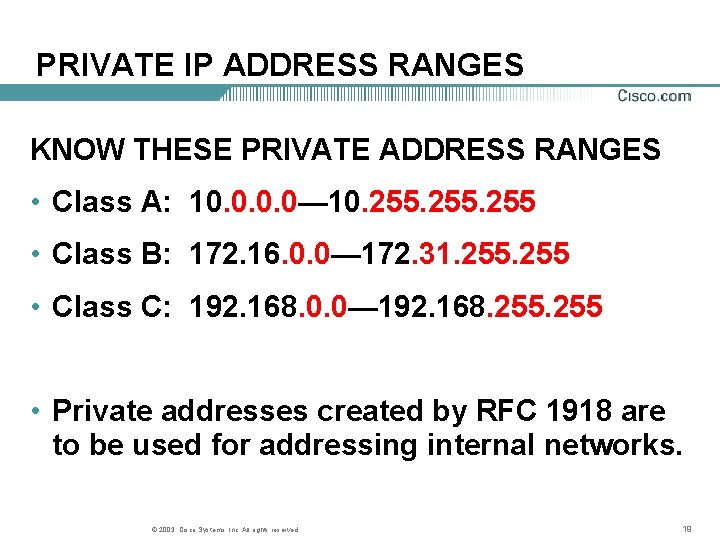
PRIVATE IP ADDRESS RANGES KNOW THESE PRIVATE ADDRESS RANGES • Class A: 10. 0— 10. 255 • Class B: 172. 16. 0. 0— 172. 31. 255 • Class C: 192. 168. 0. 0— 192. 168. 255 • Private addresses created by RFC 1918 are to be used for addressing internal networks. © 2003, Cisco Systems, Inc. All rights reserved. 19
- Slides: 19