
IP and Finance Accounting and Valuation of IP


- Slides: 27
IP and Finance - Accounting and Valuation of IP Assets and IPbased Financing – Topic 17 Mc. Lean Sibanda Training of the Trainers Program on Effective Intellectual Property Asset Management by Small and Medium Sized Enterprises (SMEs) Organised by the World Intellectual Property Organisation (WIPO) and the African Regional Intellectual Property Organization (ARIPO) Harare, Zimbabwe, 28 th November 2014
Summary q. Introduction q. Valuation methods q. Concluding Remarks
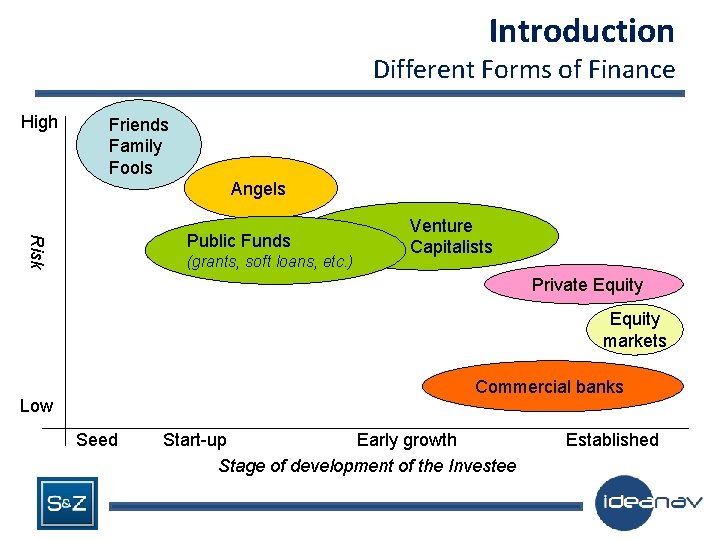
Introduction Different Forms of Finance High Friends Family Fools Angels Risk Public Funds (grants, soft loans, etc. ) Venture Capitalists Private Equity markets Low Commercial banks Seed Start-up Early growth Established Stage of development of the Investee
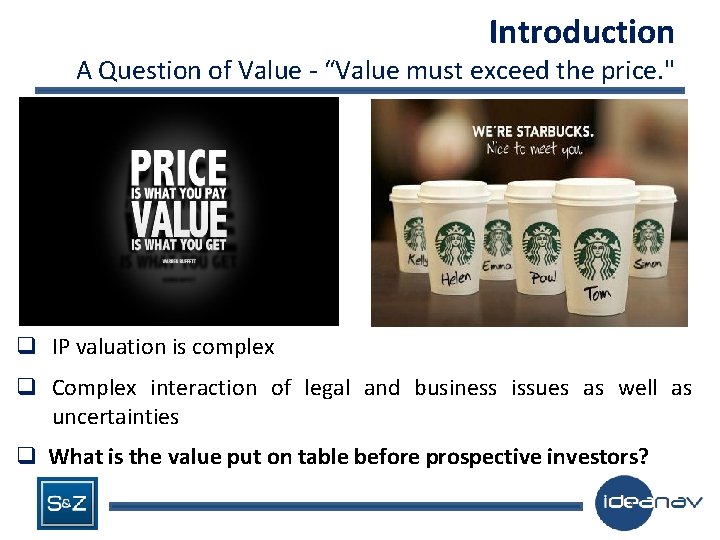
Introduction A Question of Value - “Value must exceed the price. " q IP valuation is complex q Complex interaction of legal and business issues as well as uncertainties q What is the value put on table before prospective investors? 4
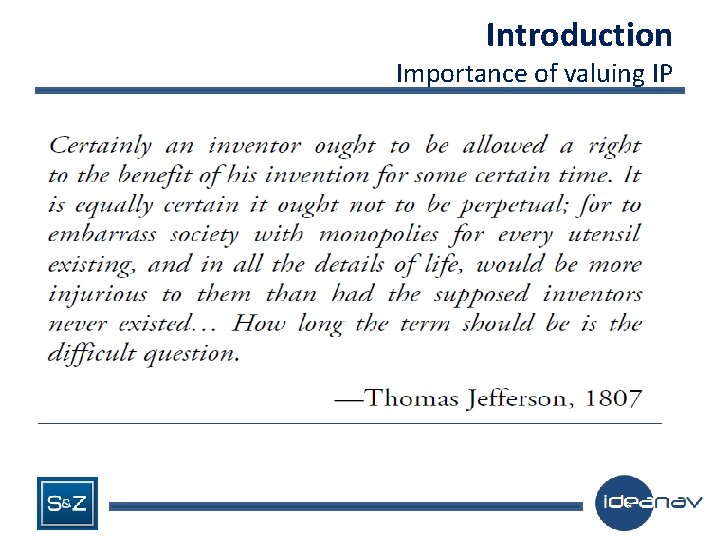
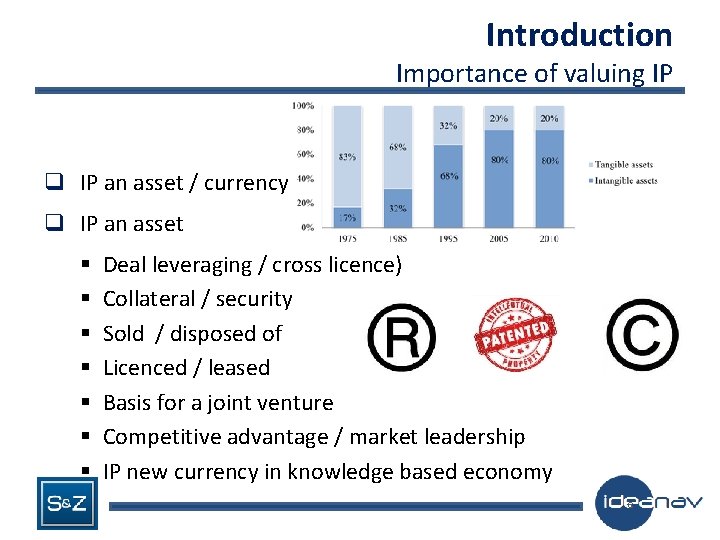
Introduction Importance of valuing IP 5
Introduction Importance of valuing IP q IP an asset / currency q IP an asset § § § § Deal leveraging / cross licence) Collateral / security Sold / disposed of Licenced / leased Basis for a joint venture Competitive advantage / market leadership IP new currency in knowledge based economy 6
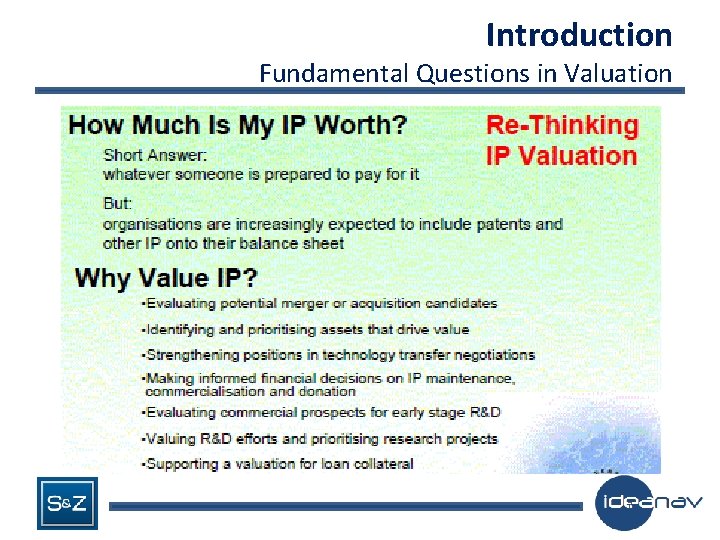
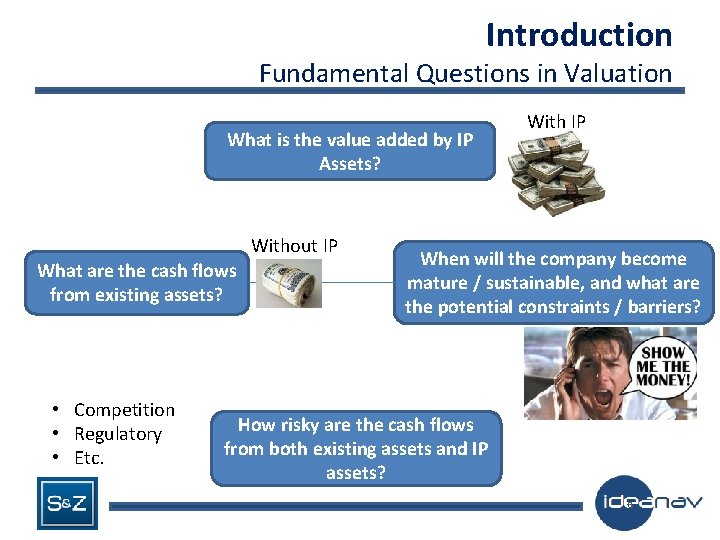
Introduction Fundamental Questions in Valuation 7
Introduction Fundamental Questions in Valuation What is the value added by IP Assets? Without IP What are the cash flows from existing assets? • Competition • Regulatory • Etc. With IP When will the company become mature / sustainable, and what are the potential constraints / barriers? How risky are the cash flows from both existing assets and IP assets? 8
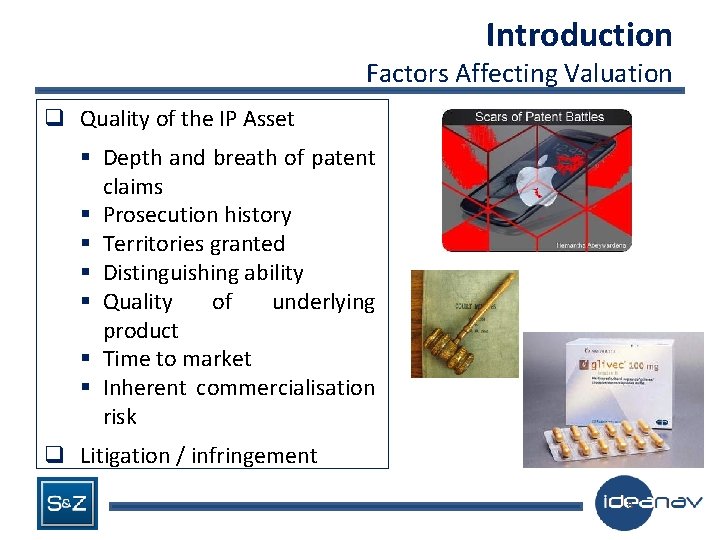
Introduction Factors Affecting Valuation q Quality of the IP Asset § Depth and breath of patent claims § Prosecution history § Territories granted § Distinguishing ability § Quality of underlying product § Time to market § Inherent commercialisation risk q Litigation / infringement 9
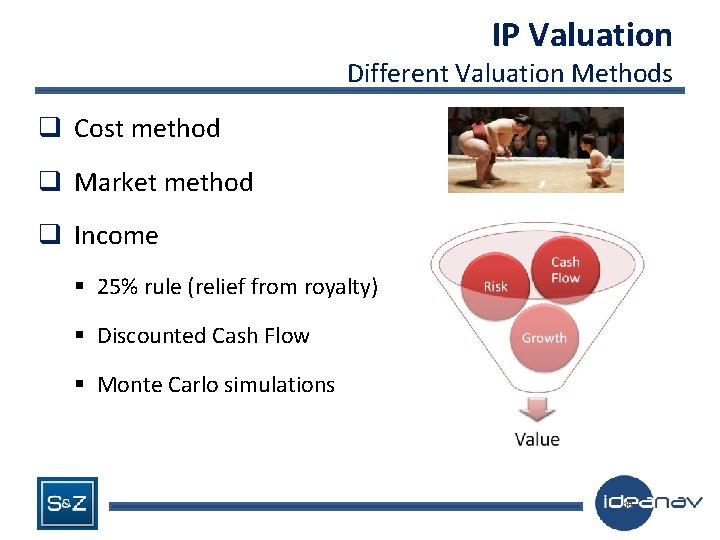
IP Valuation Different Valuation Methods q Cost method q Market method q Income § 25% rule (relief from royalty) § Discounted Cash Flow § Monte Carlo simulations 10
IP Valuation Cost Method q Recovery of costs incurred – cost to redevelop q Does not consider the time value of money / opportunity cost q Not equate to value – no link to future revenues 11
IP Valuation Market Method q Comparison with similar technologies / products / transactions q Access to transactional information q In essence a guide 12
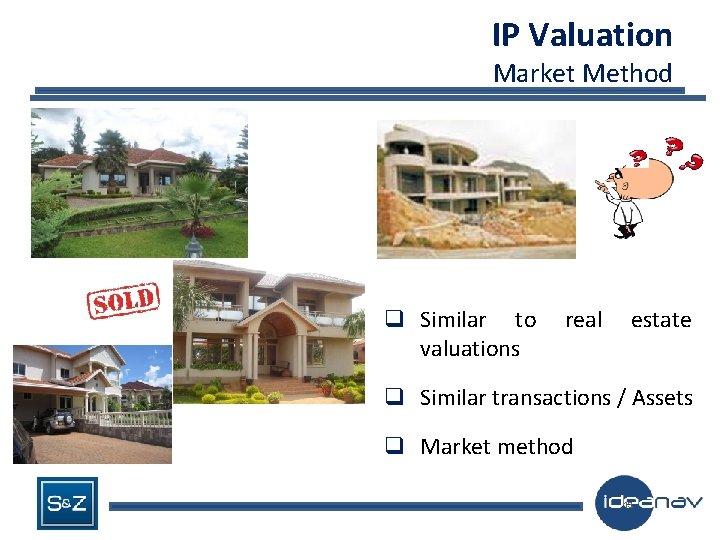
IP Valuation Market Method q Similar to valuations real estate q Similar transactions / Assets q Market method 13
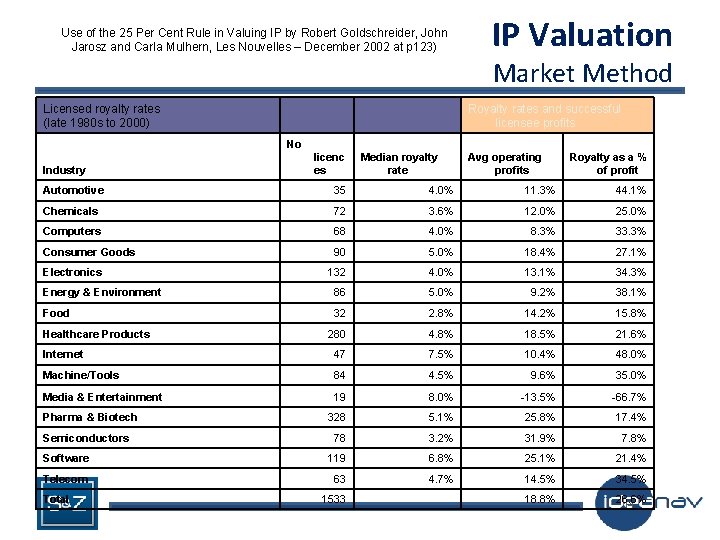
Use of the 25 Per Cent Rule in Valuing IP by Robert Goldschreider, John Jarosz and Carla Mulhern, Les Nouvelles – December 2002 at p 123) IP Valuation Market Method Licensed royalty rates (late 1980 s to 2000) Royalty rates and successful licensee profits Median royalty rate Avg operating profits No Industry licenc es Royalty as a % of profit Automotive 35 4. 0% 11. 3% 44. 1% Chemicals 72 3. 6% 12. 0% 25. 0% Computers 68 4. 0% 8. 3% 33. 3% Consumer Goods 90 5. 0% 18. 4% 27. 1% 132 4. 0% 13. 1% 34. 3% Energy & Environment 86 5. 0% 9. 2% 38. 1% Food 32 2. 8% 14. 2% 15. 8% 280 4. 8% 18. 5% 21. 6% Internet 47 7. 5% 10. 4% 48. 0% Machine/Tools 84 4. 5% 9. 6% 35. 0% Media & Entertainment 19 8. 0% -13. 5% -66. 7% 328 5. 1% 25. 8% 17. 4% 78 3. 2% 31. 9% 7. 8% Software 119 6. 8% 25. 1% 21. 4% Telecom 63 4. 7% 14. 5% 34. 5% 18. 8% 26. 6% 14 Electronics Healthcare Products Pharma & Biotech Semiconductors Total 1533
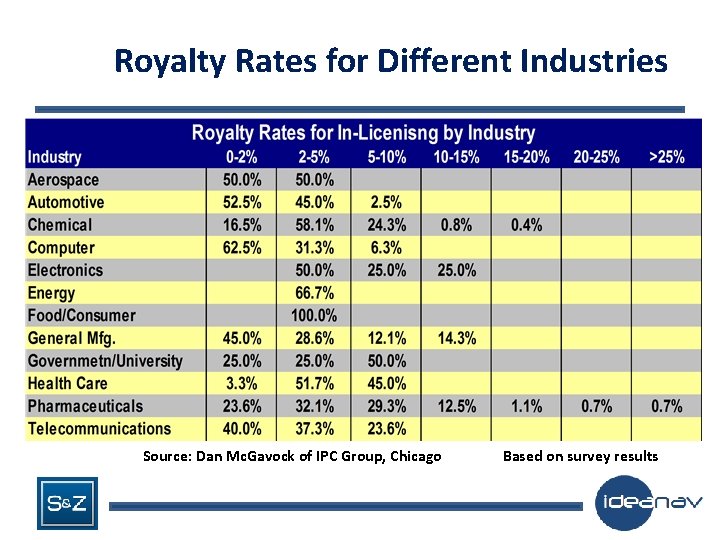
Royalty Rates for Different Industries Source: Dan Mc. Gavock of IPC Group, Chicago Based on survey results
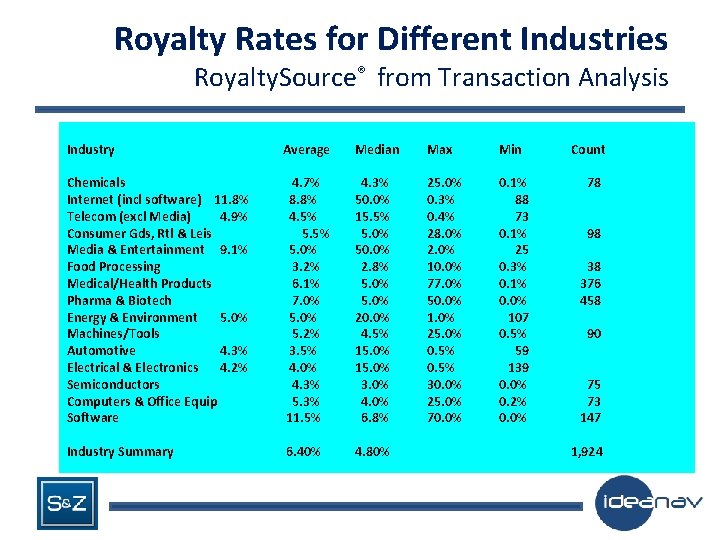
Royalty Rates for Different Industries Royalty. Source® from Transaction Analysis Industry Average Median Max Min Chemicals Internet (incl software) 11. 8% Telecom (excl Media) 4. 9% Consumer Gds, Rtl & Leis Media & Entertainment 9. 1% Food Processing Medical/Health Products Pharma & Biotech Energy & Environment 5. 0% Machines/Tools Automotive 4. 3% Electrical & Electronics 4. 2% Semiconductors Computers & Office Equip Software 4. 7% 8. 8% 4. 5% 5. 0% 3. 2% 6. 1% 7. 0% 5. 2% 3. 5% 4. 0% 4. 3% 5. 3% 11. 5% 4. 3% 50. 0% 15. 5% 5. 0% 50. 0% 2. 8% 5. 0% 20. 0% 4. 5% 15. 0% 3. 0% 4. 0% 6. 8% 25. 0% 0. 3% 0. 4% 28. 0% 2. 0% 10. 0% 77. 0% 50. 0% 1. 0% 25. 0% 0. 5% 30. 0% 25. 0% 70. 0% 0. 1% 88 73 0. 1% 25 0. 3% 0. 1% 0. 0% 107 0. 5% 59 139 0. 0% 0. 2% 0. 0% Industry Summary 6. 40% 4. 80% Count 78 98 38 376 458 90 75 73 147 1, 924
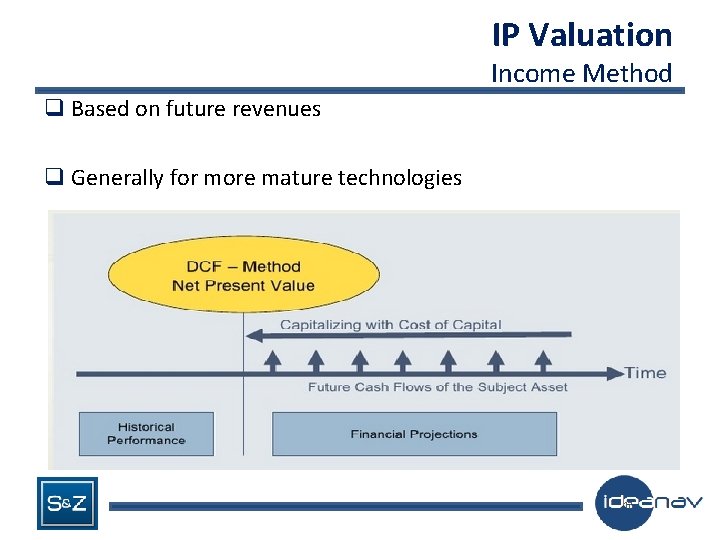
IP Valuation Income Method q Based on future revenues q Generally for more mature technologies 17
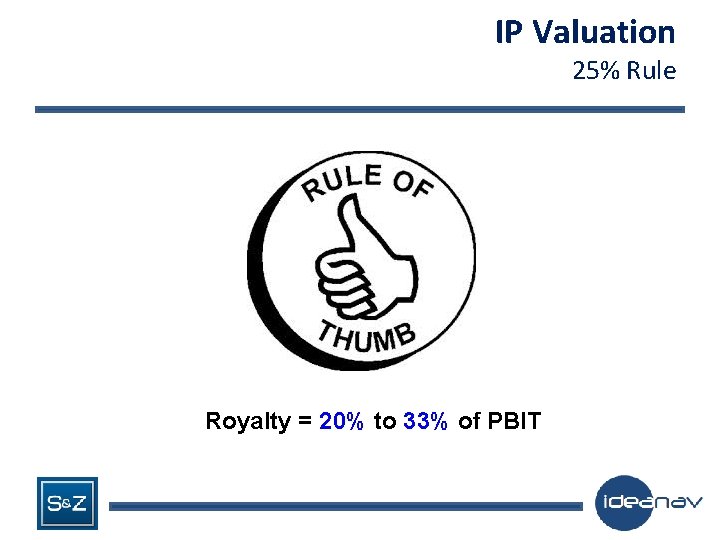
IP Valuation 25% Rule Royalty = 20% to 33% of PBIT
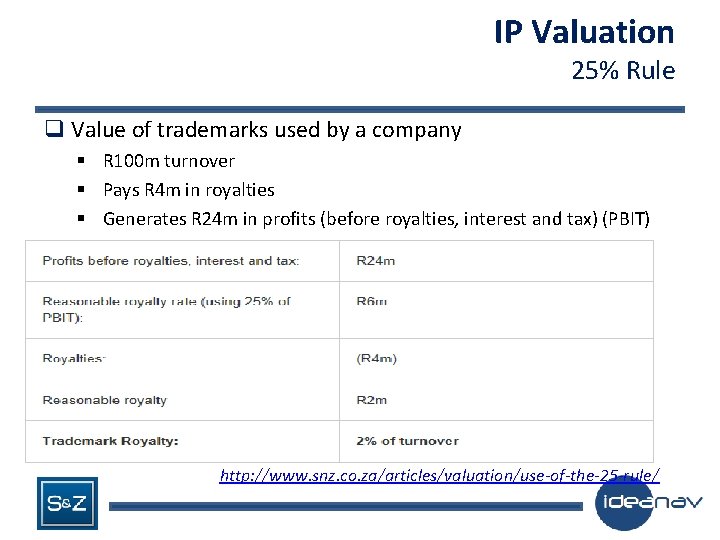
IP Valuation 25% Rule q Value of trademarks used by a company § R 100 m turnover § Pays R 4 m in royalties § Generates R 24 m in profits (before royalties, interest and tax) (PBIT) http: //www. snz. co. za/articles/valuation/use-of-the-25 -rule/
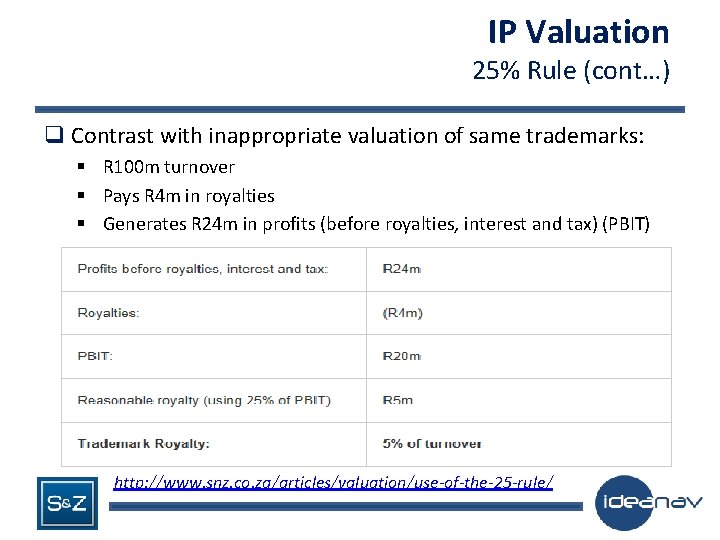
IP Valuation 25% Rule (cont…) q Contrast with inappropriate valuation of same trademarks: § R 100 m turnover § Pays R 4 m in royalties § Generates R 24 m in profits (before royalties, interest and tax) (PBIT) http: //www. snz. co. za/articles/valuation/use-of-the-25 -rule/
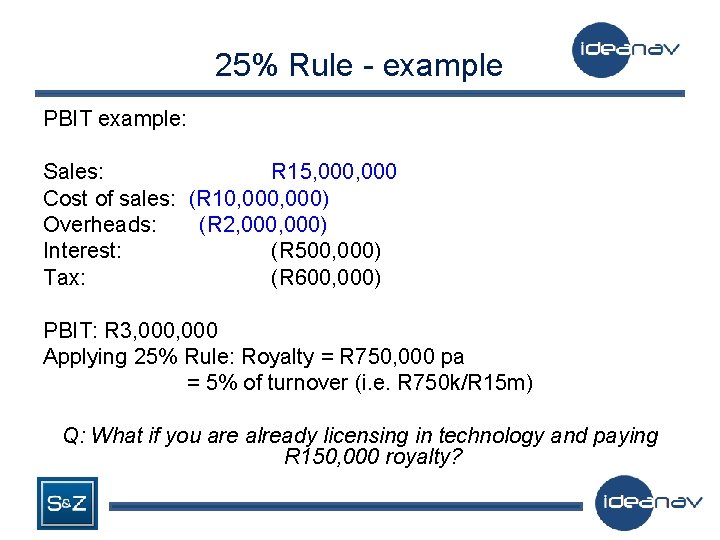
25% Rule - example PBIT example: Sales: R 15, 000 Cost of sales: (R 10, 000) Overheads: (R 2, 000) Interest: (R 500, 000) Tax: (R 600, 000) PBIT: R 3, 000 Applying 25% Rule: Royalty = R 750, 000 pa = 5% of turnover (i. e. R 750 k/R 15 m) Q: What if you are already licensing in technology and paying R 150, 000 royalty?
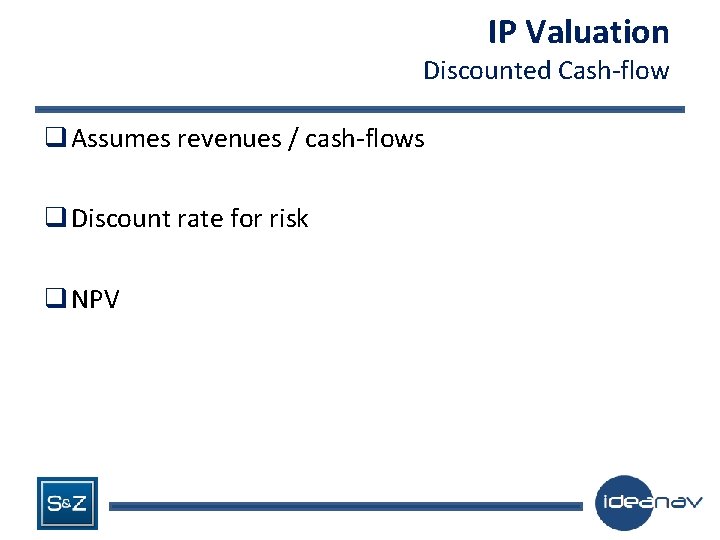
IP Valuation Discounted Cash-flow q Assumes revenues / cash-flows q Discount rate for risk q NPV
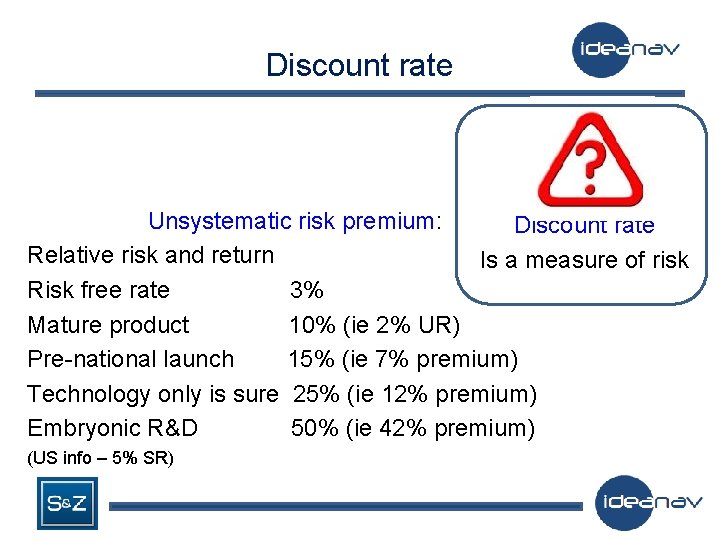
Discount rate Unsystematic risk premium: Discount rate Relative risk and return Is a measure of risk Risk free rate 3% Mature product 10% (ie 2% UR) Pre-national launch 15% (ie 7% premium) Technology only is sure 25% (ie 12% premium) Embryonic R&D 50% (ie 42% premium) (US info – 5% SR)
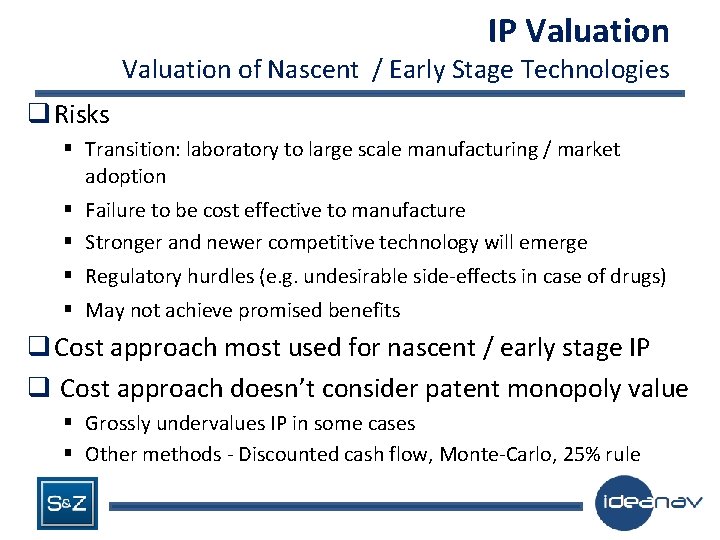
IP Valuation of Nascent / Early Stage Technologies q Risks § Transition: laboratory to large scale manufacturing / market adoption § Failure to be cost effective to manufacture § Stronger and newer competitive technology will emerge § Regulatory hurdles (e. g. undesirable side-effects in case of drugs) § May not achieve promised benefits q Cost approach most used for nascent / early stage IP q Cost approach doesn’t consider patent monopoly value § Grossly undervalues IP in some cases § Other methods - Discounted cash flow, Monte-Carlo, 25% rule
Concluding Remarks
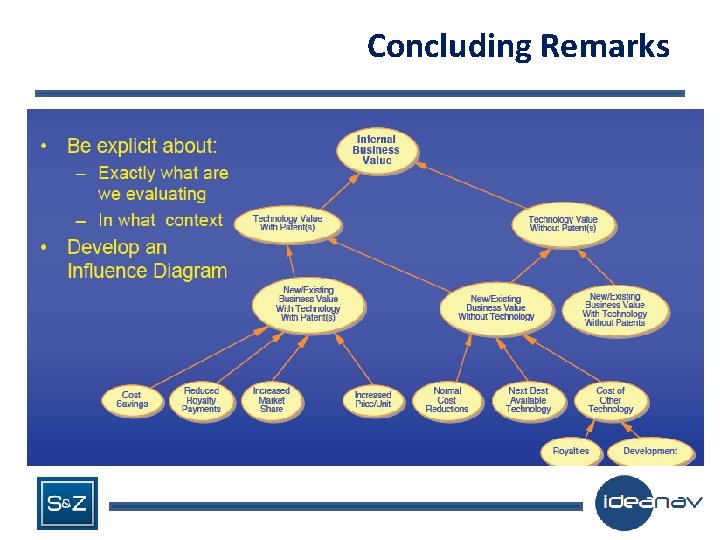
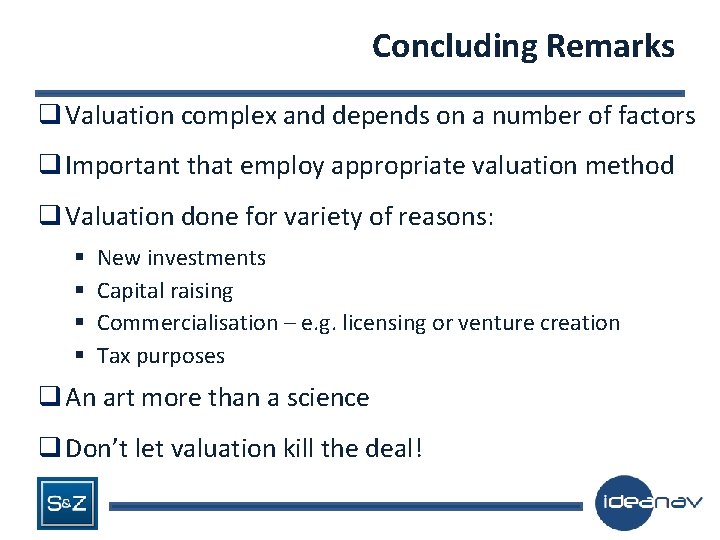
Concluding Remarks q Valuation complex and depends on a number of factors q Important that employ appropriate valuation method q Valuation done for variety of reasons: § § New investments Capital raising Commercialisation – e. g. licensing or venture creation Tax purposes q An art more than a science q Don’t let valuation kill the deal!
THANK YOU