
IP Addresses Addressing and Address Management Paul Wilson


- Slides: 47
IP Addresses, Addressing and Address Management Paul Wilson APNIC 1
Contents • Introduction to IP addresses • Introduction to RIRs • IP address management • IPv 6 management • About APNIC 2
“On the Internet, nobody knows you’re a dog…” 3 by Peter Steiner, from The New Yorker, (Vol. 69 (LXIX) no. 20)
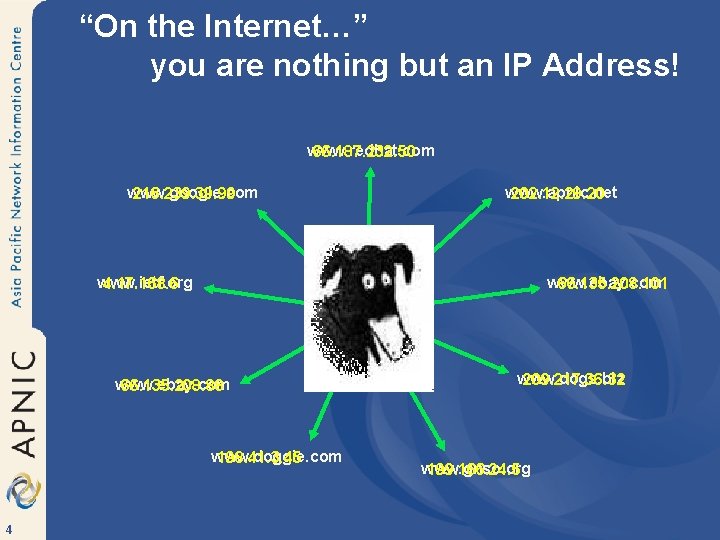
“On the Internet…” you are nothing but an IP Address! www. redhat. com 66. 187. 232. 50 www. google. com 216. 239. 99 www. apnic. net 202. 12. 29. 20 www. ietf. org 4. 17. 168. 6 www. ebay. com 66. 135. 208. 101 202. 12. 29. 142 www. ebay. com 66. 135. 208. 88 www. doggie. com 198. 41. 3. 45 4 www. dogs. biz 209. 217. 36. 32 www. gnso. org 199. 166. 24. 5
What is an IP Address? 5
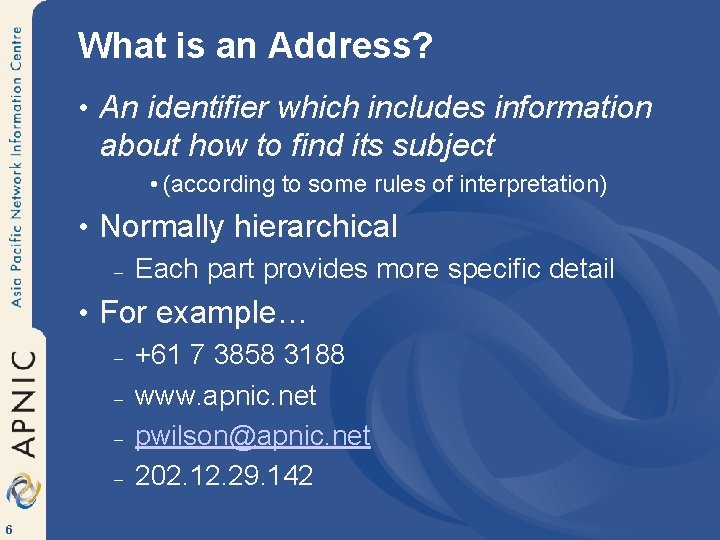
What is an Address? • An identifier which includes information about how to find its subject • (according to some rules of interpretation) • Normally hierarchical – Each part provides more specific detail • For example… – +61 7 3858 3188 – www. apnic. net – pwilson@apnic. net – 202. 12. 29. 142 6
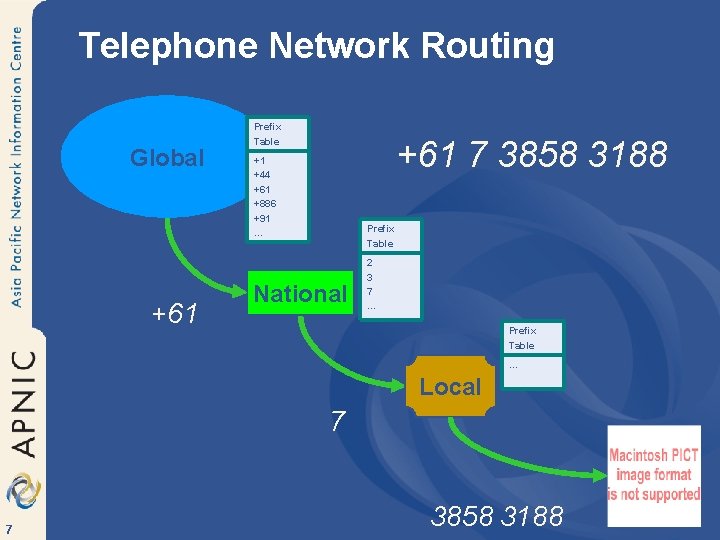
Telephone Network Routing Global +61 Prefix Table +61 7 3858 3188 +1 +44 +61 +886 +91 … Prefix Table National 2 3 7 … Prefix Table … Local 7 7 3858 3188
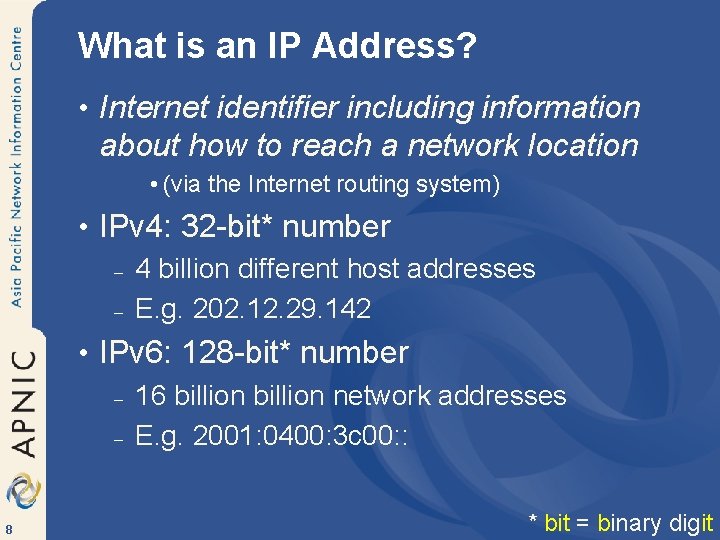
What is an IP Address? • Internet identifier including information about how to reach a network location • (via the Internet routing system) • IPv 4: 32 -bit* number – 4 billion different host addresses – E. g. 202. 12. 29. 142 • IPv 6: 128 -bit* number – 16 billion network addresses – E. g. 2001: 0400: 3 c 00: : 8 * bit = binary digit
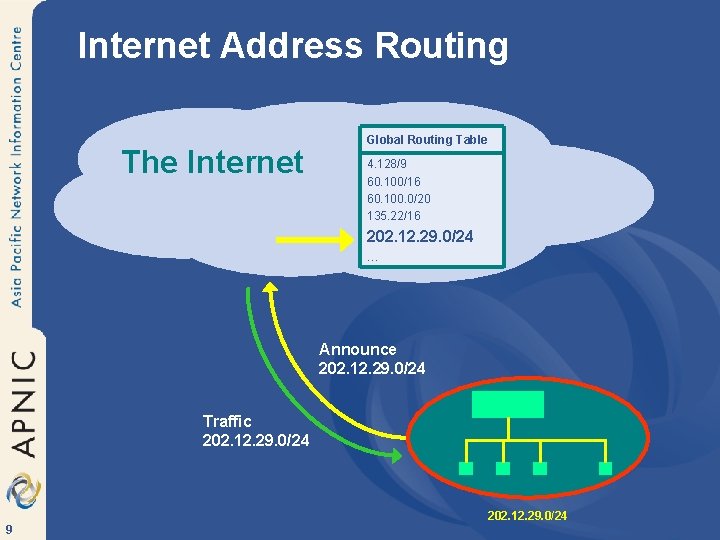
Internet Address Routing The Internet Global Routing Table 4. 128/9 60. 100/16 60. 100. 0/20 135. 22/16 … 202. 12. 29. 0/24 … Announce 202. 12. 29. 0/24 Traffic 202. 12. 29. 0/24 9
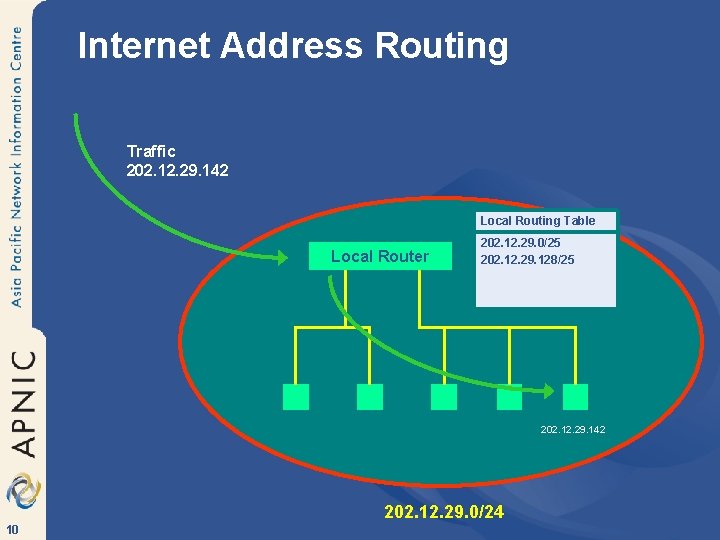
Internet Address Routing Traffic 202. 12. 29. 142 Local Routing Table Local Router 202. 12. 29. 0/25 202. 12. 29. 128/25 202. 12. 29. 142 202. 12. 29. 0/24 10
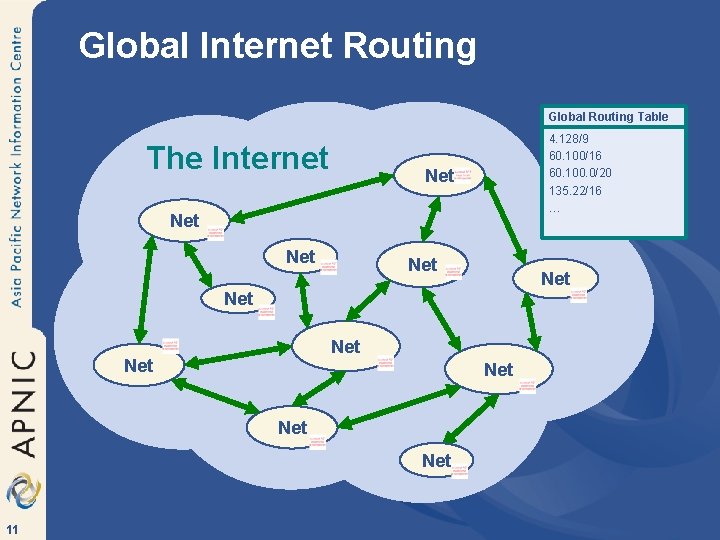
Global Internet Routing Global Routing Table The Internet 4. 128/9 60. 100/16 60. 100. 0/20 135. 22/16 … Net Net Net 11
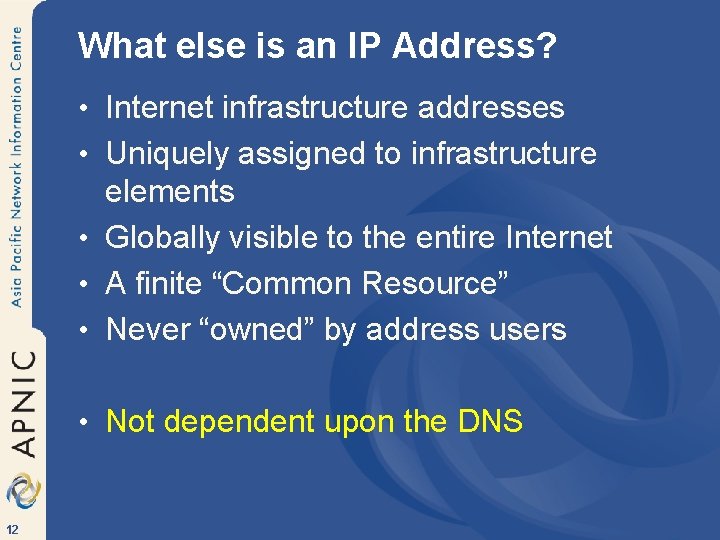
What else is an IP Address? • Internet infrastructure addresses • Uniquely assigned to infrastructure elements • Globally visible to the entire Internet • A finite “Common Resource” • Never “owned” by address users • Not dependent upon the DNS 12
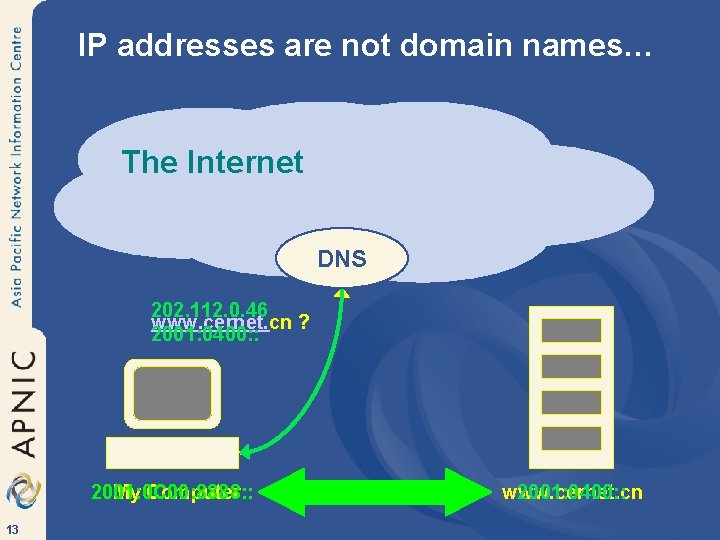
IP addresses are not domain names… The Internet DNS 202. 112. 0. 46 www. cernet. cn ? 2001: 0400: : 2001: 0 C 00: 8888: : My Computer 13 2001: 0400: : www. cernet. cn
Geography of the Internet 14
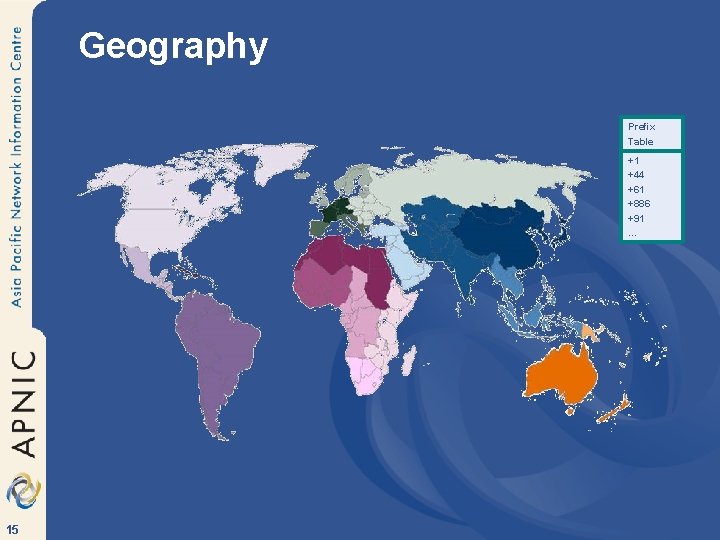
Geography Prefix Table +1 +44 +61 +886 +91 … 15
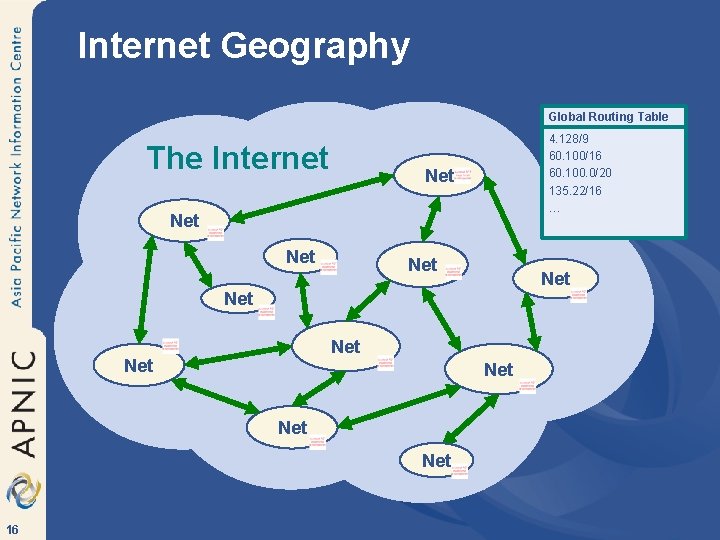
Internet Geography Global Routing Table The Internet 4. 128/9 60. 100/16 60. 100. 0/20 135. 22/16 … Net Net Net 16
Internet Geography • “Nations” of the Internet are networks – – “Frontiers” are border routers “Treaties” are peering relationships between networks • It’s a very dynamic world… – – – New nations are formed daily New borders are established hourly Routing tables change by the minute Driven almost entirely by industry No centralised control • Very different from “traditional” networks – 17 Telephony for example
Regional Internet Registries 18
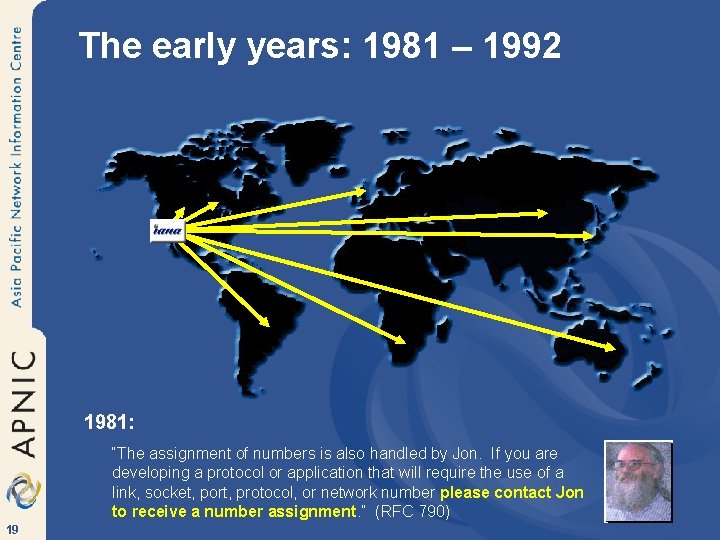
The early years: 1981 – 1992 1981: “The assignment of numbers is also handled by Jon. If you are developing a protocol or application that will require the use of a link, socket, port, protocol, or network number please contact Jon to receive a number assignment. ” (RFC 790) 19
Global routing table: ’ 88 – ’ 92 20
Global routing table: Projection 21
Global Allocations: ’ 83 – ’ 91 22
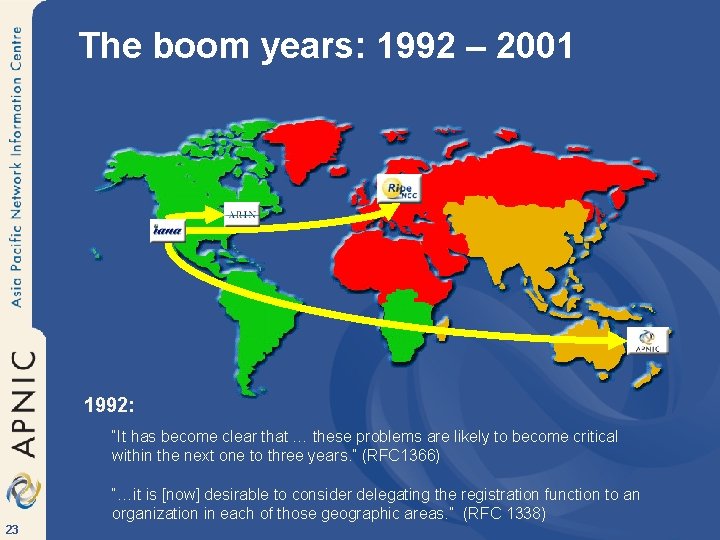
The boom years: 1992 – 2001 1992: “It has become clear that … these problems are likely to become critical within the next one to three years. ” (RFC 1366) “…it is [now] desirable to consider delegating the registration function to an organization in each of those geographic areas. ” (RFC 1338) 23
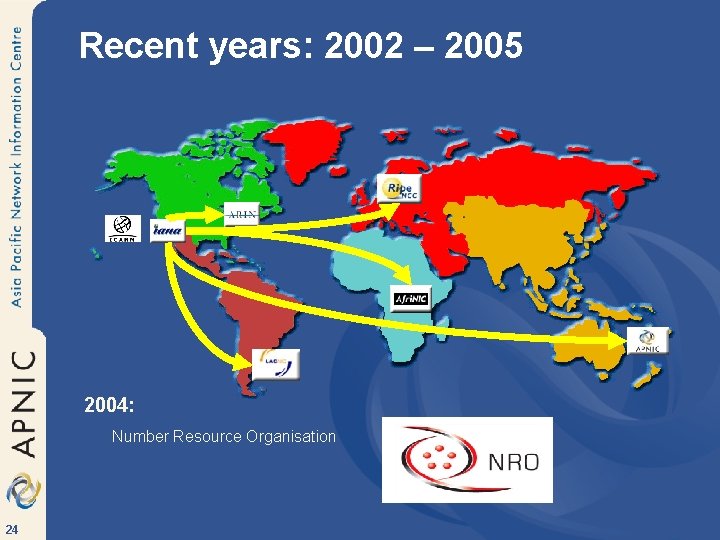
Recent years: 2002 – 2005 2004: Number Resource Organisation 24
What are RIRs? • Industry self-regulatory structures – Open membership-based bodies – Representative of ISPs globally – Service organisations – Non-profit, neutral and independent – 100% self-funded by membership • First established in early 1990’s – Voluntarily by consensus of community – To satisfy emerging technical/admin needs • In the “Internet Tradition” – Consensus-based, open and transparent 25
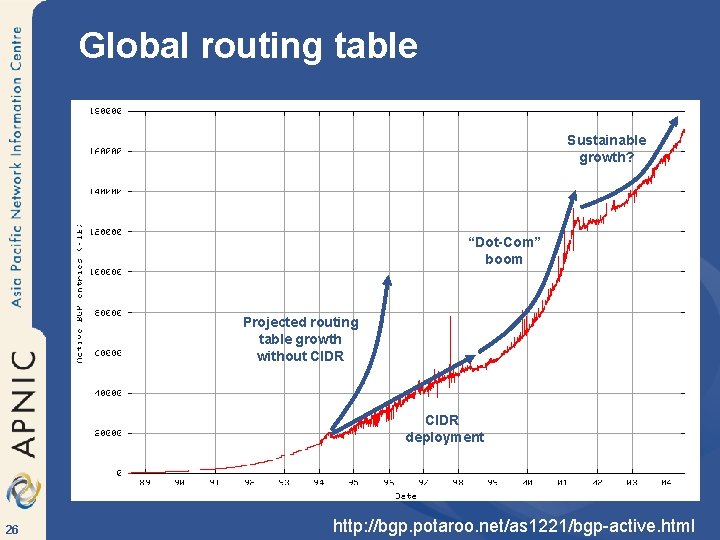
Global routing table Sustainable growth? “Dot-Com” boom Projected routing table growth without CIDR deployment 26 http: //bgp. potaroo. net/as 1221/bgp-active. html
Global allocations 27
What do RIRs do? • Internet resource allocation – – – Primarily, IP addresses – IPv 4 and IPv 6 Receive resources from IANA/ICANN, and redistribute to ISPs on a regional basis Registration services (“whois”) • Policy development and coordination – Open Policy Meetings and processes • Training and outreach – – Training courses, seminars, conferences… Liaison: IETF, ITU, APT, PITA, APEC… • Publications – 28 Newsletters, reports, web site…
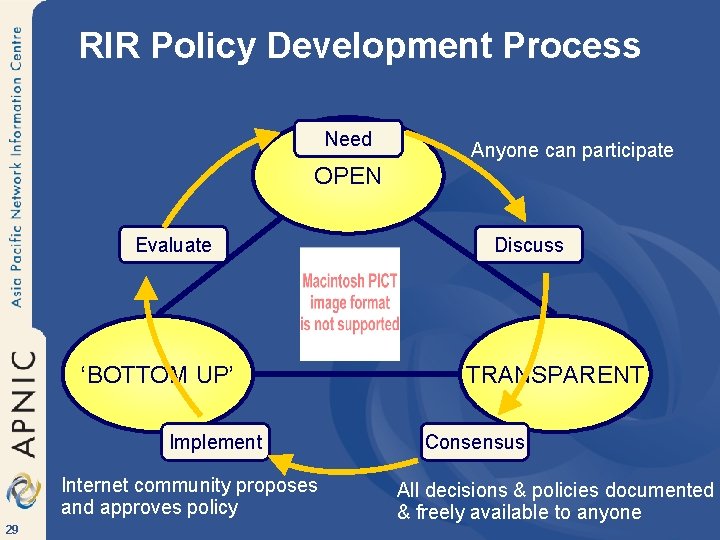
RIR Policy Development Process Need Anyone can participate OPEN Evaluate ‘BOTTOM UP’ Implement Internet community proposes and approves policy 29 Discuss TRANSPARENT Consensus All decisions & policies documented & freely available to anyone
RIR Address Management 30
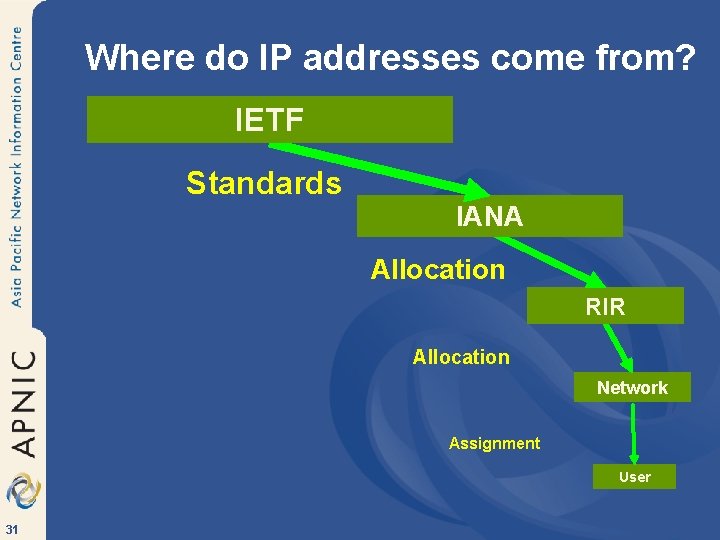
Where do IP addresses come from? IETF Standards IANA Allocation RIR Allocation Network Assignment User 31
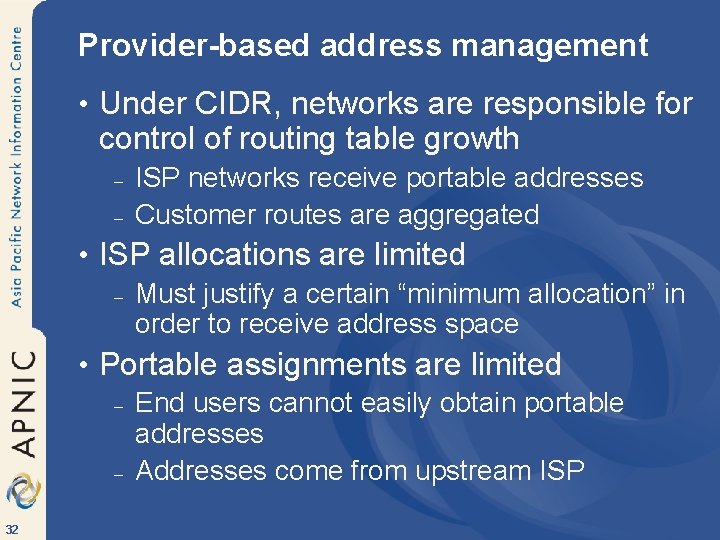
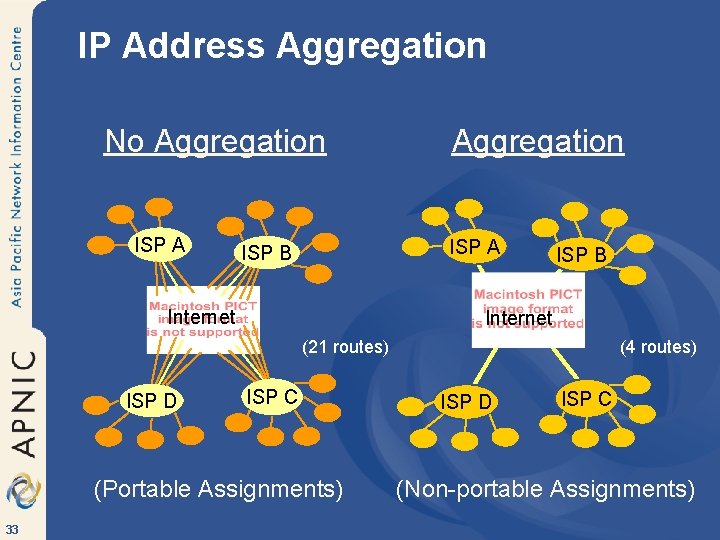
Provider-based address management • Under CIDR, networks are responsible for control of routing table growth – – ISP networks receive portable addresses Customer routes are aggregated • ISP allocations are limited – Must justify a certain “minimum allocation” in order to receive address space • Portable assignments are limited – End users cannot easily obtain portable addresses – Addresses come from upstream ISP 32
IP Address Aggregation No Aggregation ISP A ISP B Internet (21 routes) ISP D ISP C (Portable Assignments) 33 (4 routes) ISP D ISP C (Non-portable Assignments)
IPv 4 Allocations 34
Why IPv 6? 35
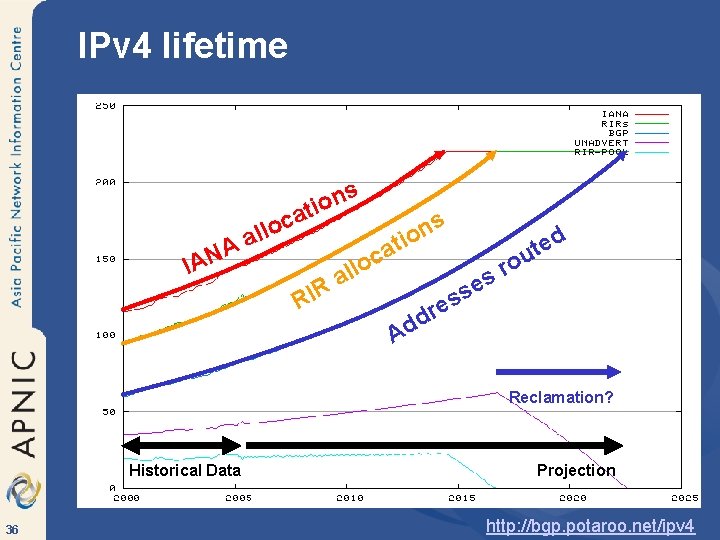
IPv 4 lifetime A N IA ns o i t a c allo RIR o all s n o ati d e t ou c s res d d A r s e Reclamation? Historical Data 36 Projection http: //bgp. potaroo. net/ipv 4
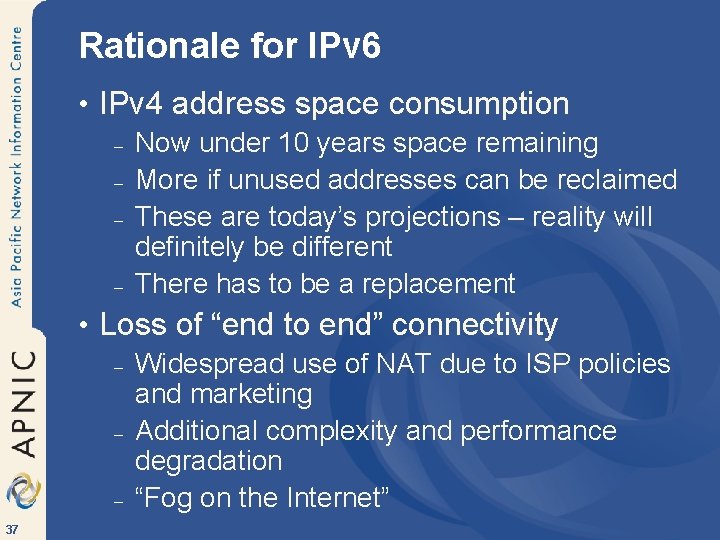
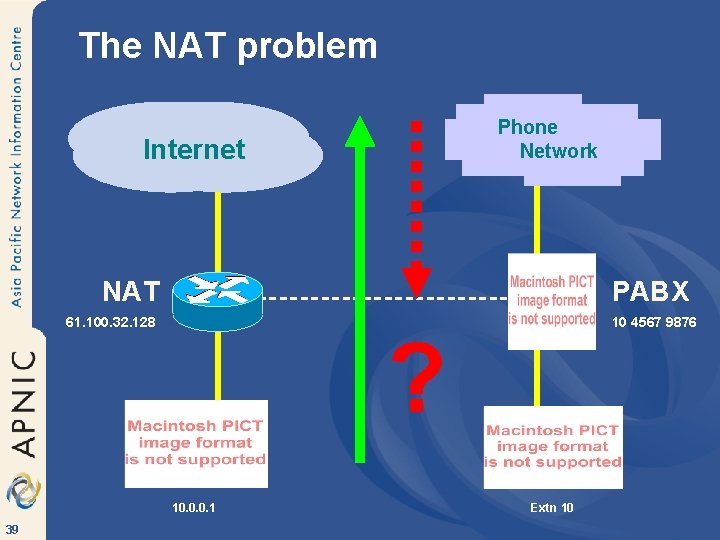
Rationale for IPv 6 • IPv 4 address space consumption – Now under 10 years space remaining – More if unused addresses can be reclaimed – These are today’s projections – reality will definitely be different – There has to be a replacement • Loss of “end to end” connectivity – Widespread use of NAT due to ISP policies and marketing – Additional complexity and performance degradation – “Fog on the Internet” 37
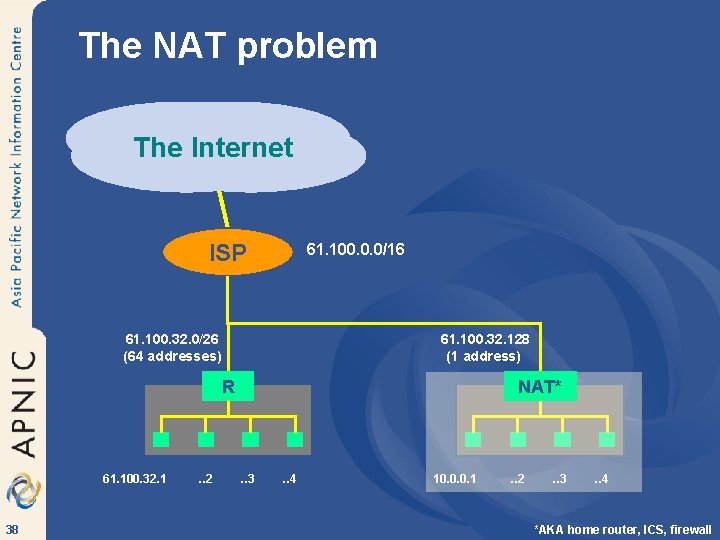
The NAT problem The Internet ISP 61. 100. 0. 0/16 61. 100. 32. 0/26 (64 addresses) 61. 100. 32. 128 (1 address) R 61. 100. 32. 1 38 . . 2 NAT* . . 3 . . 4 10. 0. 0. 1 . . 2 . . 3 . . 4 *AKA home router, ICS, firewall
The NAT problem Phone Network Internet NAT PABX 61. 100. 32. 128 ? 10. 0. 0. 1 39 10 4567 9876 Extn 10
IPv 6 Allocations 40
About APNIC 41
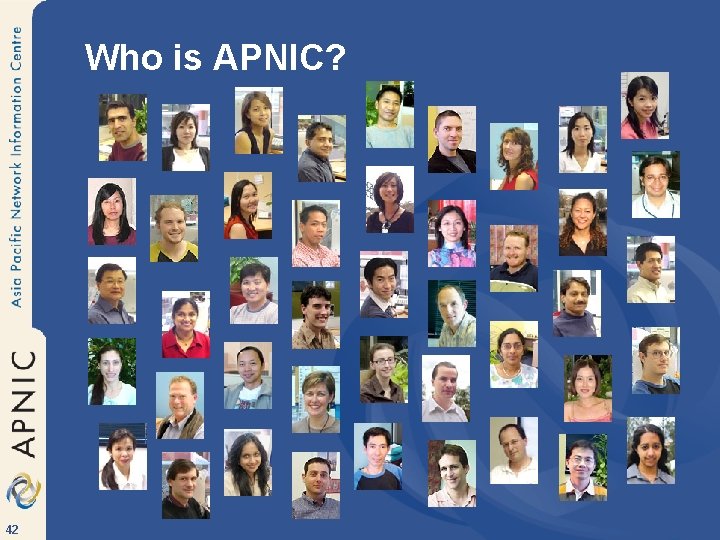
Who is APNIC? 42
What is APNIC? • RIR for Asia Pacific region – Established 1993, Tokyo – 1050 members in 45 of 62 AP economies – 45 staff, 18 nationality/language groups • Membership and community services • Other activities – Outreach – Liaison: IETF, APT, PITA, APEC, ISP-A’s – ITU Sector Member – UN ECOSOC consultative status – Deployment of rootservers… 43
APNIC Services • Internet resource allocations “My. APNIC” secure membership portal – Multilingual helpdesk – email, phone, chat, VOIP* – • Open Policy Meetings Twice annually – Webcast and remote participation – Stenocaptioning – • Training and education – Technical workshops: Routing, DNS, Security • Internet support Fellowships – R&D grants funding – ORDIG – ISP support website – 44
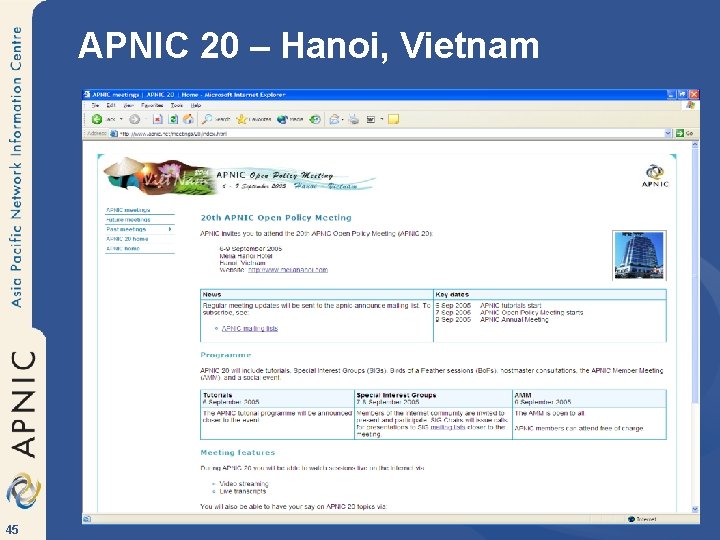
APNIC 20 – Hanoi, Vietnam 45
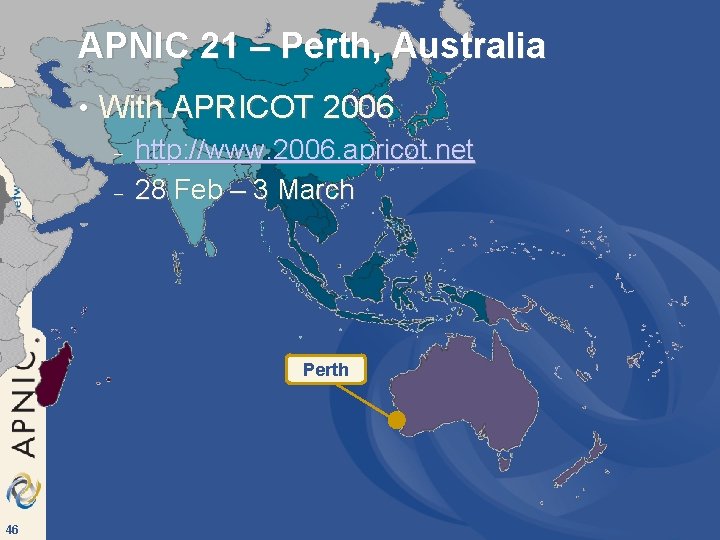
APNIC 21 – Perth, Australia • With APRICOT 2006 – http: //www. 2006. apricot. net – 28 Feb – 3 March Perth 46
Questions? pwilson@apnic. net 47