
IOOS Biological Data Services Three Steps to Enrollment
IOOS Biological Data Services Three Steps to Enrollment Tune in Turn On Drop Out May 28, 2014 Philip Goldstein (University of Colorado, OBIS-USA) Hassan Moustahfid (NOAA US IOOS) (don’t drop out)
OBIS and IOOS Biological Data Once Upon a Time in OBIS: Still around! What happened ? … The message from Federal leadership about OBIS: • Not enough information • Errors and ambiguities • Quality and completeness problems • Can’t do enough with the data • Can’t maintain support this way 1. Requirements-based and partner-based enhancements 2. OBIS-USA and IOOS joint development Outcomes • • • Presence-Abundance Integrate with Env Data & CF IOOS Biology in 3 RAs OBIS-USA from 3 M to 28 M IODE/OBIS enhancing too
Even Better: In 2015, encountering very rich data Today we see many bio datasets like this: • • • Taxonomic range, span trophic/functional groups Presence – Abundance (with effort) Intentional study locations relevant to research design Consistent sampling methods; time series Consistent env data and methods accompany bio data What enables managing data this rich? • Data content standards and data flow … • … and the enrollment process, a consistent, repeatable process.
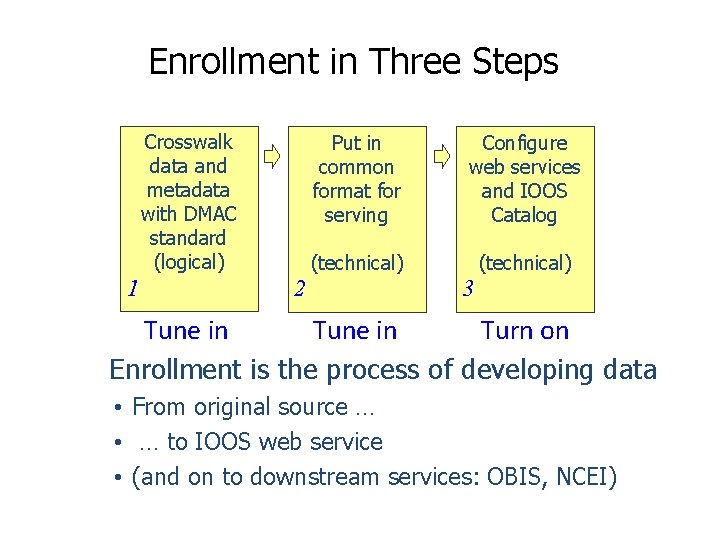
Enrollment in Three Steps Crosswalk data and metadata with DMAC standard (logical) 1 2 Put in common format for serving Configure web services and IOOS Catalog (technical) 3 Tune in Turn on Enrollment is the process of developing data • From original source … • … to IOOS web service • (and on to downstream services: OBIS, NCEI)
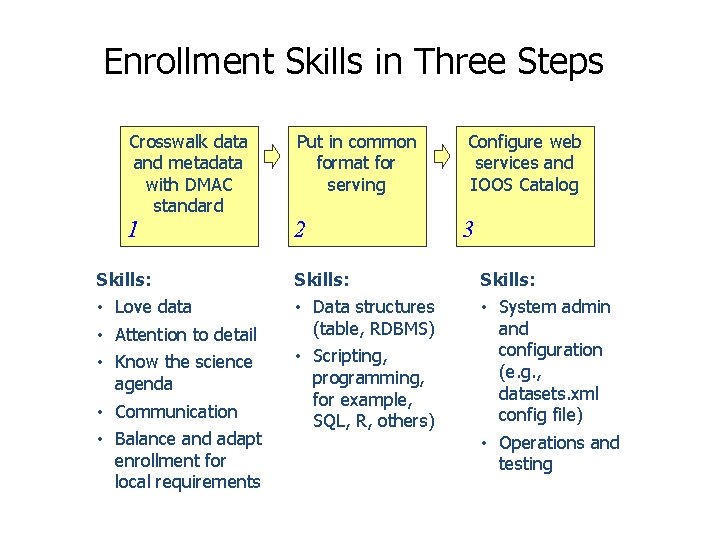
Enrollment Skills in Three Steps Crosswalk data and metadata with DMAC standard 1 Put in common format for serving 2 Configure web services and IOOS Catalog 3 Skills: • Love data • Attention to detail • Know the science agenda • Communication • Balance and adapt enrollment for local requirements • Data structures (table, RDBMS) • Scripting, programming, for example, SQL, R, others) • System admin and configuration (e. g. , datasets. xml config file) • Operations and testing

Enrollment Crosswalk Example Florida NMS Fish Sampling Timeseries • 18 years of data; via Sanctuaries MBON organization • File ‘fk 2004_dat 1. csv’: 182, 519 records (start with a single year)
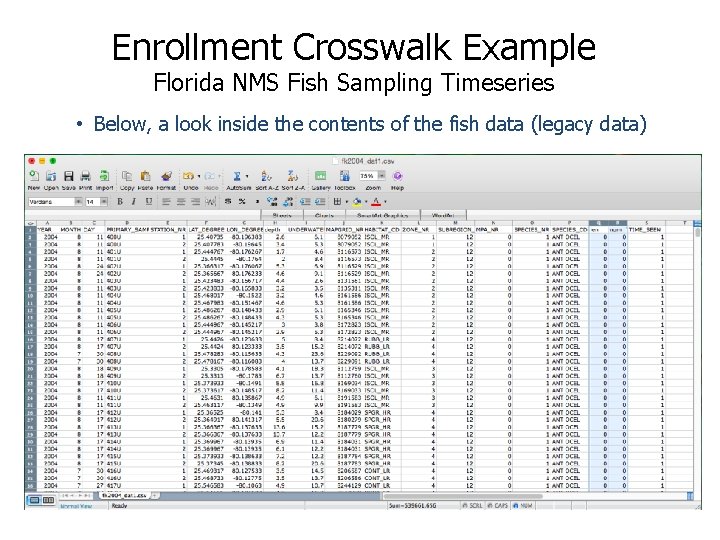
Enrollment Crosswalk Example Florida NMS Fish Sampling Timeseries • Below, a look inside the contents of the fish data (legacy data)
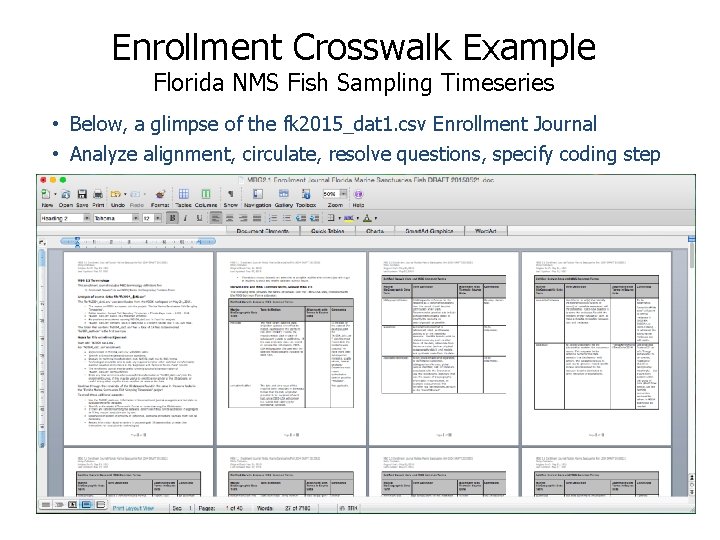
Enrollment Crosswalk Example Florida NMS Fish Sampling Timeseries • Below, a glimpse of the fk 2015_dat 1. csv Enrollment Journal • Analyze alignment, circulate, resolve questions, specify coding step

Enrollment Skills Alignment by Organization (proposed) Crosswalk data and metadata with DMAC standard 1 Data Originator Put in common format for serving 2 Configure web services and IOOS Catalog 3 IOOS Regional Association
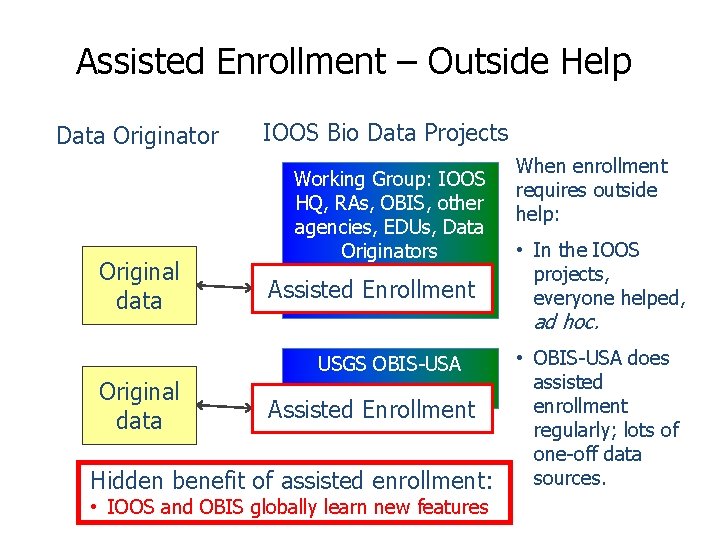
Assisted Enrollment – Outside Help Data Originator Original data IOOS Bio Data Projects Working Group: IOOS HQ, RAs, OBIS, other agencies, EDUs, Data Originators Assisted Enrollment USGS OBIS-USA Original data Assisted Enrollment Hidden benefit of assisted enrollment: • IOOS and OBIS globally learn new features When enrollment requires outside help: • In the IOOS projects, everyone helped, ad hoc. • OBIS-USA does assisted enrollment regularly; lots of one-off data sources.
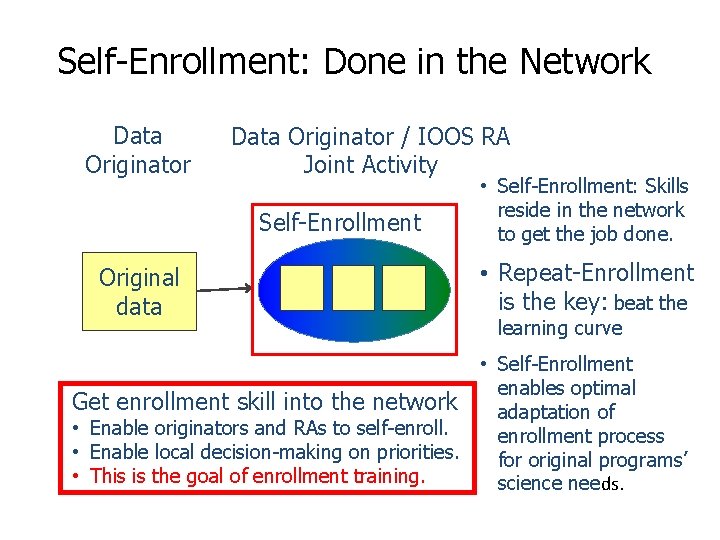
Self-Enrollment: Done in the Network Data Originator / IOOS RA Joint Activity Self-Enrollment Original data Get enrollment skill into the network • Enable originators and RAs to self-enroll. • Enable local decision-making on priorities. • This is the goal of enrollment training. • Self-Enrollment: Skills reside in the network to get the job done. • Repeat-Enrollment is the key: beat the learning curve • Self-Enrollment enables optimal adaptation of enrollment process for original programs’ science needs.
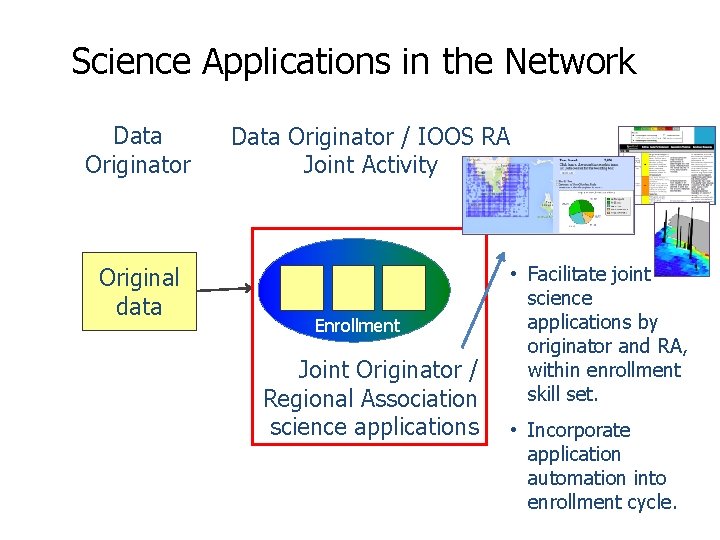
Science Applications in the Network Data Originator Original data Data Originator / IOOS RA Joint Activity Enrollment Joint Originator / Regional Association science applications • Facilitate joint science applications by originator and RA, within enrollment skill set. • Incorporate application automation into enrollment cycle.
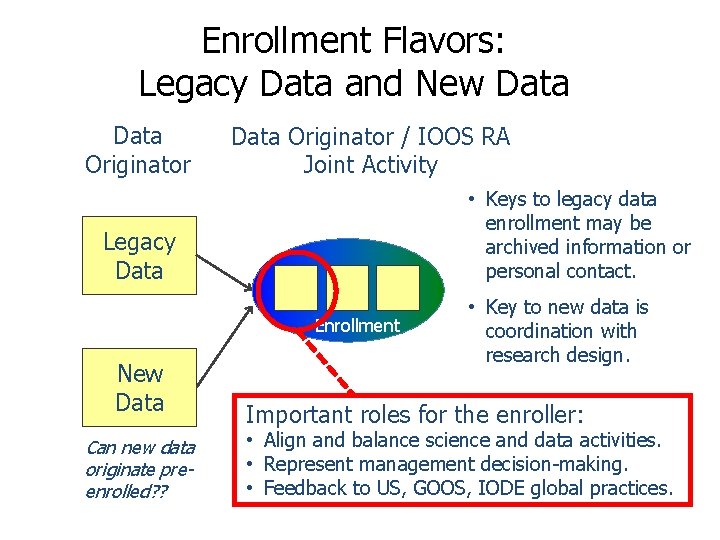
Enrollment Flavors: Legacy Data and New Data Originator / IOOS RA Joint Activity • Keys to legacy data enrollment may be archived information or personal contact. Legacy Data Enrollment New Data Can new data originate preenrolled? ? • Key to new data is coordination with research design. Important roles for the enroller: • Align and balance science and data activities. • Represent management decision-making. • Feedback to US, GOOS, IODE global practices.
Biological Data Enrollment Training Plan (proposed) Training model: • The goal is to create independent enrollers • Train-the-trainer • Train by example – while enrolling actual data • Format: • Hour sessions over time, telecon or webinar - or • Site visit, e. g. , two-day workshop
Biological Data Enrollment Training Plan (proposed) Training resources: • Experienced enrollers as instructors • Documents and tools • Prior examples • Reference implementation (proposed)
Biological Data Enrollment Training Plan (proposed) Training preparation: • Obtain dataset(s) to enroll • Identify enroller(s) to be trained • Verify technical choices / Prepare technical environment (web service installation, tools)
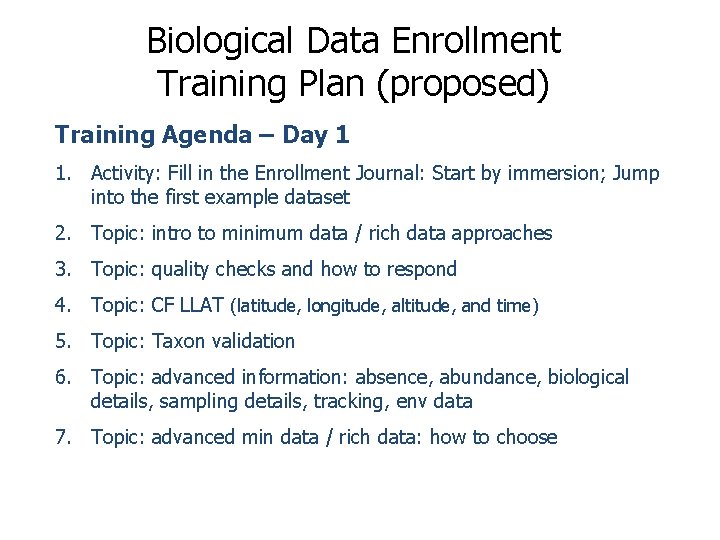
Biological Data Enrollment Training Plan (proposed) Training Agenda – Day 1 1. Activity: Fill in the Enrollment Journal: Start by immersion; Jump into the first example dataset 2. Topic: intro to minimum data / rich data approaches 3. Topic: quality checks and how to respond 4. Topic: CF LLAT (latitude, longitude, altitude, and time) 5. Topic: Taxon validation 6. Topic: advanced information: absence, abundance, biological details, sampling details, tracking, env data 7. Topic: advanced min data / rich data: how to choose
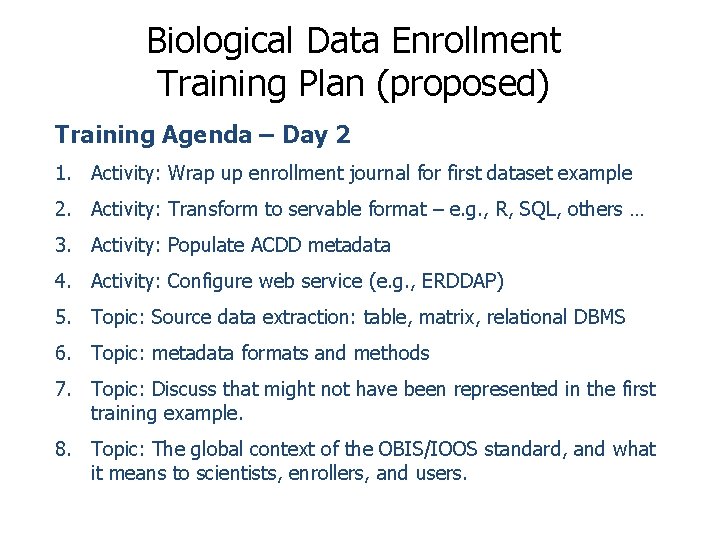
Biological Data Enrollment Training Plan (proposed) Training Agenda – Day 2 1. Activity: Wrap up enrollment journal for first dataset example 2. Activity: Transform to servable format – e. g. , R, SQL, others … 3. Activity: Populate ACDD metadata 4. Activity: Configure web service (e. g. , ERDDAP) 5. Topic: Source data extraction: table, matrix, relational DBMS 6. Topic: metadata formats and methods 7. Topic: Discuss that might not have been represented in the first training example. 8. Topic: The global context of the OBIS/IOOS standard, and what it means to scientists, enrollers, and users.
- Slides: 18