
Ionospheric Convection and FieldAligned Currents During Strong Magnetospheric
- Slides: 20
Ionospheric Convection and Field-Aligned Currents During Strong Magnetospheric Driving: A Super. DARN/AMPERE Case Study L. B. N. Clausen(1), J. B. H. Baker(1), J. M. Ruohoniemi(1), B. J. Anderson(2) (1) Space@VT, Virginia Tech, Blacksburg, USA (2) Johns Hopkins University Applied Physics Laboratory, Laurel, USA Super. DARN Workshop 2011
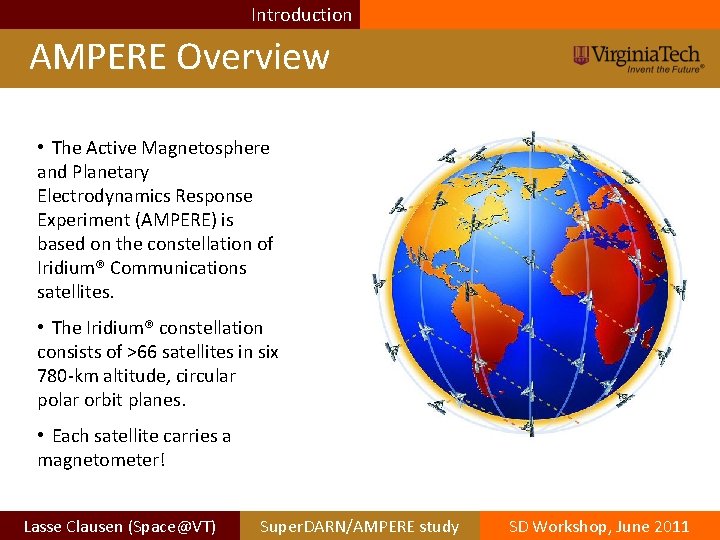
Introduction AMPERE Overview • The Active Magnetosphere and Planetary Electrodynamics Response Experiment (AMPERE) is based on the constellation of Iridium® Communications satellites. • The Iridium® constellation consists of >66 satellites in six 780 -km altitude, circular polar orbit planes. • Each satellite carries a magnetometer! Lasse Clausen (Space@VT) Super. DARN/AMPERE study SD Workshop, June 2011
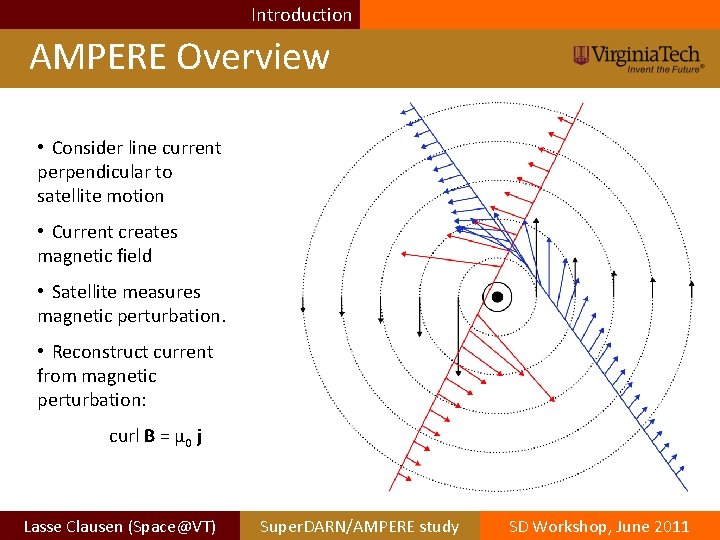
Introduction AMPERE Overview • Consider line current perpendicular to satellite motion • Current creates magnetic field • Satellite measures magnetic perturbation. • Reconstruct current from magnetic perturbation: curl B = μ 0 j Lasse Clausen (Space@VT) Super. DARN/AMPERE study SD Workshop, June 2011
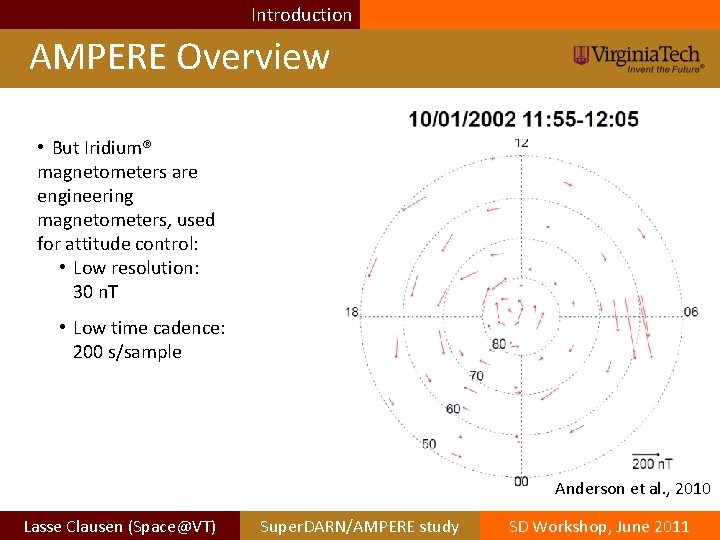
Introduction AMPERE Overview • But Iridium® magnetometers are engineering magnetometers, used for attitude control: • Low resolution: 30 n. T • Low time cadence: 200 s/sample Anderson et al. , 2010 Lasse Clausen (Space@VT) Super. DARN/AMPERE study SD Workshop, June 2011
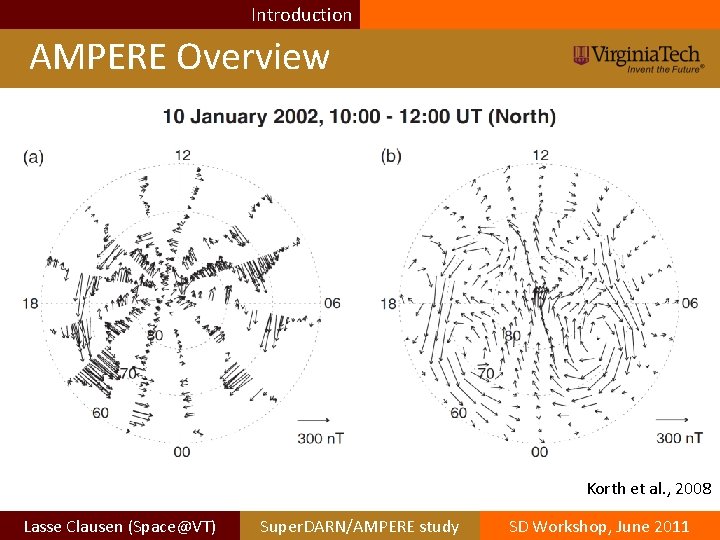
Introduction AMPERE Overview Korth et al. , 2008 Lasse Clausen (Space@VT) Super. DARN/AMPERE study SD Workshop, June 2011
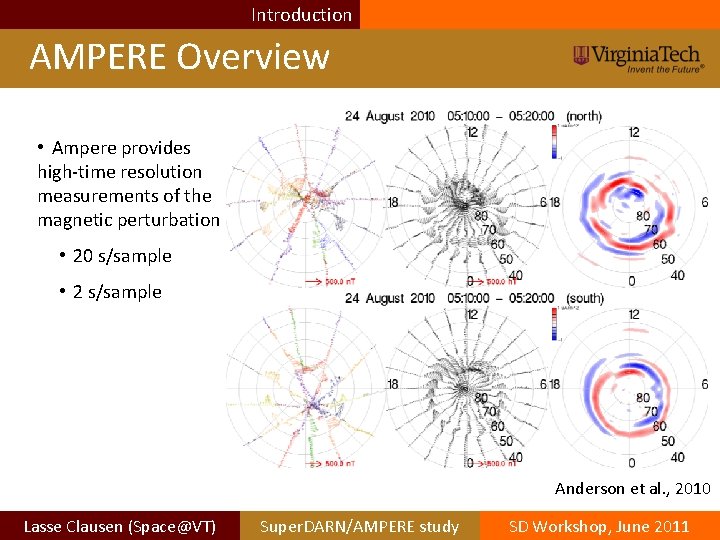
Introduction AMPERE Overview • Ampere provides high-time resolution measurements of the magnetic perturbation • 20 s/sample • 2 s/sample Anderson et al. , 2010 Lasse Clausen (Space@VT) Super. DARN/AMPERE study SD Workshop, June 2011
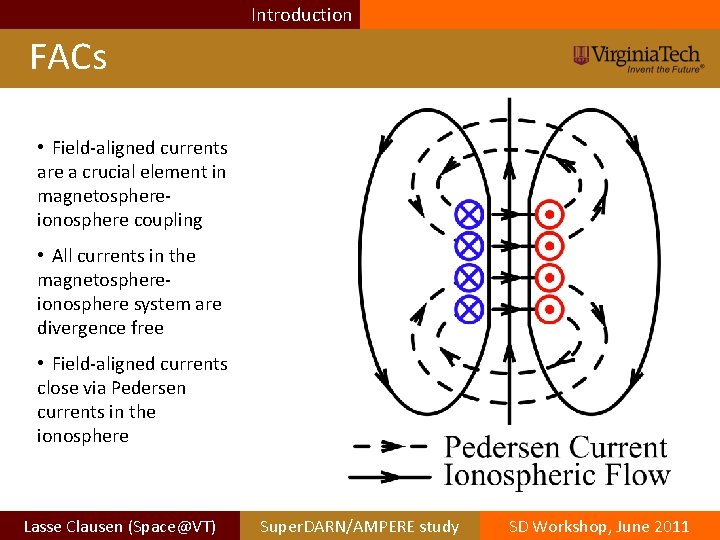
Introduction FACs • Field-aligned currents are a crucial element in magnetosphereionosphere coupling • All currents in the magnetosphereionosphere system are divergence free • Field-aligned currents close via Pedersen currents in the ionosphere Lasse Clausen (Space@VT) Super. DARN/AMPERE study SD Workshop, June 2011
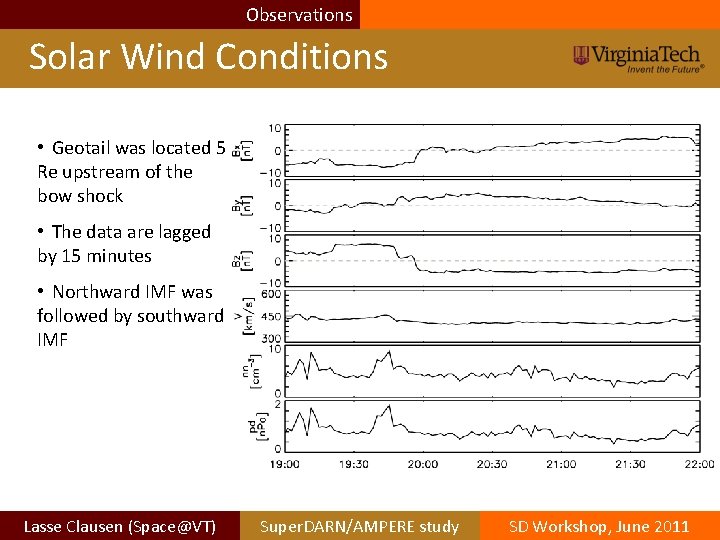
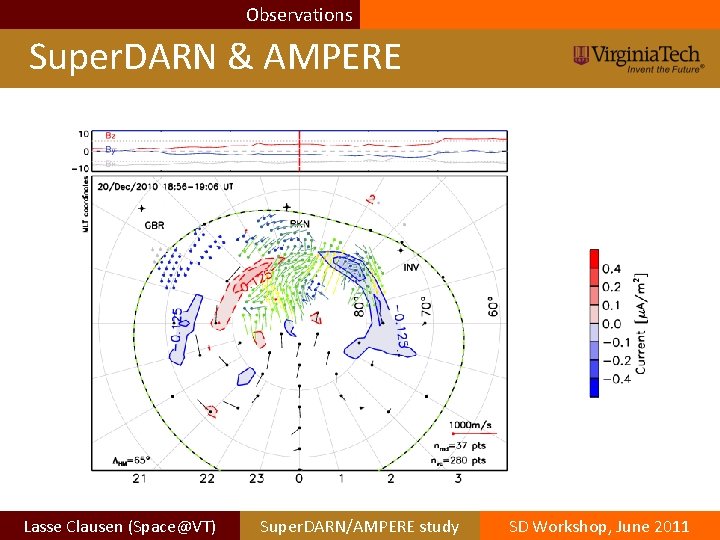
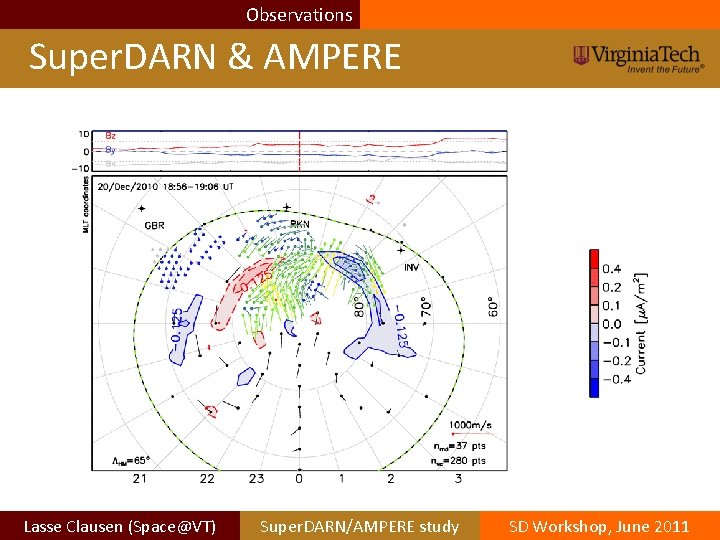
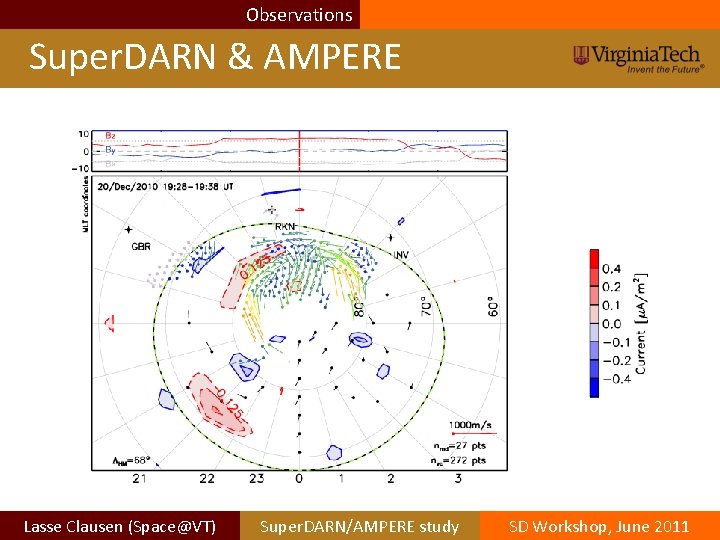
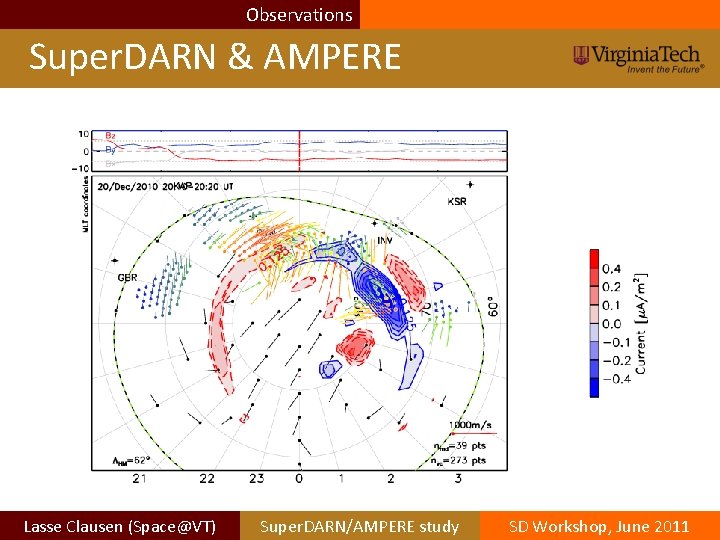
Observations Solar Wind Conditions • Geotail was located 5 Re upstream of the bow shock • The data are lagged by 15 minutes • Northward IMF was followed by southward IMF Lasse Clausen (Space@VT) Super. DARN/AMPERE study SD Workshop, June 2011
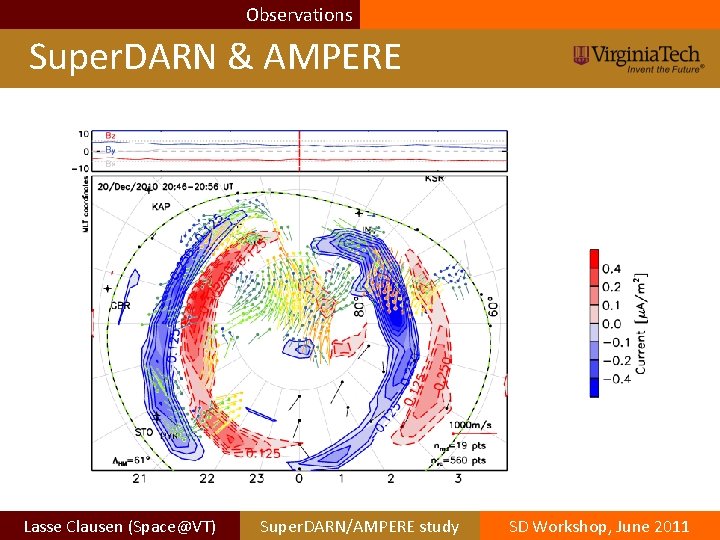
Observations Super. DARN & AMPERE Lasse Clausen (Space@VT) Super. DARN/AMPERE study SD Workshop, June 2011
Observations Super. DARN & AMPERE Lasse Clausen (Space@VT) Super. DARN/AMPERE study SD Workshop, June 2011
Observations Super. DARN & AMPERE Lasse Clausen (Space@VT) Super. DARN/AMPERE study SD Workshop, June 2011
Observations Super. DARN & AMPERE Lasse Clausen (Space@VT) Super. DARN/AMPERE study SD Workshop, June 2011
Observations Super. DARN & AMPERE Lasse Clausen (Space@VT) Super. DARN/AMPERE study SD Workshop, June 2011
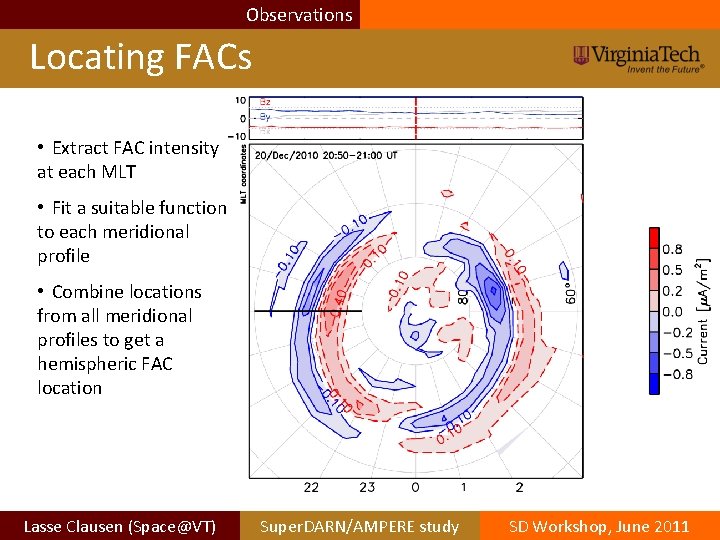
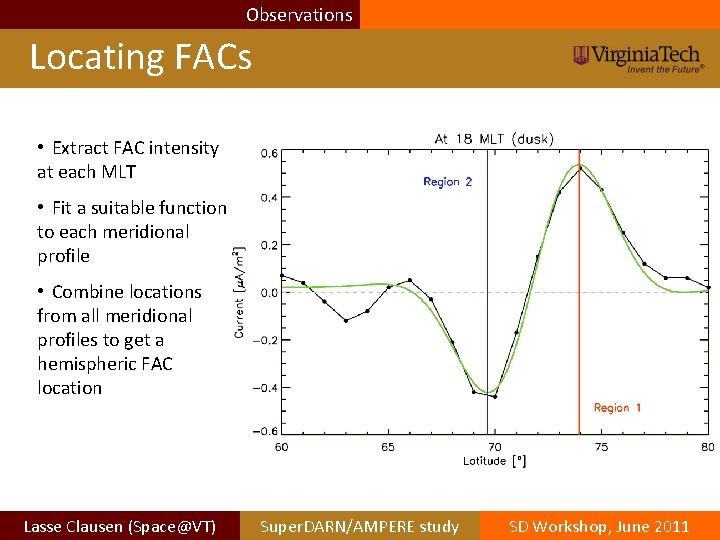
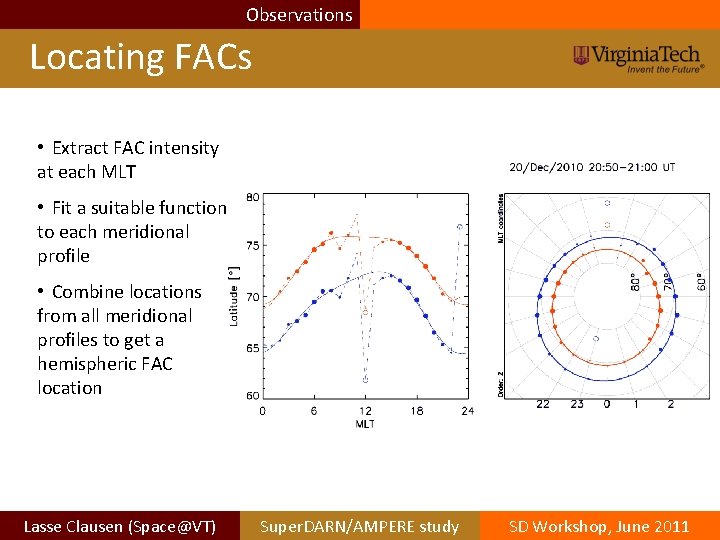
Observations Locating FACs • Extract FAC intensity at each MLT • Fit a suitable function to each meridional profile • Combine locations from all meridional profiles to get a hemispheric FAC location Lasse Clausen (Space@VT) Super. DARN/AMPERE study SD Workshop, June 2011
Observations Locating FACs • Extract FAC intensity at each MLT • Fit a suitable function to each meridional profile • Combine locations from all meridional profiles to get a hemispheric FAC location Lasse Clausen (Space@VT) Super. DARN/AMPERE study SD Workshop, June 2011
Observations Locating FACs • Extract FAC intensity at each MLT • Fit a suitable function to each meridional profile • Combine locations from all meridional profiles to get a hemispheric FAC location Lasse Clausen (Space@VT) Super. DARN/AMPERE study SD Workshop, June 2011
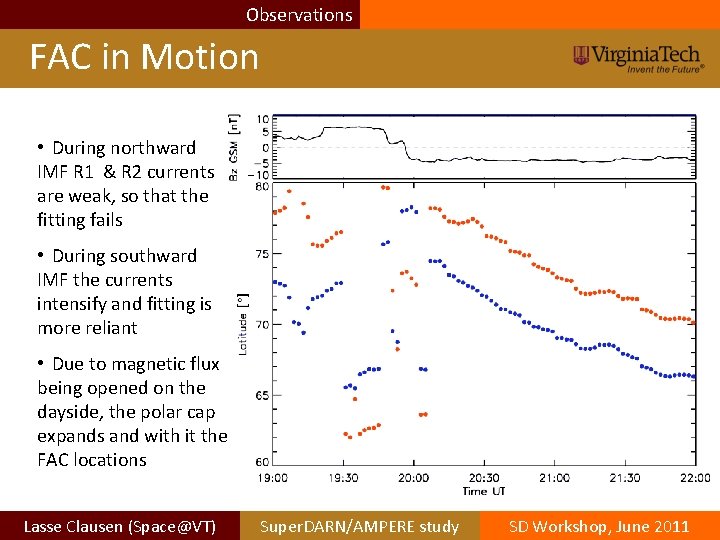
Observations FAC in Motion • During northward IMF R 1 & R 2 currents are weak, so that the fitting fails • During southward IMF the currents intensify and fitting is more reliant • Due to magnetic flux being opened on the dayside, the polar cap expands and with it the FAC locations Lasse Clausen (Space@VT) Super. DARN/AMPERE study SD Workshop, June 2011
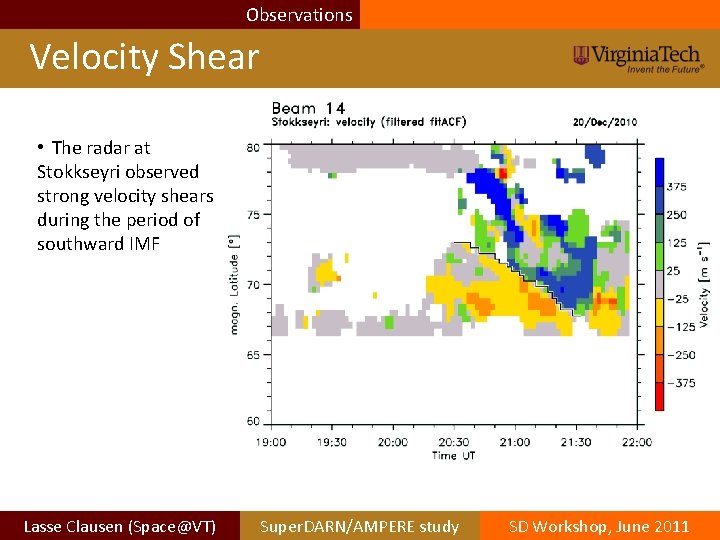
Observations Velocity Shear • The radar at Stokkseyri observed strong velocity shears during the period of southward IMF Lasse Clausen (Space@VT) Super. DARN/AMPERE study SD Workshop, June 2011
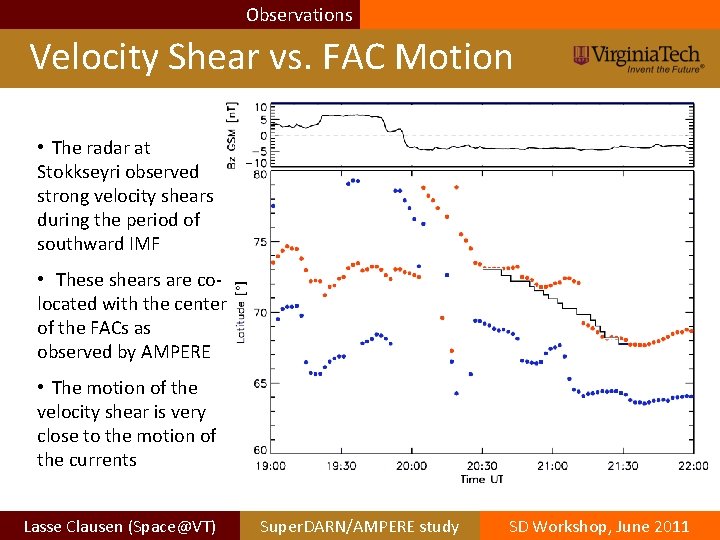
Observations Velocity Shear vs. FAC Motion • The radar at Stokkseyri observed strong velocity shears during the period of southward IMF • These shears are colocated with the center of the FACs as observed by AMPERE • The motion of the velocity shear is very close to the motion of the currents Lasse Clausen (Space@VT) Super. DARN/AMPERE study SD Workshop, June 2011
Conclusions • AMPERE provide high time resolution observations of the field-aligned currents • Dayside reconnection causes the polar cap to expand the FACs move equatorward • Co-located with the strongest FACs strong velocity shears are observed Lasse Clausen (Space@VT) Super. DARN/AMPERE study SD Workshop, June 2011