
Ionization of Water Solvent properties of water can
- Slides: 9
Ionization of Water • Solvent properties of water can be explained in terms of the uncharged H 2 O molecule, the small degree of ionization of water to hydrogen ions (H +) and hydroxide ions (OH-) must also be consider. • Like all reversible reactions, the ionization of water can be described by an equilibrium constant. • When weak acids are dissolved in water, they contribute H+ by ionizing; weak bases consume H+ by becoming protonated. These processes are also determined by equilibrium constants. • The total hydrogen ion concentration from all sources is experimentally measurable and is expressed as the p. H of the solution.
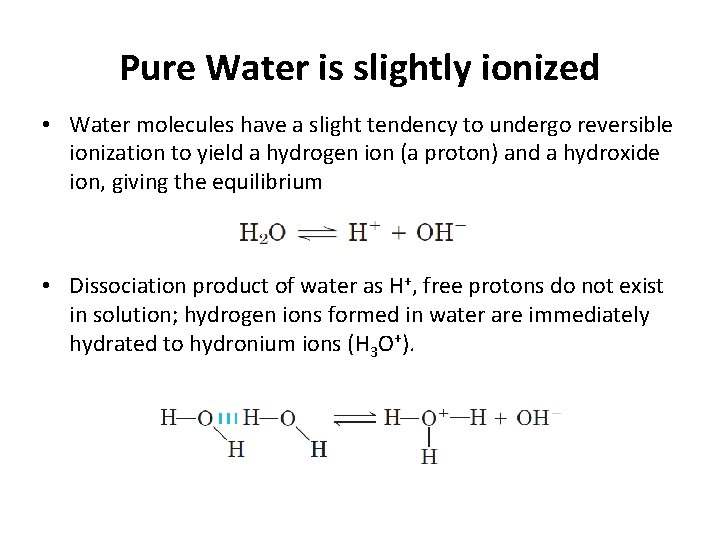
Pure Water is slightly ionized • Water molecules have a slight tendency to undergo reversible ionization to yield a hydrogen ion (a proton) and a hydroxide ion, giving the equilibrium • Dissociation product of water as H+, free protons do not exist in solution; hydrogen ions formed in water are immediately hydrated to hydronium ions (H 3 O+).
• The ionization of water can be measured by its electrical conductivity. pure water carries electrical current as H 3 O+ migrates toward the cathode and OH- toward the anode. • The movement of hydronium and hydroxide ions in the electric field is extremely fast compared with that of other ions such as Na +, K +, and Cl-.
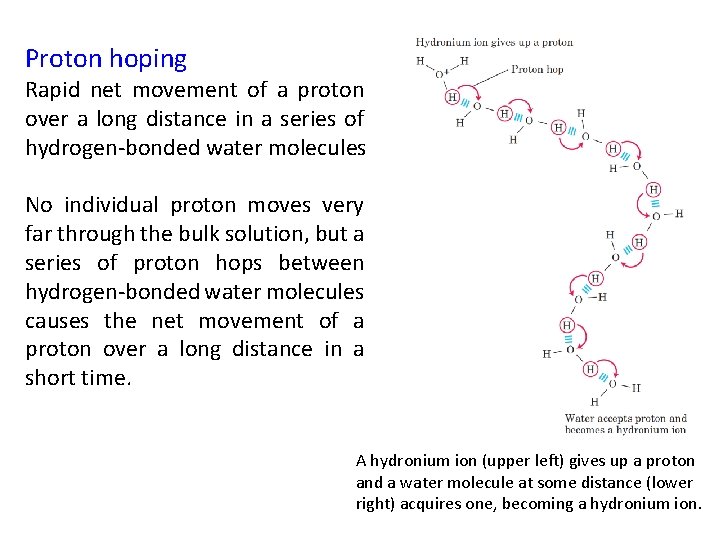
Proton hoping Rapid net movement of a proton over a long distance in a series of hydrogen-bonded water molecules No individual proton moves very far through the bulk solution, but a series of proton hops between hydrogen-bonded water molecules causes the net movement of a proton over a long distance in a short time. A hydronium ion (upper left) gives up a proton and a water molecule at some distance (lower right) acquires one, becoming a hydronium ion.
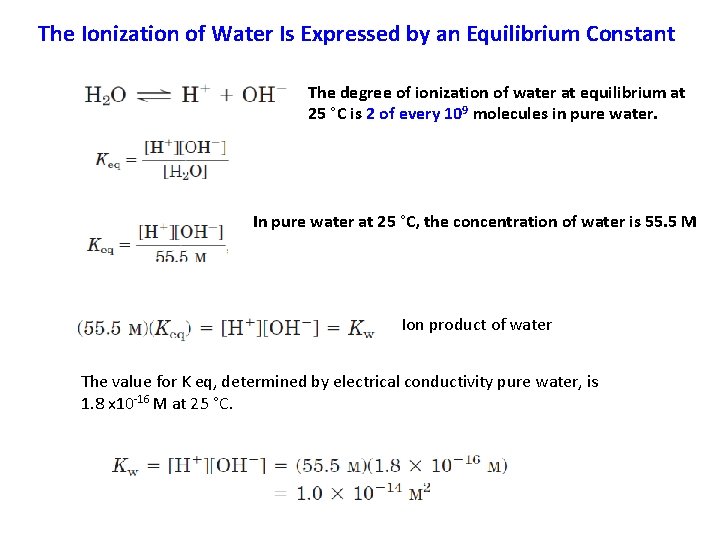
The Ionization of Water Is Expressed by an Equilibrium Constant The degree of ionization of water at equilibrium at 25 °C is 2 of every 109 molecules in pure water. In pure water at 25 °C, the concentration of water is 55. 5 M Ion product of water The value for K eq, determined by electrical conductivity pure water, is 1. 8 x 10 -16 M at 25 °C.
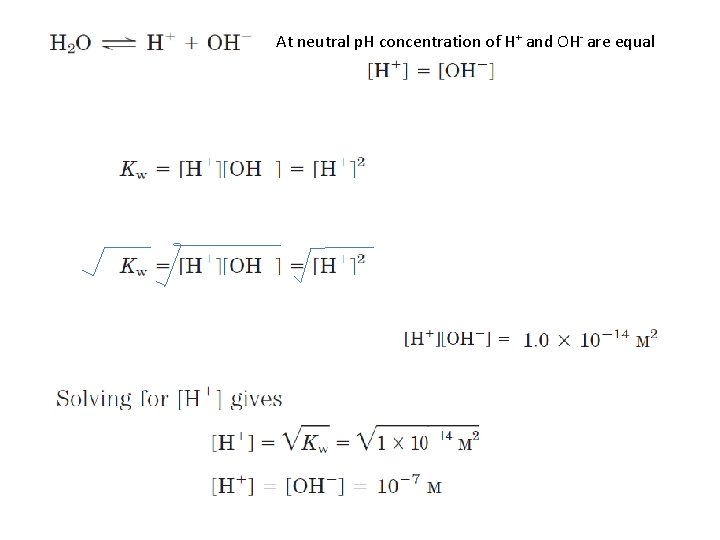
At neutral p. H concentration of H+ and OH- are equal
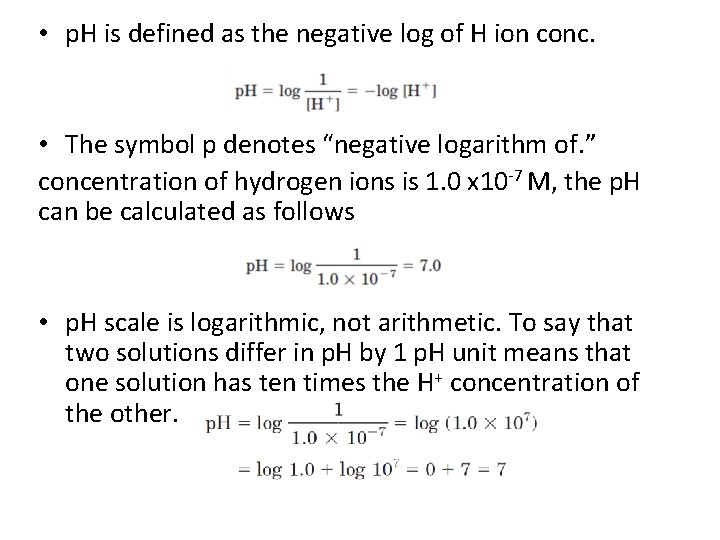
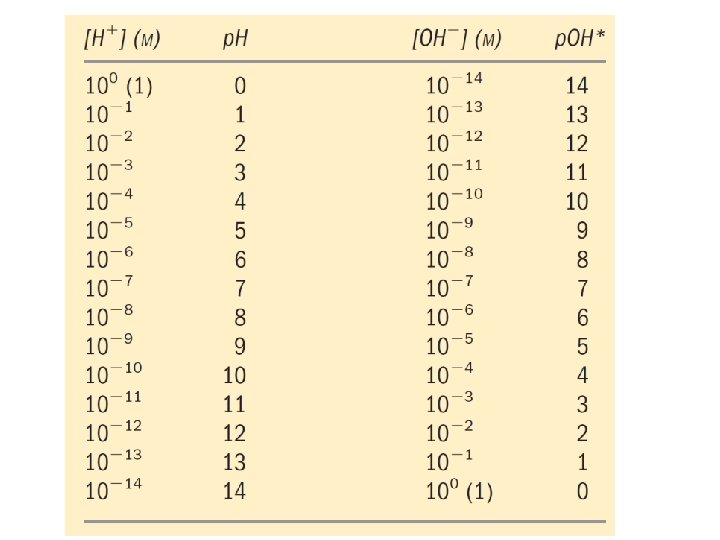
• p. H is defined as the negative log of H ion conc. • The symbol p denotes “negative logarithm of. ” concentration of hydrogen ions is 1. 0 x 10 -7 M, the p. H can be calculated as follows • p. H scale is logarithmic, not arithmetic. To say that two solutions differ in p. H by 1 p. H unit means that one solution has ten times the H+ concentration of the other.
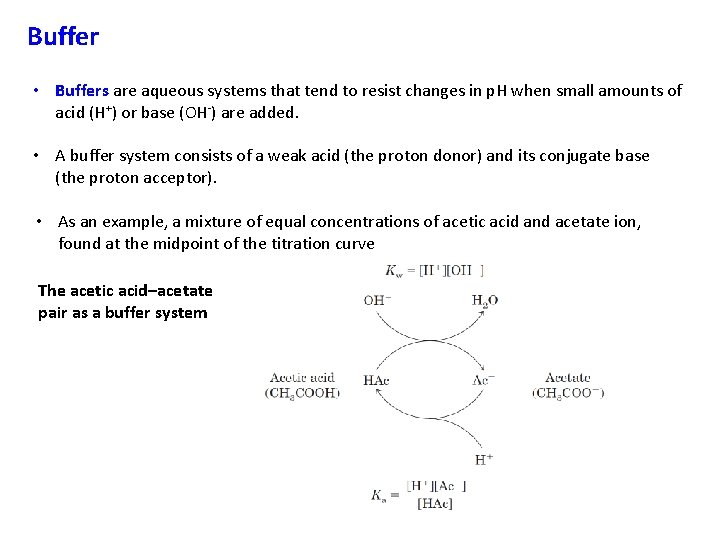
Buffer • Buffers are aqueous systems that tend to resist changes in p. H when small amounts of acid (H+) or base (OH-) are added. • A buffer system consists of a weak acid (the proton donor) and its conjugate base (the proton acceptor). • As an example, a mixture of equal concentrations of acetic acid and acetate ion, found at the midpoint of the titration curve The acetic acid–acetate pair as a buffer system