
Ionisation Energy Definition of the first ionisation energy

- Slides: 22
Ionisation Energy
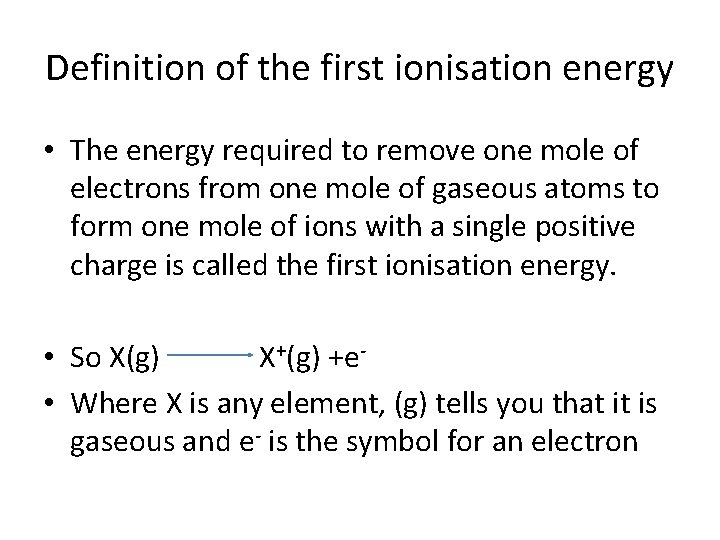
Definition of the first ionisation energy • The energy required to remove one mole of electrons from one mole of gaseous atoms to form one mole of ions with a single positive charge is called the first ionisation energy. • So X(g) X+(g) +e • Where X is any element, (g) tells you that it is gaseous and e- is the symbol for an electron
So what does this mean? • In order to measure ionisation energy the atoms have to be separated which is why we say that it must be in a gaseous state. • Ionisation energy is the energy taken to remove an electron completely from an atom. • This means that we are moving the electron from the ground state (the energy level when it is not excited) to the point at which is free of the attraction of the nucleus.
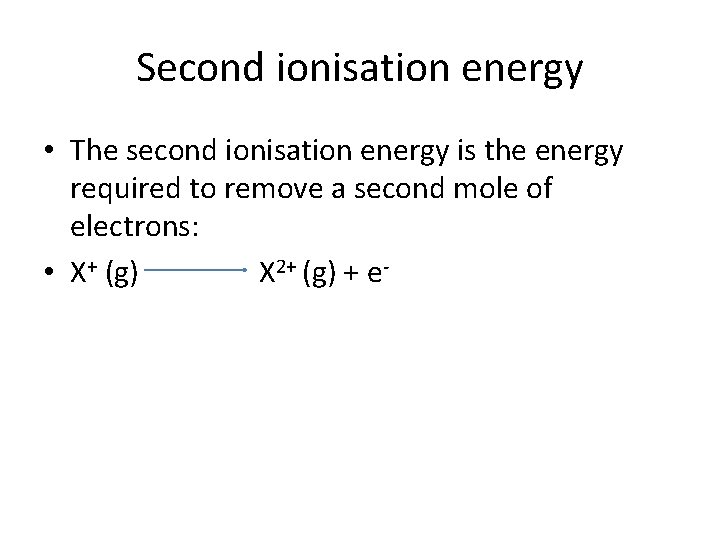
Second ionisation energy • The second ionisation energy is the energy required to remove a second mole of electrons: • X+ (g) X 2+ (g) + e-
Ionisation energy graph • Use the accompanying table to draw a graph of atomic number against first ionisation energy. • What patterns can you see?
What affects ionisation energy • Electron Shielding – the greater the number of shells shielding the lower the ionisation energy. Why? • Size of the atom – the larger the atomic radius the lower the ionisation energy. Why? • Charge – the greater the charge the higher the ionisation energy. Why?
Explaining in a group • As we go down the group: • The number of shielding shells increases • The force of attraction of the nucleus for the outermost electrons weakens • The atomic radius increases • So it is easier to remove the outermost electron from the atom (less energy needed)
Explaining across a period • The number of shielding shells remains constant • The positive charge of the nucleus increases • The force of attraction between the nucleus and the outermost electrons strengthens • The atomic radius decreases • So it is more difficult to move the outermost electron from the atom (more energy needed)
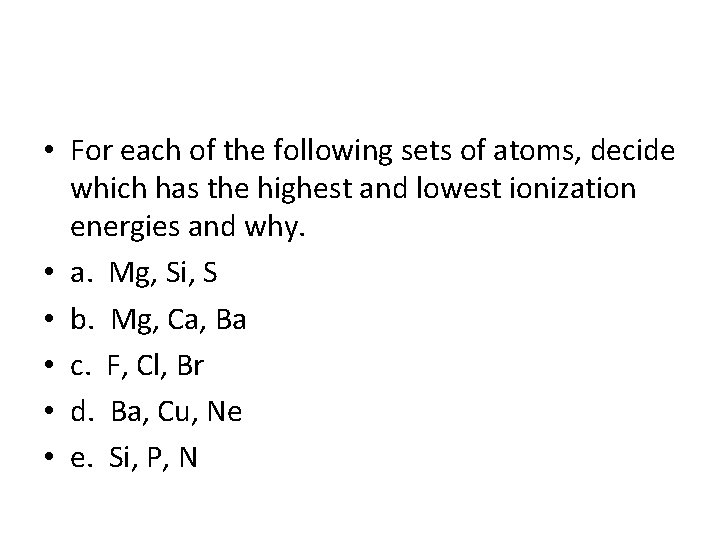
• For each of the following sets of atoms, decide which has the highest and lowest ionization energies and why. • a. Mg, Si, S • b. Mg, Ca, Ba • c. F, Cl, Br • d. Ba, Cu, Ne • e. Si, P, N
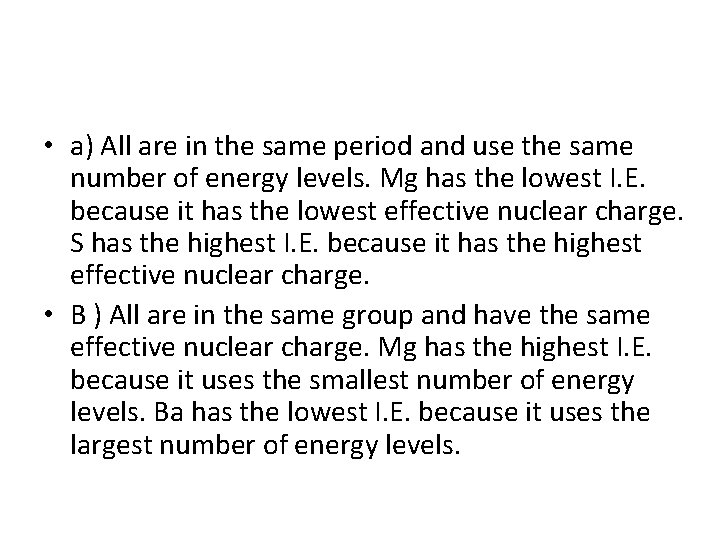
• a) All are in the same period and use the same number of energy levels. Mg has the lowest I. E. because it has the lowest effective nuclear charge. S has the highest I. E. because it has the highest effective nuclear charge. • B ) All are in the same group and have the same effective nuclear charge. Mg has the highest I. E. because it uses the smallest number of energy levels. Ba has the lowest I. E. because it uses the largest number of energy levels.
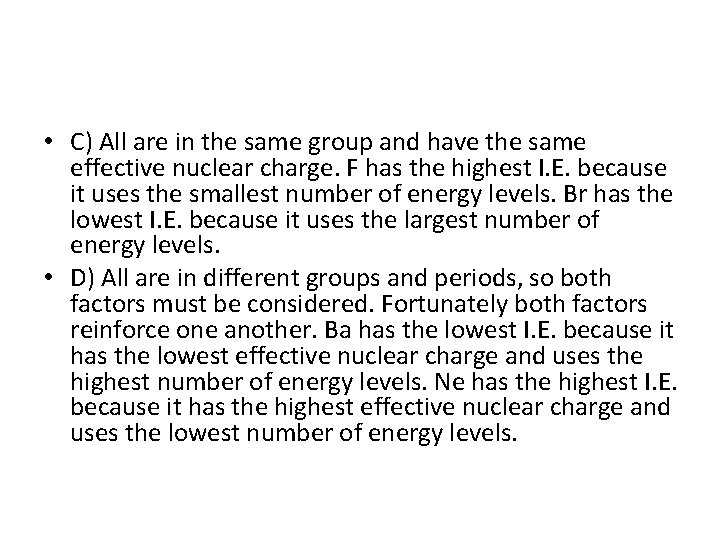
• C) All are in the same group and have the same effective nuclear charge. F has the highest I. E. because it uses the smallest number of energy levels. Br has the lowest I. E. because it uses the largest number of energy levels. • D) All are in different groups and periods, so both factors must be considered. Fortunately both factors reinforce one another. Ba has the lowest I. E. because it has the lowest effective nuclear charge and uses the highest number of energy levels. Ne has the highest I. E. because it has the highest effective nuclear charge and uses the lowest number of energy levels.
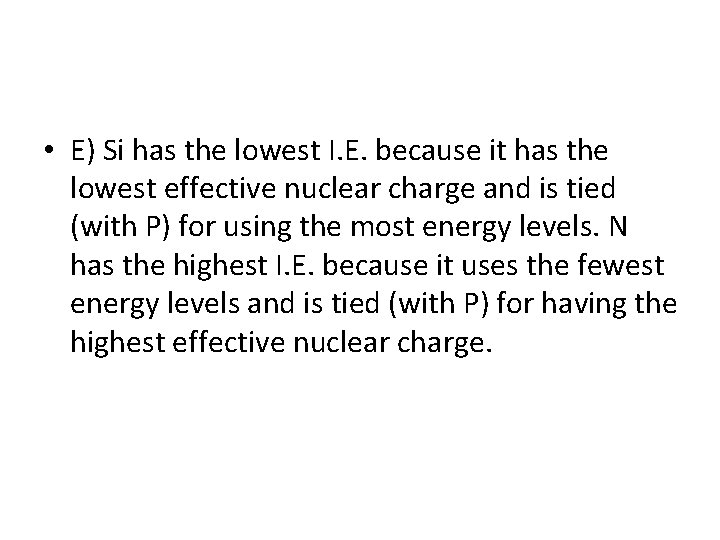
• E) Si has the lowest I. E. because it has the lowest effective nuclear charge and is tied (with P) for using the most energy levels. N has the highest I. E. because it uses the fewest energy levels and is tied (with P) for having the highest effective nuclear charge.
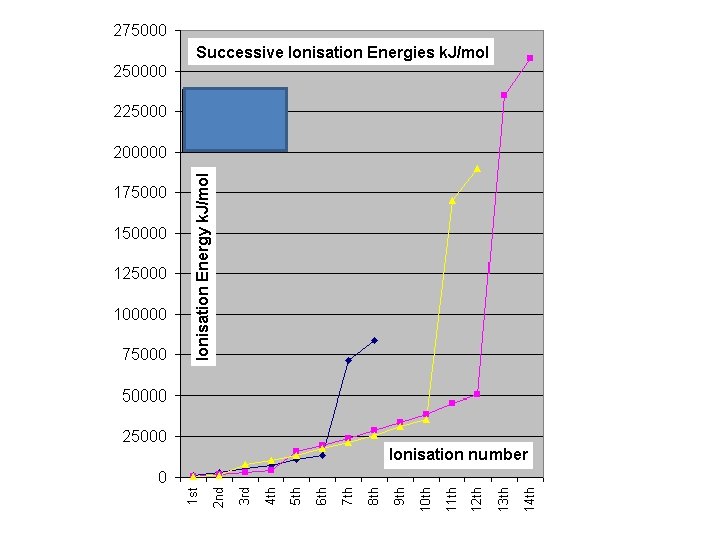
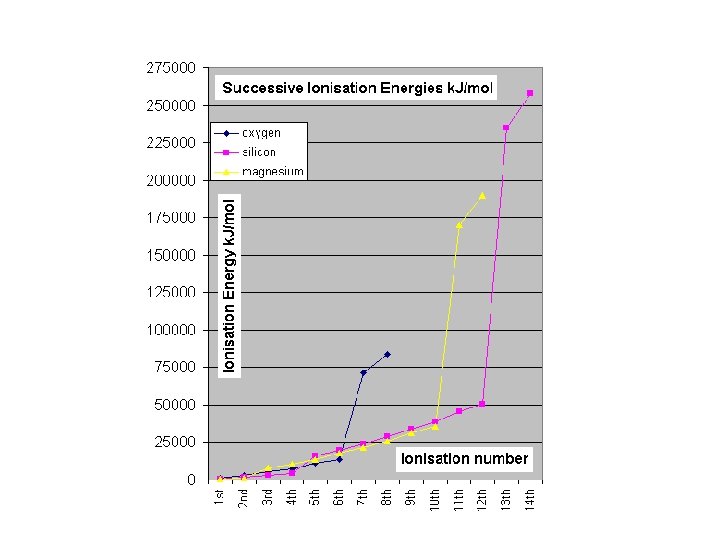
Successive ionisation energy • If we look at one ionisation energy after another for a particular element then we can see interpretable patterns
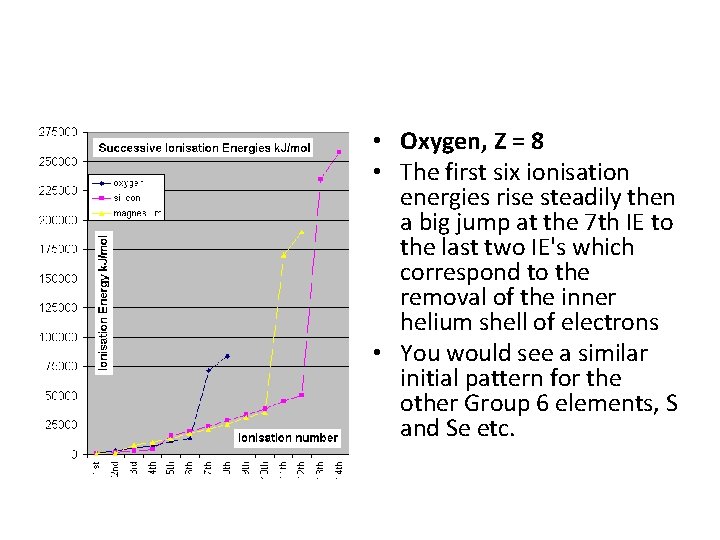
• Oxygen, Z = 8 • The first six ionisation energies rise steadily then a big jump at the 7 th IE to the last two IE's which correspond to the removal of the inner helium shell of electrons • You would see a similar initial pattern for the other Group 6 elements, S and Se etc.
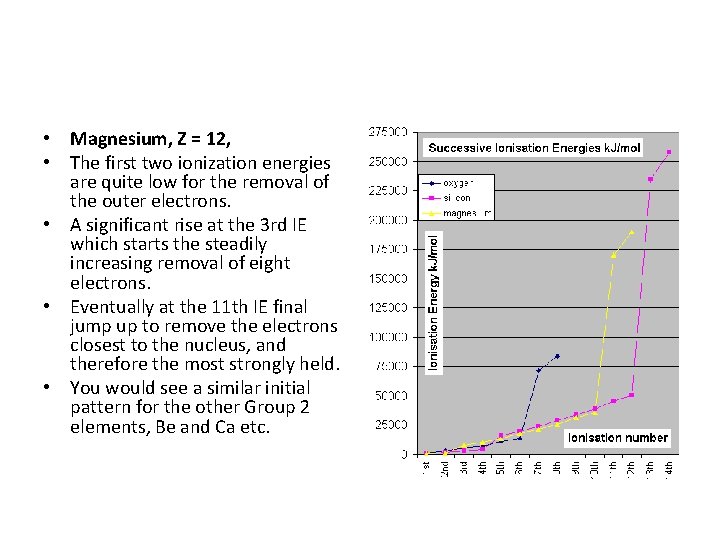
• Magnesium, Z = 12, • The first two ionization energies are quite low for the removal of the outer electrons. • A significant rise at the 3 rd IE which starts the steadily increasing removal of eight electrons. • Eventually at the 11 th IE final jump up to remove the electrons closest to the nucleus, and therefore the most strongly held. • You would see a similar initial pattern for the other Group 2 elements, Be and Ca etc.
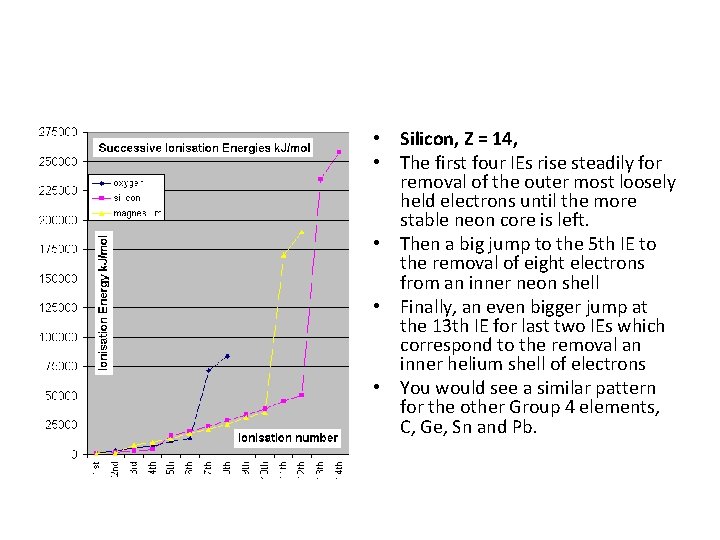
• Silicon, Z = 14, • The first four IEs rise steadily for removal of the outer most loosely held electrons until the more stable neon core is left. • Then a big jump to the 5 th IE to the removal of eight electrons from an inner neon shell • Finally, an even bigger jump at the 13 th IE for last two IEs which correspond to the removal an inner helium shell of electrons • You would see a similar pattern for the other Group 4 elements, C, Ge, Sn and Pb.
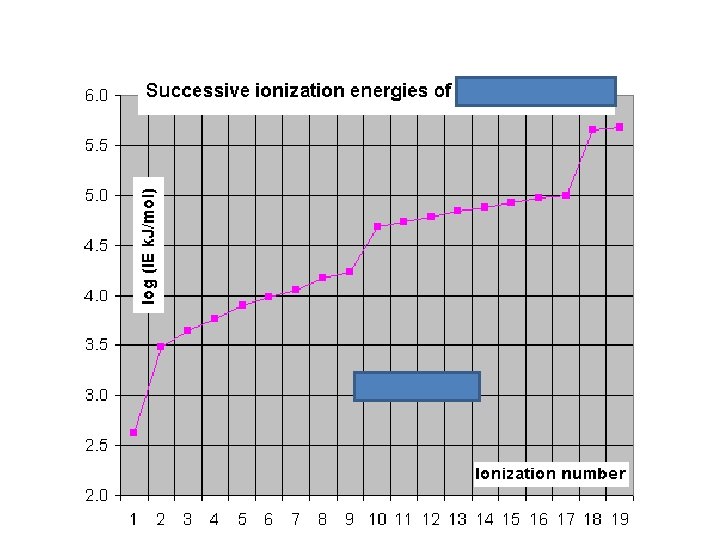
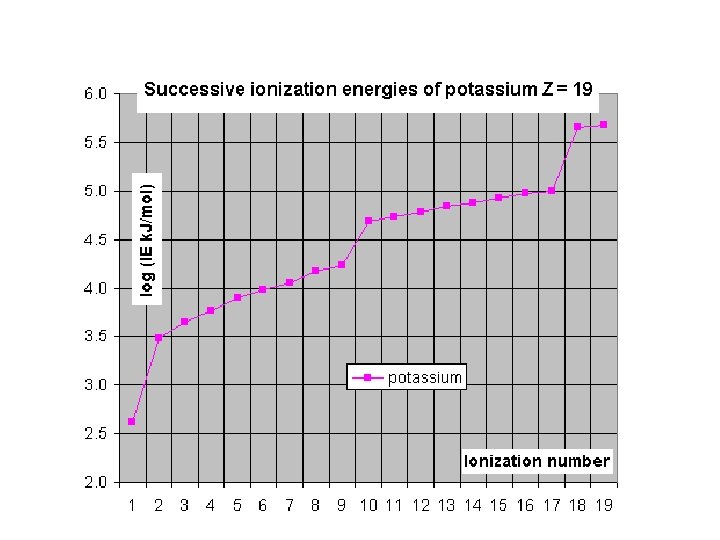
Explaining Potassium • Because of the wide range of IE values, the 'shell pattern' in ionization energies is better seen by doing a logarithmic plot of the IE values. • The first ionization energy is very low leaving an argon core of 18 e. • Then, on the 2 nd IE, eight ionisation energies rise steadily • At the 10 th IE there is the 2 nd big jump when eight ionisation energies rise steadily • Then a big jump to the last two IE's which correspond to the removal of the inner helium shell of electrons • You would see a similar initial pattern for the other Group 1 elements, Li (first jump only), same initial pattern for Na and Rb etc.