
IonIrradiation and Material Characterization Capabilities at University of
Ion-Irradiation and Material Characterization Capabilities at University of Wisconsin - Madison Ben Maier, M. S. (Ph. D Graduate Student in area of nuclear reactor materials) University of Wisconsin – Madison brmaier@wisc. edu Annual NSUF Users Meeting Idaho Falls, ID June 22 nd-25 th, 2015 1
Presentation Outline § Ion Beam Lab (IBL) - Introduction § University of Wisconsin IBL § Ion beam facility § Beam laboratory upgrades § Safety § Characterization Lab for Irradiated Materials (CLIM) § Post-irradiation examination (PIE) equipment § Sample preparation § Safety § Examples of IBL Projects § Concluding Remarks 2
Introduction § NSUF facility since 2009 § Ion beam laboratory – ion irradiation and ion beam analysis § Post-irradiation examination (PIE) equipment § Characterization Laboratory for Irradiated Materials (CLIM) § Sample preparation § Non-radioactive and radioactive samples 3
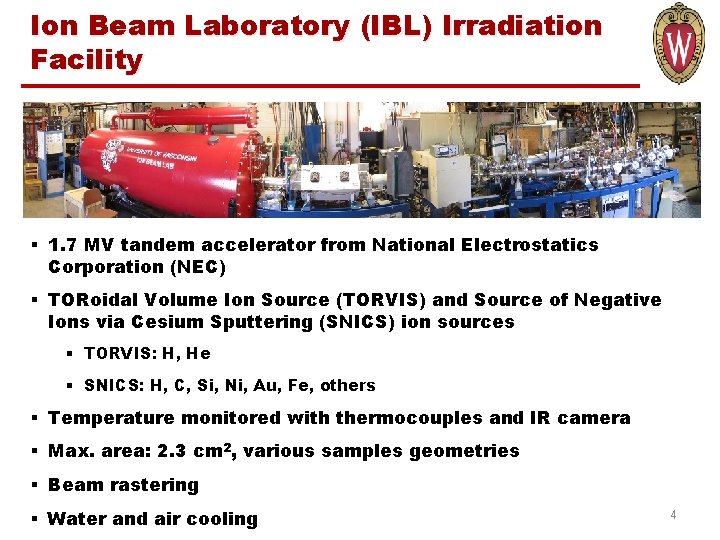
Ion Beam Laboratory (IBL) Irradiation Facility § 1. 7 MV tandem accelerator from National Electrostatics Corporation (NEC) § TORoidal Volume Ion Source (TORVIS) and Source of Negative Ions via Cesium Sputtering (SNICS) ion sources § TORVIS: H, He § SNICS: H, C, Si, Ni, Au, Fe, others § Temperature monitored with thermocouples and IR camera § Max. area: 2. 3 cm 2, various samples geometries § Beam rastering § Water and air cooling 4
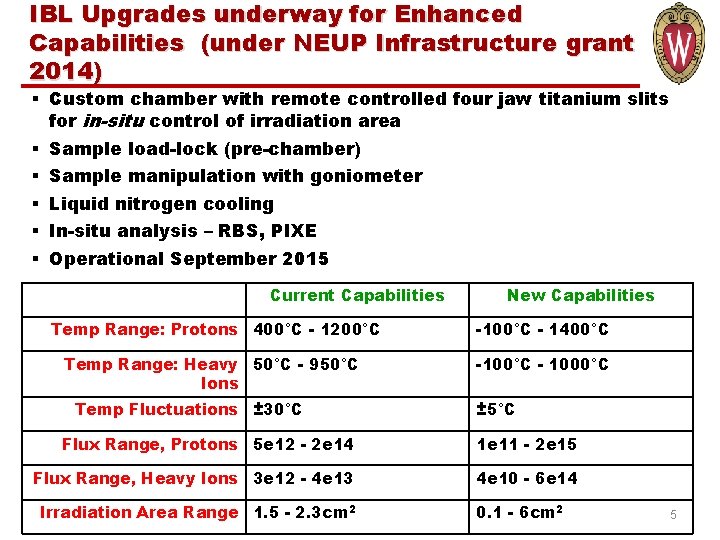
IBL Upgrades underway for Enhanced Capabilities (under NEUP Infrastructure grant 2014) § Custom chamber with remote controlled four jaw titanium slits for in-situ control of irradiation area § Sample load-lock (pre-chamber) § Sample manipulation with goniometer § Liquid nitrogen cooling § In-situ analysis – RBS, PIXE § Operational September 2015 Current Capabilities New Capabilities Temp Range: Protons 400°C - 1200°C -100°C - 1400°C Temp Range: Heavy 50°C - 950°C Ions -100°C - 1000°C Temp Fluctuations ± 30°C ± 5°C Flux Range, Protons 5 e 12 - 2 e 14 1 e 11 - 2 e 15 Flux Range, Heavy Ions 3 e 12 - 4 e 13 4 e 10 - 6 e 14 Irradiation Area Range 1. 5 - 2. 3 cm 2 0. 1 - 6 cm 2 5
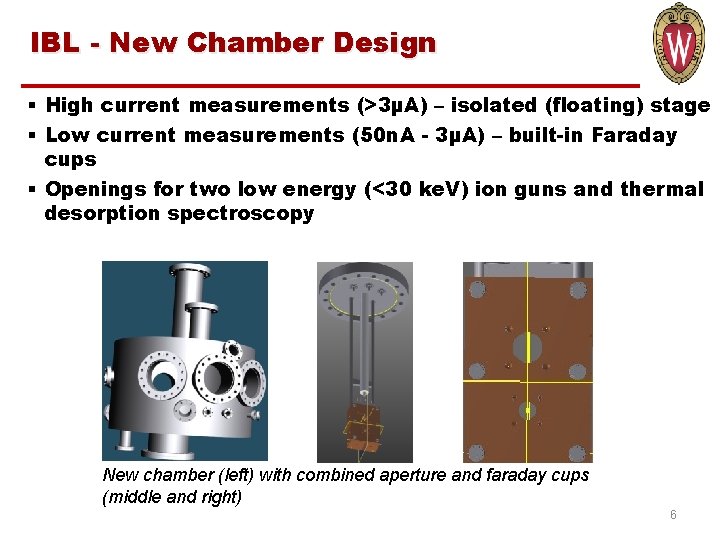
IBL - New Chamber Design § High current measurements (>3μA) – isolated (floating) stage § Low current measurements (50 n. A - 3μA) – built-in Faraday cups § Openings for two low energy (<30 ke. V) ion guns and thermal desorption spectroscopy New chamber (left) with combined aperture and faraday cups (middle and right) 6
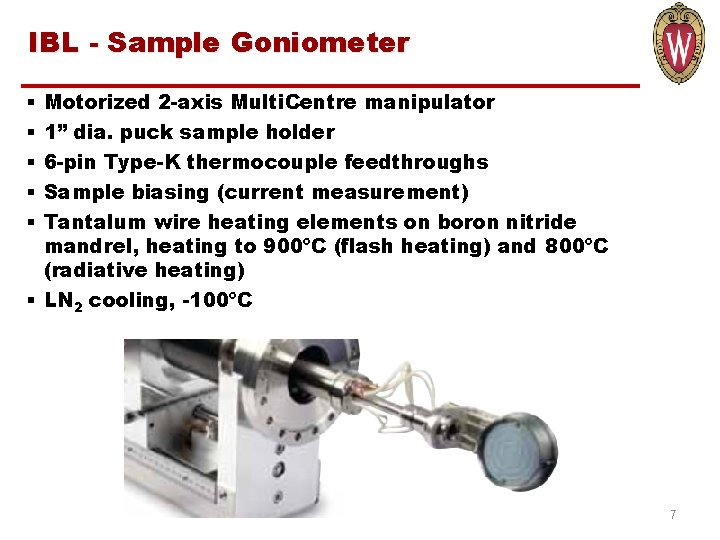
IBL - Sample Goniometer § § § Motorized 2 -axis Multi. Centre manipulator 1” dia. puck sample holder 6 -pin Type-K thermocouple feedthroughs Sample biasing (current measurement) Tantalum wire heating elements on boron nitride mandrel, heating to 900ºC (flash heating) and 800ºC (radiative heating) § LN 2 cooling, -100ºC 7
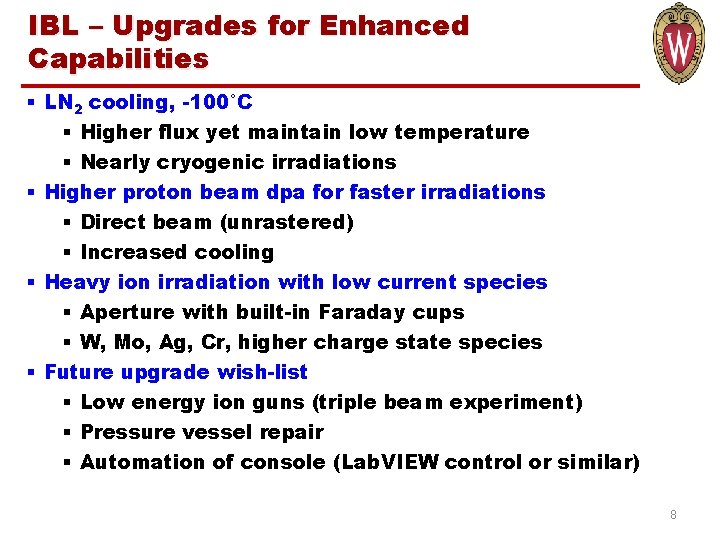
IBL – Upgrades for Enhanced Capabilities § LN 2 cooling, -100°C § Higher flux yet maintain low temperature § Nearly cryogenic irradiations § Higher proton beam dpa for faster irradiations § Direct beam (unrastered) § Increased cooling § Heavy ion irradiation with low current species § Aperture with built-in Faraday cups § W, Mo, Ag, Cr, higher charge state species § Future upgrade wish-list § Low energy ion guns (triple beam experiment) § Pressure vessel repair § Automation of console (Lab. VIEW control or similar) 8
IBL Safety Considerations § High voltages (1. 7 MV and 30 k. V) from accelerator and ion sources § H, He, N, and SF 6 gas bottles § Flammable substances: acetone, methanol § High temperature on irradiation chamber § Gamma and neutron radiation during operation § Radioactive materials – uranium, activated steels, nirradiated W § Pressurized vessels 9
IBL Safety Protection § Oxygen monitor (SF 6 leaks) § 5 gamma and 1 neutron detector § Lab locked during operation § Cage around ion source, rad prep area § Chicken stick (high voltage) § Pyrometer § Contamination wipe by radiation safety officers § Rad spill kit § Personal Protection: dosimeters, gloves, coat, goggles, mask § Radiation training required § Standard Operating Procedures 10
IBL Safety – Sample Handling § Personal Protection: dosimeters, gloves, coat, goggles, mask § Samples below 100 cpm (2 x background) safe for release § Above 100 cpm – isotope check and long time storage or use in dedicated PIE facilities § Activity predictions required before irradiation § Calculation of isotope production and decay rates (ion species, energies, reaction crosssections, half-lives, etc. ) 11
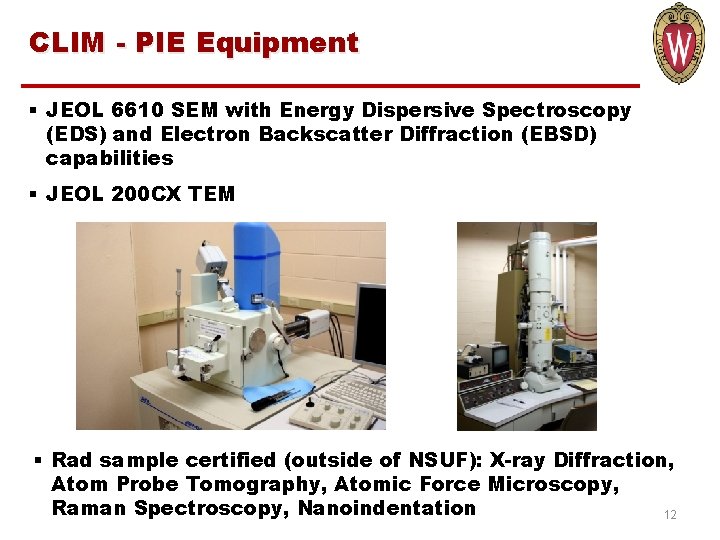
CLIM - PIE Equipment § JEOL 6610 SEM with Energy Dispersive Spectroscopy (EDS) and Electron Backscatter Diffraction (EBSD) capabilities § JEOL 200 CX TEM § Rad sample certified (outside of NSUF): X-ray Diffraction, Atom Probe Tomography, Atomic Force Microscopy, Raman Spectroscopy, Nanoindentation 12
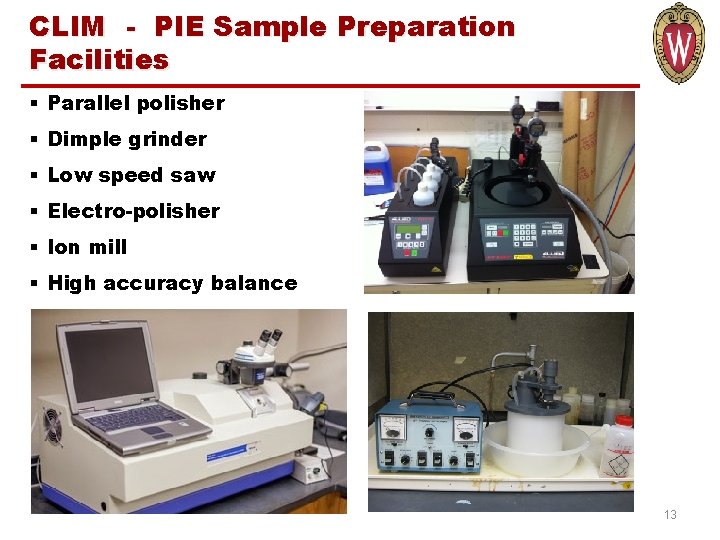
CLIM - PIE Sample Preparation Facilities § Parallel polisher § Dimple grinder § Low speed saw § Electro-polisher § Ion mill § High accuracy balance 13
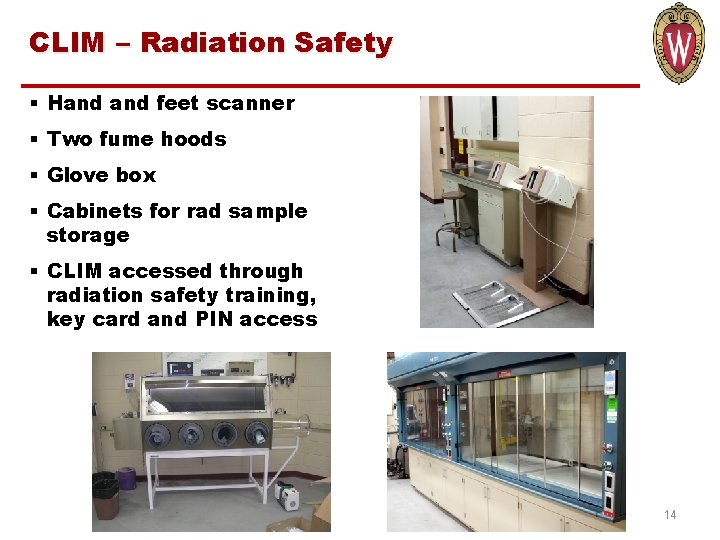
CLIM – Radiation Safety § Hand feet scanner § Two fume hoods § Glove box § Cabinets for rad sample storage § CLIM accessed through radiation safety training, key card and PIN access 14
IBL Usage in 2014 § 70% UW-Madison committed projects § 10% NSUF projects § North Carolina State University “Ion-irradiation of Nuclear Grade NBG-18 and Highly Ordered Pyrolytic (HOPG) Graphites” § Texas A&M University “Critical Evaluation of Radiation Tolerance of Nano-Crystalline Austenitic Stainless Steels” § 10% repairs § 10% free § Increased NSUF time anticipated with upgrades that are being implemented 15
Ion Irradiations – UW Madison Projects (examples) § Defects in off-stoichiometric UO 2 § Densification and thermal conductivity of UN § Ag diffusion in radiation-damaged Si. C § Neutron damage simulation in steel dedicated for corrosion studies § Dose to amorphization Si. C § Defect characterization in Si. C § Hardness change with dpa in modified Zrcontaining ferritic steels 16
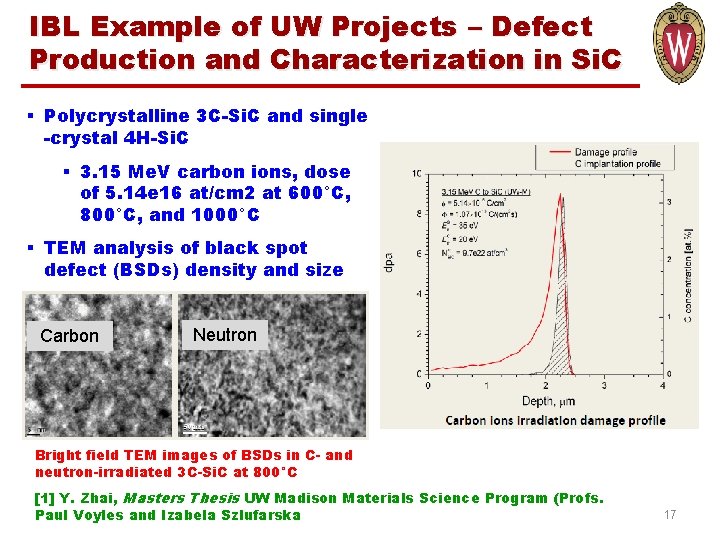
IBL Example of UW Projects – Defect Production and Characterization in Si. C § Polycrystalline 3 C-Si. C and single -crystal 4 H-Si. C § 3. 15 Me. V carbon ions, dose of 5. 14 e 16 at/cm 2 at 600°C, 800°C, and 1000°C § TEM analysis of black spot defect (BSDs) density and size Carbon Neutron Bright field TEM images of BSDs in C- and neutron-irradiated 3 C-Si. C at 800°C [1] Y. Zhai, Masters Thesis UW Madison Materials Science Program (Profs. Paul Voyles and Izabela Szlufarska 17
IBL Example of UW Projects – Defect Production and Characterization in Si. C § Black spot defects (BSDs) analyzed with TEM and STEM § Density of BSDs follows C implantation depth § Density decreases with temperature § Size increases with temperature [1] Y. Zhai, Masters Thesis UW Madison Materials Science Program (Profs. Paul Voyles and Izabela Szlufarska 18
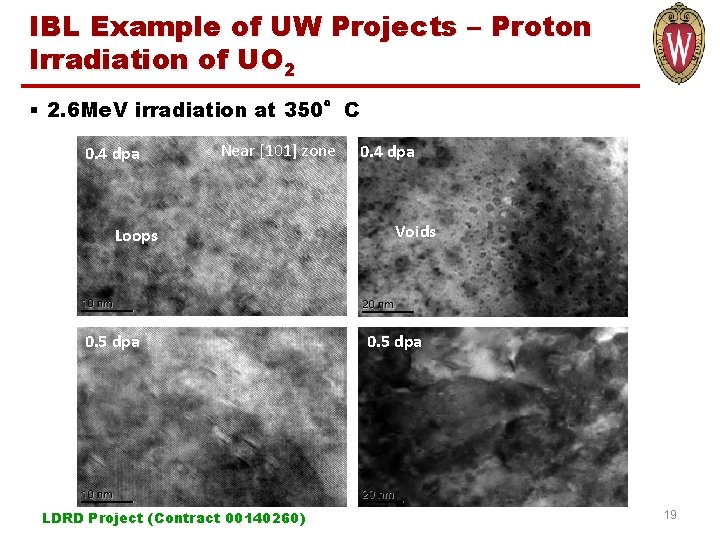
IBL Example of UW Projects – Proton Irradiation of UO 2 § 2. 6 Me. V irradiation at 350°C 0. 4 dpa Near [101] zone Loops 0. 5 dpa LDRD Project (Contract 00140260) 0. 4 dpa Voids 0. 5 dpa 19
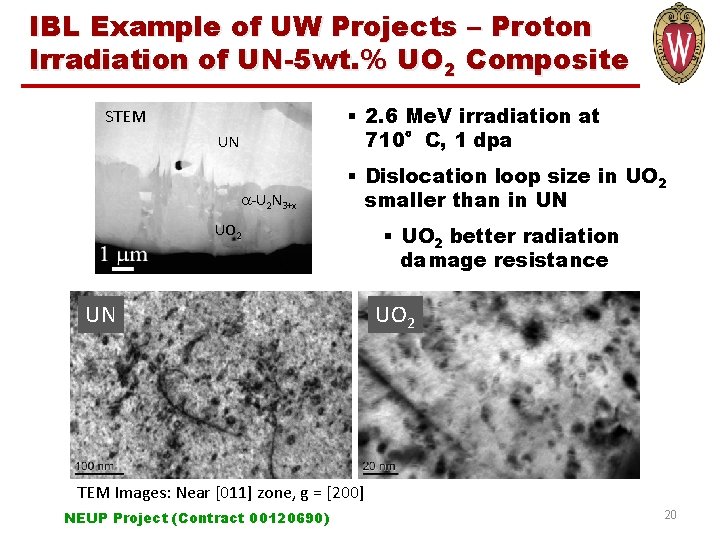
IBL Example of UW Projects – Proton Irradiation of UN-5 wt. % UO 2 Composite § 2. 6 Me. V irradiation at 710°C, 1 dpa STEM UN a-U 2 N 3+x § Dislocation loop size in UO 2 smaller than in UN UO 2 UN § UO 2 better radiation damage resistance UO 2 TEM Images: Near [011] zone, g = [200] NEUP Project (Contract 00120690) 20
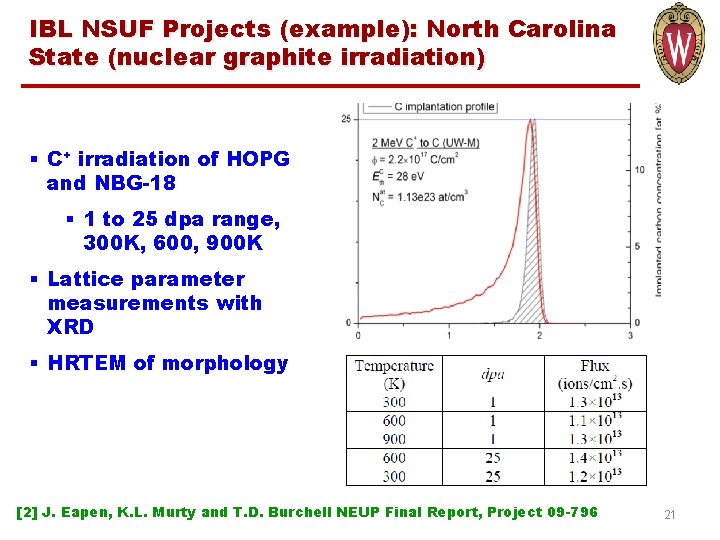
IBL NSUF Projects (example): North Carolina State (nuclear graphite irradiation) § C+ irradiation of HOPG and NBG-18 § 1 to 25 dpa range, 300 K, 600, 900 K § Lattice parameter measurements with XRD § HRTEM of morphology [2] J. Eapen, K. L. Murty and T. D. Burchell NEUP Final Report, Project 09 -796 21
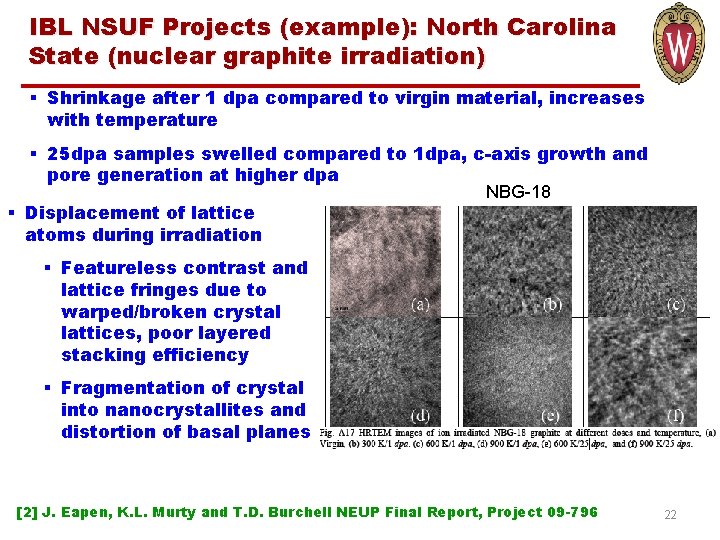
IBL NSUF Projects (example): North Carolina State (nuclear graphite irradiation) § Shrinkage after 1 dpa compared to virgin material, increases with temperature § 25 dpa samples swelled compared to 1 dpa, c-axis growth and pore generation at higher dpa NBG-18 § Displacement of lattice atoms during irradiation § Featureless contrast and lattice fringes due to warped/broken crystal lattices, poor layered stacking efficiency § Fragmentation of crystal into nanocrystallites and distortion of basal planes [2] J. Eapen, K. L. Murty and T. D. Burchell NEUP Final Report, Project 09 -796 22
Concluding Remarks § New chamber design will allow for increased throughput and irradiation/analysis capabilities § Future NSUF project (example): § University of Tennessee “Irradiation Effects on Structure and Properties of LWR Concrete” § Future UW-Madison Project (example) § Irradiation of new generation, high creep strength ferritic steels (with Oak Ridge National Laboratory and University of Tennessee) § Details, rates, and application forms: § http: //ibl. ep. wisc. edu § https: //atrnsuf. inl. gov § Contacts: § Dr. Beata Tyburska-Püschel tyburska@engr. wisc. edu § Ben Maier (brmaier@wisc. edu) § Dr. Kumar Sridharan (kumar@engr. wisc. edu) 23
Acknowledgements § Proton Irradiation of UO 2 and UN-5 wt. % UO 2 § This work was supported as a part of the Center for Materials Science of Nuclear Fuel, an Energy Frontier Research Center funded by the U. S. Department of Energy, Office of Science, Office of Basic Energy Sciences under award number FWP 1356. § NEUP Contract 00120690 (under Do. E Subcontract DE-AC 07 -051014517) § LDRD Contract 00140260 (under Do. E Subcontract DE-AC 07 -051014517) § ATR-NSUF rapid turnaround grant 13 -427_RTE_ATR, 14 -513_RTE_ATR made all the TEM and FIB work possible § North Carolina State Carbon Irradiation of Graphite § ATR-NSUF rapid turnaround grant 12 -391 24
Questions? 25
- Slides: 25