
Ionic vs Covalent Bonding Why bond Most atoms
Ionic vs. Covalent Bonding
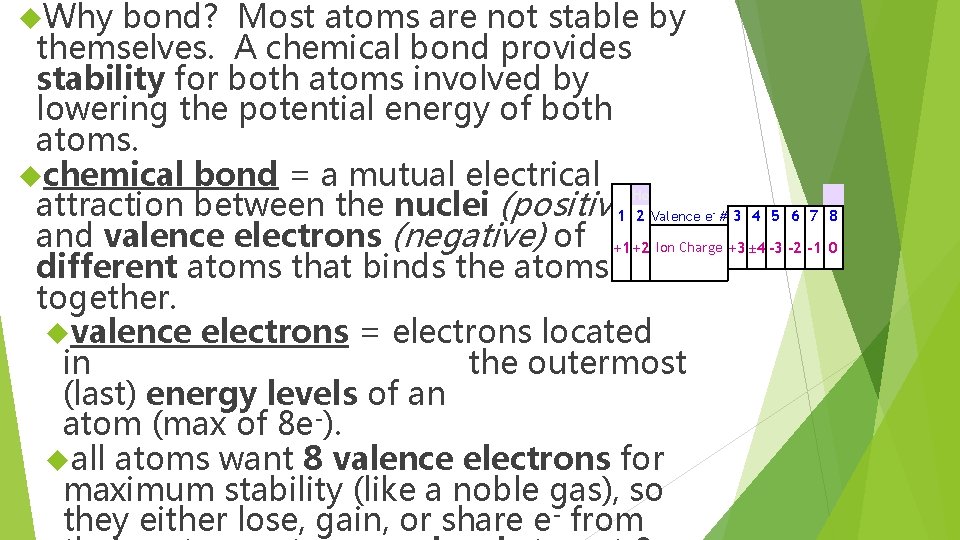
Why bond? Most atoms are not stable by themselves. A chemical bond provides stability for both atoms involved by lowering the potential energy of both atoms. chemical bond = a mutual electrical He attraction between the nuclei (positive) 1 2 Valence e # 3 4 5 6 7 8 and valence electrons (negative) of +1 +2 Ion Charge +3 ± 4 -3 -2 -1 0 different atoms that binds the atoms together. valence electrons = electrons located in the outermost (last) energy levels of an atom (max of 8 e-). all atoms want 8 valence electrons for maximum stability (like a noble gas), so they either lose, gain, or share e- from -
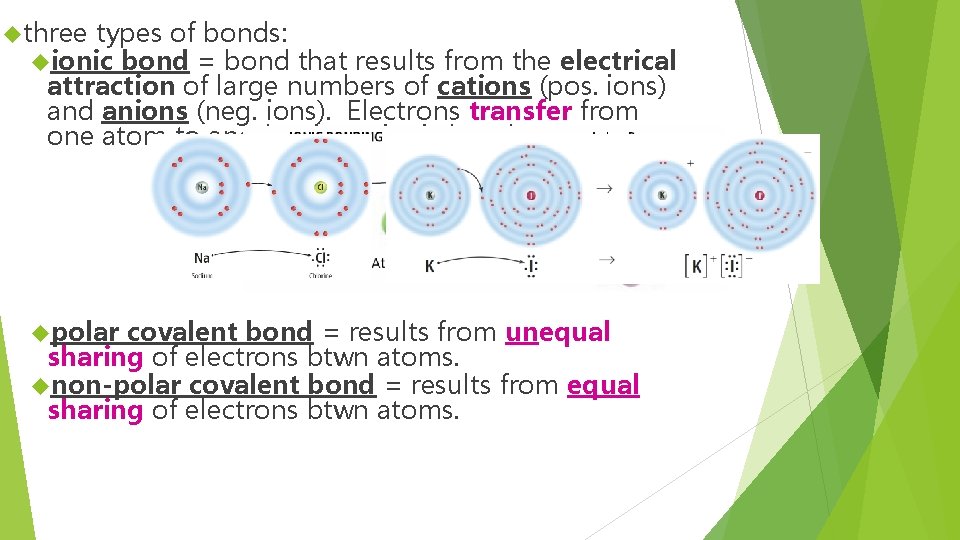
three types of bonds: ionic bond = bond that results from the electrical attraction of large numbers of cations (pos. ions) and anions (neg. ions). Electrons transfer from one atom to another in an ionic bond. polar covalent bond = results from unequal sharing of electrons btwn atoms. non-polar covalent bond = results from equal sharing of electrons btwn atoms.
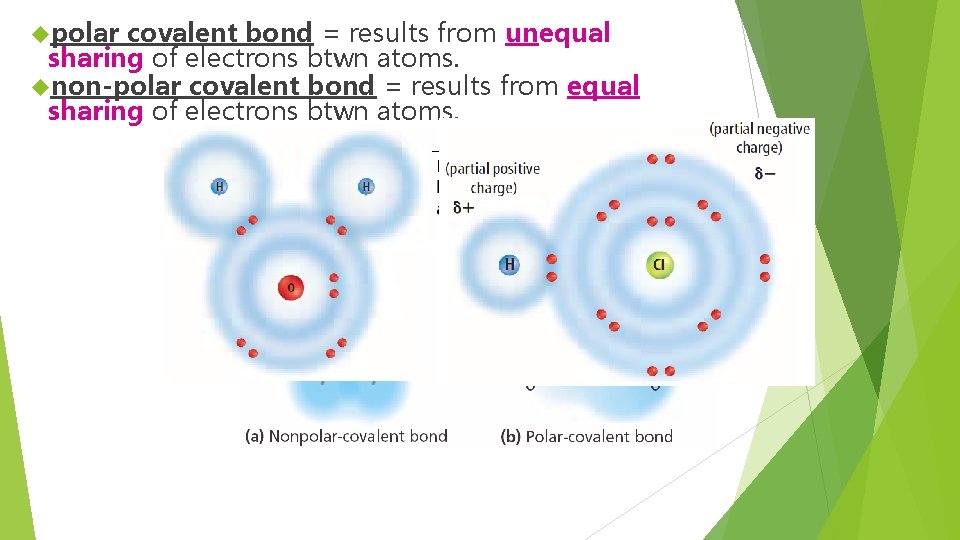
polar covalent bond = results from unequal sharing of electrons btwn atoms. non-polar covalent bond = results from equal sharing of electrons btwn atoms.
Self-Check Question! Why do atoms form chemical bonds? to become more stable
Self-Check Question! True or False? Valence electrons are the only electrons involved in the bonding process.
Self-Check Question! 8 ___ All atoms want valence electrons for maximum stability.
Self-Check Question! (Ionic, Covalent) bonds can be described as a transferring of electrons.
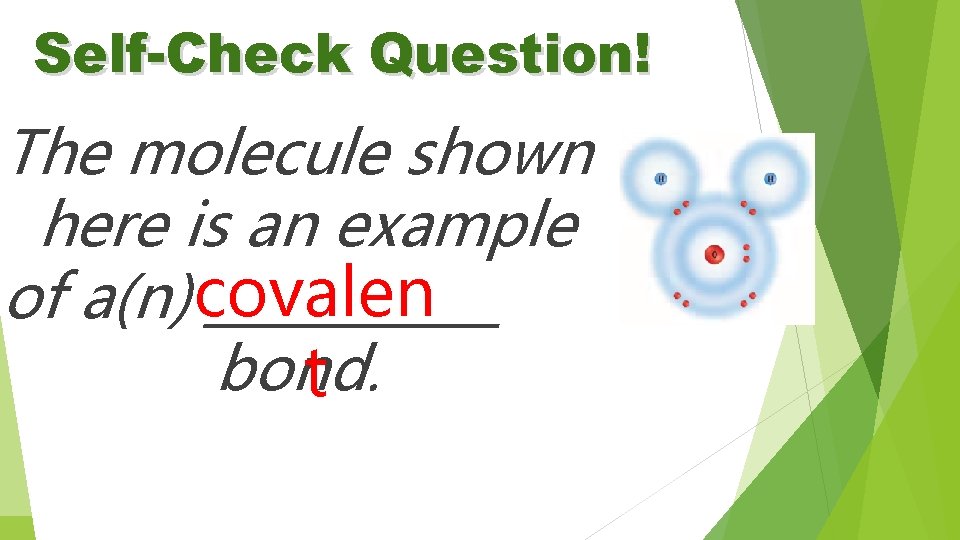
Self-Check Question! The molecule shown here is an example of a(n) covalen ______ bond. t

Types of Bonds to tell what type of bond will form between any two elements, you must know what type of elements you are dealing with: ionic bonds are formed when a metal bonds with a
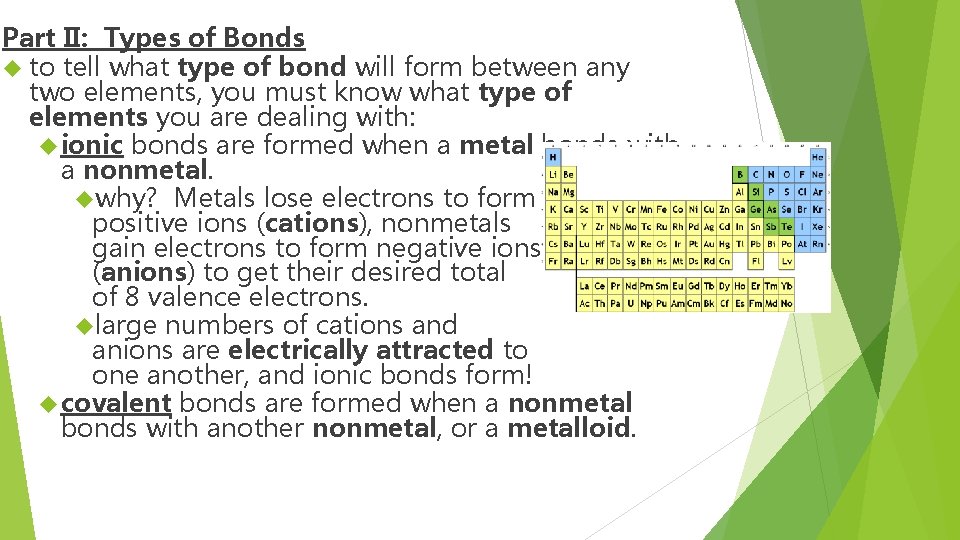
Part II: Types of Bonds to tell what type of bond will form between any two elements, you must know what type of elements you are dealing with: ionic bonds are formed when a metal bonds with a nonmetal. why? Metals lose electrons to form positive ions (cations), nonmetals gain electrons to form negative ions (anions) to get their desired total of 8 valence electrons. large numbers of cations and anions are electrically attracted to one another, and ionic bonds form! covalent bonds are formed when a nonmetal bonds with another nonmetal, or a metalloid.
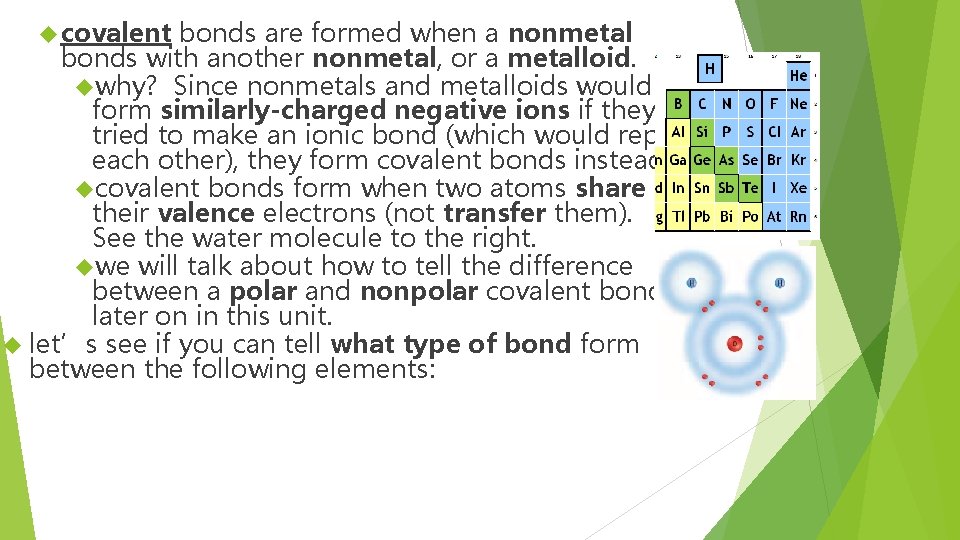
covalent bonds are formed when a nonmetal bonds with another nonmetal, or a metalloid. why? Since nonmetals and metalloids would form similarly-charged negative ions if they tried to make an ionic bond (which would repel each other), they form covalent bonds instead. covalent bonds form when two atoms share their valence electrons (not transfer them). See the water molecule to the right. we will talk about how to tell the difference between a polar and nonpolar covalent bond later on in this unit. let’s see if you can tell what type of bond form between the following elements:
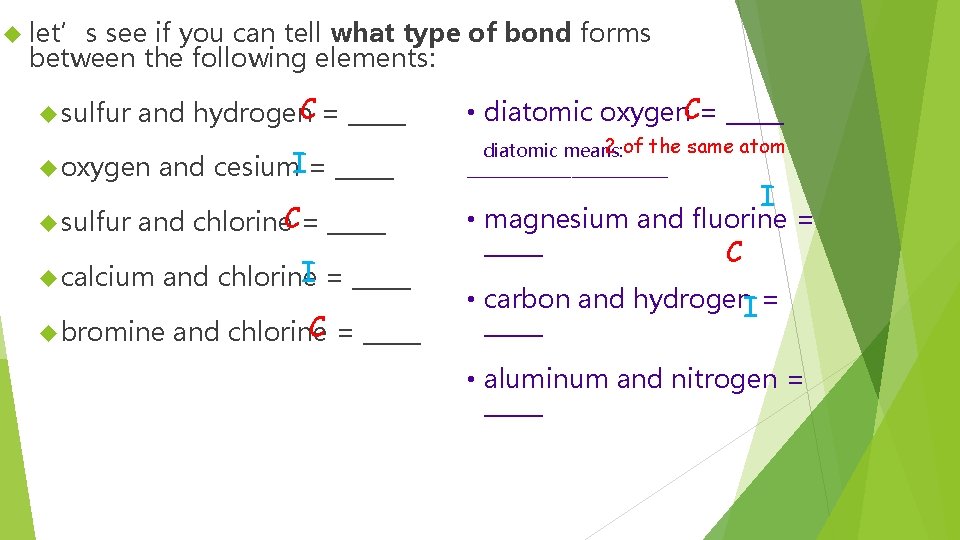
let’s see if you can tell what type of bond forms between the following elements: sulfur and hydrogen. C = _____ • diatomic oxygen. C= _____ and cesium. I = _____ 2 of the same atom diatomic means: _____________ oxygen sulfur and chlorine. C= _____ calcium I = _____ and chlorine bromine C = _____ and chlorine I • magnesium and fluorine = _____ C • carbon and hydrogen. I = _____ • aluminum and nitrogen = _____
Self-Check Question! When large #s of cations and anions electrically attract, this forms: an ionic bond
Self-Check Question! Describe what happens to electrons in a covalent bond: they are shared (not transferred) between
Self-Check Question! Nonmetals are found the upper in right-hand ____________ (or NE) corner of the periodic table:
- Slides: 16