
Ionic Nomenclature Recap Cation is ALWAYS written first
- Slides: 27
Ionic Nomenclature Recap ▶ ▶ Cation is ALWAYS written first. ▶ If monoatomic, use the name of the element. ▶ If polyatomic, use the name of the polyatomic ion. Anion is ALWAYS written second. ▶ If monoatomic, use -ide as the suffix. ▶ If polyatomic, use the name of the polyatomic ion.
Covalent Bonding
Covalent Bonds ▶ ▶ What happens to electrons in covalent bond? ▶ Electrons shared between atoms, not given or taken completely. ▶ Atomic orbitals are combined to form molecular orbitals. Generally bond between nonmetal and nonmetal. ▶ Why? 3 trends need to be taken into account… ▶ Example: CH 4
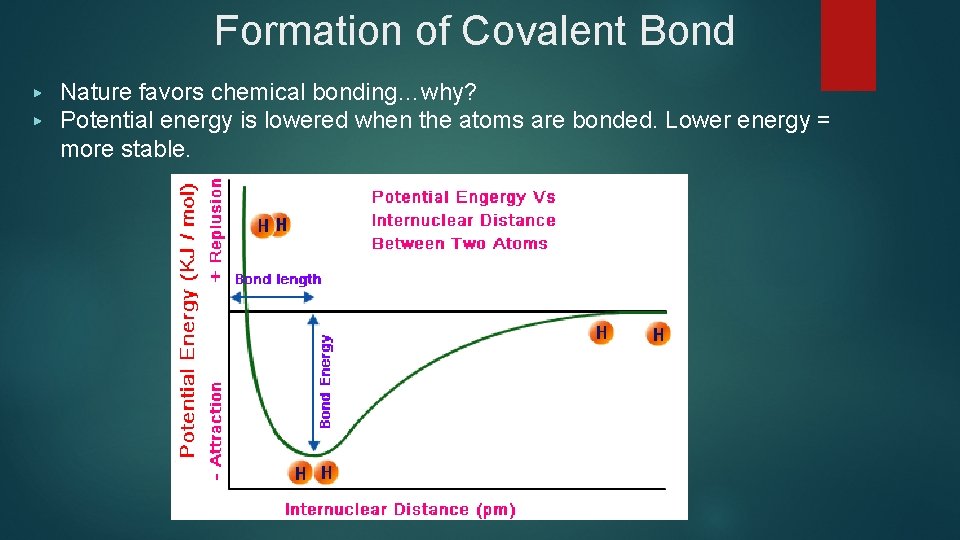
Formation of Covalent Bond ▶ ▶ Nature favors chemical bonding…why? Potential energy is lowered when the atoms are bonded. Lower energy = more stable.
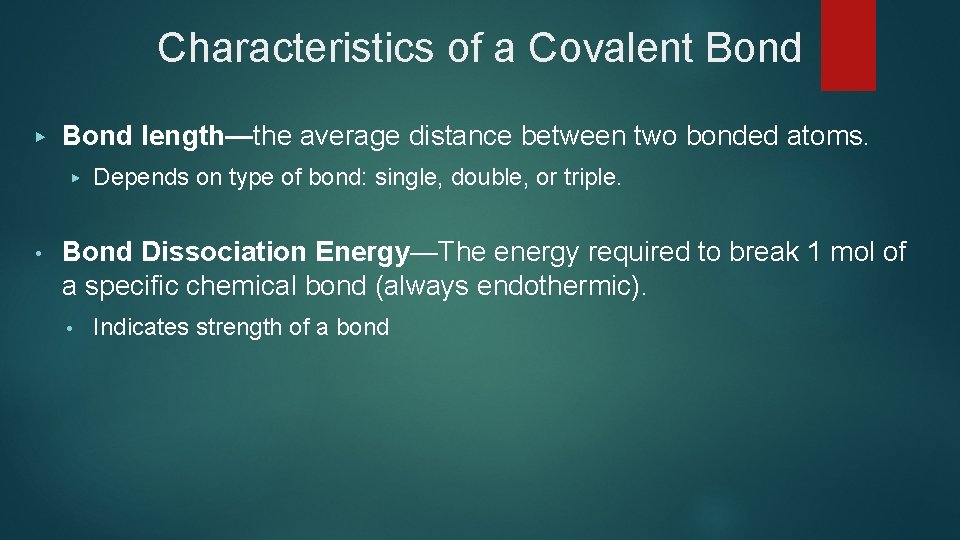
Characteristics of a Covalent Bond ▶ Bond length—the average distance between two bonded atoms. ▶ • Depends on type of bond: single, double, or triple. Bond Dissociation Energy—The energy required to break 1 mol of a specific chemical bond (always endothermic). • Indicates strength of a bond
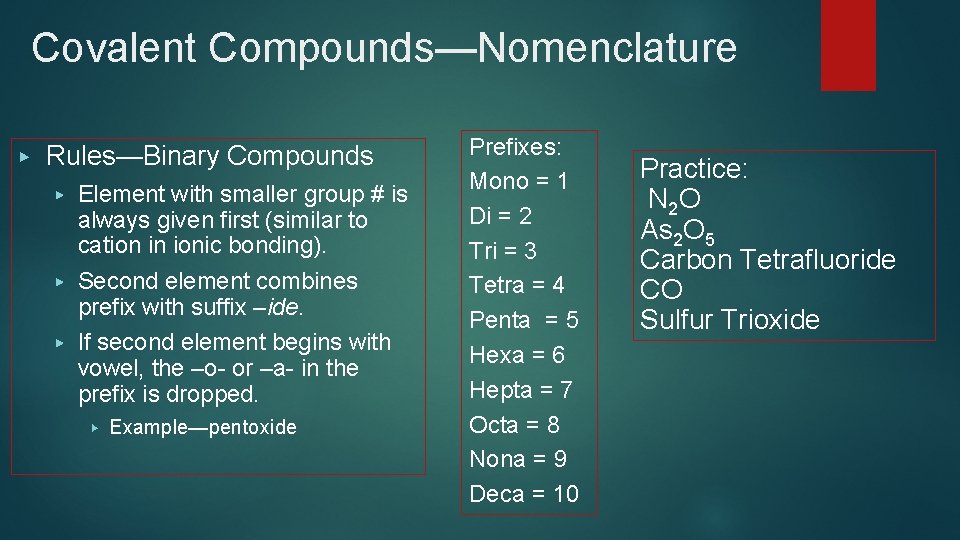
Covalent Compounds—Nomenclature ▶ Rules—Binary Compounds ▶ Element with smaller group # is always given first (similar to cation in ionic bonding). ▶ Second element combines prefix with suffix –ide. ▶ If second element begins with vowel, the –o- or –a- in the prefix is dropped. ▶ Example—pentoxide Prefixes: Mono = 1 Di = 2 Tri = 3 Tetra = 4 Penta = 5 Hexa = 6 Hepta = 7 Octa = 8 Nona = 9 Deca = 10 Practice: N 2 O As 2 O 5 Carbon Tetrafluoride CO Sulfur Trioxide
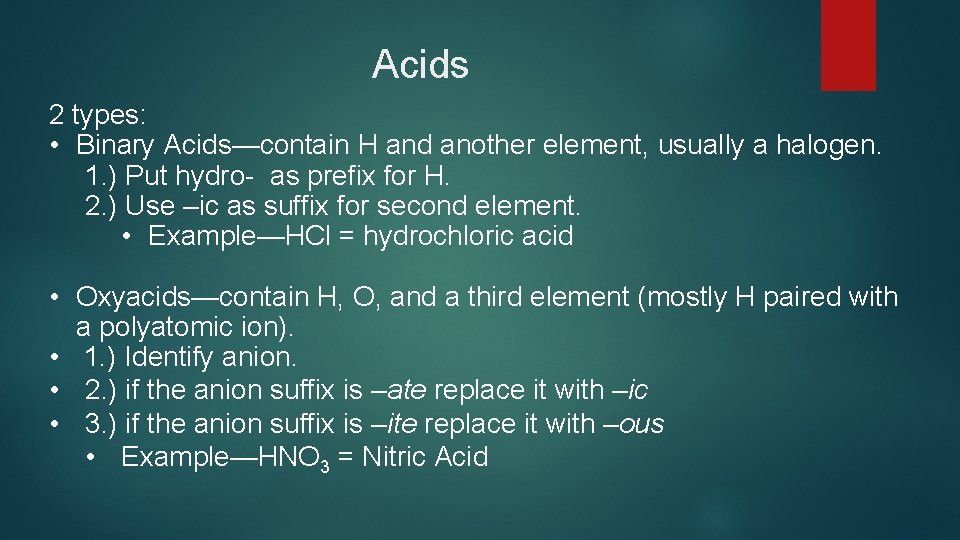
Acids 2 types: • Binary Acids—contain H and another element, usually a halogen. 1. ) Put hydro- as prefix for H. 2. ) Use –ic as suffix for second element. • Example—HCl = hydrochloric acid • Oxyacids—contain H, O, and a third element (mostly H paired with a polyatomic ion). • 1. ) Identify anion. • 2. ) if the anion suffix is –ate replace it with –ic • 3. ) if the anion suffix is –ite replace it with –ous • Example—HNO 3 = Nitric Acid
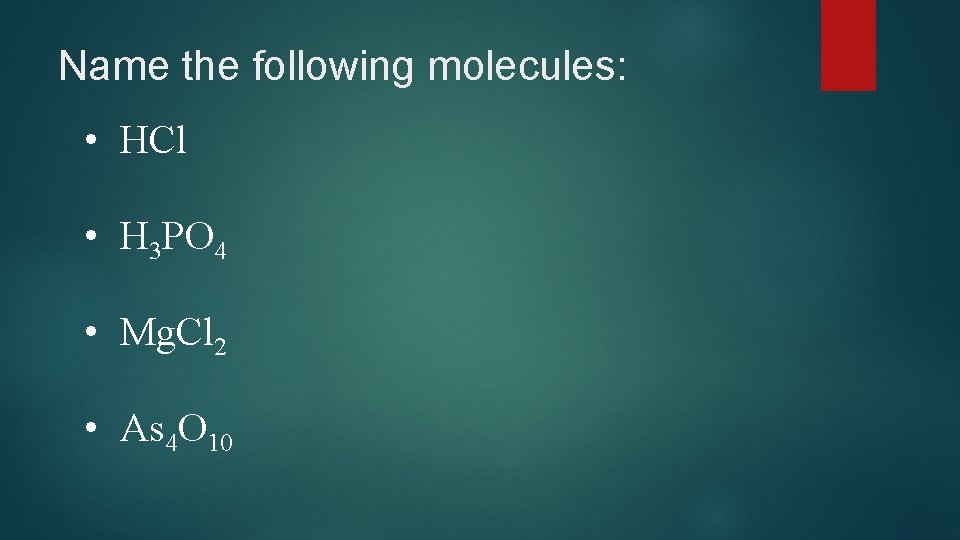
Name the following molecules: • HCl • H 3 PO 4 • Mg. Cl 2 • As 4 O 10
Octet Rule • Atoms undergo bonding in order to satisfy the octet rule. • Octet rule: Atoms want to be “noble gas-like”. • Diatomic molecule: A molecule in which there are only two atoms. • F 2, Cl 2, Br 2, I 2, H 2, O 2, N 2,
Exceptions to Octet Rule • Hydrogen—forms only one bond to have two valence electrons. • Boron—Has three valence electrons. Tends to form three bonds. • Some elements can form an expanded octet if bound to highly electronegative atoms. • Example: SF 6 • Expanded octet involves empty d orbitals to fit extra electrons.
Lewis Structures ▶ What are they? ? ▶ ▶ A formula where atomic symbols represent nuclei and inner shell electrons, and dot pairs represent valence and bonded electrons. What are they used for? ? Gives us a way to visualize bonding between atoms ▶ Represents where electrons are located ▶ Gives relative bond strengths to establish reactivity of molecules. ▶
▶ Six Steps: 1. ) Determine types of atoms in molecule. ▶ Example: CH 3 I 2. ) Write electron dot notation for each atom. 3. ) Determine the total number of valence electros available. 4. ) Arrange atoms with LEAST electronegative atom in the center (exception: H), and place one shared pair of electrons between each of the atoms. 5. ) Fill in valence shells of atoms with unshared electrons (lone pairs). 6. ) Count electrons to make sure all available valence electrons are accounted for.
Practice with Lewis Structures ▶ Draw the Lewis structures for the following molecules: ▶ NH 3 ▶ H 2 S ▶ Si. H 4 ▶ PF 3
Before we go any further… Try the Lewis structure for C 2 H 4.
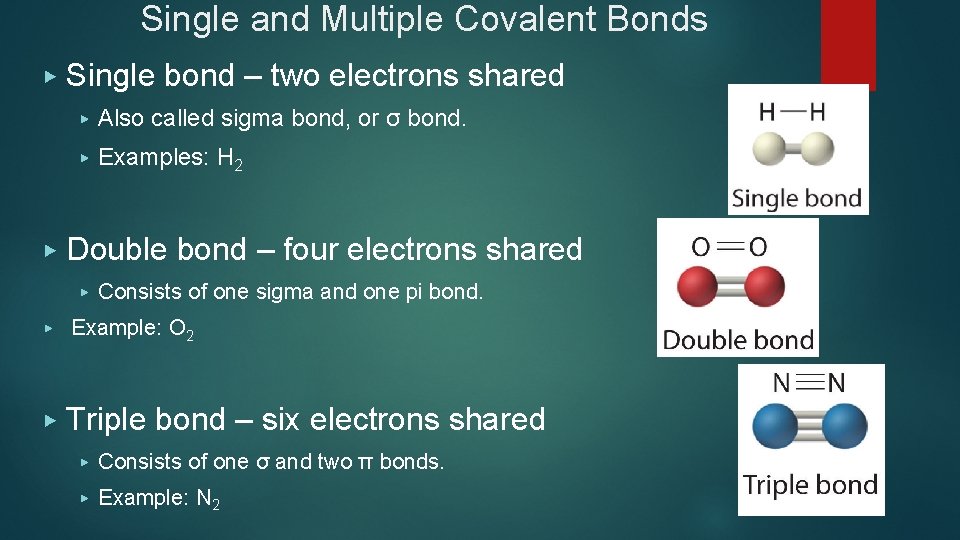
Single and Multiple Covalent Bonds ▶ ▶ Single bond – two electrons shared ▶ Also called sigma bond, or σ bond. ▶ Examples: H 2 Double bond – four electrons shared ▶ Consists of one sigma and one pi bond. ▶ Example: O 2 ▶ Triple bond – six electrons shared ▶ Consists of one σ and two π bonds. ▶ Example: N 2
Lewis structures with multiple bonds ▶ Multiple bonds become evident in lewis structures when there are not enough valence electrons after adding lone pairs. ▶ Examples: ▶ CH 2 O ▶ CO 2 ▶ HCN
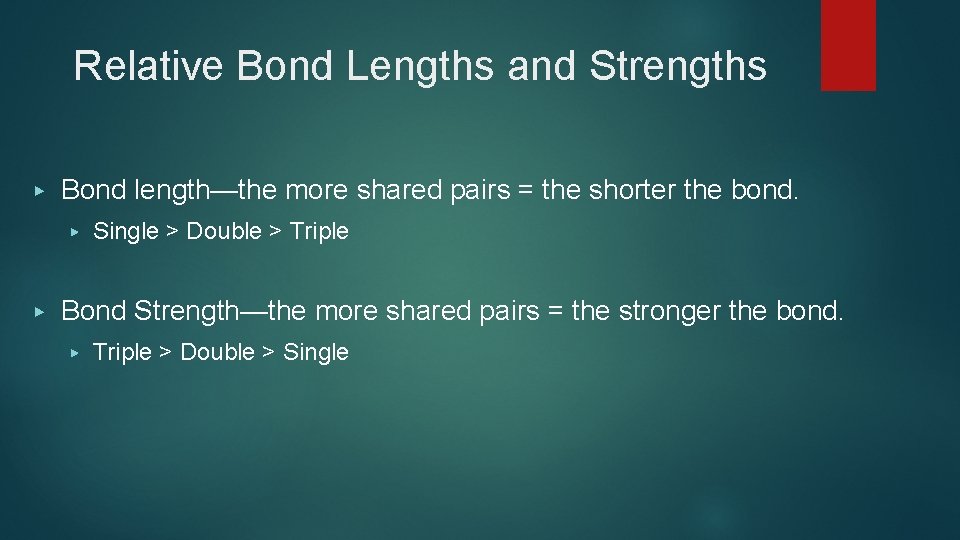
Relative Bond Lengths and Strengths ▶ Bond length—the more shared pairs = the shorter the bond. ▶ ▶ Single > Double > Triple Bond Strength—the more shared pairs = the stronger the bond. ▶ Triple > Double > Single
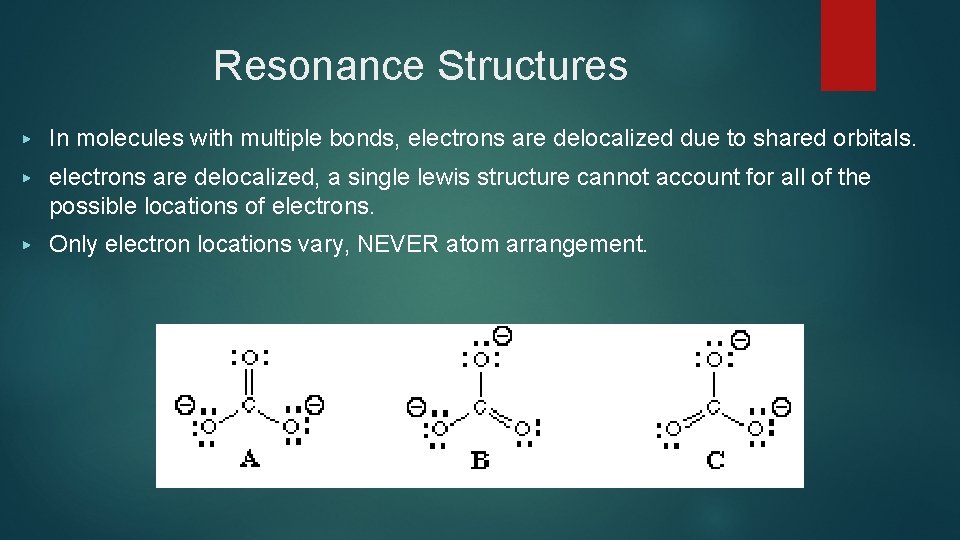
Resonance Structures ▶ In molecules with multiple bonds, electrons are delocalized due to shared orbitals. ▶ electrons are delocalized, a single lewis structure cannot account for all of the possible locations of electrons. ▶ Only electron locations vary, NEVER atom arrangement.
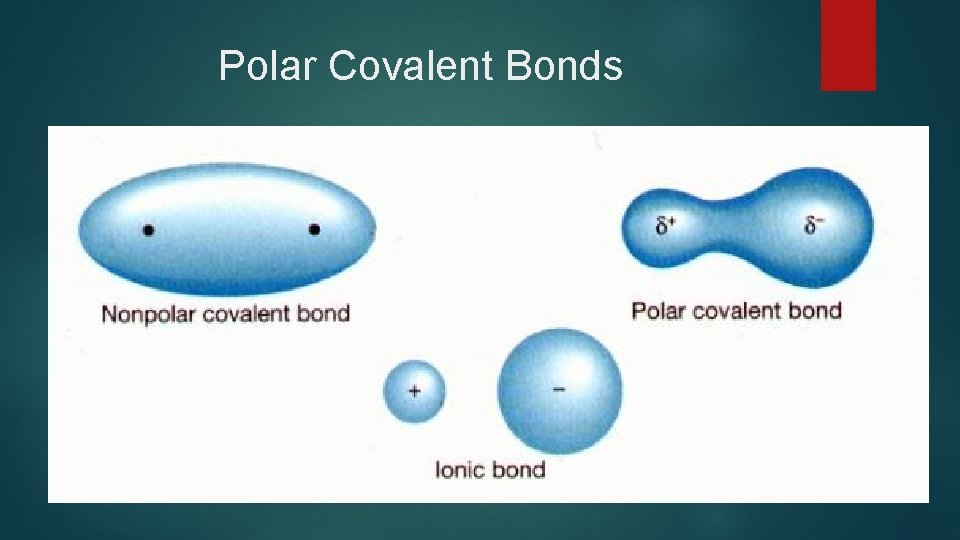
Polarity ▶ Based on electronegativity differences. ▶ Polar molecule = uneven distribution of electrons ▶ Nonpolar = even distribution
Polar Covalent Bonds
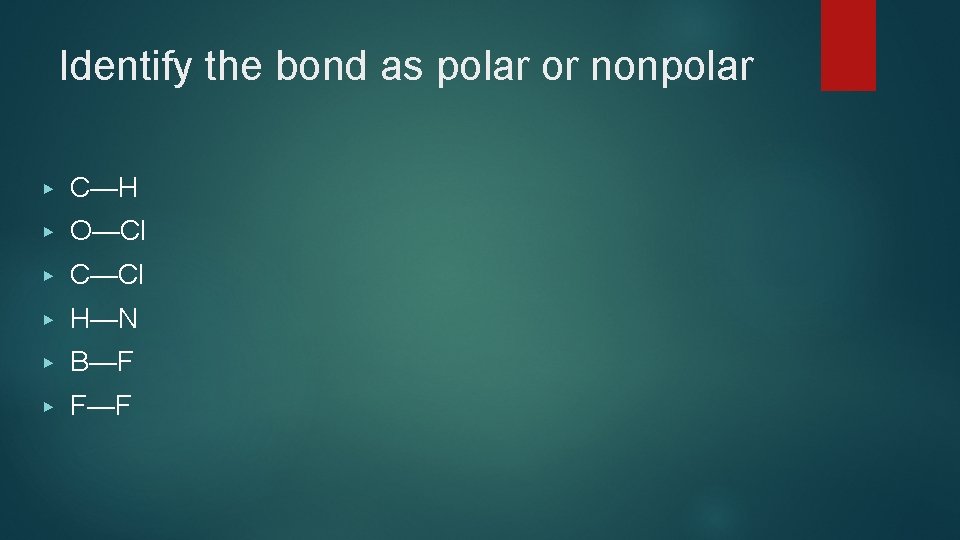
Identify the bond as polar or nonpolar ▶ C—H ▶ O—Cl ▶ C—Cl ▶ H—N ▶ B—F ▶ F—F
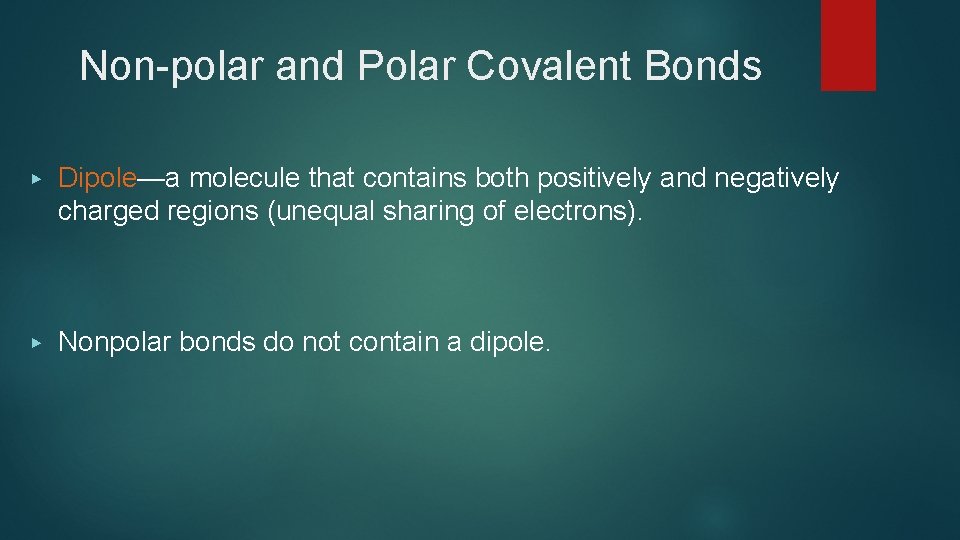
Non-polar and Polar Covalent Bonds ▶ Dipole—a molecule that contains both positively and negatively charged regions (unequal sharing of electrons). ▶ Nonpolar bonds do not contain a dipole.
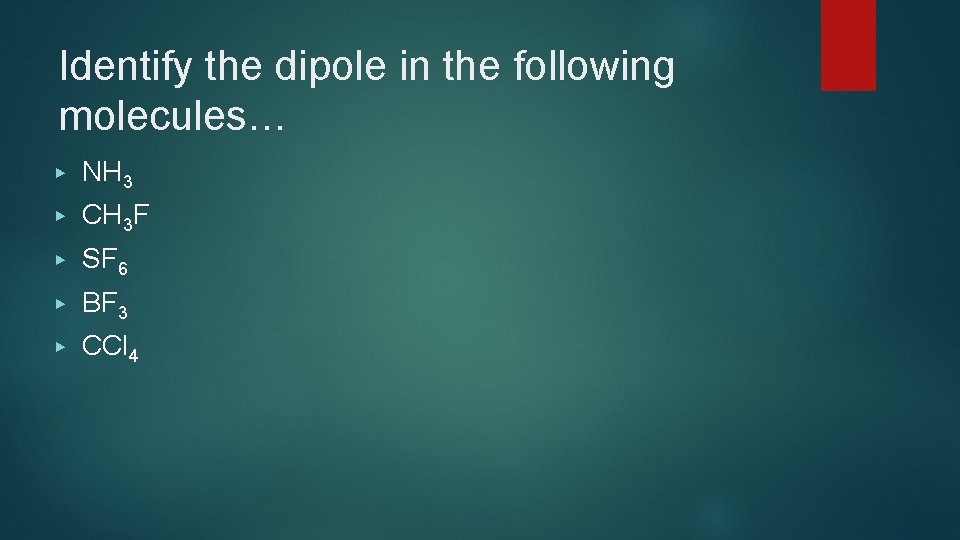
Identify the dipole in the following molecules… ▶ NH 3 ▶ CH 3 F ▶ SF 6 ▶ BF 3 ▶ CCl 4
Hybridization Orbitals of similar energy mix to produce new orbitals (hybrids) ▶ Creates optimal space around nucleus for atoms to bond. ▶ ▶ Example: Carbon
Hydrocarbons ▶ Hydrocarbons = the simplest organic compounds ▶ ▶ Contain only carbon and hydrogen Can be straight-chain, branched chain, or cyclic molecules ▶ 3 types of straight-chain hydrocarbons ▶ Alkanes—completely saturated hydrocarbons (no double or triple bonds) ▶ ▶ Alkenes—contain a double bond ▶ ▶ End in suffix -ane End in suffix -ene Alkynes—contain a triple bond ▶ End in suffix -yne
Formal Charge Used to determine the most viable Lewis structure. Formal Charge = V - N - B/2 Draw the Lewis structure for Fulminic acid (HCNO)